BY :
Dr DAULAT RAM DHAKED
Physiotherapy
>> Merriam-Webster’s definition

• Preservation, enhancement, or restoration of

movement and physical function
• Impaired or threatened by disability, injury, or disease
• That utilizes therapeutic exercise, physical modalities,
assistive devices, and patient education.
• Has a very important role in encouraging patient to
remain positive and in control of their condition.
• Although physiotherapy techniques may not change
underlying pathological changes, or prevent all
disability, may improve function by minimizing
– Contracture,
– Loss of strength and

– Decreased skin compliance.
(Askew et al 1983, Br J Rheum 22, 224-32)
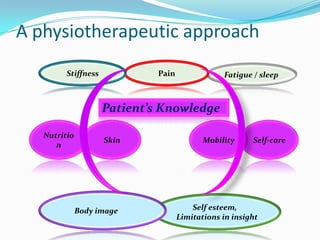
A physiotherapeutic approach
Stiffness

Pain

Fatigue / sleep

Patient’s Knowledge
Nutritio
n

Skin

Body image

Mobility

Self-care

Self esteem,
Limitations in insight
Advantages of physiotherapy treatment
• Quick – results are achieved in a rapid fashion
• Efficient – addresses both aetiology and pathogenesis to
•
•
•
•

eliminate cause not just symptoms
Safe – causes minimum adverse reactions
Specific – drugs or treatment delivered to affected organs
or tissues
Painless – uses non-invasive procedures
Stressless – avoids unnecessary surgical procedures and use
of general anaesthetics
• Dermatological patients are often polymorbid
• During hospitalization, especially older patients are

compromised
• Physiotherapeutic care can prevent complications such
as pulmonary affection or joint contractures
Major physiotherapy techniques:
• Therapy by mechanical treatment (Exercise, Massage,
•
•
•
•
•
•

and Pressure therapy)
Non-electric thermotherapy – (Heating and Cooling,
Hydrotherapy)
Electrotherapy (Electrostimulation, Interferential,
Ultrasound, Magnetotherapy, Pharmacological
phoresis, SCENAR)
Ozonetherapy
Vacuum therapy
Balneotherapy
Phototherapy
Clinical effects of electrotherapy
Electrostimulation
 Anti-inflammatory
 Analgesic
 Sedative
 Tranquilising
 Spasmolytic
 Vasodilating
 Trophic
 Stimulation of secretion
function
 Metabolic

Interferential
 Analgesic
 Trophic
 Spasmolytic
 Defibrosing
Ultrasound
 Anti-inflammatory
 Analgesic
 Spasmolytic
 Metabolic
 Defibrosing
Magnetotherapy
 Sedative
 Trophic
 Spasmolytic
 Vasoactivating
 Antiedemic
 Hypocoagulating
 Myorelaxation
 Metabolic

SCENAR (Self Controlled
Energo-Neuro Adaptive
Regulator) therapy
 Metabolic
 Immunostimulating
 Vasoactivating
 Endorphine and
encephaline release
 Correction of DNA
spontaneous structural
changes
 Neurotransmitters release
Advantages of pharmacological phoresis
 Effectively enhances delivery of topically applied drugs,








specifically to the affected organ or tissue
Avoids or minimises adverse reactions
Maintains local drug effect for a prolonged period
Avoids potential gastrointestinal degradation
Reduces dose
Suitable for various drug groups (corticosteroids, NSAIDs,
analgesics, vasodilators, hormones, anticoagulants,
antibiotics, vaccines, antfungal, antimicrobial etc.)
Eg : Iontophoresis for hyperhidrosis
Indications for electrotherapy
•Throphic ulcers,
•Hyperhidrosis and
bromidrosis,
•Eczema,
•Neurodermitis,
•Herpes,

•Neuralgia,
•Varicose veins,
•Atherosclerotic
occlusions,
•Phlebitis,
•Thrombophlebitis,
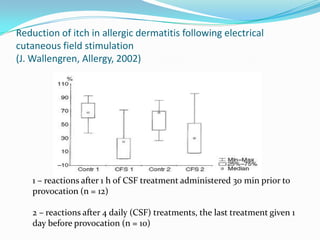
Reduction of itch in allergic dermatitis following electrical
cutaneous field stimulation
(J. Wallengren, Allergy, 2002)

1 – reactions after 1 h of CSF treatment administered 30 min prior to
provocation (n = 12)
2 – reactions after 4 daily (CSF) treatments, the last treatment given 1
day before provocation (n = 10)
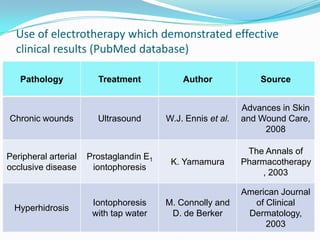
Use of electrotherapy which demonstrated effective
clinical results (PubMed database)
Pathology

Treatment

Chronic wounds

Ultrasound

Peripheral arterial
occlusive disease

Prostaglandin E1
iontophoresis

Hyperhidrosis

Iontophoresis
with tap water

Author

Source

W.J. Ennis et al.

Advances in Skin
and Wound Care,
2008

K. Yamamura

The Annals of
Pharmacotherapy
, 2003

M. Connolly and
D. de Berker

American Journal
of Clinical
Dermatology,
2003
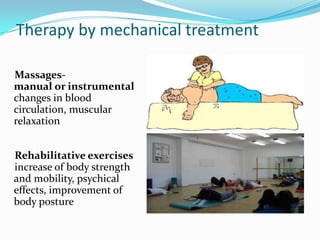
Therapy by mechanical treatment
Massagesmanual or instrumental
changes in blood
circulation, muscular
relaxation
Rehabilitative exercises
increase of body strength
and mobility, psychical
effects, improvement of
body posture
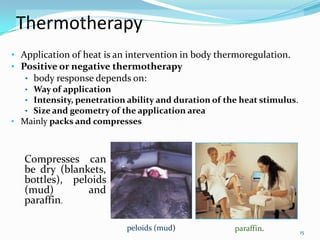
Thermotherapy
• Application of heat is an intervention in body thermoregulation.
• Positive or negative thermotherapy
• body response depends on:
• Way of application
• Intensity, penetration ability and duration of the heat stimulus.
• Size and geometry of the application area

• Mainly packs and compresses

Compresses can
be dry (blankets,
bottles), peloids
(mud)
and
paraffin.
peloids (mud)

paraffin.

15
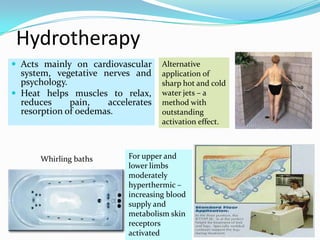
Hydrotherapy
 Acts mainly on cardiovascular

system, vegetative nerves and
psychology.
 Heat helps muscles to relax,
reduces
pain,
accelerates
resorption of oedemas.

Whirling baths

Alternative
application of
sharp hot and cold
water jets – a
method with
outstanding
activation effect.

For upper and
lower limbs
moderately
hyperthermic –
increasing blood
supply and
metabolism skin
receptors
activated

16
16
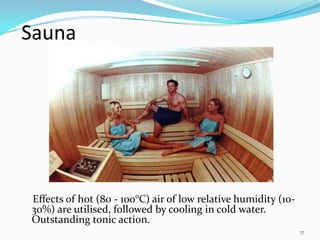
Sauna

Effects of hot (80 - 100°C) air of low relative humidity (1030%) are utilised, followed by cooling in cold water.
Outstanding tonic action.
17
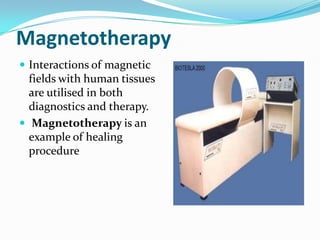
Magnetotherapy
 Interactions of magnetic

fields with human tissues
are utilised in both
diagnostics and therapy.
 Magnetotherapy is an
example of healing
procedure
IR lamps
• Radiation is absorbed mainly in body surface.
• Skin receptors are stimulated,
• Subjective feeling of heat, reflex vasodilatation and

muscular relaxation takes place.
Systemic Changes A/W Immobility
• Metabolic
• Respiratory
• Atelectasis, Hypostatic Pneumonia, and Decrease

oxygenation,
• Cardiovascular
• Orthostatic hypotension, Increased workload of heart, Risk

for thrombus
• Musculoskeletal
• muscle atrophy, osteoporosis, contractures and foot drop

• Integumentary
• skin breakdown, skin hygiene
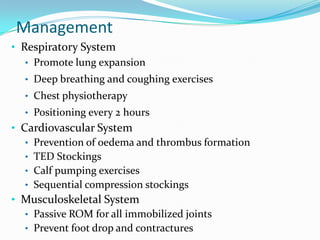
Management
• Respiratory System
• Promote lung expansion
• Deep breathing and coughing exercises
• Chest physiotherapy
• Positioning every 2 hours

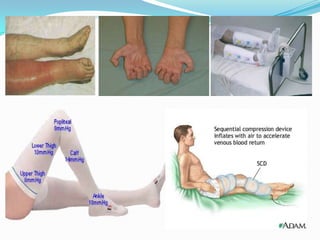
• Cardiovascular System
• Prevention of oedema and thrombus formation
• TED Stockings
• Calf pumping exercises
• Sequential compression stockings
• Musculoskeletal System
• Passive ROM for all immobilized joints
• Prevent foot drop and contractures
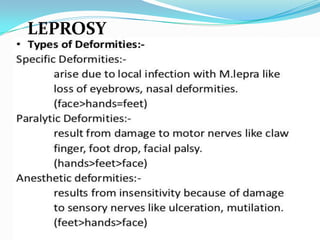
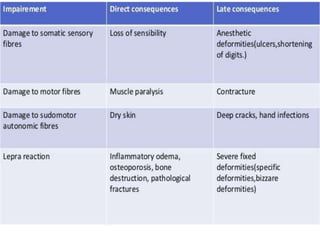
LEPROSY
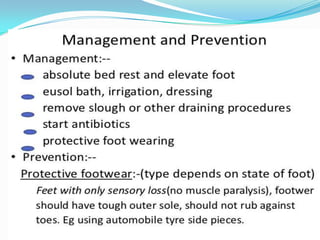
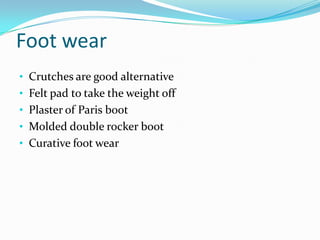
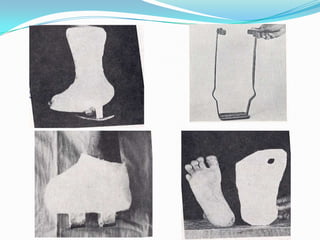
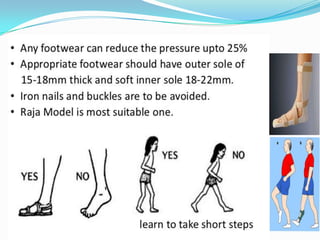
Foot wear
• Crutches are good alternative
• Felt pad to take the weight off
• Plaster of Paris boot
• Molded double rocker boot

• Curative foot wear
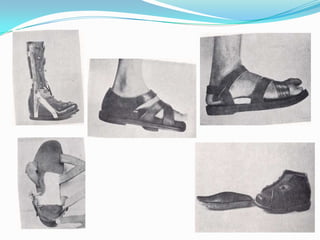
Commonly used footwear
• Flat soled Microcellular-padded slippers (MCR

chappals)
• Low molded shoe with arch support & metatarsal pad
(ASMP)
• Metatarsal bar
• Molded boot
Deformity Prevention
• Rest, body position and POP cast
• Prevent/Reduce swelling : Elevation, active and passive

exercise
• Providing hand, eye and foot protection.
• Prevention of contractures
• Exercises
• Active exercises
• Passive exercises
Systemic sclerosis
• For Raynaud's phenomenon:
• Prevention - avoid cold and trauma; use warm clothing or
heated clothing.
• For an attack - warm the body, hands and feet gently (skin
may be numb and unable to feel if heat source is too hot);
• Use gentle arm movements or gentle massage to help restore
circulation.
• Promote joint mobility and muscle strength.
• Exercises and stretches for hands, face and feet are

essential.
• Exercise for lungs and respiratory muscles should also be
taught concentrating on lung expansion.
• Aerobic activities to induce deeper breathing could be
•
•
•

•
•

suggested, e.g. swimming and walking.
Application of wax to hands and feet has been found to be
beneficial by some patients.
Oils in wax and warmth serve as a useful preparation for
exercise.
Massage of skin helps to mobilize stiff connective tissues
Have beneficial effect on circulation and nutrition of skin
Hot water bottles, electrically heated pads, hot bath or
shower also beneficial.
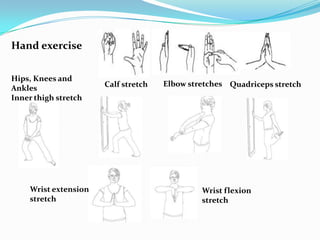
Hand exercise
Hips, Knees and
Ankles
Inner thigh stretch

Wrist extension
stretch

Calf stretch

Elbow stretches Quadriceps stretch

Wrist flexion
stretch
Psoriatic arthritis
Acute phase
• Encourage rest.
• Splints may be used for rest and pain relief, especially
for hands, wrists, knees, or ankles.
• Cold modalities should be used to decrease
inflammation and assist with pain relief.
• Joints should not be moved beyond limit of pain;
• passive movements should be limited
• Education about disease itself, importance of rest,
exercise program, joint protection, energy
conservation, and weight loss
Subacute and long-term phase
• Isometric exercises are begun, with progression to
active movement.
• Gradual range-of-motion (ROM) exercises include
passive and active exercises;
• areas with subluxation should not be forced passively.
• Heating modalities, including moist heat packs,
paraffin wax, diathermy, and ultrasound, can be used
to decrease pain;
• heat therapy should be performed just prior to
performance of ROM exercises.
• Institute gait activities, with patient bearing weight as
•
•
•
•
•

tolerated, with or without an assistive device.
Gentle stretching should be gradually introduced.
If pain persists beyond 2 hours after therapies, then
intensity should be decreased.
If a joint is swollen, then no resistive exercises should
be performed through full ROM.
Axial spine involvement, spine extension exercises
help with flexibility and strength.
Sausage toes, use extra-depth shoes with a high toe
box.
Dermatomyositis
• Activity should be maintained as much as possible

• Vigorous physical training should be avoided when

myositis is active.
• Strengthening to prevent atrophy
• Range of motion exercises to prevent contractures
• Passive stretching and splinting
Lymphedema
• Interventions include:
• Manual lymph drainage (to help improve flow of lymph
from affected arm or leg from proximal to distal).
• Short/low stretch Compression garment wear following
lymphatic drainage.
• Skin Hygiene and care (such as cleaning skin of arm or
leg daily and moisten with lotion).
• Exercise to improve cardiovascular health and help
decrease swelling in some cases.
• Compression pumps
• Garment fitting.
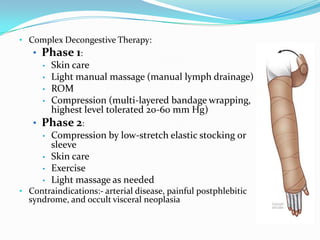
• Complex Decongestive Therapy:

• Phase 1:
• Skin care
• Light manual massage (manual lymph drainage)
• ROM
• Compression (multi-layered bandage wrapping,
highest level tolerated 20-60 mm Hg)
• Phase 2:
• Compression by low-stretch elastic stocking or
sleeve
• Skin care
• Exercise
• Light massage as needed
• Contraindications:- arterial disease, painful postphlebitic

syndrome, and occult visceral neoplasia
Venous insufficiency
• Leg elevation;
• Elevating leg above level of right atrium decreases venous
hypertension and edema,
• Done minimum of 3 times/day for ≥ 30 min
• Compression
• Bandages, stockings, and pneumatic devices;
• Intermittent pneumatic compression (IPC) uses a pump to
cyclically inflate and deflate hollow plastic leggings.
• External compression, squeezing blood and fluid out of lower
legs.
• Treats severe postphlebitic syndrome and venous stasis ulcers
• Topical wound care; and surgery,
• Weight loss, regular exercise, and reduction of dietary

sodium.
Bedsore or pressure ulcer
DO

• Change position 2 hourly to

relieve pressure.
• Use pillows, sheepskin, foam
padding, to reduce pressure
• Exercise daily, including
range-of-motion exercises
for immobile patients.
• Keep skin clean and dry.

DO NOT
•Do NOT massage the
area of the ulcer.
Massage can damage
tissue under the skin.
•Donut-shaped or ringshaped cushions are
NOT recommended.
They interfere with
blood flow
THANK YOU

Physiotherapy in dermatology ppt

  • 1.
    BY : Dr DAULATRAM DHAKED
  • 2.
    Physiotherapy >> Merriam-Webster’s definition •Preservation, enhancement, or restoration of movement and physical function • Impaired or threatened by disability, injury, or disease • That utilizes therapeutic exercise, physical modalities, assistive devices, and patient education. • Has a very important role in encouraging patient to remain positive and in control of their condition.
  • 3.
    • Although physiotherapytechniques may not change underlying pathological changes, or prevent all disability, may improve function by minimizing – Contracture, – Loss of strength and – Decreased skin compliance. (Askew et al 1983, Br J Rheum 22, 224-32)
  • 4.
    A physiotherapeutic approach Stiffness Pain Fatigue/ sleep Patient’s Knowledge Nutritio n Skin Body image Mobility Self-care Self esteem, Limitations in insight
  • 5.
    Advantages of physiotherapytreatment • Quick – results are achieved in a rapid fashion • Efficient – addresses both aetiology and pathogenesis to • • • • eliminate cause not just symptoms Safe – causes minimum adverse reactions Specific – drugs or treatment delivered to affected organs or tissues Painless – uses non-invasive procedures Stressless – avoids unnecessary surgical procedures and use of general anaesthetics
  • 6.
    • Dermatological patientsare often polymorbid • During hospitalization, especially older patients are compromised • Physiotherapeutic care can prevent complications such as pulmonary affection or joint contractures
  • 7.
    Major physiotherapy techniques: •Therapy by mechanical treatment (Exercise, Massage, • • • • • • and Pressure therapy) Non-electric thermotherapy – (Heating and Cooling, Hydrotherapy) Electrotherapy (Electrostimulation, Interferential, Ultrasound, Magnetotherapy, Pharmacological phoresis, SCENAR) Ozonetherapy Vacuum therapy Balneotherapy Phototherapy
  • 8.
    Clinical effects ofelectrotherapy Electrostimulation  Anti-inflammatory  Analgesic  Sedative  Tranquilising  Spasmolytic  Vasodilating  Trophic  Stimulation of secretion function  Metabolic Interferential  Analgesic  Trophic  Spasmolytic  Defibrosing Ultrasound  Anti-inflammatory  Analgesic  Spasmolytic  Metabolic  Defibrosing
  • 9.
    Magnetotherapy  Sedative  Trophic Spasmolytic  Vasoactivating  Antiedemic  Hypocoagulating  Myorelaxation  Metabolic SCENAR (Self Controlled Energo-Neuro Adaptive Regulator) therapy  Metabolic  Immunostimulating  Vasoactivating  Endorphine and encephaline release  Correction of DNA spontaneous structural changes  Neurotransmitters release
  • 10.
    Advantages of pharmacologicalphoresis  Effectively enhances delivery of topically applied drugs,       specifically to the affected organ or tissue Avoids or minimises adverse reactions Maintains local drug effect for a prolonged period Avoids potential gastrointestinal degradation Reduces dose Suitable for various drug groups (corticosteroids, NSAIDs, analgesics, vasodilators, hormones, anticoagulants, antibiotics, vaccines, antfungal, antimicrobial etc.) Eg : Iontophoresis for hyperhidrosis
  • 11.
    Indications for electrotherapy •Throphiculcers, •Hyperhidrosis and bromidrosis, •Eczema, •Neurodermitis, •Herpes, •Neuralgia, •Varicose veins, •Atherosclerotic occlusions, •Phlebitis, •Thrombophlebitis,
  • 12.
    Reduction of itchin allergic dermatitis following electrical cutaneous field stimulation (J. Wallengren, Allergy, 2002) 1 – reactions after 1 h of CSF treatment administered 30 min prior to provocation (n = 12) 2 – reactions after 4 daily (CSF) treatments, the last treatment given 1 day before provocation (n = 10)
  • 13.
    Use of electrotherapywhich demonstrated effective clinical results (PubMed database) Pathology Treatment Chronic wounds Ultrasound Peripheral arterial occlusive disease Prostaglandin E1 iontophoresis Hyperhidrosis Iontophoresis with tap water Author Source W.J. Ennis et al. Advances in Skin and Wound Care, 2008 K. Yamamura The Annals of Pharmacotherapy , 2003 M. Connolly and D. de Berker American Journal of Clinical Dermatology, 2003
  • 14.
    Therapy by mechanicaltreatment Massagesmanual or instrumental changes in blood circulation, muscular relaxation Rehabilitative exercises increase of body strength and mobility, psychical effects, improvement of body posture
  • 15.
    Thermotherapy • Application ofheat is an intervention in body thermoregulation. • Positive or negative thermotherapy • body response depends on: • Way of application • Intensity, penetration ability and duration of the heat stimulus. • Size and geometry of the application area • Mainly packs and compresses Compresses can be dry (blankets, bottles), peloids (mud) and paraffin. peloids (mud) paraffin. 15
  • 16.
    Hydrotherapy  Acts mainlyon cardiovascular system, vegetative nerves and psychology.  Heat helps muscles to relax, reduces pain, accelerates resorption of oedemas. Whirling baths Alternative application of sharp hot and cold water jets – a method with outstanding activation effect. For upper and lower limbs moderately hyperthermic – increasing blood supply and metabolism skin receptors activated 16 16
  • 17.
    Sauna Effects of hot(80 - 100°C) air of low relative humidity (1030%) are utilised, followed by cooling in cold water. Outstanding tonic action. 17
  • 18.
    Magnetotherapy  Interactions ofmagnetic fields with human tissues are utilised in both diagnostics and therapy.  Magnetotherapy is an example of healing procedure
  • 19.
    IR lamps • Radiationis absorbed mainly in body surface. • Skin receptors are stimulated, • Subjective feeling of heat, reflex vasodilatation and muscular relaxation takes place.
  • 20.
    Systemic Changes A/WImmobility • Metabolic • Respiratory • Atelectasis, Hypostatic Pneumonia, and Decrease oxygenation, • Cardiovascular • Orthostatic hypotension, Increased workload of heart, Risk for thrombus • Musculoskeletal • muscle atrophy, osteoporosis, contractures and foot drop • Integumentary • skin breakdown, skin hygiene
  • 21.
    Management • Respiratory System •Promote lung expansion • Deep breathing and coughing exercises • Chest physiotherapy • Positioning every 2 hours • Cardiovascular System • Prevention of oedema and thrombus formation • TED Stockings • Calf pumping exercises • Sequential compression stockings • Musculoskeletal System • Passive ROM for all immobilized joints • Prevent foot drop and contractures
  • 23.
  • 31.
    Foot wear • Crutchesare good alternative • Felt pad to take the weight off • Plaster of Paris boot • Molded double rocker boot • Curative foot wear
  • 33.
    Commonly used footwear •Flat soled Microcellular-padded slippers (MCR chappals) • Low molded shoe with arch support & metatarsal pad (ASMP) • Metatarsal bar • Molded boot
  • 36.
    Deformity Prevention • Rest,body position and POP cast • Prevent/Reduce swelling : Elevation, active and passive exercise • Providing hand, eye and foot protection. • Prevention of contractures • Exercises • Active exercises • Passive exercises
  • 37.
    Systemic sclerosis • ForRaynaud's phenomenon: • Prevention - avoid cold and trauma; use warm clothing or heated clothing. • For an attack - warm the body, hands and feet gently (skin may be numb and unable to feel if heat source is too hot); • Use gentle arm movements or gentle massage to help restore circulation. • Promote joint mobility and muscle strength. • Exercises and stretches for hands, face and feet are essential. • Exercise for lungs and respiratory muscles should also be taught concentrating on lung expansion.
  • 38.
    • Aerobic activitiesto induce deeper breathing could be • • • • • suggested, e.g. swimming and walking. Application of wax to hands and feet has been found to be beneficial by some patients. Oils in wax and warmth serve as a useful preparation for exercise. Massage of skin helps to mobilize stiff connective tissues Have beneficial effect on circulation and nutrition of skin Hot water bottles, electrically heated pads, hot bath or shower also beneficial.
  • 39.
    Hand exercise Hips, Kneesand Ankles Inner thigh stretch Wrist extension stretch Calf stretch Elbow stretches Quadriceps stretch Wrist flexion stretch
  • 40.
    Psoriatic arthritis Acute phase •Encourage rest. • Splints may be used for rest and pain relief, especially for hands, wrists, knees, or ankles. • Cold modalities should be used to decrease inflammation and assist with pain relief. • Joints should not be moved beyond limit of pain; • passive movements should be limited • Education about disease itself, importance of rest, exercise program, joint protection, energy conservation, and weight loss
  • 41.
    Subacute and long-termphase • Isometric exercises are begun, with progression to active movement. • Gradual range-of-motion (ROM) exercises include passive and active exercises; • areas with subluxation should not be forced passively. • Heating modalities, including moist heat packs, paraffin wax, diathermy, and ultrasound, can be used to decrease pain; • heat therapy should be performed just prior to performance of ROM exercises.
  • 42.
    • Institute gaitactivities, with patient bearing weight as • • • • • tolerated, with or without an assistive device. Gentle stretching should be gradually introduced. If pain persists beyond 2 hours after therapies, then intensity should be decreased. If a joint is swollen, then no resistive exercises should be performed through full ROM. Axial spine involvement, spine extension exercises help with flexibility and strength. Sausage toes, use extra-depth shoes with a high toe box.
  • 43.
    Dermatomyositis • Activity shouldbe maintained as much as possible • Vigorous physical training should be avoided when myositis is active. • Strengthening to prevent atrophy • Range of motion exercises to prevent contractures • Passive stretching and splinting
  • 44.
    Lymphedema • Interventions include: •Manual lymph drainage (to help improve flow of lymph from affected arm or leg from proximal to distal). • Short/low stretch Compression garment wear following lymphatic drainage. • Skin Hygiene and care (such as cleaning skin of arm or leg daily and moisten with lotion). • Exercise to improve cardiovascular health and help decrease swelling in some cases. • Compression pumps • Garment fitting.
  • 45.
    • Complex DecongestiveTherapy: • Phase 1: • Skin care • Light manual massage (manual lymph drainage) • ROM • Compression (multi-layered bandage wrapping, highest level tolerated 20-60 mm Hg) • Phase 2: • Compression by low-stretch elastic stocking or sleeve • Skin care • Exercise • Light massage as needed • Contraindications:- arterial disease, painful postphlebitic syndrome, and occult visceral neoplasia
  • 46.
    Venous insufficiency • Legelevation; • Elevating leg above level of right atrium decreases venous hypertension and edema, • Done minimum of 3 times/day for ≥ 30 min • Compression • Bandages, stockings, and pneumatic devices; • Intermittent pneumatic compression (IPC) uses a pump to cyclically inflate and deflate hollow plastic leggings. • External compression, squeezing blood and fluid out of lower legs. • Treats severe postphlebitic syndrome and venous stasis ulcers • Topical wound care; and surgery, • Weight loss, regular exercise, and reduction of dietary sodium.
  • 47.
    Bedsore or pressureulcer DO • Change position 2 hourly to relieve pressure. • Use pillows, sheepskin, foam padding, to reduce pressure • Exercise daily, including range-of-motion exercises for immobile patients. • Keep skin clean and dry. DO NOT •Do NOT massage the area of the ulcer. Massage can damage tissue under the skin. •Donut-shaped or ringshaped cushions are NOT recommended. They interfere with blood flow
  • 48.