BURNSA Physiotherapeutic Approach
Dr.Nidhi Ahya (Asst Prof)
Cardiovascular and Respiratory PT
DVVPF College of Physiotherapy,
Ahmednagar 414111
Objectives
• Normal Skin- Structure & Function
• Burns
• Epidemiology
• Pathophysiology of Burn Injury
• Assessment of Burn Injury
• Management of Burns
 Medical
Physiotherapy
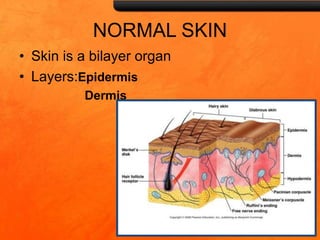
NORMAL SKIN
• Skin is a bilayer organ
• Layers:Epidermis
Dermis
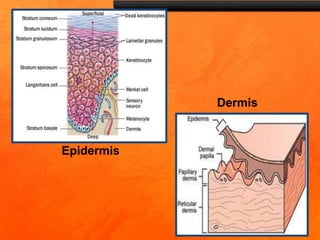
Epidermis
Dermis
BURN
Burn is coagulative necrosis of the skin’s
tissues, usually caused by excessive heat
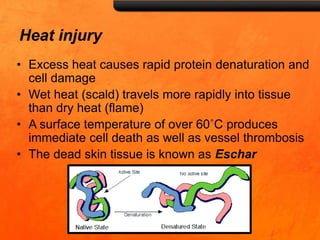
Heat injury
• Excess heat causes rapid protein denaturation and
cell damage
• Wet heat (scald) travels more rapidly into tissue
than dry heat (flame)
• A surface temperature of over 60˚C produces
immediate cell death as well as vessel thrombosis
• The dead skin tissue is known as Eschar
Inflammatory Mediator Injury (1 to 3 day)
Inflammatory response initiated by the heat injury
leads to activation of proteases, neutrophil
induced tissue hypoxia and is responsible for -
• Early tissue damage,
• Increased capillary permeability and
• Responsible for wound conversion inflammation
becomes excessive by deactivating growth factors
Ischemia induced injury
• Instant surface vascular thrombosis occurs
along with cell death
• Injured capillaries can continue to thrombose
due to initial heat
• Subsequent mediator injury to endothelial cells
• Further ischemia and further tissue necrosis.
Classification of Burn Wound
• Earlier classified based on Severity :
First degree
Second degree
Third degree
• Currently based on Depth:
Superficial
Superficial Partial Thickness
Deep partial thickness
Full thickness
Subdermal
Complications of
Burns
• Infection
• Pulmonary complications
• Metabolic complications
• Cardiac function & circulatory
complications
• Heterotopic Ossification
• Neuropathy
• Pathological Scars
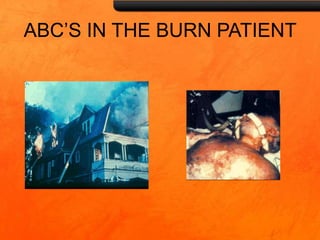
ABC’S IN THE BURN PATIENT
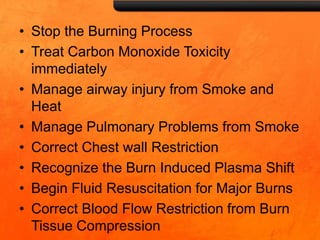
• Stop the Burning Process
• Treat Carbon Monoxide Toxicity
immediately
• Manage airway injury from Smoke and
Heat
• Manage Pulmonary Problems from Smoke
• Correct Chest wall Restriction
• Recognize the Burn Induced Plasma Shift
• Begin Fluid Resuscitation for Major Burns
• Correct Blood Flow Restriction from Burn
Tissue Compression
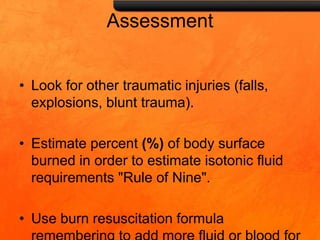
Assessment
• Look for other traumatic injuries (falls,
explosions, blunt trauma).
• Estimate percent (%) of body surface
burned in order to estimate isotonic fluid
requirements "Rule of Nine".
• Use burn resuscitation formula
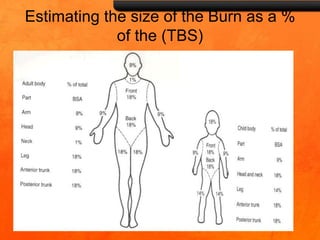
Estimating the size of the Burn as a %
of the (TBS)
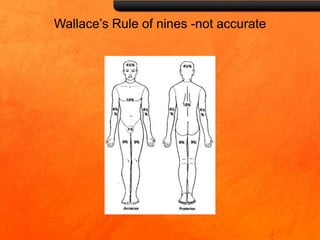
Wallace’s Rule of nines -not accurate
Emergent Phase
(Resuscitative Phase)
• Lasts from onset to 5 or more days but
usually lasts 24-48 hours
• Begins with fluid loss and edema
formation and continues until fluid
motorization and diuresis begins
• Greatest initial threat is hypovolemic
shock
Management
• Anaesthetic consultation
• High flow oxygen
• Tracheobronchial toiletting [ bronchoscopy]
• Physiotherapy
• Close monitoring [preferably ICU ]
• Ventilatory support
• Hemodynamic support, when required
Initial Assessment & Management
• Stridor
• Retraction or
• Respiratory Distress present or
• Deep Burns: Face, Neck
MAINTAINING HEMODYNAMIC
STABILITY
Early fluid resuscitation is required for
burns exceeding 20% of body
surface.
Fluid Resuscitation Protocol
Establish and maintain adequate circulation
↓
Maintain : Blood Pressure>90 systolic
Urine output 0.5-1.0ml/kg/hr
Pulse <130
Temperature >37°C
Modify protocol in the presence of massive
burns, inhalation injury, shock, and in elderly
Initial Wound Management
• Assure adequate ventilation and perfusion
• Remove heat source and any constricting items
• Maintain body temperature
• Cool water for small second degree burns only
• Assess size and depth “Rule of Nine”
• Tetanus Prophylaxis
• Escharotomy
• Full thickness deep dermal burns which
are nearly circumferential on the limbs,
neck, thorax will act like tourniquets with
the development of edema.
Escharotomies are longitudinal or
crisscross incisions through such deep
burns. This can be done without analgesia
and on the ward as the affected skin is
usually insensate and does not bleed
much.
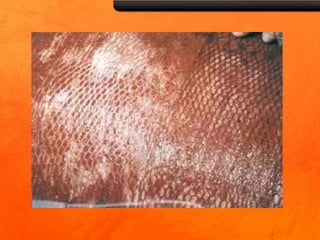
Skin Grafting
• Skin used for a graft removed with a
dermatome
• 2 types:
Split Skin Grafting ( SSG )
Full Thickness Skin Graft
• SSG : Epidermis + Sup. Dermis
• FTSG : Full dermal thickness
• Sheet Graft:
Graft applied to the recipient bed without
alteration after harvesting from donor site
Face, neck and hands are covered with
this for cosmesis
• Mesh Graft:
Processing the sheet graft – making tiny
parallel incisions in linear fashion
Graft expands & covers large areas
Rehabilitation Phase
• Defined as beginning when the patient’s burn wound is
covered with skin or healed and patient is capable of
assuming some self-care activity.
• Can occur as early as 2 weeks to as long as 2-3 months
after the burn injury
• Goals for this time is to assist patient in resuming
functional role in society & accomplish functional and
cosmetic reconstruction.
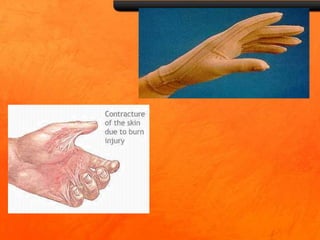
• Scars may form & contractures.
• Mature healing is reached in 6 months to 2 years
• Avoid direct sunlight for 1 year on burn
• new skin is sensitive to trauma
Physical Rehabilitation
• Prevention of scar contracture
• Preservation of normal ROM
• Prevention of hypertrophic scar
• Minimizing cosmetic deformity
• Muscular strengthening
• Cardiovascular endurance
• Return to function
• Performing ADL’s
Goals (APTA, 1999)
• Enhance wound & soft tissue healing
• Reduce risk of infection & complications
• Reduce risk of secondary impairments
• Attaining full ROM
• Restoring cardiovascular endurance
• Good to normal strength
• Independent ambulation
• Independent ADL’s
• Minimal scar formation
• Caregiver understanding towards the goals
• Increasing aerobic capacity
• Improving self management of symptoms
• Scar contractures can be prevented by:
Positioning
Splinting
Exercise
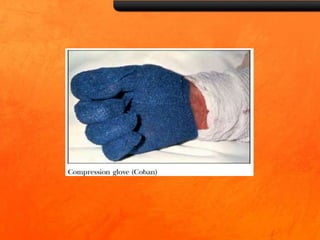
• Following wound closure:
Massage
Compression therapy
Positioning
• Goals:
Minimizes edema
Prevent tissue destruction
Maintain soft tissue length
Splinting
• Extension of positioning program
• Anti-deformity positions
• Indications:
Prevent contractures
ROM
Correction of contractures
Protection of a jt or tendon
• Worn in night
• Mostly static splinting in burns
Exercises
• Active & passive exercises
• Grafting done – delay exs for 3 – 5 days
• After clearance – active 1st & then passive
• Active assisted
• Resistive & conditioning exs
Early Active ROM and Mobility
• ROM- First Active then pasiive overpressure
• Repetitions- 5 to 7 at one time, gradually
increase as per patient tolerance
• PNF- Hold Relax and Contract Relax
techniques can be helpful in maintaining as
well for increasing ROM
• Bed mobility and Transfers should be
encouranged as early as possible.
• Independent Ambulation should be
encouraged depending on individual patient’s
condition
Scar Management
• Pressure hastens scar maturation &
minimizes hypertrophic scar
• Mech:
Thinning the dermis
Altering biochemical structure of scar
Decreasing blood flow to area
Reorganizing collagen bundles
Decreasing tissue water content
Massage
• Deep friction massage – loosen scar
• Skin pliability & texture improves
• Edges or seams of grafts benefit
• 5 -10 min , 3 – 6 times daily
Summary
• Normal Skin- Structure & Function
• Burns
• Pathophysiology of Burn Injury
• Assessment of Burn Injury
• Management of Burns
QUESTIONS
1. WRITE THE PATHOPHYSIOLOGY OF
BURNS.5MARKS
2. WRITE THE MANEGMENT OF BURNS.
Thank you

Burns management

  • 1.
    BURNSA Physiotherapeutic Approach Dr.NidhiAhya (Asst Prof) Cardiovascular and Respiratory PT DVVPF College of Physiotherapy, Ahmednagar 414111
  • 2.
    Objectives • Normal Skin-Structure & Function • Burns • Epidemiology • Pathophysiology of Burn Injury • Assessment of Burn Injury • Management of Burns  Medical Physiotherapy
  • 3.
    NORMAL SKIN • Skinis a bilayer organ • Layers:Epidermis Dermis
  • 4.
  • 5.
    BURN Burn is coagulativenecrosis of the skin’s tissues, usually caused by excessive heat
  • 6.
    Heat injury • Excessheat causes rapid protein denaturation and cell damage • Wet heat (scald) travels more rapidly into tissue than dry heat (flame) • A surface temperature of over 60˚C produces immediate cell death as well as vessel thrombosis • The dead skin tissue is known as Eschar
  • 7.
    Inflammatory Mediator Injury(1 to 3 day) Inflammatory response initiated by the heat injury leads to activation of proteases, neutrophil induced tissue hypoxia and is responsible for - • Early tissue damage, • Increased capillary permeability and • Responsible for wound conversion inflammation becomes excessive by deactivating growth factors
  • 8.
    Ischemia induced injury •Instant surface vascular thrombosis occurs along with cell death • Injured capillaries can continue to thrombose due to initial heat • Subsequent mediator injury to endothelial cells • Further ischemia and further tissue necrosis.
  • 9.
    Classification of BurnWound • Earlier classified based on Severity : First degree Second degree Third degree • Currently based on Depth: Superficial Superficial Partial Thickness Deep partial thickness Full thickness Subdermal
  • 10.
  • 11.
    • Infection • Pulmonarycomplications • Metabolic complications • Cardiac function & circulatory complications • Heterotopic Ossification • Neuropathy • Pathological Scars
  • 12.
    ABC’S IN THEBURN PATIENT
  • 13.
    • Stop theBurning Process • Treat Carbon Monoxide Toxicity immediately • Manage airway injury from Smoke and Heat • Manage Pulmonary Problems from Smoke • Correct Chest wall Restriction • Recognize the Burn Induced Plasma Shift • Begin Fluid Resuscitation for Major Burns • Correct Blood Flow Restriction from Burn Tissue Compression
  • 14.
    Assessment • Look forother traumatic injuries (falls, explosions, blunt trauma). • Estimate percent (%) of body surface burned in order to estimate isotonic fluid requirements "Rule of Nine". • Use burn resuscitation formula
  • 15.
    Estimating the sizeof the Burn as a % of the (TBS)
  • 16.
    Wallace’s Rule ofnines -not accurate
  • 17.
    Emergent Phase (Resuscitative Phase) •Lasts from onset to 5 or more days but usually lasts 24-48 hours • Begins with fluid loss and edema formation and continues until fluid motorization and diuresis begins • Greatest initial threat is hypovolemic shock
  • 18.
    Management • Anaesthetic consultation •High flow oxygen • Tracheobronchial toiletting [ bronchoscopy] • Physiotherapy • Close monitoring [preferably ICU ] • Ventilatory support • Hemodynamic support, when required
  • 19.
    Initial Assessment &Management • Stridor • Retraction or • Respiratory Distress present or • Deep Burns: Face, Neck
  • 20.
    MAINTAINING HEMODYNAMIC STABILITY Early fluidresuscitation is required for burns exceeding 20% of body surface.
  • 21.
    Fluid Resuscitation Protocol Establishand maintain adequate circulation ↓ Maintain : Blood Pressure>90 systolic Urine output 0.5-1.0ml/kg/hr Pulse <130 Temperature >37°C Modify protocol in the presence of massive burns, inhalation injury, shock, and in elderly
  • 22.
    Initial Wound Management •Assure adequate ventilation and perfusion • Remove heat source and any constricting items • Maintain body temperature • Cool water for small second degree burns only • Assess size and depth “Rule of Nine” • Tetanus Prophylaxis
  • 23.
    • Escharotomy • Fullthickness deep dermal burns which are nearly circumferential on the limbs, neck, thorax will act like tourniquets with the development of edema. Escharotomies are longitudinal or crisscross incisions through such deep burns. This can be done without analgesia and on the ward as the affected skin is usually insensate and does not bleed much.
  • 24.
    Skin Grafting • Skinused for a graft removed with a dermatome • 2 types: Split Skin Grafting ( SSG ) Full Thickness Skin Graft • SSG : Epidermis + Sup. Dermis • FTSG : Full dermal thickness
  • 25.
    • Sheet Graft: Graftapplied to the recipient bed without alteration after harvesting from donor site Face, neck and hands are covered with this for cosmesis • Mesh Graft: Processing the sheet graft – making tiny parallel incisions in linear fashion Graft expands & covers large areas
  • 27.
    Rehabilitation Phase • Definedas beginning when the patient’s burn wound is covered with skin or healed and patient is capable of assuming some self-care activity. • Can occur as early as 2 weeks to as long as 2-3 months after the burn injury • Goals for this time is to assist patient in resuming functional role in society & accomplish functional and cosmetic reconstruction. • Scars may form & contractures. • Mature healing is reached in 6 months to 2 years • Avoid direct sunlight for 1 year on burn • new skin is sensitive to trauma
  • 28.
    Physical Rehabilitation • Preventionof scar contracture • Preservation of normal ROM • Prevention of hypertrophic scar • Minimizing cosmetic deformity • Muscular strengthening • Cardiovascular endurance • Return to function • Performing ADL’s
  • 29.
    Goals (APTA, 1999) •Enhance wound & soft tissue healing • Reduce risk of infection & complications • Reduce risk of secondary impairments • Attaining full ROM • Restoring cardiovascular endurance • Good to normal strength • Independent ambulation • Independent ADL’s • Minimal scar formation • Caregiver understanding towards the goals • Increasing aerobic capacity • Improving self management of symptoms
  • 30.
    • Scar contracturescan be prevented by: Positioning Splinting Exercise • Following wound closure: Massage Compression therapy
  • 31.
    Positioning • Goals: Minimizes edema Preventtissue destruction Maintain soft tissue length
  • 32.
    Splinting • Extension ofpositioning program • Anti-deformity positions • Indications: Prevent contractures ROM Correction of contractures Protection of a jt or tendon • Worn in night • Mostly static splinting in burns
  • 33.
    Exercises • Active &passive exercises • Grafting done – delay exs for 3 – 5 days • After clearance – active 1st & then passive • Active assisted • Resistive & conditioning exs
  • 34.
    Early Active ROMand Mobility • ROM- First Active then pasiive overpressure • Repetitions- 5 to 7 at one time, gradually increase as per patient tolerance • PNF- Hold Relax and Contract Relax techniques can be helpful in maintaining as well for increasing ROM • Bed mobility and Transfers should be encouranged as early as possible. • Independent Ambulation should be encouraged depending on individual patient’s condition
  • 35.
    Scar Management • Pressurehastens scar maturation & minimizes hypertrophic scar • Mech: Thinning the dermis Altering biochemical structure of scar Decreasing blood flow to area Reorganizing collagen bundles Decreasing tissue water content
  • 38.
    Massage • Deep frictionmassage – loosen scar • Skin pliability & texture improves • Edges or seams of grafts benefit • 5 -10 min , 3 – 6 times daily
  • 39.
    Summary • Normal Skin-Structure & Function • Burns • Pathophysiology of Burn Injury • Assessment of Burn Injury • Management of Burns
  • 40.
    QUESTIONS 1. WRITE THEPATHOPHYSIOLOGY OF BURNS.5MARKS 2. WRITE THE MANEGMENT OF BURNS.
  • 41.