A type of injury to the skin caused by heat, electricity,
chemicals, light, radiation or friction.
This can be complicated by shock, infection, multiple
organ dysfunction, syndrome, electrolyte imbalance and
respiratory distress.
types of burn injury
THERMAL BURN INJURIES
CHEMICAL BURNS
ELECTRICAL BURNS
THERMAL BURN INJURIES
BACK
- The result of contact with heat
sources such as fire, steam, hot
liquids, hot metals and hot objects
o Fire/Flame Injury- Explosions, Home
& other structural fires & Car
accidents can cause fire injury
o Scalding Injury- Hot water, hot
beverages, steam and hot food can all
cause scalding.
Chemical burns
- Chemical burns occur when certain acids, alkaloids
and other caustic chemicals come into contact with
the skin.
E.g.
o Household cleaners that contain lye (paint cleaners),
sulfuric acid (toilet bowl cleaners), phenol
(deodorizers), or sodium hypochlorite (disinfectants
and bleaches)
BACK
Electrical burns
-Electrical burns occur when electric current passes through the
body, causing both external and internal injuries. Most of the
damage from electric current occurs beneath the surface of the skin.
Low Voltage -when a low-voltage electric current (less than
500 volts) passes through the body, it generally does not
cause severe burns
High Voltage- High voltage burns occur when an
electric current of more than 1000 volts passes
through the body. Electrical burn complications can be
very serious
RISK FACTORS
AGE DRUG USE GENDER
SMOKING SOCIO-ECONOMIC
STATUS SUN EXPOSURE
SEASONAL
UNSAFE HEATING
PRACTICES
Signs & symptoms
Parts:
 Minor- painful and cause reddening and blistering of the skin
 Severe- painless causes white or charred area
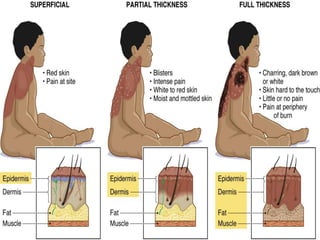
Classifications of Burns:
-Traditionally classified
as 1st, 2nd, and 3rd
degree
-Now classified as
superficial, partial
thickness and full
thickness
First degree
(superficial burn)
Signs & Symptoms
• Reddened skin
• Pain at burn site
• Involves only epidermis
Involves the epidermis
Characterized by
reddening
Tenderness and Pain
Increased warmth
Edema may occur,
but no blistering
Burn blanches under
pressure
Example - sunburn
Usually heal in ~ 7 days
SECOND DEGREE
(PARTIAL THICKNESS)
Signs & Symptoms
-Intense pain
• White to red skin
• Blisters
• Involves epidermis
& dermis
• Damage extends through the
epidermis and involves the dermis.
• Not enough to interfere with
regeneration of the epithelium
• Moist, shiny appearance
• Salmon pink to red color
• Painful
• Does not have to blister to be 2nd
degree
• Usually heal in ~7-21 days
Third degree
(Full Thickness)
Signs& Symptoms
 Dry, leathery skin
 (white, dark brown, or charred)
 Loss of sensation (little pain)
 All dermal layers/tissue
be involved
 Both epidermis and dermis are
destroyed
 Thick, dry appearance
 Pearly gray or charred black color
 Painless - nerve endings are
destroyed
 Pain is due to intermixing of 2nd
degree
 May be minor bleeding
 Cannot heal and require grafting
B. RULE OF NINE
ADULT SKIN AREAS
Head & Neck 9%
Torso 36%
Arms 18%
Legs 36%
Perineum 1%
___________
_
100%
Disadvantage: Overestimation
A. LUND-BROWDER CHART
III. METHODS TO ESTIMATE THE
EXTENT OF INJURY
DIAGNOSTIC TEST
These techniques enable doctors to analyze the depth and severity of
the burn beyond what a standard clinical evaluation can reveal.
BIOPSY- removing and studying sample tissue, it examines
the extent of collagen damage to the skin, vascular damage
to the tissue, and damage to cell proteins in the skin.
THERMOGRAPHY- studies of burn temperature, determine
the exact depth of a burn wound, deeper wounds are
cooler than more superficial wounds. There is reduced
vascular perfusion, or blood circulation, to the deeper
wounds, leading to a lower temperature.
VIDEO ANGRIOGRAPHY- measures changes in the
perfusion of tissues by injecting a substance called
indiocyanine green intravenously. Damaged tissues have
poor circulation, which is visualized by the videography.
Treatment for Burns
(First Degree)
1. Run cool water on burned area for
5 - 10 minutes or cover the area
with a cool compress.
1. Don't apply oil, butter, or ice to the
burn.
2. Take ibuprofen or acetaminophen to
relieve pain and swelling.
3. Any burn to the eye requires
immediate emergency help.
Treatment for Burns
(Second Degree)
1. Do not break blisters.
2. Do not remove clothing that is stuck to the skin.
3. Run cool water on burned area for 5 - 10
minutes, or cover the area with a cool compress
then carefully remove clothing that is not stuck
to the skin.
4. Elevate burned area above the heart.
5. Take ibuprofen or acetaminophen to relieve
pain and swelling.
6. If not near a medical facility, apply bacitracin
ointment or honey on broken blisters to
prevent infection (this is the only situation in
which bacitracin or honey should be applied to
burned skin).
7. If the burn is near the mouth, nose, or eye,
seek emergency medical help immediately.
The Treatment of Critical Burns at the Hospital
Fluid Replacement- replace lost fluids with
intravenous fluids
Infection Control- prescribe oral or intravenous
antibiotics to prevent infection
Debridement- debride severe burns to remove
damaged or contaminated tissue
Skin Grafts-taking skin from an area of the body
that has not been burned and transplanting it to the
area that has been burned
Pain Management- prescribe intravenous
morphine for the first 24 to 48 hours after admission or
surgery and then prescribe oral narcotic medication.
Physical and Occupational Therapy-
provide physical therapy for burn patients that have
difficulty with large motor tasks such as walking &
occupational therapy for patients that have difficulty
with activities of daily living and small motor tasks
like using their hands.
Prevention
1. Supervise children closely around
fires, hot items, and electrical outlets.
2. Have smoke alarms installed in your
home.
3. Have a fire extinguisher available in
your home.
4. Set your water heater at 120° F or less.
5. Teach children to stop, drop and roll.
6. If a person is on fire, smother the fire
with a blanket or other clothing item.
Complications
Minor burns
 deeper burns can cause scar tissue to form,
usually superficial and do not cause complications
Severe burns
 Dehydration
 Shock develops if dehydration is severe
 Chemical imbalances
 Destruction of muscle tissue (rhabdomyolysis)
sometimes occurs with deep third-degree burns.
 Infection;Sometimes the infection can spread
throughout the bloodstream and cause severe
illness or death.
 Thick, crusty surfaces (eschars) Eschars can
become too tight, cutting off blood supply to
healthy tissues or impairing breathing.
BURNS.pptx

BURNS.pptx

  • 2.
    A type ofinjury to the skin caused by heat, electricity, chemicals, light, radiation or friction. This can be complicated by shock, infection, multiple organ dysfunction, syndrome, electrolyte imbalance and respiratory distress.
  • 3.
    types of burninjury THERMAL BURN INJURIES CHEMICAL BURNS ELECTRICAL BURNS
  • 4.
    THERMAL BURN INJURIES BACK -The result of contact with heat sources such as fire, steam, hot liquids, hot metals and hot objects o Fire/Flame Injury- Explosions, Home & other structural fires & Car accidents can cause fire injury o Scalding Injury- Hot water, hot beverages, steam and hot food can all cause scalding.
  • 5.
    Chemical burns - Chemicalburns occur when certain acids, alkaloids and other caustic chemicals come into contact with the skin. E.g. o Household cleaners that contain lye (paint cleaners), sulfuric acid (toilet bowl cleaners), phenol (deodorizers), or sodium hypochlorite (disinfectants and bleaches) BACK
  • 6.
    Electrical burns -Electrical burnsoccur when electric current passes through the body, causing both external and internal injuries. Most of the damage from electric current occurs beneath the surface of the skin. Low Voltage -when a low-voltage electric current (less than 500 volts) passes through the body, it generally does not cause severe burns High Voltage- High voltage burns occur when an electric current of more than 1000 volts passes through the body. Electrical burn complications can be very serious
  • 7.
    RISK FACTORS AGE DRUGUSE GENDER SMOKING SOCIO-ECONOMIC STATUS SUN EXPOSURE SEASONAL UNSAFE HEATING PRACTICES
  • 8.
    Signs & symptoms Parts: Minor- painful and cause reddening and blistering of the skin  Severe- painless causes white or charred area Classifications of Burns: -Traditionally classified as 1st, 2nd, and 3rd degree -Now classified as superficial, partial thickness and full thickness
  • 10.
    First degree (superficial burn) Signs& Symptoms • Reddened skin • Pain at burn site • Involves only epidermis Involves the epidermis Characterized by reddening Tenderness and Pain Increased warmth Edema may occur, but no blistering Burn blanches under pressure Example - sunburn Usually heal in ~ 7 days
  • 11.
    SECOND DEGREE (PARTIAL THICKNESS) Signs& Symptoms -Intense pain • White to red skin • Blisters • Involves epidermis & dermis • Damage extends through the epidermis and involves the dermis. • Not enough to interfere with regeneration of the epithelium • Moist, shiny appearance • Salmon pink to red color • Painful • Does not have to blister to be 2nd degree • Usually heal in ~7-21 days
  • 12.
    Third degree (Full Thickness) Signs&Symptoms  Dry, leathery skin  (white, dark brown, or charred)  Loss of sensation (little pain)  All dermal layers/tissue be involved  Both epidermis and dermis are destroyed  Thick, dry appearance  Pearly gray or charred black color  Painless - nerve endings are destroyed  Pain is due to intermixing of 2nd degree  May be minor bleeding  Cannot heal and require grafting
  • 13.
    B. RULE OFNINE ADULT SKIN AREAS Head & Neck 9% Torso 36% Arms 18% Legs 36% Perineum 1% ___________ _ 100% Disadvantage: Overestimation
  • 14.
    A. LUND-BROWDER CHART III.METHODS TO ESTIMATE THE EXTENT OF INJURY
  • 15.
    DIAGNOSTIC TEST These techniquesenable doctors to analyze the depth and severity of the burn beyond what a standard clinical evaluation can reveal. BIOPSY- removing and studying sample tissue, it examines the extent of collagen damage to the skin, vascular damage to the tissue, and damage to cell proteins in the skin. THERMOGRAPHY- studies of burn temperature, determine the exact depth of a burn wound, deeper wounds are cooler than more superficial wounds. There is reduced vascular perfusion, or blood circulation, to the deeper wounds, leading to a lower temperature. VIDEO ANGRIOGRAPHY- measures changes in the perfusion of tissues by injecting a substance called indiocyanine green intravenously. Damaged tissues have poor circulation, which is visualized by the videography.
  • 16.
    Treatment for Burns (FirstDegree) 1. Run cool water on burned area for 5 - 10 minutes or cover the area with a cool compress. 1. Don't apply oil, butter, or ice to the burn. 2. Take ibuprofen or acetaminophen to relieve pain and swelling. 3. Any burn to the eye requires immediate emergency help.
  • 17.
    Treatment for Burns (SecondDegree) 1. Do not break blisters. 2. Do not remove clothing that is stuck to the skin. 3. Run cool water on burned area for 5 - 10 minutes, or cover the area with a cool compress then carefully remove clothing that is not stuck to the skin. 4. Elevate burned area above the heart. 5. Take ibuprofen or acetaminophen to relieve pain and swelling. 6. If not near a medical facility, apply bacitracin ointment or honey on broken blisters to prevent infection (this is the only situation in which bacitracin or honey should be applied to burned skin). 7. If the burn is near the mouth, nose, or eye, seek emergency medical help immediately.
  • 18.
    The Treatment ofCritical Burns at the Hospital Fluid Replacement- replace lost fluids with intravenous fluids Infection Control- prescribe oral or intravenous antibiotics to prevent infection Debridement- debride severe burns to remove damaged or contaminated tissue Skin Grafts-taking skin from an area of the body that has not been burned and transplanting it to the area that has been burned Pain Management- prescribe intravenous morphine for the first 24 to 48 hours after admission or surgery and then prescribe oral narcotic medication. Physical and Occupational Therapy- provide physical therapy for burn patients that have difficulty with large motor tasks such as walking & occupational therapy for patients that have difficulty with activities of daily living and small motor tasks like using their hands.
  • 19.
    Prevention 1. Supervise childrenclosely around fires, hot items, and electrical outlets. 2. Have smoke alarms installed in your home. 3. Have a fire extinguisher available in your home. 4. Set your water heater at 120° F or less. 5. Teach children to stop, drop and roll. 6. If a person is on fire, smother the fire with a blanket or other clothing item.
  • 20.
    Complications Minor burns  deeperburns can cause scar tissue to form, usually superficial and do not cause complications Severe burns  Dehydration  Shock develops if dehydration is severe  Chemical imbalances  Destruction of muscle tissue (rhabdomyolysis) sometimes occurs with deep third-degree burns.  Infection;Sometimes the infection can spread throughout the bloodstream and cause severe illness or death.  Thick, crusty surfaces (eschars) Eschars can become too tight, cutting off blood supply to healthy tissues or impairing breathing.