

Mechanical Energy
   Chapter 16/17
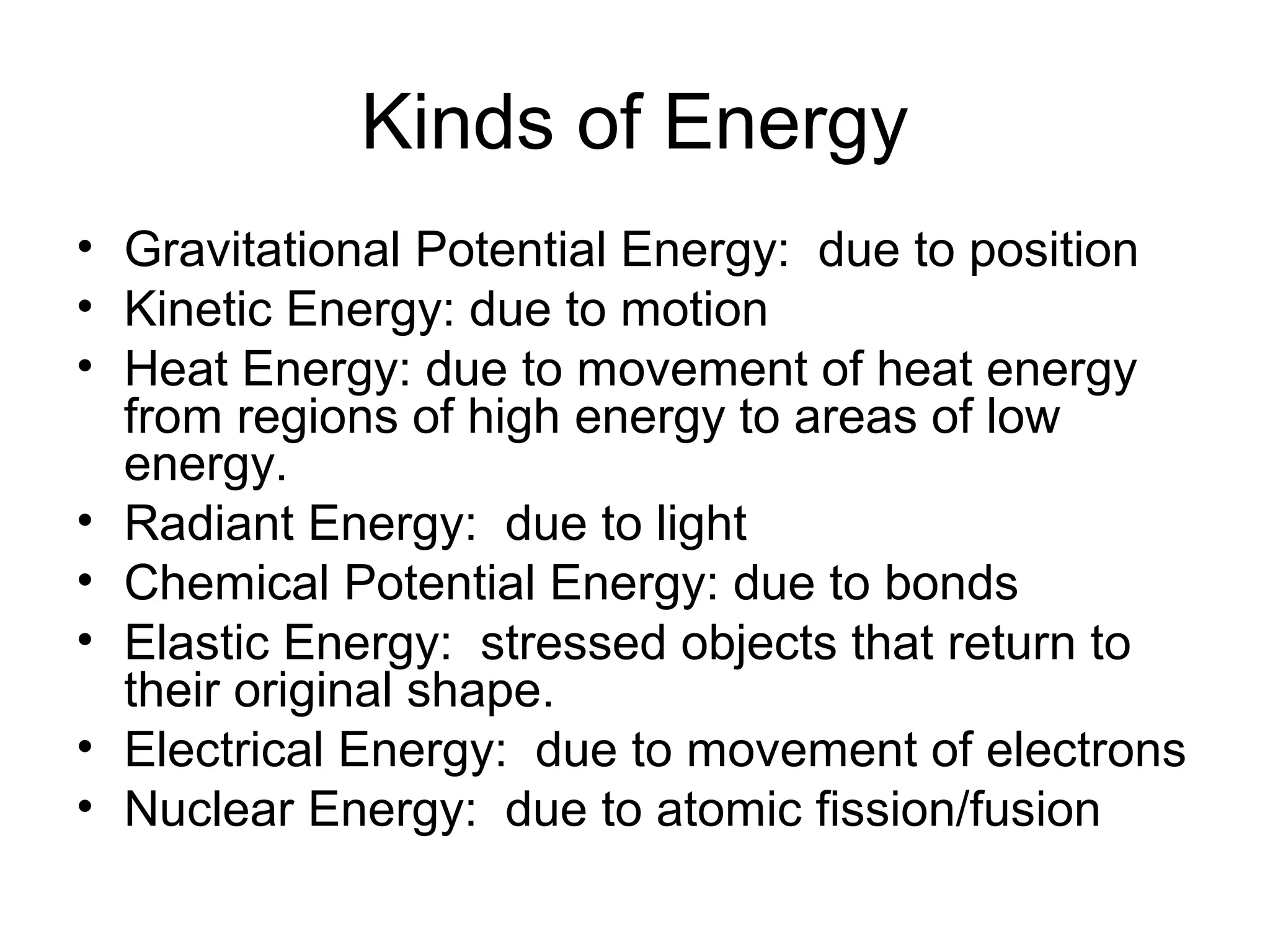
Kinds of Energy
• Gravitational Potential Energy: due to position
• Kinetic Energy: due to motion
• Heat Energy: due to movement of heat energy
  from regions of high energy to areas of low
  energy.
• Radiant Energy: due to light
• Chemical Potential Energy: due to bonds
• Elastic Energy: stressed objects that return to
  their original shape.
• Electrical Energy: due to movement of electrons
• Nuclear Energy: due to atomic fission/fusion
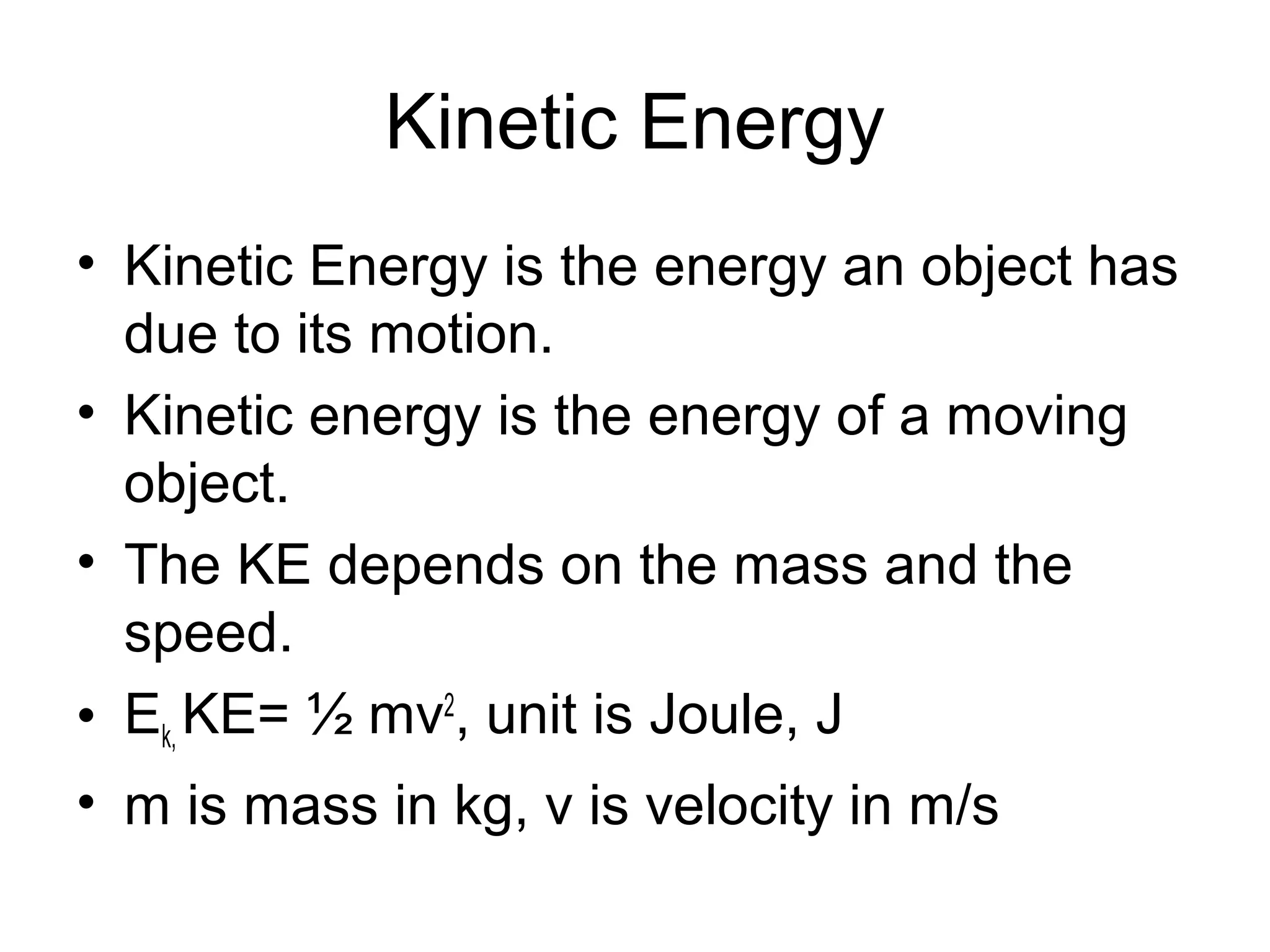
Kinetic Energy
• Kinetic Energy is the energy an object has
  due to its motion.
• Kinetic energy is the energy of a moving
  object.
• The KE depends on the mass and the
  speed.
• Ek, KE= ½ mv2, unit is Joule, J
• m is mass in kg, v is velocity in m/s
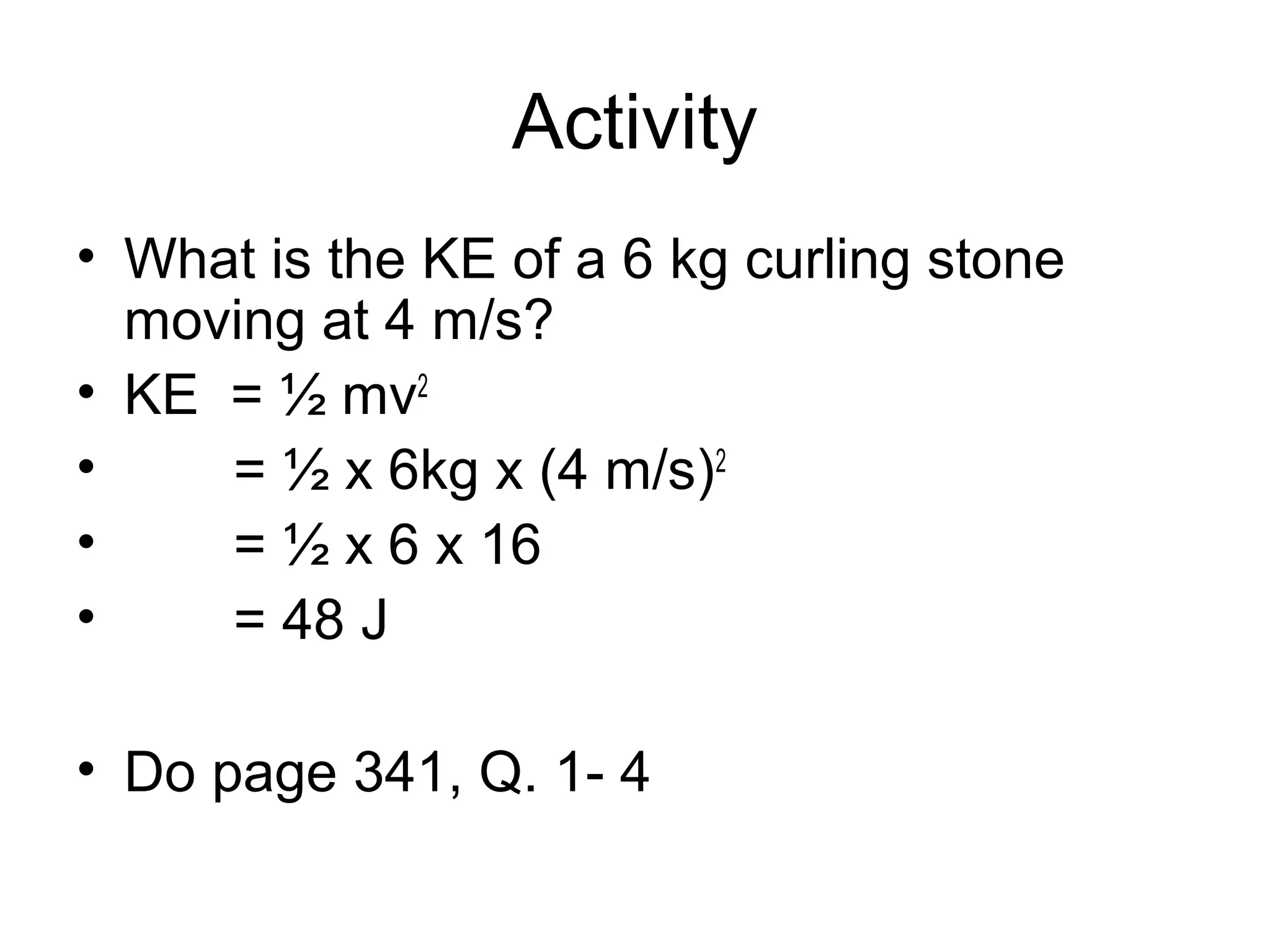
Activity
• What is the KE of a 6 kg curling stone
  moving at 4 m/s?
• KE = ½ mv2
•    = ½ x 6kg x (4 m/s)2
•    = ½ x 6 x 16
•    = 48 J

• Do page 341, Q. 1- 4
Exam Question
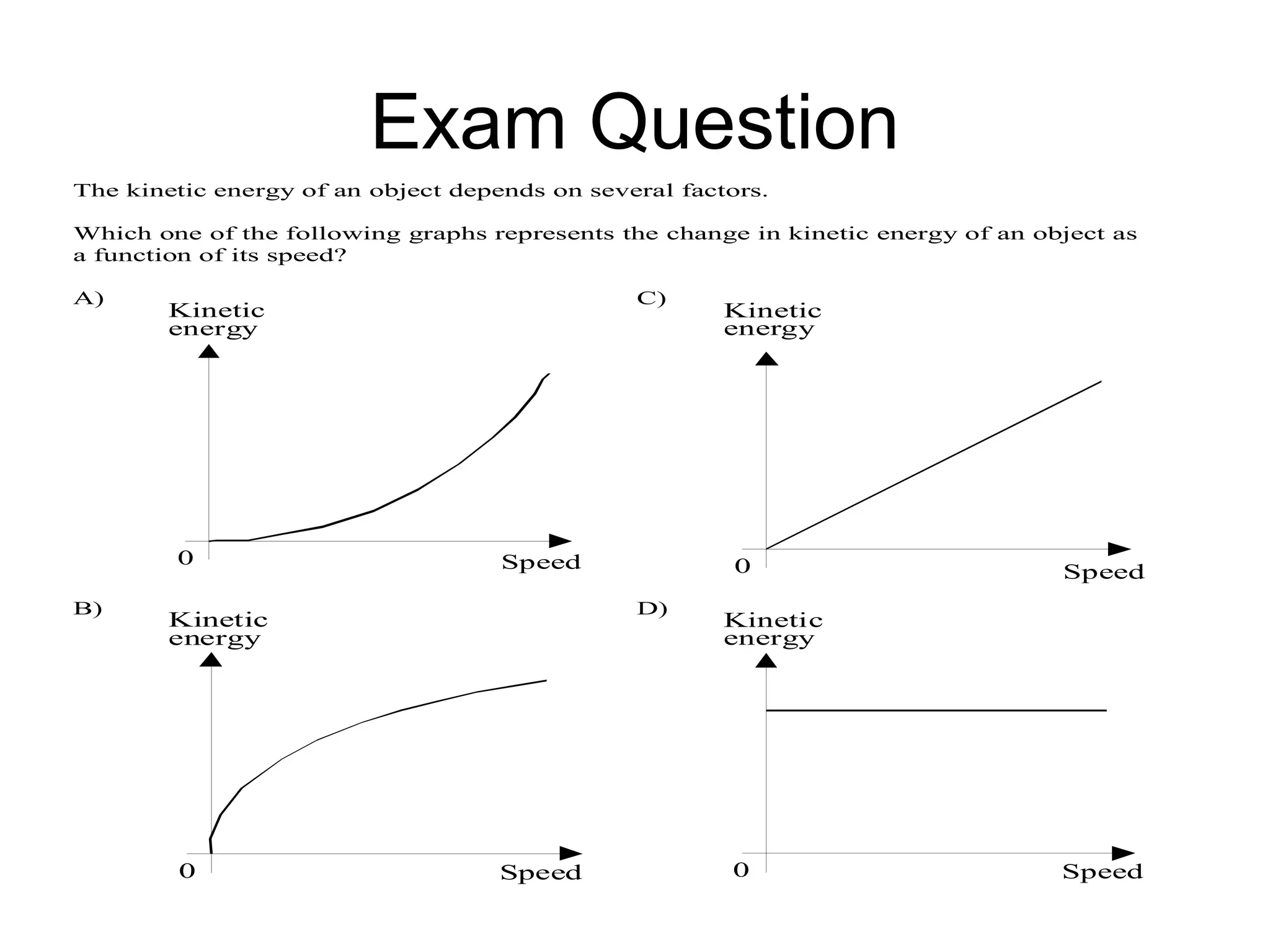
The kinetic energy of an object depends on several factors.

Which one of the following graphs represents the change in kinetic energy of an object as
a function of its speed?

A)                                             C)
        Kinetic                                        Kinetic
        energy                                         energy


        0                           Speed               0                         Speed
B)                                             D)
        Kinetic                                        Kinetic
        energy                                         energy


        0                           Speed              0                          Speed
Exam Question
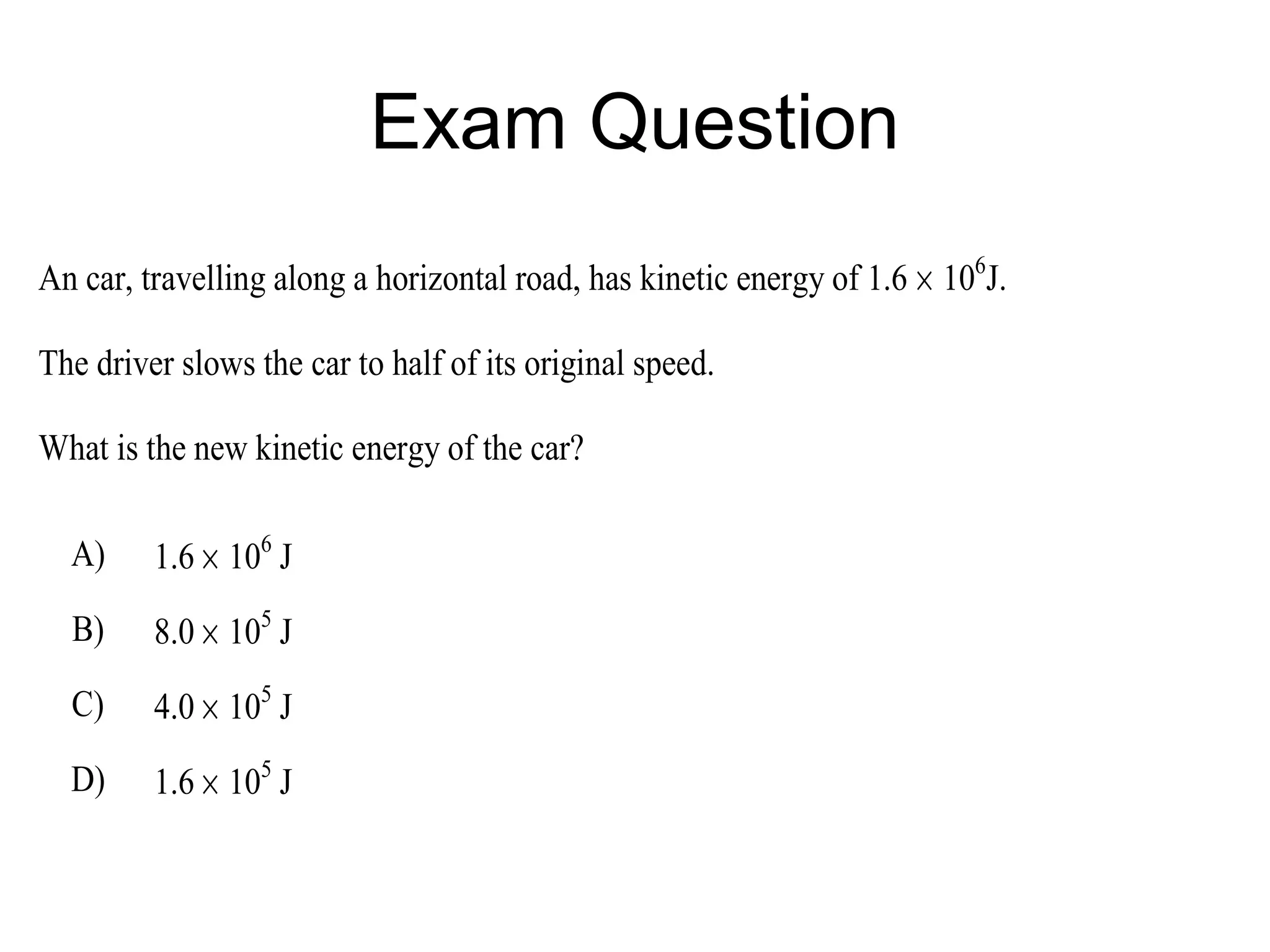
An car, travelling along a horizontal road, has kinetic energy of 1.6 × 10⁶J.

The driver slows the car to half of its original speed.

What is the new kinetic energy of the car?

  A)     1.6 × 10⁶ J
  B)     8.0 × 10⁵ J
  C)     4.0 × 10⁵ J
  D)     1.6 × 10⁵ J
Activity
• Page 341, Q 1 - 6
Potential Energy
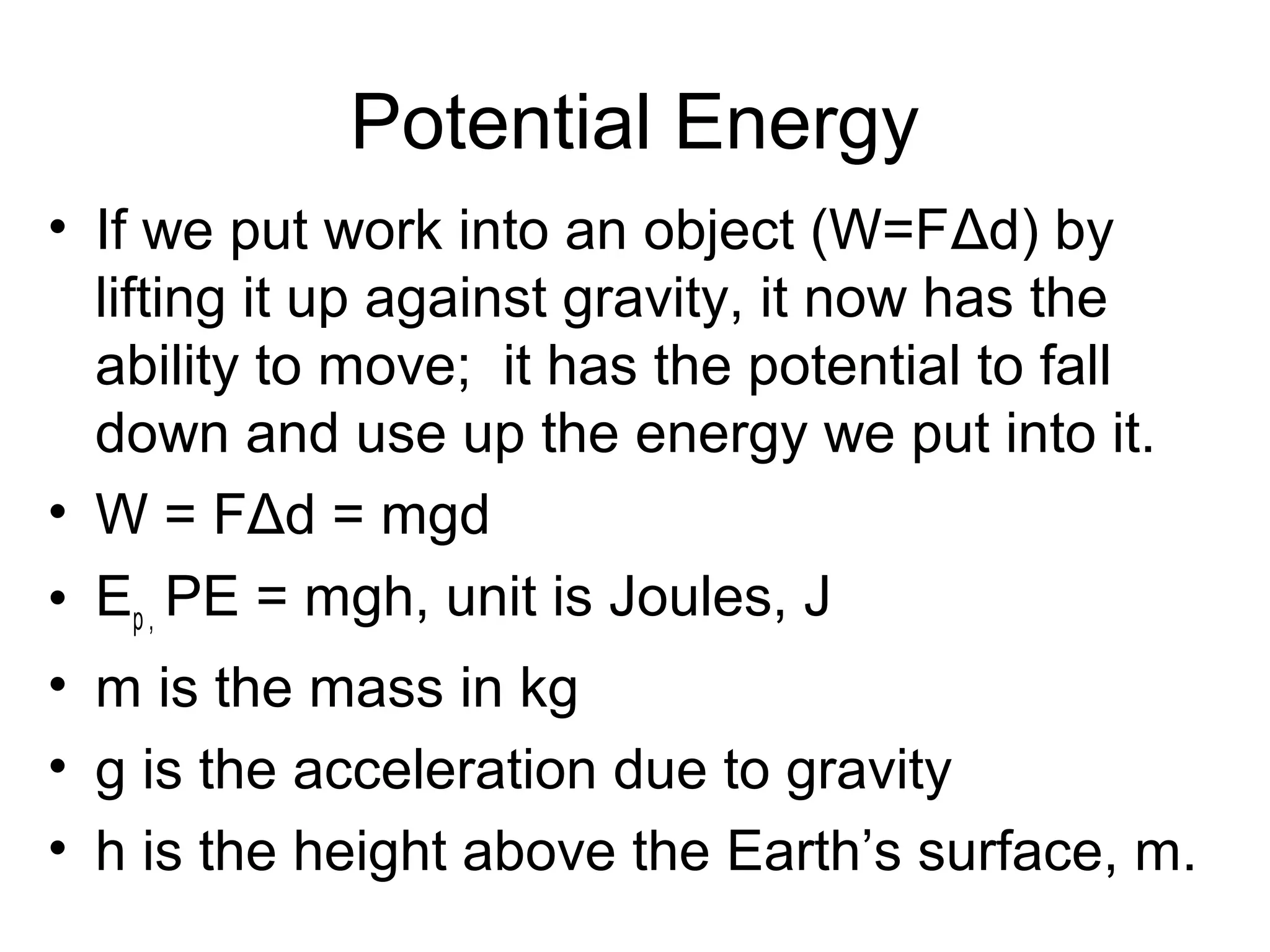
• If we put work into an object (W=FΔd) by
  lifting it up against gravity, it now has the
  ability to move; it has the potential to fall
  down and use up the energy we put into it.
• W = FΔd = mgd
• Ep , PE = mgh, unit is Joules, J
• m is the mass in kg
• g is the acceleration due to gravity
• h is the height above the Earth’s surface, m.
Activity
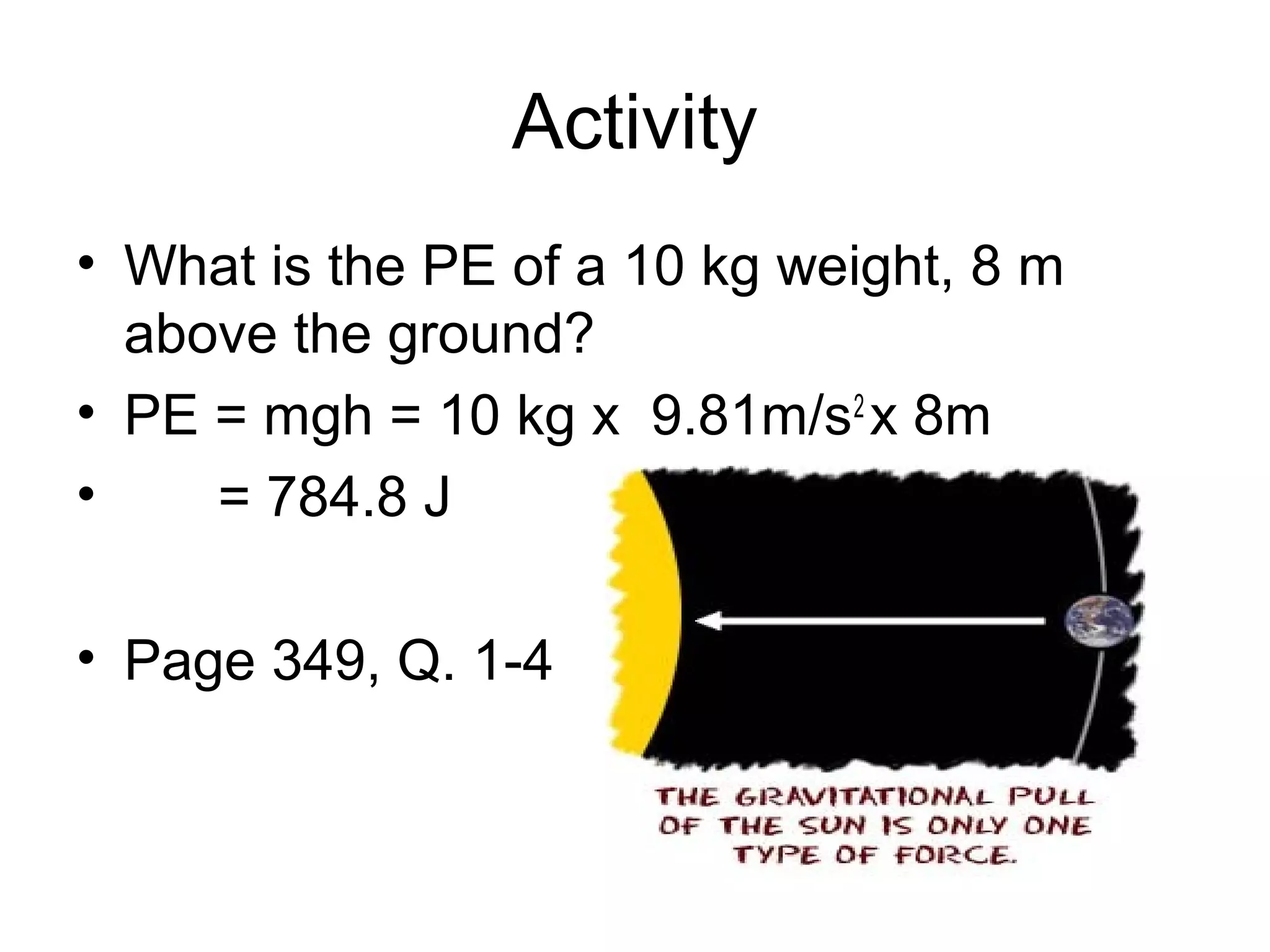
• What is the PE of a 10 kg weight, 8 m
  above the ground?
• PE = mgh = 10 kg x 9.81m/s2 x 8m
•    = 784.8 J

• Page 349, Q. 1-4
Exam Question
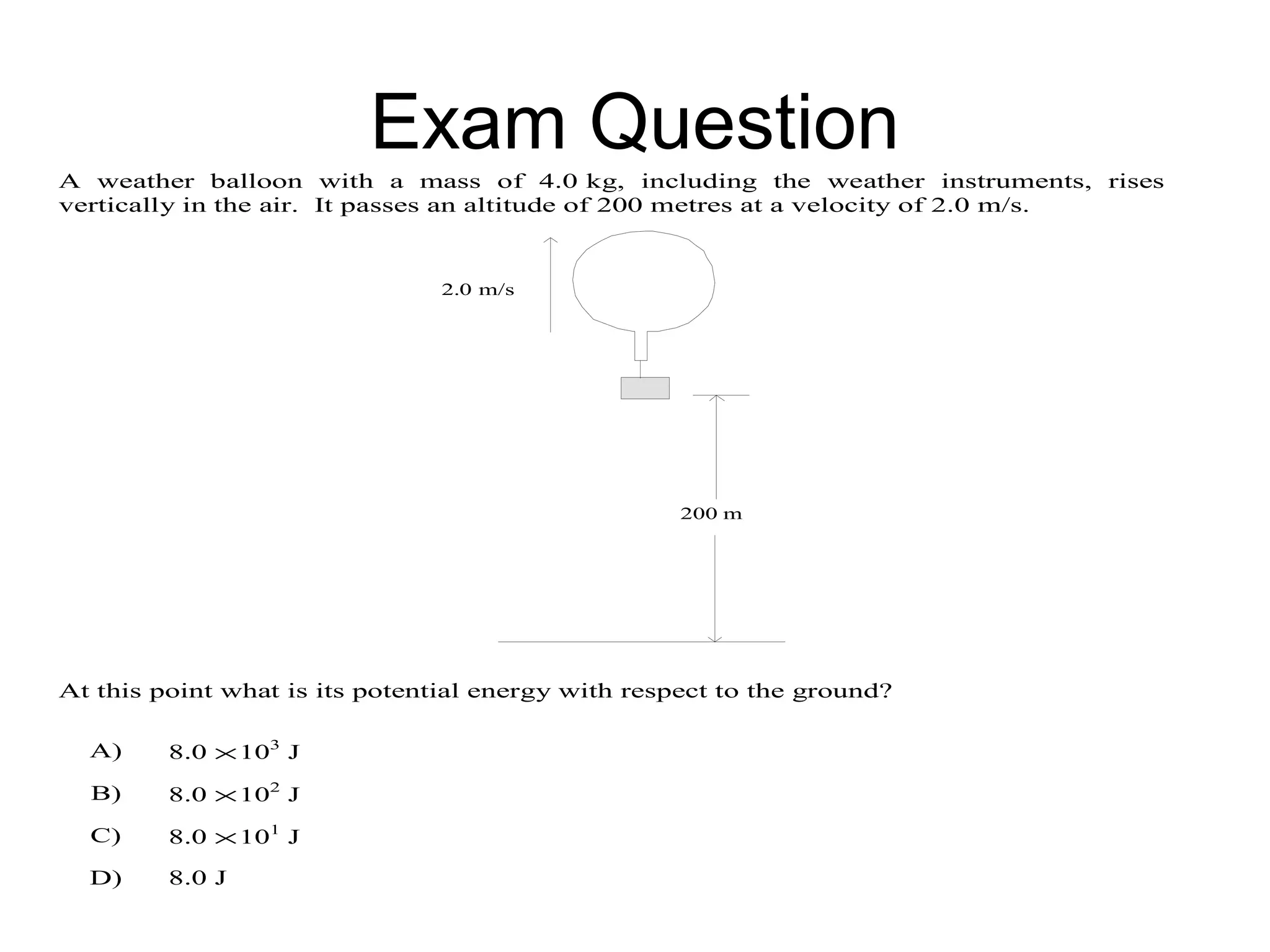
A weather balloon with a mass of 4.0 kg, including the weather instruments, rises
vertically in the air. It passes an altitude of 200 metres at a velocity of 2.0 m/s.


                                2.0 m/s


                                                    200 m


At this point what is its potential energy with respect to the ground?

  A)     8.0 × 10³ J
  B)     8.0 × 10² J
  C)     8.0 × 101 J
  D)     8.0 J
Total Energy
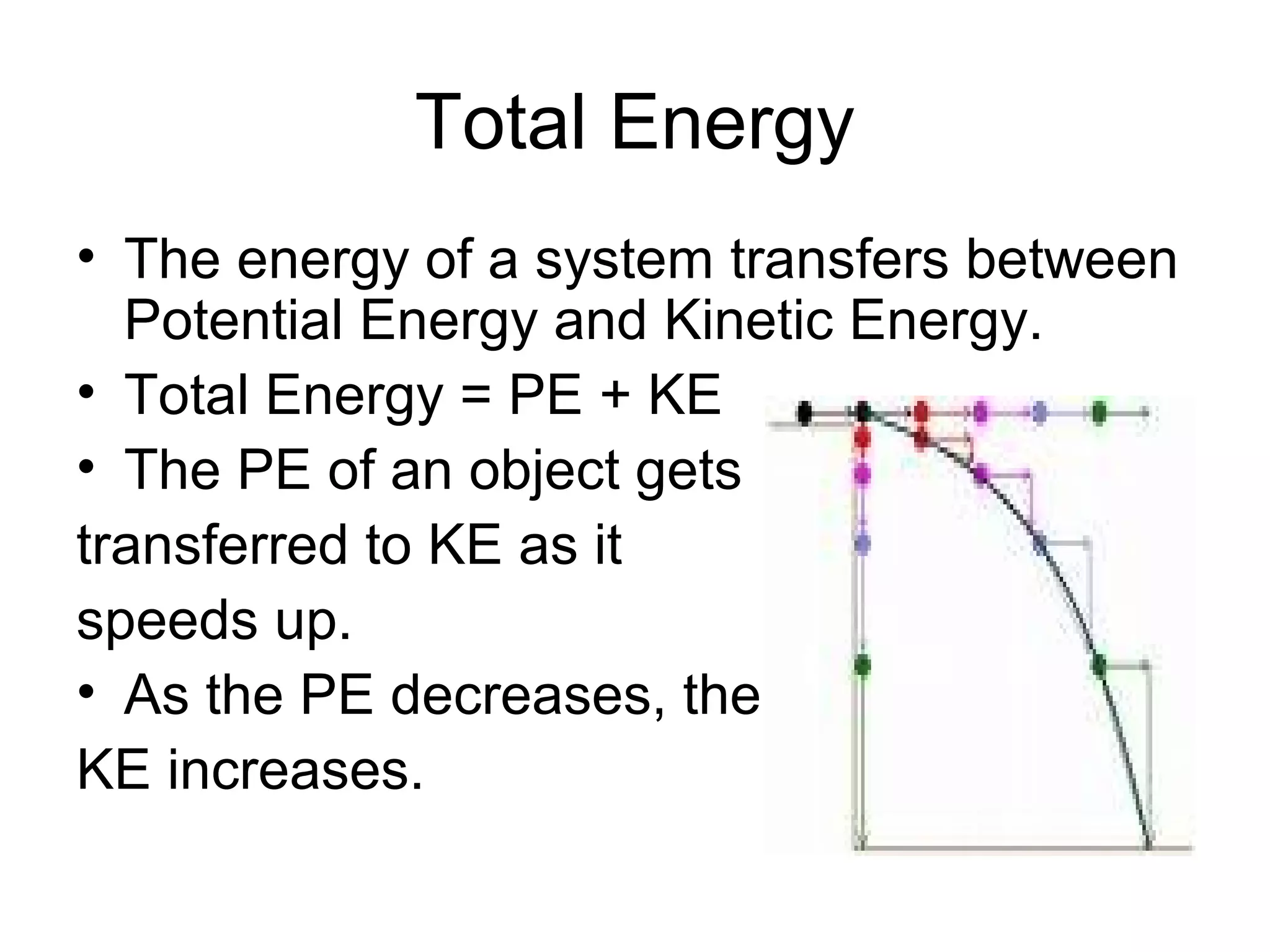
• The energy of a system transfers between
  Potential Energy and Kinetic Energy.
• Total Energy = PE + KE
• The PE of an object gets
transferred to KE as it
speeds up.
• As the PE decreases, the
KE increases.
Total Energy
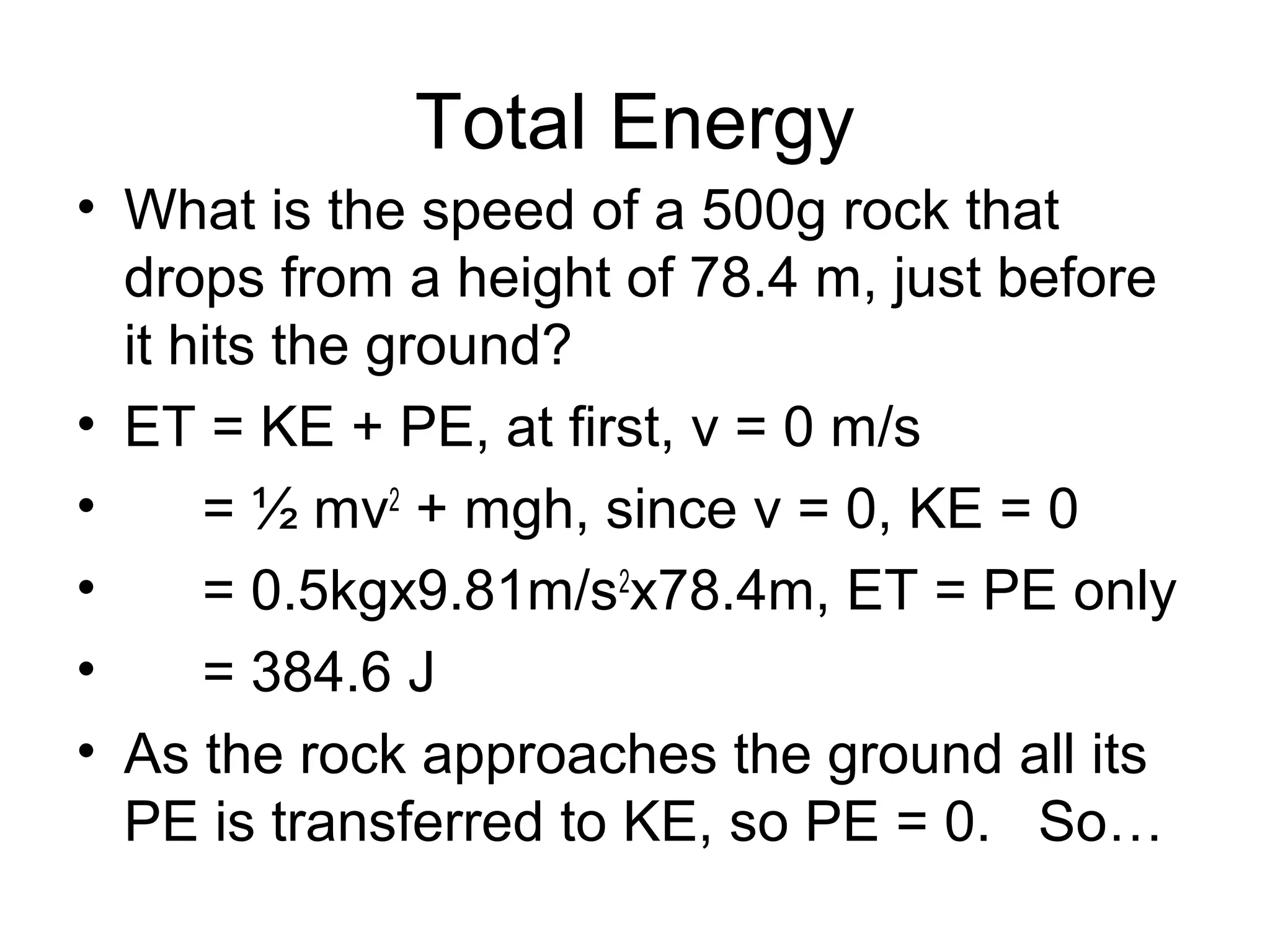
• What is the speed of a 500g rock that
  drops from a height of 78.4 m, just before
  it hits the ground?
• ET = KE + PE, at first, v = 0 m/s
•     = ½ mv2 + mgh, since v = 0, KE = 0
•     = 0.5kgx9.81m/s2x78.4m, ET = PE only
•     = 384.6 J
• As the rock approaches the ground all its
  PE is transferred to KE, so PE = 0. So…
Total Energy, Part Deux
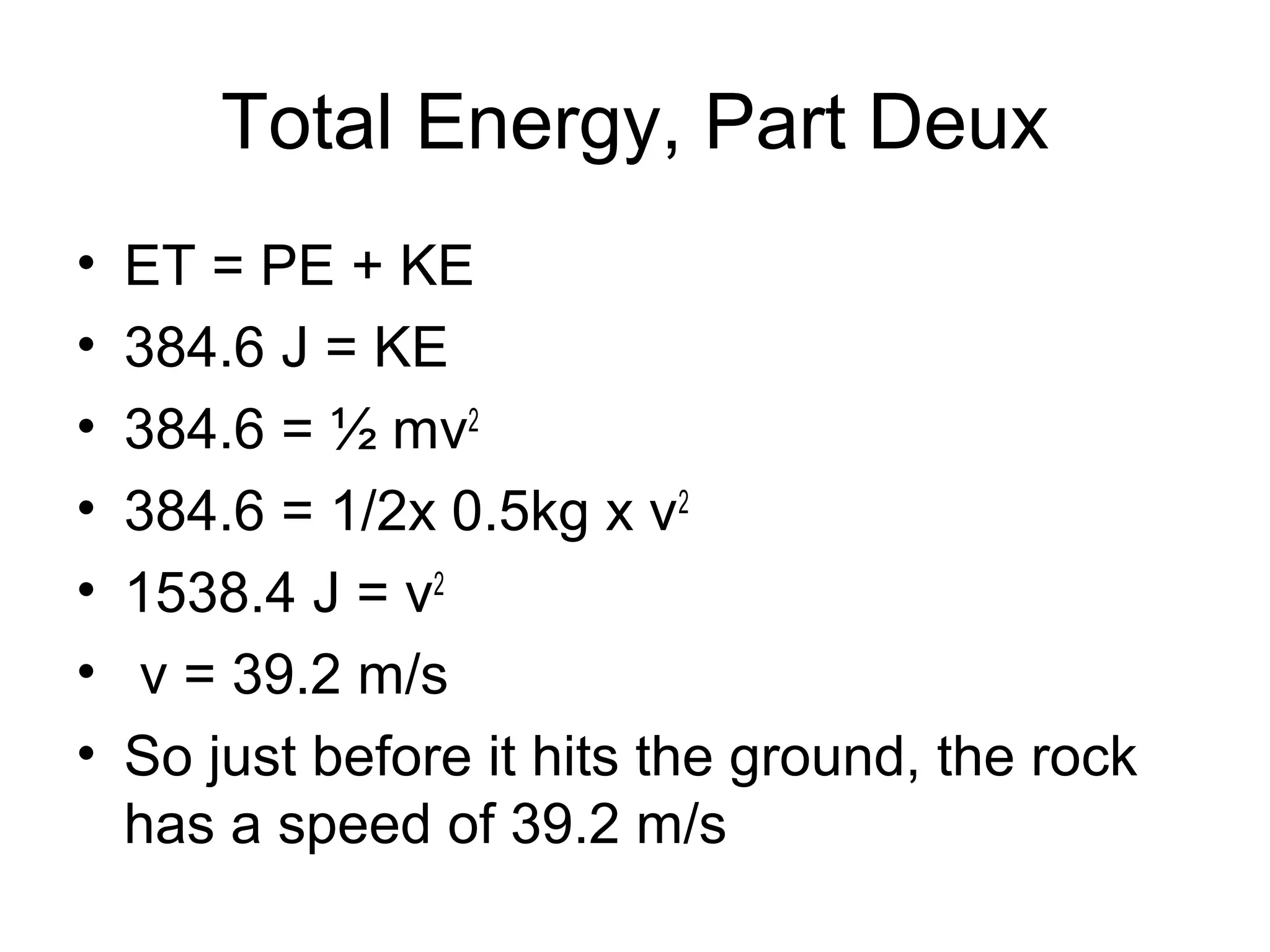
•   ET = PE + KE
•   384.6 J = KE
•   384.6 = ½ mv2
•   384.6 = 1/2x 0.5kg x v2
•   1538.4 J = v2
•   v = 39.2 m/s
•   So just before it hits the ground, the rock
    has a speed of 39.2 m/s
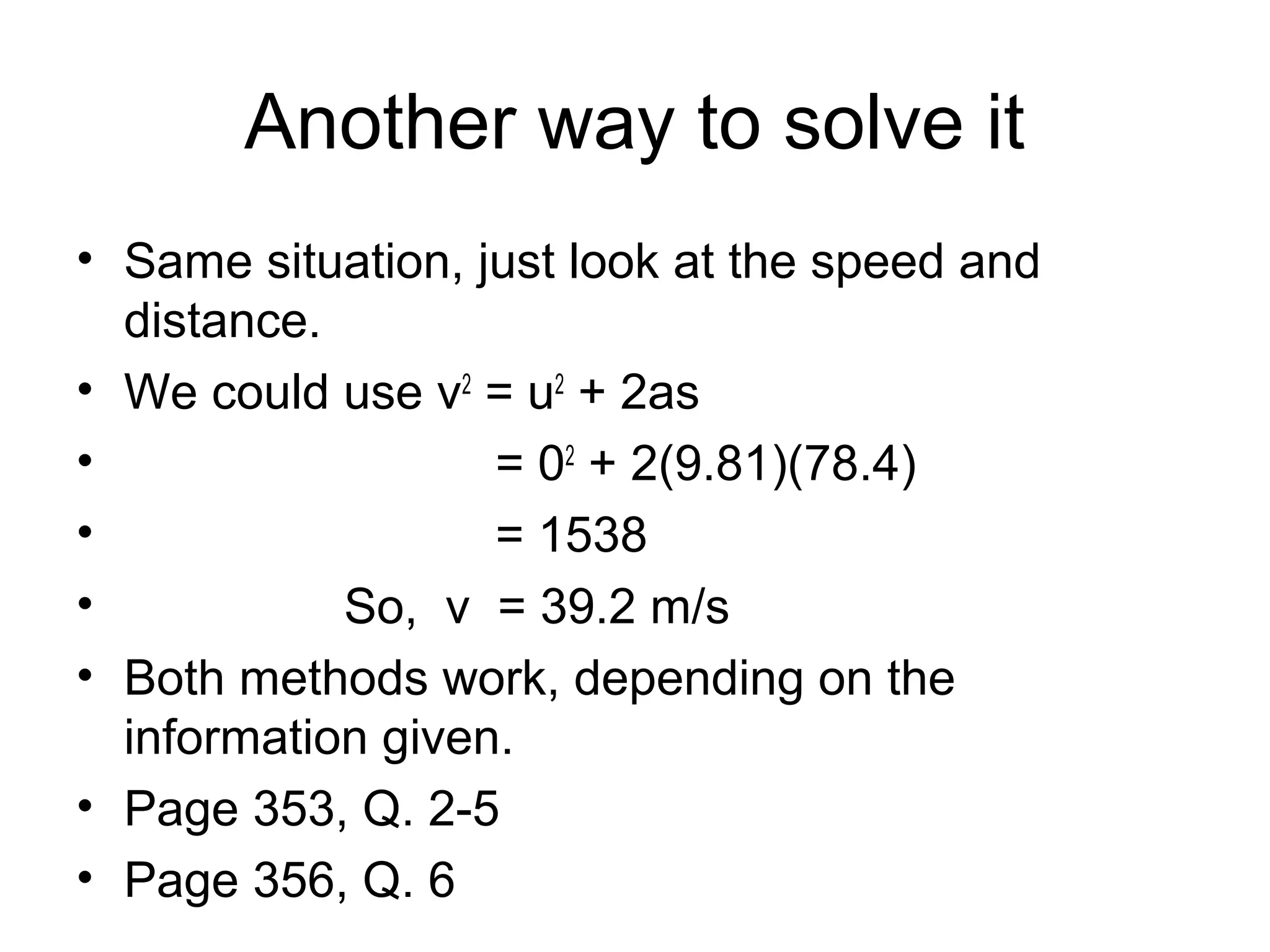
Another way to solve it
• Same situation, just look at the speed and
  distance.
• We could use v2 = u2 + 2as
•                  = 02 + 2(9.81)(78.4)
•                  = 1538
•           So, v = 39.2 m/s
• Both methods work, depending on the
  information given.
• Page 353, Q. 2-5
• Page 356, Q. 6
Exam Question
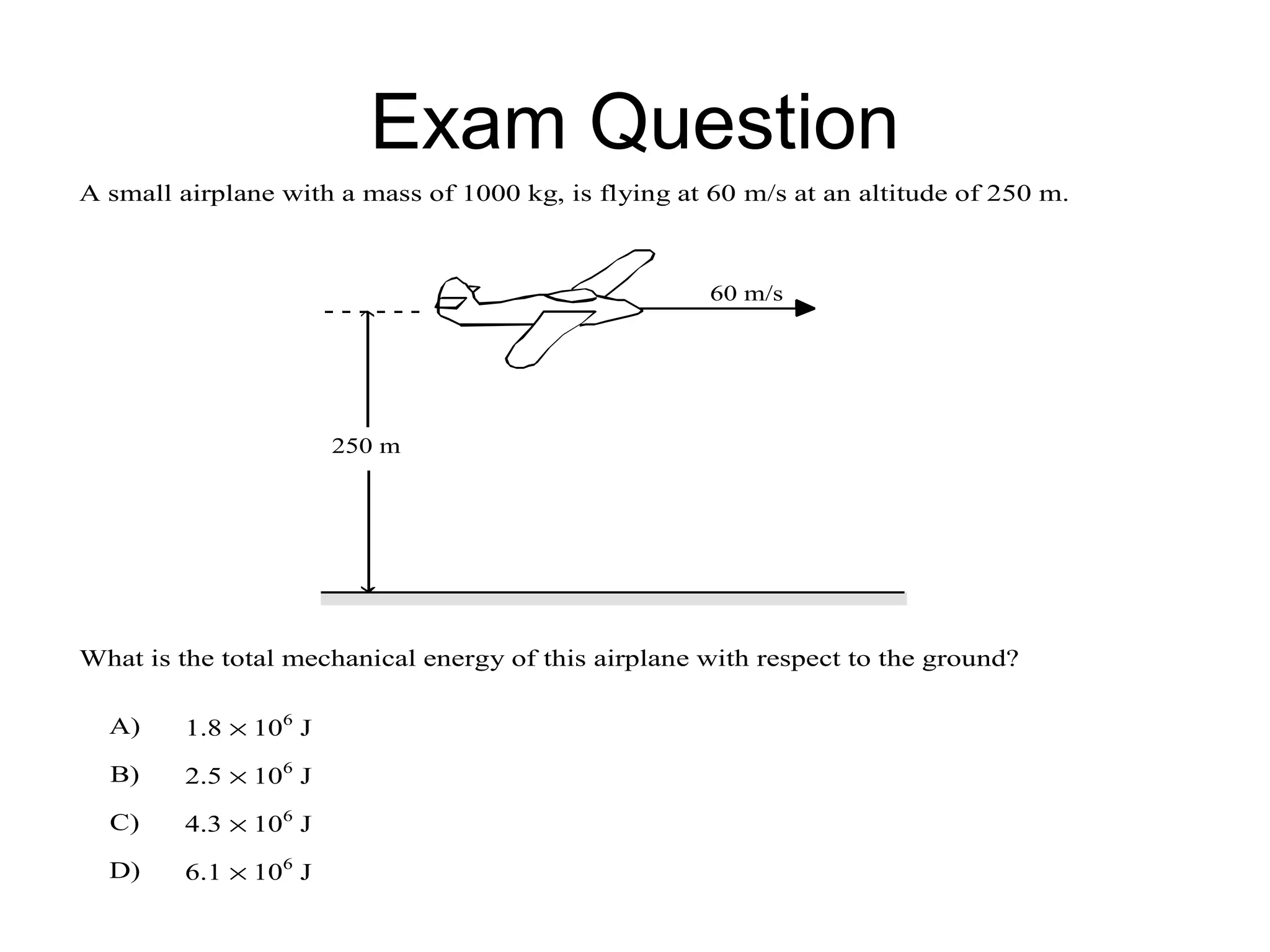
A small airplane with a mass of 1000 kg, is flying at 60 m/s at an altitude of 250 m.


                                                      60 m/s


                       250 m


What is the total mechanical energy of this airplane with respect to the ground?

  A)     1.8 × 10⁶ J
  B)     2.5 × 10⁶ J
  C)     4.3 × 10⁶ J
  D)     6.1 × 10⁶ J
Exam Question
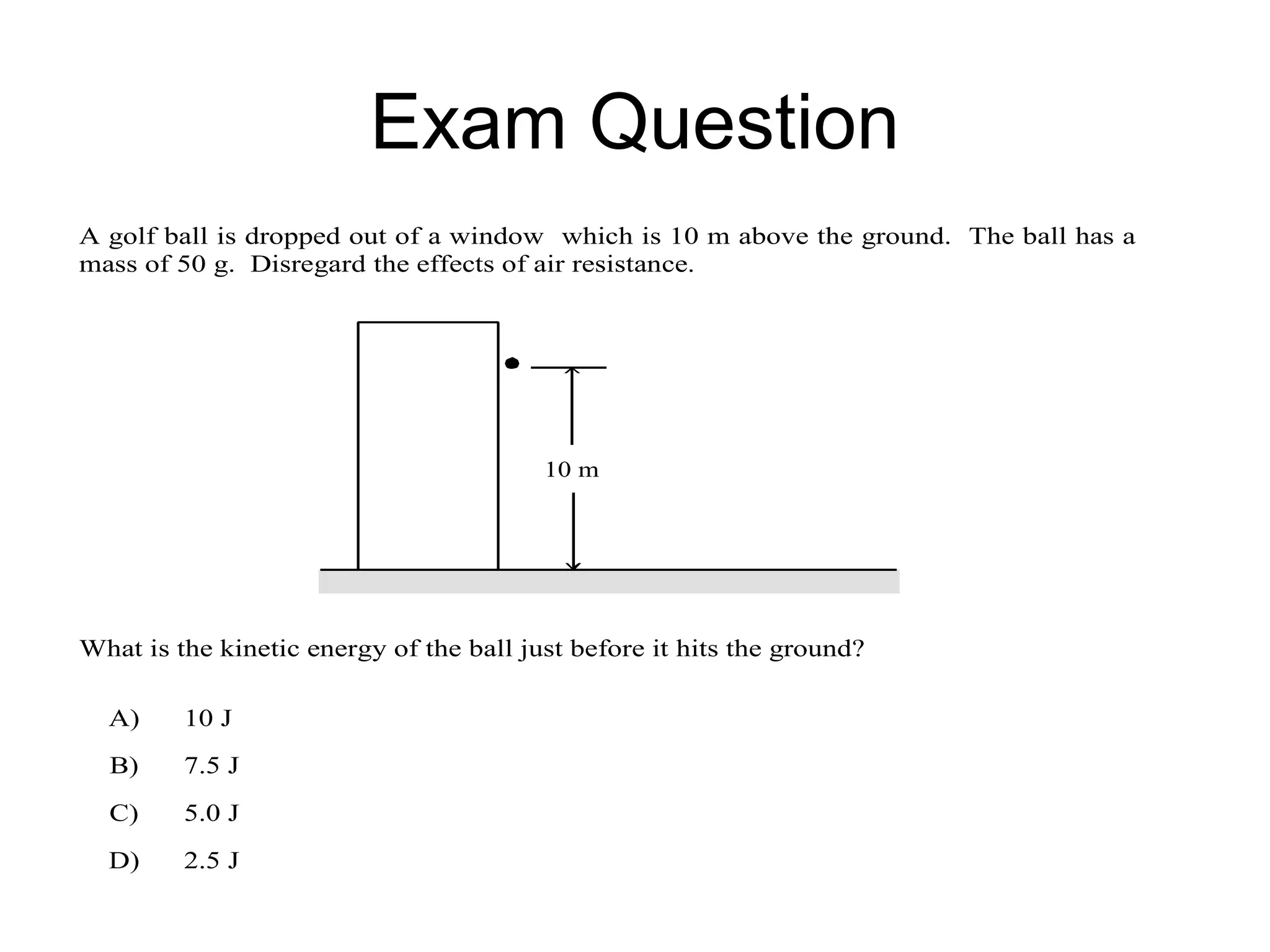
A golf ball is dropped out of a window which is 10 m above the ground. The ball has a
mass of 50 g. Disregard the effects of air resistance.


                                         10 m


What is the kinetic energy of the ball just before it hits the ground?

  A)     10 J
  B)     7.5 J
  C)     5.0 J
  D)     2.5 J
Exam Question
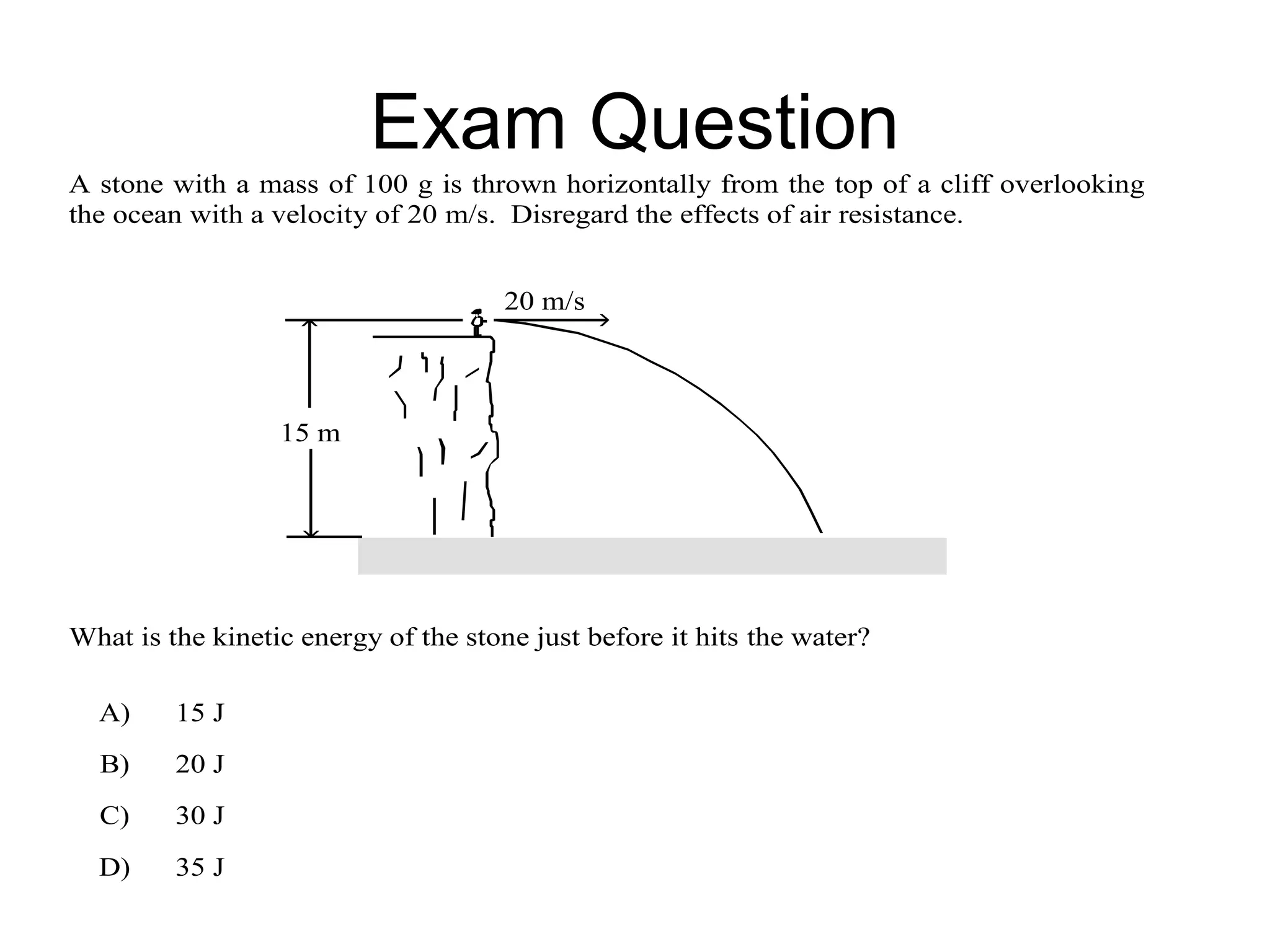
A stone with a mass of 100 g is thrown horizontally from the top of a cliff overlooking
the ocean with a velocity of 20 m/s. Disregard the effects of air resistance.


                                      20 m/s


                  15 m


What is the kinetic energy of the stone just before it hits the water?

  A)     15 J
  B)     20 J
  C)     30 J
  D)     35 J
Exam Question

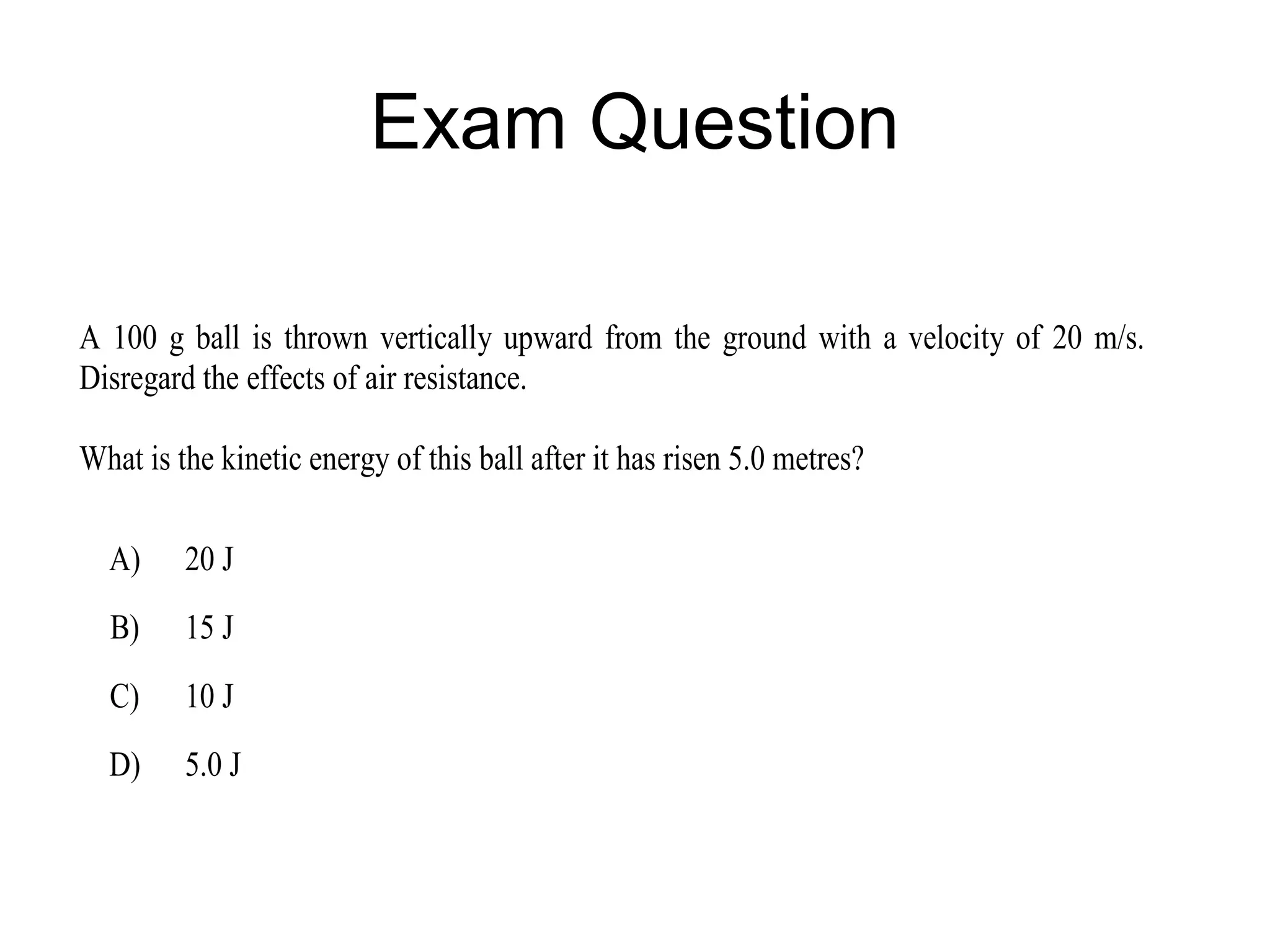
A 100 g ball is thrown vertically upward from the ground with a velocity of 20 m/s.
Disregard the effects of air resistance.

What is the kinetic energy of this ball after it has risen 5.0 metres?

  A)     20 J
  B)     15 J
  C)     10 J
  D)     5.0 J
Summary
• Energy is the ability to do work.
• Work is the transfer of energy. (W=ΔE)
• Friction often does negative work on an
  object because it removes energy from it.
• Gravitational Potential Energy is the
  energy of an object due to its height above
  the Earth’s surface. PE = mgh
• Kinetic Energy is the energy of a moving
  object. KE = ½ mv2
Summary
• The Law of Conservation of Energy states that in
  any transfer or transformation of energy, the
  total amount of energy remains the same.
• The form of the energy may be changed, e.g.
  noise, heat, vibration, friction.
• In situations where friction and air resistance are
  small enough to be ignored, and where no other
  energy is added to the system, the total
  mechanical energy is conserved.
Summary
• E total = KE + PE (before) = KE + PE (after)
• Heat is the measure of the amount of
  thermal energy that flows from one body
  to another because of a difference in
  temperature.
• Work done on an object can cause an
  increase in the temperature of an object.
Exam Question
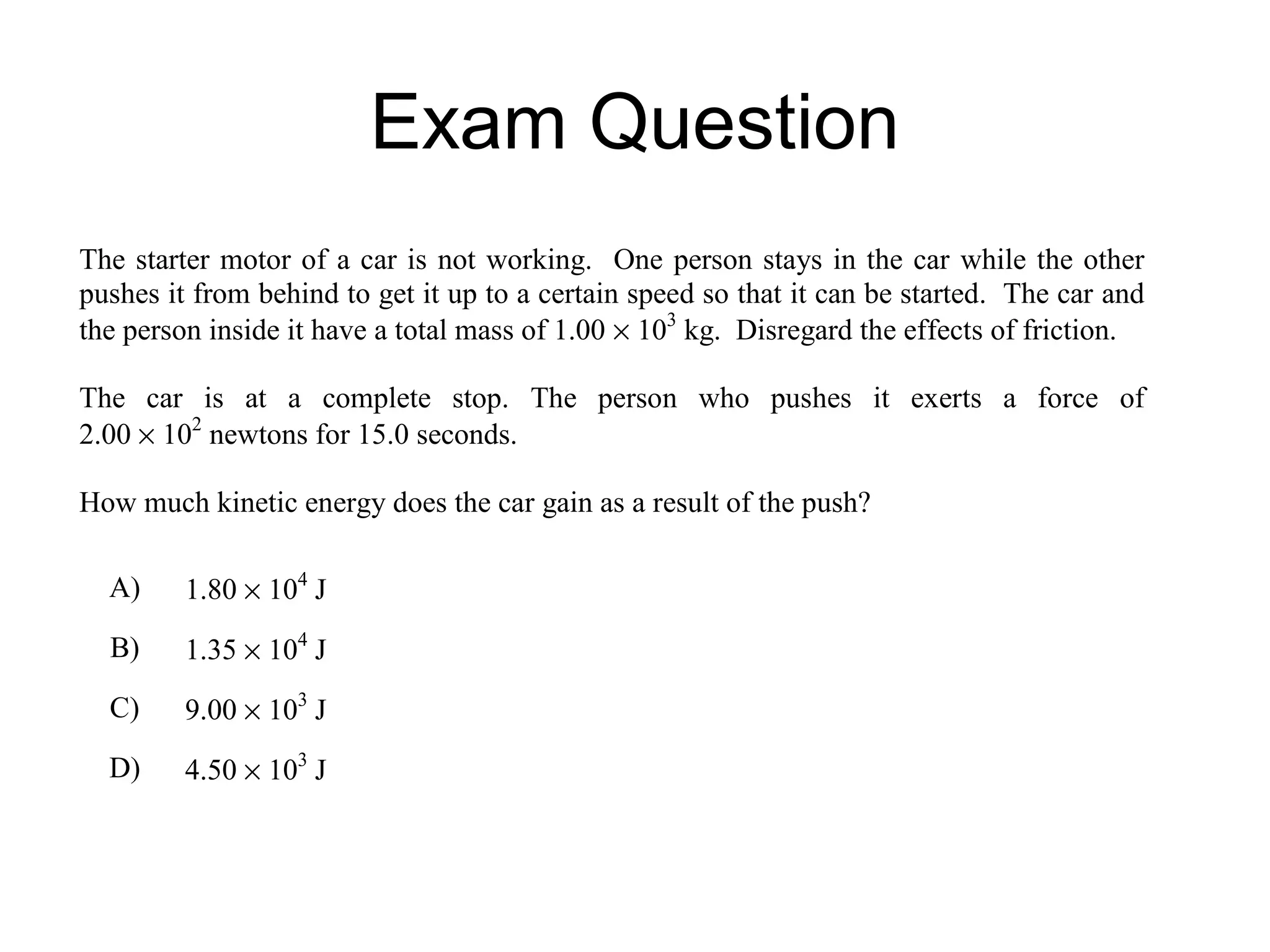
The starter motor of a car is not working. One person stays in the car while the other
pushes it from behind to get it up to a certain speed so that it can be started. The car and
the person inside it have a total mass of 1.00 × 10³ kg. Disregard the effects of friction.

The car is at a complete stop. The person who pushes it exerts a force of
2.00 × 10² newtons for 15.0 seconds.

How much kinetic energy does the car gain as a result of the push?

  A)     1.80 × 10⁴ J
  B)     1.35 × 10⁴ J
  C)     9.00 × 10³ J
  D)     4.50 × 10³ J
Activity
• Page 361, Q. 1-7
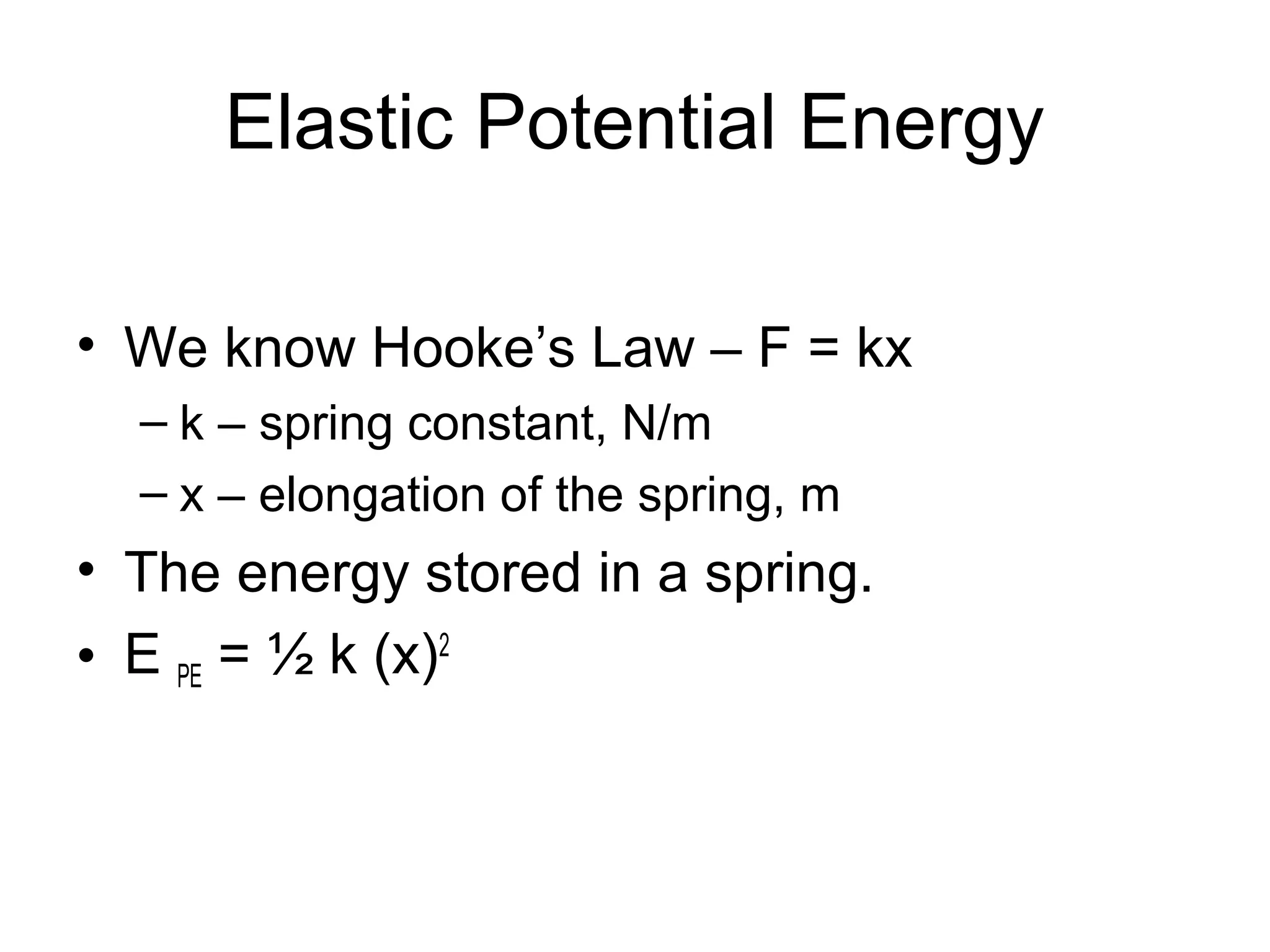
Elastic Potential Energy

• We know Hooke’s Law – F = kx
  – k – spring constant, N/m
  – x – elongation of the spring, m
• The energy stored in a spring.
• E PE = ½ k (x)2
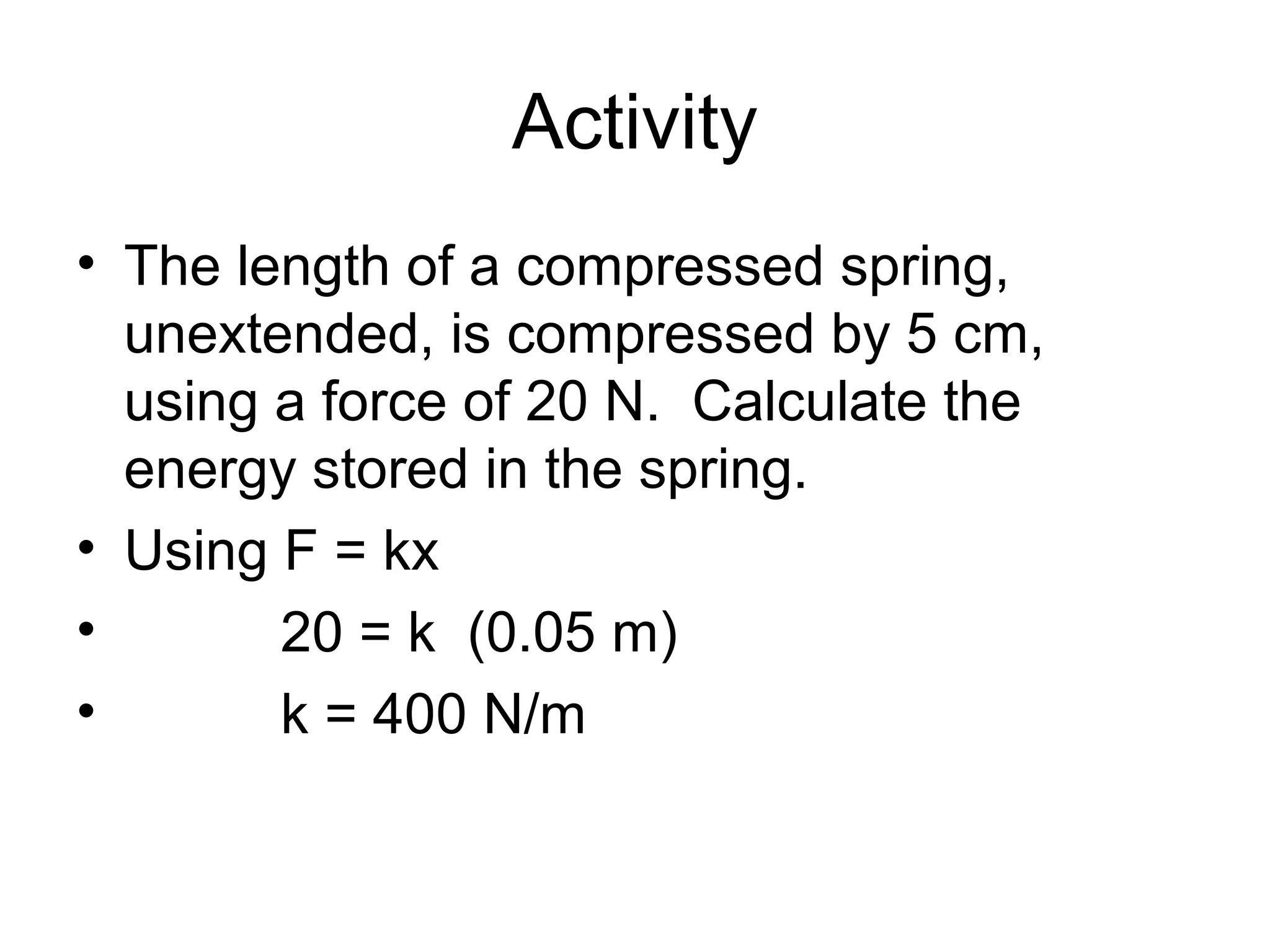
Activity
• The length of a compressed spring,
  unextended, is compressed by 5 cm,
  using a force of 20 N. Calculate the
  energy stored in the spring.
• Using F = kx
•       20 = k (0.05 m)
•       k = 400 N/m
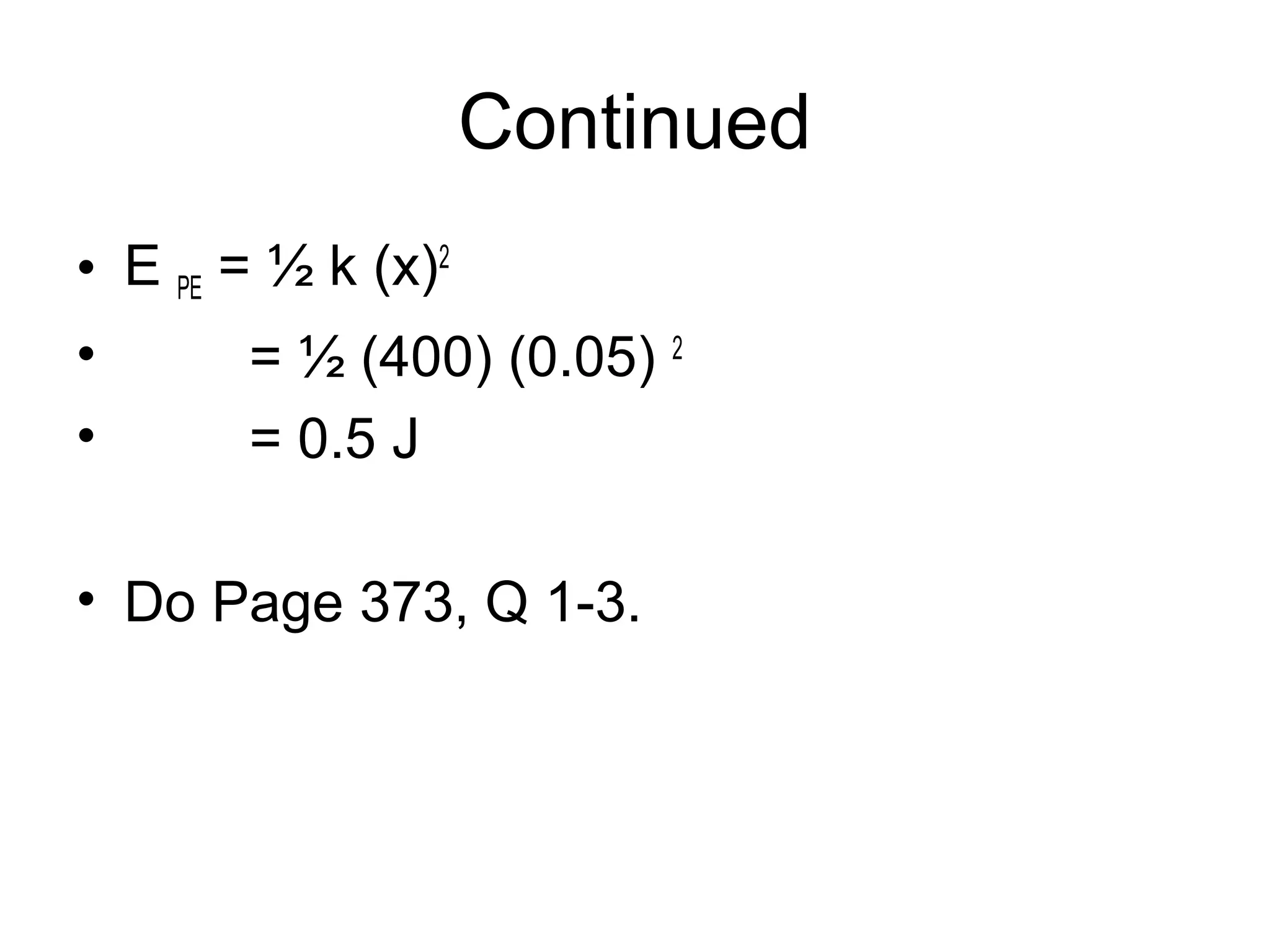
Continued
• E PE = ½ k (x)2
•      = ½ (400) (0.05) 2
•      = 0.5 J

• Do Page 373, Q 1-3.

Physics 504 Chapter 16 Energy

  • 1.
    Mechanical Energy Chapter 16/17
  • 2.
    Kinds of Energy •Gravitational Potential Energy: due to position • Kinetic Energy: due to motion • Heat Energy: due to movement of heat energy from regions of high energy to areas of low energy. • Radiant Energy: due to light • Chemical Potential Energy: due to bonds • Elastic Energy: stressed objects that return to their original shape. • Electrical Energy: due to movement of electrons • Nuclear Energy: due to atomic fission/fusion
  • 3.
    Kinetic Energy • KineticEnergy is the energy an object has due to its motion. • Kinetic energy is the energy of a moving object. • The KE depends on the mass and the speed. • Ek, KE= ½ mv2, unit is Joule, J • m is mass in kg, v is velocity in m/s
  • 4.
    Activity • What isthe KE of a 6 kg curling stone moving at 4 m/s? • KE = ½ mv2 • = ½ x 6kg x (4 m/s)2 • = ½ x 6 x 16 • = 48 J • Do page 341, Q. 1- 4
  • 5.
    Exam Question The kineticenergy of an object depends on several factors. Which one of the following graphs represents the change in kinetic energy of an object as a function of its speed? A) C) Kinetic Kinetic energy energy 0 Speed 0 Speed B) D) Kinetic Kinetic energy energy 0 Speed 0 Speed
  • 6.
    Exam Question An car,travelling along a horizontal road, has kinetic energy of 1.6 × 10⁶J. The driver slows the car to half of its original speed. What is the new kinetic energy of the car? A) 1.6 × 10⁶ J B) 8.0 × 10⁵ J C) 4.0 × 10⁵ J D) 1.6 × 10⁵ J
  • 7.
  • 8.
    Potential Energy • Ifwe put work into an object (W=FΔd) by lifting it up against gravity, it now has the ability to move; it has the potential to fall down and use up the energy we put into it. • W = FΔd = mgd • Ep , PE = mgh, unit is Joules, J • m is the mass in kg • g is the acceleration due to gravity • h is the height above the Earth’s surface, m.
  • 9.
    Activity • What isthe PE of a 10 kg weight, 8 m above the ground? • PE = mgh = 10 kg x 9.81m/s2 x 8m • = 784.8 J • Page 349, Q. 1-4
  • 10.
    Exam Question A weatherballoon with a mass of 4.0 kg, including the weather instruments, rises vertically in the air. It passes an altitude of 200 metres at a velocity of 2.0 m/s. 2.0 m/s 200 m At this point what is its potential energy with respect to the ground? A) 8.0 × 10³ J B) 8.0 × 10² J C) 8.0 × 101 J D) 8.0 J
  • 11.
    Total Energy • Theenergy of a system transfers between Potential Energy and Kinetic Energy. • Total Energy = PE + KE • The PE of an object gets transferred to KE as it speeds up. • As the PE decreases, the KE increases.
  • 12.
    Total Energy • Whatis the speed of a 500g rock that drops from a height of 78.4 m, just before it hits the ground? • ET = KE + PE, at first, v = 0 m/s • = ½ mv2 + mgh, since v = 0, KE = 0 • = 0.5kgx9.81m/s2x78.4m, ET = PE only • = 384.6 J • As the rock approaches the ground all its PE is transferred to KE, so PE = 0. So…
  • 13.
    Total Energy, PartDeux • ET = PE + KE • 384.6 J = KE • 384.6 = ½ mv2 • 384.6 = 1/2x 0.5kg x v2 • 1538.4 J = v2 • v = 39.2 m/s • So just before it hits the ground, the rock has a speed of 39.2 m/s
  • 14.
    Another way tosolve it • Same situation, just look at the speed and distance. • We could use v2 = u2 + 2as • = 02 + 2(9.81)(78.4) • = 1538 • So, v = 39.2 m/s • Both methods work, depending on the information given. • Page 353, Q. 2-5 • Page 356, Q. 6
  • 15.
    Exam Question A smallairplane with a mass of 1000 kg, is flying at 60 m/s at an altitude of 250 m. 60 m/s 250 m What is the total mechanical energy of this airplane with respect to the ground? A) 1.8 × 10⁶ J B) 2.5 × 10⁶ J C) 4.3 × 10⁶ J D) 6.1 × 10⁶ J
  • 16.
    Exam Question A golfball is dropped out of a window which is 10 m above the ground. The ball has a mass of 50 g. Disregard the effects of air resistance. 10 m What is the kinetic energy of the ball just before it hits the ground? A) 10 J B) 7.5 J C) 5.0 J D) 2.5 J
  • 17.
    Exam Question A stonewith a mass of 100 g is thrown horizontally from the top of a cliff overlooking the ocean with a velocity of 20 m/s. Disregard the effects of air resistance. 20 m/s 15 m What is the kinetic energy of the stone just before it hits the water? A) 15 J B) 20 J C) 30 J D) 35 J
  • 18.
    Exam Question A 100g ball is thrown vertically upward from the ground with a velocity of 20 m/s. Disregard the effects of air resistance. What is the kinetic energy of this ball after it has risen 5.0 metres? A) 20 J B) 15 J C) 10 J D) 5.0 J
  • 19.
    Summary • Energy isthe ability to do work. • Work is the transfer of energy. (W=ΔE) • Friction often does negative work on an object because it removes energy from it. • Gravitational Potential Energy is the energy of an object due to its height above the Earth’s surface. PE = mgh • Kinetic Energy is the energy of a moving object. KE = ½ mv2
  • 20.
    Summary • The Lawof Conservation of Energy states that in any transfer or transformation of energy, the total amount of energy remains the same. • The form of the energy may be changed, e.g. noise, heat, vibration, friction. • In situations where friction and air resistance are small enough to be ignored, and where no other energy is added to the system, the total mechanical energy is conserved.
  • 21.
    Summary • E total= KE + PE (before) = KE + PE (after) • Heat is the measure of the amount of thermal energy that flows from one body to another because of a difference in temperature. • Work done on an object can cause an increase in the temperature of an object.
  • 22.
    Exam Question The startermotor of a car is not working. One person stays in the car while the other pushes it from behind to get it up to a certain speed so that it can be started. The car and the person inside it have a total mass of 1.00 × 10³ kg. Disregard the effects of friction. The car is at a complete stop. The person who pushes it exerts a force of 2.00 × 10² newtons for 15.0 seconds. How much kinetic energy does the car gain as a result of the push? A) 1.80 × 10⁴ J B) 1.35 × 10⁴ J C) 9.00 × 10³ J D) 4.50 × 10³ J
  • 23.
  • 24.
    Elastic Potential Energy •We know Hooke’s Law – F = kx – k – spring constant, N/m – x – elongation of the spring, m • The energy stored in a spring. • E PE = ½ k (x)2
  • 25.
    Activity • The lengthof a compressed spring, unextended, is compressed by 5 cm, using a force of 20 N. Calculate the energy stored in the spring. • Using F = kx • 20 = k (0.05 m) • k = 400 N/m
  • 26.
    Continued • E PE= ½ k (x)2 • = ½ (400) (0.05) 2 • = 0.5 J • Do Page 373, Q 1-3.