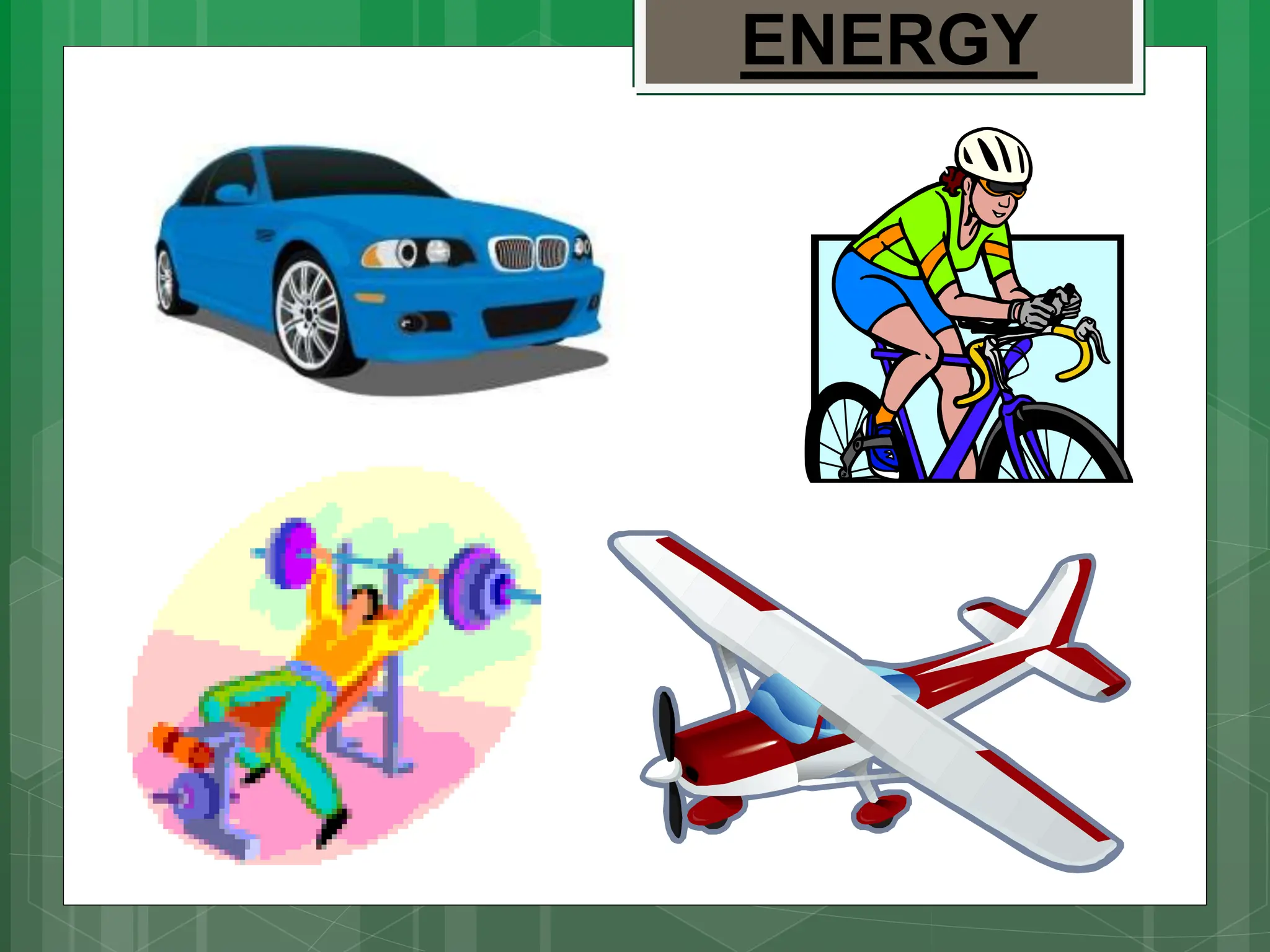




ENERG
Y
Grade 8 Science
3. Explain how kinetic energy differ
from potential energy;
4. Compute problems involving
potential and kinetic energy.
1. Define energy;
2. Identify activities/things that
possesses kinetic energy or
potential energy;
OBJECTIVES
ENERGY
What is it?
ENERGY
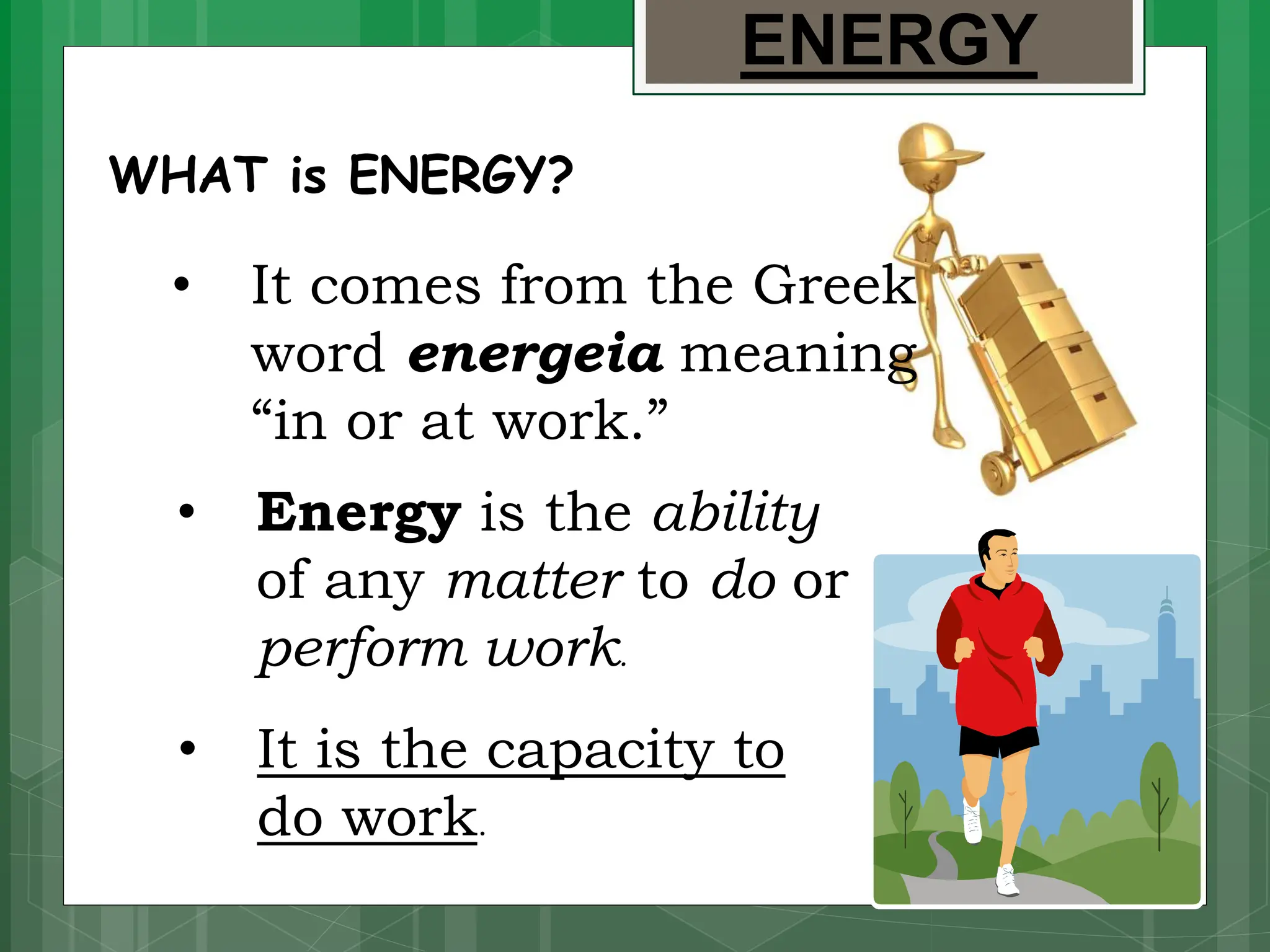
WHAT is ENERGY?
• It comes from the Greek
word energeia meaning
“in or at work.”
• Energy is the ability
of any matter to do or
perform work.
• It is the capacity to
do work.
ENERGY
MESSAGE RELAY
First Game
ENERGY
Two Main Types of Energy
KINETIC ENERGY
POTENTIAL ENERGY
and
ENERGY
ENERGY
GROUP QUIZ
Second Game
Time is Up!
A mouse running away from cat.
KINETIC
ENERGY
1
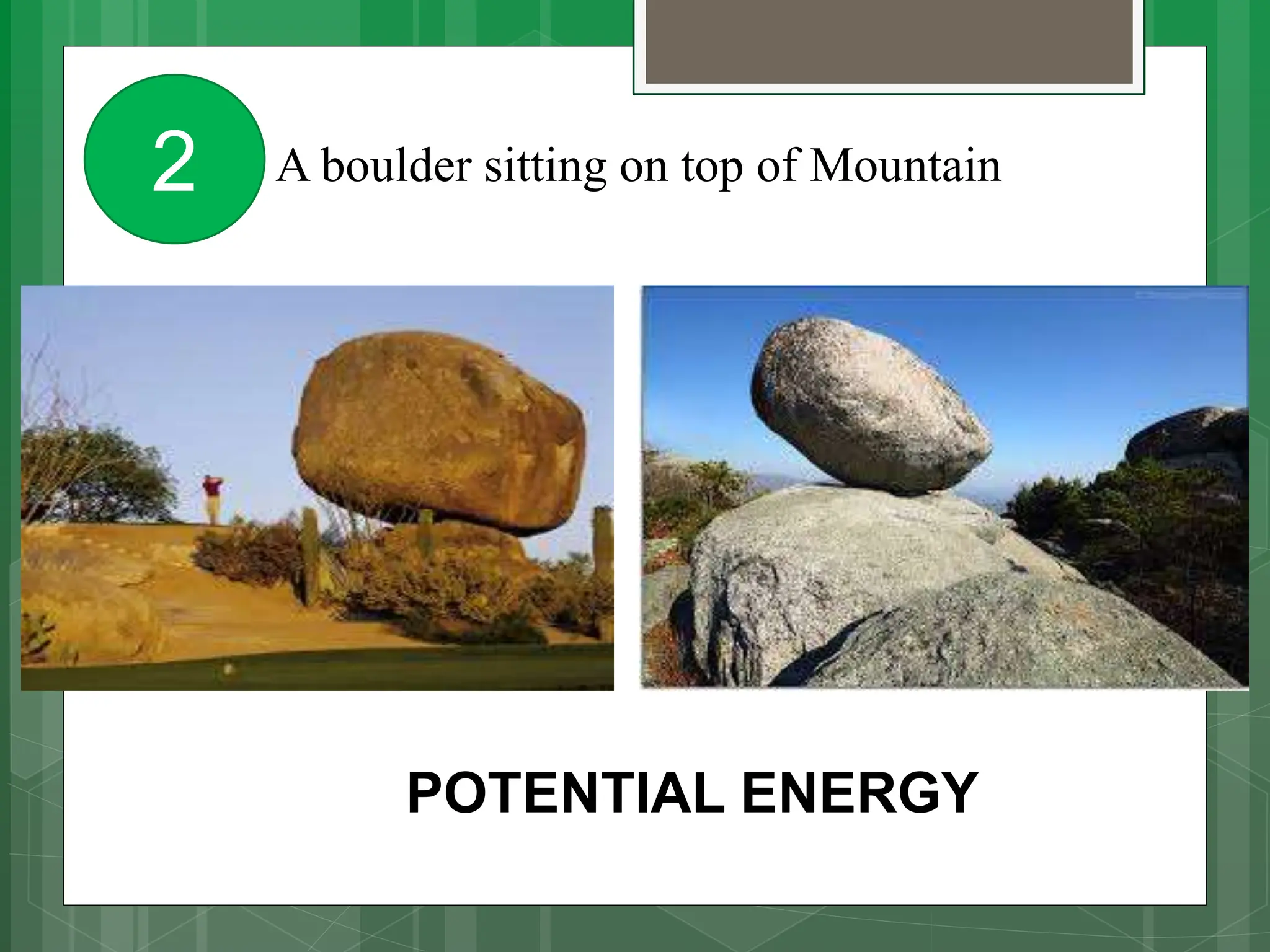
A boulder sitting on top of Mountain
POTENTIAL ENERGY
2
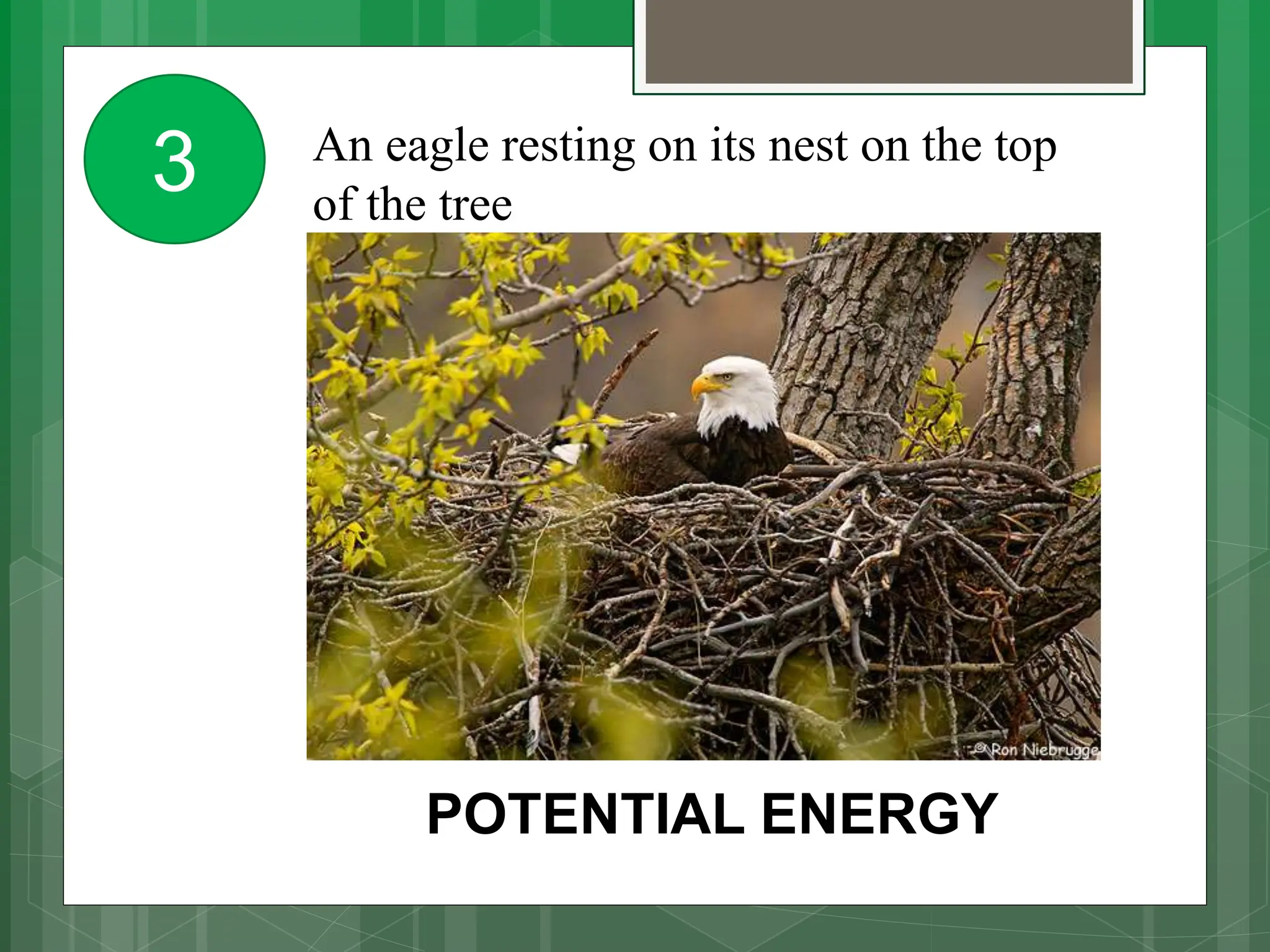
3 An eagle resting on its nest on the top
of the tree
POTENTIAL ENERGY
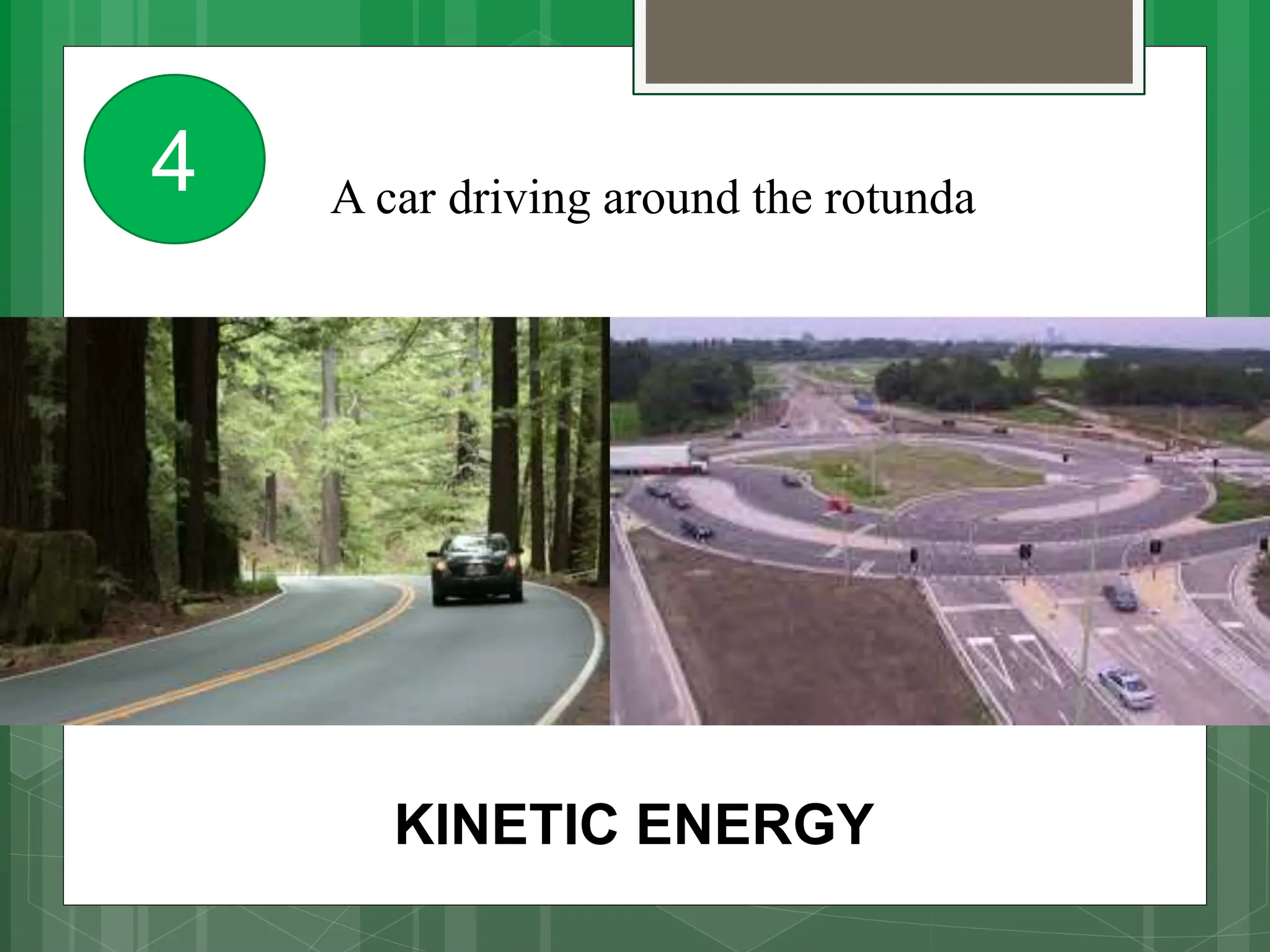
4 A car driving around the rotunda
KINETIC ENERGY
5 A ball rolling downhill
KINETIC ENERGY
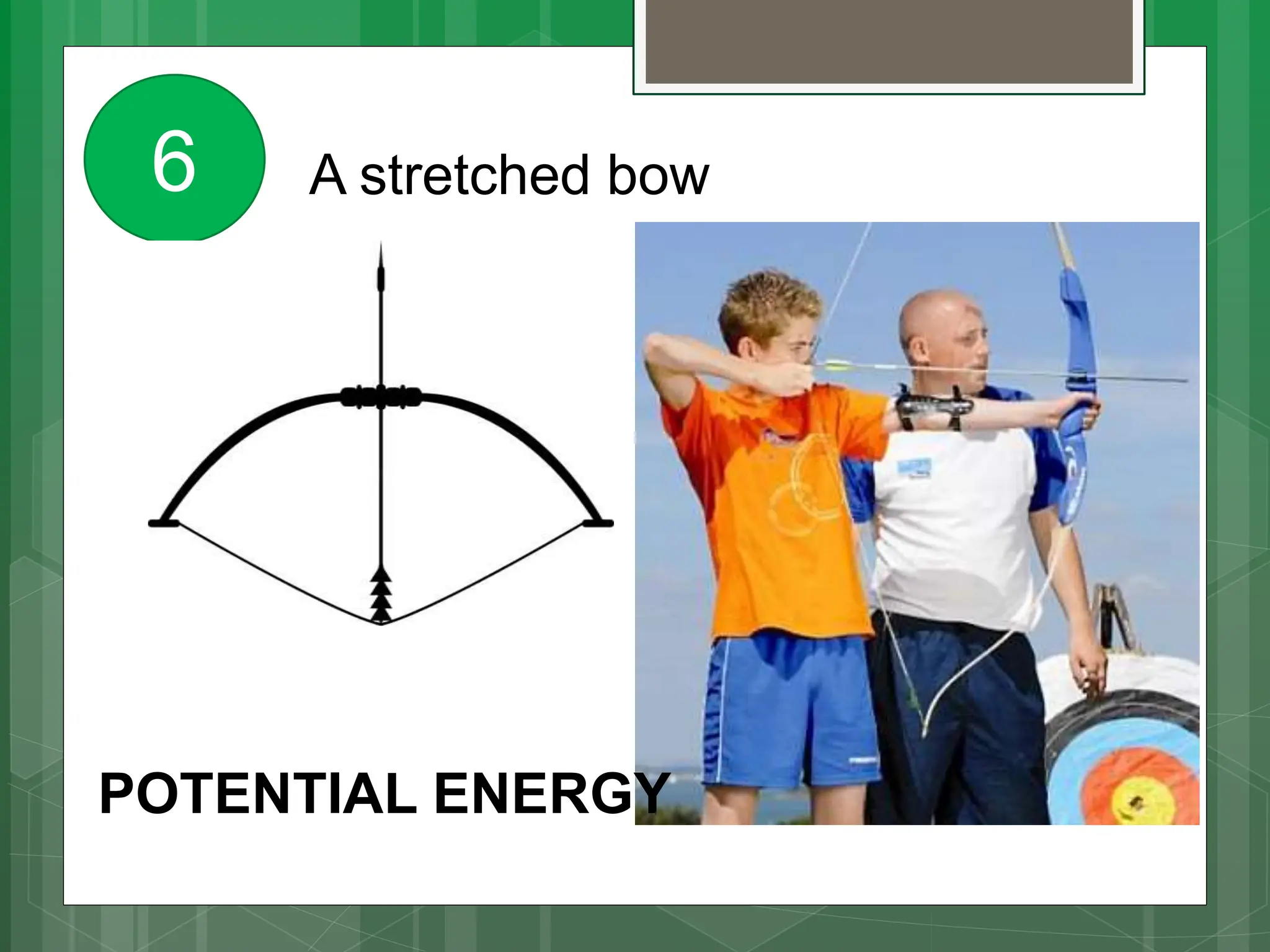
6 A stretched bow
POTENTIAL ENERGY
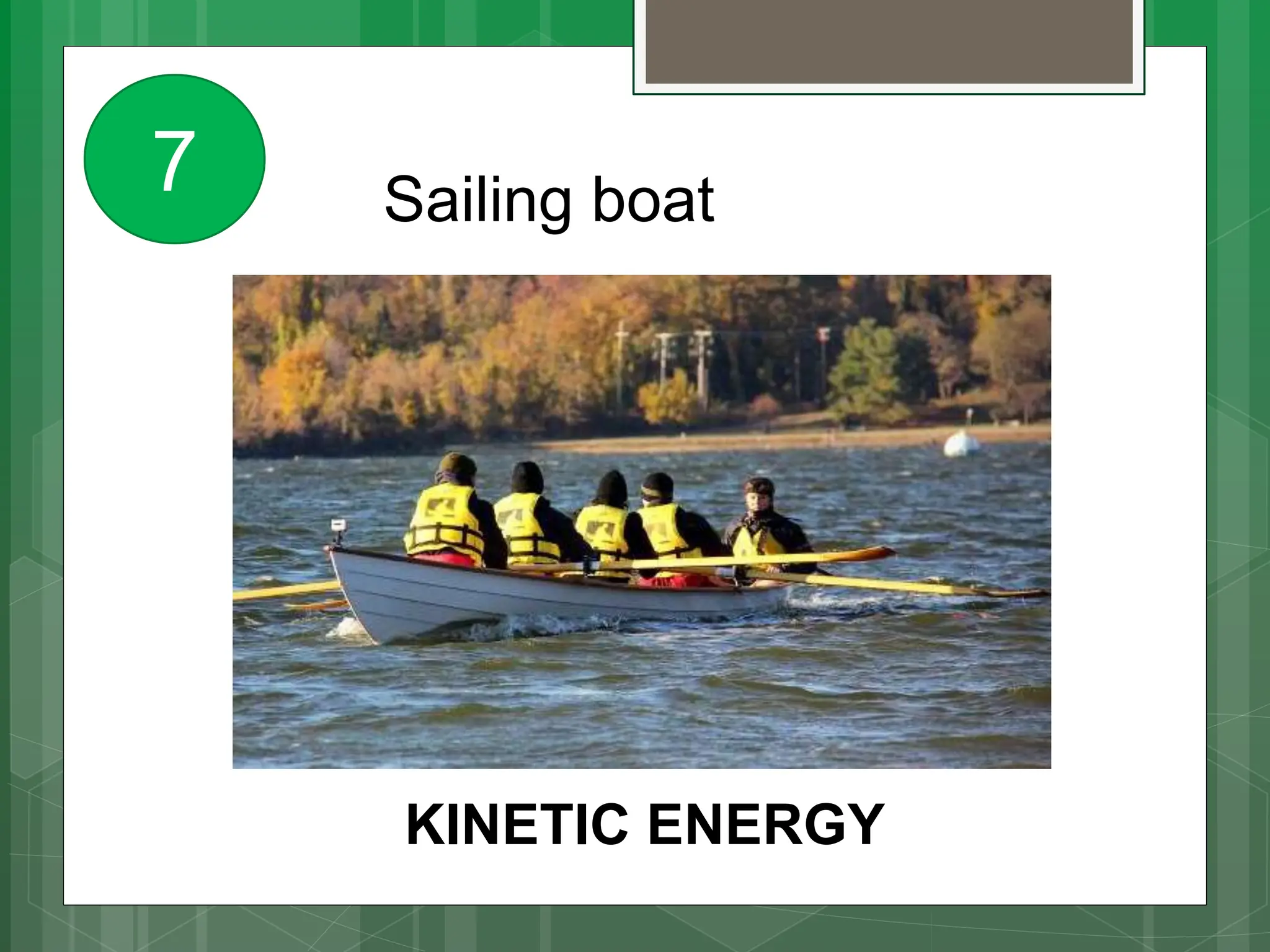
7 Sailing boat
KINETIC ENERGY
8 Books in a shelf
POTENTIAL ENERGY
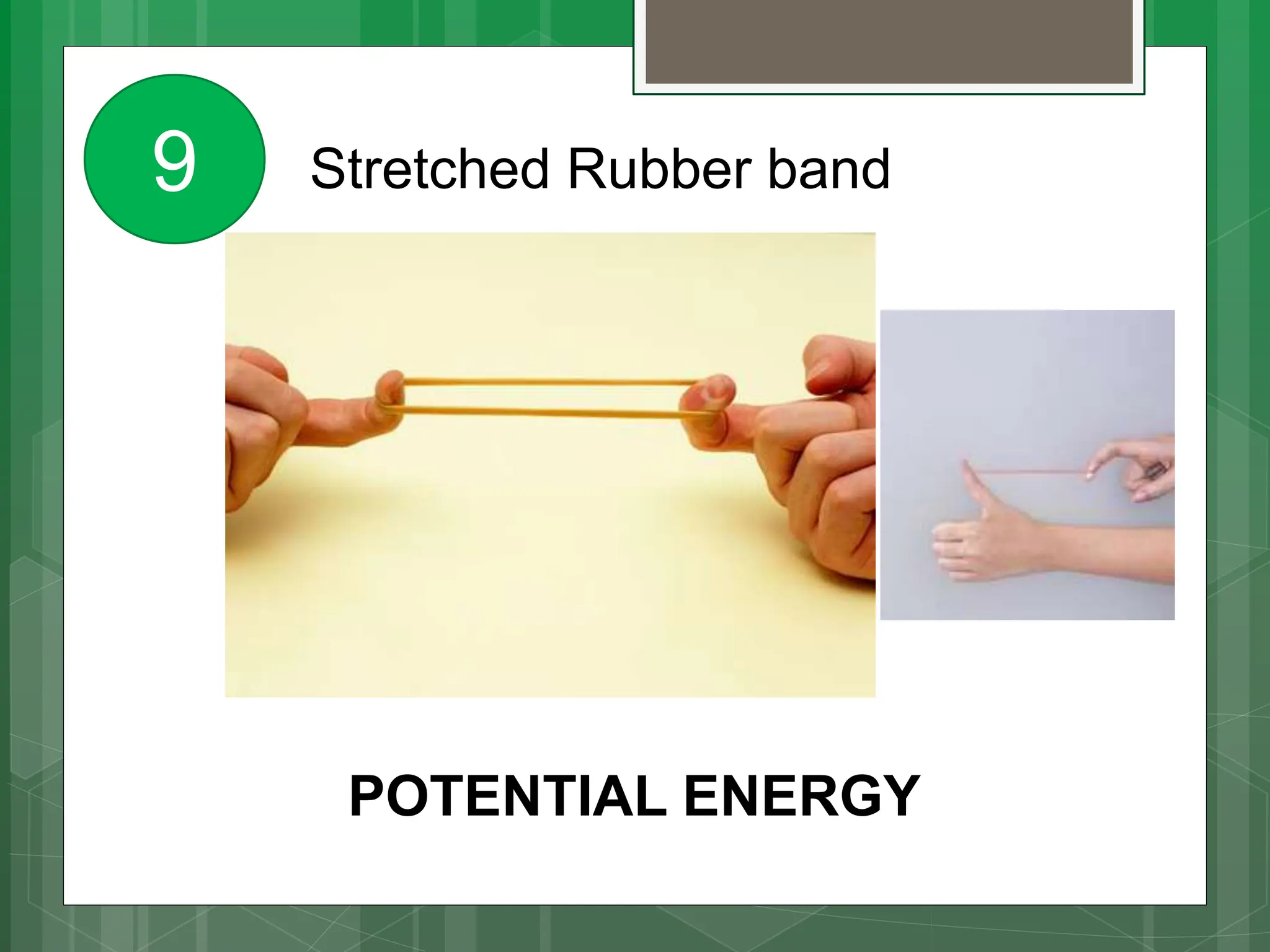
9 Stretched Rubber band
POTENTIAL ENERGY
How does kinetic energy differ from
potential energy?
Category 4 3 2 1
Teamwork All members shared their
ideas and participated in
the activity
Most of the
members shared
their ideas and
participated in the
activity
Only few of the
members shared
their ideas and
participated in the
activity
Members do not
seem to care
about the activity
Content Shows full understanding
of the topic
Shows good
understanding of
the topic
Shows good
understanding of
parts of the topic
Does not seem
to understand
the topic very
well
Delivery Speaks clearly and
distinctly (96-100%) all
the time
Speaks clearly and
distinctly (90-95%)
all the time
Speaks clearly
and distinctly (85-
89%) all the time
Often mumbles
or cannot be
understood
Posture and
Eye Contact
Stands up straight, looks
relaxed and confident.
Establishes eye contact
with everyone in the
room during the
presentation
Stands up straight
and establishes eye
contact with
everyone in the
room during the
presentation
Sometimes stand
up straight and
establishes eye
contact
Slouches and/or
does not look at
people during
presentation
2:00
1:59
1:58
1:57
1:56
1:55
1:54
1:53
1:52
1:51
1:50
1:49
1:48
1:47
1:46
1:45
1:44
1:43
1:42
1:41
1:40
1:39
1:38
1:37
1:36
1:35
1:34
1:33
1:32
1:31
1:30
1:29
1:28
1:27
1:26
1:25
1:24
1:23
1:22
1:21
1:20
1:19
1:18
1:17
1:16
1:15
1:14
1:13
1:12
1:11
1:10
1:09
1:08
1:07
1:06
1:05
1:04
1:03
1:02
1:01
1:00
0:59
0:58
0:57
0:56
0:55
0:54
0:53
0:52
0:51
0:50
0:49
0:48
0:47
0:46
0:45
0:44
0:43
0:42
0:41
0:40
0:39
0:38
0:37
0:36
0:35
0:34
0:33
0:32
0:31
0:30
0:29
0:28
0:27
0:26
0:25
0:24
0:23
0:22
0:21
0:20
0:19
0:18
0:17
0:16
0:15
0:14
0:13
0:12
0:11
0:10
0:09
0:08
0:07
0:06
0:05
0:04
0:03
0:02
0:01
End
Two Main Types of Energy
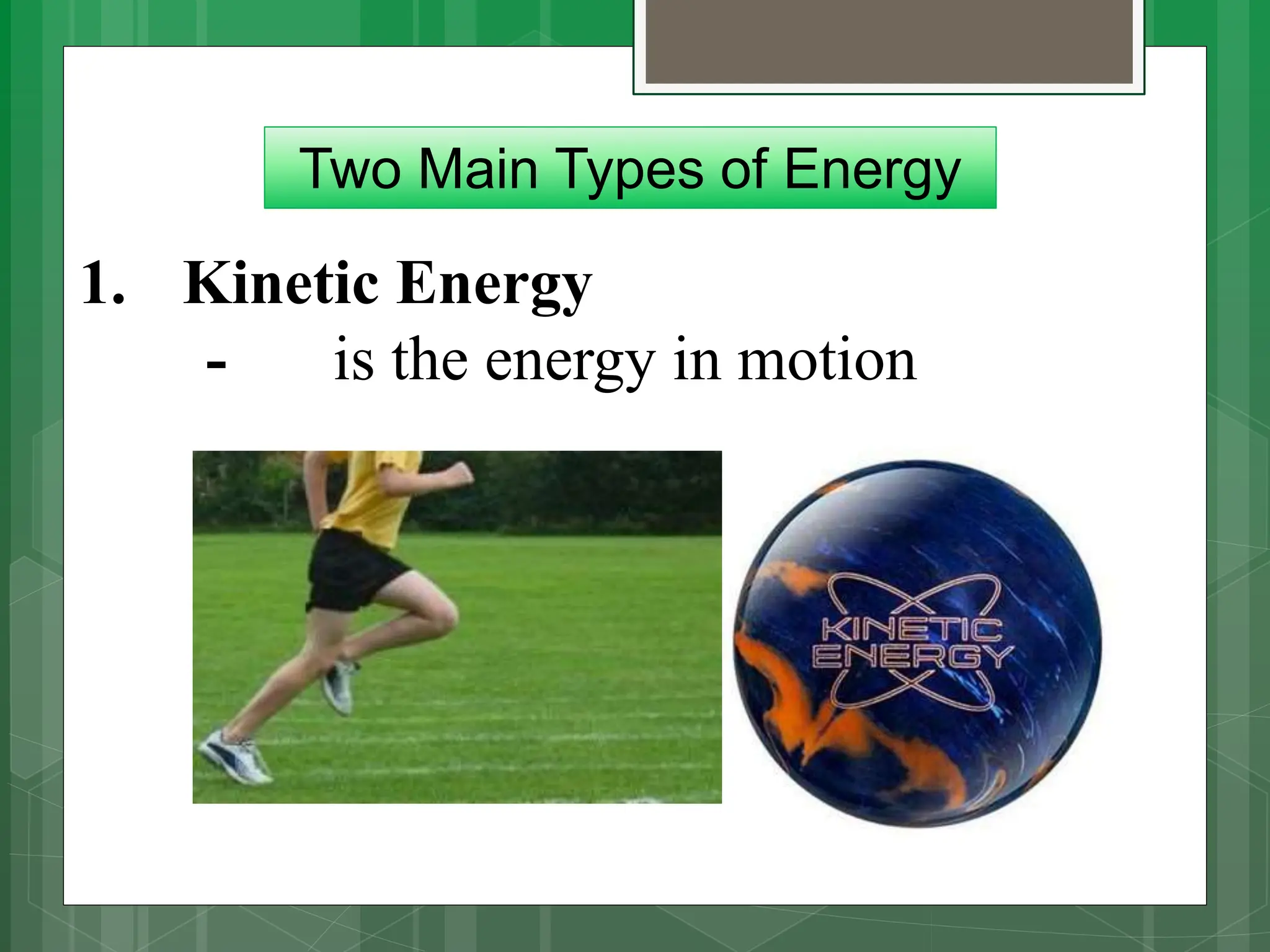
1. Kinetic Energy
- is the energy in motion
KINETIC
ENERGY
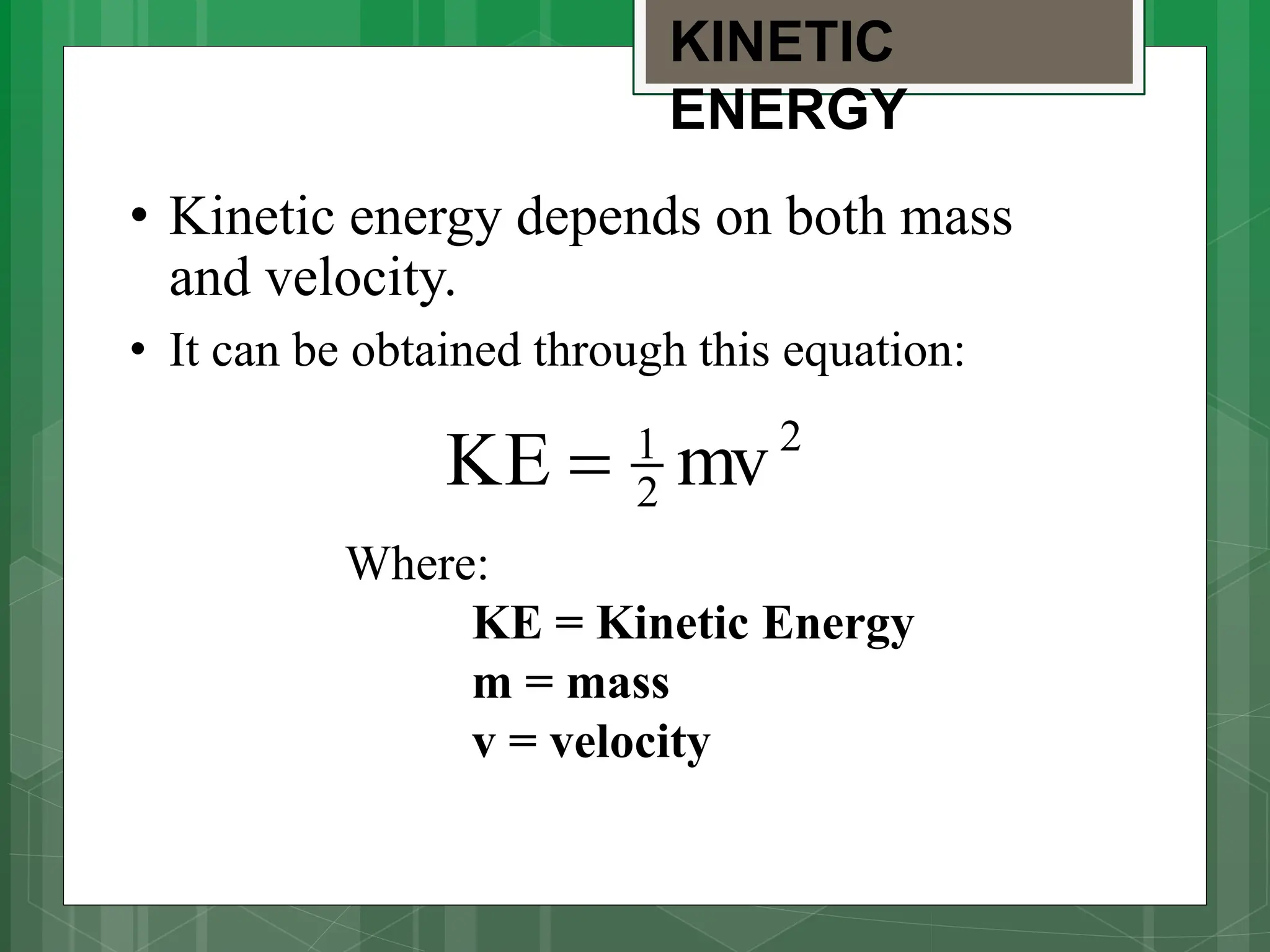
• Kinetic energy depends on both mass
and velocity.
• It can be obtained through this equation:
Where:
KE = Kinetic Energy
m = mass
v = velocity
2
2
1
mv
KE 
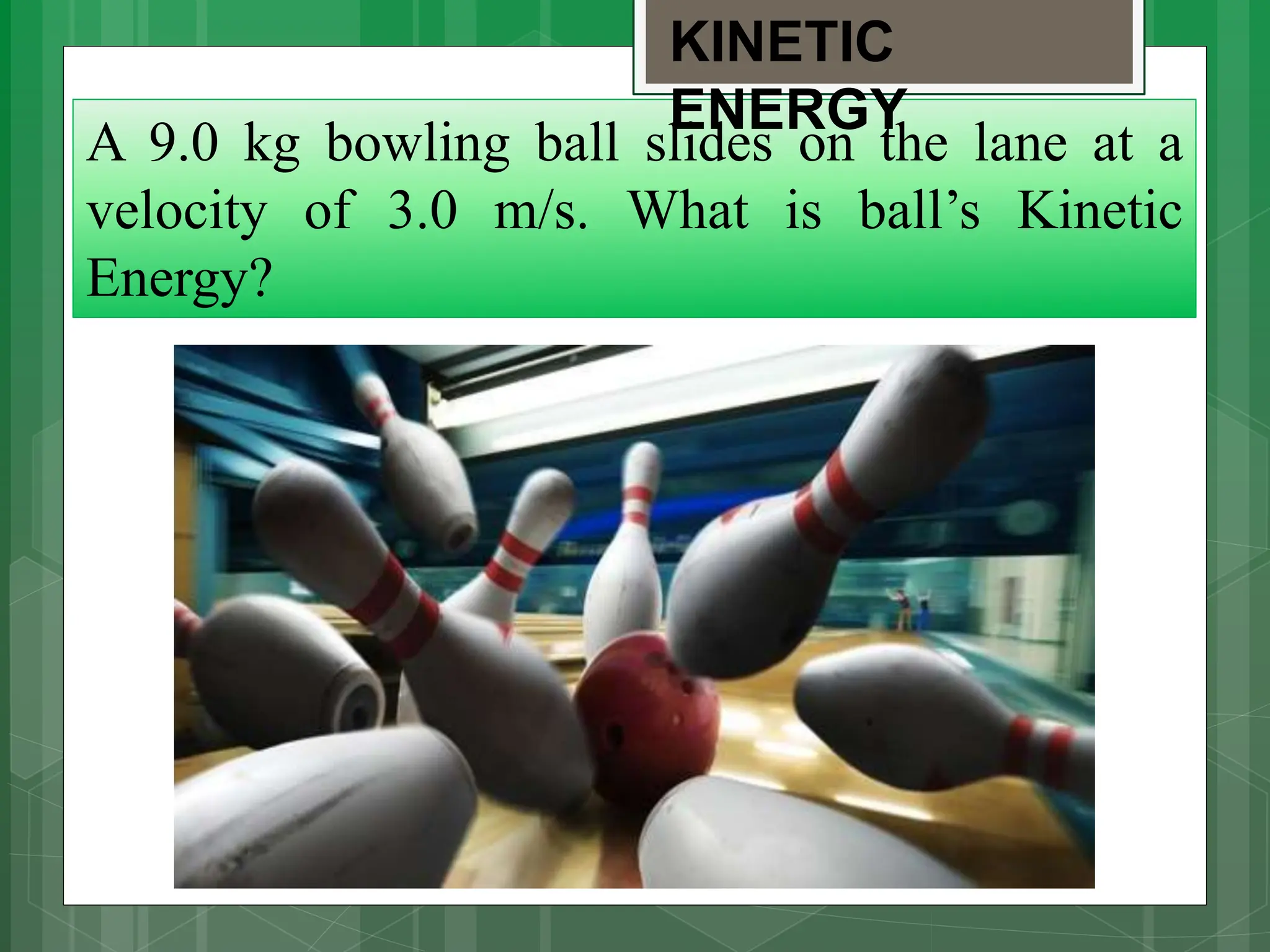
A 9.0 kg bowling ball slides on the lane at a
velocity of 3.0 m/s. What is ball’s Kinetic
Energy?
KINETIC
ENERGY
KINETIC
ENERGY
Given:
Required:
Formula:
Solution:
m=9.0 kg
v=3.0 m/s
KE?
2
2
1
mv
KE 
KE = ½ (9.0kg)(3.0m/s) 2
= ½ (9.0kg)(9.0m 2/s 2)
= ½ (81 kg m 2/s 2)
= 40.5 Joules
KE = 41 J
A 9.0 kg bowling ball slides on the lane at a velocity of 3.0 m/s.
What is ball’s Kinetic Energy?
KINETIC
ENERGY
A 9.0 kg bowling ball slides on the lane at a velocity of 3.0 m/s.
What is ball’s Kinetic Energy?
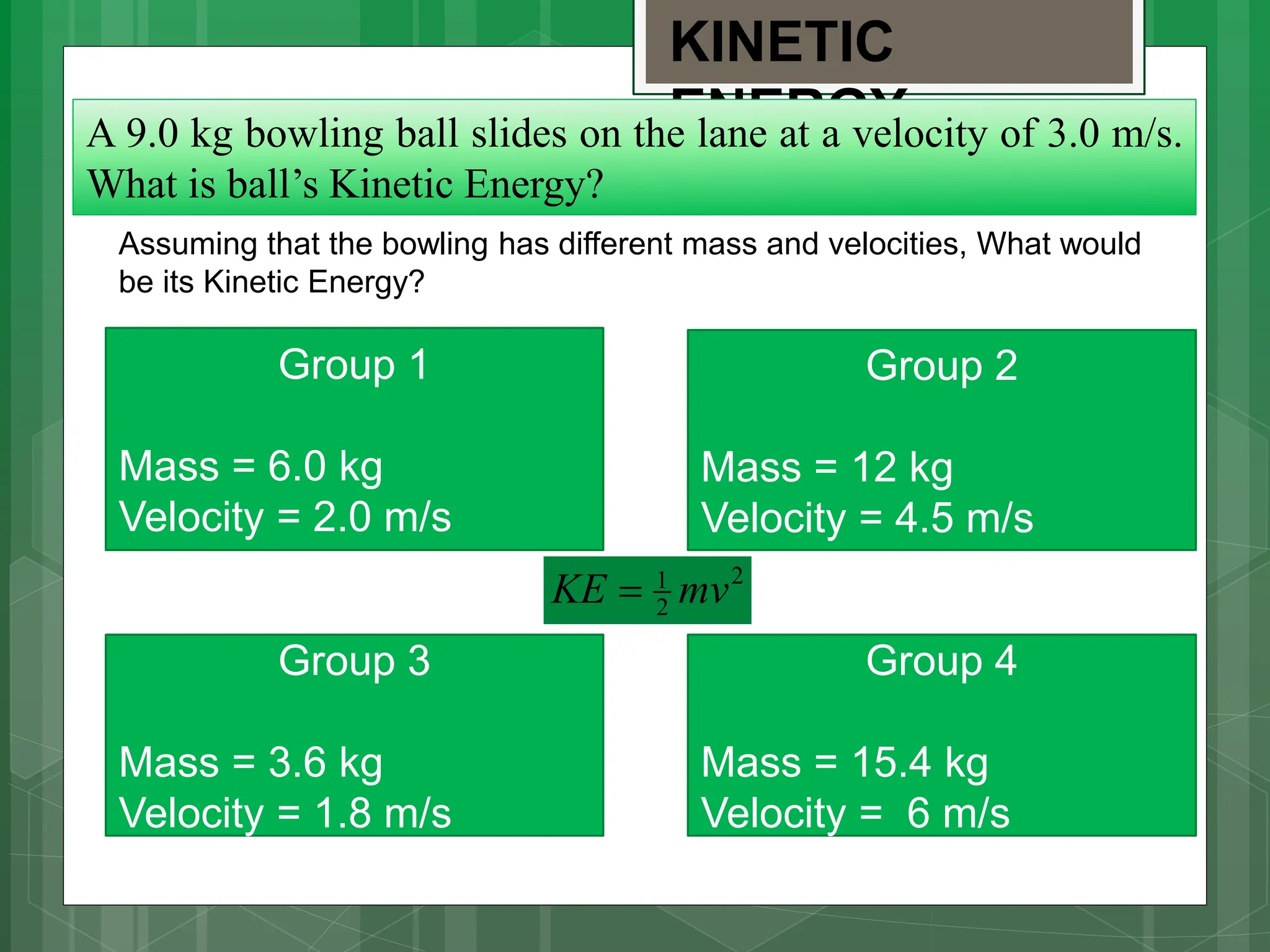
Assuming that the bowling has different mass and velocities, What would
be its Kinetic Energy?
Group 1
Mass = 6.0 kg
Velocity = 2.0 m/s
Group 2
Mass = 12 kg
Velocity = 4.5 m/s
Group 3
Mass = 3.6 kg
Velocity = 1.8 m/s
Group 4
Mass = 15.4 kg
Velocity = 6 m/s
2
2
1
mv
KE 
COMPUTATIONS
Third Game
KINETIC
ENERGY
What is your Kinetic energy if you have the
velocity of 2.5 m/s as you run from the library
to the room provided that your mass is 40 kg?
KINETIC
ENERGY
500 kg motorcycle is traveling with a velocity
of 1.3 m/s, find its KE.
KINETIC
ENERGY
Two Main Types of Energy
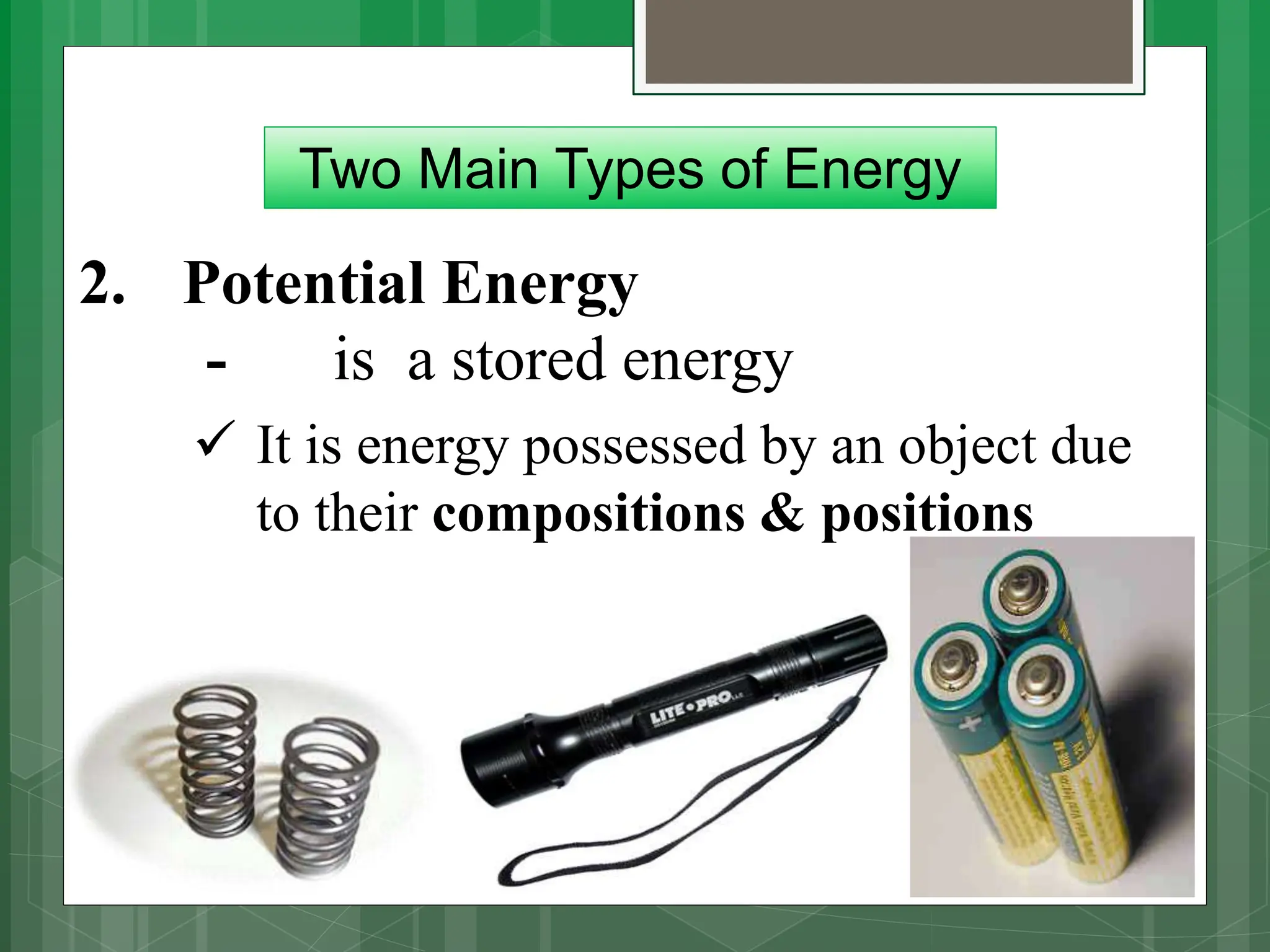
2. Potential Energy
- is a stored energy
 It is energy possessed by an object due
to their compositions & positions
POTENTIAL
ENERGY
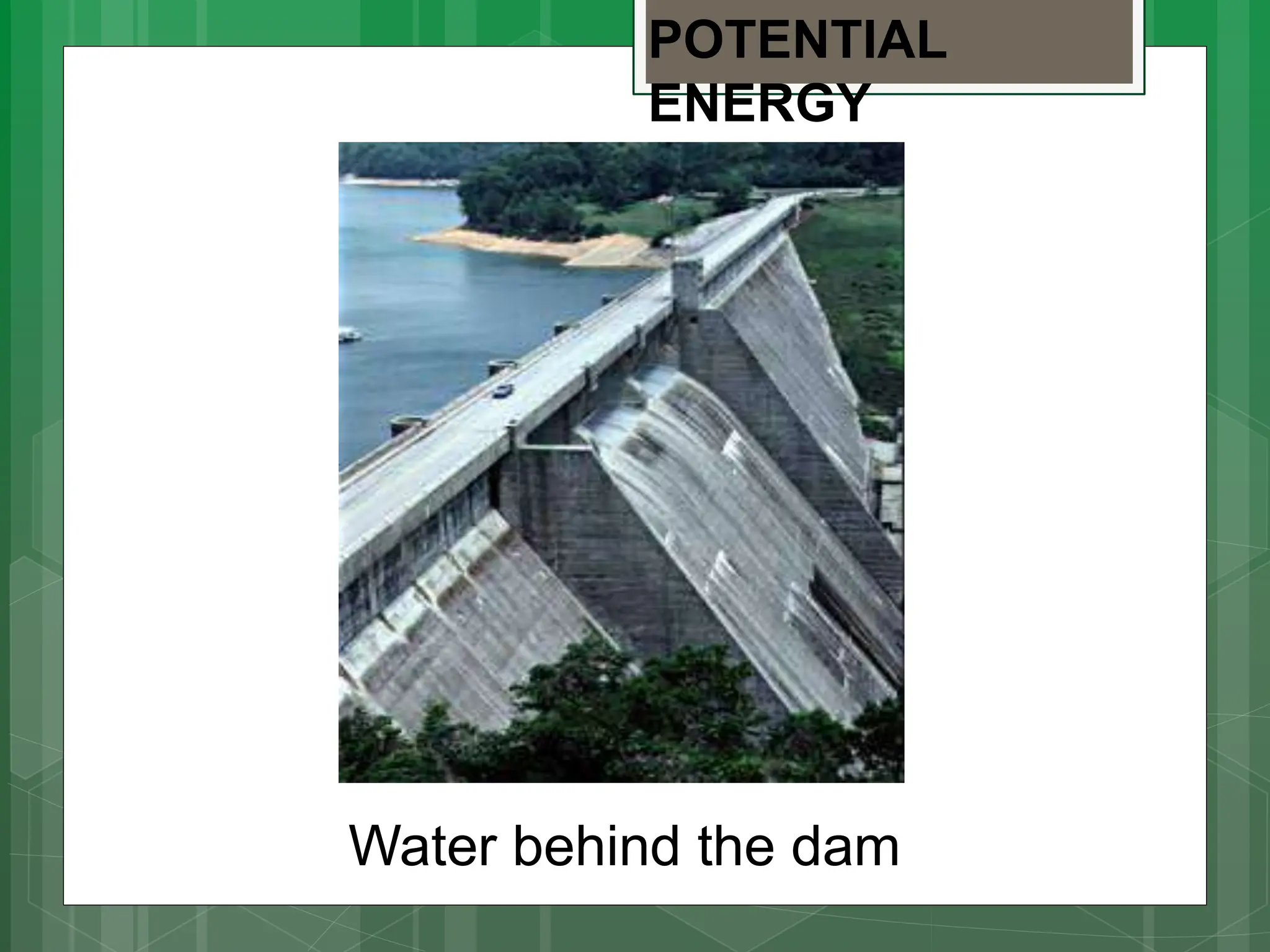
Water behind the dam
POTENTIAL
ENERGY
Potential Energy can be:
Gravitational Potential Energy
Elastic Potential Energy
Chemical Potential Energy
Energy which is in position to object’s position
relative to a certain height
Energy that is stored in a elastic materials
(Stretched/compressed)
Energy that is inherent in all substances like
petrol, wood, and plants
POTENTIAL
ENERGY
• The relationship of height and mass and
influence of gravity to PE can be expressed in
this equation:
PE = mgh
Where:
PE = Potential Energy
m = mass
g = gravitational acceleration (9.8 m/s2)
h = height
POTENTIAL
ENERGY
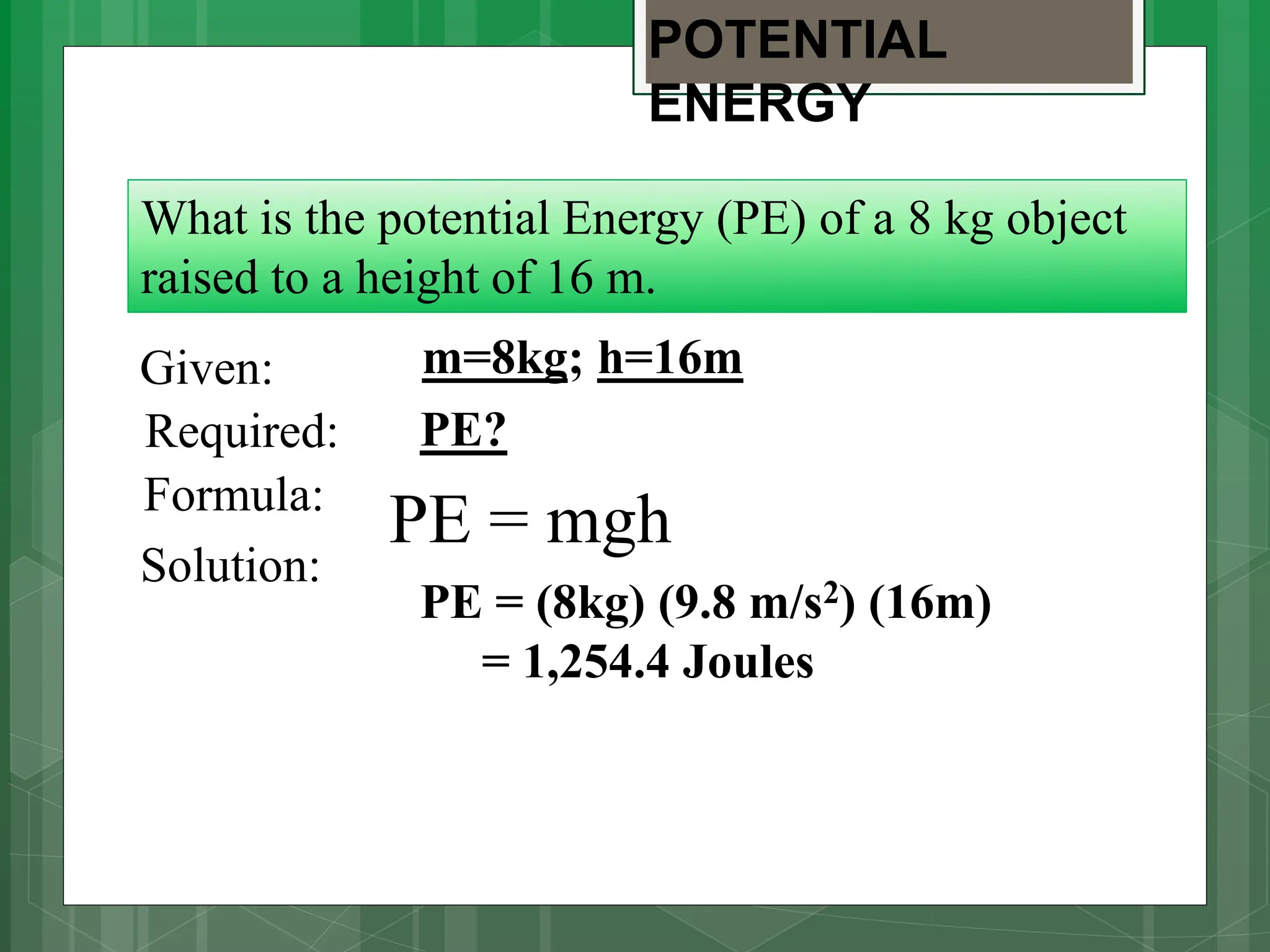
What is the potential Energy (PE) of a 8 kg object
raised to a height of 16 m.
Given:
Required:
Formula:
Solution:
m=8kg; h=16m
PE?
PE = (8kg) (9.8 m/s2) (16m)
= 1,254.4 Joules
PE = mgh
POTENTIAL
ENERGY
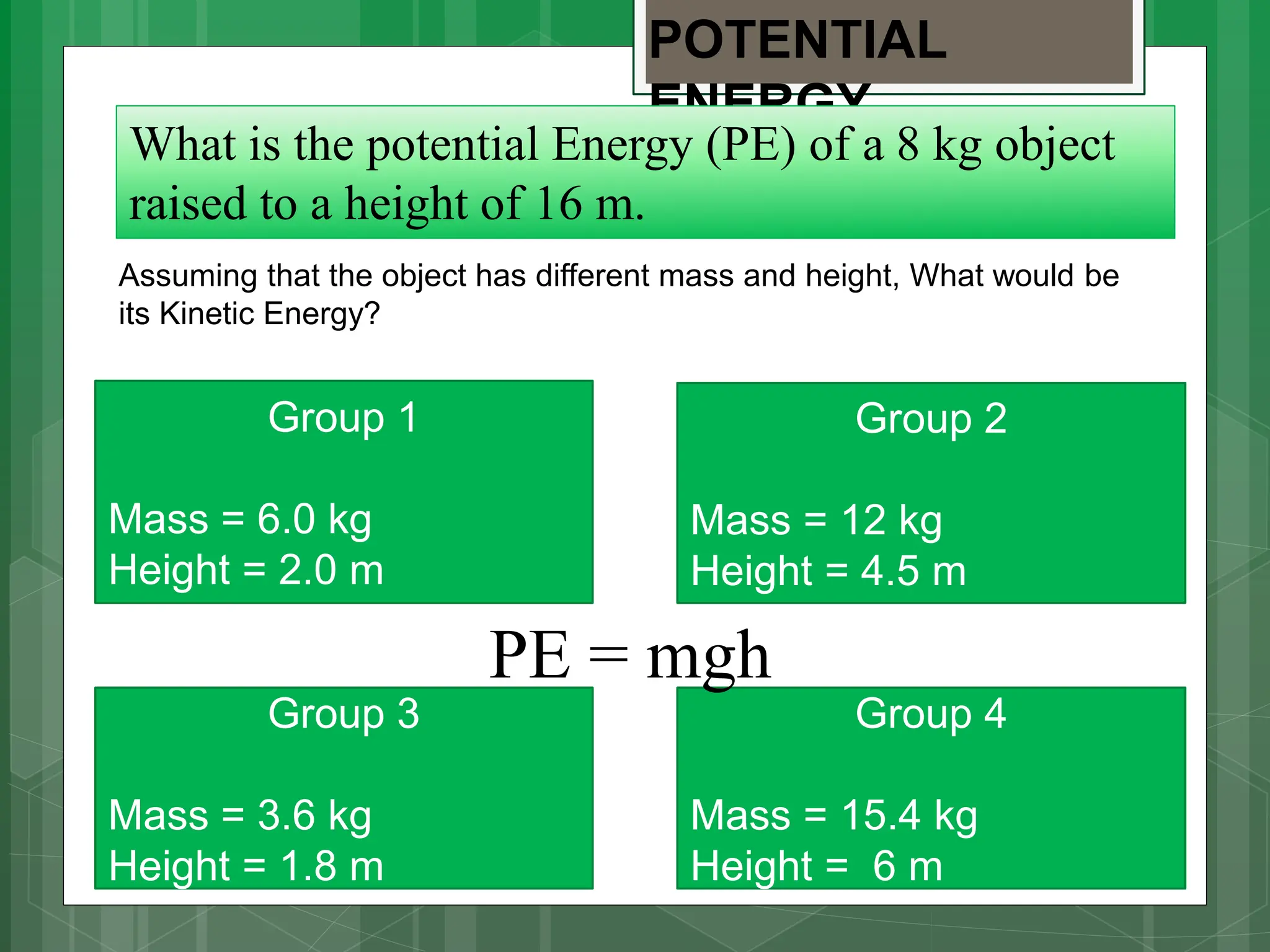
What is the potential Energy (PE) of a 8 kg object
raised to a height of 16 m.
Assuming that the object has different mass and height, What would be
its Kinetic Energy?
Group 1
Mass = 6.0 kg
Height = 2.0 m
Group 2
Mass = 12 kg
Height = 4.5 m
Group 3
Mass = 3.6 kg
Height = 1.8 m
Group 4
Mass = 15.4 kg
Height = 6 m
PE = mgh
POTENTIAL
ENERGY
COMPUTATIONS
Fourth Game
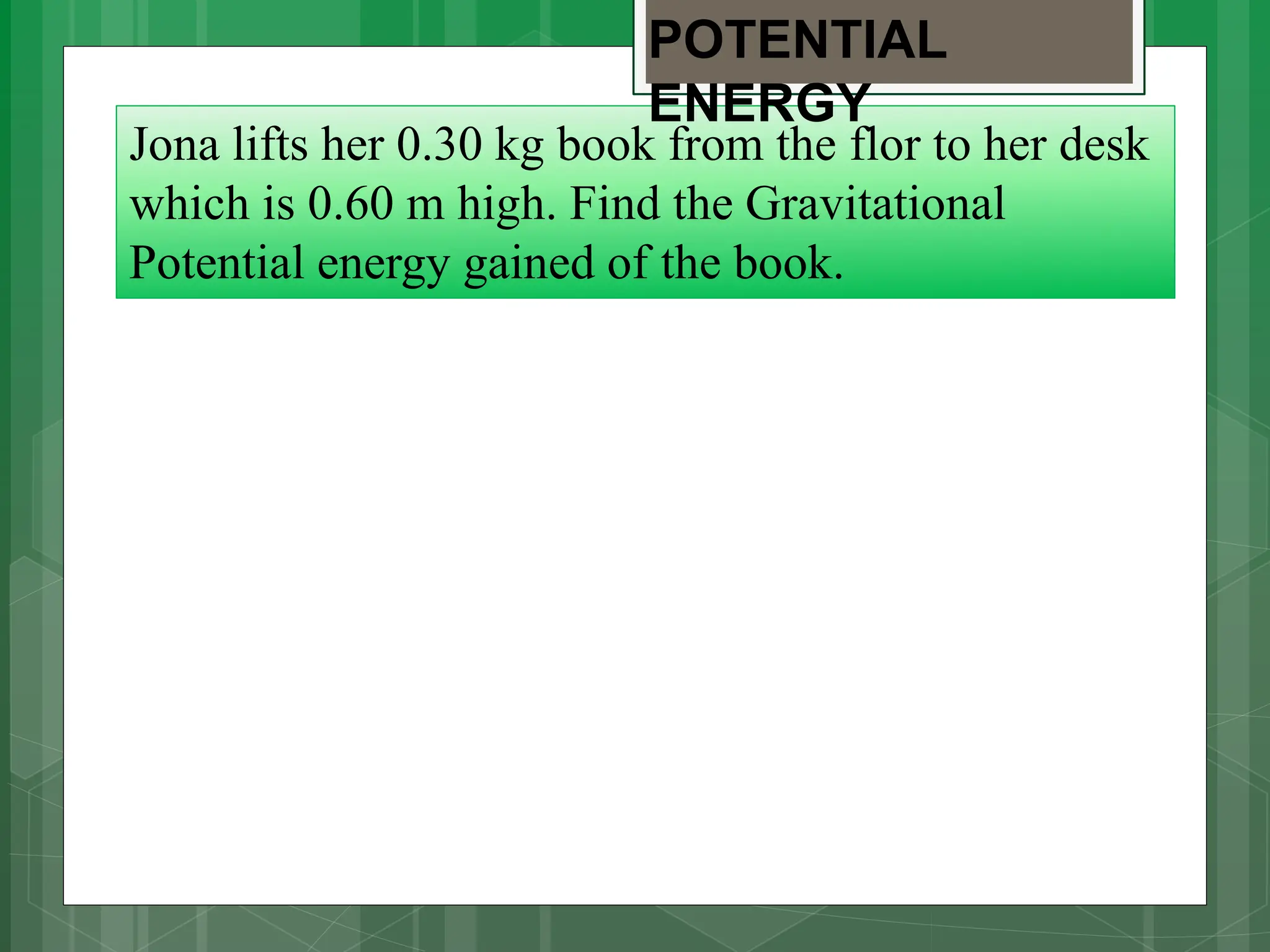
Jona lifts her 0.30 kg book from the flor to her desk
which is 0.60 m high. Find the Gravitational
Potential energy gained of the book.
POTENTIAL
ENERGY
Jill brings a 5 kg pail of water on a hill and leaves it
on the top of the hill, which is 5 m above the
ground. What is the PE does the pail have?
POTENTIAL
ENERGY
3. Explain how kinetic energy differ
from potential energy;
4. Compute problems involving
potential and kinetic energy.
1. Define energy;
2. Identify activities/things that
possesses kinetic energy or
potential energy;
OBJECTIVES
QUIZ
Definition of Terms. Define
the following
1.Energy
2.Kinetic Energy
3.Potential energy
QUIZ
Identification. Identify the following
as Kinetic or Potential
1. Running car
2. Sleeping cat
3. Flying airplaine
4. Book at the table
5. Stretched rubber band
QUIZ
Essay
1. A rock and a feather are dropped
from the same height. Which has
more Kinetic energy? Rock or a
feather? Explain your answer.
2. How Kinetic energy differ from
potential energy?
QUIZ
Problem Solving. Provide what is given, required,
formula & solution and conclusion.
1.Suppose you pedal a 25 kg bicycle
at 1.5 m/s. Find the kinetic energy of
the bicycle.
1.Calculate the potential energy does
400 kg of water in Maria Christina
Falls has at height of 100m?
1. What is the height of the ladder from
the ground if you climb at it with
your mass of 45 kg and you obtain
potential energy of 4,410 Joules?
2. The dog is running with the kinetic
energy of 2,345 Joules. Assuming
that the dog has a velocity of 0.85
m/s2, what is the mass of the dog?
ASSIGNMENT
WORK
Grade 8 Science
3. Explain how work is related to
energy;
4. Compute work done by a constant
force.
1. Define work scientifically;
2. Identify situations in which work
is done and in which no work is
done;
OBJECTIVES
WORK
What is it?
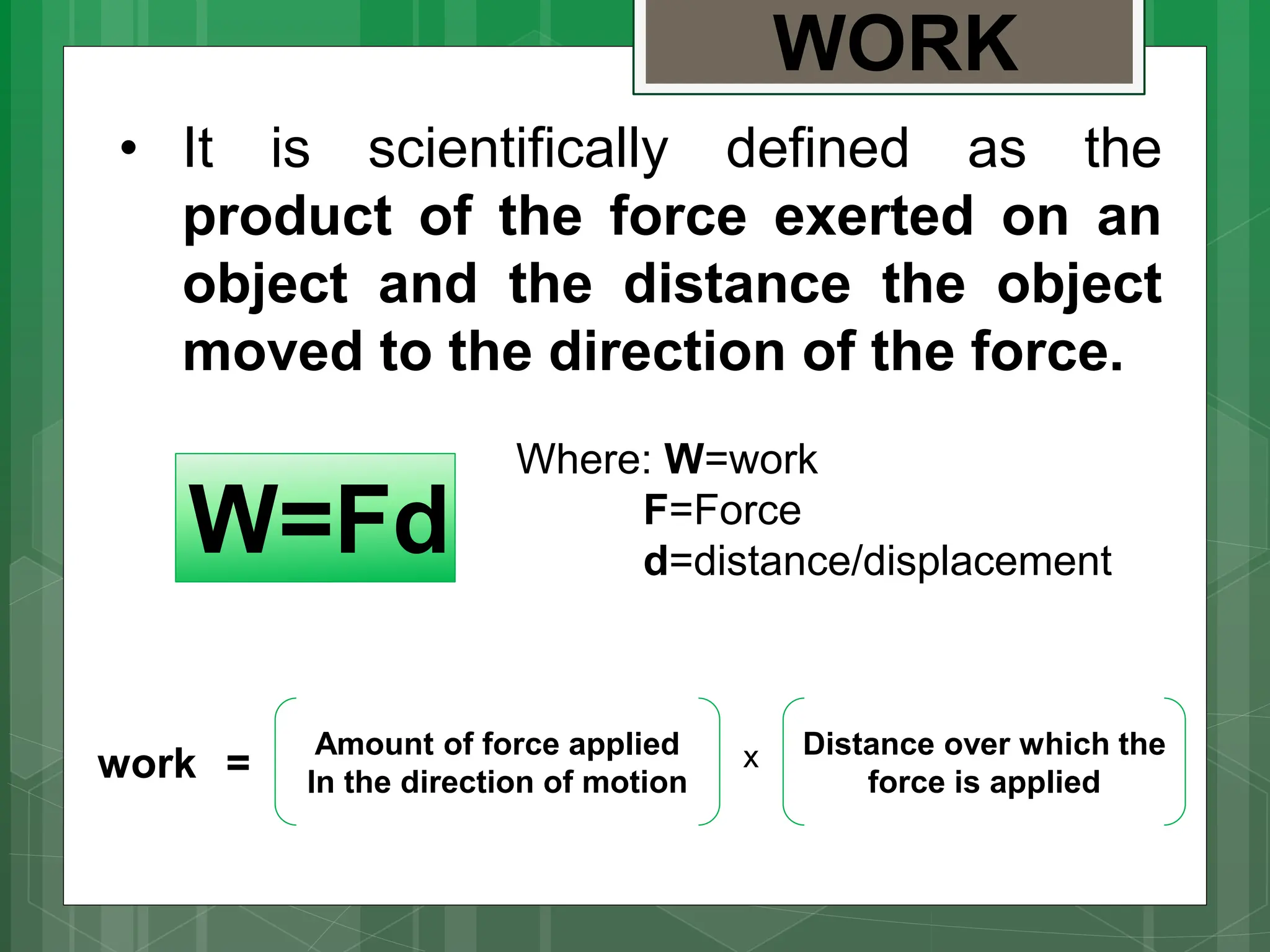
• It is scientifically defined as the
product of the force exerted on an
object and the distance the object
moved to the direction of the force.
WORK
W=Fd
Where: W=work
F=Force
d=distance/displacement
work =
Amount of force applied
In the direction of motion
Distance over which the
force is applied
x
WORK
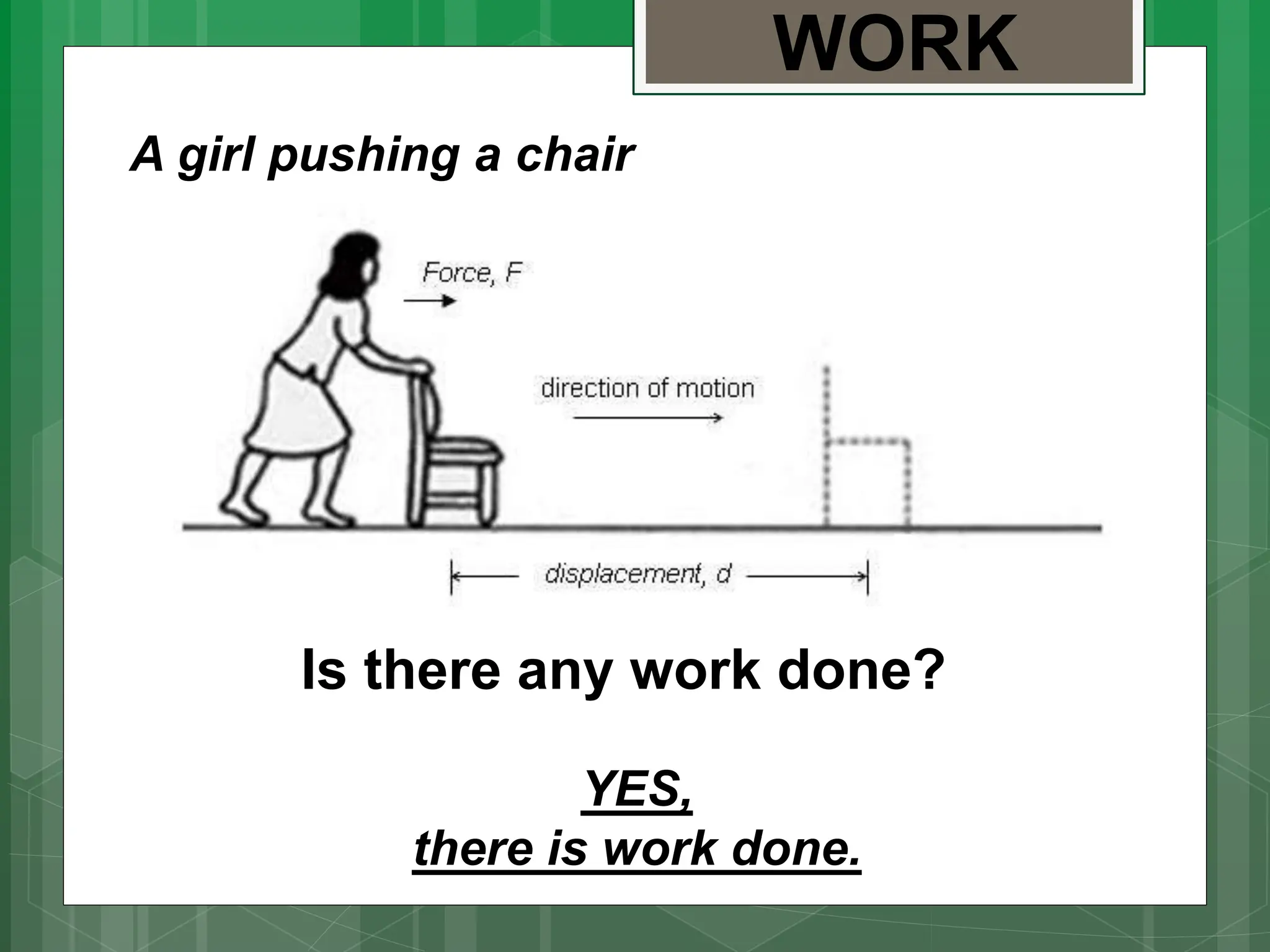
A girl pushing a chair
Is there any work done?
YES,
there is work done.
WORK
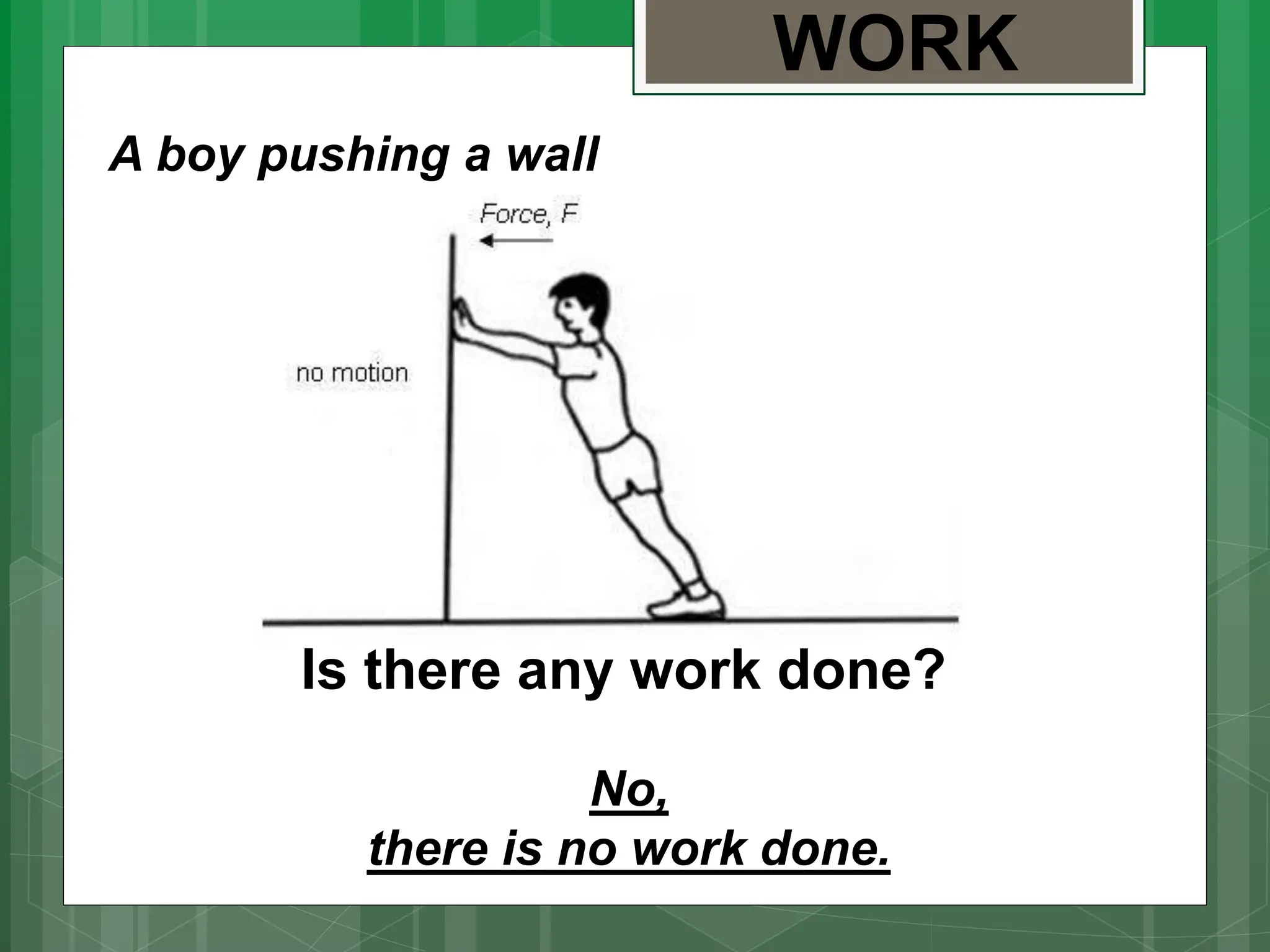
Is there any work done?
No,
there is no work done.
A boy pushing a wall
WORK
Is there any work done?
No,
there is no work done.
A waiter carrying a tray
Work is done on an object when the force applied to it
covers a distance in the direction of the applied force.
Work is done
No Work is done
No Work is done
WORK
WORK
Is there work done?
Calculating a Work
WORK
Work is done when the force (F) applied to the object causes the object to
have a displacement (d) in the same direction as the force applied.
W=Fd Where: W=work
F=Force
d=distance/displacement
WORK
Unit for Work
James Prescott Joule
One (1) Joule is equal to the work
done or energy expended in
applying a force of one Newton
through a distance of one meter.
WORK
Suppose a woman is pushing a grocery cart with a 500 Newton
force along the 7 meters aisle, how much work is done in
pushing the cart from one end of the aisle to the other?
Given:
Required:
Formula:
Solution:
F = 500 N
d = 7 m
W = ?
W = Fd
W = 500 N (7m)
W = 500 Nm
W = 3500 J
WORK
Suppose a woman is pushing a grocery cart with a 500 Newton force
along the 7 meters aisle, how much work is done in pushing the cart
from one end of the aisle to the other?
Supposing that a woman is having different amount of forces applied in
pushing the grocery cart with distinct distances. How much is the work?
Group 1
Fore = 350 N
Distance = 6 m
Group 2
Force = 700 N
Distance = 9.2 m
Group 3
Force = 156 N
Distance = 2.6 m
Group 4
Force = 875 N
Distance = 14 m
W=Fd

Energy - Physics: Grade 8 - Science.pptx

  • 1.
  • 2.
    3. Explain howkinetic energy differ from potential energy; 4. Compute problems involving potential and kinetic energy. 1. Define energy; 2. Identify activities/things that possesses kinetic energy or potential energy; OBJECTIVES
  • 3.
  • 4.
    ENERGY WHAT is ENERGY? •It comes from the Greek word energeia meaning “in or at work.” • Energy is the ability of any matter to do or perform work. • It is the capacity to do work.
  • 5.
  • 6.
  • 7.
    Two Main Typesof Energy KINETIC ENERGY POTENTIAL ENERGY and ENERGY
  • 8.
  • 9.
  • 10.
    A mouse runningaway from cat. KINETIC ENERGY 1
  • 11.
    A boulder sittingon top of Mountain POTENTIAL ENERGY 2
  • 12.
    3 An eagleresting on its nest on the top of the tree POTENTIAL ENERGY
  • 13.
    4 A cardriving around the rotunda KINETIC ENERGY
  • 14.
    5 A ballrolling downhill KINETIC ENERGY
  • 15.
    6 A stretchedbow POTENTIAL ENERGY
  • 16.
  • 17.
    8 Books ina shelf POTENTIAL ENERGY
  • 18.
    9 Stretched Rubberband POTENTIAL ENERGY
  • 19.
    How does kineticenergy differ from potential energy? Category 4 3 2 1 Teamwork All members shared their ideas and participated in the activity Most of the members shared their ideas and participated in the activity Only few of the members shared their ideas and participated in the activity Members do not seem to care about the activity Content Shows full understanding of the topic Shows good understanding of the topic Shows good understanding of parts of the topic Does not seem to understand the topic very well Delivery Speaks clearly and distinctly (96-100%) all the time Speaks clearly and distinctly (90-95%) all the time Speaks clearly and distinctly (85- 89%) all the time Often mumbles or cannot be understood Posture and Eye Contact Stands up straight, looks relaxed and confident. Establishes eye contact with everyone in the room during the presentation Stands up straight and establishes eye contact with everyone in the room during the presentation Sometimes stand up straight and establishes eye contact Slouches and/or does not look at people during presentation 2:00 1:59 1:58 1:57 1:56 1:55 1:54 1:53 1:52 1:51 1:50 1:49 1:48 1:47 1:46 1:45 1:44 1:43 1:42 1:41 1:40 1:39 1:38 1:37 1:36 1:35 1:34 1:33 1:32 1:31 1:30 1:29 1:28 1:27 1:26 1:25 1:24 1:23 1:22 1:21 1:20 1:19 1:18 1:17 1:16 1:15 1:14 1:13 1:12 1:11 1:10 1:09 1:08 1:07 1:06 1:05 1:04 1:03 1:02 1:01 1:00 0:59 0:58 0:57 0:56 0:55 0:54 0:53 0:52 0:51 0:50 0:49 0:48 0:47 0:46 0:45 0:44 0:43 0:42 0:41 0:40 0:39 0:38 0:37 0:36 0:35 0:34 0:33 0:32 0:31 0:30 0:29 0:28 0:27 0:26 0:25 0:24 0:23 0:22 0:21 0:20 0:19 0:18 0:17 0:16 0:15 0:14 0:13 0:12 0:11 0:10 0:09 0:08 0:07 0:06 0:05 0:04 0:03 0:02 0:01 End
  • 20.
    Two Main Typesof Energy 1. Kinetic Energy - is the energy in motion
  • 21.
    KINETIC ENERGY • Kinetic energydepends on both mass and velocity. • It can be obtained through this equation: Where: KE = Kinetic Energy m = mass v = velocity 2 2 1 mv KE 
  • 22.
    A 9.0 kgbowling ball slides on the lane at a velocity of 3.0 m/s. What is ball’s Kinetic Energy? KINETIC ENERGY
  • 23.
    KINETIC ENERGY Given: Required: Formula: Solution: m=9.0 kg v=3.0 m/s KE? 2 2 1 mv KE KE = ½ (9.0kg)(3.0m/s) 2 = ½ (9.0kg)(9.0m 2/s 2) = ½ (81 kg m 2/s 2) = 40.5 Joules KE = 41 J A 9.0 kg bowling ball slides on the lane at a velocity of 3.0 m/s. What is ball’s Kinetic Energy?
  • 24.
    KINETIC ENERGY A 9.0 kgbowling ball slides on the lane at a velocity of 3.0 m/s. What is ball’s Kinetic Energy? Assuming that the bowling has different mass and velocities, What would be its Kinetic Energy? Group 1 Mass = 6.0 kg Velocity = 2.0 m/s Group 2 Mass = 12 kg Velocity = 4.5 m/s Group 3 Mass = 3.6 kg Velocity = 1.8 m/s Group 4 Mass = 15.4 kg Velocity = 6 m/s 2 2 1 mv KE 
  • 25.
  • 26.
    What is yourKinetic energy if you have the velocity of 2.5 m/s as you run from the library to the room provided that your mass is 40 kg? KINETIC ENERGY
  • 27.
    500 kg motorcycleis traveling with a velocity of 1.3 m/s, find its KE. KINETIC ENERGY
  • 28.
    Two Main Typesof Energy 2. Potential Energy - is a stored energy  It is energy possessed by an object due to their compositions & positions
  • 29.
  • 30.
    POTENTIAL ENERGY Potential Energy canbe: Gravitational Potential Energy Elastic Potential Energy Chemical Potential Energy Energy which is in position to object’s position relative to a certain height Energy that is stored in a elastic materials (Stretched/compressed) Energy that is inherent in all substances like petrol, wood, and plants
  • 31.
    POTENTIAL ENERGY • The relationshipof height and mass and influence of gravity to PE can be expressed in this equation: PE = mgh Where: PE = Potential Energy m = mass g = gravitational acceleration (9.8 m/s2) h = height
  • 32.
    POTENTIAL ENERGY What is thepotential Energy (PE) of a 8 kg object raised to a height of 16 m. Given: Required: Formula: Solution: m=8kg; h=16m PE? PE = (8kg) (9.8 m/s2) (16m) = 1,254.4 Joules PE = mgh
  • 33.
    POTENTIAL ENERGY What is thepotential Energy (PE) of a 8 kg object raised to a height of 16 m. Assuming that the object has different mass and height, What would be its Kinetic Energy? Group 1 Mass = 6.0 kg Height = 2.0 m Group 2 Mass = 12 kg Height = 4.5 m Group 3 Mass = 3.6 kg Height = 1.8 m Group 4 Mass = 15.4 kg Height = 6 m PE = mgh
  • 34.
  • 35.
    Jona lifts her0.30 kg book from the flor to her desk which is 0.60 m high. Find the Gravitational Potential energy gained of the book. POTENTIAL ENERGY
  • 36.
    Jill brings a5 kg pail of water on a hill and leaves it on the top of the hill, which is 5 m above the ground. What is the PE does the pail have? POTENTIAL ENERGY
  • 37.
    3. Explain howkinetic energy differ from potential energy; 4. Compute problems involving potential and kinetic energy. 1. Define energy; 2. Identify activities/things that possesses kinetic energy or potential energy; OBJECTIVES
  • 38.
    QUIZ Definition of Terms.Define the following 1.Energy 2.Kinetic Energy 3.Potential energy
  • 39.
    QUIZ Identification. Identify thefollowing as Kinetic or Potential 1. Running car 2. Sleeping cat 3. Flying airplaine 4. Book at the table 5. Stretched rubber band
  • 40.
    QUIZ Essay 1. A rockand a feather are dropped from the same height. Which has more Kinetic energy? Rock or a feather? Explain your answer. 2. How Kinetic energy differ from potential energy?
  • 41.
    QUIZ Problem Solving. Providewhat is given, required, formula & solution and conclusion. 1.Suppose you pedal a 25 kg bicycle at 1.5 m/s. Find the kinetic energy of the bicycle. 1.Calculate the potential energy does 400 kg of water in Maria Christina Falls has at height of 100m?
  • 42.
    1. What isthe height of the ladder from the ground if you climb at it with your mass of 45 kg and you obtain potential energy of 4,410 Joules? 2. The dog is running with the kinetic energy of 2,345 Joules. Assuming that the dog has a velocity of 0.85 m/s2, what is the mass of the dog? ASSIGNMENT
  • 43.
  • 44.
    3. Explain howwork is related to energy; 4. Compute work done by a constant force. 1. Define work scientifically; 2. Identify situations in which work is done and in which no work is done; OBJECTIVES
  • 45.
  • 46.
    • It isscientifically defined as the product of the force exerted on an object and the distance the object moved to the direction of the force. WORK W=Fd Where: W=work F=Force d=distance/displacement work = Amount of force applied In the direction of motion Distance over which the force is applied x
  • 47.
    WORK A girl pushinga chair Is there any work done? YES, there is work done.
  • 48.
    WORK Is there anywork done? No, there is no work done. A boy pushing a wall
  • 49.
    WORK Is there anywork done? No, there is no work done. A waiter carrying a tray
  • 50.
    Work is doneon an object when the force applied to it covers a distance in the direction of the applied force. Work is done No Work is done No Work is done WORK
  • 51.
  • 52.
    Calculating a Work WORK Workis done when the force (F) applied to the object causes the object to have a displacement (d) in the same direction as the force applied. W=Fd Where: W=work F=Force d=distance/displacement
  • 53.
    WORK Unit for Work JamesPrescott Joule One (1) Joule is equal to the work done or energy expended in applying a force of one Newton through a distance of one meter.
  • 54.
    WORK Suppose a womanis pushing a grocery cart with a 500 Newton force along the 7 meters aisle, how much work is done in pushing the cart from one end of the aisle to the other? Given: Required: Formula: Solution: F = 500 N d = 7 m W = ? W = Fd W = 500 N (7m) W = 500 Nm W = 3500 J
  • 55.
    WORK Suppose a womanis pushing a grocery cart with a 500 Newton force along the 7 meters aisle, how much work is done in pushing the cart from one end of the aisle to the other? Supposing that a woman is having different amount of forces applied in pushing the grocery cart with distinct distances. How much is the work? Group 1 Fore = 350 N Distance = 6 m Group 2 Force = 700 N Distance = 9.2 m Group 3 Force = 156 N Distance = 2.6 m Group 4 Force = 875 N Distance = 14 m W=Fd