A. Choose the letter of the
best answer.
Pre-Assessment
1. Which characteristic of magma
mainly determines its explosiveness?
a. color
b. amount
c. temperature
d. silica content
2. Which of the following characteristics
of a volcano depends on its magma
emission?
a. age
b. size
c. shape
d. location
3. Which of the following factors
associated with huge volcanic
eruptions may cause the decrease in
the Earth’s average temperature for a
few years?
a. heat
b. light
c. acid rain
d. volcanic ash
4. A thick layer of volcanic ash can be
heavy enough to collapse the roofs of
buildings because ash ________.
a. is solid.
b. cannot be blown by winds.
c. becomes heavier as it cools.
d. consists of tiny fragments of rocks
that becomes heavy as they file up.
5. Which of the following is an active
volcano in the Philippines?
a. Apo in Davao
b.Bud Datu in Sulu
c.Isarog in Camarines Sur
d.Kanlaon in Negros Oriental
B. Answer the following questions
briefly.
6. Aside from Mayon Volcano, name
another Philippine volcano that has
erupted recently.
7. What causes a shield volcano to be
shaped like a broad dome?
8. By what process can a volcanic
eruption affect temperatures around
the world?
9. Give one positive effect and one
negative effect of volcanic eruptions.
10. How is energy from volcanoes
tapped as source of electricity?
VOLCANOES
Classification of volcanoes
• Active volcanoes are those that have a record
of eruption within the last 600 years or those
that erupted 10, 000 years ago based on
analyses of their materials.
• Inactive volcanoes, on the other hand, are
those that have not erupted for the last 10,
000 years and their physical form is being
changed by agents of weathering and erosion
through formation of deep and long gullies.
• According to PHIVOLCS, our country has
more than a hundred volcanoes as of
2013. Twenty-three are active while the
rest are inactive.
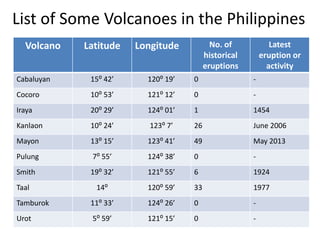
List of Some Volcanoes in the Philippines
Volcano Latitude Longitude No. of
historical
eruptions
Latest
eruption or
activity
Cabaluyan 15⁰ 42’ 120⁰ 19’ 0 -
Cocoro 10⁰ 53’ 121⁰ 12’ 0 -
Iraya 20⁰ 29’ 124⁰ 01’ 1 1454
Kanlaon 10⁰ 24’ 123⁰ 7’ 26 June 2006
Mayon 13⁰ 15’ 123⁰ 41’ 49 May 2013
Pulung 7⁰ 55’ 124⁰ 38’ 0 -
Smith 19⁰ 32’ 121⁰ 55’ 6 1924
Taal 14⁰ 120⁰ 59’ 33 1977
Tamburok 11⁰ 33’ 124⁰ 26’ 0 -
Urot 5⁰ 59’ 121⁰ 15’ 0 -
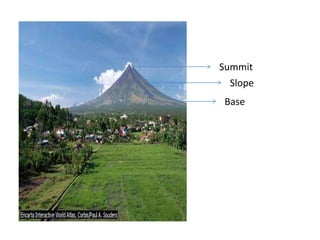
Summit
Slope
Base
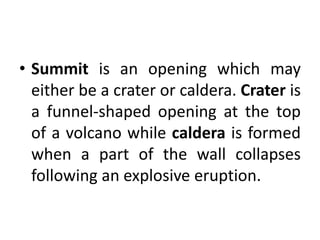
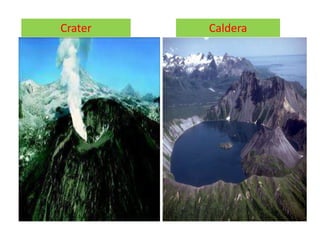
• Summit is an opening which may
either be a crater or caldera. Crater is
a funnel-shaped opening at the top
of a volcano while caldera is formed
when a part of the wall collapses
following an explosive eruption.
Crater Caldera
Primary factors affecting the volcanoes’ eruptive
style:
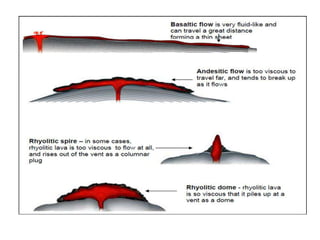
• Magma’s temperature
The higher the temperature of magma is,
the lower is its viscosity.
• Chemical composition
Magmas with high silica content are more
viscous than those with low silica content.
• Amount of dissolved gases it contains
Gas dissolved in magma tends to
increase its stability to flow.
Types of Volcanic Eruptions
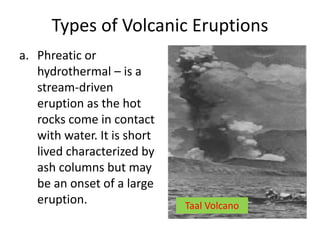
a. Phreatic or
hydrothermal – is a
stream-driven
eruption as the hot
rocks come in contact
with water. It is short
lived characterized by
ash columns but may
be an onset of a large
eruption. Taal Volcano
b. Phreatomagmatic
– is a violent
eruption due to
the contact
between water
and magma. As a
result, a large
column of very
fine ash and high-
speed and
sideway emission
of pyroclastics
called base surges
are observed.
c. Strombolian
– a periodic weak to
violent eruption
characterized by
fountain lava just
like the Irazu
Volcano in Costa
Rica.
d. Vulcanian –
characterized by tall
eruption columns
that reach up to 20
km high with
pyroclastic flow and
ash fall tephra like
that of Paricutin
Volcano in Mexico.
e. Plinian
– excessively
explosive type of
eruption of gas
and pyroclastics
just like our
Pinatubo
Volcano in
Zambales.
Three Volcanic Cones
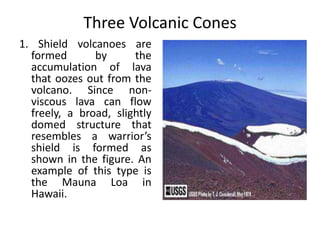
1. Shield volcanoes are
formed by the
accumulation of lava
that oozes out from the
volcano. Since non-
viscous lava can flow
freely, a broad, slightly
domed structure that
resembles a warrior’s
shield is formed as
shown in the figure. An
example of this type is
the Mauna Loa in
Hawaii.
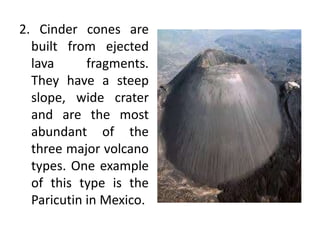
2. Cinder cones are
built from ejected
lava fragments.
They have a steep
slope, wide crater
and are the most
abundant of the
three major volcano
types. One example
of this type is the
Paricutin in Mexico.
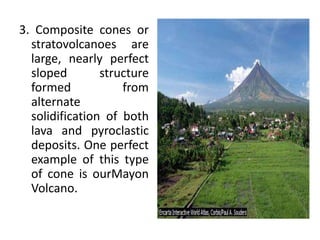
3. Composite cones or
stratovolcanoes are
large, nearly perfect
sloped structure
formed from
alternate
solidification of both
lava and pyroclastic
deposits. One perfect
example of this type
of cone is ourMayon
Volcano.
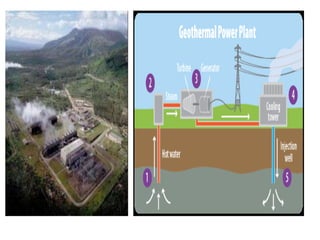
• Geothermal energy - heat from the interior of
the Earth.
- Geothermal power plants and geothermal
heat pumps
- Used to generate electricity
- Places in the Philippines that uses geothermal
power plants as source of electricity are Tiwi
(Albay), Kidapawan (North Cotabato), Calaca
(Laguna), Tongonan (Leyte), Bago City ( Negros
Occ.), Valencia (Negros Or.), and Bacon
(Sorsogon).
How do volcanic eruptions affect the
society?
• Negative effects
- Lose of lives and properties
- Decreased in the Earth’s surface
temperature
Can you name some?
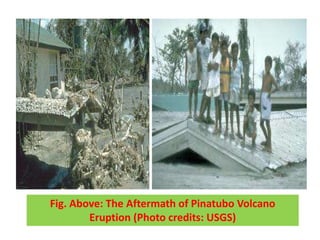
Fig. Above: The Aftermath of Pinatubo Volcano
Eruption (Photo credits: USGS)
• Positive Effects
- Spectacular scenery
- Production of very rich soil for
farming
- Making earthenware out of the ash
fall
Signs of an impending volcanic
eruption:
1. Increase in the frequency of volcanic
quakes with rumbling sounds;
occurrence of volcanic tremors.
2. Increased steaming activity; change
in color of steam emission from
white to gray due to entrained ash.
3. Crater glow due to presence of magma at or
near the crater.
4. Ground swells (or inflation), ground tilt and
ground fissuring due to magma intrusion.
5. Localized landslides, rock falls and landslides
from the summit area which may not
attributable to heavy rains.
6. Noticeable increase inn the extent of drying
up of vegetation around the volcano’s upper
slopes.
7. Increase in the temperature of hot springs,
wells (e.g., Bulusan and Canlaon) and crater
lake (e.g., Taal) near the volcano;
8. Noticeable variation in the chemical content
of springs, crater lakes within the vicinity of
the volcano;
9. Drying up of springs/wells around the
volcano; and,
10. Development of new thermal areas and/or
reactivation of old ones; appearance of
solfataras.
QUIZ…
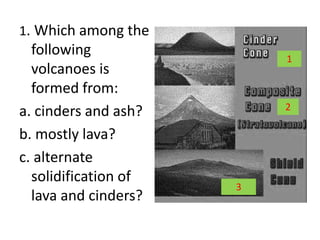
1. Which among the
following
volcanoes is
formed from:
a. cinders and ash?
b. mostly lava?
c. alternate
solidification of
lava and cinders?
1
2
3
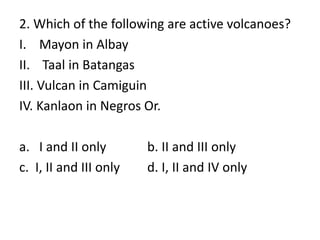
2. Which of the following are active volcanoes?
I. Mayon in Albay
II. Taal in Batangas
III. Vulcan in Camiguin
IV. Kanlaon in Negros Or.
a. I and II only b. II and III only
c. I, II and III only d. I, II and IV only
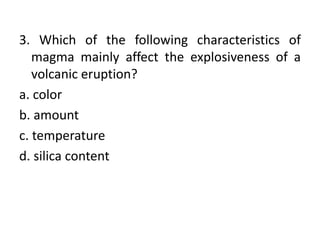
3. Which of the following characteristics of
magma mainly affect the explosiveness of a
volcanic eruption?
a. color
b. amount
c. temperature
d. silica content
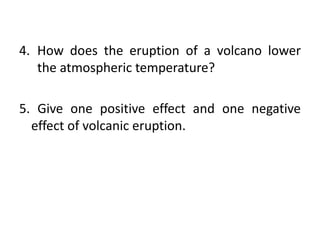
4. How does the eruption of a volcano lower
the atmospheric temperature?
5. Give one positive effect and one negative
effect of volcanic eruption.
6. Describe the shape of the volcanic cone
formed from the following types of volcanic
emission:
a. high temperature magma
b. low amount of gas magma
c. high silica content magma
The End…

Volcanoes Grade 9

  • 1.
    A. Choose theletter of the best answer. Pre-Assessment
  • 2.
    1. Which characteristicof magma mainly determines its explosiveness? a. color b. amount c. temperature d. silica content
  • 3.
    2. Which ofthe following characteristics of a volcano depends on its magma emission? a. age b. size c. shape d. location
  • 4.
    3. Which ofthe following factors associated with huge volcanic eruptions may cause the decrease in the Earth’s average temperature for a few years? a. heat b. light c. acid rain d. volcanic ash
  • 5.
    4. A thicklayer of volcanic ash can be heavy enough to collapse the roofs of buildings because ash ________. a. is solid. b. cannot be blown by winds. c. becomes heavier as it cools. d. consists of tiny fragments of rocks that becomes heavy as they file up.
  • 6.
    5. Which ofthe following is an active volcano in the Philippines? a. Apo in Davao b.Bud Datu in Sulu c.Isarog in Camarines Sur d.Kanlaon in Negros Oriental
  • 7.
    B. Answer thefollowing questions briefly. 6. Aside from Mayon Volcano, name another Philippine volcano that has erupted recently. 7. What causes a shield volcano to be shaped like a broad dome? 8. By what process can a volcanic eruption affect temperatures around the world?
  • 8.
    9. Give onepositive effect and one negative effect of volcanic eruptions. 10. How is energy from volcanoes tapped as source of electricity?
  • 9.
  • 10.
    Classification of volcanoes •Active volcanoes are those that have a record of eruption within the last 600 years or those that erupted 10, 000 years ago based on analyses of their materials. • Inactive volcanoes, on the other hand, are those that have not erupted for the last 10, 000 years and their physical form is being changed by agents of weathering and erosion through formation of deep and long gullies.
  • 11.
    • According toPHIVOLCS, our country has more than a hundred volcanoes as of 2013. Twenty-three are active while the rest are inactive.
  • 12.
    List of SomeVolcanoes in the Philippines Volcano Latitude Longitude No. of historical eruptions Latest eruption or activity Cabaluyan 15⁰ 42’ 120⁰ 19’ 0 - Cocoro 10⁰ 53’ 121⁰ 12’ 0 - Iraya 20⁰ 29’ 124⁰ 01’ 1 1454 Kanlaon 10⁰ 24’ 123⁰ 7’ 26 June 2006 Mayon 13⁰ 15’ 123⁰ 41’ 49 May 2013 Pulung 7⁰ 55’ 124⁰ 38’ 0 - Smith 19⁰ 32’ 121⁰ 55’ 6 1924 Taal 14⁰ 120⁰ 59’ 33 1977 Tamburok 11⁰ 33’ 124⁰ 26’ 0 - Urot 5⁰ 59’ 121⁰ 15’ 0 -
  • 13.
  • 14.
    • Summit isan opening which may either be a crater or caldera. Crater is a funnel-shaped opening at the top of a volcano while caldera is formed when a part of the wall collapses following an explosive eruption.
  • 15.
  • 16.
    Primary factors affectingthe volcanoes’ eruptive style: • Magma’s temperature The higher the temperature of magma is, the lower is its viscosity. • Chemical composition Magmas with high silica content are more viscous than those with low silica content. • Amount of dissolved gases it contains Gas dissolved in magma tends to increase its stability to flow.
  • 18.
    Types of VolcanicEruptions a. Phreatic or hydrothermal – is a stream-driven eruption as the hot rocks come in contact with water. It is short lived characterized by ash columns but may be an onset of a large eruption. Taal Volcano
  • 19.
    b. Phreatomagmatic – isa violent eruption due to the contact between water and magma. As a result, a large column of very fine ash and high- speed and sideway emission of pyroclastics called base surges are observed.
  • 20.
    c. Strombolian – aperiodic weak to violent eruption characterized by fountain lava just like the Irazu Volcano in Costa Rica.
  • 21.
    d. Vulcanian – characterizedby tall eruption columns that reach up to 20 km high with pyroclastic flow and ash fall tephra like that of Paricutin Volcano in Mexico.
  • 22.
    e. Plinian – excessively explosivetype of eruption of gas and pyroclastics just like our Pinatubo Volcano in Zambales.
  • 23.
    Three Volcanic Cones 1.Shield volcanoes are formed by the accumulation of lava that oozes out from the volcano. Since non- viscous lava can flow freely, a broad, slightly domed structure that resembles a warrior’s shield is formed as shown in the figure. An example of this type is the Mauna Loa in Hawaii.
  • 24.
    2. Cinder conesare built from ejected lava fragments. They have a steep slope, wide crater and are the most abundant of the three major volcano types. One example of this type is the Paricutin in Mexico.
  • 25.
    3. Composite conesor stratovolcanoes are large, nearly perfect sloped structure formed from alternate solidification of both lava and pyroclastic deposits. One perfect example of this type of cone is ourMayon Volcano.
  • 26.
    • Geothermal energy- heat from the interior of the Earth. - Geothermal power plants and geothermal heat pumps - Used to generate electricity - Places in the Philippines that uses geothermal power plants as source of electricity are Tiwi (Albay), Kidapawan (North Cotabato), Calaca (Laguna), Tongonan (Leyte), Bago City ( Negros Occ.), Valencia (Negros Or.), and Bacon (Sorsogon).
  • 28.
    How do volcaniceruptions affect the society? • Negative effects - Lose of lives and properties - Decreased in the Earth’s surface temperature Can you name some?
  • 29.
    Fig. Above: TheAftermath of Pinatubo Volcano Eruption (Photo credits: USGS)
  • 30.
    • Positive Effects -Spectacular scenery - Production of very rich soil for farming - Making earthenware out of the ash fall
  • 31.
    Signs of animpending volcanic eruption: 1. Increase in the frequency of volcanic quakes with rumbling sounds; occurrence of volcanic tremors. 2. Increased steaming activity; change in color of steam emission from white to gray due to entrained ash.
  • 32.
    3. Crater glowdue to presence of magma at or near the crater. 4. Ground swells (or inflation), ground tilt and ground fissuring due to magma intrusion. 5. Localized landslides, rock falls and landslides from the summit area which may not attributable to heavy rains. 6. Noticeable increase inn the extent of drying up of vegetation around the volcano’s upper slopes.
  • 33.
    7. Increase inthe temperature of hot springs, wells (e.g., Bulusan and Canlaon) and crater lake (e.g., Taal) near the volcano; 8. Noticeable variation in the chemical content of springs, crater lakes within the vicinity of the volcano; 9. Drying up of springs/wells around the volcano; and, 10. Development of new thermal areas and/or reactivation of old ones; appearance of solfataras.
  • 34.
  • 35.
    1. Which amongthe following volcanoes is formed from: a. cinders and ash? b. mostly lava? c. alternate solidification of lava and cinders? 1 2 3
  • 36.
    2. Which ofthe following are active volcanoes? I. Mayon in Albay II. Taal in Batangas III. Vulcan in Camiguin IV. Kanlaon in Negros Or. a. I and II only b. II and III only c. I, II and III only d. I, II and IV only
  • 37.
    3. Which ofthe following characteristics of magma mainly affect the explosiveness of a volcanic eruption? a. color b. amount c. temperature d. silica content
  • 38.
    4. How doesthe eruption of a volcano lower the atmospheric temperature? 5. Give one positive effect and one negative effect of volcanic eruption.
  • 39.
    6. Describe theshape of the volcanic cone formed from the following types of volcanic emission: a. high temperature magma b. low amount of gas magma c. high silica content magma
  • 40.