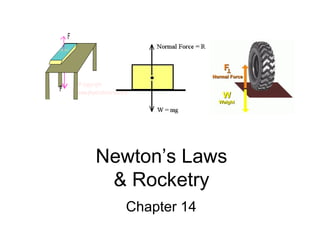
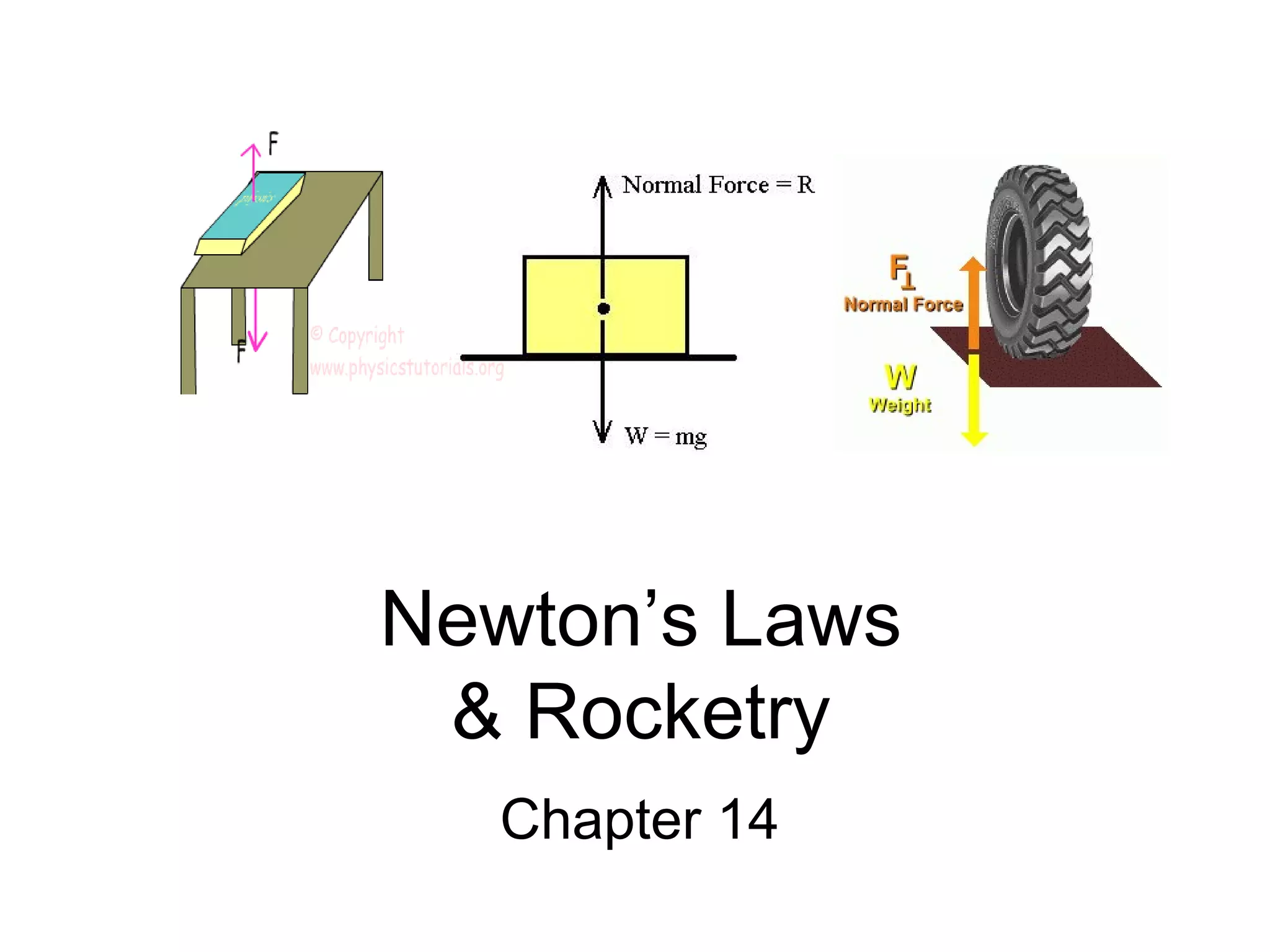
Newton’s Laws
 & Rocketry
  Chapter 14
The Causes of Motion
• Galileo developed the concept of inertia.
• Inertia is that property that causes a body
  to RESIST changes in its state of motion.
• Inertia depends on mass.
• If no net force acts on an object, it stays at
  a constant velocity.
• Constant velocity can be 0 m/s too.
Newton’s 1 Law of Motion
                    st


• In the absence of a resultant external
  force acting upon it, a body will remain at
  rest or in uniform rectilinear motion (its
  acceleration will be zero).
• It takes an unbalanced force acting on an
  object to change its state of rest or motion.
• E.g. an apple on a table has no net force.
• E.g. an apple dropping off the table has a
  net force acting on it.
Exam Question
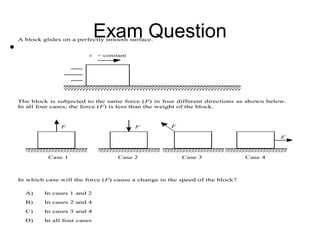
    A block glides on a perfectly smooth surface.

•                            v   = constant


    The block is subjected to the same force (F) in four different directions as shown below.
    In all four cases, the force (F) is less than the weight of the block.


                  F                           F        F

                                                                                           F


              Case 1                    Case 2             Case 3                Case 4


    In which case will the force (F) cause a change in the speed of the block?

      A)     In cases 1 and 2
      B)     In cases 2 and 4
      C)     In cases 3 and 4
      D)     In all four cases
Exam Question
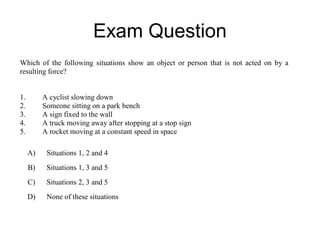
Which of the following situations show an object or person that is not acted on by a
resulting force?


1.        A cyclist slowing down
2.        Someone sitting on a park bench
3.        A sign fixed to the wall
4.        A truck moving away after stopping at a stop sign
5.        A rocket moving at a constant speed in space

     A)    Situations 1, 2 and 4
     B)    Situations 1, 3 and 5
     C)    Situations 2, 3 and 5
     D)    None of these situations
Exam Question
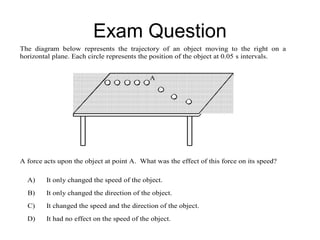
The diagram below represents the trajectory of an object moving to the right on a
horizontal plane. Each circle represents the position of the object at 0.05 s intervals.


                                             A


A force acts upon the object at point A. What was the effect of this force on its speed?

  A)     It only changed the speed of the object.
  B)     It only changed the direction of the object.
  C)     It changed the speed and the direction of the object.
  D)     It had no effect on the speed of the object.
Activity
• Page 308, Q. 1-3
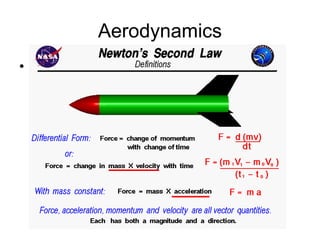
Aerodynamics
•
Newton’s 2nd Law of Motion
• If an unbalanced force acts on an object,
  the object accelerates in the direction of
  the force.
• The acceleration varies inversely with the
  mass.
• The acceleration varies directly with the
  force.
• F = ma.
• 1 N is the force required to accelerate 1 kg
  by 1m/s2.
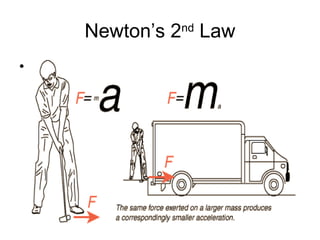
Newton’s 2 Law
            nd


•
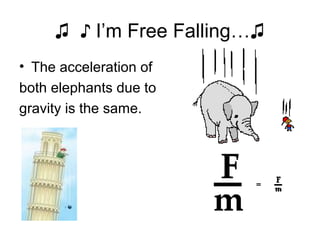
♫ ♪ I’m Free Falling…♫
• The acceleration of
both elephants due to
gravity is the same.
Activity
• What is the acceleration of a 70 kg skater
  pushed by a force of 161 N [W]?
• F = ma or a = F/m = 161 N [W]/ 70 kg
•           a = 2.3 m/s2 [W]
Exam Question

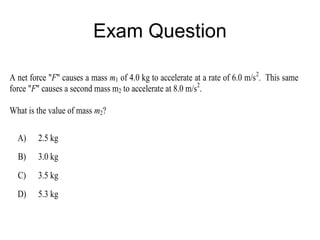
A net force "F" causes a mass m1 of 4.0 kg to accelerate at a rate of 6.0 m/s2. This same
force "F" causes a second mass m2 to accelerate at 8.0 m/s2.

What is the value of mass m2?

  A)    2.5 kg
  B)    3.0 kg
  C)    3.5 kg
  D)    5.3 kg
Exam Question
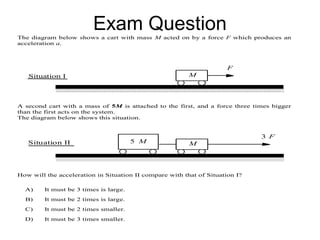
The diagram below shows a cart with mass M acted on by a force F which produces an
acceleration a.


                                                                      F
   Situation I                                           M


A second cart with a mass of 5M is attached to the first, and a force three times bigger
than the first acts on the system.
The diagram below shows this situation.


                                                                              3 F
   Situation II                         5 M              M


How will the acceleration in Situation II compare with that of Situation I?

  A)     It must be 3 times is large.
  B)     It must be 2 times is large.
  C)     It must be 2 times smaller.
  D)     It must be 3 times smaller.
Exam Question
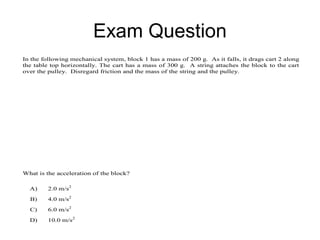
In the following mechanical system, block 1 has a mass of 200 g. As it falls, it drags cart 2 along
the table top horizontally. The cart has a mass of 300 g. A string attaches the block to the cart
over the pulley. Disregard friction and the mass of the string and the pulley.


What is the acceleration of the block?

  A)     2.0 m/s2
  B)     4.0 m/s2
  C)     6.0 m/s2
  D)     10.0 m/s2
Activity
• Page 314, Q. 1-4
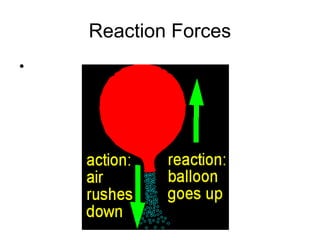
Reaction Forces
•
Newton’s 3 Law of Motion
                    rd

• Newton’s 3rd Law of Motion: For every
  action force, there is an equal and opposite
  reaction force.
• OR If object A exerts a force on object B,
  then object B exerts a force equal in
  magnitude but opposite in direction on
  object A.
• OR You cannot touch someone else without
  being touched in return.
• OR Forces exist in pairs.
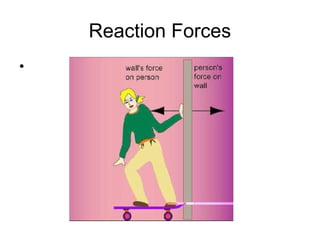
Reaction Forces
•
Examples of Reaction Forces
• E.g. A tractor exerts a force of 2000 N [W]
  on a trailer. The trailer exerts a force of
  2000 N [E] on the tractor.
• When we push on a wall it pushes back.
• When we kick a football, the same force
  kicks back on us. Our foot decelerates a
  bit because our mass is greater. The
  football accelerates a lot because its mass
  is small.
Activity
• Page 317, Q 1-4
Exam Question

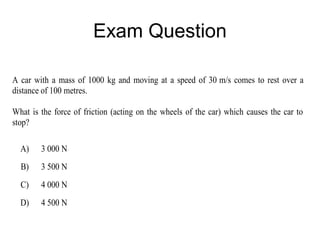
A car with a mass of 1000 kg and moving at a speed of 30 m/s comes to rest over a
distance of 100 metres.

What is the force of friction (acting on the wheels of the car) which causes the car to
stop?

  A)    3 000 N
  B)    3 500 N
  C)    4 000 N
  D)    4 500 N
Activity
• Page 321, Q. 1-6
Summary
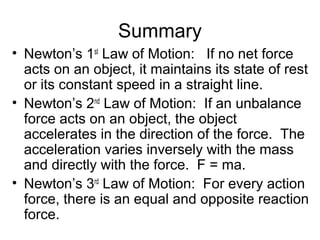
• Newton’s 1st Law of Motion: If no net force
  acts on an object, it maintains its state of rest
  or its constant speed in a straight line.
• Newton’s 2nd Law of Motion: If an unbalance
  force acts on an object, the object
  accelerates in the direction of the force. The
  acceleration varies inversely with the mass
  and directly with the force. F = ma.
• Newton’s 3rd Law of Motion: For every action
  force, there is an equal and opposite reaction
  force.
Activity
• Page 321, Q. 7-10

Physics 504 Chapter 14 Newton's Laws & Rocketry

  • 1.
    Newton’s Laws &Rocketry Chapter 14
  • 2.
    The Causes ofMotion • Galileo developed the concept of inertia. • Inertia is that property that causes a body to RESIST changes in its state of motion. • Inertia depends on mass. • If no net force acts on an object, it stays at a constant velocity. • Constant velocity can be 0 m/s too.
  • 3.
    Newton’s 1 Lawof Motion st • In the absence of a resultant external force acting upon it, a body will remain at rest or in uniform rectilinear motion (its acceleration will be zero). • It takes an unbalanced force acting on an object to change its state of rest or motion. • E.g. an apple on a table has no net force. • E.g. an apple dropping off the table has a net force acting on it.
  • 4.
    Exam Question A block glides on a perfectly smooth surface. • v = constant The block is subjected to the same force (F) in four different directions as shown below. In all four cases, the force (F) is less than the weight of the block. F F F F Case 1 Case 2 Case 3 Case 4 In which case will the force (F) cause a change in the speed of the block? A) In cases 1 and 2 B) In cases 2 and 4 C) In cases 3 and 4 D) In all four cases
  • 5.
    Exam Question Which ofthe following situations show an object or person that is not acted on by a resulting force? 1. A cyclist slowing down 2. Someone sitting on a park bench 3. A sign fixed to the wall 4. A truck moving away after stopping at a stop sign 5. A rocket moving at a constant speed in space A) Situations 1, 2 and 4 B) Situations 1, 3 and 5 C) Situations 2, 3 and 5 D) None of these situations
  • 6.
    Exam Question The diagrambelow represents the trajectory of an object moving to the right on a horizontal plane. Each circle represents the position of the object at 0.05 s intervals. A A force acts upon the object at point A. What was the effect of this force on its speed? A) It only changed the speed of the object. B) It only changed the direction of the object. C) It changed the speed and the direction of the object. D) It had no effect on the speed of the object.
  • 7.
  • 8.
  • 9.
    Newton’s 2nd Lawof Motion • If an unbalanced force acts on an object, the object accelerates in the direction of the force. • The acceleration varies inversely with the mass. • The acceleration varies directly with the force. • F = ma. • 1 N is the force required to accelerate 1 kg by 1m/s2.
  • 10.
  • 11.
    ♫ ♪ I’mFree Falling…♫ • The acceleration of both elephants due to gravity is the same.
  • 12.
    Activity • What isthe acceleration of a 70 kg skater pushed by a force of 161 N [W]? • F = ma or a = F/m = 161 N [W]/ 70 kg • a = 2.3 m/s2 [W]
  • 13.
    Exam Question A netforce "F" causes a mass m1 of 4.0 kg to accelerate at a rate of 6.0 m/s2. This same force "F" causes a second mass m2 to accelerate at 8.0 m/s2. What is the value of mass m2? A) 2.5 kg B) 3.0 kg C) 3.5 kg D) 5.3 kg
  • 14.
    Exam Question The diagrambelow shows a cart with mass M acted on by a force F which produces an acceleration a. F Situation I M A second cart with a mass of 5M is attached to the first, and a force three times bigger than the first acts on the system. The diagram below shows this situation. 3 F Situation II 5 M M How will the acceleration in Situation II compare with that of Situation I? A) It must be 3 times is large. B) It must be 2 times is large. C) It must be 2 times smaller. D) It must be 3 times smaller.
  • 15.
    Exam Question In thefollowing mechanical system, block 1 has a mass of 200 g. As it falls, it drags cart 2 along the table top horizontally. The cart has a mass of 300 g. A string attaches the block to the cart over the pulley. Disregard friction and the mass of the string and the pulley. What is the acceleration of the block? A) 2.0 m/s2 B) 4.0 m/s2 C) 6.0 m/s2 D) 10.0 m/s2
  • 16.
  • 17.
  • 18.
    Newton’s 3 Lawof Motion rd • Newton’s 3rd Law of Motion: For every action force, there is an equal and opposite reaction force. • OR If object A exerts a force on object B, then object B exerts a force equal in magnitude but opposite in direction on object A. • OR You cannot touch someone else without being touched in return. • OR Forces exist in pairs.
  • 19.
  • 20.
    Examples of ReactionForces • E.g. A tractor exerts a force of 2000 N [W] on a trailer. The trailer exerts a force of 2000 N [E] on the tractor. • When we push on a wall it pushes back. • When we kick a football, the same force kicks back on us. Our foot decelerates a bit because our mass is greater. The football accelerates a lot because its mass is small.
  • 21.
  • 22.
    Exam Question A carwith a mass of 1000 kg and moving at a speed of 30 m/s comes to rest over a distance of 100 metres. What is the force of friction (acting on the wheels of the car) which causes the car to stop? A) 3 000 N B) 3 500 N C) 4 000 N D) 4 500 N
  • 23.
  • 24.
    Summary • Newton’s 1stLaw of Motion: If no net force acts on an object, it maintains its state of rest or its constant speed in a straight line. • Newton’s 2nd Law of Motion: If an unbalance force acts on an object, the object accelerates in the direction of the force. The acceleration varies inversely with the mass and directly with the force. F = ma. • Newton’s 3rd Law of Motion: For every action force, there is an equal and opposite reaction force.
  • 25.