Physical and Mechanical
Properties of
Composites
Physical Properties of Composites
 Biocompatibility:
 Newly placed composite resins can release chemicals that, in deep cavity
preparations, could pass through the dentinal tubules into the pulp, causing an
inflammatory reaction.
 When the tubules are sealed by dentin bonding agents or protected with a base
or liner, there is no problem.
 Composites can release components into the oral cavity.
Unbound monomers and other additives can be dissolved out by water or solvents
in the diet and some components can leach out as the composite degrades over
time.
 Polished composites are well tolerated by surrounding soft tissues, and very few
individuals may be allergic to one or more of the components of the material.
Physical Properties of Composites
Strength:
Most of the composites used today are similar in
compressive strength.
They are not as strong in compressive strength as
amalgams, but are stronger than glass ionomers.
In terms of tensile and shearing strength, microfill
composites are weaker than hybrids and
Nanocomposites.
Physical Properties of Composites
Wear:
Composites wear faster than amalgams.
Recent improvements have made the latest generation of
composites more wear resistant than early composites, and
they are beginning to approach the wear rate of amalgams
under normal function.
Filler content has an effect on the wear rate
Lower volume of filler (microfills and flowables) wear faster
than more heavily filled composites.
Wear can result from abrasion by foods or toothbrushing
or by contact with opposing teeth during eating or bruxing.
Physical Properties of Composites
 Wear can result from abrasion by foods or toothbrushing or
by contact with opposing teeth during eating or bruxing.
 Bruxers (people who grind their teeth) will wear down
composites at a much faster rate than amalgam.
 It is recommended that posterior composites not be use for
very large restorations that are not protected in the functional
occlusal range by surrounding tooth structure.
Physical Properties of Composites
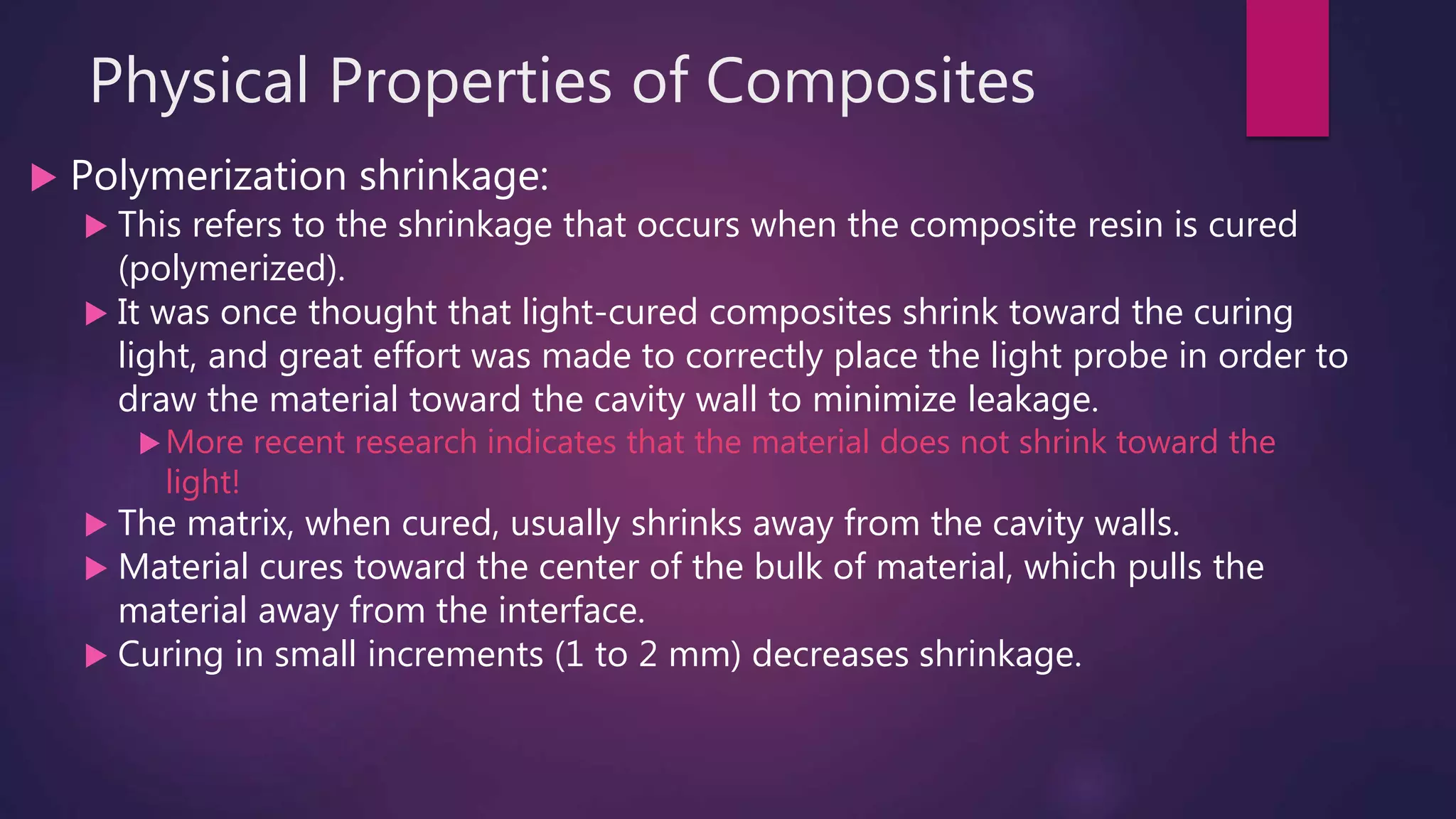
 Polymerization shrinkage:
 This refers to the shrinkage that occurs when the composite resin is cured
(polymerized).
 It was once thought that light-cured composites shrink toward the curing
light, and great effort was made to correctly place the light probe in order to
draw the material toward the cavity wall to minimize leakage.
More recent research indicates that the material does not shrink toward the
light!
 The matrix, when cured, usually shrinks away from the cavity walls.
 Material cures toward the center of the bulk of material, which pulls the
material away from the interface.
 Curing in small increments (1 to 2 mm) decreases shrinkage.
Clinical Consequences of
Polymerization Shrinkage
 As composite polymerizes and shrinks it tends to pull toward the walls
of the cavity preparation that are bonded.
 When an increment of composite is placed in contact with two
opposing walls (like class I or II preparation with buccal and lingual
enamel walls) and cured, the shrinking composite will stress the bonds
to the two walls and may end up pulling away from one of the walls.
 This will cause a gap at the margins that allows microleakage of fluid and
bacteria at the margin with possible tooth sensitivity or future staining at the
margins and recurrent caries.
Clinical Consequences of
Polymerization Shrinkage
 Shrinking composite that is well bonded to buccal and lingual
cavity walls can also but tension on the cusps of the tooth,
pulling them slightly toward each other.
 This causes discomfort when the patient bites down.
 The bond to enamel is a strong one
 When the composite shrinks near the cavosurface margins in
enamel, occasionally some of the enamel rods pull away from
the tooth
 The result of this microscopic cracking of the enamel can be seen as a
while line around the margin.
Reducing the Effects of Polymerization
Shrinkage
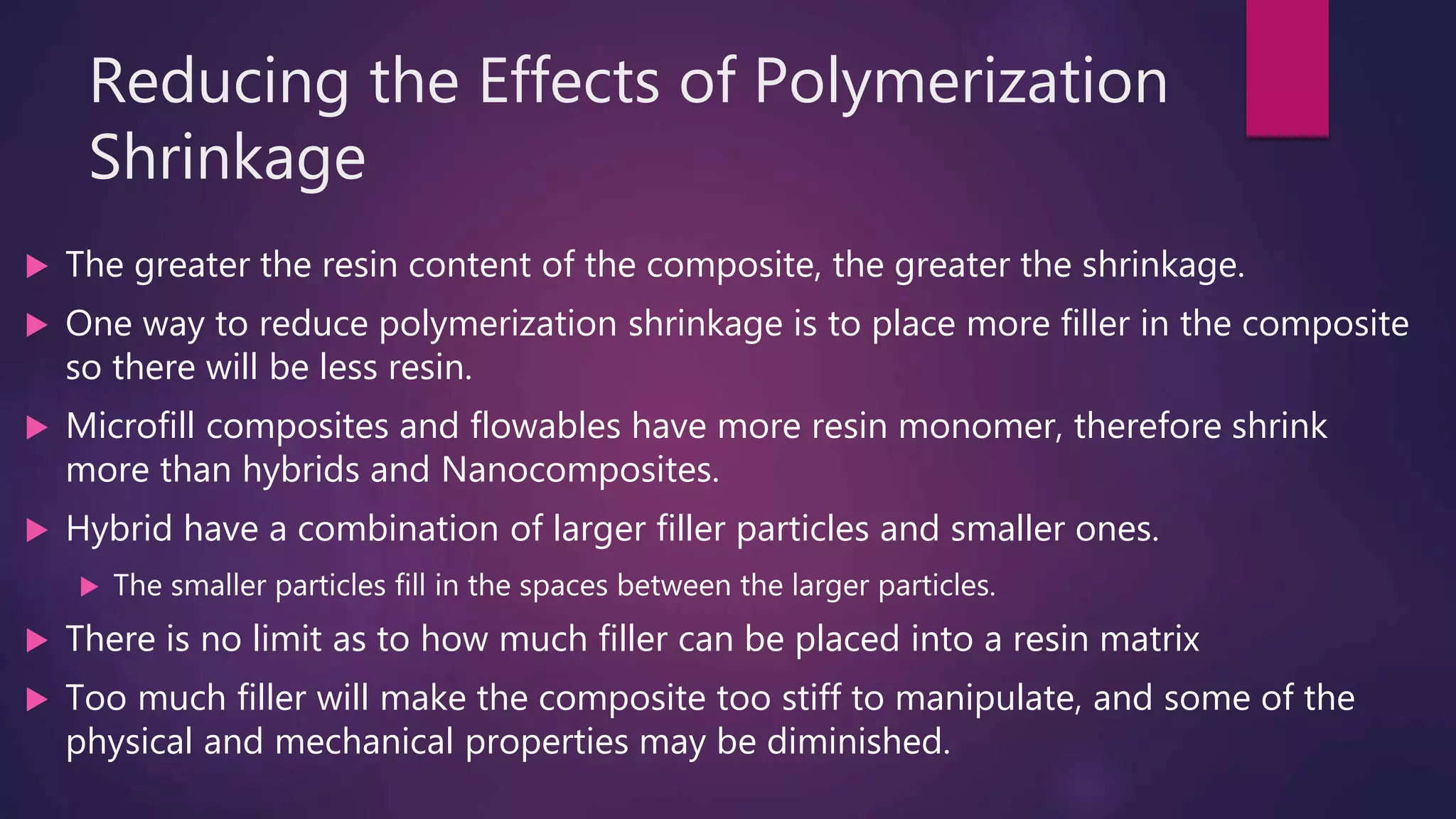
 The greater the resin content of the composite, the greater the shrinkage.
 One way to reduce polymerization shrinkage is to place more filler in the composite
so there will be less resin.
 Microfill composites and flowables have more resin monomer, therefore shrink
more than hybrids and Nanocomposites.
 Hybrid have a combination of larger filler particles and smaller ones.
 The smaller particles fill in the spaces between the larger particles.
 There is no limit as to how much filler can be placed into a resin matrix
 Too much filler will make the composite too stiff to manipulate, and some of the
physical and mechanical properties may be diminished.
Reducing the Effects of Polymerization
Shrinkage
 Another way to reduce polymerization shrinkage is to use
prepolymerized filler.
 To make these fillers, high concentrations of microfillers and nanofillers are
forced into a resin matrix under pressure and heat, and then cured.
 The highly filled clumps of resin are then ground into large filler particles (30-
60µm)
 These large particles already have undergone polymerization shrinkage.
 They are loaded into a resin matrix along with other micro- and Nanohybrid composites.
 This composite when polymerized will shrink less because a portion of its volume has
already been polymerized by way of the prepolymerized particles.
Reducing the Effects of Polymerization
Shrinkage
 The effects of polymerization shrinkage can be minimized by placing
the restoration in small incremental layers, avoid joining opposing walls
with one increment, and curing each layer separately.
 Another way to manage shrinkage is to do the indirect composite
restoration.
 The shrinkage occurs in the restoration before its placed in the tooth, then the
restoration is cemented in place with a thin layer of low-viscosity resin cement
such as that used to cement veneers.
 This thin layer will have minimal shrinkage.
Reducing the Effects of Polymerization
Shrinkage
 Shrinkage could also be reduced by using low shrinking monomers.
 Several products are undergoing testing and one resin, silorane, is commercially
available in Filtek LS (3M ESPE).
 Its polymerization shrinkage is less than 1%.
 However, it takes twice as long to polymerize and requires its own bonding agent.
 It is not compatible with most methacrylate-based bonding agents.
 https://youtu.be/a_vzPspOGa4
 Another low shrinking composite using a dimer-based material is N’Durance
(Septodont).
 Its polymerization shrinkage is less than 2% and is compatible with most bonding agents.
Physical Properties of Composites
Degree of conversion:
This indicates the percentage of carbon-to-carbon
double bonds that have undergone conversion to
single bonds during formation of the resin
polymer.
With a higher rate of conversion the physical and
mechanical properties of the resin improve: the
resin will be stronger and resist wear better.
Physical Properties of Composites
 Thermal conductivity:
Composite resin will transmit hot and cold temperatures much
like the natural tooth structure.
So, its thermal conductivity is compatible with the teeth and
much lower than that of metal, such as amalgam or gold.
It is therefore biologically protective material for the dental pulp.
14
Physical Properties of Composites
 Coefficient of Thermal Expansion (CTE):
Ideally, the CTE of the filling material would be the same as that
of the tooth structure.
In the case of composite, the CTE is greater, and therefore it will
undergo a greater change in dimension than will the adjacent
tooth structure.
This can result in debonding and leakage of the restoration..
The greater the filler content, the lower the CTE
The greaer the resin content, the greater the CTE
Microfilled composites and flowable composites have a higher
CTE than do packable or hybrid varieties
Physical Properties of Composites
 Elastic modulus
 The elastic modulus (also referred to as the E-modulus or Young’s modulus) is a
measure of the stiffness of the composite and is determined by the amount of
filler.
 The greater the volume of the filler, the stiffer (higher elastic modulus) and more
wear resistant the restoration.
 This is an important consideration for selection of the type of composite.
 For example, an occlusal restoration must have greater wear resistance than a
class V restoration.
The stiffer material is probably contraindicated at the gingival margin areas
because it does not have the flexibility needed in that area.
 Microfilled and flowable composites have fewer particles and more resin
They deform more readily under function and therefore can break more easily.
Microfills generally are used in non-stress –bearing restorations.
Physical Properties of Composites
 Water sorption:
The resin matrix absorbs water from the oral cavity over time.
The greater the resin content, the more water is absorbed.
Microfills and flowables tend to have greater water sorption
Water softens the resin matrix, which gradually degrades the
material (hydrolysis)
Water also causes some expansion (hydroscopic expansion) of the
composite over the first week after placement.
Physical Properties of Composites
 Radiopacity:
 Metals such as lithium, barium, or strontium are added to the filler to make the
restoration more opaque when viewed on a radiograph.
Some older composite materials do not have any of these adidtives and might
appear radiolucent on radiographs.
 Clinicians may have a difficult time determining whether there are recurrent caries
around such radiolucent composites, because the caries also appear someone
radiolucent on radiographs.
 Quartz is not radiopaque, but it is sometimes used as filler for composites under
in the anterior part of the mouth because it has good optical properties that can
enhance the color match to the tooth.
It allows light to be transmitted through the restoration more readily and to pick up
coloration from the surrounding tooth structure, making for a better color match.
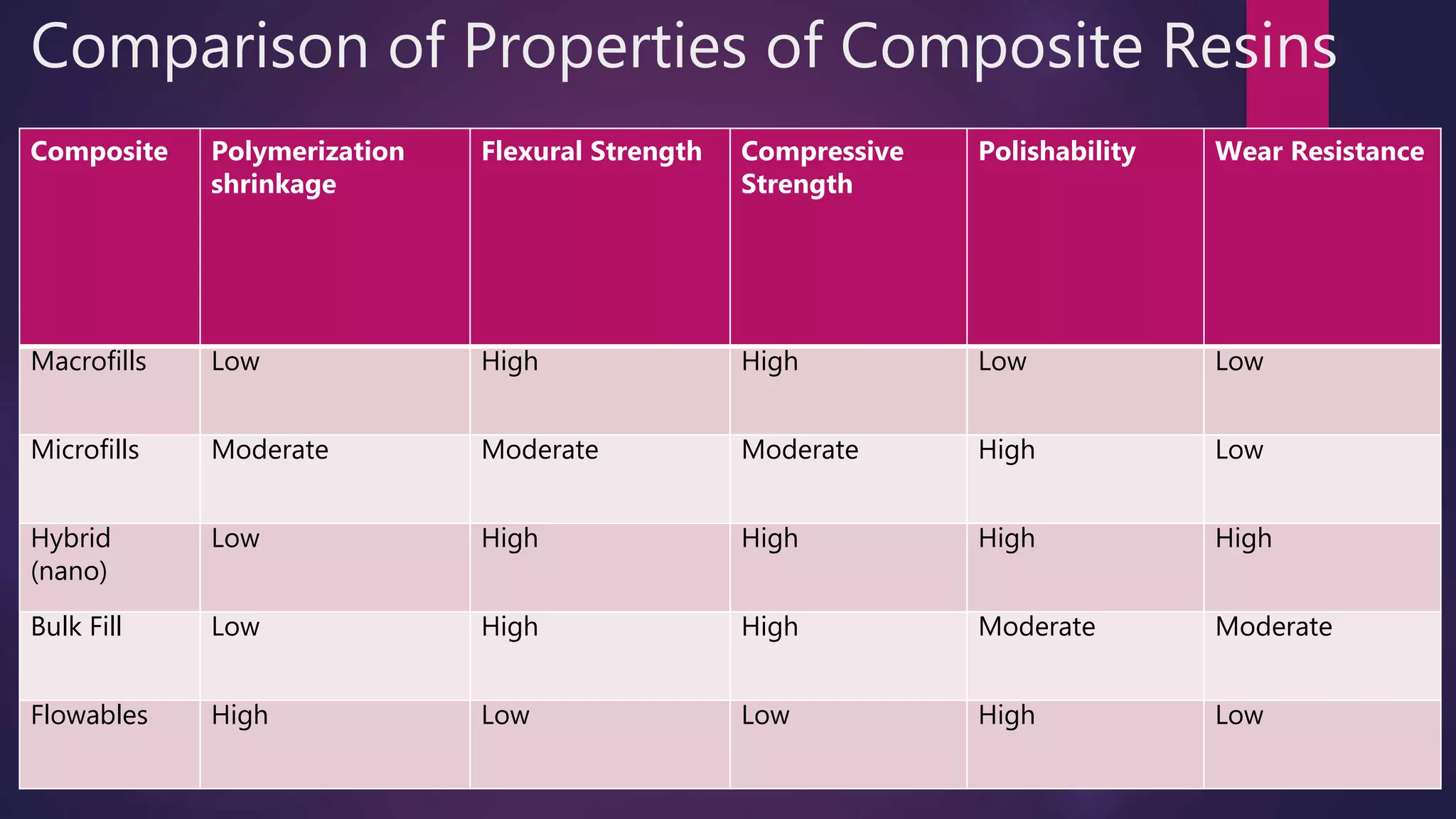
Comparison of Properties of Composite Resins
Composite Polymerization
shrinkage
Flexural Strength Compressive
Strength
Polishability Wear Resistance
Macrofills Low High High Low Low
Microfills Moderate Moderate Moderate High Low
Hybrid
(nano)
Low High High High High
Bulk Fill Low High High Moderate Moderate
Flowables High Low Low High Low

Physical and Mechanical Properties of Composites

  • 1.
  • 2.
    Physical Properties ofComposites  Biocompatibility:  Newly placed composite resins can release chemicals that, in deep cavity preparations, could pass through the dentinal tubules into the pulp, causing an inflammatory reaction.  When the tubules are sealed by dentin bonding agents or protected with a base or liner, there is no problem.  Composites can release components into the oral cavity. Unbound monomers and other additives can be dissolved out by water or solvents in the diet and some components can leach out as the composite degrades over time.  Polished composites are well tolerated by surrounding soft tissues, and very few individuals may be allergic to one or more of the components of the material.
  • 3.
    Physical Properties ofComposites Strength: Most of the composites used today are similar in compressive strength. They are not as strong in compressive strength as amalgams, but are stronger than glass ionomers. In terms of tensile and shearing strength, microfill composites are weaker than hybrids and Nanocomposites.
  • 4.
    Physical Properties ofComposites Wear: Composites wear faster than amalgams. Recent improvements have made the latest generation of composites more wear resistant than early composites, and they are beginning to approach the wear rate of amalgams under normal function. Filler content has an effect on the wear rate Lower volume of filler (microfills and flowables) wear faster than more heavily filled composites. Wear can result from abrasion by foods or toothbrushing or by contact with opposing teeth during eating or bruxing.
  • 5.
    Physical Properties ofComposites  Wear can result from abrasion by foods or toothbrushing or by contact with opposing teeth during eating or bruxing.  Bruxers (people who grind their teeth) will wear down composites at a much faster rate than amalgam.  It is recommended that posterior composites not be use for very large restorations that are not protected in the functional occlusal range by surrounding tooth structure.
  • 6.
    Physical Properties ofComposites  Polymerization shrinkage:  This refers to the shrinkage that occurs when the composite resin is cured (polymerized).  It was once thought that light-cured composites shrink toward the curing light, and great effort was made to correctly place the light probe in order to draw the material toward the cavity wall to minimize leakage. More recent research indicates that the material does not shrink toward the light!  The matrix, when cured, usually shrinks away from the cavity walls.  Material cures toward the center of the bulk of material, which pulls the material away from the interface.  Curing in small increments (1 to 2 mm) decreases shrinkage.
  • 7.
    Clinical Consequences of PolymerizationShrinkage  As composite polymerizes and shrinks it tends to pull toward the walls of the cavity preparation that are bonded.  When an increment of composite is placed in contact with two opposing walls (like class I or II preparation with buccal and lingual enamel walls) and cured, the shrinking composite will stress the bonds to the two walls and may end up pulling away from one of the walls.  This will cause a gap at the margins that allows microleakage of fluid and bacteria at the margin with possible tooth sensitivity or future staining at the margins and recurrent caries.
  • 8.
    Clinical Consequences of PolymerizationShrinkage  Shrinking composite that is well bonded to buccal and lingual cavity walls can also but tension on the cusps of the tooth, pulling them slightly toward each other.  This causes discomfort when the patient bites down.  The bond to enamel is a strong one  When the composite shrinks near the cavosurface margins in enamel, occasionally some of the enamel rods pull away from the tooth  The result of this microscopic cracking of the enamel can be seen as a while line around the margin.
  • 9.
    Reducing the Effectsof Polymerization Shrinkage  The greater the resin content of the composite, the greater the shrinkage.  One way to reduce polymerization shrinkage is to place more filler in the composite so there will be less resin.  Microfill composites and flowables have more resin monomer, therefore shrink more than hybrids and Nanocomposites.  Hybrid have a combination of larger filler particles and smaller ones.  The smaller particles fill in the spaces between the larger particles.  There is no limit as to how much filler can be placed into a resin matrix  Too much filler will make the composite too stiff to manipulate, and some of the physical and mechanical properties may be diminished.
  • 10.
    Reducing the Effectsof Polymerization Shrinkage  Another way to reduce polymerization shrinkage is to use prepolymerized filler.  To make these fillers, high concentrations of microfillers and nanofillers are forced into a resin matrix under pressure and heat, and then cured.  The highly filled clumps of resin are then ground into large filler particles (30- 60µm)  These large particles already have undergone polymerization shrinkage.  They are loaded into a resin matrix along with other micro- and Nanohybrid composites.  This composite when polymerized will shrink less because a portion of its volume has already been polymerized by way of the prepolymerized particles.
  • 11.
    Reducing the Effectsof Polymerization Shrinkage  The effects of polymerization shrinkage can be minimized by placing the restoration in small incremental layers, avoid joining opposing walls with one increment, and curing each layer separately.  Another way to manage shrinkage is to do the indirect composite restoration.  The shrinkage occurs in the restoration before its placed in the tooth, then the restoration is cemented in place with a thin layer of low-viscosity resin cement such as that used to cement veneers.  This thin layer will have minimal shrinkage.
  • 12.
    Reducing the Effectsof Polymerization Shrinkage  Shrinkage could also be reduced by using low shrinking monomers.  Several products are undergoing testing and one resin, silorane, is commercially available in Filtek LS (3M ESPE).  Its polymerization shrinkage is less than 1%.  However, it takes twice as long to polymerize and requires its own bonding agent.  It is not compatible with most methacrylate-based bonding agents.  https://youtu.be/a_vzPspOGa4  Another low shrinking composite using a dimer-based material is N’Durance (Septodont).  Its polymerization shrinkage is less than 2% and is compatible with most bonding agents.
  • 13.
    Physical Properties ofComposites Degree of conversion: This indicates the percentage of carbon-to-carbon double bonds that have undergone conversion to single bonds during formation of the resin polymer. With a higher rate of conversion the physical and mechanical properties of the resin improve: the resin will be stronger and resist wear better.
  • 14.
    Physical Properties ofComposites  Thermal conductivity: Composite resin will transmit hot and cold temperatures much like the natural tooth structure. So, its thermal conductivity is compatible with the teeth and much lower than that of metal, such as amalgam or gold. It is therefore biologically protective material for the dental pulp. 14
  • 15.
    Physical Properties ofComposites  Coefficient of Thermal Expansion (CTE): Ideally, the CTE of the filling material would be the same as that of the tooth structure. In the case of composite, the CTE is greater, and therefore it will undergo a greater change in dimension than will the adjacent tooth structure. This can result in debonding and leakage of the restoration.. The greater the filler content, the lower the CTE The greaer the resin content, the greater the CTE Microfilled composites and flowable composites have a higher CTE than do packable or hybrid varieties
  • 16.
    Physical Properties ofComposites  Elastic modulus  The elastic modulus (also referred to as the E-modulus or Young’s modulus) is a measure of the stiffness of the composite and is determined by the amount of filler.  The greater the volume of the filler, the stiffer (higher elastic modulus) and more wear resistant the restoration.  This is an important consideration for selection of the type of composite.  For example, an occlusal restoration must have greater wear resistance than a class V restoration. The stiffer material is probably contraindicated at the gingival margin areas because it does not have the flexibility needed in that area.  Microfilled and flowable composites have fewer particles and more resin They deform more readily under function and therefore can break more easily. Microfills generally are used in non-stress –bearing restorations.
  • 17.
    Physical Properties ofComposites  Water sorption: The resin matrix absorbs water from the oral cavity over time. The greater the resin content, the more water is absorbed. Microfills and flowables tend to have greater water sorption Water softens the resin matrix, which gradually degrades the material (hydrolysis) Water also causes some expansion (hydroscopic expansion) of the composite over the first week after placement.
  • 18.
    Physical Properties ofComposites  Radiopacity:  Metals such as lithium, barium, or strontium are added to the filler to make the restoration more opaque when viewed on a radiograph. Some older composite materials do not have any of these adidtives and might appear radiolucent on radiographs.  Clinicians may have a difficult time determining whether there are recurrent caries around such radiolucent composites, because the caries also appear someone radiolucent on radiographs.  Quartz is not radiopaque, but it is sometimes used as filler for composites under in the anterior part of the mouth because it has good optical properties that can enhance the color match to the tooth. It allows light to be transmitted through the restoration more readily and to pick up coloration from the surrounding tooth structure, making for a better color match.
  • 19.
    Comparison of Propertiesof Composite Resins Composite Polymerization shrinkage Flexural Strength Compressive Strength Polishability Wear Resistance Macrofills Low High High Low Low Microfills Moderate Moderate Moderate High Low Hybrid (nano) Low High High High High Bulk Fill Low High High Moderate Moderate Flowables High Low Low High Low