Types of Composites
FLOWABLE, SEALANTS, BULK-FILL, PACKABLE, CORE BUILD-UP,
PROVISIONAL
Flowable Composites
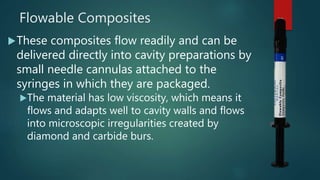
These composites flow readily and can be
delivered directly into cavity preparations by
small needle cannulas attached to the
syringes in which they are packaged.
The material has low viscosity, which means it
flows and adapts well to cavity walls and flows
into microscopic irregularities created by
diamond and carbide burs.
2
Flowable Composites
 Flowables are well suited for conservative dentistry (preventive
resin restorations, AKA sealants).
Some dentist use flowables instead of conventional sealant
material.
 Low-viscosity, light-cured resins
 Lightly (~40%) or heavily (~70%) filled
 The materials that are lightly filled shrink more when polymerized, wear
more readily, and are weaker.
 Initially, the particle size was in the range of those for hybrid
composites. However, Nanosized fillers are also being used in
the flowable composites.
Flowable Composites
 Useful as liners in large cavity preparations, because they adapt to the
preparation better than more viscous materials such as hybrid and packable
composites.
 They have a low elastic modulus
 Allows them to cushion stresses created by polymerization shrinkage or heavy occlusal loads
when they are used as an intermediate layer under hybrid or packable composites.
 The lower the elastic modulus, the more flexible the material; the higher the elastic modulus, the
stiffer the material.
 Flowable composites are useful for restoration of class V Noncarious lesions caused by
toothbrush abrasion, abrasion, acid erosion, or abfraction (from occlusal stresses, such as
bruxing (grinding of teeth), which lead to flexing of the tooth).
 https://youtu.be/-agAsNscOqA
Flowable Composites
 Lightly filled flowable composites:
 shrink more when polymerized (about 4-6%) than the hybrid composites
(<3%)
 Wear more readily
 Are weaker
 They are being improved to make them stronger and more durable
with less shrinkage.
 Some manufacturers have developed self-adhesive flowable composites
that bond directly to dentin without the need for a separate bonding agent,
since the bonding agent is incorporated into the composite.
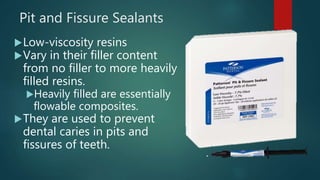
Pit and Fissure Sealants
Low-viscosity resins
Vary in their filler content
from no filler to more heavily
filled resins.
Heavily filled are essentially
flowable composites.
They are used to prevent
dental caries in pits and
fissures of teeth.
6
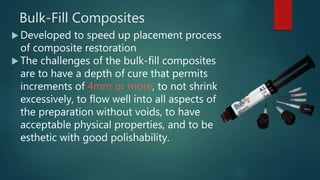
Bulk-Fill Composites
 Developed to speed up placement process
of composite restoration
 The challenges of the bulk-fill composites
are to have a depth of cure that permits
increments of 4mm or more, to not shrink
excessively, to flow well into all aspects of
the preparation without voids, to have
acceptable physical properties, and to be
esthetic with good polishability.
Bulk-Fill Composites
 To achieve a greater depth of cure, manufacturers have
increased the translucency, or reduced the amount of filler, or
changed the chemical makeup to enhance polymerization
when curing is initiated.
 Available in two consistencies:
Flowable and Viscous nanohybrids
Flowables adapt well to the internal portions of the preparations, whereas
viscous nanohybrids must be carefully manipulated into the line angles and
undercut areas.
 https://youtu.be/avLE33WfncE
Bulk-Fill Composites
 Has limitations on its use in the proximal box of class II restorations, because
the depth of the box is often 6 to 7mm, far beyond curing capability.
 More than one increment (40-60 second) should be used in the proximal box
 Polymerization shrinkage has been reduced by adding special modifiers
that relieve stress in the restoration during curing or by adjusting the
size, number, and composition of the filler.
 The shrinkage for bulk-fill composites is in the range found with other high-viscosity
composites (1.3 to 2.4%)
 Bulk-fill with increased translucency or less filler may need to be covered with
a Nanohybrid or nanocompisite in order to achieve esthetics and wear
resistance.
 Shade selection is limited
 Only 4 shades to choose from
Bulk-Fill Composites
 To achieve the desired depth of cure (4mm or more), the curing light
must be used for the recommended time.
 The curing light output should be tested periodically with a radiometer
to make sure that the output of the unit has not deteriorated,
 The light tip needs to be free of residual composite debris that could
limit the transmission of light
 Light exposure times for fast-curing lights such as an argon laser or
plasma arc curing light, typically suggested 5-10 seconds for curing,
may be too short to adequately cure bulk composite to this depth, and
time must be extended.
Packable Composites
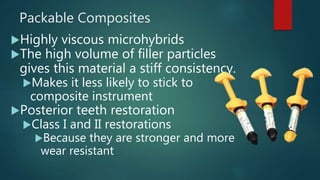
Highly viscous microhybrids
The high volume of filler particles
gives this material a stiff consistency.
Makes it less likely to stick to
composite instrument
Posterior teeth restoration
Class I and II restorations
Because they are stronger and more
wear resistant
11
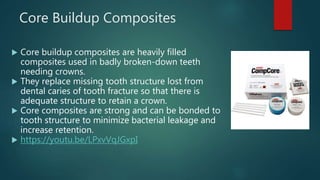
Core Buildup Composites
 Core buildup composites are heavily filled
composites used in badly broken-down teeth
needing crowns.
 They replace missing tooth structure lost from
dental caries of tooth fracture so that there is
adequate structure to retain a crown.
 Core composites are strong and can be bonded to
tooth structure to minimize bacterial leakage and
increase retention.
 https://youtu.be/LPxvVqJGxpI
12
Core Buildup Composite
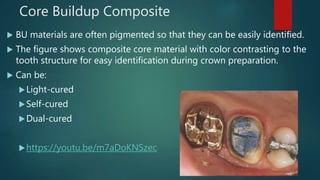
 BU materials are often pigmented so that they can be easily identified.
 The figure shows composite core material with color contrasting to the
tooth structure for easy identification during crown preparation.
 Can be:
Light-cured
Self-cured
Dual-cured
https://youtu.be/m7aDoKNSzec
Core Buildup Composite
 Dentin-colored core materials are used when all-ceramic crowns are to be placed.
 Amalgam would create an esthetically unacceptable dark discoloration under the all-
ceramic crown, as light passes through the porcelain and reflect off the amalgam.
Core Buildup Composite
 Strong and can be bonded to the tooth
structure to minimize bacterial leakage and
increase retention.
 Mechanical retention is still necessary, because
bonding alone is not strong enough to resist forces
placed on the crown.
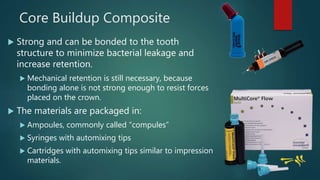
 The materials are packaged in:
 Ampoules, commonly called “compules”
 Syringes with automixing tips
 Cartridges with automixing tips similar to impression
materials.
Provisional Restorative Composites
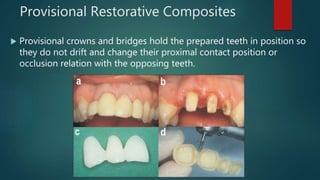
 Provisional crowns and bridges hold the prepared teeth in position so
they do not drift and change their proximal contact position or
occlusion relation with the opposing teeth.
Provisional Restorative Composites
Provisional restorations have the following
functions:
Provide esthetics in the smile zone
Maintain proper speech
Allow proper function for chewing
Maintain proper form for oral hygiene
Protect exposed dentin
Provide good marginal seal
Provisional Restorative Composites
 Until the last decade, acrylic resins (polymethylmethacrylates)
were widely used for the construction of provisional onlays,
crowns and bridges.
 They are Inexpensive, but they also:
Exhibit wear
Shrink upon polymerization
Release heat upon polymerization
Have an unpleasant odor and taste
Can discolor
Messy to use
Provisional Restorative Composites
 Newer provisional materials made with bis-acrylics
and rubberized urethane have improved the physical
and mechanical properties.
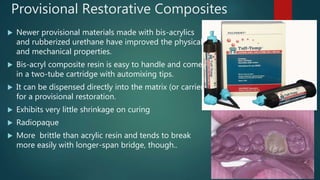
 Bis-acryl composite resin is easy to handle and comes
in a two-tube cartridge with automixing tips.
 It can be dispensed directly into the matrix (or carrier)
for a provisional restoration.
 Exhibits very little shrinkage on curing
 Radiopaque
 More brittle than acrylic resin and tends to break
more easily with longer-span bridge, though..
Provisional Restorative Composites
 Rubberized urethane is a new type of provisional composite resin that is
similar to bis-acrylic in its setting characteristic, radiopacity, and curing
shrinkage.
 However, many of its properties have been improved because of the
addition of rubber molecule to the diurethane resin.
 It has an increased flexural strength and is less brittle, so it hold sup better for
longer-span bridges.
 It is more impact resistant under occlusal loading an dis more flexible
 Easy to insert and remove
Provisional Restorative Composites
 Both bis-acrylic and rubberized urethane materials are available in several shades.
 They are dual-cured materials, so they can be chemically cured (about 90-120 seconds)
 If a clear matrix is used, they can be light cured too!
 Why only if a clear matrix is used??
 They can be repaired easily with flowable composite to add to contact areas and margins.
 Can be shaped and adjusted with acrylic burs, abrasive discs and finishing diamonds.
 They can be polished with abrasive rubber points or wheels and polishing pastes or painted
with resin glaze to provide a smooth, shiny surface.
 https://youtu.be/U-eVSg1Ty8U?t=21
Four Classification Methods for Composites
Classification Method Microfill Microhybrid Nanocomposite Flowable Hyrbid
Filler amount (Volume%) 30-50 60-70 78 30-55
Particle Size (µm) Macro (10-100) Fine(0.1-10 Micro (0.01-0.1) Nano( 0.001-0.01)
Matrix Composition Bis-GMA Bis-GMA or UDMA Silorane(Low Shrinkage) Bis-GMA or UDMA
Polymerization Method Self- or Light-
cured
Self- or Light-cured Light-cured Light-cured
General Information
 Some composites give off heat when cured.
Exothermic reaction
 To avoid shrinkage, composite resins should be placed
into the preparation in small increments
Bulk-filled composites being the exception.
7 different types of composites
 https://youtu.be/eLbqjxFaKaQ

Types of Composites

  • 1.
    Types of Composites FLOWABLE,SEALANTS, BULK-FILL, PACKABLE, CORE BUILD-UP, PROVISIONAL
  • 2.
    Flowable Composites These compositesflow readily and can be delivered directly into cavity preparations by small needle cannulas attached to the syringes in which they are packaged. The material has low viscosity, which means it flows and adapts well to cavity walls and flows into microscopic irregularities created by diamond and carbide burs. 2
  • 3.
    Flowable Composites  Flowablesare well suited for conservative dentistry (preventive resin restorations, AKA sealants). Some dentist use flowables instead of conventional sealant material.  Low-viscosity, light-cured resins  Lightly (~40%) or heavily (~70%) filled  The materials that are lightly filled shrink more when polymerized, wear more readily, and are weaker.  Initially, the particle size was in the range of those for hybrid composites. However, Nanosized fillers are also being used in the flowable composites.
  • 4.
    Flowable Composites  Usefulas liners in large cavity preparations, because they adapt to the preparation better than more viscous materials such as hybrid and packable composites.  They have a low elastic modulus  Allows them to cushion stresses created by polymerization shrinkage or heavy occlusal loads when they are used as an intermediate layer under hybrid or packable composites.  The lower the elastic modulus, the more flexible the material; the higher the elastic modulus, the stiffer the material.  Flowable composites are useful for restoration of class V Noncarious lesions caused by toothbrush abrasion, abrasion, acid erosion, or abfraction (from occlusal stresses, such as bruxing (grinding of teeth), which lead to flexing of the tooth).  https://youtu.be/-agAsNscOqA
  • 5.
    Flowable Composites  Lightlyfilled flowable composites:  shrink more when polymerized (about 4-6%) than the hybrid composites (<3%)  Wear more readily  Are weaker  They are being improved to make them stronger and more durable with less shrinkage.  Some manufacturers have developed self-adhesive flowable composites that bond directly to dentin without the need for a separate bonding agent, since the bonding agent is incorporated into the composite.
  • 6.
    Pit and FissureSealants Low-viscosity resins Vary in their filler content from no filler to more heavily filled resins. Heavily filled are essentially flowable composites. They are used to prevent dental caries in pits and fissures of teeth. 6
  • 7.
    Bulk-Fill Composites  Developedto speed up placement process of composite restoration  The challenges of the bulk-fill composites are to have a depth of cure that permits increments of 4mm or more, to not shrink excessively, to flow well into all aspects of the preparation without voids, to have acceptable physical properties, and to be esthetic with good polishability.
  • 8.
    Bulk-Fill Composites  Toachieve a greater depth of cure, manufacturers have increased the translucency, or reduced the amount of filler, or changed the chemical makeup to enhance polymerization when curing is initiated.  Available in two consistencies: Flowable and Viscous nanohybrids Flowables adapt well to the internal portions of the preparations, whereas viscous nanohybrids must be carefully manipulated into the line angles and undercut areas.  https://youtu.be/avLE33WfncE
  • 9.
    Bulk-Fill Composites  Haslimitations on its use in the proximal box of class II restorations, because the depth of the box is often 6 to 7mm, far beyond curing capability.  More than one increment (40-60 second) should be used in the proximal box  Polymerization shrinkage has been reduced by adding special modifiers that relieve stress in the restoration during curing or by adjusting the size, number, and composition of the filler.  The shrinkage for bulk-fill composites is in the range found with other high-viscosity composites (1.3 to 2.4%)  Bulk-fill with increased translucency or less filler may need to be covered with a Nanohybrid or nanocompisite in order to achieve esthetics and wear resistance.  Shade selection is limited  Only 4 shades to choose from
  • 10.
    Bulk-Fill Composites  Toachieve the desired depth of cure (4mm or more), the curing light must be used for the recommended time.  The curing light output should be tested periodically with a radiometer to make sure that the output of the unit has not deteriorated,  The light tip needs to be free of residual composite debris that could limit the transmission of light  Light exposure times for fast-curing lights such as an argon laser or plasma arc curing light, typically suggested 5-10 seconds for curing, may be too short to adequately cure bulk composite to this depth, and time must be extended.
  • 11.
    Packable Composites Highly viscousmicrohybrids The high volume of filler particles gives this material a stiff consistency. Makes it less likely to stick to composite instrument Posterior teeth restoration Class I and II restorations Because they are stronger and more wear resistant 11
  • 12.
    Core Buildup Composites Core buildup composites are heavily filled composites used in badly broken-down teeth needing crowns.  They replace missing tooth structure lost from dental caries of tooth fracture so that there is adequate structure to retain a crown.  Core composites are strong and can be bonded to tooth structure to minimize bacterial leakage and increase retention.  https://youtu.be/LPxvVqJGxpI 12
  • 13.
    Core Buildup Composite BU materials are often pigmented so that they can be easily identified.  The figure shows composite core material with color contrasting to the tooth structure for easy identification during crown preparation.  Can be: Light-cured Self-cured Dual-cured https://youtu.be/m7aDoKNSzec
  • 14.
    Core Buildup Composite Dentin-colored core materials are used when all-ceramic crowns are to be placed.  Amalgam would create an esthetically unacceptable dark discoloration under the all- ceramic crown, as light passes through the porcelain and reflect off the amalgam.
  • 15.
    Core Buildup Composite Strong and can be bonded to the tooth structure to minimize bacterial leakage and increase retention.  Mechanical retention is still necessary, because bonding alone is not strong enough to resist forces placed on the crown.  The materials are packaged in:  Ampoules, commonly called “compules”  Syringes with automixing tips  Cartridges with automixing tips similar to impression materials.
  • 16.
    Provisional Restorative Composites Provisional crowns and bridges hold the prepared teeth in position so they do not drift and change their proximal contact position or occlusion relation with the opposing teeth.
  • 17.
    Provisional Restorative Composites Provisionalrestorations have the following functions: Provide esthetics in the smile zone Maintain proper speech Allow proper function for chewing Maintain proper form for oral hygiene Protect exposed dentin Provide good marginal seal
  • 18.
    Provisional Restorative Composites Until the last decade, acrylic resins (polymethylmethacrylates) were widely used for the construction of provisional onlays, crowns and bridges.  They are Inexpensive, but they also: Exhibit wear Shrink upon polymerization Release heat upon polymerization Have an unpleasant odor and taste Can discolor Messy to use
  • 19.
    Provisional Restorative Composites Newer provisional materials made with bis-acrylics and rubberized urethane have improved the physical and mechanical properties.  Bis-acryl composite resin is easy to handle and comes in a two-tube cartridge with automixing tips.  It can be dispensed directly into the matrix (or carrier) for a provisional restoration.  Exhibits very little shrinkage on curing  Radiopaque  More brittle than acrylic resin and tends to break more easily with longer-span bridge, though..
  • 20.
    Provisional Restorative Composites Rubberized urethane is a new type of provisional composite resin that is similar to bis-acrylic in its setting characteristic, radiopacity, and curing shrinkage.  However, many of its properties have been improved because of the addition of rubber molecule to the diurethane resin.  It has an increased flexural strength and is less brittle, so it hold sup better for longer-span bridges.  It is more impact resistant under occlusal loading an dis more flexible  Easy to insert and remove
  • 21.
    Provisional Restorative Composites Both bis-acrylic and rubberized urethane materials are available in several shades.  They are dual-cured materials, so they can be chemically cured (about 90-120 seconds)  If a clear matrix is used, they can be light cured too!  Why only if a clear matrix is used??  They can be repaired easily with flowable composite to add to contact areas and margins.  Can be shaped and adjusted with acrylic burs, abrasive discs and finishing diamonds.  They can be polished with abrasive rubber points or wheels and polishing pastes or painted with resin glaze to provide a smooth, shiny surface.  https://youtu.be/U-eVSg1Ty8U?t=21
  • 22.
    Four Classification Methodsfor Composites Classification Method Microfill Microhybrid Nanocomposite Flowable Hyrbid Filler amount (Volume%) 30-50 60-70 78 30-55 Particle Size (µm) Macro (10-100) Fine(0.1-10 Micro (0.01-0.1) Nano( 0.001-0.01) Matrix Composition Bis-GMA Bis-GMA or UDMA Silorane(Low Shrinkage) Bis-GMA or UDMA Polymerization Method Self- or Light- cured Self- or Light-cured Light-cured Light-cured
  • 23.
    General Information  Somecomposites give off heat when cured. Exothermic reaction  To avoid shrinkage, composite resins should be placed into the preparation in small increments Bulk-filled composites being the exception.
  • 24.
    7 different typesof composites  https://youtu.be/eLbqjxFaKaQ