©2013 Delmar, Cengage Learning. All Rights Reserved. May not be scanned,
copied, duplicated, or posted to a publicly accessible website, in whole or in part.
Chapter 9
Hyperventilation
©2013 Delmar, Cengage Learning. All Rights Reserved. May not be scanned,
copied, duplicated, or posted to a publicly accessible website, in whole or in part.
Objectives
• Upon completion of this chapter, you will
be able to:
– Define hyperventilation
– Describe the signs and symptoms of
hyperventilation
– Explain the causes of hyperventilation
2
©2013 Delmar, Cengage Learning. All Rights Reserved. May not be scanned,
copied, duplicated, or posted to a publicly accessible website, in whole or in part.
Objectives (cont’d.)
– Explain the treatment of hyperventilation
– Describe the best way to prevent
hyperventilation
3
©2013 Delmar, Cengage Learning. All Rights Reserved. May not be scanned,
copied, duplicated, or posted to a publicly accessible website, in whole or in part.
Introduction
• Hyperventilation: an increase in the rate or
depth of breathing that results in a change
in the blood chemistry
– Usually occurs as a result of anxiety
– A common emergency in the dental office
since dental visits can cause anxiety for some
people
4
©2013 Delmar, Cengage Learning. All Rights Reserved. May not be scanned,
copied, duplicated, or posted to a publicly accessible website, in whole or in part.
Causes
• Most common cause is anxiety
• Can also be caused by:
– Certain physical conditions
– Emotional upset
– Stress
5
©2013 Delmar, Cengage Learning. All Rights Reserved. May not be scanned,
copied, duplicated, or posted to a publicly accessible website, in whole or in part.
Causes (cont’d.)
• Hyperventilation occurs most often in
patients who hide their feelings and do not
admit their fears of dentistry
– Anxiety builds until they are no longer able to
control it
• Not usually seen in children
– Children tend to cry or scream when fearful
preventing hyperventilation
6
©2013 Delmar, Cengage Learning. All Rights Reserved. May not be scanned,
copied, duplicated, or posted to a publicly accessible website, in whole or in part.
Physiology
• Carbon dioxide in the blood automatically
triggers the breathing reflex and stimulates
respiration
• A person hyperventilating increases the
depth and rate of respirations and exhale
a large amount of carbon dioxide
– Suffer from a lack of carbon dioxide
– Must work consciously to inhale and exhale
7
©2013 Delmar, Cengage Learning. All Rights Reserved. May not be scanned,
copied, duplicated, or posted to a publicly accessible website, in whole or in part.
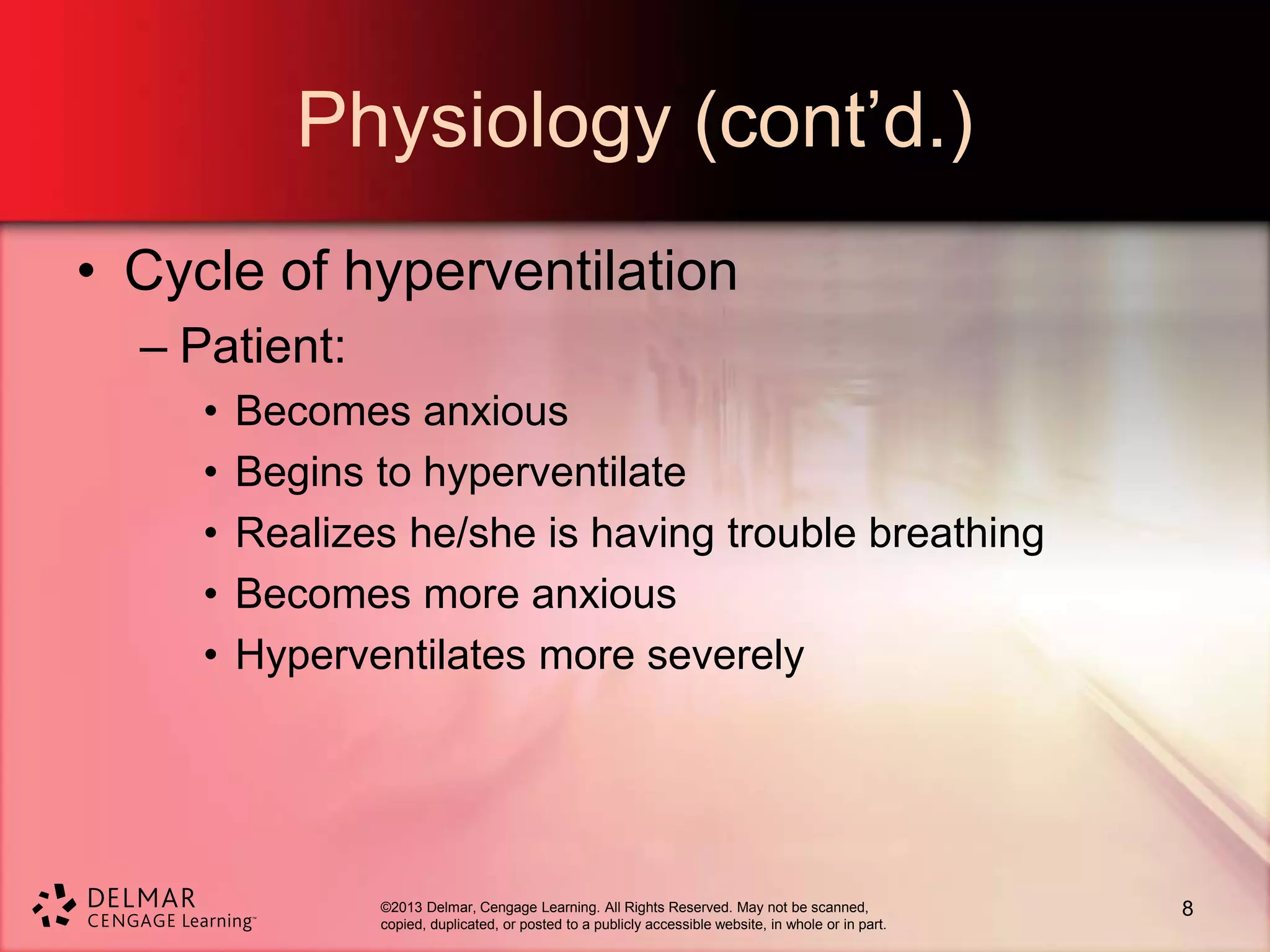
Physiology (cont’d.)
• Cycle of hyperventilation
– Patient:
• Becomes anxious
• Begins to hyperventilate
• Realizes he/she is having trouble breathing
• Becomes more anxious
• Hyperventilates more severely
8
©2013 Delmar, Cengage Learning. All Rights Reserved. May not be scanned,
copied, duplicated, or posted to a publicly accessible website, in whole or in part.
Physiology (cont’d.)
– Cycle continues until dental team recognizes
the problem, intervenes, and attempts to calm
the patient
9
©2013 Delmar, Cengage Learning. All Rights Reserved. May not be scanned,
copied, duplicated, or posted to a publicly accessible website, in whole or in part.
Signs and Symptoms
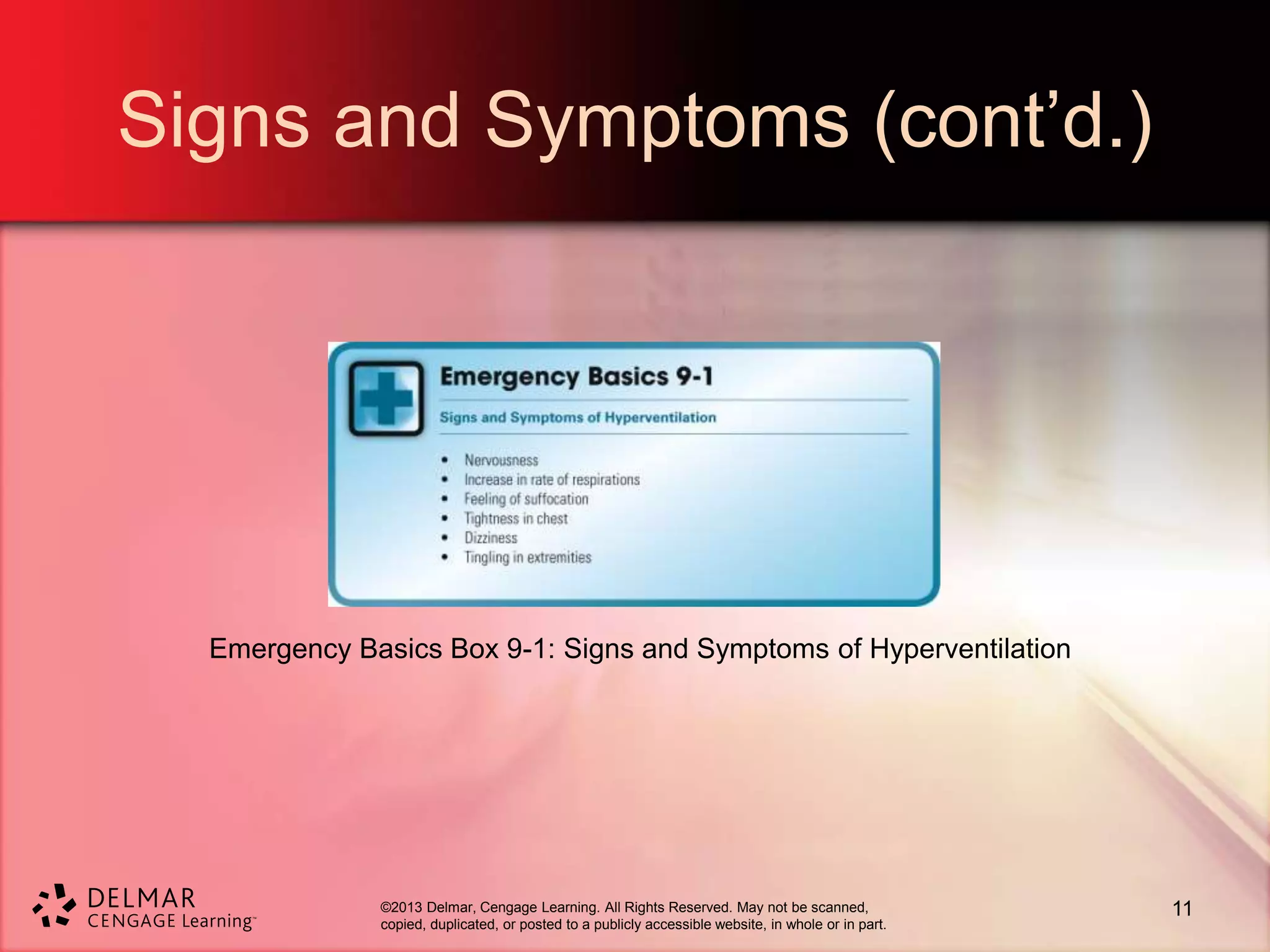
• Patient:
– Appears anxious
– Begins to breathe faster and deeper
– Usually does not realize the change in
breathing
– May complain of chest tightness or suffocation
– May experience dizziness and tingling in the
extremities
10
©2013 Delmar, Cengage Learning. All Rights Reserved. May not be scanned,
copied, duplicated, or posted to a publicly accessible website, in whole or in part.
Signs and Symptoms (cont’d.)
Emergency Basics Box 9-1: Signs and Symptoms of Hyperventilation
11
©2013 Delmar, Cengage Learning. All Rights Reserved. May not be scanned,
copied, duplicated, or posted to a publicly accessible website, in whole or in part.
Treatment
• Stop all dental treatment
– Remove all materials and instruments from
the patient’s mouth
• Position the patient upright
– Patient will be more comfortable if seated
upright
12
©2013 Delmar, Cengage Learning. All Rights Reserved. May not be scanned,
copied, duplicated, or posted to a publicly accessible website, in whole or in part.
Treatment (cont’d.)
• Attempt to calm the patient
– Explain the condition to the patient
– Tell the patient to inhale and hold their breath
for several seconds prior to exhaling
• If the patient is too upset to hold their
breath, use other techniques
– Have the patient breathe into a paper bag
– Allow the patient to hold the paper bag
13
©2013 Delmar, Cengage Learning. All Rights Reserved. May not be scanned,
copied, duplicated, or posted to a publicly accessible website, in whole or in part.
Treatment (cont’d.)
• Do not administer oxygen
– Patient has too much oxygen and not enough
carbon dioxide
• The dentist may have to administer an
anti-anxiety medication
– If the patient is experiencing a severe
hyperventilation episode
14
©2013 Delmar, Cengage Learning. All Rights Reserved. May not be scanned,
copied, duplicated, or posted to a publicly accessible website, in whole or in part.
Summary
• Hyperventilation usually occurs in the
dental office because of anxiety
• Important for the dental team to determine
what the patient fears about dentistry
– Can help prevent future episodes of
hyperventilation
15

Chapter 9- Hyperventilation

  • 1.
    ©2013 Delmar, CengageLearning. All Rights Reserved. May not be scanned, copied, duplicated, or posted to a publicly accessible website, in whole or in part. Chapter 9 Hyperventilation
  • 2.
    ©2013 Delmar, CengageLearning. All Rights Reserved. May not be scanned, copied, duplicated, or posted to a publicly accessible website, in whole or in part. Objectives • Upon completion of this chapter, you will be able to: – Define hyperventilation – Describe the signs and symptoms of hyperventilation – Explain the causes of hyperventilation 2
  • 3.
    ©2013 Delmar, CengageLearning. All Rights Reserved. May not be scanned, copied, duplicated, or posted to a publicly accessible website, in whole or in part. Objectives (cont’d.) – Explain the treatment of hyperventilation – Describe the best way to prevent hyperventilation 3
  • 4.
    ©2013 Delmar, CengageLearning. All Rights Reserved. May not be scanned, copied, duplicated, or posted to a publicly accessible website, in whole or in part. Introduction • Hyperventilation: an increase in the rate or depth of breathing that results in a change in the blood chemistry – Usually occurs as a result of anxiety – A common emergency in the dental office since dental visits can cause anxiety for some people 4
  • 5.
    ©2013 Delmar, CengageLearning. All Rights Reserved. May not be scanned, copied, duplicated, or posted to a publicly accessible website, in whole or in part. Causes • Most common cause is anxiety • Can also be caused by: – Certain physical conditions – Emotional upset – Stress 5
  • 6.
    ©2013 Delmar, CengageLearning. All Rights Reserved. May not be scanned, copied, duplicated, or posted to a publicly accessible website, in whole or in part. Causes (cont’d.) • Hyperventilation occurs most often in patients who hide their feelings and do not admit their fears of dentistry – Anxiety builds until they are no longer able to control it • Not usually seen in children – Children tend to cry or scream when fearful preventing hyperventilation 6
  • 7.
    ©2013 Delmar, CengageLearning. All Rights Reserved. May not be scanned, copied, duplicated, or posted to a publicly accessible website, in whole or in part. Physiology • Carbon dioxide in the blood automatically triggers the breathing reflex and stimulates respiration • A person hyperventilating increases the depth and rate of respirations and exhale a large amount of carbon dioxide – Suffer from a lack of carbon dioxide – Must work consciously to inhale and exhale 7
  • 8.
    ©2013 Delmar, CengageLearning. All Rights Reserved. May not be scanned, copied, duplicated, or posted to a publicly accessible website, in whole or in part. Physiology (cont’d.) • Cycle of hyperventilation – Patient: • Becomes anxious • Begins to hyperventilate • Realizes he/she is having trouble breathing • Becomes more anxious • Hyperventilates more severely 8
  • 9.
    ©2013 Delmar, CengageLearning. All Rights Reserved. May not be scanned, copied, duplicated, or posted to a publicly accessible website, in whole or in part. Physiology (cont’d.) – Cycle continues until dental team recognizes the problem, intervenes, and attempts to calm the patient 9
  • 10.
    ©2013 Delmar, CengageLearning. All Rights Reserved. May not be scanned, copied, duplicated, or posted to a publicly accessible website, in whole or in part. Signs and Symptoms • Patient: – Appears anxious – Begins to breathe faster and deeper – Usually does not realize the change in breathing – May complain of chest tightness or suffocation – May experience dizziness and tingling in the extremities 10
  • 11.
    ©2013 Delmar, CengageLearning. All Rights Reserved. May not be scanned, copied, duplicated, or posted to a publicly accessible website, in whole or in part. Signs and Symptoms (cont’d.) Emergency Basics Box 9-1: Signs and Symptoms of Hyperventilation 11
  • 12.
    ©2013 Delmar, CengageLearning. All Rights Reserved. May not be scanned, copied, duplicated, or posted to a publicly accessible website, in whole or in part. Treatment • Stop all dental treatment – Remove all materials and instruments from the patient’s mouth • Position the patient upright – Patient will be more comfortable if seated upright 12
  • 13.
    ©2013 Delmar, CengageLearning. All Rights Reserved. May not be scanned, copied, duplicated, or posted to a publicly accessible website, in whole or in part. Treatment (cont’d.) • Attempt to calm the patient – Explain the condition to the patient – Tell the patient to inhale and hold their breath for several seconds prior to exhaling • If the patient is too upset to hold their breath, use other techniques – Have the patient breathe into a paper bag – Allow the patient to hold the paper bag 13
  • 14.
    ©2013 Delmar, CengageLearning. All Rights Reserved. May not be scanned, copied, duplicated, or posted to a publicly accessible website, in whole or in part. Treatment (cont’d.) • Do not administer oxygen – Patient has too much oxygen and not enough carbon dioxide • The dentist may have to administer an anti-anxiety medication – If the patient is experiencing a severe hyperventilation episode 14
  • 15.
    ©2013 Delmar, CengageLearning. All Rights Reserved. May not be scanned, copied, duplicated, or posted to a publicly accessible website, in whole or in part. Summary • Hyperventilation usually occurs in the dental office because of anxiety • Important for the dental team to determine what the patient fears about dentistry – Can help prevent future episodes of hyperventilation 15