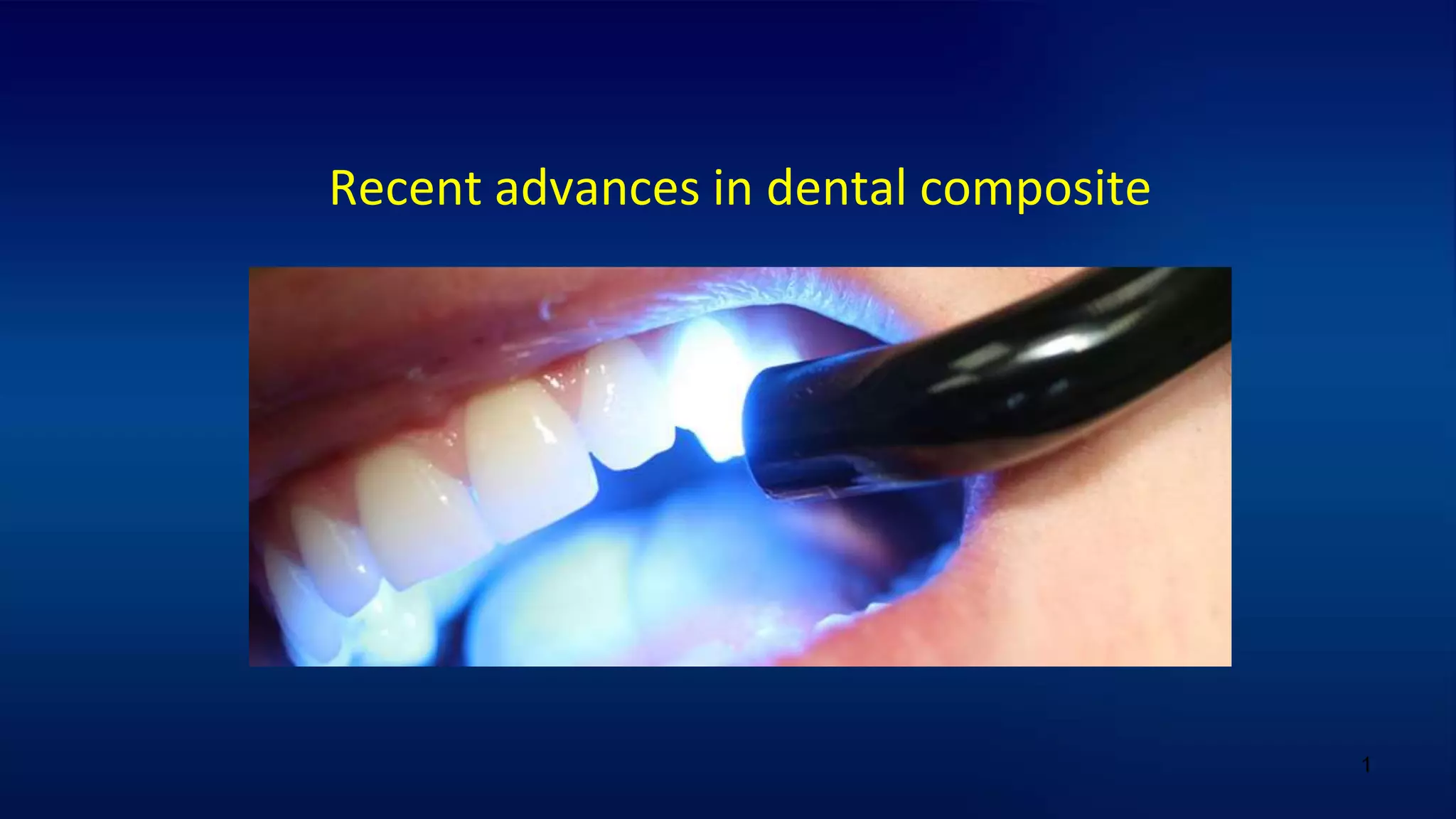
Recent advances in dental composite
1
2
3
Fillers inside composite resin
1 4
3
2
4
Fillers Resin matrix
Advantages Disadvantages
* ↑Filler amount →
↑strength & viscosity
* ↓Filler size →
↑smoothness & esthetics
* ↑ Polymerization shrinkage
(major disadv. of composite)
* ↑ Water sorption →
↑ staining (↑discoloration)
5
Disadvantages of Conventional Composite Resin
6
 Polymerization Shrinkage (major disadvantage) →
* Microleakage
* Post-operative sensitivity (pain)
* Marginal discoloration
* Recurrent caries
 Technique sensitive & time consuming (incremental placement)
7
Notes
8
 ↑ Filler loading (amount, content) → ↓ resin content → ↓ problems of resin,
such as:
* ↓ Polymerization shrinkage.
* ↓ Water sorption → ↓ Staining (↓ discoloration).
 ↑ Filler loading →
* ↑ Mechanical properties (strength, hardness, wear resistance).
* ↑ Viscosity → Improve workability (give body to the material).
 ↓ Filler size → ↑ smoothness & better esthetics.
Items to be covered
9
* Dental cement: composite resin cement
* Restoration
1. Direct composite Restoration
- Combination between composite & GIC: Compomer & Giomer
- According to viscosity: Flowable & Packable (condensable) composite
- Ormocer
- Smart composite
- Novel trends in direct composite restorations
* Nano-filled * Silorane (low-shrink) * Bulk-fill * Cention N
2. Indirect composite restoration → Just for reading (Reading only)
Composite resin cement
10
 The first trial to use the resin as cement was unfilled resin (without filler)
 but it showed Some drawbacks (disadvantages), such as:
* Polymerization shrinkage (due to high resin content)
* Irritation
 So, they tried to use filled composite (contains filler) as cement.
 It had high filler loading (60 wt %).
 Types: visible light cure, chemical and dual cure.
Composite resin cement (continued)
11
a. Visible light cured (VLC) type
-There is no difference in its composition from VLC composite restoration.
- Present in different shades.
b. Dual cure composite cement
- This material has the ability to polymerize even in absence of light source.
- Indications (uses): cementation of endodontic post and ceramic inlay & crowns.
c. Chemical cured composite cement
- Initiator: benzoyl peroxide. - Activator: tertiary amine.
- Indication: Mainly used for luting (cementation) of metallic restoration
- Contains 4-META (methacryloxy ethyl trimellitic anhydrite).
- Good bond with metal restoration.
Composite resin cement (continued)
12
GENERAL PROPERTIES (in comparison with other dental cements)
1- Good biological properties, if there is a good degree of curing →
↓ residual monomer
2- No adhesion (chemical bond) with tooth structure, but ………
3- Low degree of solubility in the oral fluids, but there are some
inhibition of polymerization caused by moisture & saliva, so it is very
important to apply air inhibition gel.
4- Good esthetic quality.
5- Good compressive and tensile strength.
Composite resin cement (continued)
13
Note: the material of choice (the best material) for cementation
of all-ceramic (translucent) restoration is composite resin
cement, why?
 ↑ Strength & ↓ solubility
 Translucent & good esthetics
 Good bond strength
POLY ACID-MODIFIED COMPOSITE (COMPOMER)
14
 A type of composite which is modified by application of
polyacrylic acid
 Not a glass ionomer material
 Light-cured low fluoride-releasing composite resins
 The term compomer is derived from the words
composite & glass ionomer
15
Compomer (continued)
 Composition
- UDMA
- Polyacid-modified monomer = TCB (HEMA and butane carboxylic
acid)
- Strontium alumino fluorosilicate glass
- Others: initiator & pigments
 Uses
- Mainly used in low stress-bearing areas (class III & V)
16
Compomer (continued)
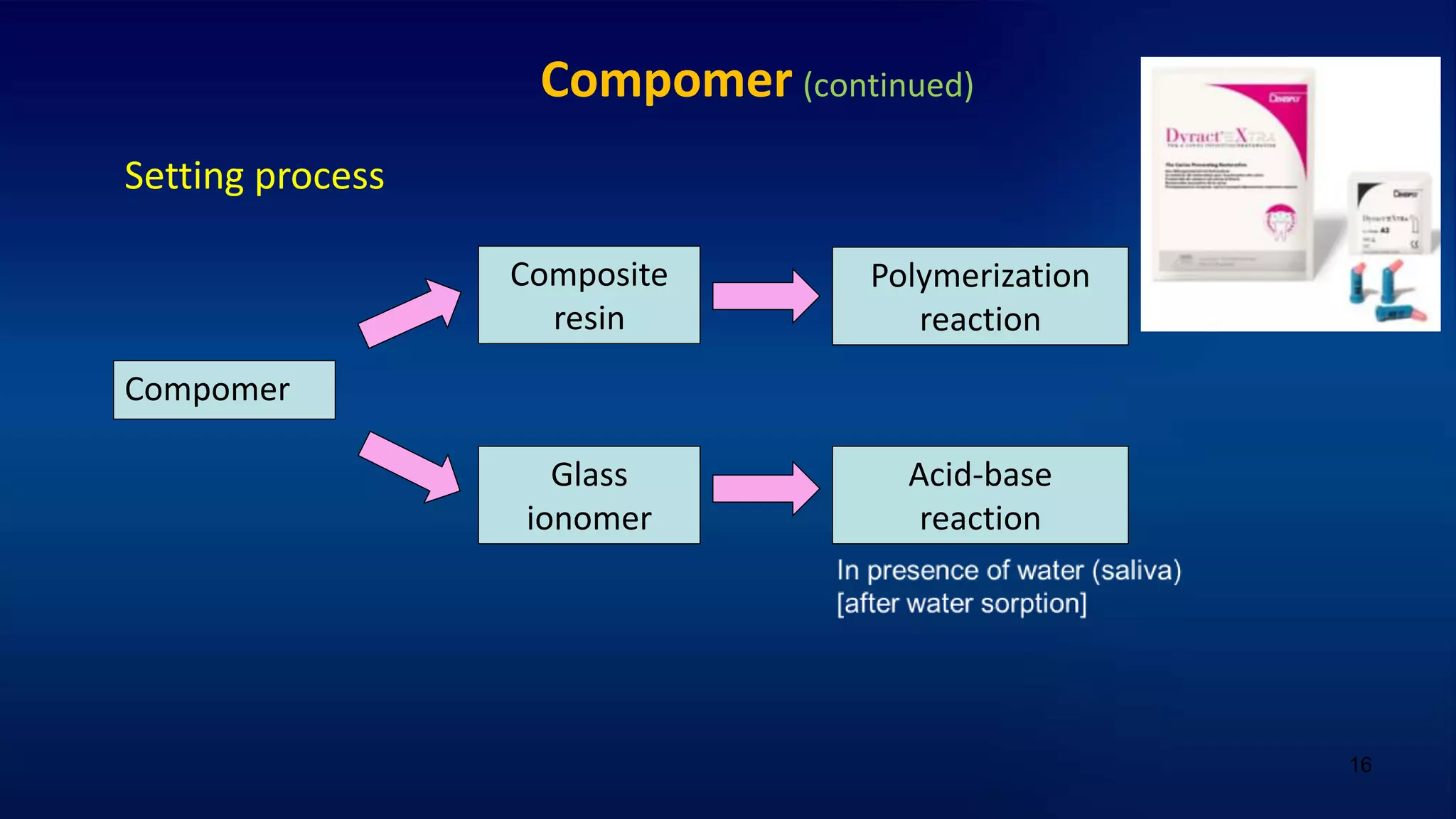
Setting process
Compomer
Composite
resin
Glass
ionomer
Polymerization
reaction
Acid-base
reaction
17
Compomer (continued)
Disadvantages
1- Fl release: lower than glass ionomer (10% of that released by glass ionomer)
- Lower amount & duration of Fl release
- No recharge from fluoride treatment [Textbook: Craig 14 ed 2019]
2- Bond: still needs etching & dentin bonding agent prior to its placement
3- Esthetic: lower than composite resin.
- Lower color stability: due to change in refractive index by
water absorption & staining [Textbook: Phillips 12 ed 2013]
4- Wear resistance: lower than composite resin
GIOMER
18
Pre-reacted glass ionomer (PRG)
 Fluoro aluminosilicate glass reacted with polyacrylic acid prior to (before)
inclusion into the silica gel urethane resin.
 Should be classified as a light cured composite.
 Differ from compomer (give reason)
* because in giomer, the acid base reaction has already
occurred. While in compomer, ………..
 Not classified as compomer (give reason) ………
19
GIOMER (PRG) [continued]
Indications (uses)
 Restoration (filling) of root caries
 Class III & V cavities
Advantages
1- Fl release & recharge
2- Biocompatible
3- Excellent esthetic
& smooth surface finish
20
Flowable composite
 Flowable = has high flow …… Why??
 Low filler loading (50%) →
* ↓ viscosity & ↑ flow → [ Pit & fissure sealant ]
* ↓ modulus of elasticity & ↑ flexibility →
stress breaker (absorb stresses) → [ Liner under class I & II ]
* ↓ mechanical properties → [ Non stress-bearing areas ]
* ↑ resin amount → ↑ polymerization shrinkage
21
Flowable composite
Indications (uses)
 Pit and fissure sealant ……. Why ??
 Liner under class I & II composites …….. Why??
 Class V restorations (non stress-bearing areas, not incisal & not occlusal) …… Why??
 Repair of broken restoration.
22
Packable composite (condensable composite)
 Packable (condensable) = able to be packed & condensed (like amalgam) → to
produce better proximal contour & contact.
 Interlocking elongated fibers (100 μm) → causes the uncured material to:
* Resist flow (↑ viscosity)
* ↑ Stiffness of uncured material
* Resist slumping, but moldable under condensation forces
Disadvantage
 ↑ viscosity → ↑ probability of voids.
23
Packable composite (condensable composite)
Notes (Phillips 12 ed 2013)
 At present, these materials have not demonstrated any advantageous
properties over the hybrid resin other than being condensable (packable).
 Despite the manufacturers’ claims, packable composites have not proven to
be an answer to the general need for:
* High wear resistance
* Easily placed
* Low polymerization shrinkage
* Depth of cure more than 2 mm
24
Ormocer (organically-modified ceramics)
 Contains inorganic-organic copolymer
 Inorganic: (Si-O-Si) polysiloxane
 Organic: methacrylate groups
 3D cross-linked copolymer
25
Ormocer (organically-modified ceramics)
Advantages
 Presence of inorganic part → ↓ organic part (↓ resin content).
* ↓ Organic part → ↓ polymerization shrinkage.
 Large space between cross-links → ↓ polymerization shrinkage.
26
Smart composite
 Ion-releasing composite: release alkaline ions, e.g. F, Ca, OH.
 Plaque (food) accumulation (caries initiation) = ↓ pH (acidic medium) →
release of alkaline ions → buffer (neutralize) the acids (↓ acidity) →
↓ tooth decomposition (↓ tooth demineralization & decalcification).
Advantages
 Fluoride release → anticariogenic (prevent caries)
Note
 The adhesive will reduce (inhibit) the benefits of fluoride release.
27
Novel trends in composite restoration
1. Nano-filled composite
2. Silorane (low shrinkage) composite
3. Bulk-fill composite
4. Cention N
28
Nano-filled composite
 True nano-composite, not nano-hybrid.
 High filler loading (90 % wt), because it has:
* Nanomers: non agglomerated particles of 20-75 nm.
* Nanoclusters: loosely bound agglomerate that act as single units.
29
Nano-filled composite
 ↑ Filler loading → * ↑ mechanical properties (surface hardness,
flexural strength & modulus of elasticity)
* ↓ resin amount → ↓ polymerization shrinkage
 ↓ Filler size (nanosize) →
* ↑ Smoothness & polishability
* Smaller than wavelength of light → no scattering
or absorption of light → ↑ translucency
30
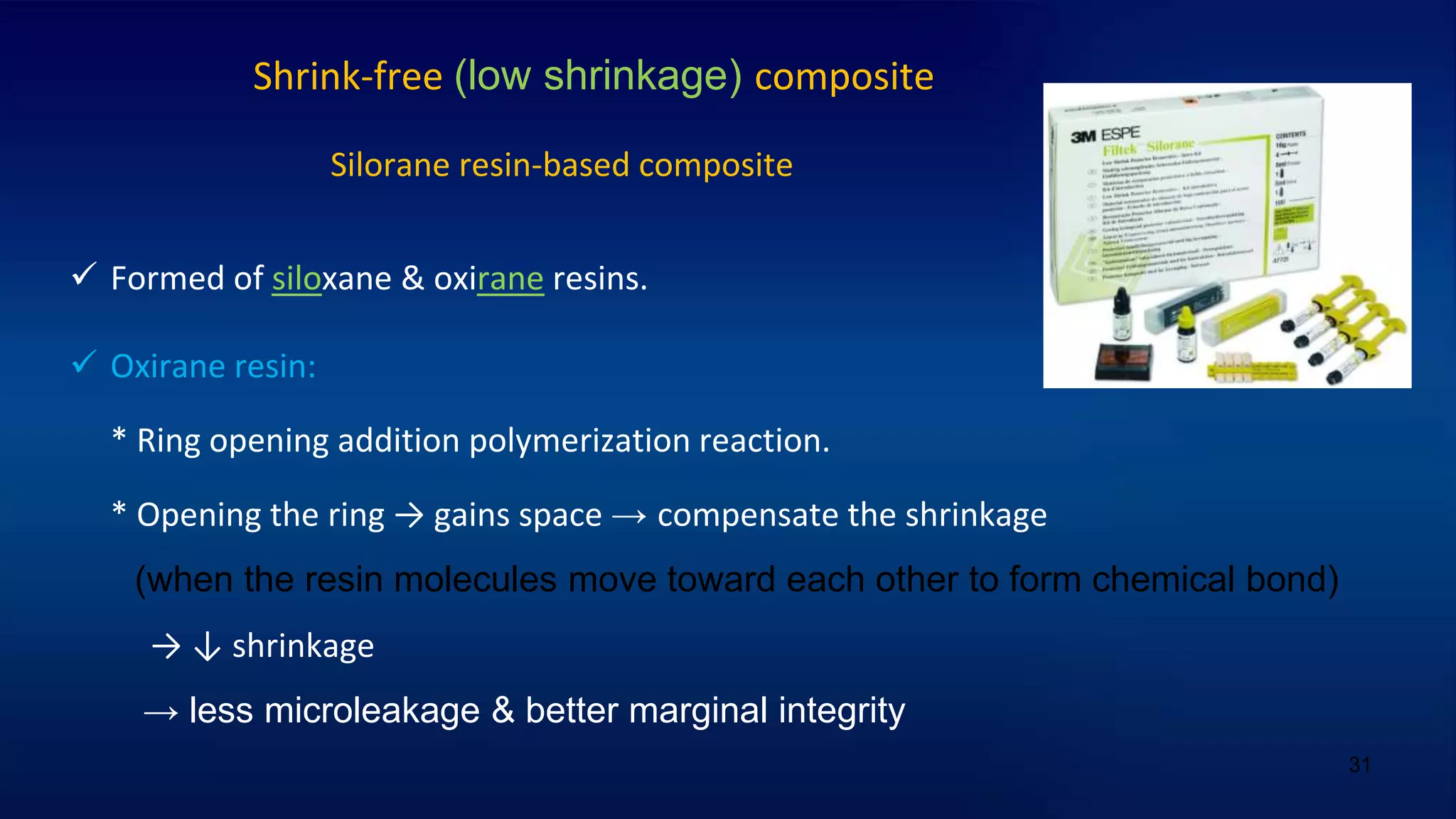
Shrink-free (low shrinkage) composite
Silorane resin-based composite
 Formed of siloxane & oxirane resins.
 Oxirane resin:
* Ring opening addition polymerization reaction.
* Opening the ring → gains space → compensate the shrinkage
(when the resin molecules move toward each other to form chemical bond)
→ ↓ shrinkage
→ less microleakage & better marginal integrity
31
Shrink-free (low shrinkage) composite
Silorane resin-based composite
 Siloxane → hydrophobic → ↓ water sorption & staining (discoloration)
 Silorane needs special adhesive system for bonding, Why?
→ because it is not methacrylate-based composite.
It is silorane-based composite ……….
32
33
Bulk-fill composite
 Bulk fill = bulk increment (layer, 4 mm)
 Can be placed with thickness of 4 mm instead of using
incremental placement (2 mm).
 The depth of cure is increased by:
* High translucency
* Extra initiator
34
Bulk fill composite
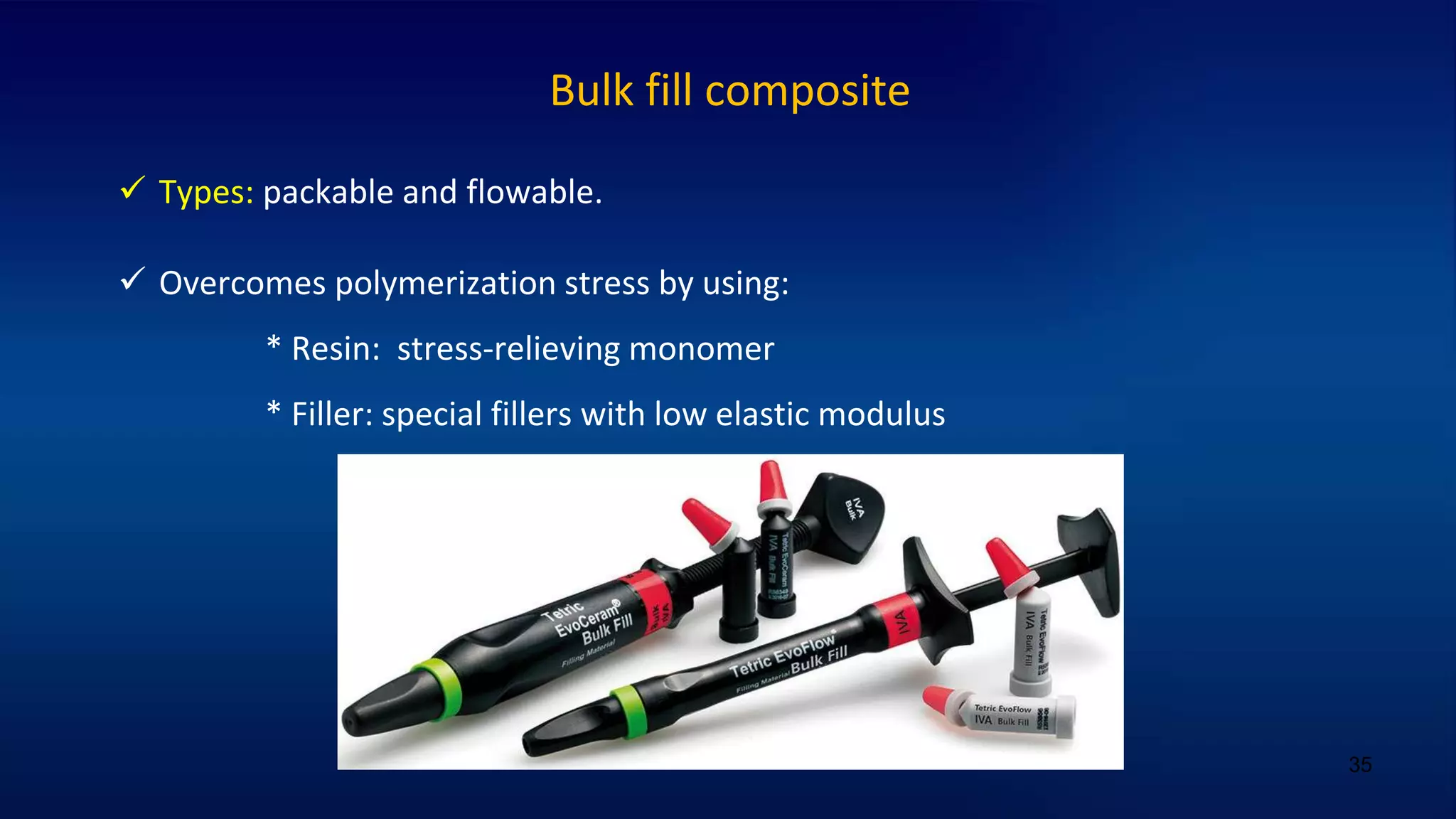
 Types: packable and flowable.
 Overcomes polymerization stress by using:
* Resin: stress-relieving monomer
* Filler: special fillers with low elastic modulus
35
Cention N
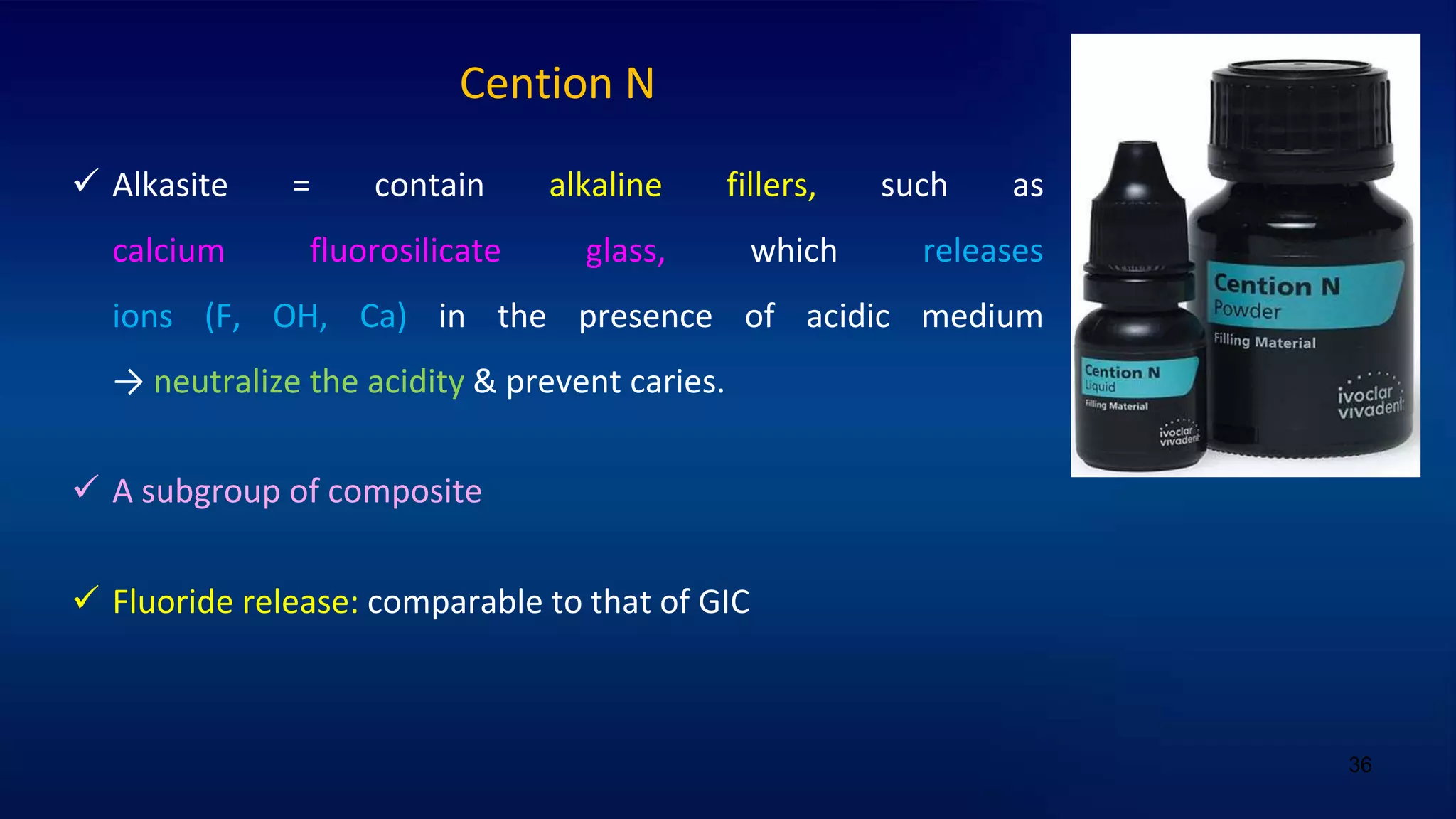
 Alkasite = contain alkaline fillers, such as
calcium fluorosilicate glass, which releases
ions (F, OH, Ca) in the presence of acidic medium
→ neutralize the acidity & prevent caries.
 A subgroup of composite
 Fluoride release: comparable to that of GIC
36
Cention N (continued)
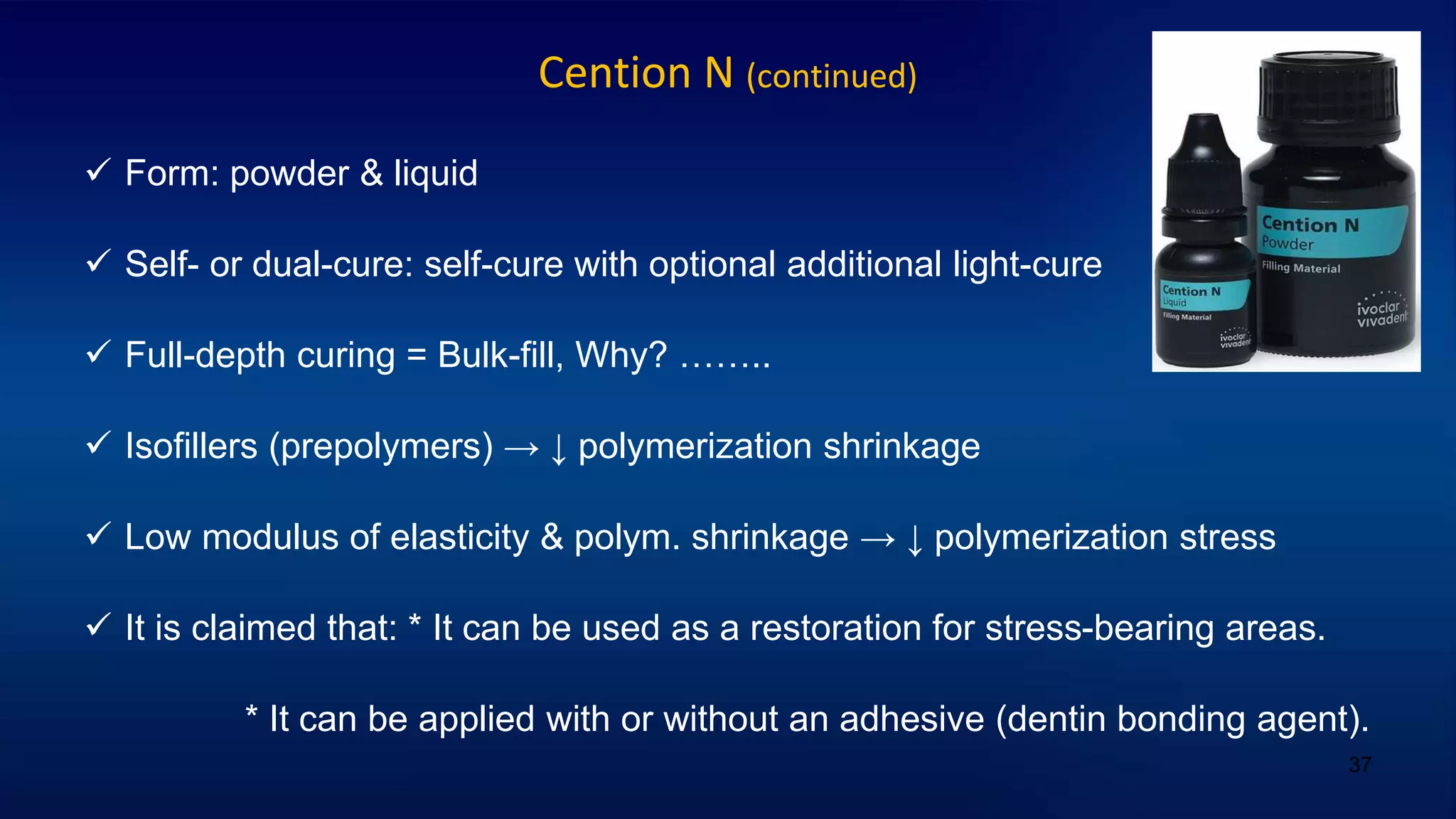
 Form: powder & liquid
 Self- or dual-cure: self-cure with optional additional light-cure
 Full-depth curing = Bulk-fill, Why? ……..
 Isofillers (prepolymers) → ↓ polymerization shrinkage
 Low modulus of elasticity & polym. shrinkage → ↓ polymerization stress
 It is claimed that: * It can be used as a restoration for stress-bearing areas.
* It can be applied with or without an adhesive (dentin bonding agent).
37
38
Indirect composite restoration
An attempt to overcome the disadvantages of direct adhesive
restorations, such as:
 Polymerization shrinkage.
 Inability to obtain proper (correct) anatomical contour,
especially proximal contact.
Just for reading (Reading only)
39
40
Indirect composite restoration(continued)
 Constructed in dental laboratory.
 Good anatomical contour & proximal contact
 The problems with polymerization shrinkage
is not totally eliminated,
→ because there is some doubt about the bond
between the resin luting cement and the
indirect composite.
41
Resin-to-resin bonding
(Introduction to dental materials, p. 229)
 One might imagine that resin-to-resin bonding should be free of
problems, this is, in fact, not the case.
 In particular, there have been problems of debonding between the luting
resin & composite inlay.
 Oxygen inhibition layer does not exist.
 The luting resin has to bond directly to fully cured resins.
 This is similar to repairing a fractured composite restoration with new
composite resin.
42
Resin-to-resin bonding (continued)
 Roughened by grit-blasting (alumina sandlasting).
 Phosphoric acid etching → clean the surface.
 HF acid is not recommended.
* HF causes degradation of the composite surface
by etching away the silica glass → leaving a weak
& porous polymer matrix. (Craig, p. 282)
 Tribochemical technique → silica layer, then silane
application.
Why?
43
Resin-to-resin bonding (continued)
The problem of resin-to-resin bonding has not yet been
resolved satisfactorily, & thus will continue to be an area
of research interest.
(Introduction to dental materials, p. 229)
44
Indirect composite restoration(continued)
Fibre-reinforced composite
 Developed as an alternative to both all-ceramic and ceramometal
restorations.
 The fibers may be:
* Made from: glass, carbon or polyethylene
* Shape: unidirectional, mesh or wave
45
Fiber-reinforced composite (continued)
Factors affecting the degree of success of fibers
 Good bond between fibers & resin matrix
 Alignment of fibers: * should be parallel to tensile force
(not perpendicular to the force direction)
46
47
Notes
48
49
Polymerization shrinkage
& polymerization stress
How to ↓ polym. shrinkage or stress?
1. Filler: * ↑ filler loading → ↓ resin content → ↓ polym. shrinkage.
* Different filler size (hybrid composite) → ↑ filler loading → ……
* Prepolymers (isofillers) → ↓ polym. shrinkage.
50
How to ↓ polym. shrinkage or stress?
2. Resin: * Silorane resin: ring-opening polymerization →
↓ polymerization shrinkage.
* Ormocer: inorganic-organic copolymer, presence of inorganic
part → ↓ organic part → ↓ polymerization shrinkage.
* Bulk fill: stress-decreasing resin → ↓ polymerization stress.
51
How to ↓ polym. shrinkage or stress? (continued)
3. Technique: indirect composite → ↓ polym. shrinkage.
4. Placement (insertion):
* Note: bonding agent → ↓ microleakage.
* Flowable composite as a liner under class I & II →
↓ polymerization stress.
* Incremental placement (layer by layer, 2 mm)
5. Curing: soft-start polymerization (gradual, start with low light intensity)
→ ↓ polym. stress.
52
Items that have been covered
53
* Dental cement: composite resin cement
* Restoration
1. Direct composite Restoration
- Combination between composite & GIC: Compomer & Giomer
- According to viscosity: Flowable & Packable (condensable) composite
- Ormocer
- Smart composite
- Novel trends in direct composite restorations
* Nano-filled * Silorane (low-shrink) * Bulk-fill * Cention N
2. Indirect composite restoration → Just for reading (Reading only)
54
References
Sakaguchi R, Ferracane J, Powers J. Craig's restorative dental materials. 14th ed. St.
Louis, Elsevier; 2019.
Anusavice KJ, Shen C, Rawls HR. Phillips' science of dental materials. 12th ed. St.
Louis, Elsevier; 2013.
Van Noort R, Barbour ME. Introduction to dental materials. 4th ed.
Mosby Elsevier; 2013.
 Recent  dental composite resins

Recent dental composite resins

  • 1.
    Recent advances indental composite 1
  • 2.
  • 3.
  • 4.
    4 Fillers Resin matrix AdvantagesDisadvantages * ↑Filler amount → ↑strength & viscosity * ↓Filler size → ↑smoothness & esthetics * ↑ Polymerization shrinkage (major disadv. of composite) * ↑ Water sorption → ↑ staining (↑discoloration)
  • 5.
  • 6.
    Disadvantages of ConventionalComposite Resin 6  Polymerization Shrinkage (major disadvantage) → * Microleakage * Post-operative sensitivity (pain) * Marginal discoloration * Recurrent caries  Technique sensitive & time consuming (incremental placement)
  • 7.
  • 8.
    Notes 8  ↑ Fillerloading (amount, content) → ↓ resin content → ↓ problems of resin, such as: * ↓ Polymerization shrinkage. * ↓ Water sorption → ↓ Staining (↓ discoloration).  ↑ Filler loading → * ↑ Mechanical properties (strength, hardness, wear resistance). * ↑ Viscosity → Improve workability (give body to the material).  ↓ Filler size → ↑ smoothness & better esthetics.
  • 9.
    Items to becovered 9 * Dental cement: composite resin cement * Restoration 1. Direct composite Restoration - Combination between composite & GIC: Compomer & Giomer - According to viscosity: Flowable & Packable (condensable) composite - Ormocer - Smart composite - Novel trends in direct composite restorations * Nano-filled * Silorane (low-shrink) * Bulk-fill * Cention N 2. Indirect composite restoration → Just for reading (Reading only)
  • 10.
    Composite resin cement 10 The first trial to use the resin as cement was unfilled resin (without filler)  but it showed Some drawbacks (disadvantages), such as: * Polymerization shrinkage (due to high resin content) * Irritation  So, they tried to use filled composite (contains filler) as cement.  It had high filler loading (60 wt %).  Types: visible light cure, chemical and dual cure.
  • 11.
    Composite resin cement(continued) 11 a. Visible light cured (VLC) type -There is no difference in its composition from VLC composite restoration. - Present in different shades. b. Dual cure composite cement - This material has the ability to polymerize even in absence of light source. - Indications (uses): cementation of endodontic post and ceramic inlay & crowns. c. Chemical cured composite cement - Initiator: benzoyl peroxide. - Activator: tertiary amine. - Indication: Mainly used for luting (cementation) of metallic restoration - Contains 4-META (methacryloxy ethyl trimellitic anhydrite). - Good bond with metal restoration.
  • 12.
    Composite resin cement(continued) 12 GENERAL PROPERTIES (in comparison with other dental cements) 1- Good biological properties, if there is a good degree of curing → ↓ residual monomer 2- No adhesion (chemical bond) with tooth structure, but ……… 3- Low degree of solubility in the oral fluids, but there are some inhibition of polymerization caused by moisture & saliva, so it is very important to apply air inhibition gel. 4- Good esthetic quality. 5- Good compressive and tensile strength.
  • 13.
    Composite resin cement(continued) 13 Note: the material of choice (the best material) for cementation of all-ceramic (translucent) restoration is composite resin cement, why?  ↑ Strength & ↓ solubility  Translucent & good esthetics  Good bond strength
  • 14.
    POLY ACID-MODIFIED COMPOSITE(COMPOMER) 14  A type of composite which is modified by application of polyacrylic acid  Not a glass ionomer material  Light-cured low fluoride-releasing composite resins  The term compomer is derived from the words composite & glass ionomer
  • 15.
    15 Compomer (continued)  Composition -UDMA - Polyacid-modified monomer = TCB (HEMA and butane carboxylic acid) - Strontium alumino fluorosilicate glass - Others: initiator & pigments  Uses - Mainly used in low stress-bearing areas (class III & V)
  • 16.
  • 17.
    17 Compomer (continued) Disadvantages 1- Flrelease: lower than glass ionomer (10% of that released by glass ionomer) - Lower amount & duration of Fl release - No recharge from fluoride treatment [Textbook: Craig 14 ed 2019] 2- Bond: still needs etching & dentin bonding agent prior to its placement 3- Esthetic: lower than composite resin. - Lower color stability: due to change in refractive index by water absorption & staining [Textbook: Phillips 12 ed 2013] 4- Wear resistance: lower than composite resin
  • 18.
    GIOMER 18 Pre-reacted glass ionomer(PRG)  Fluoro aluminosilicate glass reacted with polyacrylic acid prior to (before) inclusion into the silica gel urethane resin.  Should be classified as a light cured composite.  Differ from compomer (give reason) * because in giomer, the acid base reaction has already occurred. While in compomer, ………..  Not classified as compomer (give reason) ………
  • 19.
    19 GIOMER (PRG) [continued] Indications(uses)  Restoration (filling) of root caries  Class III & V cavities Advantages 1- Fl release & recharge 2- Biocompatible 3- Excellent esthetic & smooth surface finish
  • 20.
    20 Flowable composite  Flowable= has high flow …… Why??  Low filler loading (50%) → * ↓ viscosity & ↑ flow → [ Pit & fissure sealant ] * ↓ modulus of elasticity & ↑ flexibility → stress breaker (absorb stresses) → [ Liner under class I & II ] * ↓ mechanical properties → [ Non stress-bearing areas ] * ↑ resin amount → ↑ polymerization shrinkage
  • 21.
    21 Flowable composite Indications (uses) Pit and fissure sealant ……. Why ??  Liner under class I & II composites …….. Why??  Class V restorations (non stress-bearing areas, not incisal & not occlusal) …… Why??  Repair of broken restoration.
  • 22.
    22 Packable composite (condensablecomposite)  Packable (condensable) = able to be packed & condensed (like amalgam) → to produce better proximal contour & contact.  Interlocking elongated fibers (100 μm) → causes the uncured material to: * Resist flow (↑ viscosity) * ↑ Stiffness of uncured material * Resist slumping, but moldable under condensation forces Disadvantage  ↑ viscosity → ↑ probability of voids.
  • 23.
    23 Packable composite (condensablecomposite) Notes (Phillips 12 ed 2013)  At present, these materials have not demonstrated any advantageous properties over the hybrid resin other than being condensable (packable).  Despite the manufacturers’ claims, packable composites have not proven to be an answer to the general need for: * High wear resistance * Easily placed * Low polymerization shrinkage * Depth of cure more than 2 mm
  • 24.
    24 Ormocer (organically-modified ceramics) Contains inorganic-organic copolymer  Inorganic: (Si-O-Si) polysiloxane  Organic: methacrylate groups  3D cross-linked copolymer
  • 25.
    25 Ormocer (organically-modified ceramics) Advantages Presence of inorganic part → ↓ organic part (↓ resin content). * ↓ Organic part → ↓ polymerization shrinkage.  Large space between cross-links → ↓ polymerization shrinkage.
  • 26.
    26 Smart composite  Ion-releasingcomposite: release alkaline ions, e.g. F, Ca, OH.  Plaque (food) accumulation (caries initiation) = ↓ pH (acidic medium) → release of alkaline ions → buffer (neutralize) the acids (↓ acidity) → ↓ tooth decomposition (↓ tooth demineralization & decalcification). Advantages  Fluoride release → anticariogenic (prevent caries) Note  The adhesive will reduce (inhibit) the benefits of fluoride release.
  • 27.
  • 28.
    Novel trends incomposite restoration 1. Nano-filled composite 2. Silorane (low shrinkage) composite 3. Bulk-fill composite 4. Cention N 28
  • 29.
    Nano-filled composite  Truenano-composite, not nano-hybrid.  High filler loading (90 % wt), because it has: * Nanomers: non agglomerated particles of 20-75 nm. * Nanoclusters: loosely bound agglomerate that act as single units. 29
  • 30.
    Nano-filled composite  ↑Filler loading → * ↑ mechanical properties (surface hardness, flexural strength & modulus of elasticity) * ↓ resin amount → ↓ polymerization shrinkage  ↓ Filler size (nanosize) → * ↑ Smoothness & polishability * Smaller than wavelength of light → no scattering or absorption of light → ↑ translucency 30
  • 31.
    Shrink-free (low shrinkage)composite Silorane resin-based composite  Formed of siloxane & oxirane resins.  Oxirane resin: * Ring opening addition polymerization reaction. * Opening the ring → gains space → compensate the shrinkage (when the resin molecules move toward each other to form chemical bond) → ↓ shrinkage → less microleakage & better marginal integrity 31
  • 32.
    Shrink-free (low shrinkage)composite Silorane resin-based composite  Siloxane → hydrophobic → ↓ water sorption & staining (discoloration)  Silorane needs special adhesive system for bonding, Why? → because it is not methacrylate-based composite. It is silorane-based composite ………. 32
  • 33.
  • 34.
    Bulk-fill composite  Bulkfill = bulk increment (layer, 4 mm)  Can be placed with thickness of 4 mm instead of using incremental placement (2 mm).  The depth of cure is increased by: * High translucency * Extra initiator 34
  • 35.
    Bulk fill composite Types: packable and flowable.  Overcomes polymerization stress by using: * Resin: stress-relieving monomer * Filler: special fillers with low elastic modulus 35
  • 36.
    Cention N  Alkasite= contain alkaline fillers, such as calcium fluorosilicate glass, which releases ions (F, OH, Ca) in the presence of acidic medium → neutralize the acidity & prevent caries.  A subgroup of composite  Fluoride release: comparable to that of GIC 36
  • 37.
    Cention N (continued) Form: powder & liquid  Self- or dual-cure: self-cure with optional additional light-cure  Full-depth curing = Bulk-fill, Why? ……..  Isofillers (prepolymers) → ↓ polymerization shrinkage  Low modulus of elasticity & polym. shrinkage → ↓ polymerization stress  It is claimed that: * It can be used as a restoration for stress-bearing areas. * It can be applied with or without an adhesive (dentin bonding agent). 37
  • 38.
    38 Indirect composite restoration Anattempt to overcome the disadvantages of direct adhesive restorations, such as:  Polymerization shrinkage.  Inability to obtain proper (correct) anatomical contour, especially proximal contact. Just for reading (Reading only)
  • 39.
  • 40.
    40 Indirect composite restoration(continued) Constructed in dental laboratory.  Good anatomical contour & proximal contact  The problems with polymerization shrinkage is not totally eliminated, → because there is some doubt about the bond between the resin luting cement and the indirect composite.
  • 41.
    41 Resin-to-resin bonding (Introduction todental materials, p. 229)  One might imagine that resin-to-resin bonding should be free of problems, this is, in fact, not the case.  In particular, there have been problems of debonding between the luting resin & composite inlay.  Oxygen inhibition layer does not exist.  The luting resin has to bond directly to fully cured resins.  This is similar to repairing a fractured composite restoration with new composite resin.
  • 42.
    42 Resin-to-resin bonding (continued) Roughened by grit-blasting (alumina sandlasting).  Phosphoric acid etching → clean the surface.  HF acid is not recommended. * HF causes degradation of the composite surface by etching away the silica glass → leaving a weak & porous polymer matrix. (Craig, p. 282)  Tribochemical technique → silica layer, then silane application. Why?
  • 43.
    43 Resin-to-resin bonding (continued) Theproblem of resin-to-resin bonding has not yet been resolved satisfactorily, & thus will continue to be an area of research interest. (Introduction to dental materials, p. 229)
  • 44.
    44 Indirect composite restoration(continued) Fibre-reinforcedcomposite  Developed as an alternative to both all-ceramic and ceramometal restorations.  The fibers may be: * Made from: glass, carbon or polyethylene * Shape: unidirectional, mesh or wave
  • 45.
  • 46.
    Fiber-reinforced composite (continued) Factorsaffecting the degree of success of fibers  Good bond between fibers & resin matrix  Alignment of fibers: * should be parallel to tensile force (not perpendicular to the force direction) 46
  • 47.
  • 48.
  • 49.
  • 50.
    How to ↓polym. shrinkage or stress? 1. Filler: * ↑ filler loading → ↓ resin content → ↓ polym. shrinkage. * Different filler size (hybrid composite) → ↑ filler loading → …… * Prepolymers (isofillers) → ↓ polym. shrinkage. 50
  • 51.
    How to ↓polym. shrinkage or stress? 2. Resin: * Silorane resin: ring-opening polymerization → ↓ polymerization shrinkage. * Ormocer: inorganic-organic copolymer, presence of inorganic part → ↓ organic part → ↓ polymerization shrinkage. * Bulk fill: stress-decreasing resin → ↓ polymerization stress. 51
  • 52.
    How to ↓polym. shrinkage or stress? (continued) 3. Technique: indirect composite → ↓ polym. shrinkage. 4. Placement (insertion): * Note: bonding agent → ↓ microleakage. * Flowable composite as a liner under class I & II → ↓ polymerization stress. * Incremental placement (layer by layer, 2 mm) 5. Curing: soft-start polymerization (gradual, start with low light intensity) → ↓ polym. stress. 52
  • 53.
    Items that havebeen covered 53 * Dental cement: composite resin cement * Restoration 1. Direct composite Restoration - Combination between composite & GIC: Compomer & Giomer - According to viscosity: Flowable & Packable (condensable) composite - Ormocer - Smart composite - Novel trends in direct composite restorations * Nano-filled * Silorane (low-shrink) * Bulk-fill * Cention N 2. Indirect composite restoration → Just for reading (Reading only)
  • 54.
    54 References Sakaguchi R, FerracaneJ, Powers J. Craig's restorative dental materials. 14th ed. St. Louis, Elsevier; 2019. Anusavice KJ, Shen C, Rawls HR. Phillips' science of dental materials. 12th ed. St. Louis, Elsevier; 2013. Van Noort R, Barbour ME. Introduction to dental materials. 4th ed. Mosby Elsevier; 2013.