GOOD AFTERNOON!!!!!
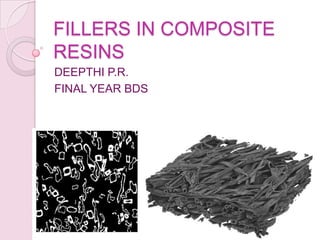
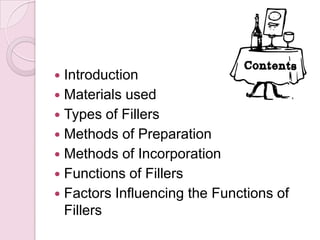
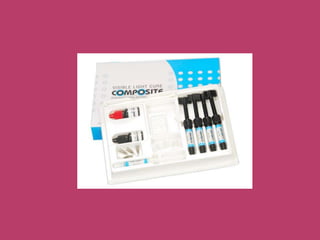
FILLERS IN COMPOSITE
RESINS
DEEPTHI P.R.
FINAL YEAR BDS
 Introduction
 Materials used
 Types of Fillers
 Methods of Preparation
 Methods of Incorporation
 Functions of Fillers
 Factors Influencing the Functions of
Fillers
 Advantages & Drawbacks of different
Materials
 Classification of Composite Resins
based on Fillers
 Recent Advances
 Summary
 References
INTRODUCTION
Composite
In materials and science, a solid formed
from two or more distinct phases that
have been combined to produce
properties superior to or intermediate
to those of the individual constituents
Dental Composite
Highly cross-linked polymeric materials
reinforced by a dispersion of glass,
crystalline or resin filler particles
and/or short fibers bound to the matrix
by silane coupling agents
 Dr. Ray L. Bowen (1962)
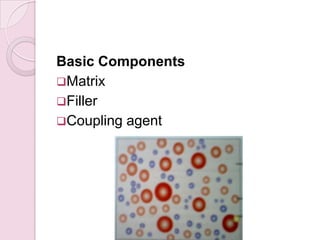
Basic Components
Matrix
Filler
Coupling agent
FILLERS
‘The inorganic and/or organic resin
particles that are designed to
strengthen a composite, decrease
thermal expansion, minimize
polymerization shrinkage and reduce
the amount of swelling caused by
water sorption’
FILLERS
 Dispersed phase of composite resins
 1950’s- Quartz in MMA filling materials
MATERIALS USED
 Quartz
 Amorphous Silica
 Glass fillers with metals
 Colloidal Silica
 Ceramics
 Organically modified
Ceramics/ORMOCERS
TYPES OF FILLERS
 3 filler categories- 35 years
Conventional
Microfine
Hybrid
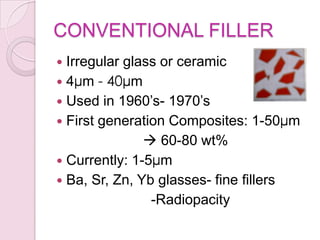
CONVENTIONAL FILLER
 Irregular glass or ceramic
 4µm - 40µm
 Used in 1960’s- 1970’s
 First generation Composites: 1-50µm
 60-80 wt%
 Currently: 1-5µm
 Ba, Sr, Zn, Yb glasses- fine fillers
-Radiopacity
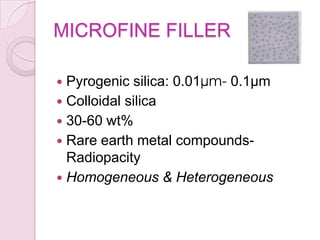
MICROFINE FILLER
 Pyrogenic silica: 0.01µm- 0.1µm
 Colloidal silica
 30-60 wt%
 Rare earth metal compounds-
Radiopacity
 Homogeneous & Heterogeneous
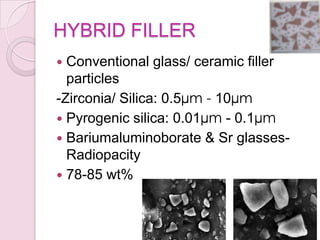
HYBRID FILLER
 Conventional glass/ ceramic filler
particles
-Zirconia/ Silica: 0.5µm - 10µm
 Pyrogenic silica: 0.01µm - 0.1µm
 Bariumaluminoborate & Sr glasses-
Radiopacity
 78-85 wt%
MEGAFILLER
 Pieces of glass: 0.5mm – 2mm
 Inserts
 Composites at points of heavy
occlusal contact or high wear
METHODS OF PREPARATION
 Grinding or milling Quartz/ Glasses:
0.1µm-100µm
 Microfillers:
Pyrolytic or Precipitation process
fumed silica
- SiCl4 in O2 & H2  macromolecule
chains of SiO2
METHODS OF PREPARATION
Colloidal particles of Sodium silicate to
water & HCl colloidal silica
Organic fillers:
 Pulverized precured resin:5µm-30µm
Silane treated colloidal silica to the
monomer at slightly elevated
temperature
METHODS OF PREPARATION
Composite paste heat cured with
Benzoyl Peroxide
Cured composite : ground into
particles of size larger than traditional
fillers
METHODS OF INCORPORATION
CONVENTIONAL FILLER PARTICLES
Surface coating of ‘Coupling agent’
Then blended with resin
MICROFILLER PARTICLES
Organic fillers + silane treated colloidal
silica blended with monomer
METHODS OF INCORPORATION
1. Homogeneous :
Microfiller loaded directly to the resin
2. Heterogeneous
Microfiller compressed into clumps:
Sintering, precipitation, silanization or
condensation
Fumed silica added to a heated resin
at ~70 wt%
METHODS OF INCORPORATION
Increase Filler loading
 Sinter colloidal silica particles: Several
tenths of a µm
Reduces compromise in the rheology
 Grinding prepolymerized composite
highly loaded with colloidal silica
particles
Particles then incorporated
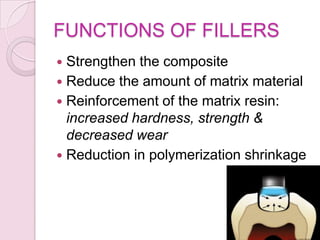
FUNCTIONS OF FILLERS
 Strengthen the composite
 Reduce the amount of matrix material
 Reinforcement of the matrix resin:
increased hardness, strength &
decreased wear
 Reduction in polymerization shrinkage
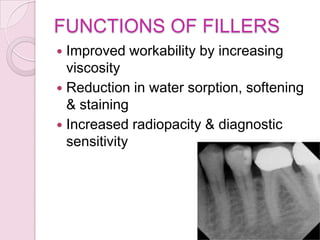
FUNCTIONS OF FILLERS
 Improved workability by increasing
viscosity
 Reduction in water sorption, softening
& staining
 Increased radiopacity & diagnostic
sensitivity
FUNCTIONS OF FILLERS
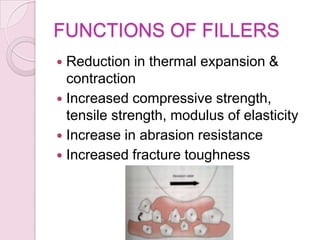
 Reduction in thermal expansion &
contraction
 Increased compressive strength,
tensile strength, modulus of elasticity
 Increase in abrasion resistance
 Increased fracture toughness
FUNCTIONS OF FILLERS
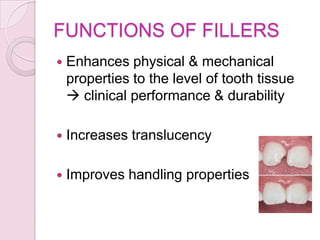
 Enhances physical & mechanical
properties to the level of tooth tissue
 clinical performance & durability
 Increases translucency
 Improves handling properties
FACTORS INFLUENCING THE
FUNCTIONS OF FILLERS
FILLER SIZE
 Large : ‘plucking’ – rough surface
- increased wear
- reduced flexural strength
 Size can’t be reduced beyond limits-
technical problems
FACTORS INFLUENCING THE
FUNCTIONS OF FILLERS
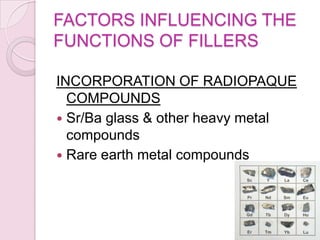
INCORPORATION OF RADIOPAQUE
COMPOUNDS
 Sr/Ba glass & other heavy metal
compounds
 Rare earth metal compounds
FACTORS INFLUENCING THE
FUNCTIONS OF FILLERS
FILLER CONTENT
As it increases:
 Reduced polymerization shrinkage
 Coefficient of thermal expansion-
more like tooth structure
 Increased hardness & abrasion
resistance
FACTORS INFLUENCING THE
FUNCTIONS OF FILLERS
 Increased color stability
 Increased depth of cure
 Increased stiffness
 Reduced resistance to toothbrush
abrasion & wear by hydroxyapatite
SILANE COATING
 Increased resistance to hydrolytic
degradation
FACTORS INFLUENCING THE
FUNCTIONS OF FILLERS
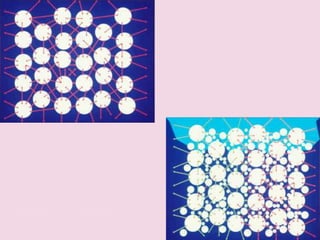
FILLER SHAPE
Spherical shape:
 Incorporates more inorganic fillers
 Improves fracture strength
REFRACTIVE INDEX
 Matches that of resin ~ 1.50
 Translucency similar to the tooth
structure
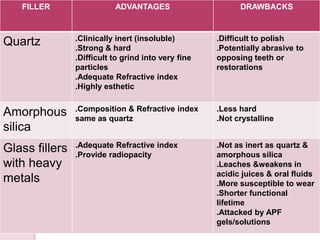
ADVANTAGES & DRAWBACKS
FILLER ADVANTAGES DRAWBACKS
Quartz .Clinically inert (insoluble)
.Strong & hard
.Difficult to grind into very fine
particles
.Adequate Refractive index
.Highly esthetic
.Difficult to polish
.Potentially abrasive to
opposing teeth or
restorations
Amorphous
silica
.Composition & Refractive index
same as quartz
.Less hard
.Not crystalline
Glass fillers
with heavy
metals
.Adequate Refractive index
.Provide radiopacity
.Not as inert as quartz &
amorphous silica
.Leaches &weakens in
acidic juices & oral fluids
.More susceptible to wear
.Shorter functional
lifetime
.Attacked by APF
gels/solutions
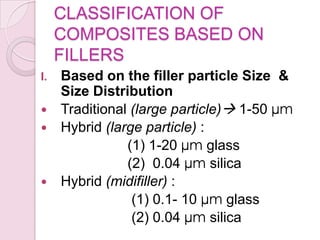
CLASSIFICATION OF
COMPOSITES BASED ON
FILLERS
I. Based on the filler particle Size &
Size Distribution
 Traditional (large particle) 1-50 µm
 Hybrid (large particle) :
(1) 1-20 µm glass
(2) 0.04 µm silica
 Hybrid (midifiller) :
(1) 0.1- 10 µm glass
(2) 0.04 µm silica
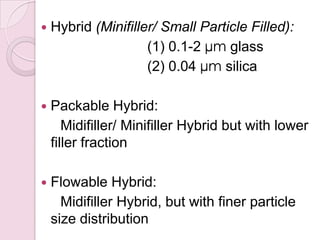
 Hybrid (Minifiller/ Small Particle Filled):
(1) 0.1-2 µm glass
(2) 0.04 µm silica
 Packable Hybrid:
Midifiller/ Minifiller Hybrid but with lower
filler fraction
 Flowable Hybrid:
Midifiller Hybrid, but with finer particle
size distribution
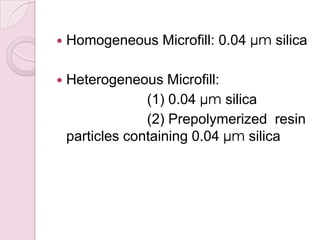
 Homogeneous Microfill: 0.04 µm silica
 Heterogeneous Microfill:
(1) 0.04 µm silica
(2) Prepolymerized resin
particles containing 0.04 µm silica
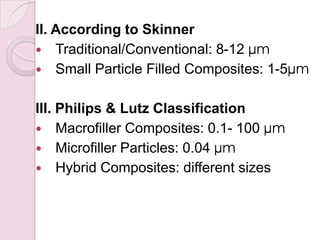
II. According to Skinner
 Traditional/Conventional: 8-12 µm
 Small Particle Filled Composites: 1-5µm
III. Philips & Lutz Classification
 Macrofiller Composites: 0.1- 100 µm
 Microfiller Particles: 0.04 µm
 Hybrid Composites: different sizes
IV. Based on Mean Particle Size of
the filler
 Traditional Composite resins
 Hybrid Composite resins
 Homogeneous Microfilled Composites
 Heterogeneous Microfilled
Composites
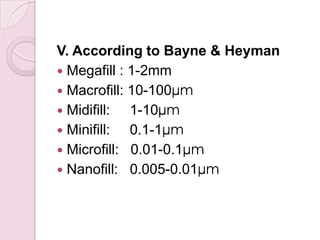
V. According to Bayne & Heyman
 Megafill : 1-2mm
 Macrofill: 10-100µm
 Midifill: 1-10µm
 Minifill: 0.1-1µm
 Microfill: 0.01-0.1µm
 Nanofill: 0.005-0.01µm
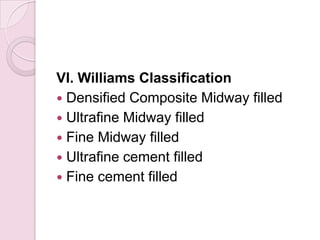
VI. Williams Classification
 Densified Composite Midway filled
 Ultrafine Midway filled
 Fine Midway filled
 Ultrafine cement filled
 Fine cement filled
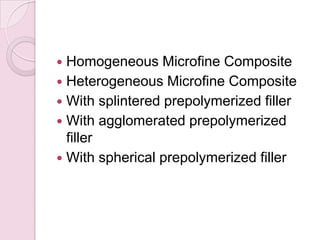
 Homogeneous Microfine Composite
 Heterogeneous Microfine Composite
 With splintered prepolymerized filler
 With agglomerated prepolymerized
filler
 With spherical prepolymerized filler
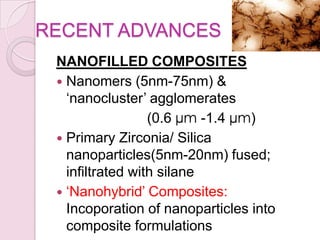
RECENT ADVANCES
NANOFILLED COMPOSITES
 Nanomers (5nm-75nm) &
‘nanocluster’ agglomerates
(0.6 µm -1.4 µm)
 Primary Zirconia/ Silica
nanoparticles(5nm-20nm) fused;
infiltrated with silane
 ‘Nanohybrid’ Composites:
Incoporation of nanoparticles into
composite formulations
RECENT ADVANCES
PROPERTIES :Nanofilled vs Others
 Physical & mechanical- similar to
microhybrid
 Water sorption similar to midifill &
microfill
Significantly better polish & gloss
retention
Lower solubility
Reduced scattering of curing light
RECENT ADVANCES
 Nanohybrid variety :
- properties similar to / better than
microhybrid
- inferior compared to nanofilled
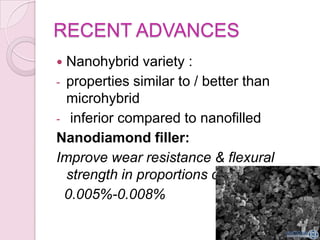
Nanodiamond filler:
Improve wear resistance & flexural
strength in proportions of
0.005%-0.008%
RECENT ADVANCES
FLAKE SHAPED GLASS FILLER(FSG)
 Thin glass platelet with a flat, smooth
surface
 Good transparency
 Increased hardness
 Compressive strength ~ commercial
composite
 High flowability
RECENT ADVANCES
POLYMETHYLMETHACRYLATE
(PMMA) FILLER PARTICLES
 2wt% additional PMMA fillers
 Inhibit crack propagation
 Enhance compressive strength
 No significant change in water
sorption/ water contact angle of the
surface
RECENT ADVANCES
SILANE COATED GLASS FILLERS
 Fluoroboroaluminosilicate glass
coated with
3- methacryloxypropyltrimethoxysilane
Or 3-aminopropyltrimethoxysilane
 Greater amount of fluoride release
 Higher pH value
RECENT ADVANCES
LEUCITE CONTAINING CERAMIC
FILLER
 IPS Empress ingots ball milled;
passed through an 800 mesh sieve
 Significant wear resistance
SUMMARY
 Fillers
– reduce curing shrinkage
-- improves physical properties
 Composite characteristics change:
- Material
- Size & size distribution
- Load
- Shape
- Surface modifiers
- Optical index
REFERENCES
 Philip’s Science of Dental Materials-
Anusavice,11th Edition
 Applied Dental Materials-John F
McCabe & Angus,W.G.Walls,8th
Edition
 Introduction to Dental Materials-
Richard van Noort,2nd Edition
 Tooth colored Restoratives, Principles
& Techniques- Albers,9th Edition
REFERENCES
 The Clinical Handing of Dental
Materials-Smith,Wright,Brown,2nd
Edition
 Clinical aspects of Dental Materials-
Gladwin&Bagby
 Dental Materials-Carol
Dixon,Hatrick,Eakle
 Dental Materials- John M
Prowers,John C.Wataha
REFERENCES
 Sturdevant’s Art & Science of
Operative Dentistry- 4th Edition
 Textbook of Operative Dentistry- Nisha
Garg & Amit Garg
 Textbook of Dental Materials-Sharmila
Hussain
REFERENCES
 Constantinos Masouras et al
Dental Materials Vol 24 No.7 July 2008:
932-939
 Lim YK et al
Dental Materials Vol 24 No.1 January
2008
 Tahimoto Y et al
Acta Biomaterials 2006 Nov;2(6): 633-
639
REFERENCES
 Kondo Y et al
Dental Materials J,2010 October
14;29(5): 596-601
 Itota T et al
Dental Materials J,2010 August
7;29(4):362-368
 Arikawa H et al
Dental Materials J,2007 Jan 26(1):38-
44
REFERENCES
 H St.Germain et al
Journal of Dental Research Feb 1985
Vol64 No.2:155-160
 Dr Moraes RR et al
Operative Dentistry 2009 Sep-
Oct;34(5):551-557
 Berger SB et al
Brazil Dental Journal 2009;20(4):314-
318
REFERENCES
 J. Mat.Sci.Mater Med.2007
Jun;18(6):1157-1162
Clinical Materials Review
Inside Dentistry July/August 2007 Vol
3,Issue 7
 Motohiro UO et al
Journal of the Ceramic Society of
Japan,Vol 118 (2010), No.1378
June :425-427
REFERENCES
 Zhong –Yu- Xiu et al
Effects of Nanodiamond Filler on
Compressive strength &
Microhardness of Composite Resins
www.cnki.com.cn
Fillers in composite resins

Fillers in composite resins

  • 1.
  • 2.
  • 3.
     Introduction  Materialsused  Types of Fillers  Methods of Preparation  Methods of Incorporation  Functions of Fillers  Factors Influencing the Functions of Fillers
  • 4.
     Advantages &Drawbacks of different Materials  Classification of Composite Resins based on Fillers  Recent Advances  Summary  References
  • 5.
    INTRODUCTION Composite In materials andscience, a solid formed from two or more distinct phases that have been combined to produce properties superior to or intermediate to those of the individual constituents
  • 6.
    Dental Composite Highly cross-linkedpolymeric materials reinforced by a dispersion of glass, crystalline or resin filler particles and/or short fibers bound to the matrix by silane coupling agents  Dr. Ray L. Bowen (1962)
  • 7.
  • 8.
    FILLERS ‘The inorganic and/ororganic resin particles that are designed to strengthen a composite, decrease thermal expansion, minimize polymerization shrinkage and reduce the amount of swelling caused by water sorption’
  • 9.
    FILLERS  Dispersed phaseof composite resins  1950’s- Quartz in MMA filling materials
  • 10.
    MATERIALS USED  Quartz Amorphous Silica  Glass fillers with metals  Colloidal Silica  Ceramics  Organically modified Ceramics/ORMOCERS
  • 11.
    TYPES OF FILLERS 3 filler categories- 35 years Conventional Microfine Hybrid
  • 12.
    CONVENTIONAL FILLER  Irregularglass or ceramic  4µm - 40µm  Used in 1960’s- 1970’s  First generation Composites: 1-50µm  60-80 wt%  Currently: 1-5µm  Ba, Sr, Zn, Yb glasses- fine fillers -Radiopacity
  • 13.
    MICROFINE FILLER  Pyrogenicsilica: 0.01µm- 0.1µm  Colloidal silica  30-60 wt%  Rare earth metal compounds- Radiopacity  Homogeneous & Heterogeneous
  • 14.
    HYBRID FILLER  Conventionalglass/ ceramic filler particles -Zirconia/ Silica: 0.5µm - 10µm  Pyrogenic silica: 0.01µm - 0.1µm  Bariumaluminoborate & Sr glasses- Radiopacity  78-85 wt%
  • 15.
    MEGAFILLER  Pieces ofglass: 0.5mm – 2mm  Inserts  Composites at points of heavy occlusal contact or high wear
  • 16.
    METHODS OF PREPARATION Grinding or milling Quartz/ Glasses: 0.1µm-100µm  Microfillers: Pyrolytic or Precipitation process fumed silica - SiCl4 in O2 & H2  macromolecule chains of SiO2
  • 17.
    METHODS OF PREPARATION Colloidalparticles of Sodium silicate to water & HCl colloidal silica Organic fillers:  Pulverized precured resin:5µm-30µm Silane treated colloidal silica to the monomer at slightly elevated temperature
  • 18.
    METHODS OF PREPARATION Compositepaste heat cured with Benzoyl Peroxide Cured composite : ground into particles of size larger than traditional fillers
  • 19.
    METHODS OF INCORPORATION CONVENTIONALFILLER PARTICLES Surface coating of ‘Coupling agent’ Then blended with resin MICROFILLER PARTICLES Organic fillers + silane treated colloidal silica blended with monomer
  • 20.
    METHODS OF INCORPORATION 1.Homogeneous : Microfiller loaded directly to the resin 2. Heterogeneous Microfiller compressed into clumps: Sintering, precipitation, silanization or condensation Fumed silica added to a heated resin at ~70 wt%
  • 21.
    METHODS OF INCORPORATION IncreaseFiller loading  Sinter colloidal silica particles: Several tenths of a µm Reduces compromise in the rheology  Grinding prepolymerized composite highly loaded with colloidal silica particles Particles then incorporated
  • 22.
    FUNCTIONS OF FILLERS Strengthen the composite  Reduce the amount of matrix material  Reinforcement of the matrix resin: increased hardness, strength & decreased wear  Reduction in polymerization shrinkage
  • 23.
    FUNCTIONS OF FILLERS Improved workability by increasing viscosity  Reduction in water sorption, softening & staining  Increased radiopacity & diagnostic sensitivity
  • 24.
    FUNCTIONS OF FILLERS Reduction in thermal expansion & contraction  Increased compressive strength, tensile strength, modulus of elasticity  Increase in abrasion resistance  Increased fracture toughness
  • 25.
    FUNCTIONS OF FILLERS Enhances physical & mechanical properties to the level of tooth tissue  clinical performance & durability  Increases translucency  Improves handling properties
  • 26.
    FACTORS INFLUENCING THE FUNCTIONSOF FILLERS FILLER SIZE  Large : ‘plucking’ – rough surface - increased wear - reduced flexural strength  Size can’t be reduced beyond limits- technical problems
  • 27.
    FACTORS INFLUENCING THE FUNCTIONSOF FILLERS INCORPORATION OF RADIOPAQUE COMPOUNDS  Sr/Ba glass & other heavy metal compounds  Rare earth metal compounds
  • 28.
    FACTORS INFLUENCING THE FUNCTIONSOF FILLERS FILLER CONTENT As it increases:  Reduced polymerization shrinkage  Coefficient of thermal expansion- more like tooth structure  Increased hardness & abrasion resistance
  • 29.
    FACTORS INFLUENCING THE FUNCTIONSOF FILLERS  Increased color stability  Increased depth of cure  Increased stiffness  Reduced resistance to toothbrush abrasion & wear by hydroxyapatite SILANE COATING  Increased resistance to hydrolytic degradation
  • 31.
    FACTORS INFLUENCING THE FUNCTIONSOF FILLERS FILLER SHAPE Spherical shape:  Incorporates more inorganic fillers  Improves fracture strength REFRACTIVE INDEX  Matches that of resin ~ 1.50  Translucency similar to the tooth structure
  • 32.
    ADVANTAGES & DRAWBACKS FILLERADVANTAGES DRAWBACKS Quartz .Clinically inert (insoluble) .Strong & hard .Difficult to grind into very fine particles .Adequate Refractive index .Highly esthetic .Difficult to polish .Potentially abrasive to opposing teeth or restorations Amorphous silica .Composition & Refractive index same as quartz .Less hard .Not crystalline Glass fillers with heavy metals .Adequate Refractive index .Provide radiopacity .Not as inert as quartz & amorphous silica .Leaches &weakens in acidic juices & oral fluids .More susceptible to wear .Shorter functional lifetime .Attacked by APF gels/solutions
  • 33.
    CLASSIFICATION OF COMPOSITES BASEDON FILLERS I. Based on the filler particle Size & Size Distribution  Traditional (large particle) 1-50 µm  Hybrid (large particle) : (1) 1-20 µm glass (2) 0.04 µm silica  Hybrid (midifiller) : (1) 0.1- 10 µm glass (2) 0.04 µm silica
  • 34.
     Hybrid (Minifiller/Small Particle Filled): (1) 0.1-2 µm glass (2) 0.04 µm silica  Packable Hybrid: Midifiller/ Minifiller Hybrid but with lower filler fraction  Flowable Hybrid: Midifiller Hybrid, but with finer particle size distribution
  • 35.
     Homogeneous Microfill:0.04 µm silica  Heterogeneous Microfill: (1) 0.04 µm silica (2) Prepolymerized resin particles containing 0.04 µm silica
  • 36.
    II. According toSkinner  Traditional/Conventional: 8-12 µm  Small Particle Filled Composites: 1-5µm III. Philips & Lutz Classification  Macrofiller Composites: 0.1- 100 µm  Microfiller Particles: 0.04 µm  Hybrid Composites: different sizes
  • 37.
    IV. Based onMean Particle Size of the filler  Traditional Composite resins  Hybrid Composite resins  Homogeneous Microfilled Composites  Heterogeneous Microfilled Composites
  • 38.
    V. According toBayne & Heyman  Megafill : 1-2mm  Macrofill: 10-100µm  Midifill: 1-10µm  Minifill: 0.1-1µm  Microfill: 0.01-0.1µm  Nanofill: 0.005-0.01µm
  • 39.
    VI. Williams Classification Densified Composite Midway filled  Ultrafine Midway filled  Fine Midway filled  Ultrafine cement filled  Fine cement filled
  • 40.
     Homogeneous MicrofineComposite  Heterogeneous Microfine Composite  With splintered prepolymerized filler  With agglomerated prepolymerized filler  With spherical prepolymerized filler
  • 41.
    RECENT ADVANCES NANOFILLED COMPOSITES Nanomers (5nm-75nm) & ‘nanocluster’ agglomerates (0.6 µm -1.4 µm)  Primary Zirconia/ Silica nanoparticles(5nm-20nm) fused; infiltrated with silane  ‘Nanohybrid’ Composites: Incoporation of nanoparticles into composite formulations
  • 43.
    RECENT ADVANCES PROPERTIES :Nanofilledvs Others  Physical & mechanical- similar to microhybrid  Water sorption similar to midifill & microfill Significantly better polish & gloss retention Lower solubility Reduced scattering of curing light
  • 44.
    RECENT ADVANCES  Nanohybridvariety : - properties similar to / better than microhybrid - inferior compared to nanofilled Nanodiamond filler: Improve wear resistance & flexural strength in proportions of 0.005%-0.008%
  • 45.
    RECENT ADVANCES FLAKE SHAPEDGLASS FILLER(FSG)  Thin glass platelet with a flat, smooth surface  Good transparency  Increased hardness  Compressive strength ~ commercial composite  High flowability
  • 46.
    RECENT ADVANCES POLYMETHYLMETHACRYLATE (PMMA) FILLERPARTICLES  2wt% additional PMMA fillers  Inhibit crack propagation  Enhance compressive strength  No significant change in water sorption/ water contact angle of the surface
  • 47.
    RECENT ADVANCES SILANE COATEDGLASS FILLERS  Fluoroboroaluminosilicate glass coated with 3- methacryloxypropyltrimethoxysilane Or 3-aminopropyltrimethoxysilane  Greater amount of fluoride release  Higher pH value
  • 48.
    RECENT ADVANCES LEUCITE CONTAININGCERAMIC FILLER  IPS Empress ingots ball milled; passed through an 800 mesh sieve  Significant wear resistance
  • 49.
    SUMMARY  Fillers – reducecuring shrinkage -- improves physical properties  Composite characteristics change: - Material - Size & size distribution - Load - Shape - Surface modifiers - Optical index
  • 50.
    REFERENCES  Philip’s Scienceof Dental Materials- Anusavice,11th Edition  Applied Dental Materials-John F McCabe & Angus,W.G.Walls,8th Edition  Introduction to Dental Materials- Richard van Noort,2nd Edition  Tooth colored Restoratives, Principles & Techniques- Albers,9th Edition
  • 51.
    REFERENCES  The ClinicalHanding of Dental Materials-Smith,Wright,Brown,2nd Edition  Clinical aspects of Dental Materials- Gladwin&Bagby  Dental Materials-Carol Dixon,Hatrick,Eakle  Dental Materials- John M Prowers,John C.Wataha
  • 52.
    REFERENCES  Sturdevant’s Art& Science of Operative Dentistry- 4th Edition  Textbook of Operative Dentistry- Nisha Garg & Amit Garg  Textbook of Dental Materials-Sharmila Hussain
  • 53.
    REFERENCES  Constantinos Masouraset al Dental Materials Vol 24 No.7 July 2008: 932-939  Lim YK et al Dental Materials Vol 24 No.1 January 2008  Tahimoto Y et al Acta Biomaterials 2006 Nov;2(6): 633- 639
  • 54.
    REFERENCES  Kondo Yet al Dental Materials J,2010 October 14;29(5): 596-601  Itota T et al Dental Materials J,2010 August 7;29(4):362-368  Arikawa H et al Dental Materials J,2007 Jan 26(1):38- 44
  • 55.
    REFERENCES  H St.Germainet al Journal of Dental Research Feb 1985 Vol64 No.2:155-160  Dr Moraes RR et al Operative Dentistry 2009 Sep- Oct;34(5):551-557  Berger SB et al Brazil Dental Journal 2009;20(4):314- 318
  • 56.
    REFERENCES  J. Mat.Sci.MaterMed.2007 Jun;18(6):1157-1162 Clinical Materials Review Inside Dentistry July/August 2007 Vol 3,Issue 7  Motohiro UO et al Journal of the Ceramic Society of Japan,Vol 118 (2010), No.1378 June :425-427
  • 57.
    REFERENCES  Zhong –Yu-Xiu et al Effects of Nanodiamond Filler on Compressive strength & Microhardness of Composite Resins www.cnki.com.cn