Elsevier items and derived items Copyright © 2016, 2011 by Mosby, Inc., an affiliate of Elsevier Inc. All rights reserved.
Practice Management
Chapter 3
1
Elsevier items and derived items Copyright © 2016, 2011 by Mosby, Inc., an affiliate of Elsevier Inc. All rights reserved.
Practice Management
1. Define the key terms in this chapter.
2. Discuss the importance of understanding patient needs.
3. Identify barriers to patient communication and the importance of
recognizing nonverbal cues.
4. Explain how improving verbal images in the patient’s mind can allay fears
and identify phrases that promote successful patient management.
5. Discuss the special needs of patients and their inherent rights as well as
ways to recognize abuse.
6. Describe reception room techniques, the role of the receptionist, and the
importance of an appealing reception area.
7. Discuss the contents of an office policy and design an office policy
statement.
8. Explain marketing techniques in dentistry, including:
• Describe the use of social media in patient marketing.
• Describe internal and external marketing.
Lesson 3.1
2
Elsevier items and derived items Copyright © 2016, 2011 by Mosby, Inc., an affiliate of Elsevier Inc. All rights reserved.
Understanding Patient Needs
 The most important person in the dental
practice is the patient
 The dental team members must convey a
helpful attitude as they alleviate patients’
discomfort and provide educational services
3
Elsevier items and derived items Copyright © 2016, 2011 by Mosby, Inc., an affiliate of Elsevier Inc. All rights reserved.
Understanding Patient Needs
 Each person who comes in contact with
patients should have an understanding of the
basic drives involved in motivating patients
 Two humanistic psychologists, Abraham
Maslow and Carl Rogers, developed theories
about patient motivation and behavior
4
Elsevier items and derived items Copyright © 2016, 2011 by Mosby, Inc., an affiliate of Elsevier Inc. All rights reserved.
Understanding Patient Needs
 Maslow’s Hierarchy of Needs
5
From Black BP: Professional nursing, ed 7, St Louis, 2014, Saunders.
Elsevier items and derived items Copyright © 2016, 2011 by Mosby, Inc., an affiliate of Elsevier Inc. All rights reserved.
Understanding Patient Needs
 Before a dentist can motivate a patient to
accept a certain type of dental treatment, the
dentist must understand where the patient is
on the hierarchy of needs
 Setting up a payment plan for dental care
often exposes a conflict of needs
6
Elsevier items and derived items Copyright © 2016, 2011 by Mosby, Inc., an affiliate of Elsevier Inc. All rights reserved.
Understanding Patient Needs
 Dr. Carl Rogers developed a client-centered
approach to understanding personality and
human relationships
 His theory assumes that patients know their
feelings, desires, and priorities
 Applied to dentistry, this philosophy encourages
listening to the patient
7
Elsevier items and derived items Copyright © 2016, 2011 by Mosby, Inc., an affiliate of Elsevier Inc. All rights reserved.
Locus of Control
 The degree to which the person feels control
over life events
 External locus of control: The belief that life “just
happens” or is controlled by fate, destiny, or
chance
 Internal locus of control: The belief that personal
actions determine life events
8
Elsevier items and derived items Copyright © 2016, 2011 by Mosby, Inc., an affiliate of Elsevier Inc. All rights reserved.
Barriers to Patient
Communication
 Often we are unable to communicate with
patients because barriers have been
established
 Several barriers to communication include:
 Prejudging a patient
 Hearing but not listening
 Being preoccupied
9
Elsevier items and derived items Copyright © 2016, 2011 by Mosby, Inc., an affiliate of Elsevier Inc. All rights reserved.
Barriers to Patient
Communication
 Recognizing nonverbal cues
 Gestures give insight into a patient’s reactions
 An alert assistant is able to pick up on nonverbal
cues and interpret them while communicating with
the patient
10
Elsevier items and derived items Copyright © 2016, 2011 by Mosby, Inc., an affiliate of Elsevier Inc. All rights reserved.
Barriers to Patient
Communication
 Recognizing nonverbal cues (Cont.)
 Nervousness: Locked ankles, hands clenching the
armrest
 Defensiveness: Crossed arms, clenched fists
 Touching: Hand on shoulder or arm around
shoulder
 Openness: Equal eye level, no desk or
authoritative posture
 Embarrassment: Hand covering mouth, avoiding
eye contact
11
Elsevier items and derived items Copyright © 2016, 2011 by Mosby, Inc., an affiliate of Elsevier Inc. All rights reserved.
Improving Verbal Images
 A health professional has an obligation to
allay fears and comfort patients by creating a
good image in the patient’s mind
 Eliminate the use of words or phrases that conjure
negative thoughts
 Be positive in responses to patients
12
Elsevier items and derived items Copyright © 2016, 2011 by Mosby, Inc., an affiliate of Elsevier Inc. All rights reserved.
The Patient
 Patient’s rights
 Members of the dental healthcare team cannot
afford to neglect a patient’s rights
13
Elsevier items and derived items Copyright © 2016, 2011 by Mosby, Inc., an affiliate of Elsevier Inc. All rights reserved.
The Patient
 Managing a patient’s special needs
 The Americans with Disabilities Act of 1990,
commonly known as the ADA, prohibits the dentist
from discriminating against a person who requires
dental care
 For most disabled individuals, if they can get into a
treatment room, they can receive treatment
14
Elsevier items and derived items Copyright © 2016, 2011 by Mosby, Inc., an affiliate of Elsevier Inc. All rights reserved.
The Patient
 Recognizing abuse
 The dentist has an obligation to examine the
patient thoroughly, ask reasonable questions
about existing conditions, and document the
injuries on the dental record
 Reports of suspected abuse should be made to
the state or county social services office
15
Elsevier items and derived items Copyright © 2016, 2011 by Mosby, Inc., an affiliate of Elsevier Inc. All rights reserved.
Reception Room Techniques
 The role of the receptionist
 In many dental offices today, the administrative
assistant is the first person to greet patients as
they enter the office
 The receptionist should acknowledge patients
immediately, by name, with a cheerful “hello” and
pleasant smile
16
Elsevier items and derived items Copyright © 2016, 2011 by Mosby, Inc., an affiliate of Elsevier Inc. All rights reserved.
Reception Room Techniques
 Reception room appeal
 A bright, cheerful, and pleasantly decorated office
usually makes a favorable impression on the
patient
 Reading material in the reception room should be
current and geared toward a wide variety of
interests
17
Elsevier items and derived items Copyright © 2016, 2011 by Mosby, Inc., an affiliate of Elsevier Inc. All rights reserved.
Reception Room Techniques
 Waiting patients
 Unexpected delays or emergencies should be
explained honestly
 Be careful not to make excuses or to say that the
dentist is running late
 Be honest about the length of time the patient will
have to wait to be seen
18
Elsevier items and derived items Copyright © 2016, 2011 by Mosby, Inc., an affiliate of Elsevier Inc. All rights reserved.
Office Policy
 The office policy brochure is the key to
establishing an understanding between the
patient and the office staff
 A copy of the office policy is given to each
new patient at the first visit; some of the
policies may be included on the office website
if one is available
19
Elsevier items and derived items Copyright © 2016, 2011 by Mosby, Inc., an affiliate of Elsevier Inc. All rights reserved.
Office Policy
 Contents of an office policy
20
Elsevier items and derived items Copyright © 2016, 2011 by Mosby, Inc., an affiliate of Elsevier Inc. All rights reserved.
Office Policy Statement
 Designing an office policy statement
 The office policy has two primary purposes
• To build the practice
• To inform the patient of office procedures and the
dentist’s philosophy
 The administrative assistant can be invaluable to
the dentist for designing the office policy
statement
21
Elsevier items and derived items Copyright © 2016, 2011 by Mosby, Inc., an affiliate of Elsevier Inc. All rights reserved.
Marketing
 Creating a website
 Today a dental office can design a web page
about the practice to promote the office
22
Elsevier items and derived items Copyright © 2016, 2011 by Mosby, Inc., an affiliate of Elsevier Inc. All rights reserved.
Marketing
 Creating a website (Cont.)
 Identify the objectives for use of the website
 Create a logo or trademark
 Design the pages
 Identify a web server to which the pages can be
uploaded
 Upload the pages to the server
 Determine when and by whom the website will be
updated
 Update the website regularly to keep it current
23
Elsevier items and derived items Copyright © 2016, 2011 by Mosby, Inc., an affiliate of Elsevier Inc. All rights reserved.
Marketing
 Enthusiastic attitude
 Seizing opportunities
 Practice ambassadors
24
Elsevier items and derived items Copyright © 2016, 2011 by Mosby, Inc., an affiliate of Elsevier Inc. All rights reserved.
Marketing
 Internal and external marketing
25
Elsevier items and derived items Copyright © 2016, 2011 by Mosby, Inc., an affiliate of Elsevier Inc. All rights reserved.
Marketing
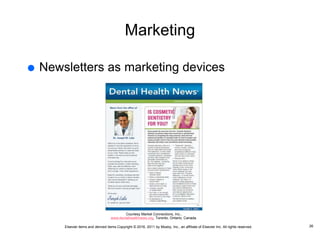
 Newsletters as marketing devices
26
Courtesy Market Connections, Inc.,
www.dentalhealthnews.org, Toronto, Ontario, Canada.
Elsevier items and derived items Copyright © 2016, 2011 by Mosby, Inc., an affiliate of Elsevier Inc. All rights reserved.
Questions?
27

Chapter 3- Practice Managament

  • 1.
    Elsevier items andderived items Copyright © 2016, 2011 by Mosby, Inc., an affiliate of Elsevier Inc. All rights reserved. Practice Management Chapter 3 1
  • 2.
    Elsevier items andderived items Copyright © 2016, 2011 by Mosby, Inc., an affiliate of Elsevier Inc. All rights reserved. Practice Management 1. Define the key terms in this chapter. 2. Discuss the importance of understanding patient needs. 3. Identify barriers to patient communication and the importance of recognizing nonverbal cues. 4. Explain how improving verbal images in the patient’s mind can allay fears and identify phrases that promote successful patient management. 5. Discuss the special needs of patients and their inherent rights as well as ways to recognize abuse. 6. Describe reception room techniques, the role of the receptionist, and the importance of an appealing reception area. 7. Discuss the contents of an office policy and design an office policy statement. 8. Explain marketing techniques in dentistry, including: • Describe the use of social media in patient marketing. • Describe internal and external marketing. Lesson 3.1 2
  • 3.
    Elsevier items andderived items Copyright © 2016, 2011 by Mosby, Inc., an affiliate of Elsevier Inc. All rights reserved. Understanding Patient Needs  The most important person in the dental practice is the patient  The dental team members must convey a helpful attitude as they alleviate patients’ discomfort and provide educational services 3
  • 4.
    Elsevier items andderived items Copyright © 2016, 2011 by Mosby, Inc., an affiliate of Elsevier Inc. All rights reserved. Understanding Patient Needs  Each person who comes in contact with patients should have an understanding of the basic drives involved in motivating patients  Two humanistic psychologists, Abraham Maslow and Carl Rogers, developed theories about patient motivation and behavior 4
  • 5.
    Elsevier items andderived items Copyright © 2016, 2011 by Mosby, Inc., an affiliate of Elsevier Inc. All rights reserved. Understanding Patient Needs  Maslow’s Hierarchy of Needs 5 From Black BP: Professional nursing, ed 7, St Louis, 2014, Saunders.
  • 6.
    Elsevier items andderived items Copyright © 2016, 2011 by Mosby, Inc., an affiliate of Elsevier Inc. All rights reserved. Understanding Patient Needs  Before a dentist can motivate a patient to accept a certain type of dental treatment, the dentist must understand where the patient is on the hierarchy of needs  Setting up a payment plan for dental care often exposes a conflict of needs 6
  • 7.
    Elsevier items andderived items Copyright © 2016, 2011 by Mosby, Inc., an affiliate of Elsevier Inc. All rights reserved. Understanding Patient Needs  Dr. Carl Rogers developed a client-centered approach to understanding personality and human relationships  His theory assumes that patients know their feelings, desires, and priorities  Applied to dentistry, this philosophy encourages listening to the patient 7
  • 8.
    Elsevier items andderived items Copyright © 2016, 2011 by Mosby, Inc., an affiliate of Elsevier Inc. All rights reserved. Locus of Control  The degree to which the person feels control over life events  External locus of control: The belief that life “just happens” or is controlled by fate, destiny, or chance  Internal locus of control: The belief that personal actions determine life events 8
  • 9.
    Elsevier items andderived items Copyright © 2016, 2011 by Mosby, Inc., an affiliate of Elsevier Inc. All rights reserved. Barriers to Patient Communication  Often we are unable to communicate with patients because barriers have been established  Several barriers to communication include:  Prejudging a patient  Hearing but not listening  Being preoccupied 9
  • 10.
    Elsevier items andderived items Copyright © 2016, 2011 by Mosby, Inc., an affiliate of Elsevier Inc. All rights reserved. Barriers to Patient Communication  Recognizing nonverbal cues  Gestures give insight into a patient’s reactions  An alert assistant is able to pick up on nonverbal cues and interpret them while communicating with the patient 10
  • 11.
    Elsevier items andderived items Copyright © 2016, 2011 by Mosby, Inc., an affiliate of Elsevier Inc. All rights reserved. Barriers to Patient Communication  Recognizing nonverbal cues (Cont.)  Nervousness: Locked ankles, hands clenching the armrest  Defensiveness: Crossed arms, clenched fists  Touching: Hand on shoulder or arm around shoulder  Openness: Equal eye level, no desk or authoritative posture  Embarrassment: Hand covering mouth, avoiding eye contact 11
  • 12.
    Elsevier items andderived items Copyright © 2016, 2011 by Mosby, Inc., an affiliate of Elsevier Inc. All rights reserved. Improving Verbal Images  A health professional has an obligation to allay fears and comfort patients by creating a good image in the patient’s mind  Eliminate the use of words or phrases that conjure negative thoughts  Be positive in responses to patients 12
  • 13.
    Elsevier items andderived items Copyright © 2016, 2011 by Mosby, Inc., an affiliate of Elsevier Inc. All rights reserved. The Patient  Patient’s rights  Members of the dental healthcare team cannot afford to neglect a patient’s rights 13
  • 14.
    Elsevier items andderived items Copyright © 2016, 2011 by Mosby, Inc., an affiliate of Elsevier Inc. All rights reserved. The Patient  Managing a patient’s special needs  The Americans with Disabilities Act of 1990, commonly known as the ADA, prohibits the dentist from discriminating against a person who requires dental care  For most disabled individuals, if they can get into a treatment room, they can receive treatment 14
  • 15.
    Elsevier items andderived items Copyright © 2016, 2011 by Mosby, Inc., an affiliate of Elsevier Inc. All rights reserved. The Patient  Recognizing abuse  The dentist has an obligation to examine the patient thoroughly, ask reasonable questions about existing conditions, and document the injuries on the dental record  Reports of suspected abuse should be made to the state or county social services office 15
  • 16.
    Elsevier items andderived items Copyright © 2016, 2011 by Mosby, Inc., an affiliate of Elsevier Inc. All rights reserved. Reception Room Techniques  The role of the receptionist  In many dental offices today, the administrative assistant is the first person to greet patients as they enter the office  The receptionist should acknowledge patients immediately, by name, with a cheerful “hello” and pleasant smile 16
  • 17.
    Elsevier items andderived items Copyright © 2016, 2011 by Mosby, Inc., an affiliate of Elsevier Inc. All rights reserved. Reception Room Techniques  Reception room appeal  A bright, cheerful, and pleasantly decorated office usually makes a favorable impression on the patient  Reading material in the reception room should be current and geared toward a wide variety of interests 17
  • 18.
    Elsevier items andderived items Copyright © 2016, 2011 by Mosby, Inc., an affiliate of Elsevier Inc. All rights reserved. Reception Room Techniques  Waiting patients  Unexpected delays or emergencies should be explained honestly  Be careful not to make excuses or to say that the dentist is running late  Be honest about the length of time the patient will have to wait to be seen 18
  • 19.
    Elsevier items andderived items Copyright © 2016, 2011 by Mosby, Inc., an affiliate of Elsevier Inc. All rights reserved. Office Policy  The office policy brochure is the key to establishing an understanding between the patient and the office staff  A copy of the office policy is given to each new patient at the first visit; some of the policies may be included on the office website if one is available 19
  • 20.
    Elsevier items andderived items Copyright © 2016, 2011 by Mosby, Inc., an affiliate of Elsevier Inc. All rights reserved. Office Policy  Contents of an office policy 20
  • 21.
    Elsevier items andderived items Copyright © 2016, 2011 by Mosby, Inc., an affiliate of Elsevier Inc. All rights reserved. Office Policy Statement  Designing an office policy statement  The office policy has two primary purposes • To build the practice • To inform the patient of office procedures and the dentist’s philosophy  The administrative assistant can be invaluable to the dentist for designing the office policy statement 21
  • 22.
    Elsevier items andderived items Copyright © 2016, 2011 by Mosby, Inc., an affiliate of Elsevier Inc. All rights reserved. Marketing  Creating a website  Today a dental office can design a web page about the practice to promote the office 22
  • 23.
    Elsevier items andderived items Copyright © 2016, 2011 by Mosby, Inc., an affiliate of Elsevier Inc. All rights reserved. Marketing  Creating a website (Cont.)  Identify the objectives for use of the website  Create a logo or trademark  Design the pages  Identify a web server to which the pages can be uploaded  Upload the pages to the server  Determine when and by whom the website will be updated  Update the website regularly to keep it current 23
  • 24.
    Elsevier items andderived items Copyright © 2016, 2011 by Mosby, Inc., an affiliate of Elsevier Inc. All rights reserved. Marketing  Enthusiastic attitude  Seizing opportunities  Practice ambassadors 24
  • 25.
    Elsevier items andderived items Copyright © 2016, 2011 by Mosby, Inc., an affiliate of Elsevier Inc. All rights reserved. Marketing  Internal and external marketing 25
  • 26.
    Elsevier items andderived items Copyright © 2016, 2011 by Mosby, Inc., an affiliate of Elsevier Inc. All rights reserved. Marketing  Newsletters as marketing devices 26 Courtesy Market Connections, Inc., www.dentalhealthnews.org, Toronto, Ontario, Canada.
  • 27.
    Elsevier items andderived items Copyright © 2016, 2011 by Mosby, Inc., an affiliate of Elsevier Inc. All rights reserved. Questions? 27