©2013 Delmar, Cengage Learning. All Rights Reserved. May not be scanned,
copied, duplicated, or posted to a publicly accessible website, in whole or in part.
Medical History
Chapter 2
©2013 Delmar, Cengage Learning. All Rights Reserved. May not be scanned,
copied, duplicated, or posted to a publicly accessible website, in whole or in part.
Objectives
• Upon completion of this chapter, you will
be able to:
– Name the basic components of a dental
patient’s medical history
– Name the basic components of a dental
patient’s dental history
– List the ASA classifications that are pertinent
to the care of a dental patient
2
©2013 Delmar, Cengage Learning. All Rights Reserved. May not be scanned,
copied, duplicated, or posted to a publicly accessible website, in whole or in part.
Objectives (cont’d.)
– Explain why confidentiality should be
maintained on all dental patient information
– Explain the importance of having an accurate,
updated medical history for the dental patient
– Demonstrate the technique for completing
and updating the health history
– Demonstrate the technique for utilizing the
Physician’s Desk Reference (PDR)
3
©2013 Delmar, Cengage Learning. All Rights Reserved. May not be scanned,
copied, duplicated, or posted to a publicly accessible website, in whole or in part.
Medical History Format
• Medical history form components:
– Patient’s general information (name, age,
address, emergency contact)
– Patient’s primary care physician
– Detailed section on patient’s medical history
• Past and present medical conditions
• Current medications, allergies, and past medical
surgeries
– Dental history
4
©2013 Delmar, Cengage Learning. All Rights Reserved. May not be scanned,
copied, duplicated, or posted to a publicly accessible website, in whole or in part.
Medical History Format (cont’d.)
• Medical history section:
– List each condition’s common name for ease
of patient understanding
– Yes/No format with room for auxiliary follow-
up questions
– Available in different languages to
accommodate non-English speaking patients
5
©2013 Delmar, Cengage Learning. All Rights Reserved. May not be scanned,
copied, duplicated, or posted to a publicly accessible website, in whole or in part.
Completing the Medical History
• Dental auxiliary or receptionist should be
available to answer patient questions
– Should question the patient about any positive
results or conflicting answers
– Should maintain a professional and caring
manner when questioning the patient
6
©2013 Delmar, Cengage Learning. All Rights Reserved. May not be scanned,
copied, duplicated, or posted to a publicly accessible website, in whole or in part.
Completing the Medical History
(cont’d.)
• Medical conditions should be reported to
the dentist, particularly any that may result
in an emergency
7
©2013 Delmar, Cengage Learning. All Rights Reserved. May not be scanned,
copied, duplicated, or posted to a publicly accessible website, in whole or in part.
Confidentiality of the Medical
History
• Information on the medical history is
confidential and should only be available
to authorized users with patient consent
• HIPAA (1996) law established rules for the
protection of PHI (Protected Health
Information)
8
©2013 Delmar, Cengage Learning. All Rights Reserved. May not be scanned,
copied, duplicated, or posted to a publicly accessible website, in whole or in part.
Updating the Health History
• Health history should be updated at every
patient visit
9
©2013 Delmar, Cengage Learning. All Rights Reserved. May not be scanned,
copied, duplicated, or posted to a publicly accessible website, in whole or in part.
Assessment of the Dental Patient
• Dental auxiliary should assess patient:
– Review the medical history
– Note likely side effects of any prescribed
medications
• Place patient into physical classification
based on the American Society of
Anesthesiologists (ASA)
– Dental team only deals with first four
classifications
10
©2013 Delmar, Cengage Learning. All Rights Reserved. May not be scanned,
copied, duplicated, or posted to a publicly accessible website, in whole or in part.
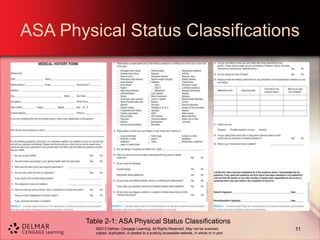
ASA Physical Status Classifications
Table 2-1: ASA Physical Status Classifications
11
©2013 Delmar, Cengage Learning. All Rights Reserved. May not be scanned,
copied, duplicated, or posted to a publicly accessible website, in whole or in part.
Using Drug Reference Manuals
• Dental auxiliary should research and
record information about the patient’s
prescribed medications
– Note side effects, particularly those that have
dental complications
12
©2013 Delmar, Cengage Learning. All Rights Reserved. May not be scanned,
copied, duplicated, or posted to a publicly accessible website, in whole or in part.
Using Drug Reference Manuals
(cont’d.)
– Physician’s Desk Reference (PDR) is one of
many resources to research drug information
– Important to have up-to-date resource as
drugs change at a rapid pace
13
©2013 Delmar, Cengage Learning. All Rights Reserved. May not be scanned,
copied, duplicated, or posted to a publicly accessible website, in whole or in part.
Using the Physician’s Desk
Reference (PDR)
• Compiled annually and contains
information about a variety of medications
• Identification section provides pictures of a
wide variety of medications, so auxiliary
can visually identify the medication
• Auxiliary should be familiar with the
contents of the drug reference source
14
©2013 Delmar, Cengage Learning. All Rights Reserved. May not be scanned,
copied, duplicated, or posted to a publicly accessible website, in whole or in part.
Using the Physician’s Desk
Reference (PDR) (cont’d.)
• Many other drug resources besides the
PDR:
– Delmar Healthcare Drug Handbook
• Also updated annually
– Drug references for specialties, such as
Delmar’s Mini Guide to Psychiatric Drugs
– Electronic versions of drug reference manuals
• CD/DVD or Web sites
15
©2013 Delmar, Cengage Learning. All Rights Reserved. May not be scanned,
copied, duplicated, or posted to a publicly accessible website, in whole or in part.
Using the Physician’s Desk
Reference (PDR) (cont’d.)
• Auxiliary should:
– Know as much as possible about the patient
to assist the dentist
– Be familiar with and utilize the drug reference
resource regularly
– Make certain the resource is up-to-date since
medications change rapidly
16
©2013 Delmar, Cengage Learning. All Rights Reserved. May not be scanned,
copied, duplicated, or posted to a publicly accessible website, in whole or in part.
Summary
• Dental staff have little knowledge of the
medical problems a patient may have
• The medical history informs the staff of:
– Medical problems for which to be prepared
– Drugs or treatments to avoid
• With this information, the dental team can
better prevent serious office emergencies
17

Chapter 2- Medical History

  • 1.
    ©2013 Delmar, CengageLearning. All Rights Reserved. May not be scanned, copied, duplicated, or posted to a publicly accessible website, in whole or in part. Medical History Chapter 2
  • 2.
    ©2013 Delmar, CengageLearning. All Rights Reserved. May not be scanned, copied, duplicated, or posted to a publicly accessible website, in whole or in part. Objectives • Upon completion of this chapter, you will be able to: – Name the basic components of a dental patient’s medical history – Name the basic components of a dental patient’s dental history – List the ASA classifications that are pertinent to the care of a dental patient 2
  • 3.
    ©2013 Delmar, CengageLearning. All Rights Reserved. May not be scanned, copied, duplicated, or posted to a publicly accessible website, in whole or in part. Objectives (cont’d.) – Explain why confidentiality should be maintained on all dental patient information – Explain the importance of having an accurate, updated medical history for the dental patient – Demonstrate the technique for completing and updating the health history – Demonstrate the technique for utilizing the Physician’s Desk Reference (PDR) 3
  • 4.
    ©2013 Delmar, CengageLearning. All Rights Reserved. May not be scanned, copied, duplicated, or posted to a publicly accessible website, in whole or in part. Medical History Format • Medical history form components: – Patient’s general information (name, age, address, emergency contact) – Patient’s primary care physician – Detailed section on patient’s medical history • Past and present medical conditions • Current medications, allergies, and past medical surgeries – Dental history 4
  • 5.
    ©2013 Delmar, CengageLearning. All Rights Reserved. May not be scanned, copied, duplicated, or posted to a publicly accessible website, in whole or in part. Medical History Format (cont’d.) • Medical history section: – List each condition’s common name for ease of patient understanding – Yes/No format with room for auxiliary follow- up questions – Available in different languages to accommodate non-English speaking patients 5
  • 6.
    ©2013 Delmar, CengageLearning. All Rights Reserved. May not be scanned, copied, duplicated, or posted to a publicly accessible website, in whole or in part. Completing the Medical History • Dental auxiliary or receptionist should be available to answer patient questions – Should question the patient about any positive results or conflicting answers – Should maintain a professional and caring manner when questioning the patient 6
  • 7.
    ©2013 Delmar, CengageLearning. All Rights Reserved. May not be scanned, copied, duplicated, or posted to a publicly accessible website, in whole or in part. Completing the Medical History (cont’d.) • Medical conditions should be reported to the dentist, particularly any that may result in an emergency 7
  • 8.
    ©2013 Delmar, CengageLearning. All Rights Reserved. May not be scanned, copied, duplicated, or posted to a publicly accessible website, in whole or in part. Confidentiality of the Medical History • Information on the medical history is confidential and should only be available to authorized users with patient consent • HIPAA (1996) law established rules for the protection of PHI (Protected Health Information) 8
  • 9.
    ©2013 Delmar, CengageLearning. All Rights Reserved. May not be scanned, copied, duplicated, or posted to a publicly accessible website, in whole or in part. Updating the Health History • Health history should be updated at every patient visit 9
  • 10.
    ©2013 Delmar, CengageLearning. All Rights Reserved. May not be scanned, copied, duplicated, or posted to a publicly accessible website, in whole or in part. Assessment of the Dental Patient • Dental auxiliary should assess patient: – Review the medical history – Note likely side effects of any prescribed medications • Place patient into physical classification based on the American Society of Anesthesiologists (ASA) – Dental team only deals with first four classifications 10
  • 11.
    ©2013 Delmar, CengageLearning. All Rights Reserved. May not be scanned, copied, duplicated, or posted to a publicly accessible website, in whole or in part. ASA Physical Status Classifications Table 2-1: ASA Physical Status Classifications 11
  • 12.
    ©2013 Delmar, CengageLearning. All Rights Reserved. May not be scanned, copied, duplicated, or posted to a publicly accessible website, in whole or in part. Using Drug Reference Manuals • Dental auxiliary should research and record information about the patient’s prescribed medications – Note side effects, particularly those that have dental complications 12
  • 13.
    ©2013 Delmar, CengageLearning. All Rights Reserved. May not be scanned, copied, duplicated, or posted to a publicly accessible website, in whole or in part. Using Drug Reference Manuals (cont’d.) – Physician’s Desk Reference (PDR) is one of many resources to research drug information – Important to have up-to-date resource as drugs change at a rapid pace 13
  • 14.
    ©2013 Delmar, CengageLearning. All Rights Reserved. May not be scanned, copied, duplicated, or posted to a publicly accessible website, in whole or in part. Using the Physician’s Desk Reference (PDR) • Compiled annually and contains information about a variety of medications • Identification section provides pictures of a wide variety of medications, so auxiliary can visually identify the medication • Auxiliary should be familiar with the contents of the drug reference source 14
  • 15.
    ©2013 Delmar, CengageLearning. All Rights Reserved. May not be scanned, copied, duplicated, or posted to a publicly accessible website, in whole or in part. Using the Physician’s Desk Reference (PDR) (cont’d.) • Many other drug resources besides the PDR: – Delmar Healthcare Drug Handbook • Also updated annually – Drug references for specialties, such as Delmar’s Mini Guide to Psychiatric Drugs – Electronic versions of drug reference manuals • CD/DVD or Web sites 15
  • 16.
    ©2013 Delmar, CengageLearning. All Rights Reserved. May not be scanned, copied, duplicated, or posted to a publicly accessible website, in whole or in part. Using the Physician’s Desk Reference (PDR) (cont’d.) • Auxiliary should: – Know as much as possible about the patient to assist the dentist – Be familiar with and utilize the drug reference resource regularly – Make certain the resource is up-to-date since medications change rapidly 16
  • 17.
    ©2013 Delmar, CengageLearning. All Rights Reserved. May not be scanned, copied, duplicated, or posted to a publicly accessible website, in whole or in part. Summary • Dental staff have little knowledge of the medical problems a patient may have • The medical history informs the staff of: – Medical problems for which to be prepared – Drugs or treatments to avoid • With this information, the dental team can better prevent serious office emergencies 17