College of Dentistry
Operative Dentistry II
Direct Esthetic Tooth-Colored
Restorations -2-
Dr. Hazem El Ajrami
• Packable composites:
It is also referred to as high density or
condensable composites. They are composites
with high filler loading and large particle size that
are appropriate for large posterior restorations.
Their packability and lack of stickiness helps
establish tight proximal contacts. They also have
good fracture resistance. However, they have
several disadvantages; they have poor adaptation
to cavity walls as well as between successive
increments and poor wear resistance due to large
filler particles. They are also opaque and
unesthetic for anterior restorations.
• Flowable composites:
A flowable composite is a low-filled
composite with low viscosity. They have two
main advantages; increased adaptability and
increased elasticity. They are indicated in
cervical lesions, in small restorations in non-
stress bearing areas and as a liner/base under
composites to provide an elastic layer that can
absorb polymerization shrinkage stresses
(elastic bonding concept).
• However, since they have low filler content,
they have inferior mechanical properties as
strength and wear resistance and have more
polymerization shrinkage. They are thus
contraindicated in large restorations in stress-
bearing areas.
• Low-shrinking silorane composites:
The main strategy to reduce inherent
polymerization shrinkage of composites focused
on increasing the filler loading, thereby reducing
the proportion of the methacrylate resin. Since
the shrinkage is caused by the resin, the lower
the proportion of resin in a composite, the lower
the shrinkage will be. However, exchanging the
resin seems the most promising pathway to solve
the shrinkage problem. The recently introduced
low-shrinkage composite is based on the
silorane resin and does not contain methacrylate
resins. The name silorane is derived from its
chemical building blocks siloxanes and oxiranes.
• The polymerization process of silorane
restorative occurs via a cationic ring-opening
reaction which results in a lower
polymerization contraction, compared to the
methacrylate based resins which polymerize
via a radical addition polymerization reaction
of their double bonds. The silorane resin is
more hydrophobic than conventional
methacrylate resins, so this results in reduced
water uptake. However, this also decreases
wettability and adaptation.
• Resin composites consist of:
A. The organic resin matrix.
B. The inorganic fillers.
C. The coupling agent.
C. The coupling agent:
It is used to bind the filler particles to the
organic resin matrix. An organo-silane is used
with bifunctional molecule. One end forms
siloxane bonds with hydroxyl group of the
silica filler while the other end is capable of
copolymerizing with the monomers of the
matrix. Its function is very critical as it allows
proper stress transfer between the resin phase
and the filler, thus increasing strength and
rigidity as well as the wear resistance of the
composite. It also provides hydrolytic stability
by preventing water from penetrating along the
resin - filler interface.
Advantages of resin composites:
1. Superior esthetic quality: their refractive
index is close to that of combined enamel
and dentin. Their filler content scatters the
incident light producing excellent
translucency. They are available in different
shades to simulate all possible tooth colors.
2. Satisfactory physical and mechanical
properties in terms of strength, toughness and
surface hardness. Heavily loaded composites
have higher strength properties.
3. Combined with adhesives, the conserve and
reinforce tooth structure. This also led to less
complex cavity preparation procedures.
4. Have low thermal conductivity. Therefore,
they do not transmit thermal shocks to the
pulp.
5. They are easy to repair.
Disadvantages of resin composite:
1. Questionable adaptation to tooth structure
due to:
A. High polymerization shrinkage, which
causes the material to pull away from the
underlying enamel and dentin.
B. Poor wettability to tooth structure because
of its high viscosity and high surface
tension. Moreover, the material is
hydrophobic and is easily displaced off the
dentin surface by compositional water.
C. High coefficient of thermal expansion than
that of the tooth structure, which causes
marginal gap formation at the tooth-
restoration interface.
These shortcomings in composite resins
invite micro-leakage around the restoration,
with its sequelae. Thus, an effective adhesive
system is mandatory with resin composite to
promote proper adaptation and prevent its
pulling away upon polymerization as well as
under stresses.
2. May exhibit high occlusal wear in areas of high
occlusal stress or when all occlusal contacts are
on the composite restoration and not shared by
tooth structure. Resin composites with smaller
particle size and higher filler loading have
higher wear resistance. Increased degree of
conversion (high degree of polymerization)
also increases the wear resistance. It is also
important to decrease the surface area of
restoration exposed to direct stresses.
3. Hydrolytic instability in the oral fluids in terms
of water sorption and hydrolysis by
environmental acids. Resin composites with
high filler content exhibit lower water sorption.
4. High technique sensitivity especially with
the adhesive systems which demands proper
isolation and attention to technique details.
The composite insertion itself is difficult and
time-consuming.
5. Conventional composites lack anticariogenic
potential by fluoride release.
Indications of resin composite:
1. Can be used in all Classes of cavity
preparations whether originating from carious
or non carious lesions. (Class I, II, III, IV, V
and VI restorations).
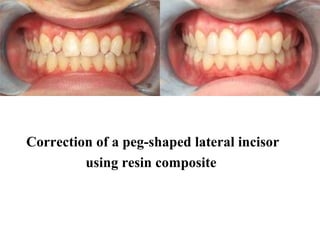
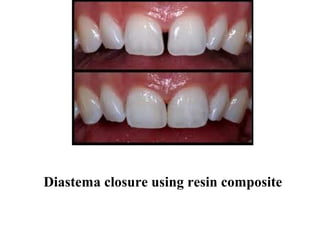
2. Used in esthetic enhancement procedures;
including correction of tooth form and
contour (shape or size), diastema closure and
partial or complete veneer for discolored or
defective teeth.
Correction of a peg-shaped lateral incisor
using resin composite
Diastema closure using resin composite
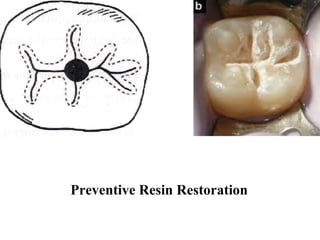
3. Used as pit and fissure sealant and in
conservative restorations, e.g. Preventive
Resin Restorations (PRR), where minimal pit
and fissure lesions are conservatively
removed and the prepared cavity is restored
with resin composite while remaining
occlusal pits and fissures are sealed with
resinous fissure sealant (dotted line).
Preventive Resin Restoration
4. Used as foundation or core build-up material
under crowns and bridges.
5. Used for cementation of indirect esthetic
restorations (resin cement).
6. Used in repair of restorations, periodontal
splinting and bonding of orthodontic
brackets.
Contraindications of resin composites:
1. Patients with bad oral hygiene and high
caries index.
2. If the operating site cannot be properly
isolated from oral fluids, e.g. deep
subgingival areas that are difficult to isolate
from the sulcular fluid. This will lead to
failure in bonding.
3. Patients with heavy occlusal stresses due to
unfavorable occlusion or bruxism, or if all
the occlusal contacts will be on the
composite material.
Cavity preparation design for resin
composite restoration:
The introduction of adhesive practices, i.e.,
bonding to enamel and dentin, has modified the
classic cavity preparation into what is known as
the "adhesive cavity design“. The adhesive
cavity design is characterized by:
1. Preservation of tooth structure: the cavity
outline is limited only to defective enamel and
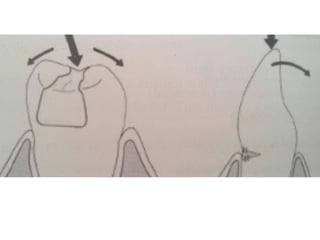
dentin, with no extension in depth or width; i.e.
the outline of the cavity takes the outline of the
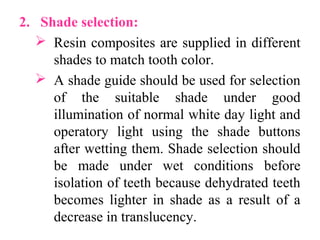
defect.
2. Beveled cavo-surface angle: the enamel walls
forming the boundaries of the cavity are
beveled to a 45° short bevel. This has the
following advantages:
A. Increases the surface area as well as surface
energy of enamel available for bonding,
with better marginal sealing and stronger
micromechanical retention.
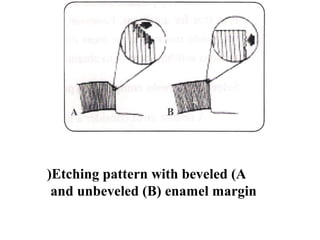
B. Exposes the ends of enamel rods, rather than
the sides, which provides for a more
retentive etching pattern with micro-pores in
enamel prisms and macro-pores in inter-
prismatic substance following acid treatment.
C. Better esthetics because of gradual color
degradation between tooth and restoration.
Etching pattern with beveled (A(
and unbeveled (B( enamel margin
• The width of the bevel is usually 0.5-1mm.
However, this width could be increased based
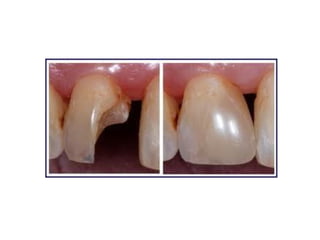
on the retention requirements, e.g. in fractured
Class IV where the etched enamel will be the
main retentive mode. In addition, smooth
rounded indentations could be made inside the
bevel (scalloping or skirting) to further
increase the surface area.
• However, the bevel is contraindicated in
stress-bearing areas, e.g. in occlusal surface of
posterior teeth, to avoid chipping of
composite in such areas if restoration is
finished into thin margins. In addition enamel
in gingival wall is not beveled to avoid
chipping of thin enamel at the margin.
3. Rounded line and point angles: to increase the
wettability and adaptation of the viscous resin
composite.
Steps of application of resin composite
restoration:
1. Selection of resin composite type.
2. Shade selection.
3. Isolation of the operatory field.
4. Application of liner/base (if needed).
5. Matricing and wedging.
6. Application of adhesive system.
7. Packing and curing of composite.
8. Finishing and polishing.
• The cavity preparation for resin composite is
relatively easy and less complex than that for
amalgam. However, manipulation and steps of
application of resin composite restoration are
more difficult and technique sensitive; it
requires a meticulous skillful operator to
obtain a durable successful composite
restoration.
1. Selection of resin composite type:
A dentist must consider a number of factors
in selecting a resin composite restorative
material. Composition in terms of filler size
and loading determines the composite's ability
to provide three functions: mechanical
support, form and contour and surface finish.
Hybrid light-activated composites are
considered almost universal and are suitable
for almost all indications of anterior and
posterior composite restorations.
• The heavily-filled hybrids, because of high
strength properties, are best for mechanical
support; the minifills and small particle
composites are best for providing contact and
contour while various types of microfill are
best in providing a lasting smooth finish.
• The filler loading also affects the modulus of
elasticity of the material; composites with high
filler loading have high modulus of elasticity
and are thus stiff and can withstand direct
occlusal forces in posterior restorations. While
composites with low filler loading, e.g.
homogenous microfill and flowable
composites, have low modulus of elasticity and
are flexible enough to withstand flexure of the
tooth under stresses.
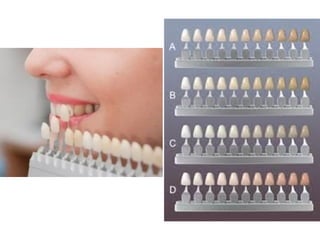
2. Shade selection:
 Resin composites are supplied in different
shades to match tooth color.
 A shade guide should be used for selection
of the suitable shade under good
illumination of normal white day light and
operatory light using the shade buttons
after wetting them. Shade selection should
be made under wet conditions before
isolation of teeth because dehydrated teeth
becomes lighter in shade as a result of a
decrease in translucency.
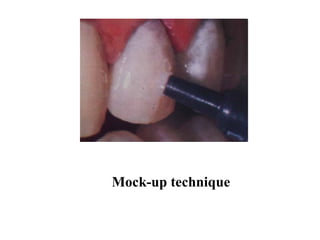
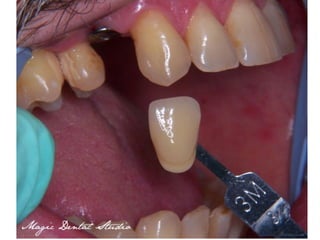
• To be more certain of the selected shade a
mock-up is made; where a small amount of the
selected shade is placed directly on the tooth to
be restored and light cured. This step assures
an accurate assessment of the selected shade
since light cured composites tend to become
slightly lighter after they are cured. An
explorer is then used to remove the cured
unbounded composite increment from the
tooth surface.
Mock-up technique
3. Isolation of the operating field:
Isolation from moisture is essential for
bonding to tooth structures. Contamination
of enamel or dentin during application of
adhesive system significantly lowers its bond
strength. Likewise, moisture contamination
during insertion of resin composite results in
deterioration of its physical properties.
• The most accurate method to properly isolate
the cavity, during bonding and application of
composite, is through the application of a
rubber dam. Isolation could also be done by
use of cotton rolls. Use of a retraction cord is
important at cervical margins to avoid seepage
of gingival fluid at the gingival seat.
Thank You

Oper.ii 11

  • 2.
    College of Dentistry OperativeDentistry II Direct Esthetic Tooth-Colored Restorations -2- Dr. Hazem El Ajrami
  • 3.
    • Packable composites: Itis also referred to as high density or condensable composites. They are composites with high filler loading and large particle size that are appropriate for large posterior restorations. Their packability and lack of stickiness helps establish tight proximal contacts. They also have good fracture resistance. However, they have several disadvantages; they have poor adaptation to cavity walls as well as between successive increments and poor wear resistance due to large filler particles. They are also opaque and unesthetic for anterior restorations.
  • 4.
    • Flowable composites: Aflowable composite is a low-filled composite with low viscosity. They have two main advantages; increased adaptability and increased elasticity. They are indicated in cervical lesions, in small restorations in non- stress bearing areas and as a liner/base under composites to provide an elastic layer that can absorb polymerization shrinkage stresses (elastic bonding concept).
  • 5.
    • However, sincethey have low filler content, they have inferior mechanical properties as strength and wear resistance and have more polymerization shrinkage. They are thus contraindicated in large restorations in stress- bearing areas.
  • 6.
    • Low-shrinking siloranecomposites: The main strategy to reduce inherent polymerization shrinkage of composites focused on increasing the filler loading, thereby reducing the proportion of the methacrylate resin. Since the shrinkage is caused by the resin, the lower the proportion of resin in a composite, the lower the shrinkage will be. However, exchanging the resin seems the most promising pathway to solve the shrinkage problem. The recently introduced low-shrinkage composite is based on the silorane resin and does not contain methacrylate resins. The name silorane is derived from its chemical building blocks siloxanes and oxiranes.
  • 7.
    • The polymerizationprocess of silorane restorative occurs via a cationic ring-opening reaction which results in a lower polymerization contraction, compared to the methacrylate based resins which polymerize via a radical addition polymerization reaction of their double bonds. The silorane resin is more hydrophobic than conventional methacrylate resins, so this results in reduced water uptake. However, this also decreases wettability and adaptation.
  • 8.
    • Resin compositesconsist of: A. The organic resin matrix. B. The inorganic fillers. C. The coupling agent.
  • 9.
    C. The couplingagent: It is used to bind the filler particles to the organic resin matrix. An organo-silane is used with bifunctional molecule. One end forms siloxane bonds with hydroxyl group of the silica filler while the other end is capable of copolymerizing with the monomers of the matrix. Its function is very critical as it allows proper stress transfer between the resin phase and the filler, thus increasing strength and rigidity as well as the wear resistance of the composite. It also provides hydrolytic stability by preventing water from penetrating along the resin - filler interface.
  • 10.
    Advantages of resincomposites: 1. Superior esthetic quality: their refractive index is close to that of combined enamel and dentin. Their filler content scatters the incident light producing excellent translucency. They are available in different shades to simulate all possible tooth colors. 2. Satisfactory physical and mechanical properties in terms of strength, toughness and surface hardness. Heavily loaded composites have higher strength properties.
  • 11.
    3. Combined withadhesives, the conserve and reinforce tooth structure. This also led to less complex cavity preparation procedures. 4. Have low thermal conductivity. Therefore, they do not transmit thermal shocks to the pulp. 5. They are easy to repair.
  • 12.
    Disadvantages of resincomposite: 1. Questionable adaptation to tooth structure due to: A. High polymerization shrinkage, which causes the material to pull away from the underlying enamel and dentin. B. Poor wettability to tooth structure because of its high viscosity and high surface tension. Moreover, the material is hydrophobic and is easily displaced off the dentin surface by compositional water.
  • 13.
    C. High coefficientof thermal expansion than that of the tooth structure, which causes marginal gap formation at the tooth- restoration interface. These shortcomings in composite resins invite micro-leakage around the restoration, with its sequelae. Thus, an effective adhesive system is mandatory with resin composite to promote proper adaptation and prevent its pulling away upon polymerization as well as under stresses.
  • 14.
    2. May exhibithigh occlusal wear in areas of high occlusal stress or when all occlusal contacts are on the composite restoration and not shared by tooth structure. Resin composites with smaller particle size and higher filler loading have higher wear resistance. Increased degree of conversion (high degree of polymerization) also increases the wear resistance. It is also important to decrease the surface area of restoration exposed to direct stresses. 3. Hydrolytic instability in the oral fluids in terms of water sorption and hydrolysis by environmental acids. Resin composites with high filler content exhibit lower water sorption.
  • 15.
    4. High techniquesensitivity especially with the adhesive systems which demands proper isolation and attention to technique details. The composite insertion itself is difficult and time-consuming. 5. Conventional composites lack anticariogenic potential by fluoride release.
  • 16.
    Indications of resincomposite: 1. Can be used in all Classes of cavity preparations whether originating from carious or non carious lesions. (Class I, II, III, IV, V and VI restorations). 2. Used in esthetic enhancement procedures; including correction of tooth form and contour (shape or size), diastema closure and partial or complete veneer for discolored or defective teeth.
  • 17.
    Correction of apeg-shaped lateral incisor using resin composite
  • 18.
    Diastema closure usingresin composite
  • 19.
    3. Used aspit and fissure sealant and in conservative restorations, e.g. Preventive Resin Restorations (PRR), where minimal pit and fissure lesions are conservatively removed and the prepared cavity is restored with resin composite while remaining occlusal pits and fissures are sealed with resinous fissure sealant (dotted line).
  • 20.
  • 21.
    4. Used asfoundation or core build-up material under crowns and bridges. 5. Used for cementation of indirect esthetic restorations (resin cement). 6. Used in repair of restorations, periodontal splinting and bonding of orthodontic brackets.
  • 22.
    Contraindications of resincomposites: 1. Patients with bad oral hygiene and high caries index. 2. If the operating site cannot be properly isolated from oral fluids, e.g. deep subgingival areas that are difficult to isolate from the sulcular fluid. This will lead to failure in bonding. 3. Patients with heavy occlusal stresses due to unfavorable occlusion or bruxism, or if all the occlusal contacts will be on the composite material.
  • 23.
    Cavity preparation designfor resin composite restoration: The introduction of adhesive practices, i.e., bonding to enamel and dentin, has modified the classic cavity preparation into what is known as the "adhesive cavity design“. The adhesive cavity design is characterized by: 1. Preservation of tooth structure: the cavity outline is limited only to defective enamel and dentin, with no extension in depth or width; i.e. the outline of the cavity takes the outline of the defect.
  • 24.
    2. Beveled cavo-surfaceangle: the enamel walls forming the boundaries of the cavity are beveled to a 45° short bevel. This has the following advantages: A. Increases the surface area as well as surface energy of enamel available for bonding, with better marginal sealing and stronger micromechanical retention.
  • 25.
    B. Exposes theends of enamel rods, rather than the sides, which provides for a more retentive etching pattern with micro-pores in enamel prisms and macro-pores in inter- prismatic substance following acid treatment. C. Better esthetics because of gradual color degradation between tooth and restoration.
  • 26.
    Etching pattern withbeveled (A( and unbeveled (B( enamel margin
  • 28.
    • The widthof the bevel is usually 0.5-1mm. However, this width could be increased based on the retention requirements, e.g. in fractured Class IV where the etched enamel will be the main retentive mode. In addition, smooth rounded indentations could be made inside the bevel (scalloping or skirting) to further increase the surface area.
  • 29.
    • However, thebevel is contraindicated in stress-bearing areas, e.g. in occlusal surface of posterior teeth, to avoid chipping of composite in such areas if restoration is finished into thin margins. In addition enamel in gingival wall is not beveled to avoid chipping of thin enamel at the margin. 3. Rounded line and point angles: to increase the wettability and adaptation of the viscous resin composite.
  • 30.
    Steps of applicationof resin composite restoration: 1. Selection of resin composite type. 2. Shade selection. 3. Isolation of the operatory field. 4. Application of liner/base (if needed). 5. Matricing and wedging. 6. Application of adhesive system. 7. Packing and curing of composite. 8. Finishing and polishing.
  • 31.
    • The cavitypreparation for resin composite is relatively easy and less complex than that for amalgam. However, manipulation and steps of application of resin composite restoration are more difficult and technique sensitive; it requires a meticulous skillful operator to obtain a durable successful composite restoration.
  • 32.
    1. Selection ofresin composite type: A dentist must consider a number of factors in selecting a resin composite restorative material. Composition in terms of filler size and loading determines the composite's ability to provide three functions: mechanical support, form and contour and surface finish. Hybrid light-activated composites are considered almost universal and are suitable for almost all indications of anterior and posterior composite restorations.
  • 33.
    • The heavily-filledhybrids, because of high strength properties, are best for mechanical support; the minifills and small particle composites are best for providing contact and contour while various types of microfill are best in providing a lasting smooth finish.
  • 34.
    • The fillerloading also affects the modulus of elasticity of the material; composites with high filler loading have high modulus of elasticity and are thus stiff and can withstand direct occlusal forces in posterior restorations. While composites with low filler loading, e.g. homogenous microfill and flowable composites, have low modulus of elasticity and are flexible enough to withstand flexure of the tooth under stresses.
  • 36.
    2. Shade selection: Resin composites are supplied in different shades to match tooth color.  A shade guide should be used for selection of the suitable shade under good illumination of normal white day light and operatory light using the shade buttons after wetting them. Shade selection should be made under wet conditions before isolation of teeth because dehydrated teeth becomes lighter in shade as a result of a decrease in translucency.
  • 39.
    • To bemore certain of the selected shade a mock-up is made; where a small amount of the selected shade is placed directly on the tooth to be restored and light cured. This step assures an accurate assessment of the selected shade since light cured composites tend to become slightly lighter after they are cured. An explorer is then used to remove the cured unbounded composite increment from the tooth surface.
  • 40.
  • 41.
    3. Isolation ofthe operating field: Isolation from moisture is essential for bonding to tooth structures. Contamination of enamel or dentin during application of adhesive system significantly lowers its bond strength. Likewise, moisture contamination during insertion of resin composite results in deterioration of its physical properties.
  • 42.
    • The mostaccurate method to properly isolate the cavity, during bonding and application of composite, is through the application of a rubber dam. Isolation could also be done by use of cotton rolls. Use of a retraction cord is important at cervical margins to avoid seepage of gingival fluid at the gingival seat.
  • 44.