T3 ASSIGNMENT
ELEMENTARY
MATH
OJASWI
231FA14025
SECTION 30
OVERVIEW
In this presentation we will be covering
the following topics:
1.Partial fractions
2.Arithmetic Progressions
3.Geometric Progressions
4.Straight lines
5.Trigonometry
PARTIAL FRACTIONS
It is a method for rewriting or splitting up a rational expression that has been
simplified.
Partial fractions is a very useful method in calculus as we will be able to integrate
partial fractions using techniques we are familiar with.
Here’s How to Solve Partial Fractions!
Start with Proper Rational Expressions (if not, you need to division
first).
You need to factor the bottom into linear factors.
Now you need to write out a partial fraction for each factor (and every
exponent of each)
Next, multiply the whole equation by the bottom.
For solving the coefficients, you need to substitute zeros of the bottom.
REAL LIFE APPLICATIONS
Partial fractions decomposition is a necessary step in the integration of the secant
function.
This may have been the first integration problem for which partial fractions were used.
Integration of the secant function is necessary to draw a Mercator map projection.
This map projection is important because it is the only conformal projection (doesn’t distort
shapes) that shows true compass directions as constant angles.
For this reason, the Mercator projection was widely used in navigation, and is the one used
in Google Maps and most other navigation software today.
In economics , Partial fractions are utilized in various factors such as selling price, consumer
purchasing power, and taxation influence quantity demand and supply, implying that multiple variables
control demand and supply.
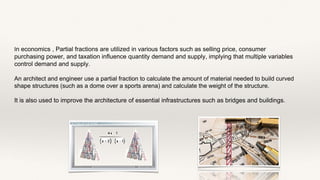
An architect and engineer use a partial fraction to calculate the amount of material needed to build curved
shape structures (such as a dome over a sports arena) and calculate the weight of the structure.
It is also used to improve the architecture of essential infrastructures such as bridges and buildings.
ARITHMETIC PROGRESSIONS
An arithmetic progression or arithmetic
sequence is a sequence of numbers such
that the difference from any succeeding term
to its preceding term remains constant
throughout the sequence. The constant
difference is called common difference of that
arithmetic progression
Formula
an = the nᵗʰ term in the sequence
a1 = the first term in the sequence
d = the common difference between terms
We come across different words like sequence, series, and progression in
AP , now let’s see what each word defines.
• Sequence is a finite or infinite list of numbers that follows a certain
pattern. For example, 0, 1, 2, 3, 4, 5… is the sequence, which is an infinite
sequence of whole numbers.
• Series is the sum of the elements to which the sequence corresponds. For
example 1 + 2 + 3 + 4 + 5…. is the series of natural numbers. Each
number in a sequence or a series is called a term. Here 1 is a term, 2 is a
term, 3 is a term, etc.
• Progression is a sequence in which the general term can be expressed
using a mathematical formula or the Sequence, which uses a
mathematical formula that can be defined as progression.
REAL LIFE APPLICATIONS
1. Roll numbers of students in a class, days in a week or
months in a year.
2. The use of arithmetic progression in daily life:
3. To determine the number of audience members a stadium
can hold.
4. When we take a taxi, we will be charged an initial cost and
then a per mile or kilometer charge.
5. Pyramid-like patterns, where objects are increasing or
decreasing in a constant manner. Ideas for this are seats in a
stadium or an auditorium.
6. Seating around tables
7. Situations involving diving in the ocean could be used as well.
8. Roll numbers of students in a class, days in a week or
months in a year.
9. Stacking cups, chairs, bowls etc. (Stacking anything works,
but the situations is different when one thing fits inside the
other.) The idea is comparing the number of objects to the
height of the object.
GEOMETRIC PROGRESSIONS
Geometric Progression (GP) is a type of
sequence where each succeeding term is
produced by multiplying each preceding term
by a fixed number, which is called a common
ratio.
Geometric series were significant in the early
development of calculus, and they remain an
important aspect of the study of series
convergence. Mathematicians use geometric
series all the time.
Let the elements of the sequence be denoted by:
a1, a2, a3, a4, …, an
a2/a1 = a3/a2 = … = an/an-1 = r (common ratio)
The common ratio is given by:
r = successive term/preceding term = arn-1 / arn-2
Geometric progression is further classified on the basis of whether they are ending or
continuing infinitely.
Finite Geometric Progression (Finite GP)
Infinite Geometric Progression (Infinite GP)
nth term of a GP is Tn = arn-1
Common ratio = r = Tn/ Tn-1
REAL LIFE APPLICATIONS
If each person decides not to have another child depending on the current population, then
annual population increase is geometric.
Each radioactive component disintegrates independently, resulting in a constant decay rate for
each.
Interest rates, email chains, and so on are other instances.
A useful application of the geometric sequence is for compound interest problems.
A population growth in which each people decide not to have another kid based on current
population then population growth each year is geometric
STRAIGHT LINES
A straight line is a line that is not curved or
bent.
The general equation of a straight line is given
below:
ax + by + c = 0
Where x and y are variables, a, b, and c are
constants.
The equation of a straight line in slope-intercept
form is given by:
y = mx + c
Here, m denotes the slope of the line, and c is
the y-intercept.
• The equation of a straight line is also called a in two
variables.
• If the product of slopes of two straight lines is -1, then
lines are perpendicular to each other.
• If two straight lines are parallel to each other, then they
have the same slope.
• Point Slope Form: (y - y1) = m (x - x1)
• Slope-Intercept Form: y = mx + c
• Standard Form = ax + by = c
REAL LIFE APPLICATIONS
1.Light travels in Straight line.
2.Roads, Railway Tracks and Bridges are constructed based on parallel lines.
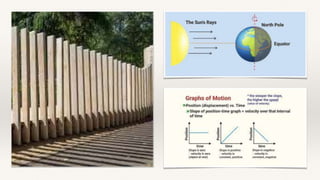
3.Use of Slopes in Physics: While plotting graphs of motion, the graph of position vs time
results in a straight line. The slope gives the velocity.
4.Straight line graphs are used in the research process and the preparation of the
government budget.
5.Straight line graphs are used in Chemistry and Biology.
6.Straight line graphs are used to estimate whether our body weight is appropriate according
to our height.
7.the pitch of a roof,
8.the slant of the plumbing pipes,
9.the steepness of the stairs
TRIGONOMET
RY
The branch of mathematics concerned
with specific functions of angles and
their application to calculations.
There are six functions of an angle
commonly used in trigonometry. Their
names and abbreviations are sine
(sin), cosine (cos), tangent (tan),
cotangent (cot), secant (sec), and
cosecant (csc).
Trigonometry basics deal with the measurement of angles and problems related to angles.
There are three basic functions in trigonometry: sine, cosine, and tangent. These three basic
ratios or functions can be used to derive other important trigonometric functions: cotangent,
secant, and cosecant.
In a right-angled triangle, we have the following three sides.
Perpendicular - It is the side opposite to the angle θ.
Base - This is the adjacent side to the angle θ.
Hypotenuse - This is the side opposite to the right angle.
If θ is the angle in a right-angled triangle, formed between the base and hypotenuse, then
• sin θ = Perpendicular/Hypotenuse
• cos θ = Base/Hypotenuse
• tan θ = Perpendicular/Base
The value of the other three functions: cot, sec, and cosec depend on tan, cos, and sin
respectively as given below.
• cot θ = 1/tan θ = Base/Perpendicular
• sec θ = 1/cos θ = Hypotenuse/Base
• cosec θ = 1/sin θ = Hypotenuse/Perpendicular
REAL LIFE APPLICATIONS
• Trigonometry can be used to measure the height of a building or
mountains.
• Trigonometry is used video games.
• Trigonometry is used in construction.
• Trigonometry is used in flight engineering.
• Trigonometry is used in physics.
• Archeologists use trigonometry.
THANK YOU

MATHEMATICS.pptx

  • 1.
  • 2.
    OVERVIEW In this presentationwe will be covering the following topics: 1.Partial fractions 2.Arithmetic Progressions 3.Geometric Progressions 4.Straight lines 5.Trigonometry
  • 3.
    PARTIAL FRACTIONS It isa method for rewriting or splitting up a rational expression that has been simplified. Partial fractions is a very useful method in calculus as we will be able to integrate partial fractions using techniques we are familiar with.
  • 4.
    Here’s How toSolve Partial Fractions! Start with Proper Rational Expressions (if not, you need to division first). You need to factor the bottom into linear factors. Now you need to write out a partial fraction for each factor (and every exponent of each) Next, multiply the whole equation by the bottom. For solving the coefficients, you need to substitute zeros of the bottom.
  • 7.
    REAL LIFE APPLICATIONS Partialfractions decomposition is a necessary step in the integration of the secant function. This may have been the first integration problem for which partial fractions were used. Integration of the secant function is necessary to draw a Mercator map projection. This map projection is important because it is the only conformal projection (doesn’t distort shapes) that shows true compass directions as constant angles. For this reason, the Mercator projection was widely used in navigation, and is the one used in Google Maps and most other navigation software today.
  • 8.
    In economics ,Partial fractions are utilized in various factors such as selling price, consumer purchasing power, and taxation influence quantity demand and supply, implying that multiple variables control demand and supply. An architect and engineer use a partial fraction to calculate the amount of material needed to build curved shape structures (such as a dome over a sports arena) and calculate the weight of the structure. It is also used to improve the architecture of essential infrastructures such as bridges and buildings.
  • 9.
    ARITHMETIC PROGRESSIONS An arithmeticprogression or arithmetic sequence is a sequence of numbers such that the difference from any succeeding term to its preceding term remains constant throughout the sequence. The constant difference is called common difference of that arithmetic progression Formula an = the nᵗʰ term in the sequence a1 = the first term in the sequence d = the common difference between terms
  • 10.
    We come acrossdifferent words like sequence, series, and progression in AP , now let’s see what each word defines. • Sequence is a finite or infinite list of numbers that follows a certain pattern. For example, 0, 1, 2, 3, 4, 5… is the sequence, which is an infinite sequence of whole numbers. • Series is the sum of the elements to which the sequence corresponds. For example 1 + 2 + 3 + 4 + 5…. is the series of natural numbers. Each number in a sequence or a series is called a term. Here 1 is a term, 2 is a term, 3 is a term, etc. • Progression is a sequence in which the general term can be expressed using a mathematical formula or the Sequence, which uses a mathematical formula that can be defined as progression.
  • 13.
    REAL LIFE APPLICATIONS 1.Roll numbers of students in a class, days in a week or months in a year. 2. The use of arithmetic progression in daily life: 3. To determine the number of audience members a stadium can hold. 4. When we take a taxi, we will be charged an initial cost and then a per mile or kilometer charge. 5. Pyramid-like patterns, where objects are increasing or decreasing in a constant manner. Ideas for this are seats in a stadium or an auditorium. 6. Seating around tables 7. Situations involving diving in the ocean could be used as well. 8. Roll numbers of students in a class, days in a week or months in a year. 9. Stacking cups, chairs, bowls etc. (Stacking anything works, but the situations is different when one thing fits inside the other.) The idea is comparing the number of objects to the height of the object.
  • 14.
    GEOMETRIC PROGRESSIONS Geometric Progression(GP) is a type of sequence where each succeeding term is produced by multiplying each preceding term by a fixed number, which is called a common ratio. Geometric series were significant in the early development of calculus, and they remain an important aspect of the study of series convergence. Mathematicians use geometric series all the time.
  • 15.
    Let the elementsof the sequence be denoted by: a1, a2, a3, a4, …, an a2/a1 = a3/a2 = … = an/an-1 = r (common ratio) The common ratio is given by: r = successive term/preceding term = arn-1 / arn-2 Geometric progression is further classified on the basis of whether they are ending or continuing infinitely. Finite Geometric Progression (Finite GP) Infinite Geometric Progression (Infinite GP) nth term of a GP is Tn = arn-1 Common ratio = r = Tn/ Tn-1
  • 18.
    REAL LIFE APPLICATIONS Ifeach person decides not to have another child depending on the current population, then annual population increase is geometric. Each radioactive component disintegrates independently, resulting in a constant decay rate for each. Interest rates, email chains, and so on are other instances. A useful application of the geometric sequence is for compound interest problems. A population growth in which each people decide not to have another kid based on current population then population growth each year is geometric
  • 20.
    STRAIGHT LINES A straightline is a line that is not curved or bent. The general equation of a straight line is given below: ax + by + c = 0 Where x and y are variables, a, b, and c are constants. The equation of a straight line in slope-intercept form is given by: y = mx + c Here, m denotes the slope of the line, and c is the y-intercept.
  • 21.
    • The equationof a straight line is also called a in two variables. • If the product of slopes of two straight lines is -1, then lines are perpendicular to each other. • If two straight lines are parallel to each other, then they have the same slope. • Point Slope Form: (y - y1) = m (x - x1) • Slope-Intercept Form: y = mx + c • Standard Form = ax + by = c
  • 24.
    REAL LIFE APPLICATIONS 1.Lighttravels in Straight line. 2.Roads, Railway Tracks and Bridges are constructed based on parallel lines. 3.Use of Slopes in Physics: While plotting graphs of motion, the graph of position vs time results in a straight line. The slope gives the velocity. 4.Straight line graphs are used in the research process and the preparation of the government budget. 5.Straight line graphs are used in Chemistry and Biology. 6.Straight line graphs are used to estimate whether our body weight is appropriate according to our height. 7.the pitch of a roof, 8.the slant of the plumbing pipes, 9.the steepness of the stairs
  • 26.
    TRIGONOMET RY The branch ofmathematics concerned with specific functions of angles and their application to calculations. There are six functions of an angle commonly used in trigonometry. Their names and abbreviations are sine (sin), cosine (cos), tangent (tan), cotangent (cot), secant (sec), and cosecant (csc).
  • 27.
    Trigonometry basics dealwith the measurement of angles and problems related to angles. There are three basic functions in trigonometry: sine, cosine, and tangent. These three basic ratios or functions can be used to derive other important trigonometric functions: cotangent, secant, and cosecant. In a right-angled triangle, we have the following three sides. Perpendicular - It is the side opposite to the angle θ. Base - This is the adjacent side to the angle θ. Hypotenuse - This is the side opposite to the right angle. If θ is the angle in a right-angled triangle, formed between the base and hypotenuse, then • sin θ = Perpendicular/Hypotenuse • cos θ = Base/Hypotenuse • tan θ = Perpendicular/Base The value of the other three functions: cot, sec, and cosec depend on tan, cos, and sin respectively as given below. • cot θ = 1/tan θ = Base/Perpendicular • sec θ = 1/cos θ = Hypotenuse/Base • cosec θ = 1/sin θ = Hypotenuse/Perpendicular
  • 30.
    REAL LIFE APPLICATIONS •Trigonometry can be used to measure the height of a building or mountains. • Trigonometry is used video games. • Trigonometry is used in construction. • Trigonometry is used in flight engineering. • Trigonometry is used in physics. • Archeologists use trigonometry.
  • 31.