THE SPANISH MATHS
  CURRICULUM OF
   BACHILLERATO
16-18-year-old students
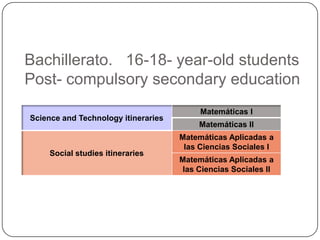
Bachillerato. 16-18- year-old students
Post- compulsory secondary education
                                          Matemáticas I
Science and Technology itineraries
                                          Matemáticas II
                                     Matemáticas Aplicadas a
                                      las Ciencias Sociales I
     Social studies itineraries
                                     Matemáticas Aplicadas a
                                      las Ciencias Sociales II
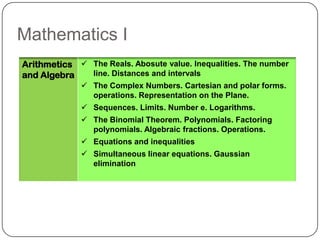
Mathematics I
Arithmetics  The Reals. Abosute value. Inequalities. The number
and Algebra   line. Distances and intervals
               The Complex Numbers. Cartesian and polar forms.
                operations. Representation on the Plane.
               Sequences. Limits. Number e. Logarithms.
               The Binomial Theorem. Polynomials. Factoring
                polynomials. Algebraic fractions. Operations.
               Equations and inequalities
               Simultaneous linear equations. Gaussian
                elimination
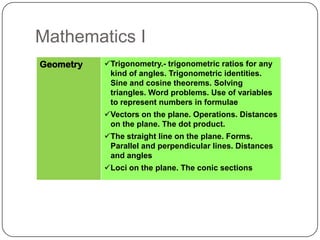
Mathematics I
Geometry   Trigonometry.- trigonometric ratios for any
            kind of angles. Trigonometric identities.
            Sine and cosine theorems. Solving
            triangles. Word problems. Use of variables
            to represent numbers in formulae
           Vectors on the plane. Operations. Distances
            on the plane. The dot product.
           The straight line on the plane. Forms.
            Parallel and perpendicular lines. Distances
            and angles
           Loci on the plane. The conic sections
Mathematics I
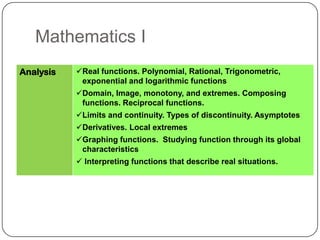
Analysis   Real functions. Polynomial, Rational, Trigonometric,
            exponential and logarithmic functions
           Domain, Image, monotony, and extremes. Composing
            functions. Reciprocal functions.
           Limits and continuity. Types of discontinuity. Asymptotes
           Derivatives. Local extremes
           Graphing functions. Studying function through its global
            characteristics
            Interpreting functions that describe real situations.
Mathematics I
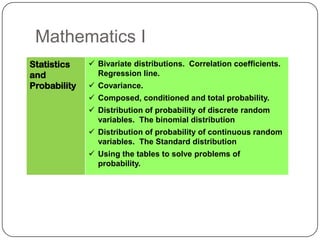
Statistics     Bivariate distributions. Correlation coefficients.
and             Regression line.
Probability    Covariance.
               Composed, conditioned and total probability.
               Distribution of probability of discrete random
                variables. The binomial distribution
               Distribution of probability of continuous random
                variables. The Standard distribution
               Using the tables to solve problems of
                probability.
Mathematics II

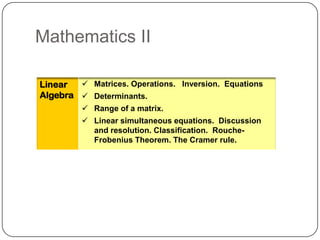
Linear   Matrices. Operations. Inversion. Equations
Algebra  Determinants.
          Range of a matrix.
          Linear simultaneous equations. Discussion
           and resolution. Classification. Rouche-
           Frobenius Theorem. The Cramer rule.
Mathematics II
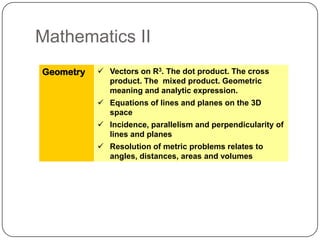
Geometry    Vectors on R3. The dot product. The cross
             product. The mixed product. Geometric
             meaning and analytic expression.
            Equations of lines and planes on the 3D
             space
            Incidence, parallelism and perpendicularity of
             lines and planes
            Resolution of metric problems relates to
             angles, distances, areas and volumes
Mathematics II
Analysis    Limits of sequences and functions.
            Continuity. Types of discontinuity
            Derivative of a function at a point.
             Function derivative. Geometric view of
             the derivative.
            Applying derivatives to the study of
             functions.
            Primitive of a function. Definite integral of
             a function. The Barrow Theorem.
            Applying integrals to calculate areas.
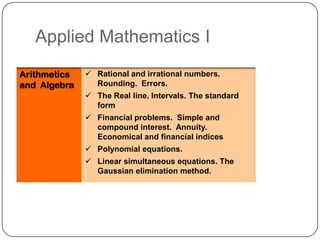
Applied Mathematics I
Arithmetics    Rational and irrational numbers.
and Algebra     Rounding. Errors.
               The Real line. Intervals. The standard
                form
               Financial problems. Simple and
                compound interest. Annuity.
                Economical and financial indices
               Polynomial equations.
               Linear simultaneous equations. The
                Gaussian elimination method.
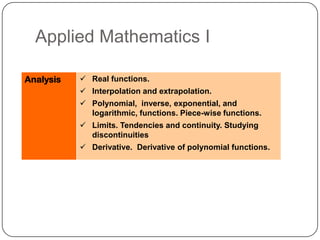
Applied Mathematics I

Analysis    Real functions.
            Interpolation and extrapolation.
            Polynomial, inverse, exponential, and
             logarithmic, functions. Piece-wise functions.
            Limits. Tendencies and continuity. Studying
             discontinuities
            Derivative. Derivative of polynomial functions.
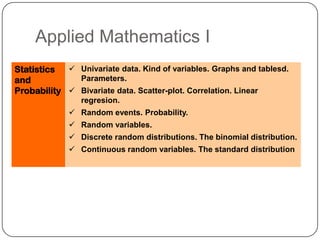
Applied Mathematics I
Statistics   Univariate data. Kind of variables. Graphs and tablesd.
and           Parameters.
Probability  Bivariate data. Scatter-plot. Correlation. Linear
                regresion.
              Random events. Probability.
              Random variables.
              Discrete random distributions. The binomial distribution.
              Continuous random variables. The standard distribution
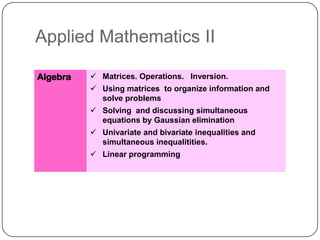
Applied Mathematics II

Algebra    Matrices. Operations. Inversion.
           Using matrices to organize information and
            solve problems
           Solving and discussing simultaneous
            equations by Gaussian elimination
           Univariate and bivariate inequalities and
            simultaneous inequalitities.
           Linear programming
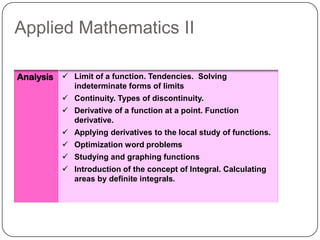
Applied Mathematics II

Analysis  Limit of a function. Tendencies. Solving
             indeterminate forms of limits
           Continuity. Types of discontinuity.
           Derivative of a function at a point. Function
            derivative.
           Applying derivatives to the local study of functions.
           Optimization word problems
           Studying and graphing functions
           Introduction of the concept of Integral. Calculating
            areas by definite integrals.
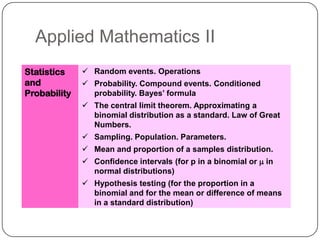
Applied Mathematics II
Statistics     Random events. Operations
and            Probability. Compound events. Conditioned
Probability     probability. Bayes’ formula
               The central limit theorem. Approximating a
                binomial distribution as a standard. Law of Great
                Numbers.
               Sampling. Population. Parameters.
               Mean and proportion of a samples distribution.
               Confidence intervals (for p in a binomial or m in
                normal distributions)
               Hypothesis testing (for the proportion in a
                binomial and for the mean or difference of means
                in a standard distribution)

The maths curriculum bachillerato

  • 1.
    THE SPANISH MATHS CURRICULUM OF BACHILLERATO 16-18-year-old students
  • 2.
    Bachillerato. 16-18- year-oldstudents Post- compulsory secondary education Matemáticas I Science and Technology itineraries Matemáticas II Matemáticas Aplicadas a las Ciencias Sociales I Social studies itineraries Matemáticas Aplicadas a las Ciencias Sociales II
  • 3.
    Mathematics I Arithmetics The Reals. Abosute value. Inequalities. The number and Algebra line. Distances and intervals  The Complex Numbers. Cartesian and polar forms. operations. Representation on the Plane.  Sequences. Limits. Number e. Logarithms.  The Binomial Theorem. Polynomials. Factoring polynomials. Algebraic fractions. Operations.  Equations and inequalities  Simultaneous linear equations. Gaussian elimination
  • 4.
    Mathematics I Geometry Trigonometry.- trigonometric ratios for any kind of angles. Trigonometric identities. Sine and cosine theorems. Solving triangles. Word problems. Use of variables to represent numbers in formulae Vectors on the plane. Operations. Distances on the plane. The dot product. The straight line on the plane. Forms. Parallel and perpendicular lines. Distances and angles Loci on the plane. The conic sections
  • 5.
    Mathematics I Analysis Real functions. Polynomial, Rational, Trigonometric, exponential and logarithmic functions Domain, Image, monotony, and extremes. Composing functions. Reciprocal functions. Limits and continuity. Types of discontinuity. Asymptotes Derivatives. Local extremes Graphing functions. Studying function through its global characteristics  Interpreting functions that describe real situations.
  • 6.
    Mathematics I Statistics  Bivariate distributions. Correlation coefficients. and Regression line. Probability  Covariance.  Composed, conditioned and total probability.  Distribution of probability of discrete random variables. The binomial distribution  Distribution of probability of continuous random variables. The Standard distribution  Using the tables to solve problems of probability.
  • 7.
    Mathematics II Linear  Matrices. Operations. Inversion. Equations Algebra  Determinants.  Range of a matrix.  Linear simultaneous equations. Discussion and resolution. Classification. Rouche- Frobenius Theorem. The Cramer rule.
  • 8.
    Mathematics II Geometry  Vectors on R3. The dot product. The cross product. The mixed product. Geometric meaning and analytic expression.  Equations of lines and planes on the 3D space  Incidence, parallelism and perpendicularity of lines and planes  Resolution of metric problems relates to angles, distances, areas and volumes
  • 9.
    Mathematics II Analysis  Limits of sequences and functions.  Continuity. Types of discontinuity  Derivative of a function at a point. Function derivative. Geometric view of the derivative.  Applying derivatives to the study of functions.  Primitive of a function. Definite integral of a function. The Barrow Theorem.  Applying integrals to calculate areas.
  • 10.
    Applied Mathematics I Arithmetics  Rational and irrational numbers. and Algebra Rounding. Errors.  The Real line. Intervals. The standard form  Financial problems. Simple and compound interest. Annuity. Economical and financial indices  Polynomial equations.  Linear simultaneous equations. The Gaussian elimination method.
  • 11.
    Applied Mathematics I Analysis  Real functions.  Interpolation and extrapolation.  Polynomial, inverse, exponential, and logarithmic, functions. Piece-wise functions.  Limits. Tendencies and continuity. Studying discontinuities  Derivative. Derivative of polynomial functions.
  • 12.
    Applied Mathematics I Statistics  Univariate data. Kind of variables. Graphs and tablesd. and Parameters. Probability  Bivariate data. Scatter-plot. Correlation. Linear regresion.  Random events. Probability.  Random variables.  Discrete random distributions. The binomial distribution.  Continuous random variables. The standard distribution
  • 13.
    Applied Mathematics II Algebra  Matrices. Operations. Inversion.  Using matrices to organize information and solve problems  Solving and discussing simultaneous equations by Gaussian elimination  Univariate and bivariate inequalities and simultaneous inequalitities.  Linear programming
  • 14.
    Applied Mathematics II Analysis Limit of a function. Tendencies. Solving indeterminate forms of limits  Continuity. Types of discontinuity.  Derivative of a function at a point. Function derivative.  Applying derivatives to the local study of functions.  Optimization word problems  Studying and graphing functions  Introduction of the concept of Integral. Calculating areas by definite integrals.
  • 15.
    Applied Mathematics II Statistics  Random events. Operations and  Probability. Compound events. Conditioned Probability probability. Bayes’ formula  The central limit theorem. Approximating a binomial distribution as a standard. Law of Great Numbers.  Sampling. Population. Parameters.  Mean and proportion of a samples distribution.  Confidence intervals (for p in a binomial or m in normal distributions)  Hypothesis testing (for the proportion in a binomial and for the mean or difference of means in a standard distribution)