THE SPANISH MATHS
CURRICULUM OF E.S.O
 12-16-year-old students
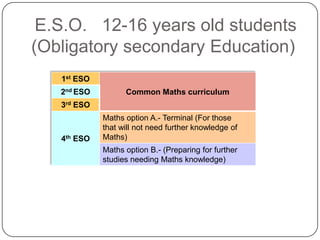
E.S.O. 12-16 years old students
(Obligatory secondary Education)
   1st ESO
   2nd ESO         Common Maths curriculum
   3rd ESO
             Maths option A.- Terminal (For those
             that will not need further knowledge of
   4th ESO   Maths)
             Maths option B.- (Preparing for further
             studies needing Maths knowledge)
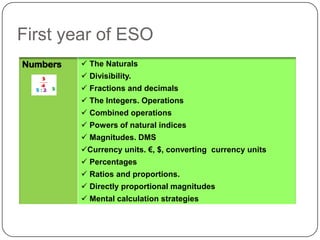
First year of ESO
Numbers    The Naturals
           Divisibility.
           Fractions and decimals
           The Integers. Operations
           Combined operations
           Powers of natural indices
           Magnitudes. DMS
          Currency units. €, $, converting currency units
           Percentages
           Ratios and proportions.
           Directly proportional magnitudes
           Mental calculation strategies
First year of ESO

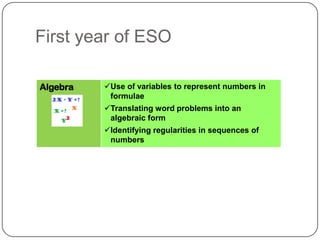
Algebra   Use of variables to represent numbers in
           formulae
          Translating word problems into an
           algebraic form
          Identifying regularities in sequences of
           numbers
First year of ESO
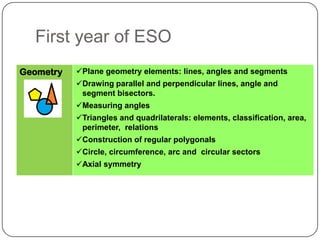
Geometry   Plane geometry elements: lines, angles and segments
           Drawing parallel and perpendicular lines, angle and
            segment bisectors.
           Measuring angles
           Triangles and quadrilaterals: elements, classification, area,
            perimeter, relations
           Construction of regular polygonals
           Circle, circumference, arc and circular sectors
           Axial symmetry
First year of ESO
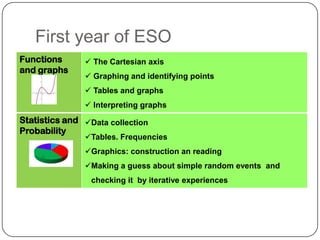
Functions       The Cartesian axis
and graphs
                Graphing and identifying points
                Tables and graphs
                Interpreting graphs
Statistics and Data collection
Probability
               Tables. Frequencies
               Graphics: construction an reading
               Making a guess about simple random events and
                 checking it by iterative experiences
Second year of ESO
Numbers    Divisibility: Prime factorization
           The L.C.F. and the G.C.M
           Equivalent fractions. The Lowest terms form.   Reducing
            to common denominator
           Operations with fractions, decimals and Integers
           Order of operations. Brackets.
           Powers. Laws of powers. The standard form
           Rounding
           Time and angles measuring. º; ; .
           Percentages, decimals and fractions
           Percent increase and decrease
           Direct and inverse proportionality
Second year of ESO
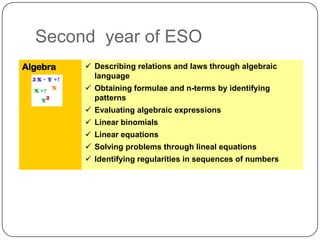
Algebra    Describing relations and laws through algebraic
            language
           Obtaining formulae and n-terms by identifying
            patterns
           Evaluating algebraic expressions
           Linear binomials
           Linear equations
           Solving problems through lineal equations
           Identifying regularities in sequences of numbers
Second year of ESO
Geometry    Right triangles. The Pythagorean Theorem
            Similarity. Similar plane figures.
            Similarity ratio Enlargements and reductions.
             Scales
            Basic elements on 3D geometry: points, lines,
             planes
            Parallel and perpendicular lines and planes
            Polyhedrons. Elements and types
            Regular polyhedrons. Laws
            The sphere. Description and laws
Second year of ESO

Functions        Graphing data from a table
and graphs       Describing phenomena given by a table
                 Interpreting monotony, continuity and extremes
                  in graphs


Statistics and  Discrete variables
Probability     Absolute, relative and cumulative frecuencies
                 Graphics: bars and pie charts
                 Mean, median and mode for a few discrete data
Third year of ESO
Numbers    Rational numbers. Comparing, ordering and graphing on
            a number line
           Decimals and fractions. Exact and periodic decimals
           Operations with fractions and decimals
           Order of operations. Brackets.
           Integers exponents powers. Laws. Operating in
            standard form. Using the calculator
           Rounding and errors
           Time and angles measuring. The sexagesimal system.
           Word problems involving direct and inverse
            proportionality. Proportional distributions
           Simple interest. Composed percentages
Third year of ESO

Algebra    Sequences of Integers and Rational numbers.
            Recurring sequences. Identifying patterns
           Arithmetic and geometric sequences
           Translating word problems into algebraic language.
           Polynomials. Evaluating polynomials. Operations.
           Linear equations and systems of equations
           Quadratic equations
           Solving problems through equations and systems
Third year of ESO
Geometry    Revising plane geometry
            Loci
            Theorem of Thales. Dividing a segment in proportional
             pieces
            Solving problems by the Pythagorean and Thales
             theorems
            Translations, rotations and reflections on the plane
            Revising 3d geometry
            Polyhedrons symmetry planes
            Spheres. Plane sections
            The Earth. Coordinates. Maps reading
            Volume and areas calculation
Third year of ESO
Functions      Diferent forms of presenting a function
and graphs     Graphing functions defined algebraically, through tables
                or by statements
               Graphs.- Monotony, continuity, extremes, symmetry and
                periodicity
               Linear functions. Solving problems by linear functions
Statistics     Discrete and continuous variables
and            Interpreting tables of frequencies and charts
Probability    Grouped data. Histograms, line and pie charts
               Graphics: bars and pie charts
               Mean, median, mode , quartiles, range and standard
                deviation
               Variation coefficient. Comparing distributions
               Random events. Frequencies
               Probability (Laplace)
Fourth year of ESO - Option A

Numbers    Operating with Integers, fractions and decimals
           Irrationals
           Standard form. Decimals and fractions. Exact and periodic
            decimals
           Powers with fractions as exponent. Operating with
            radicals
           Direct and inverse proportionality
           Percent increase and decrease
           Simple interest. Composed percentages
           Using the spread sheet to organize and solve common
            and financial problems
           Intervals. Graphing numbers on the Real line
Fourth year of ESO - Option A
Algebra    Evaluating algebraic expressions
           Sum, subtraction and product of polynomials
           Polynomial identities
           Simultaneous linear equations
           Solving word problems through equations
           Solving equations by succeeding approximations
Fourth year of ESO - Option A
Geometry      Solving problems by the Pythagorean and Thales theorems
              Solving common problems by calculating lengths, areas
               or volumes
              Cartesian coordinates. Distances between points


Functions  Functions. Studying function graphs
and graphs  Graphs characteristics.- Monotony, continuity, extremes,
                symmetry and periodicity
              Interpreting phenomena given by statements, formulae,
               tables or graphs
              Using TIC to study functions
Fourth year of ESO - Option A
Statistics     Design of statistical surveys on simple situations
and            Determining whether a sample is representative or not
Probability    Elaborating and interpreting tables of frequencies and
                charts on discrete variables. Spread sheet
               Mean, median, mode , quartiles, range and standard
                deviation
               Grouped data. Classes. Histograms, line and pie charts
               Random experiments. Random events. Frequency and
                probability
               Composed experiments.- Tree diagrams and
                contingence charts
Fourth year of ESO - Option B

 Numbers    Non periodic decimals. Irrational numbers
            The Reals. Representation on the number line. Intervals
            Rounding.
            Powers with fractions as exponent. Operating and
             reducing radicals
            Combined operations with Real numbers
            Operating with percentages. Composed interest
            Using the calculator to operate with all kind of real
             numbers
Fourth year of ESO - Option B

Algebra    Roots of a polynomial. Integers roots.
           Factoring polynomials
           The synthetic division. Polynomial identities
           Linear and quadratic equations
           Solving higher than 2 degree polynomial equations
           Reducing algebraic fractions
           Simultaneous linear equations
           Solving word problems through equations
           One- unknown inequalities and simultaneous
            inequalities.
Fourth year of ESO - Option B

Geometry  Similarity and scales. Rate of similarity for lengths,
               areas or volumes
             The Theorem of Thales. Indirect measures
             Trigonometric ratios of acute angles. Relations.
             Solving right triangles. Solving problems
             Cartesian coordinates. Distances between points.
              Graphing lines
Fourth year of ESO - Option B
Functions  Functions. Algebraic expression. Domain and graphs
and graphs  Graphs characteristics.- Monotony, continuity,
              extremes, symmetry and periodicity
             Study of linear, quadratic, inverse, exponential and
              logarithmic functions
             Piece-wise functions
             Variation rate
             Interpreting phenomena given by statements,
              formulae, tables or graphs
             Using TIC to study functions
Fourth year of ESO - Option B
Statistics   Design of statistical surveys on simple situations
and          Determining whether a sample is representative or not
Probability  Elaborating and interpreting tables of frequencies and charts
                on discrete variables. Spread sheet
              Mean, median, mode , quartiles, range and standard deviation
              Grouped data. Classes. Histograms, line and pie charts
              Random experiments. Random events. Frequency and
               probability
              Counting techniques. Combinatory
              Composed experiments.- Tree diagrams and contingence
               charts
              Conditioned probability

The maths curriculum ESO

  • 1.
    THE SPANISH MATHS CURRICULUMOF E.S.O 12-16-year-old students
  • 2.
    E.S.O. 12-16 yearsold students (Obligatory secondary Education) 1st ESO 2nd ESO Common Maths curriculum 3rd ESO Maths option A.- Terminal (For those that will not need further knowledge of 4th ESO Maths) Maths option B.- (Preparing for further studies needing Maths knowledge)
  • 3.
    First year ofESO Numbers  The Naturals  Divisibility.  Fractions and decimals  The Integers. Operations  Combined operations  Powers of natural indices  Magnitudes. DMS Currency units. €, $, converting currency units  Percentages  Ratios and proportions.  Directly proportional magnitudes  Mental calculation strategies
  • 4.
    First year ofESO Algebra Use of variables to represent numbers in formulae Translating word problems into an algebraic form Identifying regularities in sequences of numbers
  • 5.
    First year ofESO Geometry Plane geometry elements: lines, angles and segments Drawing parallel and perpendicular lines, angle and segment bisectors. Measuring angles Triangles and quadrilaterals: elements, classification, area, perimeter, relations Construction of regular polygonals Circle, circumference, arc and circular sectors Axial symmetry
  • 6.
    First year ofESO Functions  The Cartesian axis and graphs  Graphing and identifying points  Tables and graphs  Interpreting graphs Statistics and Data collection Probability Tables. Frequencies Graphics: construction an reading Making a guess about simple random events and checking it by iterative experiences
  • 7.
    Second year ofESO Numbers  Divisibility: Prime factorization  The L.C.F. and the G.C.M  Equivalent fractions. The Lowest terms form. Reducing to common denominator  Operations with fractions, decimals and Integers  Order of operations. Brackets.  Powers. Laws of powers. The standard form  Rounding  Time and angles measuring. º; ; .  Percentages, decimals and fractions  Percent increase and decrease  Direct and inverse proportionality
  • 8.
    Second year ofESO Algebra  Describing relations and laws through algebraic language  Obtaining formulae and n-terms by identifying patterns  Evaluating algebraic expressions  Linear binomials  Linear equations  Solving problems through lineal equations  Identifying regularities in sequences of numbers
  • 9.
    Second year ofESO Geometry  Right triangles. The Pythagorean Theorem  Similarity. Similar plane figures.  Similarity ratio Enlargements and reductions. Scales  Basic elements on 3D geometry: points, lines, planes  Parallel and perpendicular lines and planes  Polyhedrons. Elements and types  Regular polyhedrons. Laws  The sphere. Description and laws
  • 10.
    Second year ofESO Functions  Graphing data from a table and graphs  Describing phenomena given by a table  Interpreting monotony, continuity and extremes in graphs Statistics and  Discrete variables Probability  Absolute, relative and cumulative frecuencies  Graphics: bars and pie charts  Mean, median and mode for a few discrete data
  • 11.
    Third year ofESO Numbers  Rational numbers. Comparing, ordering and graphing on a number line  Decimals and fractions. Exact and periodic decimals  Operations with fractions and decimals  Order of operations. Brackets.  Integers exponents powers. Laws. Operating in standard form. Using the calculator  Rounding and errors  Time and angles measuring. The sexagesimal system.  Word problems involving direct and inverse proportionality. Proportional distributions  Simple interest. Composed percentages
  • 12.
    Third year ofESO Algebra  Sequences of Integers and Rational numbers. Recurring sequences. Identifying patterns  Arithmetic and geometric sequences  Translating word problems into algebraic language.  Polynomials. Evaluating polynomials. Operations.  Linear equations and systems of equations  Quadratic equations  Solving problems through equations and systems
  • 13.
    Third year ofESO Geometry  Revising plane geometry  Loci  Theorem of Thales. Dividing a segment in proportional pieces  Solving problems by the Pythagorean and Thales theorems  Translations, rotations and reflections on the plane  Revising 3d geometry  Polyhedrons symmetry planes  Spheres. Plane sections  The Earth. Coordinates. Maps reading  Volume and areas calculation
  • 14.
    Third year ofESO Functions  Diferent forms of presenting a function and graphs  Graphing functions defined algebraically, through tables or by statements  Graphs.- Monotony, continuity, extremes, symmetry and periodicity  Linear functions. Solving problems by linear functions Statistics  Discrete and continuous variables and  Interpreting tables of frequencies and charts Probability  Grouped data. Histograms, line and pie charts  Graphics: bars and pie charts  Mean, median, mode , quartiles, range and standard deviation  Variation coefficient. Comparing distributions  Random events. Frequencies  Probability (Laplace)
  • 15.
    Fourth year ofESO - Option A Numbers  Operating with Integers, fractions and decimals  Irrationals  Standard form. Decimals and fractions. Exact and periodic decimals  Powers with fractions as exponent. Operating with radicals  Direct and inverse proportionality  Percent increase and decrease  Simple interest. Composed percentages  Using the spread sheet to organize and solve common and financial problems  Intervals. Graphing numbers on the Real line
  • 16.
    Fourth year ofESO - Option A Algebra  Evaluating algebraic expressions  Sum, subtraction and product of polynomials  Polynomial identities  Simultaneous linear equations  Solving word problems through equations  Solving equations by succeeding approximations
  • 17.
    Fourth year ofESO - Option A Geometry  Solving problems by the Pythagorean and Thales theorems  Solving common problems by calculating lengths, areas or volumes  Cartesian coordinates. Distances between points Functions  Functions. Studying function graphs and graphs  Graphs characteristics.- Monotony, continuity, extremes, symmetry and periodicity  Interpreting phenomena given by statements, formulae, tables or graphs  Using TIC to study functions
  • 18.
    Fourth year ofESO - Option A Statistics  Design of statistical surveys on simple situations and  Determining whether a sample is representative or not Probability  Elaborating and interpreting tables of frequencies and charts on discrete variables. Spread sheet  Mean, median, mode , quartiles, range and standard deviation  Grouped data. Classes. Histograms, line and pie charts  Random experiments. Random events. Frequency and probability  Composed experiments.- Tree diagrams and contingence charts
  • 19.
    Fourth year ofESO - Option B Numbers  Non periodic decimals. Irrational numbers  The Reals. Representation on the number line. Intervals  Rounding.  Powers with fractions as exponent. Operating and reducing radicals  Combined operations with Real numbers  Operating with percentages. Composed interest  Using the calculator to operate with all kind of real numbers
  • 20.
    Fourth year ofESO - Option B Algebra  Roots of a polynomial. Integers roots.  Factoring polynomials  The synthetic division. Polynomial identities  Linear and quadratic equations  Solving higher than 2 degree polynomial equations  Reducing algebraic fractions  Simultaneous linear equations  Solving word problems through equations  One- unknown inequalities and simultaneous inequalities.
  • 21.
    Fourth year ofESO - Option B Geometry  Similarity and scales. Rate of similarity for lengths, areas or volumes  The Theorem of Thales. Indirect measures  Trigonometric ratios of acute angles. Relations.  Solving right triangles. Solving problems  Cartesian coordinates. Distances between points. Graphing lines
  • 22.
    Fourth year ofESO - Option B Functions  Functions. Algebraic expression. Domain and graphs and graphs  Graphs characteristics.- Monotony, continuity, extremes, symmetry and periodicity  Study of linear, quadratic, inverse, exponential and logarithmic functions  Piece-wise functions  Variation rate  Interpreting phenomena given by statements, formulae, tables or graphs  Using TIC to study functions
  • 23.
    Fourth year ofESO - Option B Statistics  Design of statistical surveys on simple situations and  Determining whether a sample is representative or not Probability  Elaborating and interpreting tables of frequencies and charts on discrete variables. Spread sheet  Mean, median, mode , quartiles, range and standard deviation  Grouped data. Classes. Histograms, line and pie charts  Random experiments. Random events. Frequency and probability  Counting techniques. Combinatory  Composed experiments.- Tree diagrams and contingence charts  Conditioned probability