Contents
1.    Scales
2.    Engineering Curves - I
3.    Engineering Curves - II
4.    Loci of Points
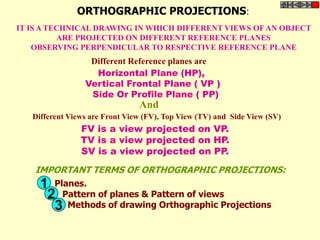
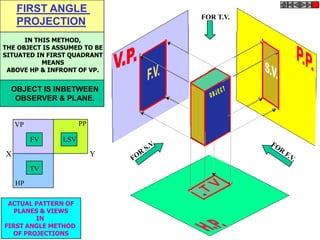
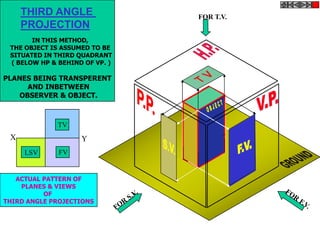
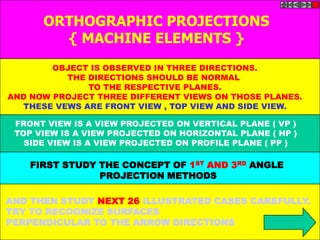
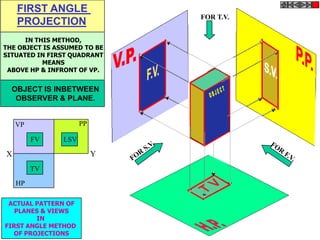
5.    Orthographic Projections - Basics
6.    Conversion of Pictorial View into Orthographic Views
7.    Projections of Points and Lines
8.    Projection of Planes
9.    Projection of Solids
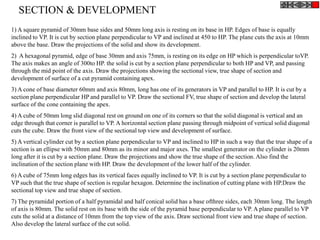
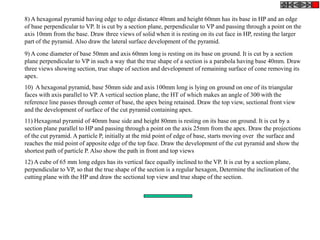
10.   Sections & Development
11.   Intersection of Surfaces
12.   Isometric Projections
13.   Exercises
14.   Solutions – Applications of Lines

                                                             EXIT
Scales

1.       Basic Information

2.       Types and important units

3.       Plain Scales (3 Problems)

4.       Diagonal Scales - information

5.       Diagonal Scales (3 Problems)

6.       Comparative Scales (3 Problems)

7.       Vernier Scales - information

8.       Vernier Scales (2 Problems)

9.       Scales of Cords - construction

10.      Scales of Cords (2 Problems)
Engineering Curves – I

1.     Classification


2.     Conic sections - explanation


3.     Common Definition


4.     Ellipse – ( six methods of construction)


5.     Parabola – ( Three methods of construction)


6.     Hyperbola – ( Three methods of construction )


7.     Methods of drawing Tangents & Normals ( four cases)
Engineering Curves – II

1.     Classification

2.     Definitions

3.     Involutes - (five cases)

4.     Cycloid

5.     Trochoids – (Superior and Inferior)

6.     Epic cycloid and Hypo - cycloid

7.     Spiral (Two cases)

8.     Helix – on cylinder & on cone

9.     Methods of drawing Tangents and Normals (Three cases)
Loci of Points

1.     Definitions - Classifications

2.     Basic locus cases (six problems)

3.     Oscillating links (two problems)

4.     Rotating Links (two problems)
Orthographic Projections - Basics
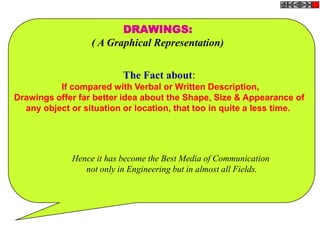
1.     Drawing – The fact about

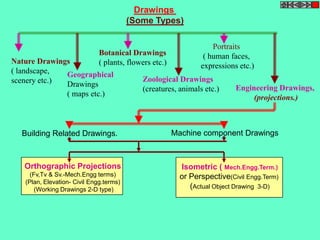
2.     Drawings - Types

3.     Orthographic (Definitions and Important terms)

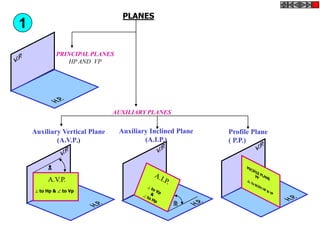
4.     Planes - Classifications

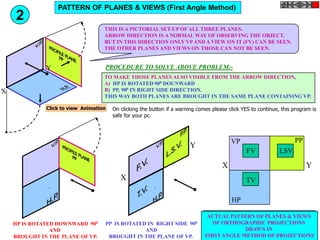
5.     Pattern of planes & views

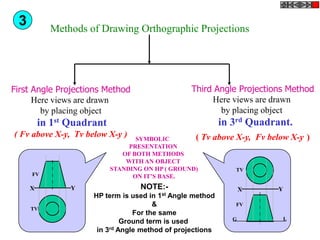
6.     Methods of orthographic projections

7.     1st angle and 3rd angle method – two illustrations
Conversion of pictorial views in to orthographic views.

1.      Explanation of various terms

2.      1st angle method - illustration


3.      3rd angle method – illustration

4.      To recognize colored surfaces and to draw three Views

5.      Seven illustrations (no.1 to 7) draw different orthographic views

6.      Total nineteen illustrations ( no.8 to 26)
Projection of Points and Lines
1.     Projections – Information
2.     Notations
3.     Quadrant Structure.
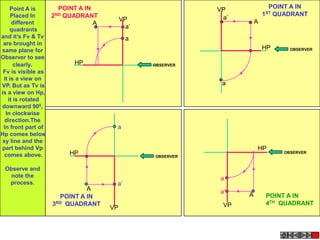
4.     Object in different Quadrants – Effect on position of views.
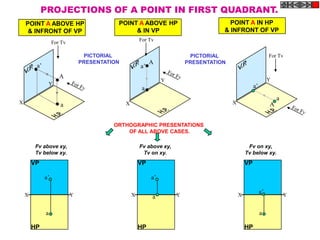
5.     Projections of a Point – in 1st quadrant.
6.
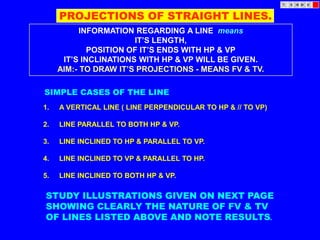
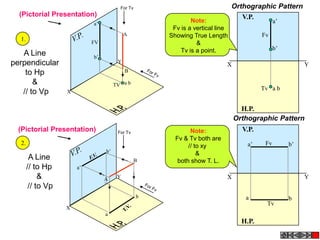
7.     Lines – Cases of Lines.
       Simple Objective & Types.

8.     Lines inclined to one plane.
9.     Lines inclined to both planes.
10.    Imp. Observations for solution
11.    Important Diagram & Tips.
12.    Group A problems 1 to 5
13.    Traces of Line ( HT & VT )
14.    To locate Traces.
15.    Group B problems: No. 6 to 8
16.    HT-VT additional information.
17.    Group B1 problems: No. 9 to 11
18.    Group B1 problems: No. 9 to 1
19.    Lines in profile plane
20.    Group C problems: No.12 & 13
21.    Applications of Lines:: Information
22.    Group D: Application Problems: 14 to 23
Projections of Planes:
 1.      About the topic:


 2.      Illustration of surface & side inclination.


 3.      Procedure to solve problem & tips:


 4.      Problems:1 to 5: Direct inclinations:


 5.      Problems:6 to 11: Indirect inclinations:


 6.      Freely suspended cases: Info:


 7.      Problems: 12 & 13


 8.      Determination of True Shape: Info:


 9.      Problems: 14 to 17
Projections of Solids:
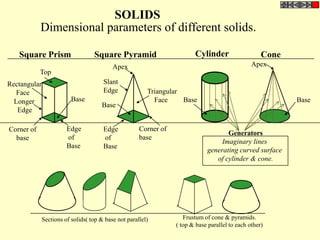
1.      Classification of Solids:

2.      Important parameters:

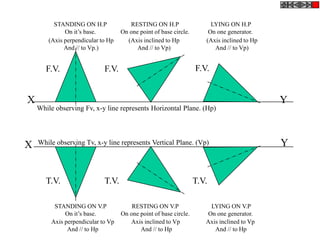
3.      Positions with Hp & Vp: Info:

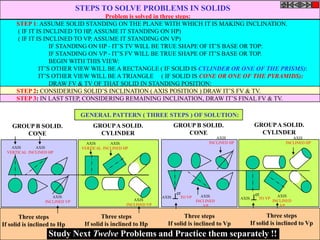
4.      Pattern of Standard Solution.

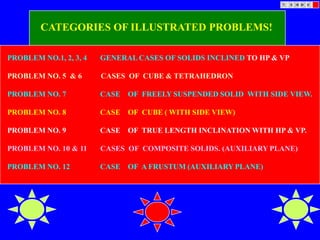
5.      Problem no 1,2,3,4: General cases:

6.      Problem no 5 & 6 (cube & tetrahedron)

7.      Problem no 7 : Freely suspended:

8.      Problem no 8 : Side view case:

9.      Problem no 9 : True length case:

10.     Problem no 10 & 11 Composite solids:

11.     Problem no 12 : Frustum & auxiliary plane:
Section & Development
1.    Applications of solids:

2.    Sectioning a solid: Information:

3.    Sectioning a solid: Illustration Terms:

4.    Typical shapes of sections & planes:


5.    Development: Information:


6.    Development of diff. solids:


7.    Development of Frustums:

8.    Problems: Standing Prism & Cone: no. 1 & 2

9.    Problems: Lying Prism & Cone: no.3 & 4

10.   Problem: Composite Solid no. 5

11.   Problem: Typical cases no.6 to 9
Intersection of Surfaces:
 1.     Essential Information:

 2.     Display of Engineering Applications:

 3.     Solution Steps to solve Problem:

 4.     Case 1: Cylinder to Cylinder:

 5.     Case 2: Prism to Cylinder:

 6.     Case 3: Cone to Cylinder

 7.     Case 4: Prism to Prism: Axis Intersecting.

 8.     Case 5: Triangular Prism to Cylinder

 9.     Case 6: Prism to Prism: Axis Skew

 10.    Case 7 Prism to Cone: from top:

 11.    Case 8: Cylinder to Cone:
Isometric Projections

1.    Definitions and explanation

2.    Important Terms

3.    Types.

4.    Isometric of plain shapes-1.

5.    Isometric of circle

6.    Isometric of a part of circle

7.    Isometric of plain shapes-2

8.    Isometric of solids & frustums (no.5 to 16)

9.    Isometric of sphere & hemi-sphere (no.17 & 18)

10.   Isometric of Section of solid.(no.19)

11.   Illustrated nineteen Problem (no.20 to 38)
OBJECTIVE OF THIS CD
                              Sky is the limit for vision.
                      Vision and memory are close relatives.
     Anything in the jurisdiction of vision can be memorized for a long period.
               We may not remember what we hear for a long time,
  but we can easily remember and even visualize what we have seen years ago.
  So vision helps visualization and both help in memorizing an event or situation.

           Video effects are far more effective, is now an established fact.
Every effort has been done in this CD, to bring various planes, objects and situations
    in-front of observer, so that he/she can further visualize in proper direction
                     and reach to the correct solution, himself.

               Off-course this all will assist & give good results
         only when one will practice all these methods and techniques
         by drawing on sheets with his/her own hands, other wise not!
                  So observe each illustration carefully
                  note proper notes given everywhere
          Go through the Tips given & solution steps carefully
    Discuss your doubts with your teacher and make practice yourself.
                       Then success is yours !!

     Go ahead confidently! CREATIVE TECHNIQUES wishes you best luck !
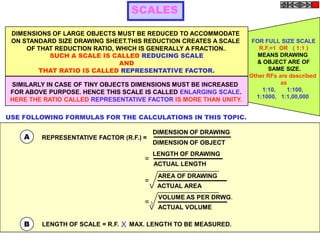
SCALES

 DIMENSIONS OF LARGE OBJECTS MUST BE REDUCED TO ACCOMMODATE
 ON STANDARD SIZE DRAWING SHEET.THIS REDUCTION CREATES A SCALE         FOR FULL SIZE SCALE
     OF THAT REDUCTION RATIO, WHICH IS GENERALLY A FRACTION..            R.F.=1 OR ( 1:1 )
           SUCH A SCALE IS CALLED REDUCING SCALE                         MEANS DRAWING
                               AND                                       & OBJECT ARE OF
        THAT RATIO IS CALLED REPRESENTATIVE FACTOR.                         SAME SIZE.
                                                                      Other RFs are described
 SIMILARLY IN CASE OF TINY OBJECTS DIMENSIONS MUST BE INCREASED                  as
 FOR ABOVE PURPOSE. HENCE THIS SCALE IS CALLED ENLARGING SCALE.           1:10,    1:100,
                                                                        1:1000, 1:1,00,000
 HERE THE RATIO CALLED REPRESENTATIVE FACTOR IS MORE THAN UNITY.

USE FOLLOWING FORMULAS FOR THE CALCULATIONS IN THIS TOPIC.

                                              DIMENSION OF DRAWING
    A    REPRESENTATIVE FACTOR (R.F.) =
                                              DIMENSION OF OBJECT
                                              LENGTH OF DRAWING
                                          =
                                               ACTUAL LENGTH
                                                AREA OF DRAWING
                                          =
                                              V ACTUAL AREA
                                                VOLUME AS PER DRWG.
                                          =3
                                              V ACTUAL VOLUME

    B    LENGTH OF SCALE = R.F.   X   MAX. LENGTH TO BE MEASURED.
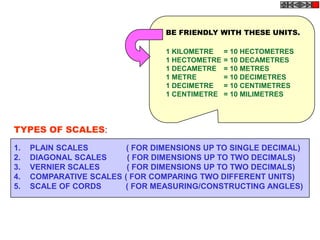
BE FRIENDLY WITH THESE UNITS.

                                   1 KILOMETRE    = 10 HECTOMETRES
                                   1 HECTOMETRE   = 10 DECAMETRES
                                   1 DECAMETRE    = 10 METRES
                                   1 METRE        = 10 DECIMETRES
                                   1 DECIMETRE    = 10 CENTIMETRES
                                   1 CENTIMETRE   = 10 MILIMETRES


TYPES OF SCALES:
1.   PLAIN SCALES          ( FOR DIMENSIONS UP TO SINGLE DECIMAL)
2.   DIAGONAL SCALES       ( FOR DIMENSIONS UP TO TWO DECIMALS)
3.   VERNIER SCALES        ( FOR DIMENSIONS UP TO TWO DECIMALS)
4.   COMPARATIVE SCALES   ( FOR COMPARING TWO DIFFERENT UNITS)
5.   SCALE OF CORDS       ( FOR MEASURING/CONSTRUCTING ANGLES)
PLAIN SCALE:-This type of scale represents two units or a unit and it‟s sub-division.
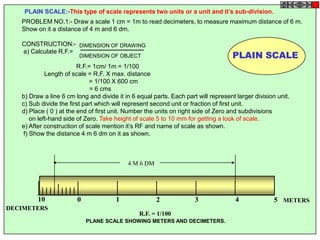
   PROBLEM NO.1:- Draw a scale 1 cm = 1m to read decimeters, to measure maximum distance of 6 m.
   Show on it a distance of 4 m and 6 dm.

   CONSTRUCTION:- DIMENSION OF DRAWING
                                                                                    PLAIN SCALE
   a) Calculate R.F.=
                         DIMENSION OF OBJECT

                         R.F.= 1cm/ 1m = 1/100
             Length of scale = R.F. X max. distance
                              = 1/100 X 600 cm
                              = 6 cms
   b) Draw a line 6 cm long and divide it in 6 equal parts. Each part will represent larger division unit.
   c) Sub divide the first part which will represent second unit or fraction of first unit.
   d) Place ( 0 ) at the end of first unit. Number the units on right side of Zero and subdivisions
       on left-hand side of Zero. Take height of scale 5 to 10 mm for getting a look of scale.
   e) After construction of scale mention it’s RF and name of scale as shown.
    f) Show the distance 4 m 6 dm on it as shown.


                                           4 M 6 DM


         10             0              1              2              3               4              5 METERS
DECIMETERS
                                                R.F. = 1/100
                            PLANE SCALE SHOWING METERS AND DECIMETERS.
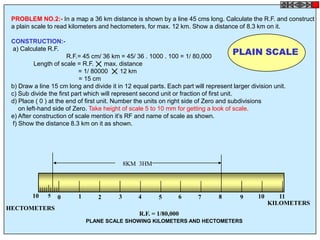
PROBLEM NO.2:- In a map a 36 km distance is shown by a line 45 cms long. Calculate the R.F. and construct
 a plain scale to read kilometers and hectometers, for max. 12 km. Show a distance of 8.3 km on it.

 CONSTRUCTION:-
 a) Calculate R.F.
                       R.F.= 45 cm/ 36 km = 45/ 36 . 1000 . 100 = 1/ 80,000
                                                                                     PLAIN SCALE
           Length of scale = R.F.      max. distance
                            = 1/ 80000      12 km
                            = 15 cm
 b) Draw a line 15 cm long and divide it in 12 equal parts. Each part will represent larger division unit.
 c) Sub divide the first part which will represent second unit or fraction of first unit.
 d) Place ( 0 ) at the end of first unit. Number the units on right side of Zero and subdivisions
     on left-hand side of Zero. Take height of scale 5 to 10 mm for getting a look of scale.
 e) After construction of scale mention it’s RF and name of scale as shown.
  f) Show the distance 8.3 km on it as shown.


                                              8KM 3HM


         10    5   0      1       2       3      4       5      6       7       8       9      10      11
                                                                                                    KILOMETERS
HECTOMETERS
                                                 R.F. = 1/80,000
                              PLANE SCALE SHOWING KILOMETERS AND HECTOMETERS
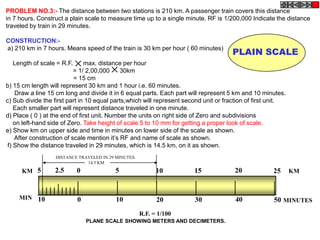
PROBLEM NO.3:- The distance between two stations is 210 km. A passenger train covers this distance
in 7 hours. Construct a plain scale to measure time up to a single minute. RF is 1/200,000 Indicate the distance
traveled by train in 29 minutes.

CONSTRUCTION:-
                                                                                     PLAIN SCALE
a) 210 km in 7 hours. Means speed of the train is 30 km per hour ( 60 minutes)

  Length of scale = R.F.       max. distance per hour
                           = 1/ 2,00,000     30km
                           = 15 cm
b) 15 cm length will represent 30 km and 1 hour i.e. 60 minutes.
    Draw a line 15 cm long and divide it in 6 equal parts. Each part will represent 5 km and 10 minutes.
c) Sub divide the first part in 10 equal parts,which will represent second unit or fraction of first unit.
    Each smaller part will represent distance traveled in one minute.
d) Place ( 0 ) at the end of first unit. Number the units on right side of Zero and subdivisions
    on left-hand side of Zero. Take height of scale 5 to 10 mm for getting a proper look of scale.
e) Show km on upper side and time in minutes on lower side of the scale as shown.
    After construction of scale mention it’s RF and name of scale as shown.
 f) Show the distance traveled in 29 minutes, which is 14.5 km, on it as shown.
                  DISTANCE TRAVELED IN 29 MINUTES.
                              14.5 KM

      KM 5        2.5      0             5                 10          15             20             25      KM


     MIN 10                0              10               20          30             40             50 MINUTES
                                                     R.F. = 1/100
                               PLANE SCALE SHOWING METERS AND DECIMETERS.
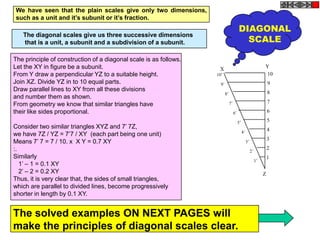
We have seen that the plain scales give only two dimensions,
such as a unit and it‟s subunit or it‟s fraction.
                                                                       DIAGONAL
                                                                         SCALE
   The diagonal scales give us three successive dimensions
   that is a unit, a subunit and a subdivision of a subunit.

The principle of construction of a diagonal scale is as follows.
Let the XY in figure be a subunit.                                 X       Y
From Y draw a perpendicular YZ to a suitable height.                       10
Join XZ. Divide YZ in to 10 equal parts.                                      9
Draw parallel lines to XY from all these divisions                            8
and number them as shown.
                                                                              7
From geometry we know that similar triangles have
their like sides proportional.                                                6
                                                                              5
Consider two similar triangles XYZ and 7’ 7Z,                                 4
we have 7Z / YZ = 7’7 / XY (each part being one unit)
                                                                              3
Means 7’ 7 = 7 / 10. x X Y = 0.7 XY
:.                                                                            2
Similarly                                                                     1
   1’ – 1 = 0.1 XY
   2’ – 2 = 0.2 XY                                                        Z
Thus, it is very clear that, the sides of small triangles,
which are parallel to divided lines, become progressively
shorter in length by 0.1 XY.


The solved examples ON NEXT PAGES will
make the principles of diagonal scales clear.
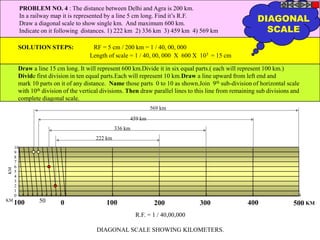
PROBLEM NO. 4 : The distance between Delhi and Agra is 200 km.
          In a railway map it is represented by a line 5 cm long. Find it’s R.F.
          Draw a diagonal scale to show single km. And maximum 600 km.
                                                                                                        DIAGONAL
          Indicate on it following distances. 1) 222 km 2) 336 km 3) 459 km 4) 569 km                     SCALE
      SOLUTION STEPS:                RF = 5 cm / 200 km = 1 / 40, 00, 000
                                    Length of scale = 1 / 40, 00, 000 X 600 X 10 5 = 15 cm

      Draw a line 15 cm long. It will represent 600 km.Divide it in six equal parts.( each will represent 100 km.)
      Divide first division in ten equal parts.Each will represent 10 km.Draw a line upward from left end and
      mark 10 parts on it of any distance. Name those parts 0 to 10 as shown.Join 9th sub-division of horizontal scale
      with 10th division of the vertical divisions. Then draw parallel lines to this line from remaining sub divisions and
      complete diagonal scale.
                                                             569 km
                                                    459 km
                                               336 km
                                      222 km
     10
     9
     8
     7
     6
KM


     5
     4
     3
     2
     1
     0
KM
     100         50      0                100                  200              300                 400                500 KM
                                                        R.F. = 1 / 40,00,000

                                       DIAGONAL SCALE SHOWING KILOMETERS.
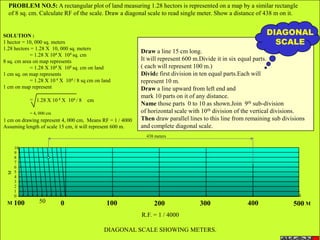
PROBLEM NO.5: A rectangular plot of land measuring 1.28 hectors is represented on a map by a similar rectangle
  of 8 sq. cm. Calculate RF of the scale. Draw a diagonal scale to read single meter. Show a distance of 438 m on it.


SOLUTION :                                                                                                   DIAGONAL
1 hector = 10, 000 sq. meters                                                                                  SCALE
1.28 hectors = 1.28 X 10, 000 sq. meters
                                                           Draw a line 15 cm long.
            = 1.28 X 104 X 104 sq. cm
8 sq. cm area on map represents                            It will represent 600 m.Divide it in six equal parts.
            = 1.28 X 104 X 104 sq. cm on land              ( each will represent 100 m.)
1 cm sq. on map represents                                 Divide first division in ten equal parts.Each will
            = 1.28 X 10 4 X 10⁴ / 8 sq cm on land          represent 10 m.
1 cm on map represent                                      Draw a line upward from left end and
                                                           mark 10 parts on it of any distance.
            = 1.28 X 10 4 X 10⁴ / 8   cm
                                                           Name those parts 0 to 10 as shown.Join 9th sub-division
            = 4, 000 cm                                    of horizontal scale with 10th division of the vertical divisions.
1 cm on drawing represent 4, 000 cm, Means RF = 1 / 4000   Then draw parallel lines to this line from remaining sub divisions
Assuming length of scale 15 cm, it will represent 600 m.   and complete diagonal scale.
                                                             438 meters

      10
      9
      8
      7
      6
      5
  M


      4
      3
      2
      1
      0
 M 100          50        0                    100              200               300                 400               500 M
                                                           R.F. = 1 / 4000

                                              DIAGONAL SCALE SHOWING METERS.
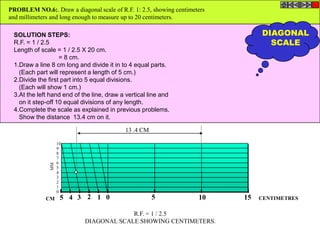
PROBLEM NO.6:. Draw a diagonal scale of R.F. 1: 2.5, showing centimeters
and millimeters and long enough to measure up to 20 centimeters.

 SOLUTION STEPS:                                                                DIAGONAL
 R.F. = 1 / 2.5                                                                   SCALE
 Length of scale = 1 / 2.5 X 20 cm.
                   = 8 cm.
 1.Draw a line 8 cm long and divide it in to 4 equal parts.
   (Each part will represent a length of 5 cm.)
 2.Divide the first part into 5 equal divisions.
   (Each will show 1 cm.)
 3.At the left hand end of the line, draw a vertical line and
   on it step-off 10 equal divisions of any length.
 4.Complete the scale as explained in previous problems.
   Show the distance 13.4 cm on it.

                                           13 .4 CM

                    10
                    9
                    8
                    7
                    6
               MM


                    5
                    4
                    3
                    2
                    1
                    0
             CM      5 4 3 2 1 0                      5              10    15   CENTIMETRES

                                         R.F. = 1 / 2.5
                            DIAGONAL SCALE SHOWING CENTIMETERS.
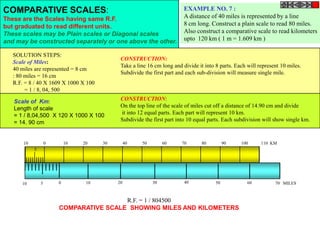
COMPARATIVE SCALES:                                                      EXAMPLE NO. 7 :
These are the Scales having same R.F.                                    A distance of 40 miles is represented by a line
but graduated to read different units.                                   8 cm long. Construct a plain scale to read 80 miles.
These scales may be Plain scales or Diagonal scales                      Also construct a comparative scale to read kilometers
and may be constructed separately or one above the other.                upto 120 km ( 1 m = 1.609 km )

   SOLUTION STEPS:
                                             CONSTRUCTION:
   Scale of Miles:
                                             Take a line 16 cm long and divide it into 8 parts. Each will represent 10 miles.
   40 miles are represented = 8 cm
                                             Subdivide the first part and each sub-division will measure single mile.
   : 80 miles = 16 cm
   R.F. = 8 / 40 X 1609 X 1000 X 100
        = 1 / 8, 04, 500

   Scale of Km:                              CONSTRUCTION:
   Length of scale                           On the top line of the scale of miles cut off a distance of 14.90 cm and divide
   = 1 / 8,04,500 X 120 X 1000 X 100         it into 12 equal parts. Each part will represent 10 km.
   = 14. 90 cm                               Subdivide the first part into 10 equal parts. Each subdivision will show single km.


       10           0       10   20    30        40   50        60      70      80          90    100      110 KM
            5


      10        5       0         10        20             30            40            50            60          70 MILES


                                         R.F. = 1 / 804500
                        COMPARATIVE SCALE SHOWING MILES AND KILOMETERS
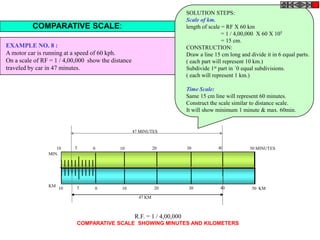
SOLUTION STEPS:
                                                                          Scale of km.
          COMPARATIVE SCALE:                                              length of scale = RF X 60 km
                                                                                          = 1 / 4,00,000 X 60 X 105
                                                                                          = 15 cm.
EXAMPLE NO. 8 :                                                           CONSTRUCTION:
A motor car is running at a speed of 60 kph.                              Draw a line 15 cm long and divide it in 6 equal parts.
On a scale of RF = 1 / 4,00,000 show the distance                         ( each part will represent 10 km.)
traveled by car in 47 minutes.                                            Subdivide 1st part in `0 equal subdivisions.
                                                                          ( each will represent 1 km.)

                                                                          Time Scale:
                                                                          Same 15 cm line will represent 60 minutes.
                                                                          Construct the scale similar to distance scale.
                                                                          It will show minimum 1 minute & max. 60min.


                                                    47 MINUTES


                   10     5      0          10                20          30            40           50 MINUTES
                MIN.


                KM         5                                                            40
                     10           0          10               20           30                         50 KM

                                                      47 KM


                                                    R.F. = 1 / 4,00,000
                           COMPARATIVE SCALE SHOWING MINUTES AND KILOMETERS
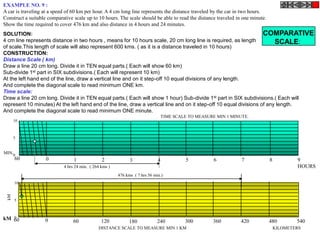
EXAMPLE NO. 9 :
A car is traveling at a speed of 60 km per hour. A 4 cm long line represents the distance traveled by the car in two hours.
Construct a suitable comparative scale up to 10 hours. The scale should be able to read the distance traveled in one minute.
Show the time required to cover 476 km and also distance in 4 hours and 24 minutes.
SOLUTION:                                                                                                           COMPARATIVE
4 cm line represents distance in two hours , means for 10 hours scale, 20 cm long line is required, as length            SCALE:
of scale.This length of scale will also represent 600 kms. ( as it is a distance traveled in 10 hours)
CONSTRUCTION:
Distance Scale ( km)
Draw a line 20 cm long. Divide it in TEN equal parts.( Each will show 60 km)
Sub-divide 1st part in SIX subdivisions.( Each will represent 10 km)
At the left hand end of the line, draw a vertical line and on it step-off 10 equal divisions of any length.
And complete the diagonal scale to read minimum ONE km.
Time scale:
Draw a line 20 cm long. Divide it in TEN equal parts.( Each will show 1 hour) Sub-divide 1st part in SIX subdivisions.( Each will
represent 10 minutes) At the left hand end of the line, draw a vertical line and on it step-off 10 equal divisions of any length.
And complete the diagonal scale to read minimum ONE minute.
                                                                                 TIME SCALE TO MEASURE MIN 1 MINUTE.
      10


      5


MIN.0
      60            0            1              2             3              4             5          6          7             8           9
                            4 hrs 24 min. ( 264 kms )                                                                                      HOURS
                                                        476 kms ( 7 hrs 56 min.)
      10
 kM


      5


   0
kM 60              0             60             120           180            240          300        360         420           480         540
                                              DISTANCE SCALE TO MEASURE MIN 1 KM                                                   KILOMETERS
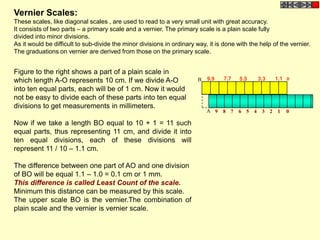
Vernier Scales:
These scales, like diagonal scales , are used to read to a very small unit with great accuracy.
It consists of two parts – a primary scale and a vernier. The primary scale is a plain scale fully
divided into minor divisions.
As it would be difficult to sub-divide the minor divisions in ordinary way, it is done with the help of the vernier.
The graduations on vernier are derived from those on the primary scale.


Figure to the right shows a part of a plain scale in
which length A-O represents 10 cm. If we divide A-O                    B   9.9    7.7   5.5    3.3    1.1 0

into ten equal parts, each will be of 1 cm. Now it would
not be easy to divide each of these parts into ten equal
divisions to get measurements in millimeters.
                                                                           A 9 8 7 6 5 4 3 2 1            0

Now if we take a length BO equal to 10 + 1 = 11 such
equal parts, thus representing 11 cm, and divide it into
ten equal divisions, each of these divisions will
represent 11 / 10 – 1.1 cm.

The difference between one part of AO and one division
of BO will be equal 1.1 – 1.0 = 0.1 cm or 1 mm.
This difference is called Least Count of the scale.
Minimum this distance can be measured by this scale.
The upper scale BO is the vernier.The combination of
plain scale and the vernier is vernier scale.
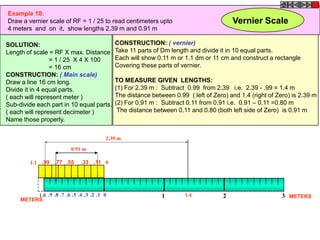
Example 10:
Draw a vernier scale of RF = 1 / 25 to read centimeters upto                             Vernier Scale
4 meters and on it, show lengths 2.39 m and 0.91 m

SOLUTION:                                    CONSTRUCTION: ( vernier)
Length of scale = RF X max. Distance         Take 11 parts of Dm length and divide it in 10 equal parts.
                 = 1 / 25 X 4 X 100          Each will show 0.11 m or 1.1 dm or 11 cm and construct a rectangle
                 = 16 cm                     Covering these parts of vernier.
CONSTRUCTION: ( Main scale)
Draw a line 16 cm long.                      TO MEASURE GIVEN LENGTHS:
Divide it in 4 equal parts.                  (1) For 2.39 m : Subtract 0.99 from 2.39 i.e. 2.39 - .99 = 1.4 m
( each will represent meter )                The distance between 0.99 ( left of Zero) and 1.4 (right of Zero) is 2.39 m
Sub-divide each part in 10 equal parts.      (2) For 0.91 m : Subtract 0.11 from 0.91 i.e. 0.91 – 0.11 =0.80 m
( each will represent decimeter )             The distance between 0.11 and 0.80 (both left side of Zero) is 0.91 m
Name those properly.

                                         2.39 m

                          0.91 m

         1.1 .99   .77 .55     .33 .11 0


          1.0 .9 .8 .7 .6 .5 .4 .3 .2 .1 0                    1        1.4           2                     3 METERS
     METERS
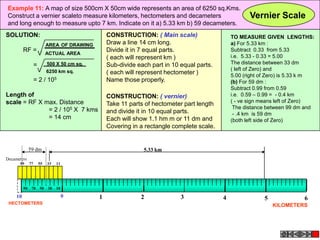
Example 11: A map of size 500cm X 50cm wide represents an area of 6250 sq.Kms.
Construct a vernier scaleto measure kilometers, hectometers and decameters                              Vernier Scale
and long enough to measure upto 7 km. Indicate on it a) 5.33 km b) 59 decameters.
SOLUTION:                                          CONSTRUCTION: ( Main scale)                   TO MEASURE GIVEN LENGTHS:
                             AREA OF DRAWING       Draw a line 14 cm long.                       a) For 5.33 km :
          RF =                                     Divide it in 7 equal parts.                   Subtract 0.33 from 5.33
                        V    ACTUAL AREA
                                                                                                 i.e. 5.33 - 0.33 = 5.00
                                                   ( each will represent km )
                    =        500 X 50 cm sq.       Sub-divide each part in 10 equal parts.       The distance between 33 dm
                        V 6250 km sq.                                                            ( left of Zero) and
                                                   ( each will represent hectometer )            5.00 (right of Zero) is 5.33 k m
                    = 2 / 105                      Name those properly.                          (b) For 59 dm :
                                                                                                 Subtract 0.99 from 0.59
Length of                                          CONSTRUCTION: ( vernier)                      i.e. 0.59 – 0.99 = - 0.4 km
scale = RF X max. Distance                                                                       ( - ve sign means left of Zero)
                                                   Take 11 parts of hectometer part length
              = 2 / 105 X 7 kms                                                                   The distance between 99 dm and
                                                   and divide it in 10 equal parts.               - .4 km is 59 dm
              = 14 cm                              Each will show 1.1 hm m or 11 dm and          (both left side of Zero)
                                                   Covering in a rectangle complete scale.


               59 dm                                            5.33 km
Decameters
      99       77       55   33   11


          90    70      50   30   10

     10                                0       1               2              3              4               5               6
 HECTOMETERS
                                                                                                                 KILOMETERS
800   900
                                 700
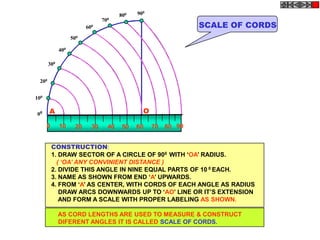
                          600                                  SCALE OF CORDS
                    500

              400

        300


  200


100


00      A                                       O

      0       10     20     30     40    50   60    70 80 90


          CONSTRUCTION:
          1. DRAW SECTOR OF A CIRCLE OF 900 WITH „OA‟ RADIUS.
            ( ‘OA’ ANY CONVINIENT DISTANCE )
          2. DIVIDE THIS ANGLE IN NINE EQUAL PARTS OF 10 0 EACH.
          3. NAME AS SHOWN FROM END „A‟ UPWARDS.
          4. FROM „A‟ AS CENTER, WITH CORDS OF EACH ANGLE AS RADIUS
             DRAW ARCS DOWNWARDS UP TO „AO‟ LINE OR IT‟S EXTENSION
             AND FORM A SCALE WITH PROPER LABELING AS SHOWN.

              AS CORD LENGTHS ARE USED TO MEASURE & CONSTRUCT
              DIFERENT ANGLES IT IS CALLED SCALE OF CORDS.
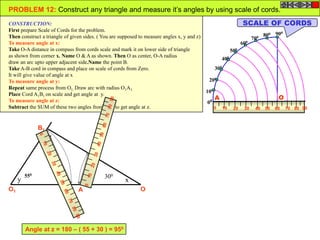
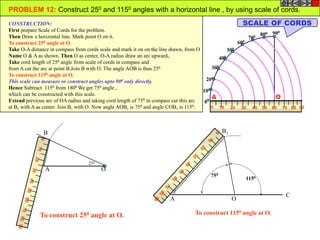
PROBLEM 12: Construct any triangle and measure it’s angles by using scale of cords.
CONSTRUCTION:                                                                                                         SCALE OF CORDS
First prepare Scale of Cords for the problem.                                                                                           0
Then construct a triangle of given sides. ( You are supposed to measure angles x, y and z)                                       800 90
                                                                                                                           700
To measure angle at x:                                                                                               600
Take O-A distance in compass from cords scale and mark it on lower side of triangle                            500
as shown from corner x. Name O & A as shown. Then O as center, O-A radius
                                                                                                         400
draw an arc upto upper adjacent side.Name the point B.
Take A-B cord in compass and place on scale of cords from Zero.                                    300
It will give value of angle at x
To measure angle at y:                                                                        200
Repeat same process from O1. Draw arc with radius O1A1.
                                                                                             100
Place Cord A1B1 on scale and get angle at y.
To measure angle at z:                                                                             A                                   O
                                                                                             00
Subtract the SUM of these two angles from 1800 to get angle at z.                                  0     10     20    30    40   50   60    70 80 90


               B1
                    z

                                      B


         550                                 300
     y                                                x
O1                        A1    A                            O


         Angle at z = 180 – ( 55 + 30 ) = 950
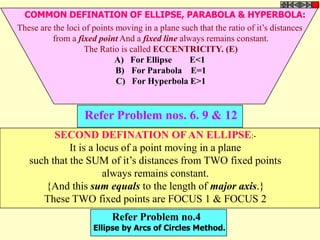
PROBLEM 12: Construct 250 and 1150 angles with a horizontal line , by using scale of cords.
CONSTRUCTION:                                                                                            SCALE OF CORDS
First prepare Scale of Cords for the problem.                                                                      0 900
Then Draw a horizontal line. Mark point O on it.                                                           70 0 80
To construct 250 angle at O.                                                                           600
Take O-A distance in compass from cords scale and mark it on on the line drawn, from O             500
Name O & A as shown. Then O as center, O-A radius draw an arc upward..                         400
Take cord length of 250 angle from scale of cords in compass and
from A cut the arc at point B.Join B with O. The angle AOB is thus 250                     300
To construct 1150 angle at O.
This scale can measure or construct angles upto 900 only directly.                       200
Hence Subtract 1150 from 1800.We get 750 angle ,
                                                                                       100
                                                                                                                      O
which can be constructed with this scale.
                                                                                           A
Extend previous arc of OA radius and taking cord length of 750 in compass cut this arc  00
at B1 with A as center. Join B1 with O. Now angle AOB1 is 750 and angle COB1 is 1150.      0 10 20 30 40 50 60 70 80 90


             B                                                                        B1


                               250
              A                      O
                                                                                750
                                                                                               1150


                                                                                                             C
                                                                A                          O

            To construct 250 angle at O.                                 To construct 1150 angle at O.
ENGINEERING CURVES
                          Part- I {Conic Sections}

ELLIPSE                      PARABOLA                HYPERBOLA

1.Concentric Circle Method   1.Rectangle Method      1.Rectangular Hyperbola
                                                      (coordinates given)
2.Rectangle Method           2 Method of Tangents
                             ( Triangle Method)      2 Rectangular Hyperbola
3.Oblong Method                                       (P-V diagram - Equation given)
                             3.Basic Locus Method
4.Arcs of Circle Method        (Directrix – focus)   3.Basic Locus Method
                                                       (Directrix – focus)
5.Rhombus Metho

6.Basic Locus Method                                 Methods of Drawing
  (Directrix – focus)                                Tangents & Normals
                                                      To These Curves.
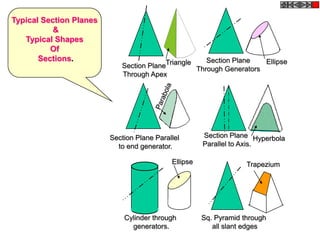
CONIC SECTIONS
        ELLIPSE, PARABOLA AND HYPERBOLA ARE CALLED CONIC SECTIONS
                                  BECAUSE
               THESE CURVES APPEAR ON THE SURFACE OF A CONE
              WHEN IT IS CUT BY SOME TYPICAL CUTTING PLANES.
                                OBSERVE
                             ILLUSTRATIONS
                              GIVEN BELOW..


                         Ellipse


   Section Plane                                Section Plane
Through Generators                                                  Hyperbola
                                                Parallel to Axis.


                       Section Plane Parallel
                         to end generator.
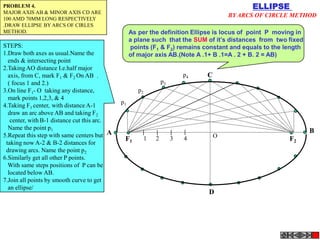
COMMON DEFINATION OF ELLIPSE, PARABOLA & HYPERBOLA:
These are the loci of points moving in a plane such that the ratio of it’s distances
          from a fixed point And a fixed line always remains constant.
                   The Ratio is called ECCENTRICITY. (E)
                            A) For Ellipse       E<1
                             B) For Parabola E=1
                             C) For Hyperbola E>1


                   Refer Problem nos. 6. 9 & 12
         SECOND DEFINATION OF AN ELLIPSE:-
             It is a locus of a point moving in a plane
   such that the SUM of it’s distances from TWO fixed points
                       always remains constant.
       {And this sum equals to the length of major axis.}
      These TWO fixed points are FOCUS 1 & FOCUS 2
                           Refer Problem no.4
                      Ellipse by Arcs of Circles Method.
ELLIPSE
                                                                         BY CONCENTRIC CIRCLE METHOD
                   Problem 1 :-
     Draw ellipse by concentric circle method.
Take major axis 100 mm and minor axis 70 mm long.                         3
                                                                2                   4
    Steps:
    1. Draw both axes as perpendicular bisectors                          C
    of each other & name their ends as shown.
    2. Taking their intersecting point as a center,         1                                5
                                                                           3
                                                                     2         4
    draw two concentric circles considering both
    as respective diameters.
                                                                1                   5
    3. Divide both circles in 12 equal parts &
    name as shown.
                                                       A                                         B
    4. From all points of outer circle draw vertical
    lines downwards and upwards respectively.
    5.From all points of inner circle draw                      10                   6
    horizontal lines to intersect those vertical
    lines.                                                 10        9         7             6
    6. Mark all intersecting points properly as                            8
    those are the points on ellipse.                                      D
    7. Join all these points along with the ends of
    both axes in smooth possible curve. It is                   9                   7
    required ellipse.
                                                                          8
Steps:
                                                                                  ELLIPSE
                                                                            BY RECTANGLE METHOD
1 Draw a rectangle taking major
and minor axes as sides.
2. In this rectangle draw both                               Problem 2
axes as perpendicular bisectors of
                                                 Draw ellipse by Rectangle method.
each other..
3. For construction, select upper        Take major axis 100 mm and minor axis 70 mm long.
left part of rectangle. Divide
vertical small side and horizontal
long side into same number of                                     D                          4
                                     4
equal parts.( here divided in four
parts)                               3                                                       3
4. Name those as shown..
5. Now join all vertical points      2                                                       2
1,2,3,4, to the upper end of minor
                                     1                                                       1
axis. And all horizontal points
i.e.1,2,3,4 to the lower end of
minor axis.                          A                                                           B
6. Then extend C-1 line upto D-1
and mark that point. Similarly
extend C-2, C-3, C-4 lines up to
D-2, D-3, & D-4 lines.
7. Mark all these points properly
and join all along with ends A
and D in smooth possible curve.
Do similar construction in right                                   C
side part.along with lower half of
the rectangle.Join all points in
smooth curve.
It is required ellipse.
ELLIPSE
                            Problem 3:-                            BY OBLONG METHOD
                  Draw ellipse by Oblong method.
         Draw a parallelogram of 100 mm and 70 mm long
        sides with included angle of 750.Inscribe Ellipse in it.
                    STEPS ARE SIMILAR TO
                      THE PREVIOUS CASE
                    (RECTANGLE METHOD)
                 ONLY IN PLACE OF RECTANGLE,
                  HERE IS A PARALLELOGRAM.


            4                                                              4

            3                                                              3

        2                                                              2

                                                                   1
    1

A                                                                  B
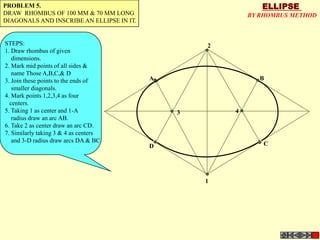
PROBLEM 4.                                                                                    ELLIPSE
MAJOR AXIS AB & MINOR AXIS CD ARE
                                                                                        BY ARCS OF CIRCLE METHOD
100 AMD 70MM LONG RESPECTIVELY
.DRAW ELLIPSE BY ARCS OF CIRLES
METHOD.                                           As per the definition Ellipse is locus of point P moving in
                                                  a plane such that the SUM of it‟s distances from two fixed
STEPS:                                            points (F1 & F2) remains constant and equals to the length
1.Draw both axes as usual.Name the                of major axis AB.(Note A .1+ B .1=A . 2 + B. 2 = AB)
  ends & intersecting point
2.Taking AO distance I.e.half major
  axis, from C, mark F1 & F2 On AB .                                       p4   C
  ( focus 1 and 2.)                                               p3
3.On line F1- O taking any distance,                 p2
  mark points 1,2,3, & 4
                                             p1
4.Taking F1 center, with distance A-1
  draw an arc above AB and taking F2
   center, with B-1 distance cut this arc.
  Name the point p1                                                                                             B
5.Repeat this step with same centers but A                                          O
                                              F1          1   2        3   4                            F2
 taking now A-2 & B-2 distances for
 drawing arcs. Name the point p2
6.Similarly get all other P points.
  With same steps positions of P can be
  located below AB.
7.Join all points by smooth curve to get
  an ellipse/
                                                                                D
PROBLEM 5.                                                    ELLIPSE
DRAW RHOMBUS OF 100 MM & 70 MM LONG                        BY RHOMBUS METHOD
DIAGONALS AND INSCRIBE AN ELLIPSE IN IT.


STEPS:                                             2
1. Draw rhombus of given
   dimensions.
2. Mark mid points of all sides &
   name Those A,B,C,& D
3. Join these points to the ends of        A                  B
   smaller diagonals.
4. Mark points 1,2,3,4 as four
  centers.
5. Taking 1 as center and 1-A                  3       4
   radius draw an arc AB.
6. Take 2 as center draw an arc CD.
7. Similarly taking 3 & 4 as centers
   and 3-D radius draw arcs DA & BC.
                                           D                  C


                                                   1
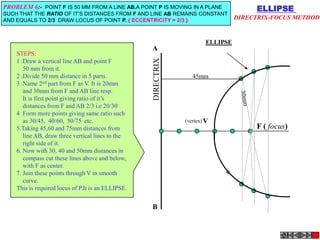
PROBLEM 6:- POINT F IS 50 MM FROM A LINE AB.A POINT P IS MOVING IN A PLANE          ELLIPSE
SUCH THAT THE RATIO OF IT’S DISTANCES FROM F AND LINE AB REMAINS CONSTANT
AND EQUALS TO 2/3 DRAW LOCUS OF POINT P. { ECCENTRICITY = 2/3 }                DIRECTRIX-FOCUS METHOD


                                                                     ELLIPSE
                                                    A
    STEPS:
    1 .Draw a vertical line AB and point F
       50 mm from it.
    2 .Divide 50 mm distance in 5 parts.                        45mm
    3 .Name 2nd part from F as V. It is 20mm
       and 30mm from F and AB line resp.
       It is first point giving ratio of it’s
       distances from F and AB 2/3 i.e 20/30
    4 Form more points giving same ratio such
       as 30/45, 40/60, 50/75 etc.                           (vertex) V
    5.Taking 45,60 and 75mm distances from                                          F ( focus)
       line AB, draw three vertical lines to the
       right side of it.
    6. Now with 30, 40 and 50mm distances in
       compass cut these lines above and below,
       with F as center.
    7. Join these points through V in smooth
       curve.
    This is required locus of P.It is an ELLIPSE.


                                                    B
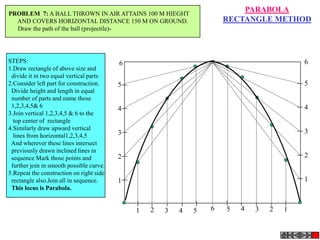
PROBLEM 7: A BALL THROWN IN AIR ATTAINS 100 M HIEGHT
                                                                           PARABOLA
  AND COVERS HORIZONTAL DISTANCE 150 M ON GROUND.                      RECTANGLE METHOD
  Draw the path of the ball (projectile)-


STEPS:                                     6                                               6
1.Draw rectangle of above size and
  divide it in two equal vertical parts
2.Consider left part for construction.     5                                               5
  Divide height and length in equal
  number of parts and name those
  1,2,3,4,5& 6                             4                                               4
3.Join vertical 1,2,3,4,5 & 6 to the
   top center of rectangle
4.Similarly draw upward vertical
                                           3                                               3
   lines from horizontal1,2,3,4,5
  And wherever these lines intersect
  previously drawn inclined lines in
  sequence Mark those points and           2                                               2
  further join in smooth possible curve.
5.Repeat the construction on right side
  rectangle also.Join all in sequence.     1                                               1
  This locus is Parabola.
.

                                               1   2   3   4   5   6   5   4   3   2   1
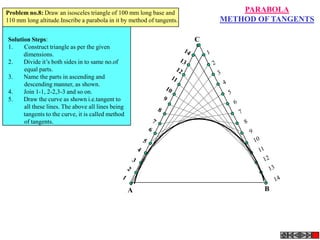
Problem no.8: Draw an isosceles triangle of 100 mm long base and                PARABOLA
110 mm long altitude.Inscribe a parabola in it by method of tangents.       METHOD OF TANGENTS

Solution Steps:                                                         C
1.    Construct triangle as per the given
      dimensions.
2.    Divide it’s both sides in to same no.of
      equal parts.
3.    Name the parts in ascending and
      descending manner, as shown.
4.    Join 1-1, 2-2,3-3 and so on.
5.    Draw the curve as shown i.e.tangent to
      all these lines. The above all lines being
      tangents to the curve, it is called method
      of tangents.


                                                   A                                B
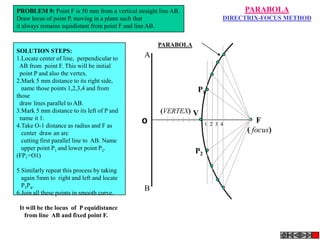
PROBLEM 9: Point F is 50 mm from a vertical straight line AB.                   PARABOLA
Draw locus of point P, moving in a plane such that                         DIRECTRIX-FOCUS METHOD
it always remains equidistant from point F and line AB.


                                                    PARABOLA
SOLUTION STEPS:
1.Locate center of line, perpendicular to      A
 AB from point F. This will be initial
 point P and also the vertex.
2.Mark 5 mm distance to its right side,
  name those points 1,2,3,4 and from                            P1
those
 draw lines parallel to AB.
3.Mark 5 mm distance to its left of P and            (VERTEX) V
 name it 1.
                                              O                      1 2 3 4
                                                                                    F
4.Take O-1 distance as radius and F as
  center draw an arc                                                             ( focus)
  cutting first parallel line to AB. Name
  upper point P1 and lower point P2.
                                                                P2
(FP1=O1)

5.Similarly repeat this process by taking
  again 5mm to right and left and locate
  P3P4.
                                               B
6.Join all these points in smooth curve.

 It will be the locus of P equidistance
   from line AB and fixed point F.
Problem No.10: Point P is 40 mm and 30 mm from horizontal              HYPERBOLA
and vertical axes respectively.Draw Hyperbola through it.             THROUGH A POINT
                                                                   OF KNOWN CO-ORDINATES
   Solution Steps:
   1) Extend horizontal
   line from P to right side.                      2
   2) Extend vertical line
   from P upward.
   3) On horizontal line
   from P, mark some points
   taking any distance and
   name them after P-1,
   2,3,4 etc.
   4) Join 1-2-3-4 points
   to pole O. Let them cut                         1
   part [P-B] also at 1,2,3,4
   points.
   5) From horizontal
   1,2,3,4 draw vertical                   2   1       P   1   2            3
   lines downwards and
   6) From vertical 1,2,3,4
   points [from P-B] draw
                                                       1
   horizontal lines.
   7) Line from 1              40 mm                   2
   horizontal and line from
   1 vertical will meet at                             3
   P1.Similarly mark P2, P3,
   P4 points.                          O
   8) Repeat the procedure
   by marking four points                  30 mm
   on upward vertical line
   from P and joining all
   those to pole O. Name
   this points P6, P7, P8 etc.
   and join them by smooth
   curve.
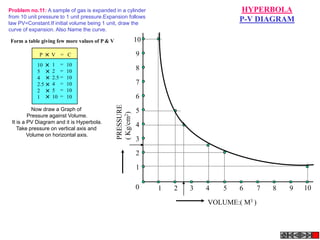
Problem no.11: A sample of gas is expanded in a cylinder                            HYPERBOLA
from 10 unit pressure to 1 unit pressure.Expansion follows
law PV=Constant.If initial volume being 1 unit, draw the
                                                                                    P-V DIAGRAM
curve of expansion. Also Name the curve.

Form a table giving few more values of P & V               10

             P    V = C                                    9
            10    1 =     10
            5     2 =     10                               8
            4     2.5 =   10
            2.5   4 =     10                               7
            2     5 =     10
            1     10 =    10                               6


                                               PRESSURE
           Now draw a Graph of                             5

                                               ( Kg/cm2)
         Pressure against Volume.
 It is a PV Diagram and it is Hyperbola.
    Take pressure on vertical axis and
                                                           4
         Volume on horizontal axis.
                                                           3
                                                           2

                                                           1

                                                           0    1   2   3   4   5   6       7   8   9   10

                                                                            VOLUME:( M3 )
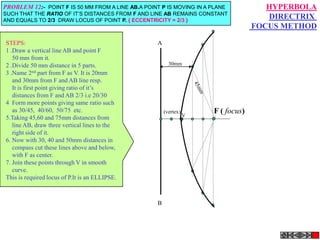
PROBLEM 12:- POINT F IS 50 MM FROM A LINE AB.A POINT P IS MOVING IN A PLANE            HYPERBOLA
SUCH THAT THE RATIO OF IT’S DISTANCES FROM F AND LINE AB REMAINS CONSTANT
AND EQUALS TO 2/3 DRAW LOCUS OF POINT P. { ECCENTRICITY = 2/3 }
                                                                                       DIRECTRIX
                                                                                    FOCUS METHOD

STEPS:                                              A
1 .Draw a vertical line AB and point F
   50 mm from it.
2 .Divide 50 mm distance in 5 parts.                      30mm
3 .Name 2nd part from F as V. It is 20mm
   and 30mm from F and AB line resp.
   It is first point giving ratio of it’s
   distances from F and AB 2/3 i.e 20/30
4 Form more points giving same ratio such
   as 30/45, 40/60, 50/75 etc.                          (vertex)
                                                                   V
                                                                       F ( focus)
5.Taking 45,60 and 75mm distances from
   line AB, draw three vertical lines to the
   right side of it.
6. Now with 30, 40 and 50mm distances in
   compass cut these lines above and below,
   with F as center.
7. Join these points through V in smooth
   curve.
This is required locus of P.It is an ELLIPSE.


                                                    B
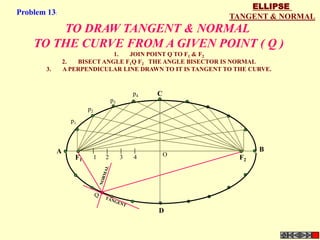
ELLIPSE
Problem 13:
                                                              TANGENT & NORMAL
        TO DRAW TANGENT & NORMAL
    TO THE CURVE FROM A GIVEN POINT ( Q )
                               1.  JOIN POINT Q TO F1 & F2
                 2.  BISECT ANGLE F1Q F2 THE ANGLE BISECTOR IS NORMAL
        3.       A PERPENDICULAR LINE DRAWN TO IT IS TANGENT TO THE CURVE.


                                               p4   C
                                      p3
                         p2
                   p1


             A                                                        B
                                                        O
                    F1        1   2        3   4                 F2


                              Q

                                                    D
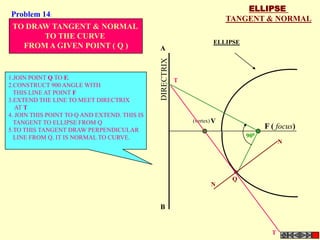
ELLIPSE
Problem 14:
                                                                   TANGENT & NORMAL
 TO DRAW TANGENT & NORMAL
       TO THE CURVE
                                                              ELLIPSE
   FROM A GIVEN POINT ( Q )                   A


1.JOIN POINT Q TO F.                              T
2.CONSTRUCT 900 ANGLE WITH
  THIS LINE AT POINT F
3.EXTEND THE LINE TO MEET DIRECTRIX
   AT T
4. JOIN THIS POINT TO Q AND EXTEND. THIS IS
  TANGENT TO ELLIPSE FROM Q                           (vertex) V
5.TO THIS TANGENT DRAW PERPENDICULAR
                                                                              F ( focus)
  LINE FROM Q. IT IS NORMAL TO CURVE.                                   900
                                                                                    N


                                                                    Q
                                                             N


                                              B


                                                                                T
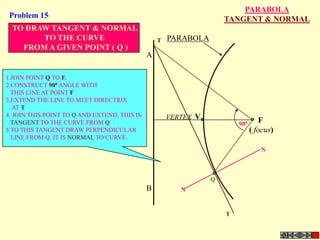
PARABOLA
 Problem 15:                                                         TANGENT & NORMAL
 TO DRAW TANGENT & NORMAL
       TO THE CURVE                               T   PARABOLA
   FROM A GIVEN POINT ( Q )
                                              A

1.JOIN POINT Q TO F.
2.CONSTRUCT 900 ANGLE WITH
  THIS LINE AT POINT F
3.EXTEND THE LINE TO MEET DIRECTRIX
   AT T
4. JOIN THIS POINT TO Q AND EXTEND. THIS IS           VERTEX V
  TANGENT TO THE CURVE FROM Q                                            900
                                                                                  F
5.TO THIS TANGENT DRAW PERPENDICULAR                                           ( focus)
  LINE FROM Q. IT IS NORMAL TO CURVE.
                                                                                  N


                                                                 Q
                                              B          N


                                                                     T
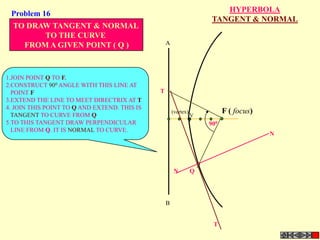
HYPERBOLA
 Problem 16
                                                                      TANGENT & NORMAL
  TO DRAW TANGENT & NORMAL
        TO THE CURVE
    FROM A GIVEN POINT ( Q )                      A


1.JOIN POINT Q TO F.
2.CONSTRUCT 900 ANGLE WITH THIS LINE AT
  POINT F                                     T
3.EXTEND THE LINE TO MEET DIRECTRIX AT T
4. JOIN THIS POINT TO Q AND EXTEND. THIS IS
  TANGENT TO CURVE FROM Q
                                                      (vertex)
                                                                 V
                                                                           F ( focus)
5.TO THIS TANGENT DRAW PERPENDICULAR                                 900
  LINE FROM Q. IT IS NORMAL TO CURVE.
                                                                                        N


                                                      N          Q


                                                  B


                                                                      T
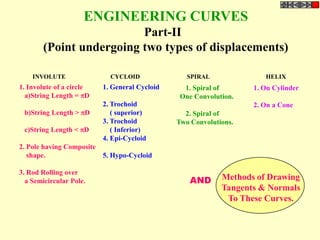
ENGINEERING CURVES
                         Part-II
       (Point undergoing two types of displacements)

    INVOLUTE                 CYCLOID               SPIRAL              HELIX
1. Involute of a circle    1. General Cycloid     1. Spiral of      1. On Cylinder
  a)String Length = D                           One Convolution.
                           2. Trochoid                              2. On a Cone
 b)String Length > D         ( superior)         2. Spiral of
                           3. Trochoid          Two Convolutions.
 c)String Length < D         ( Inferior)
                           4. Epi-Cycloid
2. Pole having Composite
   shape.                  5. Hypo-Cycloid

3. Rod Rolling over
  a Semicircular Pole.                              AND      Methods of Drawing
                                                             Tangents & Normals
                                                              To These Curves.
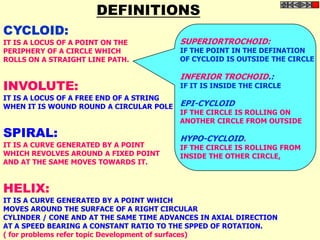
DEFINITIONS
CYCLOID:
IT IS A LOCUS OF A POINT ON THE           SUPERIORTROCHOID:
PERIPHERY OF A CIRCLE WHICH               IF THE POINT IN THE DEFINATION
ROLLS ON A STRAIGHT LINE PATH.            OF CYCLOID IS OUTSIDE THE CIRCLE

                                          INFERIOR TROCHOID.:
INVOLUTE:                                 IF IT IS INSIDE THE CIRCLE
IT IS A LOCUS OF A FREE END OF A STRING
WHEN IT IS WOUND ROUND A CIRCULAR POLE    EPI-CYCLOID
                                          IF THE CIRCLE IS ROLLING ON
                                          ANOTHER CIRCLE FROM OUTSIDE
SPIRAL:                                   HYPO-CYCLOID.
IT IS A CURVE GENERATED BY A POINT        IF THE CIRCLE IS ROLLING FROM
WHICH REVOLVES AROUND A FIXED POINT       INSIDE THE OTHER CIRCLE,
AND AT THE SAME MOVES TOWARDS IT.


HELIX:
IT IS A CURVE GENERATED BY A POINT WHICH
MOVES AROUND THE SURFACE OF A RIGHT CIRCULAR
CYLINDER / CONE AND AT THE SAME TIME ADVANCES IN AXIAL DIRECTION
AT A SPEED BEARING A CONSTANT RATIO TO THE SPPED OF ROTATION.
( for problems refer topic Development of surfaces)
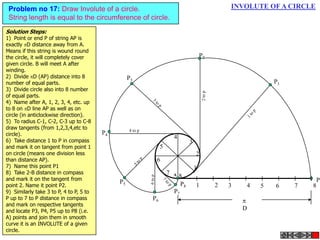
Problem no 17: Draw Involute of a circle.                                                         INVOLUTE OF A CIRCLE
 String length is equal to the circumference of circle.
Solution Steps:
1) Point or end P of string AP is
exactly D distance away from A.
Means if this string is wound round
the circle, it will completely cover                                                      P2
given circle. B will meet A after
winding.
2) Divide D (AP) distance into 8                  P3
number of equal parts.                                                                                         P1
3) Divide circle also into 8 number
of equal parts.
4) Name after A, 1, 2, 3, 4, etc. up
to 8 on D line AP as well as on
circle (in anticlockwise direction).
5) To radius C-1, C-2, C-3 up to C-8
draw tangents (from 1,2,3,4,etc to                 4 to p
circle).                                 P4
                                                                         4
6) Take distance 1 to P in compass                                                3
and mark it on tangent from point 1                              5
on circle (means one division less                                                    2
than distance AP).                                           6
7) Name this point P1                                                                 1
8) Take 2-B distance in compass                                      7   A
and mark it on the tangent from
                                                                             8
                                              P5                                                                            P
point 2. Name it point P2.                                                   P8       1        2   3   4   5   6    7   8
9) Similarly take 3 to P, 4 to P, 5 to                                   P7
P up to 7 to P distance in compass                          P6                                         
and mark on respective tangents
and locate P3, P4, P5 up to P8 (i.e.                                                                   D
A) points and join them in smooth
curve it is an INVOLUTE of a given
circle.
INVOLUTE OF A CIRCLE
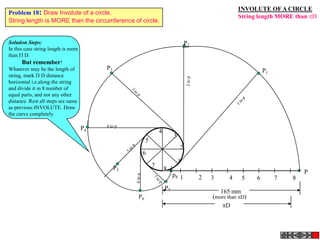
Problem 18: Draw Involute of a circle.
                                                                                                     String length MORE than D
String length is MORE than the circumference of circle.


Solution Steps:                                                                   P2
In this case string length is more
than  D.
       But remember!
Whatever may be the length of             P3                                                                    P1
string, mark  D distance
horizontal i.e.along the string
and divide it in 8 number of
equal parts, and not any other
distance. Rest all steps are same
as previous INVOLUTE. Draw
the curve completely.

                                          4 to p
                                     P4                          4
                                                                          3
                                                         5
                                                                              2
                                                     6
                                                                              1
                                               P5            7
                                                                     8
                                                                          p8 1                                               P
                                                                                       2   3     4     5    6        7   8
                                                                     P7
                                                                                              165 mm
                                                    P6                                     (more than D)
                                                                                               D
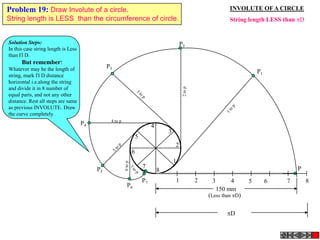
Problem 19: Draw Involute of a circle.                                                                   INVOLUTE OF A CIRCLE
String length is LESS than the circumference of circle.                                                  String length LESS than D


Solution Steps:                                                                        P2
In this case string length is Less
than  D.
       But remember!
Whatever may be the length of                  P3
                                                                                                                     P1
string, mark  D distance
horizontal i.e.along the string
and divide it in 8 number of
equal parts, and not any other
distance. Rest all steps are same
as previous INVOLUTE. Draw
the curve completely.
                                                4 to p
                                     P4                                4
                                                                               3
                                                              5
                                                                                   2
                                                          6
                                                                                   1
                                          P5                      7                                                               P
                                                                           8
                                                                  P7               1        2    3        4      5        6   7       8
                                                         P6
                                                                                                     150 mm
                                                                                                (Less than D)

                                                                                                        D
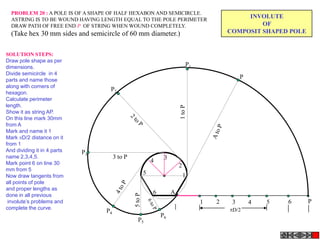
PROBLEM 20 : A POLE IS OF A SHAPE OF HALF HEXABON AND SEMICIRCLE.
  ASTRING IS TO BE WOUND HAVING LENGTH EQUAL TO THE POLE PERIMETER
                                                                                         INVOLUTE
  DRAW PATH OF FREE END P OF STRING WHEN WOUND COMPLETELY.                                   OF
  (Take hex 30 mm sides and semicircle of 60 mm diameter.)                          COMPOSIT SHAPED POLE


SOLUTION STEPS:
Draw pole shape as per
dimensions.                                                            P1
Divide semicircle in 4
parts and name those
                                                                                         P
along with corners of
                                   P2
hexagon.
Calculate perimeter
length.


                                                                  1 to P
Show it as string AP.
On this line mark 30mm
from A
Mark and name it 1
Mark D/2 distance on it
from 1
And dividing it in 4 parts   P3
name 2,3,4,5.                          3 to P             3
Mark point 6 on line 30                              4
                                                                  2
mm from 5
Now draw tangents from
                                                 5                    1
all points of pole
and proper lengths as
done in all previous
                                                     6        A
 involute’s problems and                                                    1   2    3       4   5   6     P
complete the curve.                                                                 D/2
                                  P4
                                                         P6
                                                P5
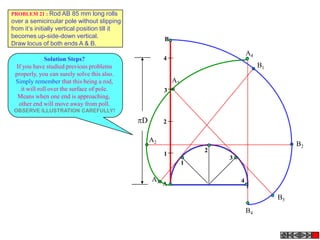
PROBLEM 21 : Rod AB 85 mm long rolls
over a semicircular pole without slipping
from it’s initially vertical position till it
becomes up-side-down vertical.                            B
Draw locus of both ends A & B.
                                                                                   A4
              Solution Steps?                             4
 If you have studied previous problems                                                  B1
 properly, you can surely solve this also.
 Simply remember that this being a rod,                       A3
   it will roll over the surface of pole.                 3
  Means when one end is approaching,
  other end will move away from poll.
 OBSERVE ILLUSTRATION CAREFULLY!
                                                D        2

                                                     A2
                                                                                                  B2
                                                                       2
                                                          1
                                                                           3
                                                                   1

                                                     A1                        4
                                                          A

                                                                                             B3
                                                                                   B4
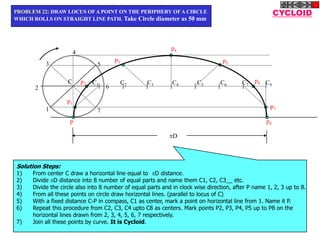
PROBLEM 22: DRAW LOCUS OF A POINT ON THE PERIPHERY OF A CIRCLE                                           CYCLOID
WHICH ROLLS ON STRAIGHT LINE PATH. Take Circle diameter as 50 mm


                                                             p4
                        4
                                          p3                                      p5
           3                      5

                    C       p2   C1            C2   C3        C4        C5       C6       C7   p6 C
                                                                                                   8
       2                              6

                   p1
           1                                                                                         p7
                                  7
                    P                                                                               p8

                                                             D


Solution Steps:
1)    From center C draw a horizontal line equal to D distance.
2)    Divide D distance into 8 number of equal parts and name them C1, C2, C3__ etc.
3)    Divide the circle also into 8 number of equal parts and in clock wise direction, after P name 1, 2, 3 up to 8.
4)    From all these points on circle draw horizontal lines. (parallel to locus of C)
5)    With a fixed distance C-P in compass, C1 as center, mark a point on horizontal line from 1. Name it P.
6)    Repeat this procedure from C2, C3, C4 upto C8 as centers. Mark points P2, P3, P4, P5 up to P8 on the
      horizontal lines drawn from 2, 3, 4, 5, 6, 7 respectively.
7)    Join all these points by curve. It is Cycloid.
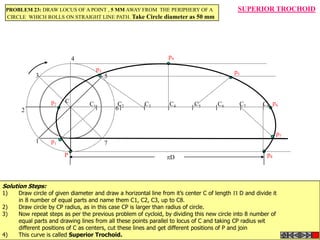
PROBLEM 23: DRAW LOCUS OF A POINT , 5 MM AWAY FROM THE PERIPHERY OF A                      SUPERIOR TROCHOID
 CIRCLE WHICH ROLLS ON STRAIGHT LINE PATH. Take Circle diameter as 50 mm


                           4                                    p4

                                      p3                                                   p5
           3                               5


                  p2   C         C1             C      C3        C4        C5       C6       C7       C8 p6
      2                                        6 2


                                                                                                             p7
           1      p1                       7
                       P                                        D                                      p8


Solution Steps:
1)   Draw circle of given diameter and draw a horizontal line from it’s center C of length  D and divide it
     in 8 number of equal parts and name them C1, C2, C3, up to C8.
2)   Draw circle by CP radius, as in this case CP is larger than radius of circle.
3)   Now repeat steps as per the previous problem of cycloid, by dividing this new circle into 8 number of
     equal parts and drawing lines from all these points parallel to locus of C and taking CP radius wit
     different positions of C as centers, cut these lines and get different positions of P and join
4)   This curve is called Superior Trochoid.
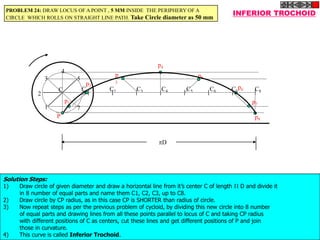
PROBLEM 24: DRAW LOCUS OF A POINT , 5 MM INSIDE THE PERIPHERY OF A
                                                                                          INFERIOR TROCHOID
CIRCLE WHICH ROLLS ON STRAIGHT LINE PATH. Take Circle diameter as 50 mm


                                                            p4
                        4
                                            p                               p5
                3                5
                                      p2    3
                    C                C1    C2      C3        C4        C5        C6      C7p6     C8
            2                        6
                            p1                                                                   p7
                1                7
                    P                                                                             p8


                                                            D


Solution Steps:
1)   Draw circle of given diameter and draw a horizontal line from it’s center C of length  D and divide it
     in 8 number of equal parts and name them C1, C2, C3, up to C8.
2)   Draw circle by CP radius, as in this case CP is SHORTER than radius of circle.
3)   Now repeat steps as per the previous problem of cycloid, by dividing this new circle into 8 number
     of equal parts and drawing lines from all these points parallel to locus of C and taking CP radius
     with different positions of C as centers, cut these lines and get different positions of P and join
     those in curvature.
4)   This curve is called Inferior Trochoid.
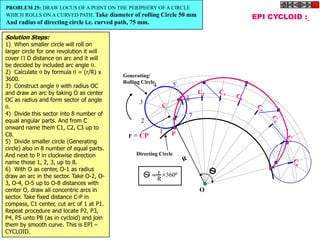
PROBLEM 25: DRAW LOCUS OF A POINT ON THE PERIPHERY OF A CIRCLE
WHICH ROLLS ON A CURVED PATH. Take diameter of rolling Circle 50 mm               EPI CYCLOID :
And radius of directing circle i.e. curved path, 75 mm.

Solution Steps:
1) When smaller circle will roll on
larger circle for one revolution it will
cover  D distance on arc and it will
be decided by included arc angle .
2) Calculate  by formula  = (r/R) x
                                             Generating/
3600.                                        Rolling Circle
3) Construct angle  with radius OC                       4          5
and draw an arc by taking O as center                                        C2
OC as radius and form sector of angle               3                    6
.
4) Divide this sector into 8 number of                                   7
equal angular parts. And from C                     2
onward name them C1, C2, C3 up to
                                                              1
C8.                                            r = CP             P
5) Divide smaller circle (Generating
circle) also in 8 number of equal parts.
And next to P in clockwise direction              Directing Circle
name those 1, 2, 3, up to 8.
6) With O as center, O-1 as radius
draw an arc in the sector. Take O-2, O-                   = r 3600
                                                            R
3, O-4, O-5 up to O-8 distances with
center O, draw all concentric arcs in                                        O
sector. Take fixed distance C-P in
compass, C1 center, cut arc of 1 at P1.
Repeat procedure and locate P2, P3,
P4, P5 unto P8 (as in cycloid) and join
them by smooth curve. This is EPI –
CYCLOID.
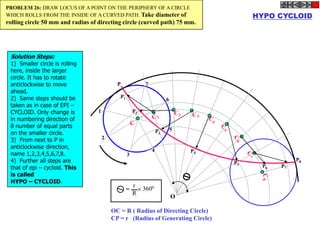
PROBLEM 26: DRAW LOCUS OF A POINT ON THE PERIPHERY OF A CIRCLE
WHICH ROLLS FROM THE INSIDE OF A CURVED PATH. Take diameter of                             HYPO CYCLOID
rolling circle 50 mm and radius of directing circle (curved path) 75 mm.


 Solution Steps:
 1) Smaller circle is rolling
 here, inside the larger
 circle. It has to rotate
 anticlockwise to move                       P              7
 ahead.
 2) Same steps should be                      P1
                                                                         6
 taken as in case of EPI –
 CYCLOID. Only change is           1                   P2
 in numbering direction of
 8 number of equal parts
                                                                             5
 on the smaller circle.                                             P3
 3) From next to P in                  2
 anticlockwise direction,
                                                                4                P4
 name 1,2,3,4,5,6,7,8.                             3
 4) Further all steps are                                                             P5
                                                                                                      P8
 that of epi – cycloid. This                                                                P6   P7
 is called
 HYPO – CYCLOID.
                                                       r
                                                   =     3600
                                                       R
                                                                             O

                                           OC = R ( Radius of Directing Circle)
                                           CP = r (Radius of Generating Circle)
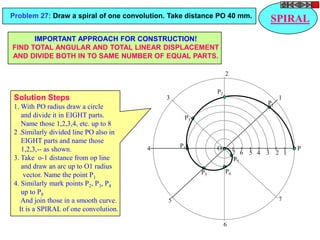
Problem 27: Draw a spiral of one convolution. Take distance PO 40 mm.
                                                                               SPIRAL
      IMPORTANT APPROACH FOR CONSTRUCTION!
FIND TOTAL ANGULAR AND TOTAL LINEAR DISPLACEMENT
AND DIVIDE BOTH IN TO SAME NUMBER OF EQUAL PARTS.

                                                                 2

                                                            P2
 Solution Steps                             3                                      1
                                                                              P1
 1. With PO radius draw a circle
    and divide it in EIGHT parts.                 P3
    Name those 1,2,3,4, etc. up to 8
 2 .Similarly divided line PO also in
    EIGHT parts and name those
                                        4        P4         O                          P
    1,2,3,-- as shown.                                                7 6 5 4 3 2 1
 3. Take o-1 distance from op line                                    P7
    and draw an arc up to O1 radius
                                                       P5        P6
     vector. Name the point P1
 4. Similarly mark points P2, P3, P4
    up to P8
    And join those in a smooth curve.        5                                     7
   It is a SPIRAL of one convolution.

                                                                 6
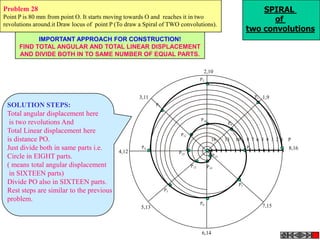
Problem 28                                                                                                       SPIRAL
Point P is 80 mm from point O. It starts moving towards O and reaches it in two                                    of
revolutions around.it Draw locus of point P (To draw a Spiral of TWO convolutions).
                                                                                                             two convolutions
            IMPORTANT APPROACH FOR CONSTRUCTION!
      FIND TOTAL ANGULAR AND TOTAL LINEAR DISPLACEMENT
      AND DIVIDE BOTH IN TO SAME NUMBER OF EQUAL PARTS.

                                                                                    2,10
                                                                                   P2


                                                    3,11                                                          P1   1,9
 SOLUTION STEPS:                                            P3

 Total angular displacement here
                                                                                   P10
  is two revolutions And                                                                          P9
 Total Linear displacement here                                        P11
 is distance PO.                                                                           16    13    10    8 7 6 5 4 3 2 1 P
 Just divide both in same parts i.e.        4,12
                                                     P4                                                      P8               8,16
                                                                      P12
 Circle in EIGHT parts.                                                                    P15

 ( means total angular displacement                                          P13         P14
  in SIXTEEN parts)
 Divide PO also in SIXTEEN parts.                                                                       P7
 Rest steps are similar to the previous                          P5

 problem.
                                                                                   P6
                                                     5,13                                                              7,15


                                                                                   6,14
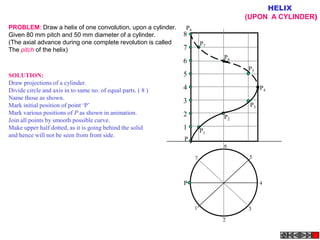
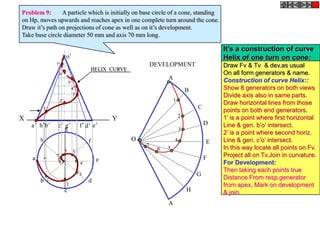
HELIX
                                                                                 (UPON A CYLINDER)
PROBLEM: Draw a helix of one convolution, upon a cylinder.    P8
Given 80 mm pitch and 50 mm diameter of a cylinder.           8
(The axial advance during one complete revolution is called            P7
The pitch of the helix)                                       7
                                                                            P6
                                                              6
                                                                                 P5
SOLUTION:                                                     5
Draw projections of a cylinder.
Divide circle and axis in to same no. of equal parts. ( 8 )   4                        P4
Name those as shown.
                                                              3
Mark initial position of point ‘P’                                                P3
Mark various positions of P as shown in animation.            2             P2
Join all points by smooth possible curve.
Make upper half dotted, as it is going behind the solid       1        P1
and hence will not be seen from front side.
                                                              P
                                                                            6

                                                                   7              5


                                                              P                        4


                                                                   1             3

                                                                            2
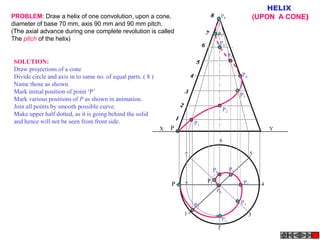
HELIX
PROBLEM: Draw a helix of one convolution, upon a cone,                                   P8                     (UPON A CONE)
diameter of base 70 mm, axis 90 mm and 90 mm pitch.
(The axial advance during one complete revolution is called                          P7
The pitch of the helix)
                                                                                         P6

                                                                                               P5
SOLUTION:
Draw projections of a cone
Divide circle and axis in to same no. of equal parts. ( 8 )                                            P4
Name those as shown.
Mark initial position of point ‘P’                                                                     P3
Mark various positions of P as shown in animation.
Join all points by smooth possible curve.                                                    P2
Make upper half dotted, as it is going behind the solid
and hence will not be seen from front side.                               P1
                                                              X   P                                                   Y

                                                                                         6

                                                                      7                                      5


                                                                                    P6            P5
                                                                               P7                       P4
                                                                  P                                               4
                                                                                     P8

                                                                          P1                           P3
                                                                      1                                     3
                                                                                          P2
                                                                                     2
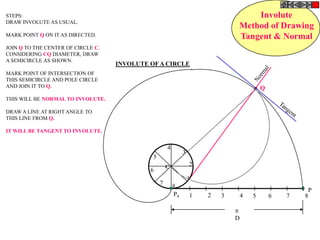
STEPS:                                                                             Involute
DRAW INVOLUTE AS USUAL.
                                                                               Method of Drawing
MARK POINT Q ON IT AS DIRECTED.                                                Tangent & Normal
JOIN Q TO THE CENTER OF CIRCLE C.
CONSIDERING CQ DIAMETER, DRAW
A SEMICIRCLE AS SHOWN.
                                    INVOLUTE OF A CIRCLE
MARK POINT OF INTERSECTION OF
THIS SEMICIRCLE AND POLE CIRCLE
AND JOIN IT TO Q.                                                                          Q
THIS WILL BE NORMAL TO INVOLUTE.

DRAW A LINE AT RIGHT ANGLE TO
THIS LINE FROM Q.

IT WILL BE TANGENT TO INVOLUTE.


                                                      4
                                                               3
                                              5
                                                      C            2
                                             6
                                                                   1
                                                  7
                                                          8
                                                                                                        P
                                                          P8       1   2   3       4   5       6   7   8

                                                                               
                                                                               D
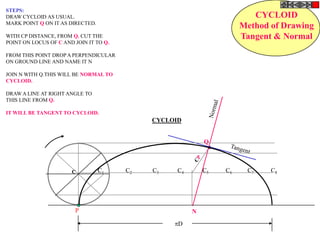
STEPS:
DRAW CYCLOID AS USUAL.                                                   CYCLOID
MARK POINT Q ON IT AS DIRECTED.
                                                                      Method of Drawing
WITH CP DISTANCE, FROM Q. CUT THE                                     Tangent & Normal
POINT ON LOCUS OF C AND JOIN IT TO Q.

FROM THIS POINT DROP A PERPENDICULAR
ON GROUND LINE AND NAME IT N

JOIN N WITH Q.THIS WILL BE NORMAL TO
CYCLOID.

DRAW A LINE AT RIGHT ANGLE TO
THIS LINE FROM Q.

IT WILL BE TANGENT TO CYCLOID.
                                             CYCLOID


                                                            Q


                       C          C1    C2   C3    C4       C5   C6    C7    C8


                        P                               N
                                                  D
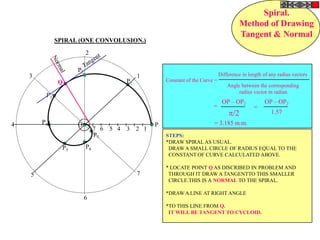
Spiral.
                                                                                        Method of Drawing
                                                                                        Tangent & Normal
              SPIRAL (ONE CONVOLUSION.)
                          2

                     P2
    3                                       1                                 Difference in length of any radius vectors
              Q                        P1           Constant of the Curve =
                                                                                  Angle between the corresponding
                                                                                       radius vector in radian.
         P3
                                                                               OP – OP2            OP – OP2
                                                                         =                    =
                                                                                  /2                 1.57

4       P4           O                          P                        = 3.185 m.m.
                               7 6 5 4 3 2 1
                               P7                   STEPS:
                                                    *DRAW SPIRAL AS USUAL.
                P5        P6                         DRAW A SMALL CIRCLE OF RADIUS EQUAL TO THE
                                                     CONSTANT OF CURVE CALCULATED ABOVE.

                                                    * LOCATE POINT Q AS DISCRIBED IN PROBLEM AND
    5                                       7        THROUGH IT DRAW A TANGENTTO THIS SMALLER
                                                     CIRCLE.THIS IS A NORMAL TO THE SPIRAL.

                                                    *DRAW A LINE AT RIGHT ANGLE
                          6
                                                    *TO THIS LINE FROM Q.
                                                     IT WILL BE TANGENT TO CYCLOID.
LOCUS
    It is a path traced out by a point moving in a plane,
     in a particular manner, for one cycle of operation.

The cases are classified in THREE categories for easy understanding.
                     A} Basic Locus Cases.
                     B} Oscillating Link……
                     C} Rotating Link………
Basic Locus Cases:
Here some geometrical objects like point, line, circle will be described with there relative
Positions. Then one point will be allowed to move in a plane maintaining specific relation
with above objects. And studying situation carefully you will be asked to draw it‟s locus.
Oscillating & Rotating Link:
Here a link oscillating from one end or rotating around it‟s center will be described.
Then a point will be allowed to slide along the link in specific manner. And now studying
the situation carefully you will be asked to draw it‟s locus.


   STUDY TEN CASES GIVEN ON NEXT PAGES
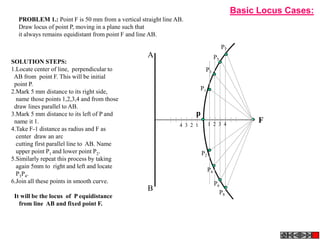
Basic Locus Cases:
  PROBLEM 1.: Point F is 50 mm from a vertical straight line AB.
  Draw locus of point P, moving in a plane such that
  it always remains equidistant from point F and line AB.

                                                                                       P7
                                                  A                               P5
SOLUTION STEPS:
1.Locate center of line, perpendicular to                                P3
 AB from point F. This will be initial
 point P.
                                                                        P1
2.Mark 5 mm distance to its right side,
  name those points 1,2,3,4 and from those
 draw lines parallel to AB.
3.Mark 5 mm distance to its left of P and                           p
 name it 1.                                                                  1 2 3 4
                                                                                                  F
                                                              4 3 2 1
4.Take F-1 distance as radius and F as
  center draw an arc
  cutting first parallel line to AB. Name
  upper point P1 and lower point P2.                                    P2
5.Similarly repeat this process by taking
  again 5mm to right and left and locate
                                                                             P4
  P3P4.
6.Join all these points in smooth curve.                                          P6
                                                  B                                 P8
 It will be the locus of P equidistance
   from line AB and fixed point F.
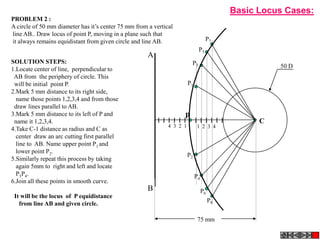
Basic Locus Cases:
PROBLEM 2 :
A circle of 50 mm diameter has it’s center 75 mm from a vertical
line AB.. Draw locus of point P, moving in a plane such that
it always remains equidistant from given circle and line AB.                       P7
                                                                              P5
                                                      A
SOLUTION STEPS:                                                          P3
1.Locate center of line, perpendicular to                                                             50 D
 AB from the periphery of circle. This
 will be initial point P.                                               P1
2.Mark 5 mm distance to its right side,
  name those points 1,2,3,4 and from those
 draw lines parallel to AB.
3.Mark 5 mm distance to its left of P and                           p
 name it 1,2,3,4.                                                                                 C
                                                              4 3 2 1         1 2 3 4
4.Take C-1 distance as radius and C as
  center draw an arc cutting first parallel
  line to AB. Name upper point P1 and
  lower point P2.
                                                                        P2
5.Similarly repeat this process by taking
  again 5mm to right and left and locate
  P3P4.                                                                      P4
6.Join all these points in smooth curve.
                                                      B                           P6
 It will be the locus of P equidistance
                                                                                       P8
   from line AB and given circle.

                                                                              75 mm
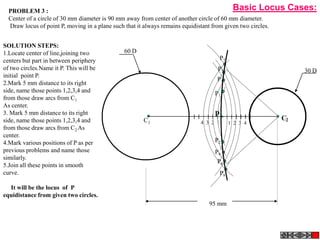
PROBLEM 3 :                                                                              Basic Locus       Cases:
  Center of a circle of 30 mm diameter is 90 mm away from center of another circle of 60 mm diameter.
  Draw locus of point P, moving in a plane such that it always remains equidistant from given two circles.


SOLUTION STEPS:
1.Locate center of line,joining two          60 D
centers but part in between periphery                                               P7
of two circles.Name it P. This will be                                          P5                              30 D
initial point P.
                                                                                P3
2.Mark 5 mm distance to its right
side, name those points 1,2,3,4 and                                            P1
from those draw arcs from C1
As center.
3. Mark 5 mm distance to its right                                             p
side, name those points 1,2,3,4 and                 C1                                                  C2
                                                                          4 3 2 1        1 2 3 4
from those draw arcs from C2 As
center.
4.Mark various positions of P as per                                           P2
previous problems and name those                                               P4
similarly.
                                                                                P6
5.Join all these points in smooth
curve.                                                                              P8

  It will be the locus of P
equidistance from given two circles.
                                                                             95 mm
Basic Locus Cases:
  Problem 4:In the given situation there are two circles of
  different diameters and one inclined line AB, as shown.
  Draw one circle touching these three objects.


                                         60 D

Solution Steps:                                                     30 D
1) Here consider two pairs,
one is a case of two circles
with centres C1 and C2 and
draw locus of point P
equidistance from                               C1
them.(As per solution of
                                                 C1           C2              350
case D above).
 2) Consider second case
that of fixed circle (C1)
and fixed line AB and
draw locus of point P
equidistance from them.
(as per solution of case B
above).
 3) Locate the point where
these two loci intersect
each other. Name it x. It
will be the point
equidistance from given
two circles and line AB.
 4) Take x as centre and its
perpendicular distance on
AB as radius, draw a circle
which will touch given two
circles and line AB.
Problem 5:-Two points A and B are 100 mm apart.                                             Basic Locus Cases:
  There is a point P, moving in a plane such that the
  difference of it’s distances from A and B always
  remains constant and equals to 40 mm.
  Draw locus of point P.

                                                                            p7
                                                                           p5
                                                                          p3
                                                                      p1
Solution Steps:
1.Locate A & B points 100 mm apart.
2.Locate point P on AB line,                                              P
                                               A                                              B
  70 mm from A and 30 mm from B                                 4 3 2 1             1 2 3 4
  As PA-PB=40 ( AB = 100 mm )
3.On both sides of P mark points 5
  mm apart. Name those 1,2,3,4 as usual.                                  p2
4.Now similar to steps of Problem 2,
                                                                           p4
  Draw different arcs taking A & B centers
  and A-1, B-1, A-2, B-2 etc as radius.                                     p6
5. Mark various positions of p i.e. and join                                   p8
   them in smooth possible curve.
  It will be locus of P
                                                        70 mm                        30 mm
Problem 6:-Two points A and B are 100 mm apart.                                                    FORK & SLIDER
   There is a point P, moving in a plane such that the
                                                                                                                  A
   difference of it’s distances from A and B always
   remains constant and equals to 40 mm.                                                                              M
   Draw locus of point P.
                                                                                                      p               M1
                                                                                                 p1                   M2
Solution Steps:                           C                                                 p2
                                                    N3 N5                                                             M3
   1) Mark lower most                         N6                                       p3
   position of M on extension                      N2
                                                        N4                              p4                            M4
   of AB (downward) by taking                                N1
   distance MN (40 mm) from                                       N7        N9          p5
                                                                       N8
   point B (because N can                                                   N10                                       M5
                                                                                            p6
   not go beyond B ).                                                             N   N11                             M6
   2) Divide line (M initial                                                                p7              600
   and M lower most ) into                                                                            N12
                                                                                             p8                       B    M7
   eight to ten parts and mark                                                                              N13
   them M1, M2, M3 up to the                                                                     p9
   last position of M .                                                                                               M8
   3) Now take MN (40 mm)                                                                        p10
   as fixed distance in compass,                                                                                      M9
   M1 center cut line CB in N1.                                                                       p11
   4) Mark point P1 on M1N1                                                                                           M10
   with same distance of MP                                                                               p12
   from M1.                                                                                                           M11
   5) Similarly locate M2P2,
   M3P3, M4P4 and join all P                                                                                p13
                                                                                                                      M12
   points.
   It will be locus of P.
                                                                                                                      M13
                                                                                                                  D
Problem No.7:                                                                                         OSCILLATING LINK
A Link OA, 80 mm long oscillates around O,
600 to right side and returns to it’s initial vertical
Position with uniform velocity.Mean while point
P initially on O starts sliding downwards and
reaches end A with uniform velocity.
Draw locus of point P                                               p
                                                               O
                                                                        p1
   Solution Steps:                                              1            p2           p4
Point P- Reaches End A (Downwards)                                                p3
1) Divide OA in EIGHT equal parts and from O to A after O       2
name 1, 2, 3, 4 up to 8. (i.e. up to point A).
2) Divide 600 angle into four parts (150 each) and mark each
point by A1, A2, A3, A4 and for return A5, A6, A7 andA8.
                                                                3
                                                                                               p5                   A4
(Initial A point).
3) Take center O, distance in compass O-1 draw an arc upto      4
OA1. Name this point as P1.
1) Similarly O center O-2 distance mark P2 on line O-A2.        5                        p6
2) This way locate P3, P4, P5, P6, P7 and P8 and join them.                                               A3
       ( It will be thw desired locus of P )                                                                   A5
                                                                6

                                                                7                 p7                A2
                                                                                                     A6
                                                               A8                  A1
                                                                 p8
                                                                                    A7
                                                                 A8
OSCILLATING LINK


 Problem No 8:
 A Link OA, 80 mm long oscillates around O,
 600 to right side, 1200 to left and returns to it’s initial
 vertical Position with uniform velocity.Mean while point
 P initially on O starts sliding downwards, reaches end A
 and returns to O again with uniform velocity.
 Draw locus of point P                                                     Op
                                                                          16

                                                                          15
                                                                                   p1               p4
                                                                               1        p2
Solution Steps:                                                           14                  p3
( P reaches A i.e. moving downwards.                                           2
 & returns to O again i.e.moves upwards )                                 13
1.Here distance traveled by point P is PA.plus A                               3                         p
AP.Hence divide it into eight equal parts.( so
                                                 12
                                                                          12                                                 A4
                                                                                                         5
total linear displacement gets divided in 16                                   4
parts) Name those as shown.                                               11
2.Link OA goes 600 to right, comes back to           A                         5                   p6
                                                    A13 11                                                         A3
original (Vertical) position, goes 600 to left                                                                          A5
                                                                          10
and returns to original vertical position. Hence                               6
total angular displacement is 2400.                           A10                             p7             A2
Divide this also in 16 parts. (150 each.)                                 9 7
                                                             A14                                              A6
Name as per previous problem.(A, A1 A2 etc)                         A9         8             A1
3.Mark different positions of P as per the                          A15   A p8
procedure adopted in previous case.                                                           A7
and complete the problem.
                                                                           A8
                                                                           A16
ROTATING LINK
Problem 9:
Rod AB, 100 mm long, revolves in clockwise direction for one revolution.
Meanwhile point P, initially on A starts moving towards B and reaches B.
Draw locus of point P.                                                          A2
 1) AB Rod revolves around
 center O for one revolution and
 point P slides along AB rod and                      A1
 reaches end B in one                                                                                  A3
 revolution.                                               p1
 2) Divide circle in 8 number of                                           p2    p6
                                                                                                  p7
 equal parts and name in arrow
 direction after A-A1, A2, A3, up
 to A8.
 3) Distance traveled by point P
 is AB mm. Divide this also into 8                                 p5
 number of equal parts.                                                                  p3
                                                                                                                p8
 4) Initially P is on end A. When
 A moves to A1, point P goes            A                                                                       B A4
                                         P       1                                   4   5    6             7
 one linear division (part) away                            2        3          p4
 from A1. Mark it from A1 and
 name the point P1.
 5) When A moves to A2, P will
 be two parts away from A2
 (Name it P2 ). Mark it as above
 from A2.
 6) From A3 mark P3 three
 parts away from P3.
 7) Similarly locate P4, P5, P6,                 A7
                                                                                                   A5
 P7 and P8 which will be eight
 parts away from A8. [Means P
 has reached B].
 8) Join all P points by smooth                                             A6
 curve. It will be locus of P
Problem 10 :                                                                              ROTATING LINK
 Rod AB, 100 mm long, revolves in clockwise direction for one revolution.
 Meanwhile point P, initially on A starts moving towards B, reaches B
 And returns to A in one revolution of rod.
 Draw locus of point P.                                                      A2

 Solution Steps
1) AB Rod revolves around center O
                                                      A1
                                                                                                 A3
for one revolution and point P slides
along rod AB reaches end B and
returns to A.
2) Divide circle in 8 number of equal                              p5
                                                                   p1
parts and name in arrow direction
after A-A1, A2, A3, up to A8.
3) Distance traveled by point P is AB
plus AB mm. Divide AB in 4 parts so
those will be 8 equal parts on return.   p4
4) Initially P is on end A. When A                                               p2                            A4
                                         A
moves to A1, point P goes one            P                 1+7              2+6 p         + 5
                                                                                           3          4   +B
linear division (part) away from A1.     p8                                           6
Mark it from A1 and name the point
P1.
5) When A moves to A2, P will be
two parts away from A2 (Name it P2
). Mark it as above from A2.                                     p7 p3
6) From A3 mark P3 three parts
away from P3.
7) Similarly locate P4, P5, P6, P7               A7
and P8 which will be eight parts away                                                           A5
from A8. [Means P has reached B].
8) Join all P points by smooth curve.
It will be locus of P
The Locus will follow the loop                                              A6
path two times in one revolution.
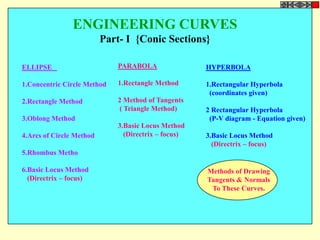
DRAWINGS:
                  ( A Graphical Representation)


                          The Fact about:
          If compared with Verbal or Written Description,
Drawings offer far better idea about the Shape, Size & Appearance of
  any object or situation or location, that too in quite a less time.


             Hence it has become the Best Media of Communication
                not only in Engineering but in almost all Fields.
Drawings
                                         (Some Types)

                                                                    Portraits
                              Botanical Drawings                 ( human faces,
Nature Drawings               ( plants, flowers etc.)           expressions etc.)
( landscape,  Geographical
scenery etc.)                               Zoological Drawings
              Drawings                                                     Engineering Drawings,
                                            (creatures, animals etc.)
                  ( maps etc.)                                                  (projections.)


  Building Related Drawings.                            Machine component Drawings


   Orthographic Projections                               Isometric ( Mech.Engg.Term.)
     (Fv,Tv & Sv.-Mech.Engg terms)                        or Perspective(Civil Engg.Term)
   (Plan, Elevation- Civil Engg.terms)
       (Working Drawings 2-D type)                           (Actual Object Drawing 3-D)
ORTHOGRAPHIC PROJECTIONS:
IT IS A TECHNICAL DRAWING IN WHICH DIFFERENT VIEWS OF AN OBJECT
          ARE PROJECTED ON DIFFERENT REFERENCE PLANES
    OBSERVING PERPENDICULAR TO RESPECTIVE REFERENCE PLANE
                  Different Reference planes are
                   Horizontal Plane (HP),
                 Vertical Frontal Plane ( VP )
                  Side Or Profile Plane ( PP)
                                And
   Different Views are Front View (FV), Top View (TV) and Side View (SV)
                FV is a view projected on VP.
                TV is a view projected on HP.
                SV is a view projected on PP.
    IMPORTANT TERMS OF ORTHOGRAPHIC PROJECTIONS:
     1 Planes.
      2 Pattern of planes & Pattern of views
       3 Methods of drawing Orthographic Projections
PLANES
1
              PRINCIPAL PLANES
                 HP AND VP


                               AUXILIARY PLANES


    Auxiliary Vertical Plane     Auxiliary Inclined Plane   Profile Plane
            (A.V.P.)                     (A.I.P.)           ( P.P.)


          
          A.V.P.
      to Hp &  to Vp

                                                  
PATTERN OF PLANES & VIEWS (First Angle Method)
2
                                 THIS IS A PICTORIAL SET-UP OF ALL THREE PLANES.
                                 ARROW DIRECTION IS A NORMAL WAY OF OBSERVING THE OBJECT.
                                 BUT IN THIS DIRECTION ONLY VP AND A VIEW ON IT (FV) CAN BE SEEN.
                                 THE OTHER PLANES AND VIEWS ON THOSE CAN NOT BE SEEN.


                                 PROCEDURE TO SOLVE ABOVE PROBLEM:-
                                 TO MAKE THOSE PLANES ALSO VISIBLE FROM THE ARROW DIRECTION,
                                 A) HP IS ROTATED 900 DOUNWARD
                                 B) PP, 900 IN RIGHT SIDE DIRECTION.
                                 THIS WAY BOTH PLANES ARE BROUGHT IN THE SAME PLANE CONTAINING VP.

          Click to view Animation   On clicking the button if a warning comes please click YES to continue, this program is
                                    safe for your pc.


                                                                                      VP                         PP
                                                                     Y
                                                                                             FV            LSV

                                                                                  X                                   Y
                                       X                                                     TV

                                                                                      HP

                                                                            ACTUAL PATTERN OF PLANES & VIEWS
HP IS ROTATED DOWNWARD     900   PP IS ROTATED IN RIGHT SIDE         900      OF ORTHOGRAPHIC PROJECTIONS
            AND                               AND                                       DRAWN IN
BROUGHT IN THE PLANE OF VP.       BROUGHT IN THE PLANE OF VP.              FIRST ANGLE METHOD OF PROJECTIONS
3         Methods of Drawing Orthographic Projections


First Angle Projections Method                   Third Angle Projections Method
      Here views are drawn                            Here views are drawn
        by placing object                               by placing object
         in 1st Quadrant                                   in 3rd Quadrant.
( Fv above X-y, Tv below X-y )    SYMBOLIC        (   Tv above X-y, Fv below X-y )
                                PRESENTATION
                              OF BOTH METHODS
                               WITH AN OBJECT
                           STANDING ON HP ( GROUND)            TV
     FV                          ON IT’S BASE.
     X          Y                  NOTE:-                         X      Y
                     HP term is used in1st  Angle method
                                       &                       FV
     TV
                                 For the same
                                                              G              L
                              Ground term is used
                      in 3rd Angle method of projections
FIRST ANGLE
                               FOR T.V.
    PROJECTION
      IN THIS METHOD,
THE OBJECT IS ASSUMED TO BE
SITUATED IN FIRST QUADRANT
           MEANS
 ABOVE HP & INFRONT OF VP.


  OBJECT IS INBETWEEN
   OBSERVER & PLANE.


    VP                PP

         FV     LSV

X                          Y
         TV

    HP

 ACTUAL PATTERN OF
   PLANES & VIEWS
        IN
FIRST ANGLE METHOD
  OF PROJECTIONS
THIRD ANGLE                FOR T.V.
     PROJECTION
       IN THIS METHOD,
 THE OBJECT IS ASSUMED TO BE
 SITUATED IN THIRD QUADRANT
 ( BELOW HP & BEHIND OF VP. )

PLANES BEING TRANSPERENT
      AND INBETWEEN
    OBSERVER & OBJECT.


              TV
 X                  Y
     LSV      FV


   ACTUAL PATTERN OF
    PLANES & VIEWS
          OF
THIRD ANGLE PROJECTIONS
ORTHOGRAPHIC PROJECTIONS
        { MACHINE ELEMENTS }
        OBJECT IS OBSERVED IN THREE DIRECTIONS.
          THE DIRECTIONS SHOULD BE NORMAL
              TO THE RESPECTIVE PLANES.
AND NOW PROJECT THREE DIFFERENT VIEWS ON THOSE PLANES.
  THESE VEWS ARE FRONT VIEW , TOP VIEW AND SIDE VIEW.

 FRONT VIEW IS A VIEW PROJECTED ON VERTICAL PLANE ( VP )
 TOP VIEW IS A VIEW PROJECTED ON HORIZONTAL PLANE ( HP )
   SIDE VIEW IS A VIEW PROJECTED ON PROFILE PLANE ( PP )

    FIRST STUDY THE CONCEPT OF 1ST AND 3RD ANGLE
                PROJECTION METHODS

AND THEN STUDY NEXT 26 ILLUSTRATED CASES CAREFULLY.
TRY TO RECOGNIZE SURFACES
PERPENDICULAR TO THE ARROW DIRECTIONS
FIRST ANGLE
                               FOR T.V.
    PROJECTION
      IN THIS METHOD,
THE OBJECT IS ASSUMED TO BE
SITUATED IN FIRST QUADRANT
           MEANS
 ABOVE HP & INFRONT OF VP.


  OBJECT IS INBETWEEN
   OBSERVER & PLANE.


    VP                PP

         FV     LSV

X                          Y
         TV

    HP

 ACTUAL PATTERN OF
   PLANES & VIEWS
        IN
FIRST ANGLE METHOD
  OF PROJECTIONS
FOR T.V.
     THIRD ANGLE
     PROJECTION
       IN THIS METHOD,
 THE OBJECT IS ASSUMED TO BE
 SITUATED IN THIRD QUADRANT
 ( BELOW HP & BEHIND OF VP. )

PLANES BEING TRANSPERENT
      AND INBETWEEN
    OBSERVER & OBJECT.


              TV
 X                  Y
     LSV      FV


   ACTUAL PATTERN OF
    PLANES & VIEWS
          OF
THIRD ANGLE PROJECTIONS
FOR T.V.
                                                                1


                                    ORTHOGRAPHIC PROJECTIONS


                                   FRONT VIEW   L.H.SIDE VIEW


                              x                                 y


PICTORIAL PRESENTATION IS GIVEN    TOP VIEW
 DRAW THREE VIEWS OF THIS OBJECT
BY FIRST ANGLE PROJECTION METHOD
FOR T.V.
                                                                    2


                                        ORTHOGRAPHIC PROJECTIONS


                                       FRONT VIEW   L.H.SIDE VIEW


                                   X                                    Y


                                       TOP VIEW


PICTORIAL PRESENTATION IS GIVEN
 DRAW THREE VIEWS OF THIS OBJECT
BY FIRST ANGLE PROJECTION METHOD
FOR T.V.
                                                                3


                                   ORTHOGRAPHIC PROJECTIONS


                                   FRONT VIEW   L.H.SIDE VIEW


                               X                                Y


                                   TOP VIEW

PICTORIAL PRESENTATION IS GIVEN
 DRAW THREE VIEWS OF THIS OBJECT
BY FIRST ANGLE PROJECTION METHOD
4
             FOR T.V.


                                       ORTHOGRAPHIC PROJECTIONS


                                       FRONT VIEW   L.H.SIDE VIEW


                                   X                                Y


                                        TOP VIEW


PICTORIAL PRESENTATION IS GIVEN
 DRAW THREE VIEWS OF THIS OBJECT
BY FIRST ANGLE PROJECTION METHOD
FOR T.V.
                                                                5


                                   ORTHOGRAPHIC PROJECTIONS


                                       FRONT VIEW   L.H.SIDE VIEW


                                   X                            Y


PICTORIAL PRESENTATION IS GIVEN
                                       TOP VIEW

 DRAW THREE VIEWS OF THIS OBJECT
BY FIRST ANGLE PROJECTION METHOD
6
            FOR T.V.

                                      ORTHOGRAPHIC PROJECTIONS


                                     FRONT VIEW    L.H.SIDE VIEW


                            X                                          Y


                                   TOP VIEW


PICTORIAL PRESENTATION IS GIVEN
 DRAW THREE VIEWS OF THIS OBJECT
BY FIRST ANGLE PROJECTION METHOD
7
               FOR T.V.


                                   ORTHOGRAPHIC PROJECTIONS

                                   FRONT VIEW    L.H.SIDE VIEW


                              X                                  Y


PICTORIAL PRESENTATION IS GIVEN       TOP VIEW

 DRAW THREE VIEWS OF THIS OBJECT
BY FIRST ANGLE PROJECTION METHOD
STUDY                                                           8
                 FOR T.V.
      Z
ILLUSTRATIONS                   ORTHOGRAPHIC PROJECTIONS


                                         FRONT VIEW

                                                               50


                                         X                 Y

                                    20


                                    25


                                               25     20

                                               TOP VIEW

 PICTORIAL PRESENTATION IS GIVEN
  DRAW THREE VIEWS OF THIS OBJECT
 BY FIRST ANGLE PROJECTION METHOD
9
       FOR T.V.
                              ORTHOGRAPHIC PROJECTIONS


                                   FRONT VIEW     L.H.SIDE VIEW


                         X                                            Y


                                       TOP VIEW
PICTORIAL PRESENTATION IS GIVEN
 DRAW THREE VIEWS OF THIS OBJECT
BY FIRST ANGLE PROJECTION METHOD
10
            FOR T.V.               ORTHOGRAPHIC PROJECTIONS


                                     FRONT VIEW   L.H.SIDE VIEW


                           X                                           Y


PICTORIAL PRESENTATION IS GIVEN       TOP VIEW

 DRAW THREE VIEWS OF THIS OBJECT
BY FIRST ANGLE PROJECTION METHOD
FOR T.V.                                              11
                               ORTHOGRAPHIC PROJECTIONS

                                   FRONT VIEW    L.H.SIDE VIEW


                           X                                      Y


                                   TOP VIEW
PICTORIAL PRESENTATION IS GIVEN
 DRAW THREE VIEWS OF THIS OBJECT
BY FIRST ANGLE PROJECTION METHOD
12
              FOR T.V.


                                     ORTHOGRAPHIC PROJECTIONS


                               FRONT VIEW           L.H.SIDE VIEW


                          X                                         Y


PICTORIAL PRESENTATION IS GIVEN    TOP VIEW

 DRAW THREE VIEWS OF THIS OBJECT
BY FIRST ANGLE PROJECTION METHOD
STUDY                                                                13
      Z
ILLUSTRATIONS       FOR T.V.
                                    ORTHOGRAPHIC PROJECTIONS


                                                                35
                                           FV


                                                                35


                                                                10
                                    x                                y


                                            10             20   30


                                                      40

                                                 70

                                                      TV
                O
 PICTORIAL PRESENTATION IS GIVEN
    DRAW FV AND TV OF THIS OBJECT
 BY FIRST ANGLE PROJECTION METHOD
STUDY
      Z                                                             14
ILLUSTRATIONS

           FOR T.V.                     ORTHOGRAPHIC PROJECTIONS
                                              FV

                                         30   10   30         SV

                                   30


                                   10


                                   30
                               x                                         y


                                                   ALL VIEWS IDENTICAL
                                              TV
 PICTORIAL PRESENTATION IS GIVEN
  DRAW THREE VIEWS OF THIS OBJECT
 BY FIRST ANGLE PROJECTION METHOD
STUDY                                                           15
      Z
ILLUSTRATIONS
                                    ORTHOGRAPHIC PROJECTIONS
                FOR T.V.
                                        ALL VIEWS IDENTICAL

                                         FV                    SV


                               x                                     y


                               10
                                                40        60


                                         40
                                                     TV
                                         60
 PICTORIAL PRESENTATION IS GIVEN
  DRAW THREE VIEWS OF THIS OBJECT
 BY FIRST ANGLE PROJECTION METHOD
FOR T.V.
                                   ORTHOGRAPHIC PROJECTIONS         16
                                            ALL VIEWS IDENTICAL

                                       FV                      SV


                             x                                           y
                                                     10


                                                    40    60


PICTORIAL PRESENTATION IS GIVEN                     TOP VIEW
                                       40
 DRAW THREE VIEWS OF THIS OBJECT
BY FIRST ANGLE PROJECTION METHOD       60
17


                                    ORTHOGRAPHIC PROJECTIONS


                                   FRONT VIEW         L.H.SIDE VIEW
                                                                  30 SQUARE
                                     40          20


                                                                      50


                                                                      20
                             10
                         X                                                 Y
                                                             30
          O                                                 60
                                          F.V.
                                                            S.V.
PICTORIAL PRESENTATION IS GIVEN
   DRAW FV AND SV OF THIS OBJECT
BY FIRST ANGLE PROJECTION METHOD
FOR T.V.
         ORTHOGRAPHIC PROJECTIONS                                18


          FV
                                40


X                               10   Y
     O
               30 D        45


                                               O
    10
                                50
                                     PICTORIAL PRESENTATION IS GIVEN
                                        DRAW FV AND TV OF THIS OBJECT
                                     BY FIRST ANGLE PROJECTION METHOD
                      80

                 TV
19
                                                             FOR T.V.


         ORTHOGRAPHIC PROJECTIONS


     FV                               40

X          O                          10   Y
                 100
    10
                                      25
     TV
                       10   30   10
                                      25
    30 R                                                     O
                  20 D
                                               PICTORIAL PRESENTATION IS GIVEN
                                                  DRAW FV AND TV OF THIS OBJECT
                                               BY FIRST ANGLE PROJECTION METHOD
PICTORIAL PRESENTATION IS GIVEN         ORTHOGRAPHIC PROJECTIONS            20
   DRAW FV AND TV OF THIS OBJECT
BY FIRST ANGLE PROJECTION METHOD
                                                                  30
           FOR T.V.
                                   FV
                                                         RECT.
                                                         SLOT

                                                 10               50
                                         35


                                                                  10
                              X                                         Y


                                                                 20 D


                                   TV


                               60 D
                                                                 30 D

                                              TOP VIEW


             O
21


                                     ORTHOGRAPHIC PROJECTIONS
                                                   10


                                           25      15


                                                                    25
                              40                               10


                                                                    25


                                                                    25

         O              O
                                     80                 25

                              F.V.                      S.V.


PICTORIAL PRESENTATION IS GIVEN
   DRAW FV AND SV OF THIS OBJECT
BY FIRST ANGLE PROJECTION METHOD
FOR T.V.
                                                                     22
                                   ORTHOGRAPHIC PROJECTIONS


                                             450


                                       30
                                                               FV


                                   40


                                   X                            Y

                                                        30 D


                                        40                      TV

             O
PICTORIAL PRESENTATION IS GIVEN
                                                         15
   DRAW FV AND TV OF THIS OBJECT                   40
BY FIRST ANGLE PROJECTION METHOD
23


                                         ORTHOGRAPHIC PROJECTIONS


                                                      HEX PART
                                                                 30
                                    20
                                                                 20
                                             40
                                                                      20

              O                                                  50
                     20
                          15

                               O                                 30
                                   100                           60
PICTORIAL PRESENTATION IS GIVEN          FRONT VIEW         L.H.SIDE VIEW
   DRAW FV ABD SV OF THIS OBJECT
BY FIRST ANGLE PROJECTION METHOD
FOR T.V.
                                       ORTHOGRAPHIC PROJECTIONS            24

                                                     20          40

                                FRONT VIEW

                                           F.V.
                                                                           30


                                  10
                            X                                              Y
                                       O


                                                                           10


                                                                           30

                                                                      10

                                                            30
           O                                                80
PICTORIAL PRESENTATION IS GIVEN               T.V.    TOP VIEW
   DRAW FV AND TV OF THIS OBJECT
BY FIRST ANGLE PROJECTION METHOD
25


        ORTHOGRAPHIC PROJECTIONS

        10    10   15


                                   25


                                   25
X                                       Y
    O                    50   10

         FV             LSV


                                   PICTORIAL PRESENTATION IS GIVEN
                                     DRAW FV AND LSV OF THIS OBJECT
                                   BY FIRST ANGLE PROJECTION METHOD
PICTORIAL PRESENTATION IS GIVEN
26                   DRAW FV AND SV OF THIS OBJECT
                  BY FIRST ANGLE PROJECTION METHOD


                           ORTHOGRAPHIC PROJECTIONS


                           30       20     10    20


                                                      15
                                     10


                                                      15

     O
                                                      15
                                            30

             15
         X                                             Y
                      50
                    F.V.                 LEFT S.V.
ORTHOGRAPHIC PROJECTIONS
                OF POINTS, LINES, PLANES, AND SOLIDS.

 TO DRAW PROJECTIONS OF ANY OBJECT,
 ONE MUST HAVE FOLLOWING INFORMATION
 A) OBJECT
     { WITH IT‟S DESCRIPTION, WELL DEFINED.}
 B) OBSERVER
     { ALWAYS OBSERVING PERPENDICULAR TO RESP. REF.PLANE}.
 C) LOCATION OF OBJECT,
     { MEANS IT‟S POSITION WITH REFFERENCE TO H.P. & V.P.}

              TERMS „ABOVE‟ & „BELOW‟ WITH RESPECTIVE TO H.P.
            AND TERMS „INFRONT‟ & „BEHIND‟ WITH RESPECTIVE TO V.P
                            FORM 4 QUADRANTS.
          OBJECTS CAN BE PLACED IN ANY ONE OF THESE 4 QUADRANTS.

  IT IS INTERESTING TO LEARN THE EFFECT ON THE POSITIONS OF VIEWS ( FV, TV )
 OF THE OBJECT WITH RESP. TO X-Y LINE, WHEN PLACED IN DIFFERENT QUADRANTS.

STUDY ILLUSTRATIONS GIVEN ON HEXT PAGES AND NOTE THE RESULTS.TO MAKE IT EASY
HERE A POINT A IS TAKEN AS AN OBJECT. BECAUSE IT’S ALL VIEWS ARE JUST POINTS.
NOTATIONS


 FOLLOWING NOTATIONS SHOULD BE FOLLOWED WHILE NAMEING
      DIFFERENT VIEWS IN ORTHOGRAPHIC PROJECTIONS.


          OBJECT            POINT A       LINE AB

          IT‟S TOP VIEW        a            ab

          IT‟S FRONT VIEW      a‟           a‟ b‟

          IT‟S SIDE VIEW       a”           a” b”


SAME SYSTEM OF NOTATIONS SHOULD BE FOLLOWED
                        INCASE NUMBERS, LIKE 1, 2, 3 – ARE USED.
VP
                                   2nd   Quad.         1ST Quad.


                     Y
                                                              Observer


                                                 X Y                HP
       X


                                   3rd Quad.            4th Quad.


THIS QUADRANT PATTERN,
IF OBSERVED ALONG X-Y LINE ( IN RED ARROW DIRECTION)
WILL EXACTLY APPEAR AS SHOWN ON RIGHT SIDE AND HENCE,
IT IS FURTHER USED TO UNDERSTAND ILLUSTRATION PROPERLLY.
Point A is      POINT A IN                            VP              POINT A IN
     Placed In    2ND QUADRANT                                          1ST QUADRANT
                                        VP                 a’
     different                 A                                    A
    quadrants                             a’
and it‟s Fv & Tv                          a
 are brought in
same plane for                                                          HP     OBSERVER

Observer to see
      clearly.           HP                    OBSERVER
 Fv is visible as
 it is a view on
VP. But as Tv is                                           a
is a view on Hp,
   it is rotated
downward 900,
  In clockwise
  direction.The
 In front part of                   a
Hp comes below
 xy line and the
part behind Vp                                                      HP
  comes above.          HP                     OBSERVER
                                                                             OBSERVER


 Observe and
  note the                                                a
  process.                          a’
                           A                              a’
                   POINT A IN                                   A        POINT A IN
                 3RD QUADRANT
                                                           VP            4TH QUADRANT
                                   VP
PROJECTIONS OF A POINT IN FIRST QUADRANT.
    POINT A ABOVE HP                       POINT A ABOVE HP                            POINT A IN HP
     & INFRONT OF VP                            & IN VP                              & INFRONT OF VP
                                                       For Tv
                   For Tv

                                 PICTORIAL                                 PICTORIAL                            For Tv
                                PRESENTATION                A             PRESENTATION
         a’                                            a’
                      A                                                                                         Y
                                                                 Y
               Y                                                                                      a’
                                                        a
                                                                                                                    a
X                     a                        X                                         X                      A


                                          ORTHOGRAPHIC PRESENTATIONS
                                              OF ALL ABOVE CASES.

         Fv above xy,                                  Fv above xy,                               Fv on xy,
         Tv below xy.                                   Tv on xy.                                Tv below xy.
        VP                                             VP                                        VP

              a’                                            a’

    X                       Y                      X                  Y                      X
                                                                                                           a’           Y
                                                            a

              a                                                                                            a

        HP                                             HP                                        HP
PROJECTIONS OF STRAIGHT LINES.
           INFORMATION REGARDING A LINE means
                       IT‟S LENGTH,
             POSITION OF IT‟S ENDS WITH HP & VP
      IT‟S INCLINATIONS WITH HP & VP WILL BE GIVEN.
     AIM:- TO DRAW IT‟S PROJECTIONS - MEANS FV & TV.

SIMPLE CASES OF THE LINE
1.   A VERTICAL LINE ( LINE PERPENDICULAR TO HP & // TO VP)

2.   LINE PARALLEL TO BOTH HP & VP.

3.   LINE INCLINED TO HP & PARALLEL TO VP.

4.   LINE INCLINED TO VP & PARALLEL TO HP.

5.   LINE INCLINED TO BOTH HP & VP.

STUDY ILLUSTRATIONS GIVEN ON NEXT PAGE
SHOWING CLEARLY THE NATURE OF FV & TV
OF LINES LISTED ABOVE AND NOTE RESULTS.
For Tv                                Orthographic Pattern
  (Pictorial Presentation)                                                       V.P.
                            a’
                                                             Note:                            a’
                                                      Fv is a vertical line
                                           A         Showing True Length                Fv
  1.
                            FV                                 &
                                                         Tv is a point.                       b’
   A Line                   b’
perpendicular                          Y
                                                                          X                             Y
    to Hp                                  B

       &                              TV a b
                                                                                        Tv a b
   // to Vp        X


                                                                                H.P.
                                                                              Orthographic Pattern
  (Pictorial Presentation)             For Tv                Note:               V.P.
                                                       Fv & Tv both are
  2.                                                        // to xy              a’     Fv        b’
                                 b’                             &
        A Line                                   B      both show T. L.
       // to Hp        a’
            &                    A     Y                                  X                             Y
        // to Vp
                                                 b                                a                b
                                                                                         Tv
                   X
                                 a
                                                                                H.P.
Fv inclined to xy        V.P.
                                                               Tv parallel to xy.                          b’
      3.                                  b’

 A Line inclined to Hp                                 B
                                                                                         a’       
          and                                     Y
     parallel to Vp          a’                                                     X                            Y
                                                   
(Pictorial presentation)                  A            b
                                                                                         a
                                                                                                  T.V.      b
                         X
                                          a
                                                                                        H.P.
                                                                                    Orthographic Projections

                                                           Tv inclined to xy            V.P.
      4.                                                   Fv parallel to xy.
                                                                                             a’       Fv    b’
 A Line inclined to Vp                b’

          and                a’
     parallel to Hp                   A
                                               Ø
                                                           B                        X                            Y
(Pictorial presentation)                                                                      a   Ø

                                               Ø                                                  Tv
                                      a                    b
                                                                                                            b
                                                                                        H.P.
For Tv
                          For Tv
                                       5.   A Line inclined to both
                                                  Hp and Vp                           b’
                b’
                                            (Pictorial presentation)
                                                                                                          B
                                   B
                                                                                  
                                                                                               Y
                          Y
                                                  On removal of object       a’
    a’                                                i.e. Line AB
                                                  Fv as a image on Vp.
                                                                                  A
           A                                      Tv as a image on Hp,
                                                                                           
                                                                        X
X                                                                                     a        T.V.       b
                a        T.V.      b
                                                  V.P.
                                                               b’
                                                          FV
                                                   a’     

                                              X                          Y
     Orthographic Projections                                                       Note These Facts:-
      Fv is seen on Vp clearly.                                               Both Fv & Tv are inclined to xy.
    To see Tv clearly, HP is                        a                            (No view is parallel to xy)
    rotated 900 downwards,                                                   Both Fv & Tv are reduced lengths.
         Hence it comes below xy.                         TV                    (No view shows True Length)

                                                   H.P.        b
Orthographic Projections                   Note the procedure                      Note the procedure
       Means Fv & Tv of Line AB                  When Fv & Tv known,                  When True Length is known,
            are shown below,                    How to find True Length.                 How to locate Fv & Tv.
                                            (Views are rotated to determine          (Component a-1 of TL is drawn
    with their apparent Inclinations
                                             True Length & it‟s inclinations            which is further rotated
                   &
                                                    with Hp & Vp).                         to determine Fv)
       V.P.                                    V.P.                                        V.P.
                      b’                                            b’    b 1’                          b’ b1’

              FV                                          FV
                                                               TL                                  
        a’                                     a’                                        a’                  1’

X                               Y       X                                        Y   X                               Y

                                                                                                           1
         a                                                               b2               a
                                                 a                  TV
                                                                                               Ø
                                                                                                   

              TV                                      TV

       H.P.          b                         H.P.             b                          H.P.        b       b1


    Here TV (ab) is not // to XY line       In this sketch, TV is rotated                 Here a -1 is component
     Hence it’s corresponding FV               and made // to XY line.                 of TL ab1 gives length of Fv.
         a’ b’ is not showing                Hence it’s corresponding                   Hence it is brought Up to
            True Length &                       FV a’ b1’ Is showing                  Locus of a’ and further rotated
                                                    True Length                       to get point b’. a’ b’ will be Fv.
      True Inclination with Hp.
                                                          &                             Similarly drawing component
                                              True Inclination with Hp.              of other TL(a‟ b1„) Tv can be drawn.
The most important diagram showing graphical relations    1) True Length ( TL) – a’ b1’ & a b
     among all important parameters of this topic.        2) Angle of TL with Hp -                      Important
                                                                                                  TEN parameters
   Study and memorize it as a CIRCUIT DIAGRAM             3) Angle of TL with Vp –   Ø          to be remembered
         And use in solving various problems.
                                                          4) Angle of FV with xy –                 with Notations

        V.P.                                              5) Angle of TV with xy –              used here onward
                Distance between
                 End Projectors.                          6) LTV (length of FV) – Component (a-1)
                                   b’       b1’
                                                          7) LFV (length of TV) – Component (a‟-1‟)
                                                          8) Position of A- Distances of a & a‟ from xy
                                                          9) Position of B- Distances of b & b‟ from xy
                                                         10) Distance between End Projectors
                                                1’
          a’
                          LTV
                                                                             NOTE this
   X                                                  Y          &       Construct with a’
          a               LFV           1                        Ø&       Construct with a
                  Ø
                                                                 b’ & b1’ on same locus.
                         
                                                                 b & b1 on same locus.


                                                                 Also Remember
                                   b        b1
        H.P.                                               True Length is never rotated. It‟s horizontal component
                                                                is drawn & it is further rotated to locate view.

                                                            Views are always rotated, made horizontal & further
                                                                       extended to locate TL,  & Ø
GROUP (A)
                                  GENERAL CASES OF THE LINE INCLINED TO BOTH HP & VP
PROBLEM 1)                                    ( based on 10 parameters).
Line AB is 75 mm long and it is 300 &
400 Inclined to Hp & Vp respectively.
End A is 12mm above Hp and 10 mm                                            b’         b’1
in front of Vp.
Draw projections. Line is in 1st quadrant.
                                                               FV
SOLUTION STEPS:                                                        TL
1) Draw xy line and one projector.
2) Locate a‟ 12mm above xy line
   & a 10mm below xy line.                                
3) Take 300 angle from a‟ & 400 from
   a and mark TL I.e. 75mm on both
                                                 a’
   lines. Name those points b1‟ and b1       X                                          Y
   respectively.
4) Join both points with a‟ and a resp.          a                   LFV
5) Draw horizontal lines (Locus) from                 Ø                           1
   both points.
6) Draw horizontal component of TL
   a b1 from point b1 and name it 1.
  ( the length a-1 gives length of Fv
       as we have seen already.)                              TV      TL
7) Extend it up to locus of a‟ and
       rotating a‟ as center locate b‟ as
       shown. Join a‟ b‟ as Fv.
8) From b‟ drop a projector down
       ward & get point b. Join a & b
                                                                            b    b1
       I.e. Tv.
PROBLEM 2:
Line AB 75mm long makes 450 inclination with Vp while it’s Fv makes 550.
End A is 10 mm above Hp and 15 mm in front of Vp.If line is in 1st quadrant
draw it’s projections and find it’s inclination with Hp.
                                                                    b’              b’1 LOCUS OF b
 Solution Steps:-
 1.Draw x-y line.
 2.Draw one projector for a‟ & a
 3.Locate a’ 10mm above x-y &
   Tv a 15 mm below xy.
 4.Draw a line 450 inclined to xy                           550
    from point a and cut TL 75 mm
    on it and name that point b1
    Draw locus from point b1
                                                   a’
 5.Take 550 angle from a’ for Fv
    above xy line.                             X                                      y
 6.Draw a vertical line from b1
    up to locus of a and name it 1.
    It is horizontal component of                  a                     LFV
    TL & is LFV.
                                                                               1
 7.Continue it to locus of a’ and
    rotate upward up to the line
    of Fv and name it b’.This a’ b’
    line is Fv.
 8. Drop a projector from b‟ on
     locus from point b1 and
     name intersecting point b.
    Line a b is Tv of line AB.
 9.Draw locus from b’ and from
    a’ with TL distance cut point b1‘
 10.Join a’ b1’ as TL and measure
    it‟s angle at a’.                                                               LOCUS OF b
 It will be true angle of line with HP.                              b         b1
PROBLEM 3:
  Fv of line AB is 500 inclined to xy and measures 55
  mm long while it’s Tv is 600 inclined to xy line.      If
  end A is 10 mm above Hp and 15 mm in front of
  Vp, draw it’s projections,find TL, inclinations of line
  with Hp & Vp.                                                   b’        b’1


SOLUTION STEPS:
1.Draw xy line and one projector.
2.Locate a’ 10 mm above xy and
 a 15 mm below xy line.
3.Draw locus from these points.                             500
4.Draw Fv 500 to xy from a’ and                       
mark b’ Cutting 55mm on it.                    a’
                                     X
5.Similarly draw Tv 600 to xy
from a & drawing projector from b’
                                                                                  y
Locate point b and join a b.
6.Then rotating views as shown,                a
                                                     
 locate True Lengths ab1 & a’b1’                          600
 and their angles with Hp and Vp.


                                                                       b1
                                                                   b
PROBLEM 4 :-
     Line AB is 75 mm long .It‟s Fv and Tv measure 50 mm & 60 mm long respectively.
     End A is 10 mm above Hp and 15 mm in front of Vp. Draw projections of line AB
     if end B is in first quadrant.Find angle with Hp and Vp.
                                                                  b’                b’1

SOLUTION STEPS:
1.Draw xy line and one projector.
2.Locate a’ 10 mm above xy and
 a 15 mm below xy line.
3.Draw locus from these points.
4.Cut 60mm distance on locus of a’                                    LTV          1’
  & mark 1’ on it as it is LTV.                   a’
5.Similarly Similarly cut 50mm on             X                                           Y
  locus of a and mark point 1 as it is LFV.
6.From 1’ draw a vertical line upward
                                                  a                LFV
  and from a’ taking TL ( 75mm ) in                                           1
                                                       
  compass, mark b’1 point on it.
  Join a’ b’1 points.
7. Draw locus from b’1
8. With same steps below get b1 point
   and draw also locus from it.
9. Now rotating one of the components
   I.e. a-1 locate b’ and join a’ with it
   to get Fv.
10. Locate tv similarly and measure
     Angles  & 
                                                                              b1
                                                                   b
PROBLEM 5 :-
 T.V. of a 75 mm long Line CD, measures 50 mm.
 End C is in Hp and 50 mm in front of Vp.
 End D is 15 mm in front of Vp and it is above Hp.
 Draw projections of CD and find angles with Hp and Vp.   d’       d’1   LOCUS OF d’ & d’1


SOLUTION STEPS:
1.Draw xy line and one projector.
2.Locate c’ on xy and
 c 50mm below xy line.
3.Draw locus from these points.
4.Draw locus of d 15 mm below xy
5.Cut 50mm & 75 mm distances on                 c’   
  locus of d from c and mark points         X                                       Y
  d & d1 as these are Tv and line CD                           d         d1   LOCUS OF d & d1
  lengths resp.& join both with c.
6.From d1 draw a vertical line upward
  up to xy I.e. up to locus of c’ and
  draw an arc as shown.
7 Then draw one projector from d to
   meet this arc in d’ point & join c’ d’
8. Draw locus of d’ and cut 75 mm
   on it from c’ as TL
9.Measure Angles          &                   c    
GROUP (B)
                  PROBLEMS INVOLVING TRACES OF THE LINE.


TRACES OF THE LINE:-

THESE ARE THE POINTS OF INTERSECTIONS OF A LINE ( OR IT‟S EXTENSION )
WITH RESPECTIVE REFFERENCE PLANES.

A LINE ITSELF OR IT’S EXTENSION, WHERE EVER TOUCHES H.P.,
THAT POINT IS CALLED TRACE OF THE LINE ON H.P.( IT IS CALLED H.T.)

SIMILARLY, A LINE ITSELF OR IT‟S EXTENSION, WHERE EVER TOUCHES V.P.,
THAT POINT IS CALLED TRACE OF THE LINE ON V.P.( IT IS CALLED V.T.)

V.T.:-   It is a point on Vp.
         Hence it is called Fv of a point in Vp.
         Hence it’s Tv comes on XY line.( Here onward named as v   )
H.T.:-   It is a point on Hp.
         Hence it is called Tv of a point in Hp.
         Hence it’s Fv comes on XY line.( Here onward named as ‟h‟ )
b’


STEPS TO LOCATE HT.
(WHEN PROJECTIONS ARE GIVEN.)
1.   Begin with FV. Extend FV up to XY line.                          a’
2.   Name this point h’                                 v        h’
     ( as it is a Fv of a point in Hp)             x                                       y
3.   Draw one projector from h’.
4.   Now extend Tv to meet this projector.           VT’         HT
     This point is HT                                                  a


STEPS TO LOCATE VT.
                                               Observe & note :-
(WHEN PROJECTIONS ARE GIVEN.)                  1. Points h’ & v always on x-y line.   b

1.   Begin with TV. Extend TV up to XY line.   2. VT’ & v always on one projector.
2.   Name this point v
                                               3. HT & h’ always on one projector.
     ( as it is a Tv of a point in Vp)
3.   Draw one projector from v.                4. FV - h’- VT’ always co-linear.
4.   Now extend Fv to meet this projector.
     This point is VT                          5. TV - v - HT always co-linear.


                                                                These points are used to
                                                                solve next three problems.
PROBLEM 6 :- Fv of line AB makes 450 angle with XY line and measures 60 mm.
Line’s Tv makes 300 with XY line. End A is 15 mm above Hp and it’s VT is 10 mm
below Hp. Draw projections of line AB,determine inclinations with Hp & Vp and locate HT, VT.


                                                                                               b’   b’1


                                                                   a’   
                                                                            450

SOLUTION STEPS:-                          15
Draw xy line, one projector and     x           v       h’
                                                                                                           y
locate fv a’ 15 mm above xy.              10                 300
Take 45    0 angle from a’ and

marking 60 mm on it locate point b’.           VT’
Draw locus of VT, 10 mm below xy
                                                                    a             
& extending Fv to this locus locate VT.
as fv-h’-vt’ lie on one st.line.
Draw projector from vt, locate v on xy.
From v take 300 angle downward as
Tv and it’s inclination can begin with v.
                                                                                         b            b1
Draw projector from b’ and locate b I.e.Tv point.
Now rotating views as usual TL and
it’s inclinations can be found.
Name extension of Fv, touching xy as h’
and below it, on extension of Tv, locate HT.
PROBLEM 7 :
One end of line AB is 10mm above Hp and other end is 100 mm in-front of Vp.
It‟s Fv is 450 inclined to xy while it‟s HT & VT are 45mm and 30 mm below xy respectively.
Draw projections and find TL with it‟s inclinations with Hp & VP.
                                                                        b’        b’  1   LOCUS OF b’ & b’1


                                                              a’       450
                                                                   
                                         10   v     h’
                              X                                                                    Y
                                         30
                                    45
                                              VT’        HT
SOLUTION STEPS:-
Draw xy line, one projector and
locate a’ 10 mm above xy.                                                                        100
Draw locus 100 mm below xy for points b & b1
Draw loci for VT and HT, 30 mm & 45 mm
                                                           a       
below xy respectively.
Take 450 angle from a’ and extend that line backward
to locate h’ and VT, & Locate v on xy above VT.
Locate HT below h’ as shown.
Then join v – HT – and extend to get top view end b.
Draw projector upward and locate b’ Make a b & a’b’ dark.                    b   b1   LOCUS OF b & b1
Now as usual rotating views find TL and it’s inclinations.
PROBLEM 8 :- Projectors drawn from HT and VT of a line AB
are 80 mm apart and those drawn from it’s ends are 50 mm apart.
End A is 10 mm above Hp, VT is 35 mm below Hp
while it’s HT is 45 mm in front of Vp. Draw projections,
locate traces and find TL of line & inclinations with Hp and Vp.
                                                                                            VT

                                                                                 b’   b’1


SOLUTION STEPS:-                                                                                      55
1.Draw xy line and two projectors,
80 mm apart and locate HT & VT ,
35 mm below xy and 55 mm above xy             Locus of a’     a’   
respectively on these projectors.                     10                   50               v
2.Locate h’ and v on xy as usual.             X                                                            y
                                                         h’                      b               b1
3.Now just like previous two problems,
Extending certain lines complete Fv & Tv
                                                    35
And as usual find TL and it’s inclinations.

                                                              a        
                                                         HT


                                                                            80
Instead of considering a & a’ as projections of first point,
         if v & VT’ are considered as first point , then true inclinations of line with
        Hp & Vp i.e. angles  &  can be constructed with points VT’ & V respectively.


                               b’                  b1’


                                                            Then from point v & HT
                    a’
                                                         angles  &  can be drawn.
    v                                                                 &
X
          
                                                    Y         From point VT‟ & h‟
                                                         angles  &  can be drawn.
                

    VT’


                                                 THIS CONCEPT IS USED TO SOLVE
                    a
                                                     NEXT THREE PROBLEMS.


                               b            b1
PROBLEM 9 :-
Line AB 100 mm long is 300 and 450 inclined to Hp & Vp respectively.                         b1’
End A is 10 mm above Hp and it’s VT is 20 mm below Hp                              b’
.Draw projections of the line and it’s HT.
                                                                        FV


                                 Locus of a & a1’                 a’         a1’

SOLUTION STEPS:-                      10
                                         X      v         h’
Draw xy, one projector                                                                       Y
and locate on it VT and V.                          (45 0)

                                      20
Draw locus of a’ 10 mm above xy.                             (300)
Take 300 from VT and draw a line.
Where it intersects with locus of a’           VT’
name it a1’ as it is TL of that part.                  HT
From a1’ cut 100 mm (TL) on it and locate point b1’
Now from v take 450 and draw a line downwards                     a    a1
& Mark on it distance VT-a1’ I.e.TL of extension & name it a1
Extend this line by 100 mm and mark point b1.
Draw it’s component on locus of VT’
& further rotate to get other end of Fv i.e.b’                         TV
Join it with VT’ and mark intersection point
(with locus of a1’ ) and name it a’
Now as usual locate points a and b and h’ and HT.

                                                                                    b   b1
PROBLEM 10 :-
  A line AB is 75 mm long. It’s Fv & Tv make 450 and 600 inclinations with X-Y line resp
  End A is 15 mm above Hp and VT is 20 mm below Xy line. Line is in first quadrant.
  Draw projections, find inclinations with Hp & Vp. Also locate HT.           b’                b1’


                                                                     FV


                           Locus of a & a1’                    a’         a1’

                              15
                                   X     v            h’
                                                                                                Y
                                               600
                              20                     
                                                           
                                               450
                                       VT’
SOLUTION STEPS:-
Similar to the previous only change                  HT
is instead of line’s inclinations,
views inclinations are given.                                  a    a1
So first take those angles from VT & v
Properly, construct Fv & Tv of extension,
then determine it’s TL( V-a1)
                                                                    TV
and on it’s extension mark TL of line
and proceed and complete it.


                                                                                b          b1
PROBLEM 11 :- The projectors drawn from VT & end A of line AB are 40mm apart.
    End A is 15mm above Hp and 25 mm in front of Vp. VT of line is 20 mm below Hp.
    If line is 75mm long, draw it’s projections, find inclinations with HP & Vp


                                                                              b’     b1’


                                                               a’      a1’

                                          15
                                 X              v                                               Y
                                          20                       
                                     25                    
                                               VT’
                                                               a


Draw two projectors for VT & end A                    40mm
  Locate these points and then                                                b            b1
       YES !
YOU CAN COMPLETE IT.
GROUP (C)
        CASES OF THE LINES IN A.V.P., A.I.P. & PROFILE PLANE.


        b’                                             Line AB is in AIP as shown in above figure no 1.
                                            It’s FV (a’b’) is shown projected on Vp.(Looking in arrow direction)
                                                                Here one can clearly see that the
                                          Inclination of AIP with HP = Inclination of FV with XY line
   a’   

                           


                                                                                        
                                                                                A           A.V.P.


                                                                                                B


           Line AB is in AVP as shown in above figure no 2..
                                                                                    
                                                                                a               b
  It’s TV (a b) is shown projected on Hp.(Looking in arrow direction)
                     Here one can clearly see that the
Inclination of AVP with VP = Inclination of TV with XY line
LINE IN A PROFILE PLANE ( MEANS IN A PLANE PERPENDICULAR TO BOTH HP & VP)
                    For T.V.

                                                  ORTHOGRAPHIC PATTERN OF LINE IN PROFILE PLANE
                                                  VP                       VT                        PP
        a’                                                                      a”
               A                                              a’

                                                         FV                          LSV

       b’                                                     b’                           b”
                                              X                                                           Y
                                                                                                HT

                                                              a
                               B
                                                        TV
               a
                                                              b
                           b                      HP

                               Results:-
                               1. TV & FV both are vertical, hence arrive on one single projector.
                               2. It’s Side View shows True Length ( TL)
                               3. Sum of it’s inclinations with HP & VP equals to 900 (  +  = 900 )
                               4. It’s HT & VT arrive on same projector and can be easily located
                                  From Side View.

  OBSERVE CAREFULLY ABOVE GIVEN ILLUSTRATION AND 2nd SOLVED PROBLEM.
PROBLEM 12 :- Line AB 80 mm long, makes 300 angle with Hp
and lies in an Aux.Vertical Plane 450 inclined to Vp.                  b’ Locus of b’     b 1’
End A is 15 mm above Hp and VT is 10 mm below X-y line.
Draw projections, fine angle with Vp and Ht.


                     Locus of a‟ & a1‟                  a’      a 1’
                         15        v           h’
                 X                       450                                                     Y
                         10                                 
                                                    
                                 VT        HT

                                                        a


                                               AVP 450 to VP


            Simply consider inclination of AVP                                        Locus of b’
             as inclination of TV of our line,
                                                                       b         b1
                        well then?
              You sure can complete it
               as previous problems!
                    Go ahead!!
PROBLEM 13 :- A line AB, 75mm long, has one end A in Vp. Other end B is 15 mm above Hp
      and 50 mm in front of Vp.Draw the projections of the line when sum of it’s
      Inclinations with HP & Vp is 900, means it is lying in a profile plane.
      Find true angles with ref.planes and it’s traces.


                                                               VT        (VT)   a”
                                                              a’
SOLUTION STEPS:-
                                                                                            Side View
After drawing xy line and one projector            Front view                             ( True Length )


                                                                           VP
Locate top view of A I.e point a on xy as
It is in Vp,                                                   b’                                 b”
Locate Fv of B i.e.b’15 mm above xy as                         a                                           (HT)
                                                    X                                HP                            Y
it is above Hp.and Tv of B i.e. b, 50 mm
 below xy asit is 50 mm in front of Vp
Draw side view structure of Vp and Hp               top view
and locate S.V. of point B i.e. b’’
From this point cut 75 mm distance on Vp and
Mark a’’ as A is in Vp. (This is also VT of line.)             b
From this point draw locus to left & get a’                  HT
Extend SV up to Hp. It will be HT. As it is a Tv
Rotate it and bring it on projector of b.
Now as discussed earlier SV gives TL of line
and at the same time on extension up to Hp & Vp
 gives inclinations with those panes.
APPLICATIONS OF PRINCIPLES OF PROJECTIONS OF LINES
                IN SOLVING CASES OF DIFFERENT PRACTICAL SITUATIONS.


                In these types of problems some situation in the field
                                            or
                            some object will be described .
                            It‟s relation with Ground ( HP )
                                           And
                   a Wall or some vertical object ( VP ) will be given.

           Indirectly information regarding Fv & Tv of some line or lines,
                   inclined to both reference Planes will be given
                                         and
                      you are supposed to draw it‟s projections
                                         and
       further to determine it‟s true Length and it‟s inclinations with ground.


          Here various problems along with
      actual pictures of those situations are given
          for you to understand those clearly.                 CHECK YOUR ANSWERS
  Now looking for views in given ARROW directions,              WITH THE SOLUTIONS
YOU are supposed to draw projections & find answers,             GIVEN IN THE END.
 Off course you must visualize the situation properly.          ALL THE BEST !!
PROBLEM 14:-Two objects, a flower (A) and an orange (B) are within a rectangular compound wall,
 whose P & Q are walls meeting at 900. Flower A is 1M & 5.5 M from walls P & Q respectively.
Orange B is 4M & 1.5M from walls P & Q respectively. Drawing projection, find distance between them
If flower is 1.5 M and orange is 3.5 M above the ground. Consider suitable scale..
                                                    TV


                                                            B                  Wall Q


                                                    A


                                       FV
PROBLEM 15 :- Two mangos on a tree A & B are 1.5 m and 3.00 m above ground
and those are 1.2 m & 1.5 m from a 0.3 m thick wall but on opposite sides of it.
If the distance measured between them along the ground and parallel to wall is 2.6 m,
Then find real distance between them by drawing their projections.

                                                    TV


                                                                 B


                                                                                        0.3M THICK
                                    A
PROBLEM 16 :- oa, ob & oc are three lines, 25mm, 45mm and 65mm
long respectively.All equally inclined and the shortest
 is vertical.This fig. is TV of three rods OA, OB and OC
whose ends A,B & C are on ground and end O is 100mm
above ground. Draw their projections and find length of
each along with their angles with ground.


                                   TV


                                        O

                                                       C
                 A


                                                           FV
                                    45 mm


                              B
PROBLEM 17:- A pipe line from point A has a downward gradient 1:5 and it runs due East-South.
Another Point B is 12 M from A and due East of A and in same level of A. Pipe line from B runs
200 Due East of South and meets pipe line from A at point C.
Draw projections and find length of pipe line from B and it’s inclination with ground.


                             5

                                   1

                 A
                                          12 M
                                                                  B                              E


                                                                                C
PROBLEM 18: A person observes two objects, A & B, on the ground, from a tower, 15 M high,
At the angles of depression 300 & 450. Object A is is due North-West direction of observer and
object B is due West direction. Draw projections of situation and find distance of objects from
observer and from tower also.


                                                                    O
                                                              300

                                                            450


                   A
                                                                                                  S

                                                B
                                          W
PROBLEM 19:-Guy ropes of two poles fixed at 4.5m and 7.5 m above ground,
are attached to a corner of a building 15 M high, make 300 and 450 inclinations
with ground respectively.The poles are 10 M apart. Determine by drawing their
projections,Length of each rope and distance of poles from building.
                                                     TV


                                                      C


                                           15 M


                             A     300

                                   4.5 M


                                             450

                                              B


                                              7.5M
PROBLEM 20:- A tank of 4 M height is to be strengthened by four stay rods from each corner
by fixing their other ends to the flooring, at a point 1.2 M and 0.7 M from two adjacent walls respectively,
as shown. Determine graphically length and angle of each rod with flooring.

                                                                             TV


                                                                                        4M
PROBLEM 21:- A horizontal wooden platform 2 M long and 1.5 M wide is supported by four chains
from it’s corners and chains are attached to a hook 5 M above the center of the platform.
Draw projections of the objects and determine length of each chain along with it’s inclination with ground.


                                  TV
                                       Hook         H


                                            D


                  A                                                         C


                                                B
PROBLEM 22.
A room is of size 6.5m L ,5m D,3.5m high.
An electric bulb hangs 1m below the center of ceiling.
A switch is placed in one of the corners of the room, 1.5m above the flooring.
Draw the projections an determine real distance between the bulb and switch.

                                     Ceiling


                  TV

                                               Bulb


      Switch


                                                          D
PROBLEM 23:-
A PICTURE FRAME 2 M WIDE AND 1 M TALL IS RESTING ON HORIZONTAL WALL RAILING
MAKES 350 INCLINATION WITH WALL. IT IS ATTAACHED TO A HOOK IN THE WALL BY TWO STRINGS.
THE HOOK IS 1.5 M ABOVE WALL RAILING. DETERMINE LENGTH OF EACH CHAIN AND TRUE ANGLE BETWEEN THEM


                                                                       350


                                                                              Wall railing
PROBLEM NO.24
                                      T.V. of a 75 mm long Line CD, measures 50 mm.
   SOME CASES OF THE LINE             End C is 15 mm below Hp and 50 mm in front of Vp.
  IN DIFFERENT QUADRANTS.             End D is 15 mm in front of Vp and it is above Hp.
                                      Draw projections of CD and find angles with Hp and Vp.
        REMEMBER:
BELOW HP- Means- Fv below xy
BEHIND V p- Means- Tv above xy.             d’             d’1   LOCUS OF d’ & d’1


               X                                                                        Y
                          c’                    d               d1   LOCUS OF d & d1


                          c       
PROBLEM NO.25
End A of line AB is in Hp and 25 mm behind Vp.
End B in Vp.and 50mm above Hp.
Distance between projectors is 70mm.
Draw projections and find it’s inclinations with Ht, Vt.

                                                                 LOCUS OF b’ & b’1
                                                           b’   b’1


                                a           


                  X            a’                         b          b1       Y
                                                                      LOCUS OF b & b1


                                                   70
PROBLEM NO.26
End A of a line AB is 25mm below Hp and 35mm behind Vp.
Line is 300 inclined to Hp.
There is a point P on AB contained by both HP & VP.
Draw projections, find inclination with Vp and traces.


             a    
                                                  b’               b’1   LOCUS OF b’ & b’1

      35


                              p p’
  X                                                                      y
                                       p’1

      25
                      =300
             a’

                                                               LOCUS OF b & b1
                                              b           b1
PROBLEM NO.27
End A of a line AB is 25mm above Hp and end B is 55mm behind Vp.
The distance between end projectors is 75mm.
If both it’s HT & VT coincide on xy in a point,
35mm from projector of A and within two projectors,
                                                             b     b1
Draw projections, find TL and angles and HT, VT.


                                                                        55

                         a’
                                  
                    25
                X                     Vt                                      Y
                                      Ht


                              
                          a
                               35                             b’        b’1


                                           75
PROJECTIONS OF PLANES
          In this topic various plane figures are the objects.

  What is usually asked in the problem?
                  To draw their projections means F.V, T.V. & S.V.

  What will be given in the problem?
                        1. Description of the plane figure.
                        2. It’s position with HP and VP.

In which manner it’s position with HP & VP will be described?

1.Inclination of it’s SURFACE with one of the reference planes will be given.
2. Inclination of one of it’s EDGES with other reference plane will be given
    (Hence this will be a case of an object inclined to both reference Planes.)
                 Study the illustration showing
          surface & side inclination given on next page.
CASE OF A RECTANGLE – OBSERVE AND NOTE ALL STEPS.

SURFACE PARALLEL TO HP           SURFACE INCLINED TO HP        ONE SMALL SIDE INCLINED TO VP
 PICTORIAL PRESENTATION           PICTORIAL PRESENTATION           PICTORIAL PRESENTATION


       ORTHOGRAPHIC                 ORTHOGRAPHIC                    ORTHOGRAPHIC
        TV-True Shape               FV- Inclined to XY             FV- Apparent Shape
        FV- Line // to xy          TV- Reduced Shape               TV-Previous Shape
                                                                  VP
  VP                             VP
                                                                             d1’   c1’


       a’            d’                                                a1’   b1’
       b’            c’

       a             d                a1         d1

       b             c                b1         c1
  HP                        A    HP                        B      HP
                                                                                         C
PROCEDURE OF SOLVING THE PROBLEM:
    IN THREE STEPS EACH PROBLEM CAN BE SOLVED:( As Shown In Previous Illustration )
    STEP 1. Assume suitable conditions & draw Fv & Tv of initial position.
    STEP 2. Now consider surface inclination & draw 2nd Fv & Tv.
    STEP 3. After this,consider side/edge inclination and draw 3rd ( final) Fv & Tv.

    ASSUMPTIONS FOR INITIAL POSITION:
    (Initial Position means assuming surface // to HP or VP)
    1.If in problem surface is inclined to HP – assume it // HP
               Or If surface is inclined to VP – assume it // to VP
    2. Now if surface is assumed // to HP- It’s TV will show True Shape.
       And If surface is assumed // to VP – It’s FV will show True Shape.
    3. Hence begin with drawing TV or FV as True Shape.
    4. While drawing this True Shape –
       keep one side/edge ( which is making inclination) perpendicular to xy line
       ( similar to pair no. A on previous page illustration ).

Now Complete STEP 2. By making surface inclined to the resp plane & project it‟s other view.
                  (Ref. 2nd pair B on previous page illustration )

Now Complete STEP 3. By making side inclined to the resp plane & project it‟s other view.
                 (Ref. 3nd pair  C on previous page illustration )


     APPLY SAME STEPS TO SOLVE NEXT ELEVEN PROBLEMS
Problem 1:                                Read problem and answer following questions
Rectangle 30mm and 50mm                   1. Surface inclined to which plane? ------- HP
sides is resting on HP on one             2. Assumption for initial position? ------// to HP
small side which is 300 inclined          3. So which view will show True shape? --- TV
to VP,while the surface of the            4. Which side will be vertical? ---One small side.
plane makes 450 inclination with          Hence begin with TV, draw rectangle below X-Y
HP. Draw it’s projections.                        drawing one small side vertical.

            Surface // to Hp           Surface inclined to Hp
                                                         d’c’             c’1       d’1
                               c’d’
    a’b’
                                           a’ b’ 450             b’1          a’1         Y
X                                                                       300
     a                             d       a1               d1                         Side
                                                                                     Inclined
                                                                                       to Vp

      b                            c       b1               c1
Problem 2:                                               Read problem and answer following questions
A 300 – 600 set square of longest side                   1 .Surface inclined to which plane? -------     VP
100 mm long, is in VP and 300 inclined                   2. Assumption for initial position? ------// to VP
to HP while it’s surface is 450 inclined                 3. So which view will show True shape? --- FV
to VP.Draw it’s projections                              4. Which side will be vertical? ------longest side.

(Surface & Side inclinations directly given)
                                                          Hence begin with FV, draw triangle above X-Y
                                                                 keeping longest side vertical.
                    a’                   a’1

                                  c’                     c’1
                                                                      side inclined to Hp
                                                                               c’1

                                                               a’1


                                                                                             b’1
                                         b’1
                    b’
                                                                                       300
          X                                a
                                               b   450           a1                          b1     Y
                     a           c
                     b                                                    c1
                                                     c
                    Surface // to Vp   Surface inclined to Vp
Problem 3:                                                Read problem and answer following questions
A 300 – 600 set square of longest side                    1 .Surface inclined to which plane? -------     VP
100 mm long is in VP and it’s surface                     2. Assumption for initial position? ------// to VP
450 inclined to VP. One end of longest                    3. So which view will show True shape? --- FV
side is 10 mm and other end is 35 mm                      4. Which side will be vertical? ------longest side.
above HP. Draw it’s projections
                                                           Hence begin with FV, draw triangle above X-Y
(Surface inclination directly given.
                                                                  keeping longest side vertical.
Side inclination indirectly given)

                                                           First TWO steps are similar to previous problem.
                                                           Note the manner in which side inclination is given.
          a’                  a’1                          End A 35 mm above Hp & End B is 10 mm above Hp.
                                                           So redraw 2nd Fv as final Fv placing these ends as said.
                         c’                   c’1
                                                                     c’1

                                                    a’1


                                                      35
                                                                                b’1
                              b’1
         b’
   X                                                                                  10   Y
                               a                     a1
                                    b   450                                      b1
          a             c
          b                                                     c1
                                              c
Problem 4:                                           Read problem and answer following questions
A regular pentagon of 30 mm sides is                 1. Surface inclined to which plane? -------      HP
resting on HP on one of it’s sides with it’s         2. Assumption for initial position? ------ // to HP
surface 450 inclined to HP.                          3. So which view will show True shape? --- TV
Draw it’s projections when the side in HP            4. Which side will be vertical? -------- any side.
makes 300 angle with VP                                 Hence begin with TV,draw pentagon below
  SURFACE AND SIDE INCLINATIONS                         X-Y line, taking one side vertical.
       ARE DIRECTLY GIVEN.
                                                              d’                 d’1
                                                    c’e’
                                                                   e’1                       c’1
                                           b’ a’
          X   b’ a’        c’e’       d’                                                     b’1 Y
                                                   450                    a’1
                                                                                 a1    300
                                e                        e1
                                                                     e1
                 a                         a1                                                b1

                                                                   d1
                                     d
                                                                            d1               c1
                 b                         b1

                            c                            c1
Problem 5:                                               Read problem and answer following questions
  A regular pentagon of 30 mm sides is resting             1. Surface inclined to which plane? -------      HP
  on HP on one of it’s sides while it’s opposite           2. Assumption for initial position? ------ // to HP
  vertex (corner) is 30 mm above HP.                       3. So which view will show True shape? --- TV
  Draw projections when side in HP is 300                  4. Which side will be vertical? --------any side.
  inclined to VP.                                             Hence begin with TV,draw pentagon below
  SURFACE INCLINATION INDIRECTLY GIVEN
                                                              X-Y line, taking one side vertical.
     SIDE INCLINATION DIRECTLY GIVEN:

                    ONLY CHANGE is
   the manner in which surface inclination is described:
  One side on Hp & it’s opposite corner 30 mm above Hp.                              d’            d’1
Hence redraw 1st Fv as a 2nd Fv making above arrangement.
          Keep a’b’ on xy & d’ 30 mm above xy.                                c’e’                       c’1
                                                               30                    e’1

                                 b’ a’         c’e’          d’          a’
                             X                                           b’                 a’1          b’1 Y
                                                                                                  300
                                                                              e1              a1
                                                       e
                                                                                       e1
                                    a                               a1                                   b1

                                                              d                      d1
                                                                                              d1         c1
                                   b                              b1

                                                   c                          c1
c’1
                                                                                                                b’1
   Problem 8: A circle of 50 mm diameter is                a’        b’ d’       c’
   resting on Hp on end A of it’s diameter AC                                             300                  a’1           d’1 Y
                                                  X
   which is 300 inclined to Hp while it’s Tv                                                   d1
                                                                                                           450
                                                                     d
   is 450 inclined to Vp.Draw it’s projections.

                                                           a                      ca                     c1
                                                                                      1

Read problem and answer following questions
1. Surface inclined to which plane? -------      HP                     b                      b1
2. Assumption for initial position? ------ // to HP
3. So which view will show True shape? --- TV              The difference in these two problems is in step 3 only.
4. Which diameter horizontal? ----------         AC        In problem no.8 inclination of Tv of that AC is
   Hence begin with TV,draw rhombus below                  given,It could be drawn directly as shown in 3rd step.
   X-Y line, taking longer diagonal // to X-Y              While in no.9 angle of AC itself i.e. it’s TL, is
                                                           given. Hence here angle of TL is taken,locus of c1
                                                           Is drawn and then LTV I.e. a1 c1 is marked and
                                                           final TV was completed.Study illustration carefully.
  Problem 9: A circle of 50 mm diameter is
  resting on Hp on end A of it’s diameter AC
  which is 300 inclined to Hp while it makes                                                                           c’1
  450 inclined to Vp. Draw it’s projections.                                                             b’1
                                                      a’        b’ d’       c’
                                                                                                     a’1              d’1
                                                                d                         d1
                                                                                                               300
       Note the difference in
                                                      a                      ca                     c1
      construction of 3rd step                                                   1

         in both solutions.
                                                                 b                        b1
Read problem and answer following questions
Problem 10: End A of diameter AB of a circle is in HP   1. Surface inclined to which plane? -------      HP
     A nd end B is in VP.Diameter AB, 50 mm long is     2. Assumption for initial position? ------ // to HP
     300 & 600 inclined to HP & VP respectively.        3. So which view will show True shape? --- TV
     Draw projections of circle.                        4. Which diameter horizontal? ----------         AB
                                                           Hence begin with TV,draw CIRCLE below
                                                           X-Y line, taking DIA. AB // to X-Y

The problem is similar to previous problem of circle – no.9.
But in the 3rd step there is one more change.
Like 9th problem True Length inclination of dia.AB is definitely expected
but if you carefully note - the the SUM of it‟s inclinations with HP & VP is 900.
Means Line AB lies in a Profile Plane.
Hence it‟s both Tv & Fv must arrive on one single projector.
So do the construction accordingly AND note     the case carefully..


                                300
X                                                                   Y
                                                            600
                                                                               SOLVE SEPARATELY
                                                                               ON DRAWING SHEET
                                                                               GIVING NAMES TO VARIOUS
                                                                               POINTS AS USUAL,
                                                                               AS THE CASE IS IMPORTANT
Problem 11:                                                       Read problem and answer following questions
 A hexagonal lamina has its one side in HP and                     1. Surface inclined to which plane? -------      HP
 Its apposite parallel side is 25mm above Hp and                   2. Assumption for initial position? ------ // to HP
 In Vp. Draw it’s projections.
 Take side of hexagon 30 mm long.
                                                                   3. So which view will show True shape? --- TV
                                                                   4. Which diameter horizontal? ----------         AC
                                                                      Hence begin with TV,draw rhombus below
                                                                      X-Y line, taking longer diagonal // to X-Y
ONLY CHANGE is the manner in which surface inclination
is described:
One side on Hp & it’s opposite side 25 mm above Hp.
Hence redraw 1st Fv as a 2nd Fv making above arrangement.
Keep a’b’ on xy & d’e’ 25 mm above xy.

                                                                                      e’1      d’1

                                                             25                 f’1                  c1’
                                 X a’b’       c’ f’   d’e’                              a’1   b’1          Y
                                          f                           f1                e1     d1
                                                                                f1                   c1
                                    a                   e     a1           e1
                                                                                      a1      b1            As 3rd step
                                    b                   d     b1           d1                         redraw 2nd Tv keeping
                                                                     c1
                                                                                                        side DE on xy line.
                                               c
                                                                                                        Because it is in VP
                                                                                                        as said in problem.
FREELY SUSPENDED CASES.
                                                                   IMPORTANT POINTS
                                              1.In this case the plane of the figure always remains perpendicular to Hp.
Problem 12:                                   2.It may remain parallel or inclined to Vp.
An isosceles triangle of 40 mm long           3.Hence TV in this case will be always a LINE view.
base side, 60 mm long altitude Is             4.Assuming surface // to Vp, draw true shape in suspended position as FV.
freely suspended from one corner of            (Here keep line joining point of contact & centroid of fig. vertical )
Base side.It‟s plane is 450 inclined to       5.Always begin with FV as a True Shape but in a suspended position.
 Vp. Draw it‟s projections.                   AS shown in 1st FV.

                                                                                       a’1
                                                        a’
                              C

                                                                           b’1
                                                  b’   g‟                            g’1
               H
                                    G                                     c’                       c’1
                    H/3
                                              X                                                          Y

                          A               B

                                                   b         a,g      c                      450
   First draw a given triangle
    With given dimensions,
  Locate it‟s centroid position
               And                                       Similarly solve next problem
join it with point of suspension.                                of Semi-circle
IMPORTANT POINTS
Problem 13                                          1.In this case the plane of the figure always remains perpendicular to Hp.
:A semicircle of 100 mm diameter                    2.It may remain parallel or inclined to Vp.
 is suspended from a point on its                   3.Hence TV in this case will be always a LINE view.
 straight edge 30 mm from the midpoint              4.Assuming surface // to Vp, draw true shape in suspended position as FV.
of that edge so that the surface makes               (Here keep line joining point of contact & centroid of fig. vertical )
 an angle of 450 with VP.                           5.Always begin with FV as a True Shape but in a suspended position.
Draw its projections.                               AS shown in 1st FV.


                                        A
                                                                a’
                                            20 mm
                                                                           p’
                                    P

                                G                     b’
                               CG                                    g’

                                                           c’

                                                                                        e’
                                                                          d’
                                                X                                                                   Y


  First draw a given semicircle
       With given diameter,
  Locate it‟s centroid position                            b c       a p,g d        e
               And
join it with point of suspension.
To determine true shape of plane figure when it‟s projections are given.
                 BY USING AUXILIARY PLANE METHOD
                                          WHAT WILL BE THE PROBLEM?
                                          Description of final Fv & Tv will be given.
                                          You are supposed to determine true shape of that plane figure.

Follow the below given steps:
1.   Draw the given Fv & Tv as per the given information in problem.
2.   Then among all lines of Fv & Tv select a line showing True Length (T.L.)
     (It’s other view must be // to xy)
3.   Draw x1-y1 perpendicular to this line showing T.L.
4.   Project view on x1-y1 ( it must be a line view)
5.   Draw x2-y2 // to this line view & project new view on it.
     It will be the required answer i.e. True Shape.

                                                                 The facts you must know:-
                                         If you carefully study and observe the solutions of all previous problems,
                                                                       You will find
                                           IF ONE VIEW IS A LINE VIEW & THAT TOO PARALLEL TO XY LINE,
                                             THEN AND THEN IT’S OTHER VIEW WILL SHOW TRUE SHAPE:


      NOW FINAL VIEWS ARE ALWAYS SOME SHAPE, NOT LINE VIEWS:
                    SO APPLYING ABOVE METHOD:
                                                                                          Study Next
WE FIRST CONVERT ONE VIEW IN INCLINED LINE VIEW .(By using x1y1 aux.plane)                Four Cases
          THEN BY MAKING IT // TO X2-Y2 WE GET TRUE SHAPE.
Problem 14 Tv is a triangle abc. Ab is 50 mm long, angle cab is 300 and angle cba is 650.
 a‟b‟c‟ is a Fv. a‟ is 25 mm, b‟ is 40 mm and c‟ is 10 mm above Hp respectively. Draw projections
 of that figure and find it‟s true shape.
As per the procedure-
1.First draw Fv & Tv as per the data.
2.In Tv line ab is // to xy hence it‟s other view a‟b‟ is TL. So draw x1y1 perpendicular to it.
3.Project view on x1y1.
   a) First draw projectors from a‟b‟ & c‟ on x1y1.
   b) from xy take distances of a,b & c( Tv) mark on these projectors from x1y1. Name points a1b1 & c1.
   c) This line view is an Aux.Tv. Draw x2y2 // to this line view and project Aux. Fv on it.
      for that from x1y1 take distances of a‟b‟ & c‟ and mark from x2y= on new projectors.
4.Name points a‟1 b‟1 & c‟1 and join them. This will be the required true shape.
                                   Y1
                                                         a1b1    Y
                                                                2

                                  b’                            b’1
 15
          a’

 15
                                                C1
 10                      C’                X1
      X                                              X2                        a’1
                                       Y
                              c                           c’1

                                                                       ALWAYS FOR NEW FV TAKE
                                                                      DISTANCES OF PREVIOUS FV
               300            650                                     AND FOR NEW TV, DISTANCES
          a                                                                OF PREVIOUS TV
                                       b
                     50 mm                                                 REMEMBER!!
Problem 15: Fv & Tv of a triangular plate are shown.
             Determine it’s true shape.


USE SAME PROCEDURE STEPS                                       50
OF PREVIOUS PROBLEM:                                      25
BUT THERE IS ONE DIFFICULTY:                                                      c’
                                            15
NO LINE IS // TO XY IN ANY VIEW.                     a’
                                                                         1’
MEANS NO TL IS AVAILABLE.
                                            20
IN SUCH CASES DRAW ONE LINE                                         b’
// TO XY IN ANY VIEW & IT’S OTHER           10
                                                 X                                      Y
VIEW CAN BE CONSIDERED AS TL               15
                                                                                        x1
FOR THE PURPOSE.                                     a                            c

HERE a’ 1’ line in Fv is drawn // to xy.   40
HENCE it’s Tv a-1 becomes TL.                                            1                             c’1
                                                                                                 a’1              y2
                                                               b
THEN FOLLOW SAME STEPS AND
                                                                                                             c1
DETERMINE TRUE SHAPE.                                                             b’1
(STUDY THE ILLUSTRATION)                                                     y1
                                                                                  x2


                     ALWAYS FOR NEW FV TAKE                                                 b1
                    DISTANCES OF PREVIOUS FV
                    AND FOR NEW TV, DISTANCES                                                                d1
                         OF PREVIOUS TV
                           REMEMBER!!
PROBLEM 16: Fv & Tv both are circles of 50 mm diameter. Determine true shape of an elliptical plate.

ADOPT SAME PROCEDURE.
a c is considered as line // to xy.
Then a‟c‟ becomes TL for the purpose.
Using steps properly true shape can be
                                             50D                       y1
Easily determined.                                           b’                                b1   y2
Study the illustration.
                                                                  TL               ac1
                                                                                    1
                                                   a’                  c’                                  b’1
                                                                                         c’1
                                                        d’                d
                                                                       X1 1
                                         X                    d          Y
                                                                              X2

    ALWAYS, FOR NEW FV
                                                                                                         a’1
     TAKE DISTANCES OF                                                             d’1
      PREVIOUS FV AND                              a                   c                 TRUE SHAPE
   FOR NEW TV, DISTANCES
       OF PREVIOUS TV
       REMEMBER!!                        50 D.               b
Problem 17 : Draw a regular pentagon of
  30 mm sides with one side 300 inclined to xy.
  This figure is Tv of some plane whose Fv is
  A line 450 inclined to xy.
  Determine it’s true shape.                                                                b1
                                                                       a1
                                                                                                           c1
IN THIS CASE ALSO TRUE LENGTH
IS NOT AVAILABLE IN ANY VIEW.                         X1

BUT ACTUALLY WE DONOT REQUIRE
TL TO FIND IT’S TRUE SHAPE, AS ONE                     a’                   e1                        d1
VIEW (FV) IS ALREADY A LINE VIEW.
SO JUST BY DRAWING X1Y1 // TO THIS                          b’
VIEW WE CAN PROJECT VIEW ON IT                                         e’
AND GET TRUE SHAPE:
                                                                            c’                   Y1
                                                                                     d’
STUDY THE ILLUSTRATION..                                                              450
                                                  X              300                                        Y
                                                                        e

                                                                                     d
           ALWAYS FOR NEW FV                           a
           TAKE DISTANCES OF
          PREVIOUS FV AND FOR
          NEW TV, DISTANCES OF
              PREVIOUS TV                                                        c
             REMEMBER!!                                     b
SOLIDS
        To understand and remember various solids in this subject properly,
              those are classified & arranged in to two major groups.
                  Group A                                      Group B
  Solids having top and base of same shape         Solids having base of some shape
                                                  and just a point as a top, called apex.


    Cylinder                                              Cone


                      Prisms                                     Pyramids


Triangular    Square     Pentagonal Hexagonal   Triangular   Square       Pentagonal Hexagonal

      Cube                                        Tetrahedron
  ( A solid having                                  ( A solid having
  six square faces)                              Four triangular faces)
SOLIDS
            Dimensional parameters of different solids.

   Square Prism                    Square Pyramid                        Cylinder                    Cone
                                           Apex                                                  Apex
            Top
Rectangular                            Slant
   Face                                Edge              Triangular
  Longer                  Base                             Face     Base                                    Base
                                      Base
   Edge

Corner of               Edge           Edge           Corner of
                                                                                     Generators
  base                  of             of             base
                                                                                   Imaginary lines
                        Base           Base
                                                                              generating curved surface
                                                                                 of cylinder & cone.


              Sections of solids( top & base not parallel)           Frustum of cone & pyramids.
                                                                  ( top & base parallel to each other)
STANDING ON H.P              RESTING ON H.P                   LYING ON H.P
              On it’s base.         On one point of base circle.       On one generator.
        (Axis perpendicular to Hp     (Axis inclined to Hp            (Axis inclined to Hp
              And // to Vp.)              And // to Vp)                  And // to Vp)


       F.V.                  F.V.                                  F.V.


X                                                                                            Y
    While observing Fv, x-y line represents Horizontal Plane. (Hp)


X   While observing Tv, x-y line represents Vertical Plane. (Vp)                             Y


       T.V.                  T.V.                                  T.V.

          STANDING ON V.P               RESTING ON V.P                 LYING ON V.P
              On it’s base.         On one point of base circle.      On one generator.
         Axis perpendicular to Vp      Axis inclined to Vp            Axis inclined to Vp
               And // to Hp                And // to Hp                  And // to Hp
STEPS TO SOLVE PROBLEMS IN SOLIDS
                                    Problem is solved in three steps:
      STEP 1: ASSUME SOLID STANDING ON THE PLANE WITH WHICH IT IS MAKING INCLINATION.
      ( IF IT IS INCLINED TO HP, ASSUME IT STANDING ON HP)
      ( IF IT IS INCLINED TO VP, ASSUME IT STANDING ON VP)
                   IF STANDING ON HP - IT’S TV WILL BE TRUE SHAPE OF IT’S BASE OR TOP:
                   IF STANDING ON VP - IT’S FV WILL BE TRUE SHAPE OF IT’S BASE OR TOP.
                   BEGIN WITH THIS VIEW:
               IT’S OTHER VIEW WILL BE A RECTANGLE ( IF SOLID IS CYLINDER OR ONE OF THE PRISMS):
               IT’S OTHER VIEW WILL BE A TRIANGLE ( IF SOLID IS CONE OR ONE OF THE PYRAMIDS):
                   DRAW FV & TV OF THAT SOLID IN STANDING POSITION:
      STEP 2: CONSIDERING SOLID’S INCLINATION ( AXIS POSITION ) DRAW IT’S FV & TV.
      STEP 3: IN LAST STEP, CONSIDERING REMAINING INCLINATION, DRAW IT’S FINAL FV & TV.

                                 GENERAL PATTERN ( THREE STEPS ) OF SOLUTION:
    GROUP B SOLID.                   GROUP A SOLID.                      GROUP B SOLID.                      GROUP A SOLID.
       CONE                            CYLINDER                             CONE                               CYLINDER
                                                                                          AXIS                                 AXIS
                                   AXIS      AXIS                                      INCLINED HP                          INCLINED HP
    AXIS      AXIS               VERTICAL INCLINED HP
  VERTICAL INCLINED HP


                                                                         er         AXIS                      er         AXIS
                     AXIS                                         AXIS    TO VP                      AXIS      TO VP
                  INCLINED VP                          AXIS                       INCLINED                             INCLINED
                                                    INCLINED VP                      VP                                   VP


       Three steps                       Three steps                       Three steps                             Three steps
If solid is inclined to Hp        If solid is inclined to Hp        If solid is inclined to Vp              If solid is inclined to Vp
                   Study Next Twelve Problems and Practice them separately !!
CATEGORIES OF ILLUSTRATED PROBLEMS!

PROBLEM NO.1, 2, 3, 4   GENERAL CASES OF SOLIDS INCLINED TO HP & VP

PROBLEM NO. 5 & 6       CASES OF CUBE & TETRAHEDRON

PROBLEM NO. 7           CASE OF FREELY SUSPENDED SOLID WITH SIDE VIEW.

PROBLEM NO. 8           CASE OF CUBE ( WITH SIDE VIEW)

PROBLEM NO. 9           CASE OF TRUE LENGTH INCLINATION WITH HP & VP.

PROBLEM NO. 10 & 11     CASES OF COMPOSITE SOLIDS. (AUXILIARY PLANE)

PROBLEM NO. 12          CASE OF A FRUSTUM (AUXILIARY PLANE)
Solution Steps :
Problem 1. A square pyramid, 40                        Triangular face on Hp , means it is lying on Hp:
mm base sides and axis 60 mm long,                     1.Assume it standing on Hp.
                                                       2.It’s Tv will show True Shape of base( square)
has a triangular face on the ground                    3.Draw square of 40mm sides with one side vertical Tv &
and the vertical plane containing the                    taking 50 mm axis project Fv. ( a triangle)
axis makes an angle of 450 with the                    4.Name all points as shown in illustration.
                                                       5.Draw 2nd Fv in lying position I.e.o’c’d’ face on xy. And project it’s Tv.
VP. Draw its projections. Take apex                    6.Make visible lines dark and hidden dotted, as per the procedure.
nearer to VP                                           7.Then construct remaining inclination with Vp
                                                         ( Vp containing axis ic the center line of 2nd Tv.Make it 450 to xy as
                                                         shown take apex near to xy, as it is nearer to Vp) & project final Fv.

                     o’
                                                                              a’1         b’1


X a’b’                       c’
                              d’                                                                           o’1    Y
                                                                        d’1              c’1

                                             a1
        a                    d       d1                                       a1

                                                                  o1
                   o
        b                    c       c1        b1                                                (APEX
                                                                                                NEARER             (APEX
                                                                                                TO V.P).           AWAY
   For dark and dotted lines
                                                                                                                 FROM V.P.)
1.Draw proper outline of new view DARK. 2. Decide direction of an observer.
3. Select nearest point to observer and draw all lines starting from it-dark.
4. Select farthest point to observer and draw all lines (remaining)from it- dotted.
Solution Steps:
   Problem 2:                                                             Resting on Hp on one generator, means lying on Hp:
   A cone 40 mm diameter and 50 mm axis                                   1.Assume it standing on Hp.
   is resting on one generator on Hp                                      2.It’s Tv will show True Shape of base( circle )
   which makes 300 inclination with Vp                                    3.Draw 40mm dia. Circle as Tv &
                                                                             taking 50 mm axis project Fv. ( a triangle)
   Draw it’s projections.                                                 4.Name all points as shown in illustration.
                                                                          5.Draw 2nd Fv in lying position I.e.o’e’ on xy. And
     For dark and dotted lines
1.Draw proper outline of new vie                                            project it’s Tv below xy.
   DARK.                                                                  6.Make visible lines dark and hidden dotted,
2. Decide direction of an observer.                                        as per the procedure.
3. Select nearest point to observer                                       7.Then construct remaining inclination with Vp
   and draw all lines starting from                                       ( generator o1e1 300 to xy as shown) & project final Fv.
   it-dark.
4. Select farthest point to observer                o’
   and draw all lines (remaining)                                                                                    a’1
   from it- dotted.
                                                                                                               h’1         b’1

                                                                                                     g’1

                                                                                                     f’1       c’
                              X        a’ h’b’   c’ g    f’ d’ e’                             o’
                                                                                                        e’1 d’1 1                Y   o1
                                                                                                                                      30
                                                    ’
                                                   g                      g1
                                                                                                     g1                              o1
                                           h                f       f1         h1                               h1
                                                                                                     f1               a1
                                       a                        e e1            a1              o1
                                                                                                          e1               b1

                                           b                d        d1        b1
                                                                                                               d1
                                                   c                      c1                                          c1
Solution Steps:
Problem 3:                                        Resting on Vp on one point of base, means inclined to Vp:
A cylinder 40 mm diameter and 50 mm               1.Assume it standing on Vp
                                                  2.It’s Fv will show True Shape of base & top( circle )
axis is resting on one point of a base            3.Draw 40mm dia. Circle as Fv & taking 50 mm axis project Tv.
circle on Vp while it’s axis makes 450              ( a Rectangle)
with Vp and Fv of the axis 350 with Hp.           4.Name all points as shown in illustration.
                                                  5.Draw 2nd Tv making axis 450 to xy And project it’s Fv above xy.
Draw projections..                                6.Make visible lines dark and hidden dotted, as per the procedure.
                                                  7.Then construct remaining inclination with Hp
                                                  ( Fv of axis I.e. center line of view to xy as shown) & project final Tv.


                  4’d’                  d’                  4’

                          3’
          1’ a’           c’ a’              c’                   3’
                                                    1’


                  2’ b’                 b’                 2’
      X                                                                350
                                                                                                        Y
            a     bd      c       450                                                   c1
                                                                                  d1
                                                                                       b1

                                                                             a1
                                                                                                           3

                                                                                                 4
                                                                                                       2
            1     24      3
                                                                                             1
Solution Steps :
                                                      1.Assume it standing on Hp but as said on apex.( inverted ).
Problem 4:A square pyramid 30 mm base side            2.It’s Tv will show True Shape of base( square)
                                                      3.Draw a corner case square of 30 mm sides as Tv(as shown)
and 50 mm long axis is resting on it’s apex on Hp,
                                                      Showing all slant edges dotted, as those will not be visible from top.
such that it’s one slant edge is vertical and a
                                                      4.taking 50 mm axis project Fv. ( a triangle)
triangular face through it is perpendicular to Vp.    5.Name all points as shown in illustration.
Draw it’s projections.                                6.Draw 2nd Fv keeping o’a’ slant edge vertical & project it’s Tv
                                                      7.Make visible lines dark and hidden dotted, as per the procedure.
                                                      8.Then redrew 2nd Tv as final Tv keeping a1o1d1 triangular face
                                                         perpendicular to Vp I.e.xy. Then as usual project final Fv.


    a’        b’d’         c’                                      a’1
                                                                   d’1                   b’1
                                                                                         c’1


 X                 o’                                             o’1                          Y
               d                                 d1


  a             b
                o            c a1
                               o1                    b1      c1
Solution Steps:
Problem 5: A cube of 50 mm long                  1.Assuming standing on Hp, begin with Tv,a square with all sides
edges is so placed on Hp on one                  equally inclined to xy.Project Fv and name all points of FV & TV.
corner that a body diagonal is                   2.Draw a body-diagonal joining c’ with 3’( This can become // to xy)
 parallel to Hp and perpendicular to             3.From 1’ drop a perpendicular on this and name it p’
Vp Draw it’s projections.                        4.Draw 2nd Fv in which 1’-p’ line is vertical means c’-3’ diagonal
                                                   must be horizontal. .Now as usual project Tv..
                                                 6.In final Tv draw same diagonal is perpendicular to Vp as said in problem.
                                                 Then as usual project final FV.
                                                                                           a’1

                                                                               d’1
                                                                                                           d’1
            a’      b’d’          c’
                                            3’
                                                                                              c’1


       3’                              1’                               1’                    1’
  X                 d
                                                                                                           Y
                                                                   d1


        a                              c              a1                     c1


                    b                                              b1
Problem 6:A tetrahedron of 50 mm                     Solution Steps
long edges is resting on one edge on             As it is resting assume it standing on Hp.
Hp while one triangular face containing          Begin with Tv , an equilateral triangle as side case as shown:
this edge is vertical and 450 inclined to        First project base points of Fv on xy, name those & axis line.
Vp. Draw projections.                            From a’ with TL of edge, 50 mm, cut on axis line & mark o’
                                                 (as axis is not known, o’ is finalized by slant edge length)
IMPORTANT:                                       Then complete Fv.
Tetrahedron is a                                 In 2nd Fv make face o’b’c’ vertical as said in problem.
special type                                     And like all previous problems solve completely.
of triangular
pyramid in which
base sides &                                                                                     o’1
slant edges are                             o’
equal in length.             TL
Solid of four faces.                                                                a’1
Like cube it is also                                                          900
described by One X          a’                     b’                                                  b’1
                                                   c’                                     c’1                Y
 dimension only..                                                                          450
Axis length                                        c                    c1
generally not given.
                             a              o           a1              o1


                                                   b                     b1
FREELY SUSPENDED SOLIDS:
Positions of CG, on axis, from base, for different solids are shown below.


                                 H
                  CG


 H/2                                               CG
                                                                    H/4

       GROUP A SOLIDS                         GROUP B SOLIDS
       ( Cylinder & Prisms)                   ( Cone & Pyramids)
Solution Steps:
Problem 7: A pentagonal pyramid               In all suspended cases axis shows inclination with Hp.
30 mm base sides & 60 mm long axis,           1.Hence assuming it standing on Hp, drew Tv - a regular pentagon,corner case.
is freely suspended from one corner of        2.Project Fv & locate CG position on axis – ( ¼ H from base.) and name g’ and
 base so that a plane containing it’s axis      Join it with corner d’
remains parallel to Vp.                       3.As 2nd Fv, redraw first keeping line g’d’ vertical.
Draw it’s three views.                        4.As usual project corresponding Tv and then Side View looking from.


                                                                                  LINE   d’g’ VERTICAL                            d”
                                                                o’                                  d’

                                                                                                          c’e’          e”              c”
                                                                         FOR SIDE VIEW
                                                                                                     g’
                                         H                                                                       a’b’
                                                                                                                             a”        b”
                                                           g’
                                             H/4                                                                                  o”
      IMPORTANT:                                   a’ b’        c’ e’        d’                                                             Y
                                     X
      When a solid is freely                                                                              e1
                                                                     e
      suspended from a                                                                                           a1
      corner, then line                         a
                                                                                                d1
      joining point of                                     o                 do
                                                                                1
      contact & C.G.                               b                                                              b1
      remains vertical.                                          c                                   c1
      ( Here axis shows
      inclination with Hp.)
      So in all such cases,
      assume solid standing
      on Hp initially.)
Solution Steps:                                                                   Problem 8:
1.Assuming it standing on Hp begin with Tv, a square of corner case.              A cube of 50 mm long edges is so placed
2.Project corresponding Fv.& name all points as usual in both views.              on Hp on one corner that a body diagonal
3.Join a’1’ as body diagonal and draw 2nd Fv making it vertical (I’ on xy)        through this corner is perpendicular to Hp
4.Project it’s Tv drawing dark and dotted lines as per the procedure.             and parallel to Vp Draw it’s three views.
5.With standard method construct Left-hand side view.
( Draw a 450 inclined Line in Tv region ( below xy).
Project horizontally all points of Tv on this line and
 reflect vertically upward, above xy.After this, draw
horizontal lines, from all points of Fv, to meet these
lines. Name points of intersections and join properly.                                                a’’
For dark & dotted lines
locate observer on left side of Fv as shown.)

                                                                                          d’’                   b’’
                       a’        b’d’           c’


                                                                                                     c’’
              X                                                         1’                                            Y
                                                 1’
                                 d                                           d1                         1’


                   a                              c                a1                c1


                                 b                                           b
Problem 9: A right circular cone,              This case resembles to problem no.7 & 9 from projections of planes topic.
40 mm base diameter and 60 mm               In previous all cases 2nd inclination was done by a parameter not showing TL.Like
long axis is resting on Hp on one         Tv of axis is inclined to Vp etc. But here it is clearly said that the axis is 40 0 inclined
point of base circle such that it’s       to Vp. Means here TL inclination is expected. So the same construction done in those
axis makes 450 inclination with              Problems is done here also. See carefully the final Tv and inclination taken there.
Hp and 400 inclination with Vp.                               So assuming it standing on HP begin as usual.
Draw it’s projections.


                          o’                                                                     o’1

                                                                                                                              a’1
                                                                                                              h’1                     b’1

                                                                                                      g’1                              c’1


                                              450                                                      f’1                     d’1
     X     a’ h’b’    c’ g’    f’ d’ e’
                                                                                                                    e’1
                                                                                                                                                  y
                                                                                                                               Axis True Length
                         g                          g1                                                       400
               h                      f        h1         f1
                                                                                     Axis Tv Length
           a                              e   a1     1         e1
                                                                                o1
                                                                                                                                         Locus of
                                                                                                                                         Center 1
                                               b1         d1                                                              1
               b                      d
                         c                           c1
                                                               Axis Tv Length
Problem 10: A triangular prism,
40 mm base side 60 mm axis
is lying on Hp on one rectangular face
with axis perpendicular to Vp.
One square pyramid is leaning on it’s face          F.V.
centrally with axis // to vp. It’s base side is
30 mm & axis is 60 mm long resting on Hp
on one edge of base.Draw FV & TV of
both solids.Project another FV
on an AVP 450 inclined to VP.                     X        Y
                                                               450
Steps :
Draw Fv of lying prism
( an equilateral Triangle)
And Fv of a leaning pyramid.                 T.V.
Project Tv of both solids.
Draw x1y1 450 inclined to xy
and project aux.Fv on it.                                       Aux.F.V.
Mark the distances of first FV
from first xy for the distances
of aux. Fv from x1y1 line.
Note the observer’s directions
Shown by arrows and further
 steps carefully.
Problem 11:A hexagonal prism of
base side 30 mm longand axis 40 mm long,
is standing on Hp on it’s base with
one base edge // to Vp.
A tetrahedron is placed centrally
on the top of it.The base of tetrahedron is
a triangle formed by joining alternate corners
of top of prism..Draw projections of both solids.                      o’
Project an auxiliary Tv on AIP 450 inclined to Hp.

STEPS:
Draw a regular hexagon as Tv of
standing prism With one side // to xy                                                                                  Y1
and name the top points.Project it’s Fv –                 a’   b’ f’        c’ e’        d’
a rectangle and name it’s top.
Now join it’s alternate corners                      Fv
a-c-e and the triangle formed is base
of a tetrahedron as said.                            X                                        Y                         Aux.Tv
Locate center of this triangle                                                                               e1                  o1
                                                                                                  450
& locate apex o
                                                               f                e
Extending it’s axis line upward                                                                         f1                  d1
mark apex o’
By cutting TL of edge of tetrahedron
equal to a-c. and complete Fv                        Tva               o             d                            a1                  c1
of tetrahedron.
Draw an AIP ( x1y1) 450 inclined to xy                                                                                           b1
And project Aux.Tv on it by using similar                      b            c
Steps like previous problem.                                                        X1
Problem 12: A frustum of regular hexagonal pyramid is standing on it’s larger base
On Hp with one base side perpendicular to Vp.Draw it’s Fv & Tv.
Project it’s Aux.Tv on an AIP parallel to one of the slant edges showing TL.
Base side is 50 mm long , top side is 30 mm long and 50 mm is height of frustum.


                         Fv
                                                               AIP // to slant edge
              1’       2’5’    3’4’                   Y1
                                                               Showing true length
                                                               i.e. a’- 1’
                                                                    4
                                                           5                 3
                                                                    1             2

 X      a’         b’ e’              c’ d’ Y                                    Aux.Tv
                   e                                       d1
                                                                        c1
                                        d        e1
       Tv                  5
                               4            X1                 a1                b1
        a          1
                               3
                           2
                                        c

                    b
ENGINEERING APPLICATIONS
           OF
     THE PRINCIPLES
           OF
 PROJECTIONS OF SOLIDES.


1. SECTIONS OF SOLIDS.
2. DEVELOPMENT.
3. INTERSECTIONS.

         STUDY CAREFULLY
   THE ILLUSTRATIONS GIVEN ON
          NEXT SIX PAGES !
SECTIONING A SOLID.                                        The action of cutting is called
       An object ( here a solid ) is cut by                            SECTIONING a solid
        some imaginary cutting plane                                              &
  to understand internal details of that object.                    The plane of cutting is called
                                                                         SECTION PLANE.
Two cutting actions means section planes are recommended.

                                                                                     OBSERVER

A) Section Plane perpendicular to Vp and inclined to Hp.                  ASSUME
                                                                          UPPER PART
   ( This is a definition of an Aux. Inclined Plane i.e. A.I.P.)          REMOVED

   NOTE:- This section plane appears                                      (A)
              as a straight line in FV.

B) Section Plane perpendicular to Hp and inclined to Vp.
    ( This is a definition of an Aux. Vertical Plane i.e. A.V.P.)
    NOTE:- This section plane appears                                    (B)
               as a straight line in TV.
Remember:-
1. After launching a section plane                                      ASSUME
                                                                        LOWER PART
   either in FV or TV, the part towards observer                        REMOVED
                                                                                     OBSERVER
   is assumed to be removed.
2. As far as possible the smaller part is
   assumed to be removed.
For TV
ILLUSTRATION SHOWING
   IMPORTANT TERMS
     IN SECTIONING.


             SECTION
             PLANE

                                                  TRUE SHAPE
                                                  Of SECTION

                       x                    y

      Apparent Shape
         of section
                                            SECTION LINES
                                              (450 to XY)


                           SECTIONAL T.V.
Typical Section Planes
           &
   Typical Shapes
          Of
       Sections.                                     Section Plane   Ellipse
                            Section PlaneTriangle Through Generators
                            Through Apex


                         Section Plane Parallel       Section Plane Hyperbola
                           to end generator.          Parallel to Axis.

                                            Ellipse                Trapezium


                             Cylinder through         Sq. Pyramid through
                               generators.               all slant edges
DEVELOPMENT OF SURFACES OF SOLIDS.
 MEANING:-
 ASSUME OBJECT HOLLOW AND MADE-UP OF THIN SHEET. CUT OPEN IT FROM ONE SIDE AND
 UNFOLD THE SHEET COMPLETELY. THEN THE SHAPE OF THAT UNFOLDED SHEET IS CALLED
 DEVELOPMENT OF LATERLAL SUEFACES OF THAT OBJECT OR SOLID.

 LATERLAL SURFACE IS THE SURFACE EXCLUDING SOLID’S TOP & BASE.

 ENGINEERING APLICATION:
 THERE ARE SO MANY PRODUCTS OR OBJECTS WHICH ARE DIFFICULT TO MANUFACTURE BY
 CONVENTIONAL MANUFACTURING PROCESSES, BECAUSE OF THEIR SHAPES AND SIZES.
 THOSE ARE FABRICATED IN SHEET METAL INDUSTRY BY USING
 DEVELOPMENT TECHNIQUE. THERE IS A VAST RANGE OF SUCH OBJECTS.

 EXAMPLES:-
 Boiler Shells & chimneys, Pressure Vessels, Shovels, Trays, Boxes & Cartons, Feeding Hoppers,
 Large Pipe sections, Body & Parts of automotives, Ships, Aeroplanes and many more.

  WHAT IS
                                        To learn methods of development of surfaces of
  OUR OBJECTIVE
                                          different solids, their sections and frustums.
  IN THIS TOPIC ?
                                    1. Development is different drawing than PROJECTIONS.
But before going ahead,             2. It is a shape showing AREA, means it’s a 2-D plain drawing.
    note following                  3. Hence all dimensions of it must be TRUE dimensions.
   Important points.                4. As it is representing shape of an un-folded sheet, no edges can remain hidden
                                       And hence DOTTED LINES are never shown on development.
                 Study illustrations given on next page carefully.
Development of lateral surfaces of different solids.
                                    (Lateral surface is the surface excluding top & base)
    Cylinder:        A Rectangle
                                                                                         Pyramids: (No.of triangles)
                                                          Cone: (Sector of circle)

H


                           D
    D
            H= Height D= base diameter                                 
    Prisms:         No.of Rectangles                 R=Base circle radius.                 L= Slant edge.
                                                     L=Slant height.                       S = Edge of base
                                                         R 3600
                                                          =L
                                           H


        S       S      H= Height S = Edge of base
                                                                           Cube: Six Squares.

                Tetrahedron: Four Equilateral Triangles


                          All sides
                        equal in length
FRUSTUMS
DEVELOPMENT OF                             DEVELOPMENT OF
FRUSTUM OF CONE                       FRUSTUM OF SQUARE PYRAMID
                                                               Base side

                                                                   Top side


              


   =   R 3600
        L


R= Base circle radius of cone
L= Slant height of cone                 L= Slant edge of pyramid
L1 = Slant height of cut part.          L1 = Slant edge of cut part.


                                 STUDY NEXT NINE PROBLEMS OF
                                   SECTIONS & DEVELOPMENT
Problem 1: A pentagonal prism , 30 mm base side & 50 mm axis                  Solution Steps:for sectional views:
 is standing on Hp on it’s base whose one side is perpendicular to Vp.         Draw three views of standing prism.
 It is cut by a section plane 450 inclined to Hp, through mid point of axis.   Locate sec.plane in Fv as described.
 Draw Fv, sec.Tv & sec. Side view. Also draw true shape of section and         Project points where edges are getting
 Development of surface of remaining solid.                                    Cut on Tv & Sv as shown in illustration.
                         C
                                                                               Join those points in sequence and show
           B                                                                   Section lines in it.
                                D                                              Make remaining part of solid dark.
                                         Y1


          A                                                          A         B        C         D
                     E                                                                                     E         A
                                                       d”    c”

               X1                                 e”               b”


                X                                      a”
                                                                    Y
                                 e                                                   DEVELOPMENT
                                              d
For True Shape:            a                                             For Development:
Draw x1y1 // to sec. plane
                                                                         Draw development of entire solid. Name from
Draw projectors on it from                    c
                                                                         cut-open edge I.e. A. in sequence as shown.
cut points.
                                     b                                   Mark the cut points on respective edges.
Mark distances of points
                                                                         Join them in sequence in st. lines.
of Sectioned part from Tv,
                                                                         Make existing parts dev.dark.
on above projectors from
x1y1 and join in sequence.
Draw section lines in it.
It is required true shape.
Problem 2: A cone, 50 mm base diameter and 70 mm axis is                       Solution Steps:for sectional views:
standing on it’s base on Hp. It cut by a section plane 450 inclined            Draw three views of standing cone.
 to Hp through base end of end generator.Draw projections,                     Locate sec.plane in Fv as described.
sectional views, true shape of section and development of surfaces             Project points where generators are
of remaining solid.                                                            getting Cut on Tv & Sv as shown in
                                                                               illustration.Join those points in
                                                                               sequence and show Section lines in it.
                                                                               Make remaining part of solid dark.
                                       Y1                                                               A
                                                              SECTIONAL S.V
                                            o’                                                                B

                                                                                DEVELOPMENT                       C

                                                                                                                      D

                 X1                                                                                                     E
                        X    a’ h’b’    c’ g’    f’ d’   e’                              Y
                                                              g” h”f”   a”e”   b”d” c”                                F
                                            g
For True Shape:                  h                                                                                G
                                                    f
Draw x1y1 // to sec. plane
Draw projectors on it from                                    For Development:                                H
cut points.                  a                           e    Draw development of entire solid.
Mark distances of points                                      Name from cut-open edge i.e. A.           A
of Sectioned part from Tv,                                    in sequence as shown.Mark the cut
on above projectors from         b                  d
                                                              points on respective edges.
x1y1 and join in sequence.                  c                 Join them in sequence in curvature.
Draw section lines in it.        SECTIONAL T.V
                                                              Make existing parts dev.dark.
It is required true shape.
Problem 3: A cone 40mm diameter and 50 mm axis is resting on one generator on Hp( lying on Hp)
 which is // to Vp.. Draw it‟s projections.It is cut by a horizontal section plane through it‟s base
 center. Draw sectional TV, development of the surface of the remaining part of cone.

Follow similar solution steps for Sec.views - True shape – Development as per previous problem!

                      o’                                                      DEVELOPMENT
                                                                                     A
                                                                                         B
                                                          HORIZONTAL
                                                          SECTION PLANE                         C

                                                                                                    D
    X   a’ h’b’   c’ g’    f’ d’ e’                               o’ Y
                      g                                                   O                         E
                                            g1
            h                  f      f1          h1                                                F

        a                          e e1            a1              o1                           G
                  O
                                                                                            H
            b                  d       d1         b1
                      c                                                              A
                                             c1
                                                  SECTIONAL T.V
                                      (SHOWING TRUE SHAPE OF SECTION)
Note the steps to locate                      Problem 4: A hexagonal prism. 30 mm base side &
                            Points 1, 2 , 5, 6 in sec.Fv:                  55 mm axis is lying on Hp on it’s rect.face with axis
                             Those are transferred to                      // to Vp. It is cut by a section plane normal to Hp and
                             1st TV, then to 1st Fv and                    300 inclined to Vp bisecting axis.
    a’ b’   c’ f’   d’ e’         Then on 2nd Fv.                          Draw sec. Views, true shape & development.

                                 3
                                      SECTIONAL F.V.
                                                 4
                                                                           Use similar steps for sec.views & true shape.
                                                                           NOTE: for development, always cut open object from
                            2                          5                   From an edge in the boundary of the view in which
                                                                           sec.plane appears as a line.
                                                                           Here it is Tv and in boundary, there is c1 edge.Hence
                            1                          6                   it is opened from c and named C,D,E,F,A,B,C.
X                                                                      Y
                                  8                7
              f
                                                           f1

                       e                                   a1 e1
     a
                                                                       A.V.P300 inclined to Vp
                                                                       Through mid-point of axis.
    b                  d                                b1 d1

                                                                                        AS SECTION PLANE IS IN T.V.,
             c X1                                      c1                    CUT OPEN FROM BOUNDRY EDGE C1 FOR DEVELOPMENT.

                                                                   C           D          E         F        A          B        C


                                              Y1


                                                                                              DEVELOPMENT
Problem 5:A solid composed of a half-cone and half- hexagonal pyramid is
               3                            shown in figure.It is cut by a section plane 45 0 inclined to Hp, passing through
         2                                   mid-point of axis.Draw F.v., sectional T.v.,true shape of section and
                       4                    development of remaining part of the solid.
                                   Y1       ( take radius of cone and each side of hexagon 30mm long and axis 70mm.)
                           5
1                                      O’                                                              Note:
                    6                                                                A                 Fv & TV 8f two solids
                                                                                                       sandwiched
     7                                                                                        B        Section lines style in both:
                                                                                                       Development of
                                                4’                                                     half cone & half pyramid:
                                        3’
    X1                                   5’             F.V.
                                                                                                       C
                               2’ 6’                                     4               2
                                                                               3

                                                                                                   1       D
                   1’ 7’
          X                                                      Y
                   d’e’         c’f’                 g’b’   a’       O
                                 f
                                                                                                           E
                                                       g                                           7
                               6
                   e                        5
         SECTIONAL 7                                                     4     5         6
                                                4
         TOP VIEW.                                          a
                                                                                                       F
                        1                   3
                   d               2                   b                                       G

                                   c
                                                                                     A
Problem 6: Draw a semicircle 0f 100 mm diameter and inscribe in it a largest                             TO DRAW PRINCIPAL
circle.If the semicircle is development of a cone and inscribed circle is some                           VIEWS FROM GIVEN
curve on it, then draw the projections of cone showing that curve.                                         DEVELOPMENT.


                                                                                                E
                                                                                     D                       F
                              o’                          R=Base circle radius.                 4
                                                          L=Slant height.                3               5
                                                           =  R 3600 C
                                                                L
                                                                                                                         G
                        1’
                        7’                                                          2                            6
                                                                       B                                                     H
                             6’
                               2’
                                                                                         1
                                     3’ 5’       4’
                                                                                                        7
   X     a’ h’ b’       c’ g’            d’f’ e’ Y
                                                                   A                                                             A
                                                                                               O
                             g                                                                                       L
                                 6
            h                                f               Solution Steps:
                                         5
                                                             Draw semicircle of given diameter, divide it in 8 Parts and inscribe in it
                                                              a largest circle as shown.Name intersecting points 1, 2, 3 etc.
        a           7
                                 o                           Semicircle being dev.of a cone it’s radius is slant height of cone.( L )
                                             4        e
                                                             Then using above formula find R of base of cone. Using this data
                    1
                                                             draw Fv & Tv of cone and form 8 generators and name.
                                                             Take o -1 distance from dev.,mark on TL i.e.o’a’ on Fv & bring on o’b’
            b                        3       d               and name 1’ Similarly locate all points on Fv. Then project all on Tv
                        2
                                                             on respective generators and join by smooth curve.
                             c
Problem 7:Draw a semicircle 0f 100 mm diameter and inscribe in it a largest          TO DRAW PRINCIPAL
rhombus.If the semicircle is development of a cone and rhombus is some curve         VIEWS FROM GIVEN
on it, then draw the projections of cone showing that curve.                           DEVELOPMENT.

                                                                                           Solution Steps:
                       o’                                                                  Similar to previous
                                                                                                Problem:
                                                                               E
                                                                   D                   F

                                                             C                                  G


                      2’ 6’
                                                         B                                            H
                                3’ 5’
       a’ h’ b’       c’ g’         f’ d’ e’                                   
  X           1’ 7’                         4’   Y
                       g                             A                                                    A
                                                                               O           L
              7            6
          h                             f
                                5
                                                                       R=Base circle radius.
                                                                       L=Slant height.
      a                                 4    e                           = R 3600
                                                                             L


          b                         3
                                        d
                            2
              1
                       c
Problem 8: A half cone of 50 mm base diameter, 70 mm axis, is standing on it’s half base on HP with it’s flat face
parallel and nearer to VP.An inextensible string is wound round it’s surface from one point of base circle and
brought back to the same point.If the string is of shortest length, find it and show it on the projections of the cone.

TO DRAW A CURVE ON
  PRINCIPAL VIEWS
FROM DEVELOPMENT.                                                                             Concept: A string wound
                                                                                              from a point up to the same
                          o’                                                                  Point, of shortest length
                                                              A                               Must appear st. line on it’s
                                                                                              Development.
                                                                          B
                                                                                              Solution steps:
                                                                                              Hence draw development,
                                                              1               C               Name it as usual and join
                               3’                                                             A to A This is shortest
                         2’              4’                                                   Length of that string.
                                                                                  D
                 1’                                               2
                                                                                              Further steps are as usual.
                                                                  3                           On dev. Name the points of
                                                                                              Intersections of this line with
X                                                     Y               4               E
       a’       b’       c’             d’       e’                                           Different generators.Bring
                                                          O                                   Those on Fv & Tv and join
       a                 o              4        e
                                                                                              by smooth curves.
                                                                                              Draw 4’ a’ part of string dotted
                                    3                                                         As it is on back side of cone.
                     1    2
            b                                d
                         c

                                                                              A
Problem 9:      A particle which is initially on base circle of a cone, standing
on Hp, moves upwards and reaches apex in one complete turn around the cone.
Draw it’s path on projections of cone as well as on it’s development.
Take base circle diameter 50 mm and axis 70 mm long.

                                                                                                It‟s a construction of curve
                         o’                                                                     Helix of one turn on cone:
                7’                                                 DEVELOPMENT                  Draw Fv & Tv & dev.as usual
                                             HELIX CURVE
                    6’                                                                          On all form generators & name.
                                                                        A                       Construction of curve Helix::
                             5’
                              4’
                                                                                    B           Show 8 generators on both views
                                3’                                                              Divide axis also in same parts.
                    2’                                                      1
                                                                                                Draw horizontal lines from those
         1’                                                                             C
                                                                                                points on both end generators.
X                                                  Y                            2               1’ is a point where first horizontal
    a’ h’b’     c’ g
                   g’                f’ d’ e’                                               D   Line & gen. b’o’ intersect.
                                                                                3
                                                                                                2’ is a point where second horiz.
        h                                f                 O                4               E   Line & gen. c’o’ intersect.
                                                               7
                         6                                          6   5                       In this way locate all points on Fv.
                               5
    a
                7
                                                                                            F   Project all on Tv.Join in curvature.
                    O                         e                                                 For Development:
                                     4
                                                                                                Then taking each points true
                                     3                                                  G
        b   1                            d                                                      Distance From resp.generator
                         2                                                                      from apex, Mark on development
                         c                                                          H           & join.
                                                                        A
INTERPENETRATION OF SOLIDS
  WHEN ONE SOLID PENETRATES ANOTHER SOLID THEN THEIR SURFACES INTERSECT
                                   AND
        AT THE JUNCTION OF INTERSECTION A TYPICAL CURVE IS FORMED,
                  WHICH REMAINS COMMON TO BOTH SOLIDS.

                    THIS CURVE IS CALLED CURVE OF INTERSECTION
                                          AND
                    IT IS A RESULT OF INTERPENETRATION OF SOLIDS.

                   PURPOSE OF DRAWING THESE CURVES:-
WHEN TWO OBJECTS ARE TO BE JOINED TOGATHER, MAXIMUM SURFACE CONTACT BETWEEN BOTH
        BECOMES A BASIC REQUIREMENT FOR STRONGEST & LEAK-PROOF JOINT.
             Curves of Intersections being common to both Intersecting solids,
                  show exact & maximum surface contact of both solids.


                      Study Following Illustrations Carefully.

         Minimum Surface Contact.
             ( Point Contact)                              (Maximum Surface Contact)
                                              Lines of Intersections.    Curves of Intersections.


  Square Pipes.            Circular Pipes.      Square Pipes.              Circular Pipes.
SOME ACTUAL OBJECTS ARE SHOWN, SHOWING CURVES OF INTERSECTIONS.
                          BY WHITE ARROWS.


A machine component having          An Industrial Dust collector.     Intersection of a Cylindrical
two intersecting cylindrical        Intersection of two cylinders.    main and Branch Pipe.
surfaces with the axis at
 acute angle to each other.


                                                                      Pump lid having shape of a
                                                    Two Cylindrical      hexagonal Prism and
 A Feeding Hopper          Forged End of a
                                                       surfaces.       Hemi-sphere intersecting
    In industry.           Connecting Rod.
                                                                              each other.
FOLLOWING CASES ARE SOLVED.                        COMMON SOLUTION STEPS
   REFFER ILLUSTRATIONS                            One solid will be standing on HP
            AND
                                                   Other will penetrate horizontally.
    NOTE THE COMMON
      CONSTRUCTION                                 Draw three views of standing solid.
          FOR ALL                                  Name views as per the illustrations.
                                                   Beginning with side view draw three
  1.CYLINDER TO CYLINDER2.                         Views of penetrating solids also.
                                                   On it’s S.V. mark number of points
  2.SQ.PRISM TO CYLINDER                           And name those(either letters or nos.)
                                                   The points which are on standard
  3.CONE TO CYLINDER                               generators or edges of standing solid,
                                                   ( in S.V.) can be marked on respective
  4.TRIANGULAR PRISM TO CYLNDER
                                                   generators in Fv and Tv. And other
  5.SQ.PRISM TO SQ.PRISM                           points from SV should be brought to
                                                   Tv first and then projecting upward
  6.SQ.PRISM TO SQ.PRISM                           To Fv.
  ( SKEW POSITION)                                 Dark and dotted line’s decision should
  7.SQARE PRISM TO CONE ( from top )               be taken by observing side view from
                                                   it’s right side as shown by arrow.
  8.CYLINDER TO CONE
                                                   Accordingly those should be joined
                                                   by curvature or straight lines.
                                       Note:
                                       Incase cone is penetrating solid Side view is not necessary.
                                       Similarly in case of penetration from top it is not required.
Problem: A cylinder 50mm dia.and 70mm axis is completely penetrated             CASE 1.
by another of 40 mm dia.and 70 mm axis horizontally Both axes intersect    CYLINDER STANDING
& bisect each other. Draw projections showing curves of intersections.             &
                                                                          CYLINDER PENETRATING

           1’            2’ 4’             3’          4”         1”3”         2”


                                            a’                     a”
                                   b ’h’                     h”           b”

                                 c’g’                   g”                 c”

                                   d’f’                     f”            d”
                                            a’                     e”
X                                                                                   Y

                         4


           1                                3


                     2
Problem: A cylinder 50mm dia.and 70mm axis is completely penetrated                    CASE 2.
by a square prism of 25 mm sides.and 70 mm axis, horizontally. Both axes         CYLINDER STANDING
Intersect & bisect each other. All faces of prism are equally inclined to Hp.             &
Draw projections showing curves of intersections.                               SQ.PRISM PENETRATING
             1’               2’ 4’        3’              4”         1”3”       2”

                a’                              a’                      a”


                     b’               b’                    d”                   b”
                     d’               d’

                c’                          c’
                                                                        c”
X                                                                                     Y

                              4


            1                               3


                          2
Problem: A cylinder of 80 mm diameter and 100 mm axis
                                                                        CASE 3.
is completely penetrated by a cone of 80 mm diameter and           CYLINDER STANDING
120 mm long axis horizontally.Both axes intersect & bisect                 &
each other. Draw projections showing curve of intersections.       CONE PENETRATING


                                                   7’

                                                   6’ 8’


                                                   1’ 5’


                                                   2’ 4’
                                                   3’
X                                                              Y

                                                    1

                                                    28


                                                    37


                                                    46
                                                    5
Problem: A sq.prism 30 mm base sides.and 70mm axis is completely penetrated             CASE 4.
by another square prism of 25 mm sides.and 70 mm axis, horizontally. Both axes    SQ.PRISM STANDING
Intersects & bisect each other. All faces of prisms are equally inclined to Vp.           &
Draw projections showing curves of intersections.                               SQ.PRISM PENETRATING


            1’          2’4’     3’            4”        1”3”      2”

           a’                         a’                  a”


                  b’        b’                   d”               b”
                  d’        d’

           c’                         c’
                                                          c”
X                                                                         Y
                        4


           1                      3


                    2
Problem: A cylinder 50mm dia.and 70mm axis is completely penetrated
by a triangular prism of 45 mm sides.and 70 mm axis, horizontally.
One flat face of prism is parallel to Vp and Contains axis of cylinder.
Draw projections showing curves of intersections.


          CASE 5. CYLINDER STANDING & TRIANGULAR PRISM PENETRATING
                            1’          2’4’   3’              4”         1”
                                                                           3”       2”

                           a                       a                       a

                                               b                                b
                               b                                                     c
                                         c
                                         d
                               e               e                                     d
                                                                                e
                           f                       f                       f
                 X                                                                       Y
                                        4


                           1                       3


                                    2
Problem: A sq.prism 30 mm base sides.and 70mm axis is                               CASE 6.
completely penetrated by another square prism of 25 mm side                  SQ.PRISM STANDING
s.and 70 mm axis, horizontally. Both axes Intersect & bisect                          &
each other.Two faces of penetrating prism are 300 inclined to Hp.          SQ.PRISM PENETRATING
Draw projections showing curves of intersections.                            (300 SKEW POSITION)
                             1’          2’4’          3’      4”          1”3”     2”

                                                  a’
                                                        f’                f”

                                             e’


                                             b’
                                                        c’
                                                                               c”
                                                  d’
                 X                                                  300                  Y
                                         4


                            1                          3


                                     2
CASE 7.
                                                                      CONE STANDING & SQ.PRISM PENETRATING
                                                                              (BOTH AXES VERTICAL)

                            2’

                  1’

                                 3’

                                                5’

                                         4’
                                                             6’
X       a’ b’h’             c’g’              d’f’      e’            Y
                                     g

           h                             8
                                                        f
                                 9              7
                       10                                                 Problem: A cone70 mm base diameter and 90 mm axis
                                                        6
    a             1
                                                                  e       is completely penetrated by a square prism from top
                            2
                                                                          with it’s axis // to cone’s axis and 5 mm away from it.
                                 3                  5                     a vertical plane containing both axes is parallel to Vp.
                                         4
                                                                          Take all faces of sq.prism equally inclined to Vp.
           b                                            d
                                                                          Base Side of prism is 0 mm and axis is 100 mm long.
                                     c                                    Draw projections showing curves of intersections.
                                                5 mm OFF-SET
Problem: A vertical cone, base diameter 75 mm and axis 100 mm long,             CASE 8.
is completely penetrated by a cylinder of 45 mm diameter. The axis of the    CONE STANDING
cylinder is parallel to Hp and Vp and intersects axis of the cone at a point       &
28 mm above the base. Draw projections showing curves of intersection. CYLINDER PENETRATING
                         o’                                         o”


                    1                  1
                        2       8,2                                       8    1
                                                                                     2
                                                                      7                  3
                        3        3
                                7,
                    4                 64                              6                  4
          5                                       5                             5
X         a’ b’h’       c’g’          d’f’   e’           g”   g”h”           a”e”       b”d”   c”   Y
                            g

              h                              f


      a                                               e


              b                              d

                            c
ISOMETRIC DRAWING                         TYPICAL CONDITION.
   IT IS A TYPE OF PICTORIAL PROJECTION      IN THIS 3-D DRAWING OF AN OBJECT,
    IN WHICH ALL THREE DIMENSIONS OF          ALL THREE DIMENSIONAL AXES ARE
  AN OBJECT ARE SHOWN IN ONE VIEW AND        MENTAINED AT EQUAL INCLINATIONS
 IF REQUIRED, THEIR ACTUAL SIZES CAN BE            WITH EACH OTHER.( 1200)
         MEASURED DIRECTLY FROM IT.


    3-D DRAWINGS CAN BE DRAWN              NOW OBSERVE BELOW GIVEN DRAWINGS.
IN NUMEROUS WAYS AS SHOWN BELOW.            ONE CAN NOTE SPECIFIC INCLINATION
ALL THESE DRAWINGS MAY BE CALLED                    AMONG H, L & D AXES.
      3-DIMENSIONAL DRAWINGS,               ISO MEANS SAME, SIMILAR OR EQUAL.
          OR PHOTOGRAPHIC                            HERE ONE CAN FIND
       OR PICTORIAL DRAWINGS.             EDUAL INCLINATION AMONG H, L & D AXES.
     HERE NO SPECIFIC RELATION             EACH IS 1200 INCLINED WITH OTHER TWO.
 AMONG H, L & D AXES IS MENTAINED.        HENCE IT IS CALLED ISOMETRIC DRAWING


            L


                                                   H
     H                                                                  H
            PURPOSE OF ISOMETRIC DRAWING IS TO UNDERSTAND
 OVERALL SHAPE, SIZE & APPEARANCE OF AN OBJECT PRIOR TO IT‟S PRODUCTION.
SOME IMPORTANT TERMS:

ISOMETRIC AXES, LINES AND PLANES:

The three lines AL, AD and AH, meeting at point A and making
1200 angles with each other are termed Isometric Axes.
                                                                               A
The lines parallel to these axes are called Isometric Lines.

The planes representing the faces of of the cube as well as

                                                                                   H
other planes parallel to these planes are called Isometric Planes.

ISOMETRIC SCALE:
When one holds the object in such a way that all three dimensions
are visible then in the process all dimensions become proportionally
inclined to observer‟s eye sight and hence appear apparent in lengths.

This reduction is 0.815 or 9 / 11 ( approx.) It forms a reducing scale which
Is used to draw isometric drawings and is called Isometric scale.

In practice, while drawing isometric projection, it is necessary to convert
true lengths into isometric lengths for measuring and marking the sizes.
This is conveniently done by constructing an isometric scale as described
on next page.
TYPES OF ISOMETRIC DRAWINGS


  ISOMETRIC VIEW                                           ISOMETRIC PROJECTION
Drawn by using True scale                                  Drawn by using Isometric scale
   ( True dimensions )                                        ( Reduced dimensions )


                                                           D
                                                       4


                                                3


        H                              2                   C                  H
                                                           4

                                1                3

                                           2
                                                               CONSTRUCTION OF ISOM.SCALE.
                      0                                        From point A, with line AB draw 300 and
                                 1
                                                               450 inclined lines AC & AD resp on AD.
                                450                            Mark divisions of true length and from
                      0   300
              A                                            B   each division-point draw vertical lines
                      Isometric scale [ Line AC ]              upto AC line.
                                                               The divisions thus obtained on AC
                   required for Isometric Projection           give lengths on isometric scale.
1                                                   Isometric view if the Shape is
   ISOMETRIC                    SHAPE
      OF
                                                     F.V.       or         T.V.
                                                                D
 PLANE FIGURES                                  H
                                RECTANGLE                                                       D
                        A                   D   A
  AS THESE ALL ARE
                                                                C
    2-D FIGURES                                                                                             C
WE REQUIRE ONLY TWO                                                         A
  ISOMETRIC AXES.
                        B                   C   B                                       B
   IF THE FIGURE IS                                                 B
                                                H
  FRONT VIEW, H & L
                            TRIANGLE                                                        B
 AXES ARE REQUIRED.     1
                                                                3
                                            B   1                                                       3
IF THE FIGURE IS TOP                                            A                                               A
VIEW, D & L AXES ARE                        3
                                                                        1
     REQUIRED.
                        2                   A   2                                       2
 Shapes containing                                              4
Inclined lines should       PENTAGON            H       E
   be enclosed in a     1          E
                                            4   1                   D                   4
rectangle as shown.                                                                                 D
Then first draw isom.   A                   D   A
                                                                                    E

of that rectangle and                                                   1                                           3
  then inscribe that                                                3           A                           C
                                                            C
    shape as it is.     2                                                                           B
                            B          C    3       B
                                                2                                           2
STUDY                                   2
      Z
ILLUSTRATIONS


DRAW ISOMETRIC VIEW OF A
CIRCLE IF IT IS A TV OR FV.

FIRST ENCLOSE IT IN A SQUARE.
IT‟S ISOMETRIC IS A RHOMBUS WITH
D & L AXES FOR TOP VIEW.
THEN USE H & L AXES FOR ISOMETRIC
WHEN IT IS FRONT VIEW.
FOR CONSTRUCTION USE RHOMBUS
METHOD SHOWN HERE. STUDY IT.
                           2


           A                            B


                   3                4


           D                            C


                           1
3
     STUDY
       Z
 ILLUSTRATIONS
                                             25 R

DRAW ISOMETRIC VIEW OF THE FIGURE
SHOWN WITH DIMENTIONS (ON RIGHT SIDE)
CONSIDERING IT FIRST AS F.V. AND THEN T.V.
                                                                       50 MM

                   IF FRONT VIEW


                                                              100 MM

                                                    IF TOP VIEW
ISOMETRIC                    SHAPE             IF F.V.            IF T.V.          4
        OF
  PLANE FIGURES                  HEXAGON


 AS THESE ALL ARE
   2-D FIGURES
 WE REQUIRE ONLY
  TWO ISOMETRIC
      AXES.                      CIRCLE

  IF THE FIGURE IS
 FRONT VIEW, H & L
AXES ARE REQUIRED.

 IF THE FIGURE IS
  TOP VIEW, D & L For Isometric of Circle/Semicircle use Rhombus method. Construct Rhombus
AXES ARE REQUIRED. of sides equal to Diameter of circle always. ( Ref. topic ENGG. CURVES.)

                                SEMI CIRCLE
      For Isometric of
      Circle/Semicircle
   use Rhombus method.
 Construct it of sides equal
to diameter of circle always.
 ( Ref. Previous two pages.)
5
     STUDY
       Z
 ILLUSTRATIONS                               ISOMETRIC VIEW OF
                                         PENTAGONAL PYRAMID
                                               STANDING ON H.P.
                                     (Height is added from center of pentagon)


ISOMETRIC VIEW OF BASE OF
  PENTAGONAL PYRAMID
     STANDING ON H.P.


                                                  4
             4
                                                              D
                     D                     E
         E


 1                           3   1                                    3
     A                   C
                                       A                          C
                     B
                 2
                                                          B
                                                      2
6
    STUDY
      Z
ILLUSTRATIONS
                       ISOMETRIC VIEW OF
                      PENTAGONALL PRISM
                         LYING ON H.P.


                                                   4
                                   H       E
                                   1               D


                                   A


                                                   3
                                               C
                                       B
                                   2
  ISOMETRIC VIEW OF
  HEXAGONAL PRISM
   STANDING ON H.P.
7
    STUDY
      Z
ILLUSTRATIONS
                         CYLINDER STANDING ON H.P.


CYLINDER LYING ON H.P.
8
    STUDY
      Z                           HALF CYLINDER
ILLUSTRATIONS
                                  STANDING ON H.P.
                               ( ON IT’S SEMICIRCULAR BASE)


  HALF CYLINDER
    LYING ON H.P.
( with flat face // to H.P.)
9
                                    ISOMETRIC VIEW OF
              STUDY
                Z            A FRUSTOM OF SQUARE PYRAMID
          ILLUSTRATIONS
                            STANDING ON H.P. ON IT’S LARGER BASE.


     60
                   FV


 X                      Y


40   20


              TV
STUDY                                                                                     10
ILLUSTRATION


  PROJECTIONS OF FRUSTOM OF                                         ISOMETRIC VIEW
 PENTAGONAL PYRAMID ARE GIVEN.                                             OF
                                                             FRUSTOM OF PENTAGONAL PYRAMID
    DRAW IT‟S ISOMETRIC VIEW.


                                 SOLUTION STEPS:
         60
FV
                                 FIRST DRAW ISOMETRIC
                                 OF IT‟S BASE.

     x                    y      THEN DRAWSAME SHAPE
                  E              AS TOP, 60 MM ABOVE THE
              1       4          BASE PENTAGON CENTER.
              A
                                 THEN REDUCE THE TOP TO
                                 20 MM SIDES AND JOIN WITH
TV 40 20              D          THE PROPER BASE CORNERS.


              B
              2       3
                  C
ISOMETRIC VIEW OF             11
    STUDY                      A FRUSTOM OF CONE
      Z
ILLUSTRATIONS           STANDING ON H.P. ON IT’S LARGER BASE.


     60
               FV


 X                  Y


40   20


          TV
PROBLEM: A SQUARE PYRAMID OF 30 MM BASE SIDES AND           12
    STUDY       50 MM LONG AXIS, IS CENTRALLY PLACED ON THE TOP OF A
      Z
ILLUSTRATIONS   CUBE OF 50 MM LONG EDGES.DRAW ISOMETRIC VIEW OF THE PAIR.
13
    STUDY
      Z
ILLUSTRATIONS


                                                              c
PROBLEM: A TRIANGULAR PYRAMID
OF 30 MM BASE SIDES AND 50 MM                a
LONG AXIS, IS CENTRALLY PLACED                         o
ON THE TOP OF A CUBE OF 50 MM                      p                               a
LONG EDGES.                                             b
DRAW ISOMETRIC VIEW OF THE PAIR.                                                        o   c
                                                                                   p

                                                                                   b


                                       SOLUTION HINTS.
                      TO DRAW ISOMETRIC OF A CUBE IS SIMPLE. DRAW IT AS USUAL.

                      BUT FOR PYRAMID AS IT’S BASE IS AN EQUILATERAL TRIANGLE,
                    IT CAN NOT BE DRAWN DIRECTLY.SUPPORT OF IT’S TV IS REQUIRED.

               SO DRAW TRIANGLE AS A TV, SEPARATELY AND NAME VARIOUS POINTS AS SHOWN.
                          AFTER THIS PLACE IT ON THE TOP OF CUBE AS SHOWN.
             THEN ADD HEIGHT FROM IT’S CENTER AND COMPLETE IT’S ISOMETRIC AS SHOWN.
14
    STUDY          PROBLEM:
      Z
ILLUSTRATIONS
                   A SQUARE PLATE IS PIERCED THROUGH CENTRALLY
                   BY A CYLINDER WHICH COMES OUT EQUALLY FROM BOTH FACES
                   OF PLATE. IT‟S FV & TV ARE SHOWN. DRAW ISOMETRIC VIEW.


  FV        30

            10

            30


            30 D


 50    +


       50

       TV
15
    STUDY                  PROBLEM:
      Z
ILLUSTRATIONS              A CIRCULAR PLATE IS PIERCED THROUGH CENTRALLY
                           BY A SQUARE PYRAMID WHICH COMES OUT EQUALLY FROM BOTH FACES
                           OF PLATE. IT‟S FV & TV ARE SHOWN. DRAW ISOMETRIC VIEW.


  FV              30


                  10


                  30


                   40 SQUARE


                60 D
 TV
16
    STUDY
      Z                F.V. & T.V. of an object are given. Draw it‟s isometric view.
ILLUSTRATIONS


               10


          20
                     40


     FV


                     40

 X                     Y


     TV

 50 D               30 D
STUDY
         Z
ILLUSTRATIONS     ISOMETRIC PROJECTIONS OF SPHERE & HEMISPHERE                                                 17


                           450                                                 r

                   300                                                        R               r
                                                                                         r
    Isom. Scale
                                                                                    P


                       C
     r                     r
                   R                                 C
R                                                                    TO DRAW ISOMETRIC PROJECTION
                                                 R                         OF A HEMISPHERE
                    P                                    r
                                                     P                                    Adopt same procedure.
C = Center of Sphere.                                                                   Draw lower semicircle only.
                                                                                        Then around „C‟ construct
P = Point of contact                                                                    Rhombus of Sides equal to
R = True Radius of Sphere                                                                   Isometric Diameter.
r = Isometric Radius.                                                                      For this use iso-scale.
                                                                                         Then construct ellipse in
                                  TO DRAW ISOMETRIC PROJECTION OF A SPHERE                this Rhombus as usual
                               1. FIRST DRAW ISOMETRIC OF SQUARE PLATE.                        And Complete
                               2. LOCATE IT‟S CENTER. NAME IT P.                           Isometric-Projection
                               3. FROM PDRAW VERTICAL LINE UPWARD, LENGTH „ r mm‟             of Hemi-sphere.
                                  AND LOCATE CENTER OF SPHERE “C”
                               4. „C‟ AS CENTER, WITH RADIUS „R‟ DRAW CIRCLE.
                                  THIS IS ISOMETRIC PROJECTION OF A SPHERE.
PROBLEM:                                                  18
A HEMI-SPHERE IS CENTRALLY PLACED                                  STUDY
ON THE TOP OF A FRUSTOM OF CONE.                                    Z
                                                               ILLUSTRATIONS
DRAW ISOMETRIC PROJECTIONS OF THE ASSEMBLY.


                                              r
                           50 D
                                              R           r
            30 D
                                                      r
50
                                                  P


            50 D

FIRST CONSTRUCT ISOMETRIC SCALE.
USE THIS SCALE FOR ALL DIMENSIONS
IN THIS PROBLEM.


                         450

                   300
19
    STUDY            A SQUARE PYRAMID OF 40 MM BASE SIDES AND 60 MM AXIS
      Z
ILLUSTRATIONS
                 IS CUT BY AN INCLINED SECTION PLANE THROUGH THE MID POINT
                OF AXIS AS SHOWN.DRAW ISOMETRIC VIEW OF SECTION OF PYRAMID.


                                                           3’ 4’

                    4

                          3                 1’2’


                                     X                                 Y
           1                                a                      d
                                                   1
                                                           4

                    2
                                                       o

                                                            3
                                            b      2               c
20
    STUDY
      Z         F.V. & T.V. of an object are given. Draw it‟s isometric view.
ILLUSTRATIONS


                                                                       50


                                                     O
                                                 X                 Y

                                            20


                                            25


                O
                                                         25   20
21
    STUDY
      Z             F.V. & T.V. of an object are given. Draw it‟s isometric view.
ILLUSTRATIONS


                                                                                 35
                                                           FV


                                                                                 35


                                                                                 10
                                                 x                                    y
                                                     O


                                                             10             20   30


                                                                       40

                                                                  70

                                                                       TV
                O
22
    STUDY
      Z         F.V. & T.V. and S.V.of an object are given. Draw it‟s isometric view.
ILLUSTRATIONS


                                                        FV

                                                  30   10    30          SV

                                             30


                                             10


                                             30
                                         x                                            y


                                                             ALL VIEWS IDENTICAL
                                                        TV
24
    STUDY
      Z         F.V. & T.V. and S.V.of an object are given. Draw it‟s isometric view.
ILLUSTRATIONS

                                                  ALL VIEWS IDENTICAL

                                                   FV                      SV


                                         x                                        y


                                        10
                                                            40        60


                                                    40
                                                                 TV
                                                    60
F.V. & T.V. and S.V.of an object are given. Draw it‟s isometric view.
                                                                                        25
    STUDY
      Z
ILLUSTRATIONS
                                                          ALL VIEWS IDENTICAL

                                                     FV                      SV


                                           x                                             y
                                                                   10


                                                                  40    60


                                                     40           TV

                                                     60
26
                                                                                      STUDY
                                                                                        Z
                                                                                  ILLUSTRATIONS
          F.V. & T.V. and S.V.of an object are given. Draw it‟s isometric view.


          ORTHOGRAPHIC PROJECTIONS


              FRONT VIEW      L.H.SIDE VIEW

                                              20

                                              20

                                              20
      x                                            y
          O
                                   50
     20


     30

                                                                       O
              20   20    20

              TOP VIEW
27
    STUDY
      Z
ILLUSTRATIONS
                     F.V. and S.V.of an object are given.
                     Draw it‟s isometric view.


                                                            30 SQUARE
                               40          20


                                                                50


                                                                20
                    10

                         O                           30
                                                     60
                                    F.V.
                                                    S.V.
                O
28
    STUDY
      Z
ILLUSTRATIONS
                       F.V. & T.V. of an object are given. Draw it‟s isometric view.


         FV
                                         40


                                         10
    O
                30 D               45


   10
                                          50
                                                                 O


                       80

                  TV
29
    STUDY         F.V. & T.V. of an object are given. Draw it‟s isometric view.
      Z
ILLUSTRATIONS


      FV                             40

 X          O                        10   Y
                100
     10
                                     25
      TV
                      10   30   10
                                     25
     30 R                                                      O
                 20 D
30
    STUDY       F.V. & T.V. of an object are given. Draw it‟s isometric view.
      Z
ILLUSTRATIONS

                                                                              30


                                                FV
                                                                     RECT.
                                                                     SLOT

                                                              10              50
                                                         35


                                                                              10
                                            X                                       Y
                                                     O
                                                                             20 D


                                                TV


                                             60 D
                                                                             30 D

                O
31
    STUDY
      Z
ILLUSTRATIONS
                    F.V. and S.V.of an object are given. Draw it‟s isometric view.


                                                                            10


                                                                25          15


                                                                                             25
                                                 40                                     10


                                                                                             25


                                                                                             25

                O                       O
                                                         80                      25

                                                  F.V.                           S.V.
F.V. & T.V. of an object are given. Draw it‟s isometric view.
                                                                                      32
    STUDY
      Z
ILLUSTRATIONS


                                                            450


                                                  30
                                                                                FV


                                                40


                                              X                                  Y
                                                        O
                                                                       30 D


                                                   40                            TV


                                                                        15
                     O                                            40
33
    STUDY
      Z
ILLUSTRATIONS
                                  F.V. and S.V.of an object are given.
                                  Draw it‟s isometric view.


                                                      HEX PART
                                                                 30
                                     20
                                                                 20
                                            40
                                                                      20

                O                                                50
                    20
                         15

                              O                                  30
                                    100                          60
34
    STUDY           F.V. & T.V. of an object are given. Draw it‟s isometric view.
      Z
ILLUSTRATIONS
                                                                20        40


                                                      F.V.
                                                                                    30


                                             10
                                         X                                          Y
                                                  O


                                                                                    10


                                                                                    30

                                                                               10

                                                                     30
                O                                                    80

                                                         T.V.
F.V. and S.V.of an object are given.
                                                              35
             Draw it‟s isometric view.


        10   10   15                                    STUDY
                                                          Z
                                                    ILLUSTRATIONS
                                      25


                                      25
X                                          Y
    O                     50     10
         FV               LSV


                                                            36
NOTE THE SMALL CHZNGE IN 2ND FV & SV.
   DRAW ISOMETRIC ACCORDINGLY.

             10


    X                                          Y
         O         FV           LSV
37
    STUDY
      Z
ILLUSTRATIONS


                                   F.V. and S.V.of an object are given.
                                   Draw it‟s isometric view.


                                       30            20     10    20


                                                                       15
                                                       10


                                                                       15

                O
                                                                       15
                                                             30

                    15
                    X    O                                                Y
                              50
                             F.V.                         LEFT S.V.
38
    STUDY
      Z
ILLUSTRATIONS
                             F.V. and S.V.of an object are given.
                             Draw it‟s isometric view.


                               30                                   10


                                                      60


                    30
                O

                         O            40                            40
                                      F.V.                      S.V.
EXERCISES:

PROJECTIONS OF STRAIGHT LINES
1. A line AB is in first quadrant. Its ends A and B are 25mm and 65mm in front of VP
respectively. The distance between the end projectors is 75mm. The line is inclined at 30 0 to
VP and its VT is 10mm above HP. Draw the projections of AB and determine its true length
and HT and inclination with HP.
2. A line AB measures 100mm. The projections through its VT and end A are 50mm apart.
The point A is 35mm above HP and 25mm in front VP. The VT is 15mm above HP. Draw the
projections of line and determine its HT and Inclinations with HP and VP.
3. Draw the three views of line AB, 80mm long, when it is lying in profile plane and inclined
at 350 to HP. Its end A is in HP and 20mm in front of VP, while other end B is in first
quadrant. Determine also its traces.
4. A line AB 75 mm long, has its one end A in VP and other end B 15mm above HP and
50mm in front of VP. Draw the projections of line when sum of inclinations with HP and VP
is 900. Determine the true angles of inclination and show traces.
5. A line AB is 75mm long and lies in an auxiliary inclined plane (AIP) which makes an
angle of 450 with the HP. The front view of the line measures 55mm. The end A is in VP and
20mm above HP. Draw the projections of the line AB and find its inclination with HP and
VP.
6. Line AB lies in an AVP 500 inclined to Vp while line is 300 inclined to Hp. End A is 10
mm above Hp. & 15 mm in front of Vp.Distance between projectors is 50 mm.Draw
projections and find TL and inclination of line with Vp. Locate traces also.
APPLICATIONS OF LINES
Room , compound wall cases
7) A room measures 8m x 5m x4m high. An electric point hang in the center of ceiling and 1m
below it. A thin straight wire connects the point to the switch in one of the corners of the room and
2m above the floor. Draw the projections of the and its length and slope angle with the floor.
8) A room is of size 6m5m3.5m high. Determine graphically the real distance between the top
corner and its diagonally apposite bottom corners. consider appropriate scale
9) Two pegs A and B are fixed in each of the two adjacent side walls of the rectangular room 3m x
4m sides. Peg A is 1.5m above the floor, 1.2m from the longer side wall and is protruding 0.3m
from the wall. Peg B is 2m above the floor, 1m from other side wall and protruding 0.2m from the
wall. Find the distance between the ends of the two pegs. Also find the height of the roof if the
shortest distance between peg A and and center of the ceiling is 5m.
10) Two fan motors hang from the ceiling of a hall 12m x 5m x 8m high at heights of 4m and 6m
respectively. Determine graphically the distance between the motors. Also find the distance of
each motor from the top corner joining end and front wall.
11) Two mangos on a two tree are 2m and 3m above the ground level and 1.5m and 2.5m from a
0.25m thick wall but on apposite sides of it. Distances being measured from the center line of the
wall. The distance between the apples, measured along ground and parallel to the wall is 3m.
Determine the real distance between the ranges.
POLES,ROADS, PIPE LINES,, NORTH- EAST-SOUTH WEST, SLOPE AND GRADIENT CASES.
12)Three vertical poles AB, CD and EF are lying along the corners of equilateral triangle lying on the
ground of 100mm sides. Their lengths are 5m, 8m and 12m respectively. Draw their projections and find
real distance between their top ends.
13) A straight road going up hill from a point A due east to another point B is 4km long and has a slop of
250. Another straight road from B due 300 east of north to a point C is also 4 kms long but going
downward and has slope of 150. Find the length and slope of the straight road connecting A and C.
14) An electric transmission line laid along an uphill from the hydroelectric power station due west to a
substation is 2km long and has a slop of 300. Another line from the substation, running W 450 N to
village, is 4km long and laid on the ground level. Determine the length and slope of the proposed
telephone line joining the the power station and village.
15) Two wire ropes are attached to the top corner of a 15m high building. The other end of one wire rope
is attached to the top of the vertical pole 5m high and the rope makes an angle of depression of 45 0. The
rope makes 300 angle of depression and is attached to the top of a 2m high pole. The pole in the top
view are 2m apart. Draw the projections of the wire ropes.
16) Two hill tops A and B are 90m and 60m above the ground level respectively. They are observed from
the point C, 20m above the ground. From C angles and elevations for A and B are 45 0 and 300
respectively. From B angle of elevation of A is 450. Determine the two distances between A, B and C.
PROJECTIONS OF PLANES:-
1. A thin regular pentagon of 30mm sides has one side // to Hp and 30 0 inclined to Vp while its surface is 450
inclines to Hp. Draw its projections.
2. A circle of 50mm diameter has end A of diameter AB in Hp and AB diameter 300 inclined to Hp. Draw its
projections if
a) the TV of same diameter is 450 inclined to Vp, OR b) Diameter AB is in profile plane.
3. A thin triangle PQR has sides PQ = 60mm. QR = 80mm. and RP = 50mm. long respectively. Side PQ rest on
ground and makes 300 with Vp. Point P is 30mm in front of Vp and R is 40mm above ground. Draw its
projections.
4. An isosceles triangle having base 60mm long and altitude 80mm long appears as an equilateral triangle of
60mm sides with one side 300 inclined to XY in top view. Draw its projections.
5. A 300-600 set-square of 40mm long shortest side in Hp appears is an isosceles triangle in its TV. Draw
projections of it and find its inclination with Hp.
6. A rhombus of 60mm and 40mm long diagonals is so placed on Hp that in TV it appears as a square of 40mm
long diagonals. Draw its FV.
7. Draw projections of a circle 40 mm diameter resting on Hp on a point A on the circumference with its surface 30 0
inclined to Hp and 450 to Vp.
8. A top view of plane figure whose surface is perpendicular to Vp and 60 0 inclined to Hp is regular hexagon of 30mm
sides with one side 300 inclined to xy.Determine it’s true shape.
9. Draw a rectangular abcd of side 50mm and 30mm with longer 35 0 with XY, representing TV of a quadrilateral plane
ABCD. The point A and B are 25 and 50mm above Hp respectively. Draw a suitable Fv and determine its true shape.
10.Draw a pentagon abcde having side 500 to XY, with the side ab =30mm, bc = 60mm, cd =50mm, de = 25mm and
angles abc 1200, cde 1250. A figure is a TV of a plane whose ends A,B and E are 15, 25 and 35mm above Hp
respectively. Complete the projections and determine the true shape of the plane figure.0
PROJECTIONS OF SOLIDS
1. Draw the projections of a square prism of 25mm sides base and 50mm long axis. The prism is
resting with one of its corners in VP and axis inclined at 300 to VP and parallel to HP.
2. A pentagonal pyramid, base 40mm side and height 75mm rests on one edge on its base on the
ground so that the highest point in the base is 25mm. above ground. Draw the projections when the
axis is parallel to Vp. Draw an another front view on an AVP inclined at 30 0 to edge on which it is
resting so that the base is visible.
3. A square pyramid of side 30mm and axis 60 mm long has one of its slant edges inclined at 45 0 to
HP and a plane containing that slant edge and axis is inclined at 300 to VP. Draw the projections.
4. A hexagonal prism, base 30mm sides and axis 75mm long, has an edge of the base parallel to the
HP and inclined at 450 to the VP. Its axis makes an angle of 600 with the HP. Draw its projections.
Draw another top view on an auxiliary plane inclined at 500 to the HP.
5. Draw the three views of a cone having base 50 mm diameter and axis 60mm long It is resting on a
ground on a point of its base circle. The axis is inclined at 40 0 to ground and at 300 to VP.
6. Draw the projections of a square prism resting on an edge of base on HP. The axis makes an angle
of 300 with VP and 450 with HP. Take edge of base 25mm and axis length as 125mm.
7. A right pentagonal prism is suspended from one of its corners of base. Draw the projections (three
views) when the edge of base apposite to the point of suspension makes an angle of 30 0 to VP. Take
base side 30mm and axis length 60mm.s
8. A cone base diameter 50mm and axis 70mm long, is freely suspended from a point on the rim of
its base. Draw the front view and the top view when the plane containing its axis is perpendicular to
HP and makes an angle of 450 with VP.
CASES OF COMPOSITE SOLIDS.
9. A cube of 40mm long edges is resting on the ground with its vertical faces equally inclined to
the VP. A right circular cone base 25mm diameter and height 50mm is placed centrally on the top
of the cube so that their axis are in a straight line. Draw the front and top views of the solids.
Project another top view on an AIP making 450 with the HP
10.A square bar of 30mm base side and 100mm long is pushed through the center of a cylindrical
block of 30mm thickness and 70mm diameter, so that the bar comes out equally through the block
on either side. Draw the front view, top view and side view of the solid when the axis of the bar is
inclined at 300 to HP and parallel to VP, the sides of a bar being 450 to VP.
11.A cube of 50mm long edges is resting on the ground with its vertical faces equally inclined to
VP. A hexagonal pyramid , base 25mm side and axis 50mm long, is placed centrally on the top of
the cube so that their axes are in a straight line and two edges of its base are parallel to VP. Draw
the front view and the top view of the solids, project another top view on an AIP making an angle
of 450 with the HP.
12.A circular block, 75mm diameter and 25mm thick is pierced centrally through its flat faces by
a square prism of 35mm base sides and 125mm long axis, which comes out equally on both sides
of the block. Draw the projections of the solids when the combined axis is parallel to HP and
inclined at 300 to VP, and a face of the prism makes an angle of 30 0 with HP. Draw side view also.
SECTION & DEVELOPMENT
1) A square pyramid of 30mm base sides and 50mm long axis is resting on its base in HP. Edges of base is equally
inclined to VP. It is cut by section plane perpendicular to VP and inclined at 450 to HP. The plane cuts the axis at 10mm
above the base. Draw the projections of the solid and show its development.
2) A hexagonal pyramid, edge of base 30mm and axis 75mm, is resting on its edge on HP which is perpendicular toVP.
The axis makes an angle of 300to HP. the solid is cut by a section plane perpendicular to both HP and VP, and passing
through the mid point of the axis. Draw the projections showing the sectional view, true shape of section and
development of surface of a cut pyramid containing apex.
3) A cone of base diameter 60mm and axis 80mm, long has one of its generators in VP and parallel to HP. It is cut by a
section plane perpendicular HP and parallel to VP. Draw the sectional FV, true shape of section and develop the lateral
surface of the cone containing the apex.
4) A cube of 50mm long slid diagonal rest on ground on one of its corners so that the solid diagonal is vertical and an
edge through that corner is parallel to VP. A horizontal section plane passing through midpoint of vertical solid diagonal
cuts the cube. Draw the front view of the sectional top view and development of surface.
5) A vertical cylinder cut by a section plane perpendicular to VP and inclined to HP in such a way that the true shape of a
section is an ellipse with 50mm and 80mm as its minor and major axes. The smallest generator on the cylinder is 20mm
long after it is cut by a section plane. Draw the projections and show the true shape of the section. Also find the
inclination of the section plane with HP. Draw the development of the lower half of the cylinder.
6) A cube of 75mm long edges has its vertical faces equally inclined to VP. It is cut by a section plane perpendicular to
VP such that the true shape of section is regular hexagon. Determine the inclination of cutting plane with HP.Draw the
sectional top view and true shape of section.
7) The pyramidal portion of a half pyramidal and half conical solid has a base ofthree sides, each 30mm long. The length
of axis is 80mm. The solid rest on its base with the side of the pyramid base perpendicular to VP. A plane parallel to VP
cuts the solid at a distance of 10mm from the top view of the axis. Draw sectional front view and true shape of section.
Also develop the lateral surface of the cut solid.
8) A hexagonal pyramid having edge to edge distance 40mm and height 60mm has its base in HP and an edge
of base perpendicular to VP. It is cut by a section plane, perpendicular to VP and passing through a point on the
axis 10mm from the base. Draw three views of solid when it is resting on its cut face in HP, resting the larger
part of the pyramid. Also draw the lateral surface development of the pyramid.
9) A cone diameter of base 50mm and axis 60mm long is resting on its base on ground. It is cut by a section
plane perpendicular to VP in such a way that the true shape of a section is a parabola having base 40mm. Draw
three views showing section, true shape of section and development of remaining surface of cone removing its
apex.
10) A hexagonal pyramid, base 50mm side and axis 100mm long is lying on ground on one of its triangular
faces with axis parallel to VP. A vertical section plane, the HT of which makes an angle of 300 with the
reference line passes through center of base, the apex being retained. Draw the top view, sectional front view
and the development of surface of the cut pyramid containing apex.
11) Hexagonal pyramid of 40mm base side and height 80mm is resting on its base on ground. It is cut by a
section plane parallel to HP and passing through a point on the axis 25mm from the apex. Draw the projections
of the cut pyramid. A particle P, initially at the mid point of edge of base, starts moving over the surface and
reaches the mid point of apposite edge of the top face. Draw the development of the cut pyramid and show the
shortest path of particle P. Also show the path in front and top views
12) A cube of 65 mm long edges has its vertical face equally inclined to the VP. It is cut by a section plane,
perpendicular to VP, so that the true shape of the section is a regular hexagon, Determine the inclination of the
cutting plane with the HP and draw the sectional top view and true shape of the section.
PROBLEM 14:-Two objects, a flower (A) and an orange (B) are within a rectangular compound wall,
     whose P & Q are walls meeting at 900. Flower A is 1.5M & 1 M from walls P & Q respectively.
    Orange B is 3.5M & 5.5M from walls P & Q respectively. Drawing projection, find distance between
    them If flower is 1.5 M and orange is 3.5 M above the ground. Consider suitable scale..

                                                  b’       b’1


            3,5M
                          a’
                   1.5M
x                                                                y
                                         Wall P                                            Wall P
                                                                                      B
            1.5M
                           a
       3.6M
                      1M
                                                                               A
                                                                     Wall Q
                                                       b
                                5.5M
           Wall Q                                                              F.V.
PROBLEM 15 :- Two mangos on a tree A & B are 1.5 m and 3.00 m above ground
and those are 1.2 m & 1.5 m from a 0.3 m thick wall but on opposite sides of it.
If the distance measured between them along the ground and parallel to wall is 2.6 m,
Then find real distance between them by drawing their projections.


                                                                      TV
                                                 b’       b1’
                                                                                        B
            3.00 m
                         a’

                1.5m                                                 A                      0.3M THICK
                                              WALL
  (GL)   X                                                      Y
                                                      b
     0.3m              1.5m

      Wall thickness
                       1.2m
                         a
                                       2.6m
                              REAL DISTANCE BETWEEN
                              MANGOS A & B IS = a’ b1’
PROBLEM 16 :-
    oa, ob & oc are three lines, 25mm, 45mm and 65mm
                                                                             Tv
    long respectively.All equally inclined and the shortest
     is vertical.This fig. is TV of three rods OA, OB and OC
    whose ends A,B & C are on ground and end O is 100mm
    above ground. Draw their projections and find length of
    each along with their angles with ground.                                O
                        o’
                                                                                       C

                                                               A

          TL2                           TL1

                                                                                  Fv
      b1’ b’             a’       a1’         c’   c1’
x                                                         y
                             a                                           B


                        o                                Answers:
                                                         TL1 TL2 & TL3
          b
                                          c
PROBLEM 17:- A pipe line from point A has a downward gradient 1:5 and it runs due South - East.
         Another Point B is 12 M from A and due East of A and in same level of A. Pipe line from B runs
         150 Due East of South and meets pipe line from A at point C.
         Draw projections and find length of pipe line from B and it‟s inclination with ground.


                    12m
     a’       5           b’
                    1                                                         5
                                                                                   1
FV


                                                                 A                12 M
                                c’       c’1   c’2                                          B              E
 x                                                   y
          N

W                          b
     a        450                                    EAST
                                                                                                C
                          150


TV


                                     c
                                                            = Inclination of pipe line BC


     SOUTH
PROBLEM 18: A person observes two objects, A & B, on the ground, from a tower, 15 M high,
At the angles of depression 300 & 450. Object A is is due North-West direction of observer and
object B is due West direction. Draw projections of situation and find distance of objects from
observer and from tower also.
                                          o’
                                300
                          450


                                               15M
                                                                                 O
    a’1     a’       b’                                                         300
                                                                               450

           a                               N


W                                                    E   A
                 b                        o                                                       S
    Answers:
                                                                          B
    Distances of objects
    from observe                                                  W
    o’a’1 & o’b’
    From tower                        S
    oa & ob
PROBLEM 19:-Guy ropes of two poles fixed at 4.5m and 7.5 m above ground,
             are attached to a corner of a building 15 M high, make 300 and 450 inclinations
             with ground respectively.The poles are 10 M apart. Determine by drawing their
             projections,Length of each rope and distance of poles from building.


           c1’        c’           c’2                                      TV

                                                                                    C
                                         300
                                               b’
      a’                                               15M
            450
                                                                             15 M
                                                7.5M
4.5M
                                                                     300
                                                                A
                                                                    4.5 M
                                                                             450
                           12M
                                                                             B
  a                                             b
                                                                             7.5M


                      c
Answers:
Length of Rope BC= b’c’2
Length of Rope AC= a’c’1

Distances of poles from building = ca & cb
PROBLEM 20:- A tank of 4 M height is to be strengthened by four stay rods from each corner
by fixing their other ends to the flooring, at a point 1.2 M and 0.7 M from two adjacent walls respectively,
as shown. Determine graphically length and angle of each rod with flooring.


                              FV
                                             a’


                                                                                                    TV
                      True Length
 Answers:
 Length of each rod
 = a‟b‟1
 Angle with Hp.
                                                                                                          A
 =
         X              b’1                              Y
                                  b’
                                                                                                           4M
                                             a
                                                                                          B

                              b


                                    TV
PROBLEM 21:- A horizontal wooden platform 2 M long and 1.5 M wide is supported by four chains
from it‟s corners and chains are attached to a hook 5 M above the center of the platform.
Draw projections of the objects and determine length of each chain along with it‟s inclination
with ground.
                   h’


                                                    TV
                                              H          Hook
               TL                   5M


    d’1
x             a’d’         b’c’ y (GL)


          d                   c
                                                            D
                                  1.5 M
                     h
                                          A                                           C
          a                    b
                     2M
Answers:
Length of each chain
= a‟d‟1                                                         B
Angle with Hp.
=
PROBLEM 22.
    A room is of size 6.5m L ,5m D,3.5m high.
    An electric bulb hangs 1m below the center of ceiling.
    A switch is placed in one of the corners of the room, 1.5m above the flooring.
    Draw the projections an determine real distance between the bulb and switch.


                       6.5m                                              Ceiling

                                                        TV
                  1m     b’   b’1                                             Bulb

3.5m
             a’

       1.5
x                                        y   Switch
              a
                                                                                     D


    5m                   b

                                                      B- Bulb
                                                      A-Switch
                                                      Answer :- a’ b’1
PROBLEM 23:-
A PICTURE FRAME 2 M WIDE AND 1 M TALL IS RESTING ON HORIZONTAL WALL RAILING
MAKES 350 INCLINATION WITH WALL. IT IS ATTAACHED TO A HOOK IN THE WALL BY TWO STRINGS.
THE HOOK IS 1.5 M ABOVE WALL RAILING. DETERMINE LENGTH OF EACH CHAIN AND TRUE ANGLE BETWEEN THEM


                                  h’

                                       (chains)


              a’b’                                1.5M
                                                                                  A       350

                      1M                                                                  B


                           c’d’    (wall railing)                                     D
  X                                                 Y
        a1       ad
                                                                                          C     Wall railing
                                  (frame)


                                  h


                                    (chains)
                                                    Answers:
                                                    Length of each chain= hb1
         b1      bc                                 True angle between chains =

ENGINEERING DRAWING JNTUH

  • 1.
    Contents 1. Scales 2. Engineering Curves - I 3. Engineering Curves - II 4. Loci of Points 5. Orthographic Projections - Basics 6. Conversion of Pictorial View into Orthographic Views 7. Projections of Points and Lines 8. Projection of Planes 9. Projection of Solids 10. Sections & Development 11. Intersection of Surfaces 12. Isometric Projections 13. Exercises 14. Solutions – Applications of Lines EXIT
  • 2.
    Scales 1. Basic Information 2. Types and important units 3. Plain Scales (3 Problems) 4. Diagonal Scales - information 5. Diagonal Scales (3 Problems) 6. Comparative Scales (3 Problems) 7. Vernier Scales - information 8. Vernier Scales (2 Problems) 9. Scales of Cords - construction 10. Scales of Cords (2 Problems)
  • 3.
    Engineering Curves –I 1. Classification 2. Conic sections - explanation 3. Common Definition 4. Ellipse – ( six methods of construction) 5. Parabola – ( Three methods of construction) 6. Hyperbola – ( Three methods of construction ) 7. Methods of drawing Tangents & Normals ( four cases)
  • 4.
    Engineering Curves –II 1. Classification 2. Definitions 3. Involutes - (five cases) 4. Cycloid 5. Trochoids – (Superior and Inferior) 6. Epic cycloid and Hypo - cycloid 7. Spiral (Two cases) 8. Helix – on cylinder & on cone 9. Methods of drawing Tangents and Normals (Three cases)
  • 5.
    Loci of Points 1. Definitions - Classifications 2. Basic locus cases (six problems) 3. Oscillating links (two problems) 4. Rotating Links (two problems)
  • 6.
    Orthographic Projections -Basics 1. Drawing – The fact about 2. Drawings - Types 3. Orthographic (Definitions and Important terms) 4. Planes - Classifications 5. Pattern of planes & views 6. Methods of orthographic projections 7. 1st angle and 3rd angle method – two illustrations
  • 7.
    Conversion of pictorialviews in to orthographic views. 1. Explanation of various terms 2. 1st angle method - illustration 3. 3rd angle method – illustration 4. To recognize colored surfaces and to draw three Views 5. Seven illustrations (no.1 to 7) draw different orthographic views 6. Total nineteen illustrations ( no.8 to 26)
  • 8.
    Projection of Pointsand Lines 1. Projections – Information 2. Notations 3. Quadrant Structure. 4. Object in different Quadrants – Effect on position of views. 5. Projections of a Point – in 1st quadrant. 6. 7. Lines – Cases of Lines. Simple Objective & Types. 8. Lines inclined to one plane. 9. Lines inclined to both planes. 10. Imp. Observations for solution 11. Important Diagram & Tips. 12. Group A problems 1 to 5 13. Traces of Line ( HT & VT ) 14. To locate Traces. 15. Group B problems: No. 6 to 8 16. HT-VT additional information. 17. Group B1 problems: No. 9 to 11 18. Group B1 problems: No. 9 to 1 19. Lines in profile plane 20. Group C problems: No.12 & 13 21. Applications of Lines:: Information 22. Group D: Application Problems: 14 to 23
  • 9.
    Projections of Planes: 1. About the topic: 2. Illustration of surface & side inclination. 3. Procedure to solve problem & tips: 4. Problems:1 to 5: Direct inclinations: 5. Problems:6 to 11: Indirect inclinations: 6. Freely suspended cases: Info: 7. Problems: 12 & 13 8. Determination of True Shape: Info: 9. Problems: 14 to 17
  • 10.
    Projections of Solids: 1. Classification of Solids: 2. Important parameters: 3. Positions with Hp & Vp: Info: 4. Pattern of Standard Solution. 5. Problem no 1,2,3,4: General cases: 6. Problem no 5 & 6 (cube & tetrahedron) 7. Problem no 7 : Freely suspended: 8. Problem no 8 : Side view case: 9. Problem no 9 : True length case: 10. Problem no 10 & 11 Composite solids: 11. Problem no 12 : Frustum & auxiliary plane:
  • 11.
    Section & Development 1. Applications of solids: 2. Sectioning a solid: Information: 3. Sectioning a solid: Illustration Terms: 4. Typical shapes of sections & planes: 5. Development: Information: 6. Development of diff. solids: 7. Development of Frustums: 8. Problems: Standing Prism & Cone: no. 1 & 2 9. Problems: Lying Prism & Cone: no.3 & 4 10. Problem: Composite Solid no. 5 11. Problem: Typical cases no.6 to 9
  • 12.
    Intersection of Surfaces: 1. Essential Information: 2. Display of Engineering Applications: 3. Solution Steps to solve Problem: 4. Case 1: Cylinder to Cylinder: 5. Case 2: Prism to Cylinder: 6. Case 3: Cone to Cylinder 7. Case 4: Prism to Prism: Axis Intersecting. 8. Case 5: Triangular Prism to Cylinder 9. Case 6: Prism to Prism: Axis Skew 10. Case 7 Prism to Cone: from top: 11. Case 8: Cylinder to Cone:
  • 13.
    Isometric Projections 1. Definitions and explanation 2. Important Terms 3. Types. 4. Isometric of plain shapes-1. 5. Isometric of circle 6. Isometric of a part of circle 7. Isometric of plain shapes-2 8. Isometric of solids & frustums (no.5 to 16) 9. Isometric of sphere & hemi-sphere (no.17 & 18) 10. Isometric of Section of solid.(no.19) 11. Illustrated nineteen Problem (no.20 to 38)
  • 14.
    OBJECTIVE OF THISCD Sky is the limit for vision. Vision and memory are close relatives. Anything in the jurisdiction of vision can be memorized for a long period. We may not remember what we hear for a long time, but we can easily remember and even visualize what we have seen years ago. So vision helps visualization and both help in memorizing an event or situation. Video effects are far more effective, is now an established fact. Every effort has been done in this CD, to bring various planes, objects and situations in-front of observer, so that he/she can further visualize in proper direction and reach to the correct solution, himself. Off-course this all will assist & give good results only when one will practice all these methods and techniques by drawing on sheets with his/her own hands, other wise not! So observe each illustration carefully note proper notes given everywhere Go through the Tips given & solution steps carefully Discuss your doubts with your teacher and make practice yourself. Then success is yours !! Go ahead confidently! CREATIVE TECHNIQUES wishes you best luck !
  • 15.
    SCALES DIMENSIONS OFLARGE OBJECTS MUST BE REDUCED TO ACCOMMODATE ON STANDARD SIZE DRAWING SHEET.THIS REDUCTION CREATES A SCALE FOR FULL SIZE SCALE OF THAT REDUCTION RATIO, WHICH IS GENERALLY A FRACTION.. R.F.=1 OR ( 1:1 ) SUCH A SCALE IS CALLED REDUCING SCALE MEANS DRAWING AND & OBJECT ARE OF THAT RATIO IS CALLED REPRESENTATIVE FACTOR. SAME SIZE. Other RFs are described SIMILARLY IN CASE OF TINY OBJECTS DIMENSIONS MUST BE INCREASED as FOR ABOVE PURPOSE. HENCE THIS SCALE IS CALLED ENLARGING SCALE. 1:10, 1:100, 1:1000, 1:1,00,000 HERE THE RATIO CALLED REPRESENTATIVE FACTOR IS MORE THAN UNITY. USE FOLLOWING FORMULAS FOR THE CALCULATIONS IN THIS TOPIC. DIMENSION OF DRAWING A REPRESENTATIVE FACTOR (R.F.) = DIMENSION OF OBJECT LENGTH OF DRAWING = ACTUAL LENGTH AREA OF DRAWING = V ACTUAL AREA VOLUME AS PER DRWG. =3 V ACTUAL VOLUME B LENGTH OF SCALE = R.F. X MAX. LENGTH TO BE MEASURED.
  • 16.
    BE FRIENDLY WITHTHESE UNITS. 1 KILOMETRE = 10 HECTOMETRES 1 HECTOMETRE = 10 DECAMETRES 1 DECAMETRE = 10 METRES 1 METRE = 10 DECIMETRES 1 DECIMETRE = 10 CENTIMETRES 1 CENTIMETRE = 10 MILIMETRES TYPES OF SCALES: 1. PLAIN SCALES ( FOR DIMENSIONS UP TO SINGLE DECIMAL) 2. DIAGONAL SCALES ( FOR DIMENSIONS UP TO TWO DECIMALS) 3. VERNIER SCALES ( FOR DIMENSIONS UP TO TWO DECIMALS) 4. COMPARATIVE SCALES ( FOR COMPARING TWO DIFFERENT UNITS) 5. SCALE OF CORDS ( FOR MEASURING/CONSTRUCTING ANGLES)
  • 17.
    PLAIN SCALE:-This typeof scale represents two units or a unit and it‟s sub-division. PROBLEM NO.1:- Draw a scale 1 cm = 1m to read decimeters, to measure maximum distance of 6 m. Show on it a distance of 4 m and 6 dm. CONSTRUCTION:- DIMENSION OF DRAWING PLAIN SCALE a) Calculate R.F.= DIMENSION OF OBJECT R.F.= 1cm/ 1m = 1/100 Length of scale = R.F. X max. distance = 1/100 X 600 cm = 6 cms b) Draw a line 6 cm long and divide it in 6 equal parts. Each part will represent larger division unit. c) Sub divide the first part which will represent second unit or fraction of first unit. d) Place ( 0 ) at the end of first unit. Number the units on right side of Zero and subdivisions on left-hand side of Zero. Take height of scale 5 to 10 mm for getting a look of scale. e) After construction of scale mention it’s RF and name of scale as shown. f) Show the distance 4 m 6 dm on it as shown. 4 M 6 DM 10 0 1 2 3 4 5 METERS DECIMETERS R.F. = 1/100 PLANE SCALE SHOWING METERS AND DECIMETERS.
  • 18.
    PROBLEM NO.2:- Ina map a 36 km distance is shown by a line 45 cms long. Calculate the R.F. and construct a plain scale to read kilometers and hectometers, for max. 12 km. Show a distance of 8.3 km on it. CONSTRUCTION:- a) Calculate R.F. R.F.= 45 cm/ 36 km = 45/ 36 . 1000 . 100 = 1/ 80,000 PLAIN SCALE Length of scale = R.F. max. distance = 1/ 80000 12 km = 15 cm b) Draw a line 15 cm long and divide it in 12 equal parts. Each part will represent larger division unit. c) Sub divide the first part which will represent second unit or fraction of first unit. d) Place ( 0 ) at the end of first unit. Number the units on right side of Zero and subdivisions on left-hand side of Zero. Take height of scale 5 to 10 mm for getting a look of scale. e) After construction of scale mention it’s RF and name of scale as shown. f) Show the distance 8.3 km on it as shown. 8KM 3HM 10 5 0 1 2 3 4 5 6 7 8 9 10 11 KILOMETERS HECTOMETERS R.F. = 1/80,000 PLANE SCALE SHOWING KILOMETERS AND HECTOMETERS
  • 19.
    PROBLEM NO.3:- Thedistance between two stations is 210 km. A passenger train covers this distance in 7 hours. Construct a plain scale to measure time up to a single minute. RF is 1/200,000 Indicate the distance traveled by train in 29 minutes. CONSTRUCTION:- PLAIN SCALE a) 210 km in 7 hours. Means speed of the train is 30 km per hour ( 60 minutes) Length of scale = R.F. max. distance per hour = 1/ 2,00,000 30km = 15 cm b) 15 cm length will represent 30 km and 1 hour i.e. 60 minutes. Draw a line 15 cm long and divide it in 6 equal parts. Each part will represent 5 km and 10 minutes. c) Sub divide the first part in 10 equal parts,which will represent second unit or fraction of first unit. Each smaller part will represent distance traveled in one minute. d) Place ( 0 ) at the end of first unit. Number the units on right side of Zero and subdivisions on left-hand side of Zero. Take height of scale 5 to 10 mm for getting a proper look of scale. e) Show km on upper side and time in minutes on lower side of the scale as shown. After construction of scale mention it’s RF and name of scale as shown. f) Show the distance traveled in 29 minutes, which is 14.5 km, on it as shown. DISTANCE TRAVELED IN 29 MINUTES. 14.5 KM KM 5 2.5 0 5 10 15 20 25 KM MIN 10 0 10 20 30 40 50 MINUTES R.F. = 1/100 PLANE SCALE SHOWING METERS AND DECIMETERS.
  • 20.
    We have seenthat the plain scales give only two dimensions, such as a unit and it‟s subunit or it‟s fraction. DIAGONAL SCALE The diagonal scales give us three successive dimensions that is a unit, a subunit and a subdivision of a subunit. The principle of construction of a diagonal scale is as follows. Let the XY in figure be a subunit. X Y From Y draw a perpendicular YZ to a suitable height. 10 Join XZ. Divide YZ in to 10 equal parts. 9 Draw parallel lines to XY from all these divisions 8 and number them as shown. 7 From geometry we know that similar triangles have their like sides proportional. 6 5 Consider two similar triangles XYZ and 7’ 7Z, 4 we have 7Z / YZ = 7’7 / XY (each part being one unit) 3 Means 7’ 7 = 7 / 10. x X Y = 0.7 XY :. 2 Similarly 1 1’ – 1 = 0.1 XY 2’ – 2 = 0.2 XY Z Thus, it is very clear that, the sides of small triangles, which are parallel to divided lines, become progressively shorter in length by 0.1 XY. The solved examples ON NEXT PAGES will make the principles of diagonal scales clear.
  • 21.
    PROBLEM NO. 4: The distance between Delhi and Agra is 200 km. In a railway map it is represented by a line 5 cm long. Find it’s R.F. Draw a diagonal scale to show single km. And maximum 600 km. DIAGONAL Indicate on it following distances. 1) 222 km 2) 336 km 3) 459 km 4) 569 km SCALE SOLUTION STEPS: RF = 5 cm / 200 km = 1 / 40, 00, 000 Length of scale = 1 / 40, 00, 000 X 600 X 10 5 = 15 cm Draw a line 15 cm long. It will represent 600 km.Divide it in six equal parts.( each will represent 100 km.) Divide first division in ten equal parts.Each will represent 10 km.Draw a line upward from left end and mark 10 parts on it of any distance. Name those parts 0 to 10 as shown.Join 9th sub-division of horizontal scale with 10th division of the vertical divisions. Then draw parallel lines to this line from remaining sub divisions and complete diagonal scale. 569 km 459 km 336 km 222 km 10 9 8 7 6 KM 5 4 3 2 1 0 KM 100 50 0 100 200 300 400 500 KM R.F. = 1 / 40,00,000 DIAGONAL SCALE SHOWING KILOMETERS.
  • 22.
    PROBLEM NO.5: Arectangular plot of land measuring 1.28 hectors is represented on a map by a similar rectangle of 8 sq. cm. Calculate RF of the scale. Draw a diagonal scale to read single meter. Show a distance of 438 m on it. SOLUTION : DIAGONAL 1 hector = 10, 000 sq. meters SCALE 1.28 hectors = 1.28 X 10, 000 sq. meters Draw a line 15 cm long. = 1.28 X 104 X 104 sq. cm 8 sq. cm area on map represents It will represent 600 m.Divide it in six equal parts. = 1.28 X 104 X 104 sq. cm on land ( each will represent 100 m.) 1 cm sq. on map represents Divide first division in ten equal parts.Each will = 1.28 X 10 4 X 10⁴ / 8 sq cm on land represent 10 m. 1 cm on map represent Draw a line upward from left end and mark 10 parts on it of any distance. = 1.28 X 10 4 X 10⁴ / 8 cm Name those parts 0 to 10 as shown.Join 9th sub-division = 4, 000 cm of horizontal scale with 10th division of the vertical divisions. 1 cm on drawing represent 4, 000 cm, Means RF = 1 / 4000 Then draw parallel lines to this line from remaining sub divisions Assuming length of scale 15 cm, it will represent 600 m. and complete diagonal scale. 438 meters 10 9 8 7 6 5 M 4 3 2 1 0 M 100 50 0 100 200 300 400 500 M R.F. = 1 / 4000 DIAGONAL SCALE SHOWING METERS.
  • 23.
    PROBLEM NO.6:. Drawa diagonal scale of R.F. 1: 2.5, showing centimeters and millimeters and long enough to measure up to 20 centimeters. SOLUTION STEPS: DIAGONAL R.F. = 1 / 2.5 SCALE Length of scale = 1 / 2.5 X 20 cm. = 8 cm. 1.Draw a line 8 cm long and divide it in to 4 equal parts. (Each part will represent a length of 5 cm.) 2.Divide the first part into 5 equal divisions. (Each will show 1 cm.) 3.At the left hand end of the line, draw a vertical line and on it step-off 10 equal divisions of any length. 4.Complete the scale as explained in previous problems. Show the distance 13.4 cm on it. 13 .4 CM 10 9 8 7 6 MM 5 4 3 2 1 0 CM 5 4 3 2 1 0 5 10 15 CENTIMETRES R.F. = 1 / 2.5 DIAGONAL SCALE SHOWING CENTIMETERS.
  • 24.
    COMPARATIVE SCALES: EXAMPLE NO. 7 : These are the Scales having same R.F. A distance of 40 miles is represented by a line but graduated to read different units. 8 cm long. Construct a plain scale to read 80 miles. These scales may be Plain scales or Diagonal scales Also construct a comparative scale to read kilometers and may be constructed separately or one above the other. upto 120 km ( 1 m = 1.609 km ) SOLUTION STEPS: CONSTRUCTION: Scale of Miles: Take a line 16 cm long and divide it into 8 parts. Each will represent 10 miles. 40 miles are represented = 8 cm Subdivide the first part and each sub-division will measure single mile. : 80 miles = 16 cm R.F. = 8 / 40 X 1609 X 1000 X 100 = 1 / 8, 04, 500 Scale of Km: CONSTRUCTION: Length of scale On the top line of the scale of miles cut off a distance of 14.90 cm and divide = 1 / 8,04,500 X 120 X 1000 X 100 it into 12 equal parts. Each part will represent 10 km. = 14. 90 cm Subdivide the first part into 10 equal parts. Each subdivision will show single km. 10 0 10 20 30 40 50 60 70 80 90 100 110 KM 5 10 5 0 10 20 30 40 50 60 70 MILES R.F. = 1 / 804500 COMPARATIVE SCALE SHOWING MILES AND KILOMETERS
  • 25.
    SOLUTION STEPS: Scale of km. COMPARATIVE SCALE: length of scale = RF X 60 km = 1 / 4,00,000 X 60 X 105 = 15 cm. EXAMPLE NO. 8 : CONSTRUCTION: A motor car is running at a speed of 60 kph. Draw a line 15 cm long and divide it in 6 equal parts. On a scale of RF = 1 / 4,00,000 show the distance ( each part will represent 10 km.) traveled by car in 47 minutes. Subdivide 1st part in `0 equal subdivisions. ( each will represent 1 km.) Time Scale: Same 15 cm line will represent 60 minutes. Construct the scale similar to distance scale. It will show minimum 1 minute & max. 60min. 47 MINUTES 10 5 0 10 20 30 40 50 MINUTES MIN. KM 5 40 10 0 10 20 30 50 KM 47 KM R.F. = 1 / 4,00,000 COMPARATIVE SCALE SHOWING MINUTES AND KILOMETERS
  • 26.
    EXAMPLE NO. 9: A car is traveling at a speed of 60 km per hour. A 4 cm long line represents the distance traveled by the car in two hours. Construct a suitable comparative scale up to 10 hours. The scale should be able to read the distance traveled in one minute. Show the time required to cover 476 km and also distance in 4 hours and 24 minutes. SOLUTION: COMPARATIVE 4 cm line represents distance in two hours , means for 10 hours scale, 20 cm long line is required, as length SCALE: of scale.This length of scale will also represent 600 kms. ( as it is a distance traveled in 10 hours) CONSTRUCTION: Distance Scale ( km) Draw a line 20 cm long. Divide it in TEN equal parts.( Each will show 60 km) Sub-divide 1st part in SIX subdivisions.( Each will represent 10 km) At the left hand end of the line, draw a vertical line and on it step-off 10 equal divisions of any length. And complete the diagonal scale to read minimum ONE km. Time scale: Draw a line 20 cm long. Divide it in TEN equal parts.( Each will show 1 hour) Sub-divide 1st part in SIX subdivisions.( Each will represent 10 minutes) At the left hand end of the line, draw a vertical line and on it step-off 10 equal divisions of any length. And complete the diagonal scale to read minimum ONE minute. TIME SCALE TO MEASURE MIN 1 MINUTE. 10 5 MIN.0 60 0 1 2 3 4 5 6 7 8 9 4 hrs 24 min. ( 264 kms ) HOURS 476 kms ( 7 hrs 56 min.) 10 kM 5 0 kM 60 0 60 120 180 240 300 360 420 480 540 DISTANCE SCALE TO MEASURE MIN 1 KM KILOMETERS
  • 27.
    Vernier Scales: These scales,like diagonal scales , are used to read to a very small unit with great accuracy. It consists of two parts – a primary scale and a vernier. The primary scale is a plain scale fully divided into minor divisions. As it would be difficult to sub-divide the minor divisions in ordinary way, it is done with the help of the vernier. The graduations on vernier are derived from those on the primary scale. Figure to the right shows a part of a plain scale in which length A-O represents 10 cm. If we divide A-O B 9.9 7.7 5.5 3.3 1.1 0 into ten equal parts, each will be of 1 cm. Now it would not be easy to divide each of these parts into ten equal divisions to get measurements in millimeters. A 9 8 7 6 5 4 3 2 1 0 Now if we take a length BO equal to 10 + 1 = 11 such equal parts, thus representing 11 cm, and divide it into ten equal divisions, each of these divisions will represent 11 / 10 – 1.1 cm. The difference between one part of AO and one division of BO will be equal 1.1 – 1.0 = 0.1 cm or 1 mm. This difference is called Least Count of the scale. Minimum this distance can be measured by this scale. The upper scale BO is the vernier.The combination of plain scale and the vernier is vernier scale.
  • 28.
    Example 10: Draw avernier scale of RF = 1 / 25 to read centimeters upto Vernier Scale 4 meters and on it, show lengths 2.39 m and 0.91 m SOLUTION: CONSTRUCTION: ( vernier) Length of scale = RF X max. Distance Take 11 parts of Dm length and divide it in 10 equal parts. = 1 / 25 X 4 X 100 Each will show 0.11 m or 1.1 dm or 11 cm and construct a rectangle = 16 cm Covering these parts of vernier. CONSTRUCTION: ( Main scale) Draw a line 16 cm long. TO MEASURE GIVEN LENGTHS: Divide it in 4 equal parts. (1) For 2.39 m : Subtract 0.99 from 2.39 i.e. 2.39 - .99 = 1.4 m ( each will represent meter ) The distance between 0.99 ( left of Zero) and 1.4 (right of Zero) is 2.39 m Sub-divide each part in 10 equal parts. (2) For 0.91 m : Subtract 0.11 from 0.91 i.e. 0.91 – 0.11 =0.80 m ( each will represent decimeter ) The distance between 0.11 and 0.80 (both left side of Zero) is 0.91 m Name those properly. 2.39 m 0.91 m 1.1 .99 .77 .55 .33 .11 0 1.0 .9 .8 .7 .6 .5 .4 .3 .2 .1 0 1 1.4 2 3 METERS METERS
  • 29.
    Example 11: Amap of size 500cm X 50cm wide represents an area of 6250 sq.Kms. Construct a vernier scaleto measure kilometers, hectometers and decameters Vernier Scale and long enough to measure upto 7 km. Indicate on it a) 5.33 km b) 59 decameters. SOLUTION: CONSTRUCTION: ( Main scale) TO MEASURE GIVEN LENGTHS: AREA OF DRAWING Draw a line 14 cm long. a) For 5.33 km : RF = Divide it in 7 equal parts. Subtract 0.33 from 5.33 V ACTUAL AREA i.e. 5.33 - 0.33 = 5.00 ( each will represent km ) = 500 X 50 cm sq. Sub-divide each part in 10 equal parts. The distance between 33 dm V 6250 km sq. ( left of Zero) and ( each will represent hectometer ) 5.00 (right of Zero) is 5.33 k m = 2 / 105 Name those properly. (b) For 59 dm : Subtract 0.99 from 0.59 Length of CONSTRUCTION: ( vernier) i.e. 0.59 – 0.99 = - 0.4 km scale = RF X max. Distance ( - ve sign means left of Zero) Take 11 parts of hectometer part length = 2 / 105 X 7 kms The distance between 99 dm and and divide it in 10 equal parts. - .4 km is 59 dm = 14 cm Each will show 1.1 hm m or 11 dm and (both left side of Zero) Covering in a rectangle complete scale. 59 dm 5.33 km Decameters 99 77 55 33 11 90 70 50 30 10 10 0 1 2 3 4 5 6 HECTOMETERS KILOMETERS
  • 30.
    800 900 700 600 SCALE OF CORDS 500 400 300 200 100 00 A O 0 10 20 30 40 50 60 70 80 90 CONSTRUCTION: 1. DRAW SECTOR OF A CIRCLE OF 900 WITH „OA‟ RADIUS. ( ‘OA’ ANY CONVINIENT DISTANCE ) 2. DIVIDE THIS ANGLE IN NINE EQUAL PARTS OF 10 0 EACH. 3. NAME AS SHOWN FROM END „A‟ UPWARDS. 4. FROM „A‟ AS CENTER, WITH CORDS OF EACH ANGLE AS RADIUS DRAW ARCS DOWNWARDS UP TO „AO‟ LINE OR IT‟S EXTENSION AND FORM A SCALE WITH PROPER LABELING AS SHOWN. AS CORD LENGTHS ARE USED TO MEASURE & CONSTRUCT DIFERENT ANGLES IT IS CALLED SCALE OF CORDS.
  • 31.
    PROBLEM 12: Constructany triangle and measure it’s angles by using scale of cords. CONSTRUCTION: SCALE OF CORDS First prepare Scale of Cords for the problem. 0 Then construct a triangle of given sides. ( You are supposed to measure angles x, y and z) 800 90 700 To measure angle at x: 600 Take O-A distance in compass from cords scale and mark it on lower side of triangle 500 as shown from corner x. Name O & A as shown. Then O as center, O-A radius 400 draw an arc upto upper adjacent side.Name the point B. Take A-B cord in compass and place on scale of cords from Zero. 300 It will give value of angle at x To measure angle at y: 200 Repeat same process from O1. Draw arc with radius O1A1. 100 Place Cord A1B1 on scale and get angle at y. To measure angle at z: A O 00 Subtract the SUM of these two angles from 1800 to get angle at z. 0 10 20 30 40 50 60 70 80 90 B1 z B 550 300 y x O1 A1 A O Angle at z = 180 – ( 55 + 30 ) = 950
  • 32.
    PROBLEM 12: Construct250 and 1150 angles with a horizontal line , by using scale of cords. CONSTRUCTION: SCALE OF CORDS First prepare Scale of Cords for the problem. 0 900 Then Draw a horizontal line. Mark point O on it. 70 0 80 To construct 250 angle at O. 600 Take O-A distance in compass from cords scale and mark it on on the line drawn, from O 500 Name O & A as shown. Then O as center, O-A radius draw an arc upward.. 400 Take cord length of 250 angle from scale of cords in compass and from A cut the arc at point B.Join B with O. The angle AOB is thus 250 300 To construct 1150 angle at O. This scale can measure or construct angles upto 900 only directly. 200 Hence Subtract 1150 from 1800.We get 750 angle , 100 O which can be constructed with this scale. A Extend previous arc of OA radius and taking cord length of 750 in compass cut this arc 00 at B1 with A as center. Join B1 with O. Now angle AOB1 is 750 and angle COB1 is 1150. 0 10 20 30 40 50 60 70 80 90 B B1 250 A O 750 1150 C A O To construct 250 angle at O. To construct 1150 angle at O.
  • 33.
    ENGINEERING CURVES Part- I {Conic Sections} ELLIPSE PARABOLA HYPERBOLA 1.Concentric Circle Method 1.Rectangle Method 1.Rectangular Hyperbola (coordinates given) 2.Rectangle Method 2 Method of Tangents ( Triangle Method) 2 Rectangular Hyperbola 3.Oblong Method (P-V diagram - Equation given) 3.Basic Locus Method 4.Arcs of Circle Method (Directrix – focus) 3.Basic Locus Method (Directrix – focus) 5.Rhombus Metho 6.Basic Locus Method Methods of Drawing (Directrix – focus) Tangents & Normals To These Curves.
  • 34.
    CONIC SECTIONS ELLIPSE, PARABOLA AND HYPERBOLA ARE CALLED CONIC SECTIONS BECAUSE THESE CURVES APPEAR ON THE SURFACE OF A CONE WHEN IT IS CUT BY SOME TYPICAL CUTTING PLANES. OBSERVE ILLUSTRATIONS GIVEN BELOW.. Ellipse Section Plane Section Plane Through Generators Hyperbola Parallel to Axis. Section Plane Parallel to end generator.
  • 35.
    COMMON DEFINATION OFELLIPSE, PARABOLA & HYPERBOLA: These are the loci of points moving in a plane such that the ratio of it’s distances from a fixed point And a fixed line always remains constant. The Ratio is called ECCENTRICITY. (E) A) For Ellipse E<1 B) For Parabola E=1 C) For Hyperbola E>1 Refer Problem nos. 6. 9 & 12 SECOND DEFINATION OF AN ELLIPSE:- It is a locus of a point moving in a plane such that the SUM of it’s distances from TWO fixed points always remains constant. {And this sum equals to the length of major axis.} These TWO fixed points are FOCUS 1 & FOCUS 2 Refer Problem no.4 Ellipse by Arcs of Circles Method.
  • 36.
    ELLIPSE BY CONCENTRIC CIRCLE METHOD Problem 1 :- Draw ellipse by concentric circle method. Take major axis 100 mm and minor axis 70 mm long. 3 2 4 Steps: 1. Draw both axes as perpendicular bisectors C of each other & name their ends as shown. 2. Taking their intersecting point as a center, 1 5 3 2 4 draw two concentric circles considering both as respective diameters. 1 5 3. Divide both circles in 12 equal parts & name as shown. A B 4. From all points of outer circle draw vertical lines downwards and upwards respectively. 5.From all points of inner circle draw 10 6 horizontal lines to intersect those vertical lines. 10 9 7 6 6. Mark all intersecting points properly as 8 those are the points on ellipse. D 7. Join all these points along with the ends of both axes in smooth possible curve. It is 9 7 required ellipse. 8
  • 37.
    Steps: ELLIPSE BY RECTANGLE METHOD 1 Draw a rectangle taking major and minor axes as sides. 2. In this rectangle draw both Problem 2 axes as perpendicular bisectors of Draw ellipse by Rectangle method. each other.. 3. For construction, select upper Take major axis 100 mm and minor axis 70 mm long. left part of rectangle. Divide vertical small side and horizontal long side into same number of D 4 4 equal parts.( here divided in four parts) 3 3 4. Name those as shown.. 5. Now join all vertical points 2 2 1,2,3,4, to the upper end of minor 1 1 axis. And all horizontal points i.e.1,2,3,4 to the lower end of minor axis. A B 6. Then extend C-1 line upto D-1 and mark that point. Similarly extend C-2, C-3, C-4 lines up to D-2, D-3, & D-4 lines. 7. Mark all these points properly and join all along with ends A and D in smooth possible curve. Do similar construction in right C side part.along with lower half of the rectangle.Join all points in smooth curve. It is required ellipse.
  • 38.
    ELLIPSE Problem 3:- BY OBLONG METHOD Draw ellipse by Oblong method. Draw a parallelogram of 100 mm and 70 mm long sides with included angle of 750.Inscribe Ellipse in it. STEPS ARE SIMILAR TO THE PREVIOUS CASE (RECTANGLE METHOD) ONLY IN PLACE OF RECTANGLE, HERE IS A PARALLELOGRAM. 4 4 3 3 2 2 1 1 A B
  • 39.
    PROBLEM 4. ELLIPSE MAJOR AXIS AB & MINOR AXIS CD ARE BY ARCS OF CIRCLE METHOD 100 AMD 70MM LONG RESPECTIVELY .DRAW ELLIPSE BY ARCS OF CIRLES METHOD. As per the definition Ellipse is locus of point P moving in a plane such that the SUM of it‟s distances from two fixed STEPS: points (F1 & F2) remains constant and equals to the length 1.Draw both axes as usual.Name the of major axis AB.(Note A .1+ B .1=A . 2 + B. 2 = AB) ends & intersecting point 2.Taking AO distance I.e.half major axis, from C, mark F1 & F2 On AB . p4 C ( focus 1 and 2.) p3 3.On line F1- O taking any distance, p2 mark points 1,2,3, & 4 p1 4.Taking F1 center, with distance A-1 draw an arc above AB and taking F2 center, with B-1 distance cut this arc. Name the point p1 B 5.Repeat this step with same centers but A O F1 1 2 3 4 F2 taking now A-2 & B-2 distances for drawing arcs. Name the point p2 6.Similarly get all other P points. With same steps positions of P can be located below AB. 7.Join all points by smooth curve to get an ellipse/ D
  • 40.
    PROBLEM 5. ELLIPSE DRAW RHOMBUS OF 100 MM & 70 MM LONG BY RHOMBUS METHOD DIAGONALS AND INSCRIBE AN ELLIPSE IN IT. STEPS: 2 1. Draw rhombus of given dimensions. 2. Mark mid points of all sides & name Those A,B,C,& D 3. Join these points to the ends of A B smaller diagonals. 4. Mark points 1,2,3,4 as four centers. 5. Taking 1 as center and 1-A 3 4 radius draw an arc AB. 6. Take 2 as center draw an arc CD. 7. Similarly taking 3 & 4 as centers and 3-D radius draw arcs DA & BC. D C 1
  • 41.
    PROBLEM 6:- POINTF IS 50 MM FROM A LINE AB.A POINT P IS MOVING IN A PLANE ELLIPSE SUCH THAT THE RATIO OF IT’S DISTANCES FROM F AND LINE AB REMAINS CONSTANT AND EQUALS TO 2/3 DRAW LOCUS OF POINT P. { ECCENTRICITY = 2/3 } DIRECTRIX-FOCUS METHOD ELLIPSE A STEPS: 1 .Draw a vertical line AB and point F 50 mm from it. 2 .Divide 50 mm distance in 5 parts. 45mm 3 .Name 2nd part from F as V. It is 20mm and 30mm from F and AB line resp. It is first point giving ratio of it’s distances from F and AB 2/3 i.e 20/30 4 Form more points giving same ratio such as 30/45, 40/60, 50/75 etc. (vertex) V 5.Taking 45,60 and 75mm distances from F ( focus) line AB, draw three vertical lines to the right side of it. 6. Now with 30, 40 and 50mm distances in compass cut these lines above and below, with F as center. 7. Join these points through V in smooth curve. This is required locus of P.It is an ELLIPSE. B
  • 42.
    PROBLEM 7: ABALL THROWN IN AIR ATTAINS 100 M HIEGHT PARABOLA AND COVERS HORIZONTAL DISTANCE 150 M ON GROUND. RECTANGLE METHOD Draw the path of the ball (projectile)- STEPS: 6 6 1.Draw rectangle of above size and divide it in two equal vertical parts 2.Consider left part for construction. 5 5 Divide height and length in equal number of parts and name those 1,2,3,4,5& 6 4 4 3.Join vertical 1,2,3,4,5 & 6 to the top center of rectangle 4.Similarly draw upward vertical 3 3 lines from horizontal1,2,3,4,5 And wherever these lines intersect previously drawn inclined lines in sequence Mark those points and 2 2 further join in smooth possible curve. 5.Repeat the construction on right side rectangle also.Join all in sequence. 1 1 This locus is Parabola. . 1 2 3 4 5 6 5 4 3 2 1
  • 43.
    Problem no.8: Drawan isosceles triangle of 100 mm long base and PARABOLA 110 mm long altitude.Inscribe a parabola in it by method of tangents. METHOD OF TANGENTS Solution Steps: C 1. Construct triangle as per the given dimensions. 2. Divide it’s both sides in to same no.of equal parts. 3. Name the parts in ascending and descending manner, as shown. 4. Join 1-1, 2-2,3-3 and so on. 5. Draw the curve as shown i.e.tangent to all these lines. The above all lines being tangents to the curve, it is called method of tangents. A B
  • 44.
    PROBLEM 9: PointF is 50 mm from a vertical straight line AB. PARABOLA Draw locus of point P, moving in a plane such that DIRECTRIX-FOCUS METHOD it always remains equidistant from point F and line AB. PARABOLA SOLUTION STEPS: 1.Locate center of line, perpendicular to A AB from point F. This will be initial point P and also the vertex. 2.Mark 5 mm distance to its right side, name those points 1,2,3,4 and from P1 those draw lines parallel to AB. 3.Mark 5 mm distance to its left of P and (VERTEX) V name it 1. O 1 2 3 4 F 4.Take O-1 distance as radius and F as center draw an arc ( focus) cutting first parallel line to AB. Name upper point P1 and lower point P2. P2 (FP1=O1) 5.Similarly repeat this process by taking again 5mm to right and left and locate P3P4. B 6.Join all these points in smooth curve. It will be the locus of P equidistance from line AB and fixed point F.
  • 45.
    Problem No.10: PointP is 40 mm and 30 mm from horizontal HYPERBOLA and vertical axes respectively.Draw Hyperbola through it. THROUGH A POINT OF KNOWN CO-ORDINATES Solution Steps: 1) Extend horizontal line from P to right side. 2 2) Extend vertical line from P upward. 3) On horizontal line from P, mark some points taking any distance and name them after P-1, 2,3,4 etc. 4) Join 1-2-3-4 points to pole O. Let them cut 1 part [P-B] also at 1,2,3,4 points. 5) From horizontal 1,2,3,4 draw vertical 2 1 P 1 2 3 lines downwards and 6) From vertical 1,2,3,4 points [from P-B] draw 1 horizontal lines. 7) Line from 1 40 mm 2 horizontal and line from 1 vertical will meet at 3 P1.Similarly mark P2, P3, P4 points. O 8) Repeat the procedure by marking four points 30 mm on upward vertical line from P and joining all those to pole O. Name this points P6, P7, P8 etc. and join them by smooth curve.
  • 46.
    Problem no.11: Asample of gas is expanded in a cylinder HYPERBOLA from 10 unit pressure to 1 unit pressure.Expansion follows law PV=Constant.If initial volume being 1 unit, draw the P-V DIAGRAM curve of expansion. Also Name the curve. Form a table giving few more values of P & V 10 P V = C 9 10 1 = 10 5 2 = 10 8 4 2.5 = 10 2.5 4 = 10 7 2 5 = 10 1 10 = 10 6 PRESSURE Now draw a Graph of 5 ( Kg/cm2) Pressure against Volume. It is a PV Diagram and it is Hyperbola. Take pressure on vertical axis and 4 Volume on horizontal axis. 3 2 1 0 1 2 3 4 5 6 7 8 9 10 VOLUME:( M3 )
  • 47.
    PROBLEM 12:- POINTF IS 50 MM FROM A LINE AB.A POINT P IS MOVING IN A PLANE HYPERBOLA SUCH THAT THE RATIO OF IT’S DISTANCES FROM F AND LINE AB REMAINS CONSTANT AND EQUALS TO 2/3 DRAW LOCUS OF POINT P. { ECCENTRICITY = 2/3 } DIRECTRIX FOCUS METHOD STEPS: A 1 .Draw a vertical line AB and point F 50 mm from it. 2 .Divide 50 mm distance in 5 parts. 30mm 3 .Name 2nd part from F as V. It is 20mm and 30mm from F and AB line resp. It is first point giving ratio of it’s distances from F and AB 2/3 i.e 20/30 4 Form more points giving same ratio such as 30/45, 40/60, 50/75 etc. (vertex) V F ( focus) 5.Taking 45,60 and 75mm distances from line AB, draw three vertical lines to the right side of it. 6. Now with 30, 40 and 50mm distances in compass cut these lines above and below, with F as center. 7. Join these points through V in smooth curve. This is required locus of P.It is an ELLIPSE. B
  • 48.
    ELLIPSE Problem 13: TANGENT & NORMAL TO DRAW TANGENT & NORMAL TO THE CURVE FROM A GIVEN POINT ( Q ) 1. JOIN POINT Q TO F1 & F2 2. BISECT ANGLE F1Q F2 THE ANGLE BISECTOR IS NORMAL 3. A PERPENDICULAR LINE DRAWN TO IT IS TANGENT TO THE CURVE. p4 C p3 p2 p1 A B O F1 1 2 3 4 F2 Q D
  • 49.
    ELLIPSE Problem 14: TANGENT & NORMAL TO DRAW TANGENT & NORMAL TO THE CURVE ELLIPSE FROM A GIVEN POINT ( Q ) A 1.JOIN POINT Q TO F. T 2.CONSTRUCT 900 ANGLE WITH THIS LINE AT POINT F 3.EXTEND THE LINE TO MEET DIRECTRIX AT T 4. JOIN THIS POINT TO Q AND EXTEND. THIS IS TANGENT TO ELLIPSE FROM Q (vertex) V 5.TO THIS TANGENT DRAW PERPENDICULAR F ( focus) LINE FROM Q. IT IS NORMAL TO CURVE. 900 N Q N B T
  • 50.
    PARABOLA Problem 15: TANGENT & NORMAL TO DRAW TANGENT & NORMAL TO THE CURVE T PARABOLA FROM A GIVEN POINT ( Q ) A 1.JOIN POINT Q TO F. 2.CONSTRUCT 900 ANGLE WITH THIS LINE AT POINT F 3.EXTEND THE LINE TO MEET DIRECTRIX AT T 4. JOIN THIS POINT TO Q AND EXTEND. THIS IS VERTEX V TANGENT TO THE CURVE FROM Q 900 F 5.TO THIS TANGENT DRAW PERPENDICULAR ( focus) LINE FROM Q. IT IS NORMAL TO CURVE. N Q B N T
  • 51.
    HYPERBOLA Problem 16 TANGENT & NORMAL TO DRAW TANGENT & NORMAL TO THE CURVE FROM A GIVEN POINT ( Q ) A 1.JOIN POINT Q TO F. 2.CONSTRUCT 900 ANGLE WITH THIS LINE AT POINT F T 3.EXTEND THE LINE TO MEET DIRECTRIX AT T 4. JOIN THIS POINT TO Q AND EXTEND. THIS IS TANGENT TO CURVE FROM Q (vertex) V F ( focus) 5.TO THIS TANGENT DRAW PERPENDICULAR 900 LINE FROM Q. IT IS NORMAL TO CURVE. N N Q B T
  • 52.
    ENGINEERING CURVES Part-II (Point undergoing two types of displacements) INVOLUTE CYCLOID SPIRAL HELIX 1. Involute of a circle 1. General Cycloid 1. Spiral of 1. On Cylinder a)String Length = D One Convolution. 2. Trochoid 2. On a Cone b)String Length > D ( superior) 2. Spiral of 3. Trochoid Two Convolutions. c)String Length < D ( Inferior) 4. Epi-Cycloid 2. Pole having Composite shape. 5. Hypo-Cycloid 3. Rod Rolling over a Semicircular Pole. AND Methods of Drawing Tangents & Normals To These Curves.
  • 53.
    DEFINITIONS CYCLOID: IT IS ALOCUS OF A POINT ON THE SUPERIORTROCHOID: PERIPHERY OF A CIRCLE WHICH IF THE POINT IN THE DEFINATION ROLLS ON A STRAIGHT LINE PATH. OF CYCLOID IS OUTSIDE THE CIRCLE INFERIOR TROCHOID.: INVOLUTE: IF IT IS INSIDE THE CIRCLE IT IS A LOCUS OF A FREE END OF A STRING WHEN IT IS WOUND ROUND A CIRCULAR POLE EPI-CYCLOID IF THE CIRCLE IS ROLLING ON ANOTHER CIRCLE FROM OUTSIDE SPIRAL: HYPO-CYCLOID. IT IS A CURVE GENERATED BY A POINT IF THE CIRCLE IS ROLLING FROM WHICH REVOLVES AROUND A FIXED POINT INSIDE THE OTHER CIRCLE, AND AT THE SAME MOVES TOWARDS IT. HELIX: IT IS A CURVE GENERATED BY A POINT WHICH MOVES AROUND THE SURFACE OF A RIGHT CIRCULAR CYLINDER / CONE AND AT THE SAME TIME ADVANCES IN AXIAL DIRECTION AT A SPEED BEARING A CONSTANT RATIO TO THE SPPED OF ROTATION. ( for problems refer topic Development of surfaces)
  • 54.
    Problem no 17:Draw Involute of a circle. INVOLUTE OF A CIRCLE String length is equal to the circumference of circle. Solution Steps: 1) Point or end P of string AP is exactly D distance away from A. Means if this string is wound round the circle, it will completely cover P2 given circle. B will meet A after winding. 2) Divide D (AP) distance into 8 P3 number of equal parts. P1 3) Divide circle also into 8 number of equal parts. 4) Name after A, 1, 2, 3, 4, etc. up to 8 on D line AP as well as on circle (in anticlockwise direction). 5) To radius C-1, C-2, C-3 up to C-8 draw tangents (from 1,2,3,4,etc to 4 to p circle). P4 4 6) Take distance 1 to P in compass 3 and mark it on tangent from point 1 5 on circle (means one division less 2 than distance AP). 6 7) Name this point P1 1 8) Take 2-B distance in compass 7 A and mark it on the tangent from 8 P5 P point 2. Name it point P2. P8 1 2 3 4 5 6 7 8 9) Similarly take 3 to P, 4 to P, 5 to P7 P up to 7 to P distance in compass P6  and mark on respective tangents and locate P3, P4, P5 up to P8 (i.e. D A) points and join them in smooth curve it is an INVOLUTE of a given circle.
  • 55.
    INVOLUTE OF ACIRCLE Problem 18: Draw Involute of a circle. String length MORE than D String length is MORE than the circumference of circle. Solution Steps: P2 In this case string length is more than  D. But remember! Whatever may be the length of P3 P1 string, mark  D distance horizontal i.e.along the string and divide it in 8 number of equal parts, and not any other distance. Rest all steps are same as previous INVOLUTE. Draw the curve completely. 4 to p P4 4 3 5 2 6 1 P5 7 8 p8 1 P 2 3 4 5 6 7 8 P7 165 mm P6 (more than D) D
  • 56.
    Problem 19: DrawInvolute of a circle. INVOLUTE OF A CIRCLE String length is LESS than the circumference of circle. String length LESS than D Solution Steps: P2 In this case string length is Less than  D. But remember! Whatever may be the length of P3 P1 string, mark  D distance horizontal i.e.along the string and divide it in 8 number of equal parts, and not any other distance. Rest all steps are same as previous INVOLUTE. Draw the curve completely. 4 to p P4 4 3 5 2 6 1 P5 7 P 8 P7 1 2 3 4 5 6 7 8 P6 150 mm (Less than D) D
  • 57.
    PROBLEM 20 :A POLE IS OF A SHAPE OF HALF HEXABON AND SEMICIRCLE. ASTRING IS TO BE WOUND HAVING LENGTH EQUAL TO THE POLE PERIMETER INVOLUTE DRAW PATH OF FREE END P OF STRING WHEN WOUND COMPLETELY. OF (Take hex 30 mm sides and semicircle of 60 mm diameter.) COMPOSIT SHAPED POLE SOLUTION STEPS: Draw pole shape as per dimensions. P1 Divide semicircle in 4 parts and name those P along with corners of P2 hexagon. Calculate perimeter length. 1 to P Show it as string AP. On this line mark 30mm from A Mark and name it 1 Mark D/2 distance on it from 1 And dividing it in 4 parts P3 name 2,3,4,5. 3 to P 3 Mark point 6 on line 30 4 2 mm from 5 Now draw tangents from 5 1 all points of pole and proper lengths as done in all previous 6 A involute’s problems and 1 2 3 4 5 6 P complete the curve. D/2 P4 P6 P5
  • 58.
    PROBLEM 21 :Rod AB 85 mm long rolls over a semicircular pole without slipping from it’s initially vertical position till it becomes up-side-down vertical. B Draw locus of both ends A & B. A4 Solution Steps? 4 If you have studied previous problems B1 properly, you can surely solve this also. Simply remember that this being a rod, A3 it will roll over the surface of pole. 3 Means when one end is approaching, other end will move away from poll. OBSERVE ILLUSTRATION CAREFULLY! D 2 A2 B2 2 1 3 1 A1 4 A B3 B4
  • 59.
    PROBLEM 22: DRAWLOCUS OF A POINT ON THE PERIPHERY OF A CIRCLE CYCLOID WHICH ROLLS ON STRAIGHT LINE PATH. Take Circle diameter as 50 mm p4 4 p3 p5 3 5 C p2 C1 C2 C3 C4 C5 C6 C7 p6 C 8 2 6 p1 1 p7 7 P p8 D Solution Steps: 1) From center C draw a horizontal line equal to D distance. 2) Divide D distance into 8 number of equal parts and name them C1, C2, C3__ etc. 3) Divide the circle also into 8 number of equal parts and in clock wise direction, after P name 1, 2, 3 up to 8. 4) From all these points on circle draw horizontal lines. (parallel to locus of C) 5) With a fixed distance C-P in compass, C1 as center, mark a point on horizontal line from 1. Name it P. 6) Repeat this procedure from C2, C3, C4 upto C8 as centers. Mark points P2, P3, P4, P5 up to P8 on the horizontal lines drawn from 2, 3, 4, 5, 6, 7 respectively. 7) Join all these points by curve. It is Cycloid.
  • 60.
    PROBLEM 23: DRAWLOCUS OF A POINT , 5 MM AWAY FROM THE PERIPHERY OF A SUPERIOR TROCHOID CIRCLE WHICH ROLLS ON STRAIGHT LINE PATH. Take Circle diameter as 50 mm 4 p4 p3 p5 3 5 p2 C C1 C C3 C4 C5 C6 C7 C8 p6 2 6 2 p7 1 p1 7 P D p8 Solution Steps: 1) Draw circle of given diameter and draw a horizontal line from it’s center C of length  D and divide it in 8 number of equal parts and name them C1, C2, C3, up to C8. 2) Draw circle by CP radius, as in this case CP is larger than radius of circle. 3) Now repeat steps as per the previous problem of cycloid, by dividing this new circle into 8 number of equal parts and drawing lines from all these points parallel to locus of C and taking CP radius wit different positions of C as centers, cut these lines and get different positions of P and join 4) This curve is called Superior Trochoid.
  • 61.
    PROBLEM 24: DRAWLOCUS OF A POINT , 5 MM INSIDE THE PERIPHERY OF A INFERIOR TROCHOID CIRCLE WHICH ROLLS ON STRAIGHT LINE PATH. Take Circle diameter as 50 mm p4 4 p p5 3 5 p2 3 C C1 C2 C3 C4 C5 C6 C7p6 C8 2 6 p1 p7 1 7 P p8 D Solution Steps: 1) Draw circle of given diameter and draw a horizontal line from it’s center C of length  D and divide it in 8 number of equal parts and name them C1, C2, C3, up to C8. 2) Draw circle by CP radius, as in this case CP is SHORTER than radius of circle. 3) Now repeat steps as per the previous problem of cycloid, by dividing this new circle into 8 number of equal parts and drawing lines from all these points parallel to locus of C and taking CP radius with different positions of C as centers, cut these lines and get different positions of P and join those in curvature. 4) This curve is called Inferior Trochoid.
  • 62.
    PROBLEM 25: DRAWLOCUS OF A POINT ON THE PERIPHERY OF A CIRCLE WHICH ROLLS ON A CURVED PATH. Take diameter of rolling Circle 50 mm EPI CYCLOID : And radius of directing circle i.e. curved path, 75 mm. Solution Steps: 1) When smaller circle will roll on larger circle for one revolution it will cover  D distance on arc and it will be decided by included arc angle . 2) Calculate  by formula  = (r/R) x Generating/ 3600. Rolling Circle 3) Construct angle  with radius OC 4 5 and draw an arc by taking O as center C2 OC as radius and form sector of angle 3 6 . 4) Divide this sector into 8 number of 7 equal angular parts. And from C 2 onward name them C1, C2, C3 up to 1 C8. r = CP P 5) Divide smaller circle (Generating circle) also in 8 number of equal parts. And next to P in clockwise direction Directing Circle name those 1, 2, 3, up to 8. 6) With O as center, O-1 as radius draw an arc in the sector. Take O-2, O- = r 3600 R 3, O-4, O-5 up to O-8 distances with center O, draw all concentric arcs in O sector. Take fixed distance C-P in compass, C1 center, cut arc of 1 at P1. Repeat procedure and locate P2, P3, P4, P5 unto P8 (as in cycloid) and join them by smooth curve. This is EPI – CYCLOID.
  • 63.
    PROBLEM 26: DRAWLOCUS OF A POINT ON THE PERIPHERY OF A CIRCLE WHICH ROLLS FROM THE INSIDE OF A CURVED PATH. Take diameter of HYPO CYCLOID rolling circle 50 mm and radius of directing circle (curved path) 75 mm. Solution Steps: 1) Smaller circle is rolling here, inside the larger circle. It has to rotate anticlockwise to move P 7 ahead. 2) Same steps should be P1 6 taken as in case of EPI – CYCLOID. Only change is 1 P2 in numbering direction of 8 number of equal parts 5 on the smaller circle. P3 3) From next to P in 2 anticlockwise direction, 4 P4 name 1,2,3,4,5,6,7,8. 3 4) Further all steps are P5 P8 that of epi – cycloid. This P6 P7 is called HYPO – CYCLOID. r = 3600 R O OC = R ( Radius of Directing Circle) CP = r (Radius of Generating Circle)
  • 64.
    Problem 27: Drawa spiral of one convolution. Take distance PO 40 mm. SPIRAL IMPORTANT APPROACH FOR CONSTRUCTION! FIND TOTAL ANGULAR AND TOTAL LINEAR DISPLACEMENT AND DIVIDE BOTH IN TO SAME NUMBER OF EQUAL PARTS. 2 P2 Solution Steps 3 1 P1 1. With PO radius draw a circle and divide it in EIGHT parts. P3 Name those 1,2,3,4, etc. up to 8 2 .Similarly divided line PO also in EIGHT parts and name those 4 P4 O P 1,2,3,-- as shown. 7 6 5 4 3 2 1 3. Take o-1 distance from op line P7 and draw an arc up to O1 radius P5 P6 vector. Name the point P1 4. Similarly mark points P2, P3, P4 up to P8 And join those in a smooth curve. 5 7 It is a SPIRAL of one convolution. 6
  • 65.
    Problem 28 SPIRAL Point P is 80 mm from point O. It starts moving towards O and reaches it in two of revolutions around.it Draw locus of point P (To draw a Spiral of TWO convolutions). two convolutions IMPORTANT APPROACH FOR CONSTRUCTION! FIND TOTAL ANGULAR AND TOTAL LINEAR DISPLACEMENT AND DIVIDE BOTH IN TO SAME NUMBER OF EQUAL PARTS. 2,10 P2 3,11 P1 1,9 SOLUTION STEPS: P3 Total angular displacement here P10 is two revolutions And P9 Total Linear displacement here P11 is distance PO. 16 13 10 8 7 6 5 4 3 2 1 P Just divide both in same parts i.e. 4,12 P4 P8 8,16 P12 Circle in EIGHT parts. P15 ( means total angular displacement P13 P14 in SIXTEEN parts) Divide PO also in SIXTEEN parts. P7 Rest steps are similar to the previous P5 problem. P6 5,13 7,15 6,14
  • 66.
    HELIX (UPON A CYLINDER) PROBLEM: Draw a helix of one convolution, upon a cylinder. P8 Given 80 mm pitch and 50 mm diameter of a cylinder. 8 (The axial advance during one complete revolution is called P7 The pitch of the helix) 7 P6 6 P5 SOLUTION: 5 Draw projections of a cylinder. Divide circle and axis in to same no. of equal parts. ( 8 ) 4 P4 Name those as shown. 3 Mark initial position of point ‘P’ P3 Mark various positions of P as shown in animation. 2 P2 Join all points by smooth possible curve. Make upper half dotted, as it is going behind the solid 1 P1 and hence will not be seen from front side. P 6 7 5 P 4 1 3 2
  • 67.
    HELIX PROBLEM: Draw ahelix of one convolution, upon a cone, P8 (UPON A CONE) diameter of base 70 mm, axis 90 mm and 90 mm pitch. (The axial advance during one complete revolution is called P7 The pitch of the helix) P6 P5 SOLUTION: Draw projections of a cone Divide circle and axis in to same no. of equal parts. ( 8 ) P4 Name those as shown. Mark initial position of point ‘P’ P3 Mark various positions of P as shown in animation. Join all points by smooth possible curve. P2 Make upper half dotted, as it is going behind the solid and hence will not be seen from front side. P1 X P Y 6 7 5 P6 P5 P7 P4 P 4 P8 P1 P3 1 3 P2 2
  • 68.
    STEPS: Involute DRAW INVOLUTE AS USUAL. Method of Drawing MARK POINT Q ON IT AS DIRECTED. Tangent & Normal JOIN Q TO THE CENTER OF CIRCLE C. CONSIDERING CQ DIAMETER, DRAW A SEMICIRCLE AS SHOWN. INVOLUTE OF A CIRCLE MARK POINT OF INTERSECTION OF THIS SEMICIRCLE AND POLE CIRCLE AND JOIN IT TO Q. Q THIS WILL BE NORMAL TO INVOLUTE. DRAW A LINE AT RIGHT ANGLE TO THIS LINE FROM Q. IT WILL BE TANGENT TO INVOLUTE. 4 3 5 C 2 6 1 7 8 P P8 1 2 3 4 5 6 7 8  D
  • 69.
    STEPS: DRAW CYCLOID ASUSUAL. CYCLOID MARK POINT Q ON IT AS DIRECTED. Method of Drawing WITH CP DISTANCE, FROM Q. CUT THE Tangent & Normal POINT ON LOCUS OF C AND JOIN IT TO Q. FROM THIS POINT DROP A PERPENDICULAR ON GROUND LINE AND NAME IT N JOIN N WITH Q.THIS WILL BE NORMAL TO CYCLOID. DRAW A LINE AT RIGHT ANGLE TO THIS LINE FROM Q. IT WILL BE TANGENT TO CYCLOID. CYCLOID Q C C1 C2 C3 C4 C5 C6 C7 C8 P N D
  • 70.
    Spiral. Method of Drawing Tangent & Normal SPIRAL (ONE CONVOLUSION.) 2 P2 3 1 Difference in length of any radius vectors Q P1 Constant of the Curve = Angle between the corresponding radius vector in radian. P3 OP – OP2 OP – OP2 = = /2 1.57 4 P4 O P = 3.185 m.m. 7 6 5 4 3 2 1 P7 STEPS: *DRAW SPIRAL AS USUAL. P5 P6 DRAW A SMALL CIRCLE OF RADIUS EQUAL TO THE CONSTANT OF CURVE CALCULATED ABOVE. * LOCATE POINT Q AS DISCRIBED IN PROBLEM AND 5 7 THROUGH IT DRAW A TANGENTTO THIS SMALLER CIRCLE.THIS IS A NORMAL TO THE SPIRAL. *DRAW A LINE AT RIGHT ANGLE 6 *TO THIS LINE FROM Q. IT WILL BE TANGENT TO CYCLOID.
  • 71.
    LOCUS It is a path traced out by a point moving in a plane, in a particular manner, for one cycle of operation. The cases are classified in THREE categories for easy understanding. A} Basic Locus Cases. B} Oscillating Link…… C} Rotating Link……… Basic Locus Cases: Here some geometrical objects like point, line, circle will be described with there relative Positions. Then one point will be allowed to move in a plane maintaining specific relation with above objects. And studying situation carefully you will be asked to draw it‟s locus. Oscillating & Rotating Link: Here a link oscillating from one end or rotating around it‟s center will be described. Then a point will be allowed to slide along the link in specific manner. And now studying the situation carefully you will be asked to draw it‟s locus. STUDY TEN CASES GIVEN ON NEXT PAGES
  • 72.
    Basic Locus Cases: PROBLEM 1.: Point F is 50 mm from a vertical straight line AB. Draw locus of point P, moving in a plane such that it always remains equidistant from point F and line AB. P7 A P5 SOLUTION STEPS: 1.Locate center of line, perpendicular to P3 AB from point F. This will be initial point P. P1 2.Mark 5 mm distance to its right side, name those points 1,2,3,4 and from those draw lines parallel to AB. 3.Mark 5 mm distance to its left of P and p name it 1. 1 2 3 4 F 4 3 2 1 4.Take F-1 distance as radius and F as center draw an arc cutting first parallel line to AB. Name upper point P1 and lower point P2. P2 5.Similarly repeat this process by taking again 5mm to right and left and locate P4 P3P4. 6.Join all these points in smooth curve. P6 B P8 It will be the locus of P equidistance from line AB and fixed point F.
  • 73.
    Basic Locus Cases: PROBLEM2 : A circle of 50 mm diameter has it’s center 75 mm from a vertical line AB.. Draw locus of point P, moving in a plane such that it always remains equidistant from given circle and line AB. P7 P5 A SOLUTION STEPS: P3 1.Locate center of line, perpendicular to 50 D AB from the periphery of circle. This will be initial point P. P1 2.Mark 5 mm distance to its right side, name those points 1,2,3,4 and from those draw lines parallel to AB. 3.Mark 5 mm distance to its left of P and p name it 1,2,3,4. C 4 3 2 1 1 2 3 4 4.Take C-1 distance as radius and C as center draw an arc cutting first parallel line to AB. Name upper point P1 and lower point P2. P2 5.Similarly repeat this process by taking again 5mm to right and left and locate P3P4. P4 6.Join all these points in smooth curve. B P6 It will be the locus of P equidistance P8 from line AB and given circle. 75 mm
  • 74.
    PROBLEM 3 : Basic Locus Cases: Center of a circle of 30 mm diameter is 90 mm away from center of another circle of 60 mm diameter. Draw locus of point P, moving in a plane such that it always remains equidistant from given two circles. SOLUTION STEPS: 1.Locate center of line,joining two 60 D centers but part in between periphery P7 of two circles.Name it P. This will be P5 30 D initial point P. P3 2.Mark 5 mm distance to its right side, name those points 1,2,3,4 and P1 from those draw arcs from C1 As center. 3. Mark 5 mm distance to its right p side, name those points 1,2,3,4 and C1 C2 4 3 2 1 1 2 3 4 from those draw arcs from C2 As center. 4.Mark various positions of P as per P2 previous problems and name those P4 similarly. P6 5.Join all these points in smooth curve. P8 It will be the locus of P equidistance from given two circles. 95 mm
  • 75.
    Basic Locus Cases: Problem 4:In the given situation there are two circles of different diameters and one inclined line AB, as shown. Draw one circle touching these three objects. 60 D Solution Steps: 30 D 1) Here consider two pairs, one is a case of two circles with centres C1 and C2 and draw locus of point P equidistance from C1 them.(As per solution of C1 C2 350 case D above). 2) Consider second case that of fixed circle (C1) and fixed line AB and draw locus of point P equidistance from them. (as per solution of case B above). 3) Locate the point where these two loci intersect each other. Name it x. It will be the point equidistance from given two circles and line AB. 4) Take x as centre and its perpendicular distance on AB as radius, draw a circle which will touch given two circles and line AB.
  • 76.
    Problem 5:-Two pointsA and B are 100 mm apart. Basic Locus Cases: There is a point P, moving in a plane such that the difference of it’s distances from A and B always remains constant and equals to 40 mm. Draw locus of point P. p7 p5 p3 p1 Solution Steps: 1.Locate A & B points 100 mm apart. 2.Locate point P on AB line, P A B 70 mm from A and 30 mm from B 4 3 2 1 1 2 3 4 As PA-PB=40 ( AB = 100 mm ) 3.On both sides of P mark points 5 mm apart. Name those 1,2,3,4 as usual. p2 4.Now similar to steps of Problem 2, p4 Draw different arcs taking A & B centers and A-1, B-1, A-2, B-2 etc as radius. p6 5. Mark various positions of p i.e. and join p8 them in smooth possible curve. It will be locus of P 70 mm 30 mm
  • 77.
    Problem 6:-Two pointsA and B are 100 mm apart. FORK & SLIDER There is a point P, moving in a plane such that the A difference of it’s distances from A and B always remains constant and equals to 40 mm. M Draw locus of point P. p M1 p1 M2 Solution Steps: C p2 N3 N5 M3 1) Mark lower most N6 p3 position of M on extension N2 N4 p4 M4 of AB (downward) by taking N1 distance MN (40 mm) from N7 N9 p5 N8 point B (because N can N10 M5 p6 not go beyond B ). N N11 M6 2) Divide line (M initial p7 600 and M lower most ) into N12 p8 B M7 eight to ten parts and mark N13 them M1, M2, M3 up to the p9 last position of M . M8 3) Now take MN (40 mm) p10 as fixed distance in compass, M9 M1 center cut line CB in N1. p11 4) Mark point P1 on M1N1 M10 with same distance of MP p12 from M1. M11 5) Similarly locate M2P2, M3P3, M4P4 and join all P p13 M12 points. It will be locus of P. M13 D
  • 78.
    Problem No.7: OSCILLATING LINK A Link OA, 80 mm long oscillates around O, 600 to right side and returns to it’s initial vertical Position with uniform velocity.Mean while point P initially on O starts sliding downwards and reaches end A with uniform velocity. Draw locus of point P p O p1 Solution Steps: 1 p2 p4 Point P- Reaches End A (Downwards) p3 1) Divide OA in EIGHT equal parts and from O to A after O 2 name 1, 2, 3, 4 up to 8. (i.e. up to point A). 2) Divide 600 angle into four parts (150 each) and mark each point by A1, A2, A3, A4 and for return A5, A6, A7 andA8. 3 p5 A4 (Initial A point). 3) Take center O, distance in compass O-1 draw an arc upto 4 OA1. Name this point as P1. 1) Similarly O center O-2 distance mark P2 on line O-A2. 5 p6 2) This way locate P3, P4, P5, P6, P7 and P8 and join them. A3 ( It will be thw desired locus of P ) A5 6 7 p7 A2 A6 A8 A1 p8 A7 A8
  • 79.
    OSCILLATING LINK ProblemNo 8: A Link OA, 80 mm long oscillates around O, 600 to right side, 1200 to left and returns to it’s initial vertical Position with uniform velocity.Mean while point P initially on O starts sliding downwards, reaches end A and returns to O again with uniform velocity. Draw locus of point P Op 16 15 p1 p4 1 p2 Solution Steps: 14 p3 ( P reaches A i.e. moving downwards. 2 & returns to O again i.e.moves upwards ) 13 1.Here distance traveled by point P is PA.plus A 3 p AP.Hence divide it into eight equal parts.( so 12 12 A4 5 total linear displacement gets divided in 16 4 parts) Name those as shown. 11 2.Link OA goes 600 to right, comes back to A 5 p6 A13 11 A3 original (Vertical) position, goes 600 to left A5 10 and returns to original vertical position. Hence 6 total angular displacement is 2400. A10 p7 A2 Divide this also in 16 parts. (150 each.) 9 7 A14 A6 Name as per previous problem.(A, A1 A2 etc) A9 8 A1 3.Mark different positions of P as per the A15 A p8 procedure adopted in previous case. A7 and complete the problem. A8 A16
  • 80.
    ROTATING LINK Problem 9: RodAB, 100 mm long, revolves in clockwise direction for one revolution. Meanwhile point P, initially on A starts moving towards B and reaches B. Draw locus of point P. A2 1) AB Rod revolves around center O for one revolution and point P slides along AB rod and A1 reaches end B in one A3 revolution. p1 2) Divide circle in 8 number of p2 p6 p7 equal parts and name in arrow direction after A-A1, A2, A3, up to A8. 3) Distance traveled by point P is AB mm. Divide this also into 8 p5 number of equal parts. p3 p8 4) Initially P is on end A. When A moves to A1, point P goes A B A4 P 1 4 5 6 7 one linear division (part) away 2 3 p4 from A1. Mark it from A1 and name the point P1. 5) When A moves to A2, P will be two parts away from A2 (Name it P2 ). Mark it as above from A2. 6) From A3 mark P3 three parts away from P3. 7) Similarly locate P4, P5, P6, A7 A5 P7 and P8 which will be eight parts away from A8. [Means P has reached B]. 8) Join all P points by smooth A6 curve. It will be locus of P
  • 81.
    Problem 10 : ROTATING LINK Rod AB, 100 mm long, revolves in clockwise direction for one revolution. Meanwhile point P, initially on A starts moving towards B, reaches B And returns to A in one revolution of rod. Draw locus of point P. A2 Solution Steps 1) AB Rod revolves around center O A1 A3 for one revolution and point P slides along rod AB reaches end B and returns to A. 2) Divide circle in 8 number of equal p5 p1 parts and name in arrow direction after A-A1, A2, A3, up to A8. 3) Distance traveled by point P is AB plus AB mm. Divide AB in 4 parts so those will be 8 equal parts on return. p4 4) Initially P is on end A. When A p2 A4 A moves to A1, point P goes one P 1+7 2+6 p + 5 3 4 +B linear division (part) away from A1. p8 6 Mark it from A1 and name the point P1. 5) When A moves to A2, P will be two parts away from A2 (Name it P2 ). Mark it as above from A2. p7 p3 6) From A3 mark P3 three parts away from P3. 7) Similarly locate P4, P5, P6, P7 A7 and P8 which will be eight parts away A5 from A8. [Means P has reached B]. 8) Join all P points by smooth curve. It will be locus of P The Locus will follow the loop A6 path two times in one revolution.
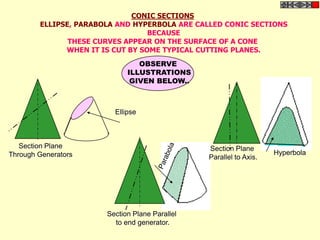
  • 82.
    DRAWINGS: ( A Graphical Representation) The Fact about: If compared with Verbal or Written Description, Drawings offer far better idea about the Shape, Size & Appearance of any object or situation or location, that too in quite a less time. Hence it has become the Best Media of Communication not only in Engineering but in almost all Fields.
  • 83.
    Drawings (Some Types) Portraits Botanical Drawings ( human faces, Nature Drawings ( plants, flowers etc.) expressions etc.) ( landscape, Geographical scenery etc.) Zoological Drawings Drawings Engineering Drawings, (creatures, animals etc.) ( maps etc.) (projections.) Building Related Drawings. Machine component Drawings Orthographic Projections Isometric ( Mech.Engg.Term.) (Fv,Tv & Sv.-Mech.Engg terms) or Perspective(Civil Engg.Term) (Plan, Elevation- Civil Engg.terms) (Working Drawings 2-D type) (Actual Object Drawing 3-D)
  • 84.
    ORTHOGRAPHIC PROJECTIONS: IT ISA TECHNICAL DRAWING IN WHICH DIFFERENT VIEWS OF AN OBJECT ARE PROJECTED ON DIFFERENT REFERENCE PLANES OBSERVING PERPENDICULAR TO RESPECTIVE REFERENCE PLANE Different Reference planes are Horizontal Plane (HP), Vertical Frontal Plane ( VP ) Side Or Profile Plane ( PP) And Different Views are Front View (FV), Top View (TV) and Side View (SV) FV is a view projected on VP. TV is a view projected on HP. SV is a view projected on PP. IMPORTANT TERMS OF ORTHOGRAPHIC PROJECTIONS: 1 Planes. 2 Pattern of planes & Pattern of views 3 Methods of drawing Orthographic Projections
  • 85.
    PLANES 1 PRINCIPAL PLANES HP AND VP AUXILIARY PLANES Auxiliary Vertical Plane Auxiliary Inclined Plane Profile Plane (A.V.P.) (A.I.P.) ( P.P.)  A.V.P.  to Hp &  to Vp 
  • 86.
    PATTERN OF PLANES& VIEWS (First Angle Method) 2 THIS IS A PICTORIAL SET-UP OF ALL THREE PLANES. ARROW DIRECTION IS A NORMAL WAY OF OBSERVING THE OBJECT. BUT IN THIS DIRECTION ONLY VP AND A VIEW ON IT (FV) CAN BE SEEN. THE OTHER PLANES AND VIEWS ON THOSE CAN NOT BE SEEN. PROCEDURE TO SOLVE ABOVE PROBLEM:- TO MAKE THOSE PLANES ALSO VISIBLE FROM THE ARROW DIRECTION, A) HP IS ROTATED 900 DOUNWARD B) PP, 900 IN RIGHT SIDE DIRECTION. THIS WAY BOTH PLANES ARE BROUGHT IN THE SAME PLANE CONTAINING VP. Click to view Animation On clicking the button if a warning comes please click YES to continue, this program is safe for your pc. VP PP Y FV LSV X Y X TV HP ACTUAL PATTERN OF PLANES & VIEWS HP IS ROTATED DOWNWARD 900 PP IS ROTATED IN RIGHT SIDE 900 OF ORTHOGRAPHIC PROJECTIONS AND AND DRAWN IN BROUGHT IN THE PLANE OF VP. BROUGHT IN THE PLANE OF VP. FIRST ANGLE METHOD OF PROJECTIONS
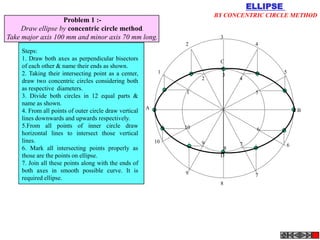
  • 87.
    3 Methods of Drawing Orthographic Projections First Angle Projections Method Third Angle Projections Method Here views are drawn Here views are drawn by placing object by placing object in 1st Quadrant in 3rd Quadrant. ( Fv above X-y, Tv below X-y ) SYMBOLIC ( Tv above X-y, Fv below X-y ) PRESENTATION OF BOTH METHODS WITH AN OBJECT STANDING ON HP ( GROUND) TV FV ON IT’S BASE. X Y NOTE:- X Y HP term is used in1st Angle method & FV TV For the same G L Ground term is used in 3rd Angle method of projections
  • 88.
    FIRST ANGLE FOR T.V. PROJECTION IN THIS METHOD, THE OBJECT IS ASSUMED TO BE SITUATED IN FIRST QUADRANT MEANS ABOVE HP & INFRONT OF VP. OBJECT IS INBETWEEN OBSERVER & PLANE. VP PP FV LSV X Y TV HP ACTUAL PATTERN OF PLANES & VIEWS IN FIRST ANGLE METHOD OF PROJECTIONS
  • 89.
    THIRD ANGLE FOR T.V. PROJECTION IN THIS METHOD, THE OBJECT IS ASSUMED TO BE SITUATED IN THIRD QUADRANT ( BELOW HP & BEHIND OF VP. ) PLANES BEING TRANSPERENT AND INBETWEEN OBSERVER & OBJECT. TV X Y LSV FV ACTUAL PATTERN OF PLANES & VIEWS OF THIRD ANGLE PROJECTIONS
  • 90.
    ORTHOGRAPHIC PROJECTIONS { MACHINE ELEMENTS } OBJECT IS OBSERVED IN THREE DIRECTIONS. THE DIRECTIONS SHOULD BE NORMAL TO THE RESPECTIVE PLANES. AND NOW PROJECT THREE DIFFERENT VIEWS ON THOSE PLANES. THESE VEWS ARE FRONT VIEW , TOP VIEW AND SIDE VIEW. FRONT VIEW IS A VIEW PROJECTED ON VERTICAL PLANE ( VP ) TOP VIEW IS A VIEW PROJECTED ON HORIZONTAL PLANE ( HP ) SIDE VIEW IS A VIEW PROJECTED ON PROFILE PLANE ( PP ) FIRST STUDY THE CONCEPT OF 1ST AND 3RD ANGLE PROJECTION METHODS AND THEN STUDY NEXT 26 ILLUSTRATED CASES CAREFULLY. TRY TO RECOGNIZE SURFACES PERPENDICULAR TO THE ARROW DIRECTIONS
  • 91.
    FIRST ANGLE FOR T.V. PROJECTION IN THIS METHOD, THE OBJECT IS ASSUMED TO BE SITUATED IN FIRST QUADRANT MEANS ABOVE HP & INFRONT OF VP. OBJECT IS INBETWEEN OBSERVER & PLANE. VP PP FV LSV X Y TV HP ACTUAL PATTERN OF PLANES & VIEWS IN FIRST ANGLE METHOD OF PROJECTIONS
  • 92.
    FOR T.V. THIRD ANGLE PROJECTION IN THIS METHOD, THE OBJECT IS ASSUMED TO BE SITUATED IN THIRD QUADRANT ( BELOW HP & BEHIND OF VP. ) PLANES BEING TRANSPERENT AND INBETWEEN OBSERVER & OBJECT. TV X Y LSV FV ACTUAL PATTERN OF PLANES & VIEWS OF THIRD ANGLE PROJECTIONS
  • 93.
    FOR T.V. 1 ORTHOGRAPHIC PROJECTIONS FRONT VIEW L.H.SIDE VIEW x y PICTORIAL PRESENTATION IS GIVEN TOP VIEW DRAW THREE VIEWS OF THIS OBJECT BY FIRST ANGLE PROJECTION METHOD
  • 94.
    FOR T.V. 2 ORTHOGRAPHIC PROJECTIONS FRONT VIEW L.H.SIDE VIEW X Y TOP VIEW PICTORIAL PRESENTATION IS GIVEN DRAW THREE VIEWS OF THIS OBJECT BY FIRST ANGLE PROJECTION METHOD
  • 95.
    FOR T.V. 3 ORTHOGRAPHIC PROJECTIONS FRONT VIEW L.H.SIDE VIEW X Y TOP VIEW PICTORIAL PRESENTATION IS GIVEN DRAW THREE VIEWS OF THIS OBJECT BY FIRST ANGLE PROJECTION METHOD
  • 96.
    4 FOR T.V. ORTHOGRAPHIC PROJECTIONS FRONT VIEW L.H.SIDE VIEW X Y TOP VIEW PICTORIAL PRESENTATION IS GIVEN DRAW THREE VIEWS OF THIS OBJECT BY FIRST ANGLE PROJECTION METHOD
  • 97.
    FOR T.V. 5 ORTHOGRAPHIC PROJECTIONS FRONT VIEW L.H.SIDE VIEW X Y PICTORIAL PRESENTATION IS GIVEN TOP VIEW DRAW THREE VIEWS OF THIS OBJECT BY FIRST ANGLE PROJECTION METHOD
  • 98.
    6 FOR T.V. ORTHOGRAPHIC PROJECTIONS FRONT VIEW L.H.SIDE VIEW X Y TOP VIEW PICTORIAL PRESENTATION IS GIVEN DRAW THREE VIEWS OF THIS OBJECT BY FIRST ANGLE PROJECTION METHOD
  • 99.
    7 FOR T.V. ORTHOGRAPHIC PROJECTIONS FRONT VIEW L.H.SIDE VIEW X Y PICTORIAL PRESENTATION IS GIVEN TOP VIEW DRAW THREE VIEWS OF THIS OBJECT BY FIRST ANGLE PROJECTION METHOD
  • 100.
    STUDY 8 FOR T.V. Z ILLUSTRATIONS ORTHOGRAPHIC PROJECTIONS FRONT VIEW 50 X Y 20 25 25 20 TOP VIEW PICTORIAL PRESENTATION IS GIVEN DRAW THREE VIEWS OF THIS OBJECT BY FIRST ANGLE PROJECTION METHOD
  • 101.
    9 FOR T.V. ORTHOGRAPHIC PROJECTIONS FRONT VIEW L.H.SIDE VIEW X Y TOP VIEW PICTORIAL PRESENTATION IS GIVEN DRAW THREE VIEWS OF THIS OBJECT BY FIRST ANGLE PROJECTION METHOD
  • 102.
    10 FOR T.V. ORTHOGRAPHIC PROJECTIONS FRONT VIEW L.H.SIDE VIEW X Y PICTORIAL PRESENTATION IS GIVEN TOP VIEW DRAW THREE VIEWS OF THIS OBJECT BY FIRST ANGLE PROJECTION METHOD
  • 103.
    FOR T.V. 11 ORTHOGRAPHIC PROJECTIONS FRONT VIEW L.H.SIDE VIEW X Y TOP VIEW PICTORIAL PRESENTATION IS GIVEN DRAW THREE VIEWS OF THIS OBJECT BY FIRST ANGLE PROJECTION METHOD
  • 104.
    12 FOR T.V. ORTHOGRAPHIC PROJECTIONS FRONT VIEW L.H.SIDE VIEW X Y PICTORIAL PRESENTATION IS GIVEN TOP VIEW DRAW THREE VIEWS OF THIS OBJECT BY FIRST ANGLE PROJECTION METHOD
  • 105.
    STUDY 13 Z ILLUSTRATIONS FOR T.V. ORTHOGRAPHIC PROJECTIONS 35 FV 35 10 x y 10 20 30 40 70 TV O PICTORIAL PRESENTATION IS GIVEN DRAW FV AND TV OF THIS OBJECT BY FIRST ANGLE PROJECTION METHOD
  • 106.
    STUDY Z 14 ILLUSTRATIONS FOR T.V. ORTHOGRAPHIC PROJECTIONS FV 30 10 30 SV 30 10 30 x y ALL VIEWS IDENTICAL TV PICTORIAL PRESENTATION IS GIVEN DRAW THREE VIEWS OF THIS OBJECT BY FIRST ANGLE PROJECTION METHOD
  • 107.
    STUDY 15 Z ILLUSTRATIONS ORTHOGRAPHIC PROJECTIONS FOR T.V. ALL VIEWS IDENTICAL FV SV x y 10 40 60 40 TV 60 PICTORIAL PRESENTATION IS GIVEN DRAW THREE VIEWS OF THIS OBJECT BY FIRST ANGLE PROJECTION METHOD
  • 108.
    FOR T.V. ORTHOGRAPHIC PROJECTIONS 16 ALL VIEWS IDENTICAL FV SV x y 10 40 60 PICTORIAL PRESENTATION IS GIVEN TOP VIEW 40 DRAW THREE VIEWS OF THIS OBJECT BY FIRST ANGLE PROJECTION METHOD 60
  • 109.
    17 ORTHOGRAPHIC PROJECTIONS FRONT VIEW L.H.SIDE VIEW 30 SQUARE 40 20 50 20 10 X Y 30 O 60 F.V. S.V. PICTORIAL PRESENTATION IS GIVEN DRAW FV AND SV OF THIS OBJECT BY FIRST ANGLE PROJECTION METHOD
  • 110.
    FOR T.V. ORTHOGRAPHIC PROJECTIONS 18 FV 40 X 10 Y O 30 D 45 O 10 50 PICTORIAL PRESENTATION IS GIVEN DRAW FV AND TV OF THIS OBJECT BY FIRST ANGLE PROJECTION METHOD 80 TV
  • 111.
    19 FOR T.V. ORTHOGRAPHIC PROJECTIONS FV 40 X O 10 Y 100 10 25 TV 10 30 10 25 30 R O 20 D PICTORIAL PRESENTATION IS GIVEN DRAW FV AND TV OF THIS OBJECT BY FIRST ANGLE PROJECTION METHOD
  • 112.
    PICTORIAL PRESENTATION ISGIVEN ORTHOGRAPHIC PROJECTIONS 20 DRAW FV AND TV OF THIS OBJECT BY FIRST ANGLE PROJECTION METHOD 30 FOR T.V. FV RECT. SLOT 10 50 35 10 X Y 20 D TV 60 D 30 D TOP VIEW O
  • 113.
    21 ORTHOGRAPHIC PROJECTIONS 10 25 15 25 40 10 25 25 O O 80 25 F.V. S.V. PICTORIAL PRESENTATION IS GIVEN DRAW FV AND SV OF THIS OBJECT BY FIRST ANGLE PROJECTION METHOD
  • 114.
    FOR T.V. 22 ORTHOGRAPHIC PROJECTIONS 450 30 FV 40 X Y 30 D 40 TV O PICTORIAL PRESENTATION IS GIVEN 15 DRAW FV AND TV OF THIS OBJECT 40 BY FIRST ANGLE PROJECTION METHOD
  • 115.
    23 ORTHOGRAPHIC PROJECTIONS HEX PART 30 20 20 40 20 O 50 20 15 O 30 100 60 PICTORIAL PRESENTATION IS GIVEN FRONT VIEW L.H.SIDE VIEW DRAW FV ABD SV OF THIS OBJECT BY FIRST ANGLE PROJECTION METHOD
  • 116.
    FOR T.V. ORTHOGRAPHIC PROJECTIONS 24 20 40 FRONT VIEW F.V. 30 10 X Y O 10 30 10 30 O 80 PICTORIAL PRESENTATION IS GIVEN T.V. TOP VIEW DRAW FV AND TV OF THIS OBJECT BY FIRST ANGLE PROJECTION METHOD
  • 117.
    25 ORTHOGRAPHIC PROJECTIONS 10 10 15 25 25 X Y O 50 10 FV LSV PICTORIAL PRESENTATION IS GIVEN DRAW FV AND LSV OF THIS OBJECT BY FIRST ANGLE PROJECTION METHOD
  • 118.
    PICTORIAL PRESENTATION ISGIVEN 26 DRAW FV AND SV OF THIS OBJECT BY FIRST ANGLE PROJECTION METHOD ORTHOGRAPHIC PROJECTIONS 30 20 10 20 15 10 15 O 15 30 15 X Y 50 F.V. LEFT S.V.
  • 119.
    ORTHOGRAPHIC PROJECTIONS OF POINTS, LINES, PLANES, AND SOLIDS. TO DRAW PROJECTIONS OF ANY OBJECT, ONE MUST HAVE FOLLOWING INFORMATION A) OBJECT { WITH IT‟S DESCRIPTION, WELL DEFINED.} B) OBSERVER { ALWAYS OBSERVING PERPENDICULAR TO RESP. REF.PLANE}. C) LOCATION OF OBJECT, { MEANS IT‟S POSITION WITH REFFERENCE TO H.P. & V.P.} TERMS „ABOVE‟ & „BELOW‟ WITH RESPECTIVE TO H.P. AND TERMS „INFRONT‟ & „BEHIND‟ WITH RESPECTIVE TO V.P FORM 4 QUADRANTS. OBJECTS CAN BE PLACED IN ANY ONE OF THESE 4 QUADRANTS. IT IS INTERESTING TO LEARN THE EFFECT ON THE POSITIONS OF VIEWS ( FV, TV ) OF THE OBJECT WITH RESP. TO X-Y LINE, WHEN PLACED IN DIFFERENT QUADRANTS. STUDY ILLUSTRATIONS GIVEN ON HEXT PAGES AND NOTE THE RESULTS.TO MAKE IT EASY HERE A POINT A IS TAKEN AS AN OBJECT. BECAUSE IT’S ALL VIEWS ARE JUST POINTS.
  • 120.
    NOTATIONS FOLLOWING NOTATIONSSHOULD BE FOLLOWED WHILE NAMEING DIFFERENT VIEWS IN ORTHOGRAPHIC PROJECTIONS. OBJECT POINT A LINE AB IT‟S TOP VIEW a ab IT‟S FRONT VIEW a‟ a‟ b‟ IT‟S SIDE VIEW a” a” b” SAME SYSTEM OF NOTATIONS SHOULD BE FOLLOWED INCASE NUMBERS, LIKE 1, 2, 3 – ARE USED.
  • 121.
    VP 2nd Quad. 1ST Quad. Y Observer X Y HP X 3rd Quad. 4th Quad. THIS QUADRANT PATTERN, IF OBSERVED ALONG X-Y LINE ( IN RED ARROW DIRECTION) WILL EXACTLY APPEAR AS SHOWN ON RIGHT SIDE AND HENCE, IT IS FURTHER USED TO UNDERSTAND ILLUSTRATION PROPERLLY.
  • 122.
    Point A is POINT A IN VP POINT A IN Placed In 2ND QUADRANT 1ST QUADRANT VP a’ different A A quadrants a’ and it‟s Fv & Tv a are brought in same plane for HP OBSERVER Observer to see clearly. HP OBSERVER Fv is visible as it is a view on VP. But as Tv is a is a view on Hp, it is rotated downward 900, In clockwise direction.The In front part of a Hp comes below xy line and the part behind Vp HP comes above. HP OBSERVER OBSERVER Observe and note the a process. a’ A a’ POINT A IN A POINT A IN 3RD QUADRANT VP 4TH QUADRANT VP
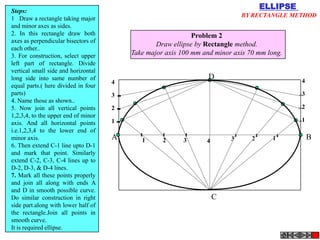
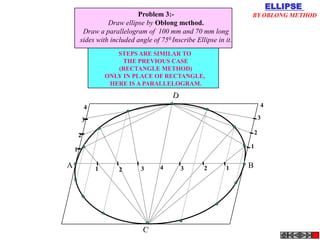
  • 123.
    PROJECTIONS OF APOINT IN FIRST QUADRANT. POINT A ABOVE HP POINT A ABOVE HP POINT A IN HP & INFRONT OF VP & IN VP & INFRONT OF VP For Tv For Tv PICTORIAL PICTORIAL For Tv PRESENTATION A PRESENTATION a’ a’ A Y Y Y a’ a a X a X X A ORTHOGRAPHIC PRESENTATIONS OF ALL ABOVE CASES. Fv above xy, Fv above xy, Fv on xy, Tv below xy. Tv on xy. Tv below xy. VP VP VP a’ a’ X Y X Y X a’ Y a a a HP HP HP
  • 124.
    PROJECTIONS OF STRAIGHTLINES. INFORMATION REGARDING A LINE means IT‟S LENGTH, POSITION OF IT‟S ENDS WITH HP & VP IT‟S INCLINATIONS WITH HP & VP WILL BE GIVEN. AIM:- TO DRAW IT‟S PROJECTIONS - MEANS FV & TV. SIMPLE CASES OF THE LINE 1. A VERTICAL LINE ( LINE PERPENDICULAR TO HP & // TO VP) 2. LINE PARALLEL TO BOTH HP & VP. 3. LINE INCLINED TO HP & PARALLEL TO VP. 4. LINE INCLINED TO VP & PARALLEL TO HP. 5. LINE INCLINED TO BOTH HP & VP. STUDY ILLUSTRATIONS GIVEN ON NEXT PAGE SHOWING CLEARLY THE NATURE OF FV & TV OF LINES LISTED ABOVE AND NOTE RESULTS.
  • 125.
    For Tv Orthographic Pattern (Pictorial Presentation) V.P. a’ Note: a’ Fv is a vertical line A Showing True Length Fv 1. FV & Tv is a point. b’ A Line b’ perpendicular Y X Y to Hp B & TV a b Tv a b // to Vp X H.P. Orthographic Pattern (Pictorial Presentation) For Tv Note: V.P. Fv & Tv both are 2. // to xy a’ Fv b’ b’ & A Line B both show T. L. // to Hp a’ & A Y X Y // to Vp b a b Tv X a H.P.
  • 126.
    Fv inclined toxy V.P. Tv parallel to xy. b’ 3. b’ A Line inclined to Hp B a’  and  Y parallel to Vp a’ X Y  (Pictorial presentation) A b a T.V. b X a H.P. Orthographic Projections Tv inclined to xy V.P. 4. Fv parallel to xy. a’ Fv b’ A Line inclined to Vp b’ and a’ parallel to Hp A Ø B X Y (Pictorial presentation) a Ø Ø Tv a b b H.P.
  • 127.
    For Tv For Tv 5. A Line inclined to both Hp and Vp b’ b’ (Pictorial presentation) B B   Y Y On removal of object a’ a’ i.e. Line AB Fv as a image on Vp. A A Tv as a image on Hp,   X X a T.V. b a T.V. b V.P. b’ FV a’  X Y Orthographic Projections Note These Facts:- Fv is seen on Vp clearly. Both Fv & Tv are inclined to xy. To see Tv clearly, HP is a  (No view is parallel to xy) rotated 900 downwards, Both Fv & Tv are reduced lengths. Hence it comes below xy. TV (No view shows True Length) H.P. b
  • 128.
    Orthographic Projections Note the procedure Note the procedure Means Fv & Tv of Line AB When Fv & Tv known, When True Length is known, are shown below, How to find True Length. How to locate Fv & Tv. (Views are rotated to determine (Component a-1 of TL is drawn with their apparent Inclinations True Length & it‟s inclinations which is further rotated & with Hp & Vp). to determine Fv) V.P. V.P. V.P. b’ b’ b 1’ b’ b1’ FV FV TL  a’  a’  a’  1’ X Y X Y X Y 1 a  b2 a a  TV Ø  TV TV H.P. b H.P. b H.P. b b1 Here TV (ab) is not // to XY line In this sketch, TV is rotated Here a -1 is component Hence it’s corresponding FV and made // to XY line. of TL ab1 gives length of Fv. a’ b’ is not showing Hence it’s corresponding Hence it is brought Up to True Length & FV a’ b1’ Is showing Locus of a’ and further rotated True Length to get point b’. a’ b’ will be Fv. True Inclination with Hp. & Similarly drawing component True Inclination with Hp. of other TL(a‟ b1„) Tv can be drawn.
  • 129.
    The most importantdiagram showing graphical relations 1) True Length ( TL) – a’ b1’ & a b among all important parameters of this topic. 2) Angle of TL with Hp -  Important TEN parameters Study and memorize it as a CIRCUIT DIAGRAM 3) Angle of TL with Vp – Ø to be remembered And use in solving various problems. 4) Angle of FV with xy –  with Notations V.P. 5) Angle of TV with xy –  used here onward Distance between End Projectors. 6) LTV (length of FV) – Component (a-1) b’ b1’ 7) LFV (length of TV) – Component (a‟-1‟) 8) Position of A- Distances of a & a‟ from xy 9) Position of B- Distances of b & b‟ from xy  10) Distance between End Projectors  1’ a’ LTV NOTE this X Y &  Construct with a’ a LFV 1 Ø&  Construct with a Ø b’ & b1’ on same locus.  b & b1 on same locus. Also Remember b b1 H.P. True Length is never rotated. It‟s horizontal component is drawn & it is further rotated to locate view. Views are always rotated, made horizontal & further extended to locate TL,  & Ø
  • 130.
    GROUP (A) GENERAL CASES OF THE LINE INCLINED TO BOTH HP & VP PROBLEM 1) ( based on 10 parameters). Line AB is 75 mm long and it is 300 & 400 Inclined to Hp & Vp respectively. End A is 12mm above Hp and 10 mm b’ b’1 in front of Vp. Draw projections. Line is in 1st quadrant. FV SOLUTION STEPS: TL 1) Draw xy line and one projector. 2) Locate a‟ 12mm above xy line & a 10mm below xy line.  3) Take 300 angle from a‟ & 400 from a and mark TL I.e. 75mm on both a’ lines. Name those points b1‟ and b1 X Y respectively. 4) Join both points with a‟ and a resp. a LFV 5) Draw horizontal lines (Locus) from Ø 1 both points. 6) Draw horizontal component of TL a b1 from point b1 and name it 1. ( the length a-1 gives length of Fv as we have seen already.) TV TL 7) Extend it up to locus of a‟ and rotating a‟ as center locate b‟ as shown. Join a‟ b‟ as Fv. 8) From b‟ drop a projector down ward & get point b. Join a & b b b1 I.e. Tv.
  • 131.
    PROBLEM 2: Line AB75mm long makes 450 inclination with Vp while it’s Fv makes 550. End A is 10 mm above Hp and 15 mm in front of Vp.If line is in 1st quadrant draw it’s projections and find it’s inclination with Hp. b’ b’1 LOCUS OF b Solution Steps:- 1.Draw x-y line. 2.Draw one projector for a‟ & a 3.Locate a’ 10mm above x-y & Tv a 15 mm below xy. 4.Draw a line 450 inclined to xy 550 from point a and cut TL 75 mm on it and name that point b1 Draw locus from point b1 a’ 5.Take 550 angle from a’ for Fv above xy line. X y 6.Draw a vertical line from b1 up to locus of a and name it 1. It is horizontal component of a LFV TL & is LFV. 1 7.Continue it to locus of a’ and rotate upward up to the line of Fv and name it b’.This a’ b’ line is Fv. 8. Drop a projector from b‟ on locus from point b1 and name intersecting point b. Line a b is Tv of line AB. 9.Draw locus from b’ and from a’ with TL distance cut point b1‘ 10.Join a’ b1’ as TL and measure it‟s angle at a’. LOCUS OF b It will be true angle of line with HP. b b1
  • 132.
    PROBLEM 3: Fv of line AB is 500 inclined to xy and measures 55 mm long while it’s Tv is 600 inclined to xy line. If end A is 10 mm above Hp and 15 mm in front of Vp, draw it’s projections,find TL, inclinations of line with Hp & Vp. b’ b’1 SOLUTION STEPS: 1.Draw xy line and one projector. 2.Locate a’ 10 mm above xy and a 15 mm below xy line. 3.Draw locus from these points. 500 4.Draw Fv 500 to xy from a’ and  mark b’ Cutting 55mm on it. a’ X 5.Similarly draw Tv 600 to xy from a & drawing projector from b’ y Locate point b and join a b. 6.Then rotating views as shown, a  locate True Lengths ab1 & a’b1’ 600 and their angles with Hp and Vp. b1 b
  • 133.
    PROBLEM 4 :- Line AB is 75 mm long .It‟s Fv and Tv measure 50 mm & 60 mm long respectively. End A is 10 mm above Hp and 15 mm in front of Vp. Draw projections of line AB if end B is in first quadrant.Find angle with Hp and Vp. b’ b’1 SOLUTION STEPS: 1.Draw xy line and one projector. 2.Locate a’ 10 mm above xy and a 15 mm below xy line. 3.Draw locus from these points. 4.Cut 60mm distance on locus of a’  LTV 1’ & mark 1’ on it as it is LTV. a’ 5.Similarly Similarly cut 50mm on X Y locus of a and mark point 1 as it is LFV. 6.From 1’ draw a vertical line upward a LFV and from a’ taking TL ( 75mm ) in 1  compass, mark b’1 point on it. Join a’ b’1 points. 7. Draw locus from b’1 8. With same steps below get b1 point and draw also locus from it. 9. Now rotating one of the components I.e. a-1 locate b’ and join a’ with it to get Fv. 10. Locate tv similarly and measure Angles  &  b1 b
  • 134.
    PROBLEM 5 :- T.V. of a 75 mm long Line CD, measures 50 mm. End C is in Hp and 50 mm in front of Vp. End D is 15 mm in front of Vp and it is above Hp. Draw projections of CD and find angles with Hp and Vp. d’ d’1 LOCUS OF d’ & d’1 SOLUTION STEPS: 1.Draw xy line and one projector. 2.Locate c’ on xy and c 50mm below xy line. 3.Draw locus from these points. 4.Draw locus of d 15 mm below xy 5.Cut 50mm & 75 mm distances on c’  locus of d from c and mark points X Y d & d1 as these are Tv and line CD d d1 LOCUS OF d & d1 lengths resp.& join both with c. 6.From d1 draw a vertical line upward up to xy I.e. up to locus of c’ and draw an arc as shown. 7 Then draw one projector from d to meet this arc in d’ point & join c’ d’ 8. Draw locus of d’ and cut 75 mm on it from c’ as TL 9.Measure Angles  &  c 
  • 135.
    GROUP (B) PROBLEMS INVOLVING TRACES OF THE LINE. TRACES OF THE LINE:- THESE ARE THE POINTS OF INTERSECTIONS OF A LINE ( OR IT‟S EXTENSION ) WITH RESPECTIVE REFFERENCE PLANES. A LINE ITSELF OR IT’S EXTENSION, WHERE EVER TOUCHES H.P., THAT POINT IS CALLED TRACE OF THE LINE ON H.P.( IT IS CALLED H.T.) SIMILARLY, A LINE ITSELF OR IT‟S EXTENSION, WHERE EVER TOUCHES V.P., THAT POINT IS CALLED TRACE OF THE LINE ON V.P.( IT IS CALLED V.T.) V.T.:- It is a point on Vp. Hence it is called Fv of a point in Vp. Hence it’s Tv comes on XY line.( Here onward named as v ) H.T.:- It is a point on Hp. Hence it is called Tv of a point in Hp. Hence it’s Fv comes on XY line.( Here onward named as ‟h‟ )
  • 136.
    b’ STEPS TO LOCATEHT. (WHEN PROJECTIONS ARE GIVEN.) 1. Begin with FV. Extend FV up to XY line. a’ 2. Name this point h’ v h’ ( as it is a Fv of a point in Hp) x y 3. Draw one projector from h’. 4. Now extend Tv to meet this projector. VT’ HT This point is HT a STEPS TO LOCATE VT. Observe & note :- (WHEN PROJECTIONS ARE GIVEN.) 1. Points h’ & v always on x-y line. b 1. Begin with TV. Extend TV up to XY line. 2. VT’ & v always on one projector. 2. Name this point v 3. HT & h’ always on one projector. ( as it is a Tv of a point in Vp) 3. Draw one projector from v. 4. FV - h’- VT’ always co-linear. 4. Now extend Fv to meet this projector. This point is VT 5. TV - v - HT always co-linear. These points are used to solve next three problems.
  • 137.
    PROBLEM 6 :-Fv of line AB makes 450 angle with XY line and measures 60 mm. Line’s Tv makes 300 with XY line. End A is 15 mm above Hp and it’s VT is 10 mm below Hp. Draw projections of line AB,determine inclinations with Hp & Vp and locate HT, VT. b’ b’1 a’  450 SOLUTION STEPS:- 15 Draw xy line, one projector and x v h’ y locate fv a’ 15 mm above xy. 10 300 Take 45 0 angle from a’ and marking 60 mm on it locate point b’. VT’ Draw locus of VT, 10 mm below xy a  & extending Fv to this locus locate VT. as fv-h’-vt’ lie on one st.line. Draw projector from vt, locate v on xy. From v take 300 angle downward as Tv and it’s inclination can begin with v. b b1 Draw projector from b’ and locate b I.e.Tv point. Now rotating views as usual TL and it’s inclinations can be found. Name extension of Fv, touching xy as h’ and below it, on extension of Tv, locate HT.
  • 138.
    PROBLEM 7 : Oneend of line AB is 10mm above Hp and other end is 100 mm in-front of Vp. It‟s Fv is 450 inclined to xy while it‟s HT & VT are 45mm and 30 mm below xy respectively. Draw projections and find TL with it‟s inclinations with Hp & VP. b’ b’ 1 LOCUS OF b’ & b’1 a’ 450  10 v h’ X Y 30 45 VT’ HT SOLUTION STEPS:- Draw xy line, one projector and locate a’ 10 mm above xy. 100 Draw locus 100 mm below xy for points b & b1 Draw loci for VT and HT, 30 mm & 45 mm a  below xy respectively. Take 450 angle from a’ and extend that line backward to locate h’ and VT, & Locate v on xy above VT. Locate HT below h’ as shown. Then join v – HT – and extend to get top view end b. Draw projector upward and locate b’ Make a b & a’b’ dark. b b1 LOCUS OF b & b1 Now as usual rotating views find TL and it’s inclinations.
  • 139.
    PROBLEM 8 :-Projectors drawn from HT and VT of a line AB are 80 mm apart and those drawn from it’s ends are 50 mm apart. End A is 10 mm above Hp, VT is 35 mm below Hp while it’s HT is 45 mm in front of Vp. Draw projections, locate traces and find TL of line & inclinations with Hp and Vp. VT b’ b’1 SOLUTION STEPS:- 55 1.Draw xy line and two projectors, 80 mm apart and locate HT & VT , 35 mm below xy and 55 mm above xy Locus of a’ a’  respectively on these projectors. 10 50 v 2.Locate h’ and v on xy as usual. X y h’ b b1 3.Now just like previous two problems, Extending certain lines complete Fv & Tv 35 And as usual find TL and it’s inclinations. a  HT 80
  • 140.
    Instead of consideringa & a’ as projections of first point, if v & VT’ are considered as first point , then true inclinations of line with Hp & Vp i.e. angles  &  can be constructed with points VT’ & V respectively. b’ b1’ Then from point v & HT a’ angles  &  can be drawn. v & X  Y From point VT‟ & h‟ angles  &  can be drawn.  VT’ THIS CONCEPT IS USED TO SOLVE a NEXT THREE PROBLEMS. b b1
  • 141.
    PROBLEM 9 :- LineAB 100 mm long is 300 and 450 inclined to Hp & Vp respectively. b1’ End A is 10 mm above Hp and it’s VT is 20 mm below Hp b’ .Draw projections of the line and it’s HT. FV Locus of a & a1’ a’ a1’ SOLUTION STEPS:- 10 X v h’ Draw xy, one projector Y and locate on it VT and V. (45 0) 20 Draw locus of a’ 10 mm above xy.  (300) Take 300 from VT and draw a line. Where it intersects with locus of a’ VT’ name it a1’ as it is TL of that part. HT From a1’ cut 100 mm (TL) on it and locate point b1’ Now from v take 450 and draw a line downwards a a1 & Mark on it distance VT-a1’ I.e.TL of extension & name it a1 Extend this line by 100 mm and mark point b1. Draw it’s component on locus of VT’ & further rotate to get other end of Fv i.e.b’ TV Join it with VT’ and mark intersection point (with locus of a1’ ) and name it a’ Now as usual locate points a and b and h’ and HT. b b1
  • 142.
    PROBLEM 10 :- A line AB is 75 mm long. It’s Fv & Tv make 450 and 600 inclinations with X-Y line resp End A is 15 mm above Hp and VT is 20 mm below Xy line. Line is in first quadrant. Draw projections, find inclinations with Hp & Vp. Also locate HT. b’ b1’ FV Locus of a & a1’ a’ a1’ 15 X v h’ Y 600 20   450 VT’ SOLUTION STEPS:- Similar to the previous only change HT is instead of line’s inclinations, views inclinations are given. a a1 So first take those angles from VT & v Properly, construct Fv & Tv of extension, then determine it’s TL( V-a1) TV and on it’s extension mark TL of line and proceed and complete it. b b1
  • 143.
    PROBLEM 11 :-The projectors drawn from VT & end A of line AB are 40mm apart. End A is 15mm above Hp and 25 mm in front of Vp. VT of line is 20 mm below Hp. If line is 75mm long, draw it’s projections, find inclinations with HP & Vp b’ b1’ a’ a1’ 15 X v Y 20  25  VT’ a Draw two projectors for VT & end A 40mm Locate these points and then b b1 YES ! YOU CAN COMPLETE IT.
  • 144.
    GROUP (C) CASES OF THE LINES IN A.V.P., A.I.P. & PROFILE PLANE. b’ Line AB is in AIP as shown in above figure no 1. It’s FV (a’b’) is shown projected on Vp.(Looking in arrow direction) Here one can clearly see that the Inclination of AIP with HP = Inclination of FV with XY line a’    A A.V.P. B Line AB is in AVP as shown in above figure no 2..  a b It’s TV (a b) is shown projected on Hp.(Looking in arrow direction) Here one can clearly see that the Inclination of AVP with VP = Inclination of TV with XY line
  • 145.
    LINE IN APROFILE PLANE ( MEANS IN A PLANE PERPENDICULAR TO BOTH HP & VP) For T.V. ORTHOGRAPHIC PATTERN OF LINE IN PROFILE PLANE VP VT PP a’ a” A a’ FV LSV b’ b’ b” X Y HT a B TV a b b HP Results:- 1. TV & FV both are vertical, hence arrive on one single projector. 2. It’s Side View shows True Length ( TL) 3. Sum of it’s inclinations with HP & VP equals to 900 (  +  = 900 ) 4. It’s HT & VT arrive on same projector and can be easily located From Side View. OBSERVE CAREFULLY ABOVE GIVEN ILLUSTRATION AND 2nd SOLVED PROBLEM.
  • 146.
    PROBLEM 12 :-Line AB 80 mm long, makes 300 angle with Hp and lies in an Aux.Vertical Plane 450 inclined to Vp. b’ Locus of b’ b 1’ End A is 15 mm above Hp and VT is 10 mm below X-y line. Draw projections, fine angle with Vp and Ht. Locus of a‟ & a1‟ a’ a 1’ 15 v h’ X 450 Y 10   VT HT a AVP 450 to VP Simply consider inclination of AVP Locus of b’ as inclination of TV of our line, b b1 well then? You sure can complete it as previous problems! Go ahead!!
  • 147.
    PROBLEM 13 :-A line AB, 75mm long, has one end A in Vp. Other end B is 15 mm above Hp and 50 mm in front of Vp.Draw the projections of the line when sum of it’s Inclinations with HP & Vp is 900, means it is lying in a profile plane. Find true angles with ref.planes and it’s traces. VT (VT) a” a’ SOLUTION STEPS:- Side View After drawing xy line and one projector Front view ( True Length ) VP Locate top view of A I.e point a on xy as It is in Vp, b’ b” Locate Fv of B i.e.b’15 mm above xy as a  (HT) X HP Y it is above Hp.and Tv of B i.e. b, 50 mm below xy asit is 50 mm in front of Vp Draw side view structure of Vp and Hp top view and locate S.V. of point B i.e. b’’ From this point cut 75 mm distance on Vp and Mark a’’ as A is in Vp. (This is also VT of line.) b From this point draw locus to left & get a’ HT Extend SV up to Hp. It will be HT. As it is a Tv Rotate it and bring it on projector of b. Now as discussed earlier SV gives TL of line and at the same time on extension up to Hp & Vp gives inclinations with those panes.
  • 148.
    APPLICATIONS OF PRINCIPLESOF PROJECTIONS OF LINES IN SOLVING CASES OF DIFFERENT PRACTICAL SITUATIONS. In these types of problems some situation in the field or some object will be described . It‟s relation with Ground ( HP ) And a Wall or some vertical object ( VP ) will be given. Indirectly information regarding Fv & Tv of some line or lines, inclined to both reference Planes will be given and you are supposed to draw it‟s projections and further to determine it‟s true Length and it‟s inclinations with ground. Here various problems along with actual pictures of those situations are given for you to understand those clearly. CHECK YOUR ANSWERS Now looking for views in given ARROW directions, WITH THE SOLUTIONS YOU are supposed to draw projections & find answers, GIVEN IN THE END. Off course you must visualize the situation properly. ALL THE BEST !!
  • 149.
    PROBLEM 14:-Two objects,a flower (A) and an orange (B) are within a rectangular compound wall, whose P & Q are walls meeting at 900. Flower A is 1M & 5.5 M from walls P & Q respectively. Orange B is 4M & 1.5M from walls P & Q respectively. Drawing projection, find distance between them If flower is 1.5 M and orange is 3.5 M above the ground. Consider suitable scale.. TV B Wall Q A FV
  • 150.
    PROBLEM 15 :-Two mangos on a tree A & B are 1.5 m and 3.00 m above ground and those are 1.2 m & 1.5 m from a 0.3 m thick wall but on opposite sides of it. If the distance measured between them along the ground and parallel to wall is 2.6 m, Then find real distance between them by drawing their projections. TV B 0.3M THICK A
  • 151.
    PROBLEM 16 :-oa, ob & oc are three lines, 25mm, 45mm and 65mm long respectively.All equally inclined and the shortest is vertical.This fig. is TV of three rods OA, OB and OC whose ends A,B & C are on ground and end O is 100mm above ground. Draw their projections and find length of each along with their angles with ground. TV O C A FV 45 mm B
  • 152.
    PROBLEM 17:- Apipe line from point A has a downward gradient 1:5 and it runs due East-South. Another Point B is 12 M from A and due East of A and in same level of A. Pipe line from B runs 200 Due East of South and meets pipe line from A at point C. Draw projections and find length of pipe line from B and it’s inclination with ground. 5 1 A 12 M B E C
  • 153.
    PROBLEM 18: Aperson observes two objects, A & B, on the ground, from a tower, 15 M high, At the angles of depression 300 & 450. Object A is is due North-West direction of observer and object B is due West direction. Draw projections of situation and find distance of objects from observer and from tower also. O 300 450 A S B W
  • 154.
    PROBLEM 19:-Guy ropesof two poles fixed at 4.5m and 7.5 m above ground, are attached to a corner of a building 15 M high, make 300 and 450 inclinations with ground respectively.The poles are 10 M apart. Determine by drawing their projections,Length of each rope and distance of poles from building. TV C 15 M A 300 4.5 M 450 B 7.5M
  • 155.
    PROBLEM 20:- Atank of 4 M height is to be strengthened by four stay rods from each corner by fixing their other ends to the flooring, at a point 1.2 M and 0.7 M from two adjacent walls respectively, as shown. Determine graphically length and angle of each rod with flooring. TV 4M
  • 156.
    PROBLEM 21:- Ahorizontal wooden platform 2 M long and 1.5 M wide is supported by four chains from it’s corners and chains are attached to a hook 5 M above the center of the platform. Draw projections of the objects and determine length of each chain along with it’s inclination with ground. TV Hook H D A C B
  • 157.
    PROBLEM 22. A roomis of size 6.5m L ,5m D,3.5m high. An electric bulb hangs 1m below the center of ceiling. A switch is placed in one of the corners of the room, 1.5m above the flooring. Draw the projections an determine real distance between the bulb and switch. Ceiling TV Bulb Switch D
  • 158.
    PROBLEM 23:- A PICTUREFRAME 2 M WIDE AND 1 M TALL IS RESTING ON HORIZONTAL WALL RAILING MAKES 350 INCLINATION WITH WALL. IT IS ATTAACHED TO A HOOK IN THE WALL BY TWO STRINGS. THE HOOK IS 1.5 M ABOVE WALL RAILING. DETERMINE LENGTH OF EACH CHAIN AND TRUE ANGLE BETWEEN THEM 350 Wall railing
  • 159.
    PROBLEM NO.24 T.V. of a 75 mm long Line CD, measures 50 mm. SOME CASES OF THE LINE End C is 15 mm below Hp and 50 mm in front of Vp. IN DIFFERENT QUADRANTS. End D is 15 mm in front of Vp and it is above Hp. Draw projections of CD and find angles with Hp and Vp. REMEMBER: BELOW HP- Means- Fv below xy BEHIND V p- Means- Tv above xy. d’ d’1 LOCUS OF d’ & d’1 X Y c’  d d1 LOCUS OF d & d1 c 
  • 160.
    PROBLEM NO.25 End Aof line AB is in Hp and 25 mm behind Vp. End B in Vp.and 50mm above Hp. Distance between projectors is 70mm. Draw projections and find it’s inclinations with Ht, Vt. LOCUS OF b’ & b’1 b’ b’1 a  X a’  b b1 Y LOCUS OF b & b1 70
  • 161.
    PROBLEM NO.26 End Aof a line AB is 25mm below Hp and 35mm behind Vp. Line is 300 inclined to Hp. There is a point P on AB contained by both HP & VP. Draw projections, find inclination with Vp and traces. a  b’ b’1 LOCUS OF b’ & b’1 35 p p’ X y p’1 25 =300 a’ LOCUS OF b & b1 b b1
  • 162.
    PROBLEM NO.27 End Aof a line AB is 25mm above Hp and end B is 55mm behind Vp. The distance between end projectors is 75mm. If both it’s HT & VT coincide on xy in a point, 35mm from projector of A and within two projectors, b b1 Draw projections, find TL and angles and HT, VT. 55 a’  25 X Vt Y Ht  a 35 b’ b’1 75
  • 163.
    PROJECTIONS OF PLANES In this topic various plane figures are the objects. What is usually asked in the problem? To draw their projections means F.V, T.V. & S.V. What will be given in the problem? 1. Description of the plane figure. 2. It’s position with HP and VP. In which manner it’s position with HP & VP will be described? 1.Inclination of it’s SURFACE with one of the reference planes will be given. 2. Inclination of one of it’s EDGES with other reference plane will be given (Hence this will be a case of an object inclined to both reference Planes.) Study the illustration showing surface & side inclination given on next page.
  • 164.
    CASE OF ARECTANGLE – OBSERVE AND NOTE ALL STEPS. SURFACE PARALLEL TO HP SURFACE INCLINED TO HP ONE SMALL SIDE INCLINED TO VP PICTORIAL PRESENTATION PICTORIAL PRESENTATION PICTORIAL PRESENTATION ORTHOGRAPHIC ORTHOGRAPHIC ORTHOGRAPHIC TV-True Shape FV- Inclined to XY FV- Apparent Shape FV- Line // to xy TV- Reduced Shape TV-Previous Shape VP VP VP d1’ c1’ a’ d’ a1’ b1’ b’ c’ a d a1 d1 b c b1 c1 HP A HP B HP C
  • 165.
    PROCEDURE OF SOLVINGTHE PROBLEM: IN THREE STEPS EACH PROBLEM CAN BE SOLVED:( As Shown In Previous Illustration ) STEP 1. Assume suitable conditions & draw Fv & Tv of initial position. STEP 2. Now consider surface inclination & draw 2nd Fv & Tv. STEP 3. After this,consider side/edge inclination and draw 3rd ( final) Fv & Tv. ASSUMPTIONS FOR INITIAL POSITION: (Initial Position means assuming surface // to HP or VP) 1.If in problem surface is inclined to HP – assume it // HP Or If surface is inclined to VP – assume it // to VP 2. Now if surface is assumed // to HP- It’s TV will show True Shape. And If surface is assumed // to VP – It’s FV will show True Shape. 3. Hence begin with drawing TV or FV as True Shape. 4. While drawing this True Shape – keep one side/edge ( which is making inclination) perpendicular to xy line ( similar to pair no. A on previous page illustration ). Now Complete STEP 2. By making surface inclined to the resp plane & project it‟s other view. (Ref. 2nd pair B on previous page illustration ) Now Complete STEP 3. By making side inclined to the resp plane & project it‟s other view. (Ref. 3nd pair C on previous page illustration ) APPLY SAME STEPS TO SOLVE NEXT ELEVEN PROBLEMS
  • 166.
    Problem 1: Read problem and answer following questions Rectangle 30mm and 50mm 1. Surface inclined to which plane? ------- HP sides is resting on HP on one 2. Assumption for initial position? ------// to HP small side which is 300 inclined 3. So which view will show True shape? --- TV to VP,while the surface of the 4. Which side will be vertical? ---One small side. plane makes 450 inclination with Hence begin with TV, draw rectangle below X-Y HP. Draw it’s projections. drawing one small side vertical. Surface // to Hp Surface inclined to Hp d’c’ c’1 d’1 c’d’ a’b’ a’ b’ 450 b’1 a’1 Y X 300 a d a1 d1 Side Inclined to Vp b c b1 c1
  • 167.
    Problem 2: Read problem and answer following questions A 300 – 600 set square of longest side 1 .Surface inclined to which plane? ------- VP 100 mm long, is in VP and 300 inclined 2. Assumption for initial position? ------// to VP to HP while it’s surface is 450 inclined 3. So which view will show True shape? --- FV to VP.Draw it’s projections 4. Which side will be vertical? ------longest side. (Surface & Side inclinations directly given) Hence begin with FV, draw triangle above X-Y keeping longest side vertical. a’ a’1 c’ c’1 side inclined to Hp c’1 a’1 b’1 b’1 b’ 300 X a b 450 a1 b1 Y a c b c1 c Surface // to Vp Surface inclined to Vp
  • 168.
    Problem 3: Read problem and answer following questions A 300 – 600 set square of longest side 1 .Surface inclined to which plane? ------- VP 100 mm long is in VP and it’s surface 2. Assumption for initial position? ------// to VP 450 inclined to VP. One end of longest 3. So which view will show True shape? --- FV side is 10 mm and other end is 35 mm 4. Which side will be vertical? ------longest side. above HP. Draw it’s projections Hence begin with FV, draw triangle above X-Y (Surface inclination directly given. keeping longest side vertical. Side inclination indirectly given) First TWO steps are similar to previous problem. Note the manner in which side inclination is given. a’ a’1 End A 35 mm above Hp & End B is 10 mm above Hp. So redraw 2nd Fv as final Fv placing these ends as said. c’ c’1 c’1 a’1 35 b’1 b’1 b’ X 10 Y a a1 b 450 b1 a c b c1 c
  • 169.
    Problem 4: Read problem and answer following questions A regular pentagon of 30 mm sides is 1. Surface inclined to which plane? ------- HP resting on HP on one of it’s sides with it’s 2. Assumption for initial position? ------ // to HP surface 450 inclined to HP. 3. So which view will show True shape? --- TV Draw it’s projections when the side in HP 4. Which side will be vertical? -------- any side. makes 300 angle with VP Hence begin with TV,draw pentagon below SURFACE AND SIDE INCLINATIONS X-Y line, taking one side vertical. ARE DIRECTLY GIVEN. d’ d’1 c’e’ e’1 c’1 b’ a’ X b’ a’ c’e’ d’ b’1 Y 450 a’1 a1 300 e e1 e1 a a1 b1 d1 d d1 c1 b b1 c c1
  • 170.
    Problem 5: Read problem and answer following questions A regular pentagon of 30 mm sides is resting 1. Surface inclined to which plane? ------- HP on HP on one of it’s sides while it’s opposite 2. Assumption for initial position? ------ // to HP vertex (corner) is 30 mm above HP. 3. So which view will show True shape? --- TV Draw projections when side in HP is 300 4. Which side will be vertical? --------any side. inclined to VP. Hence begin with TV,draw pentagon below SURFACE INCLINATION INDIRECTLY GIVEN X-Y line, taking one side vertical. SIDE INCLINATION DIRECTLY GIVEN: ONLY CHANGE is the manner in which surface inclination is described: One side on Hp & it’s opposite corner 30 mm above Hp. d’ d’1 Hence redraw 1st Fv as a 2nd Fv making above arrangement. Keep a’b’ on xy & d’ 30 mm above xy. c’e’ c’1 30 e’1 b’ a’ c’e’ d’ a’ X b’ a’1 b’1 Y 300 e1 a1 e e1 a a1 b1 d d1 d1 c1 b b1 c c1
  • 171.
    c’1 b’1 Problem 8: A circle of 50 mm diameter is a’ b’ d’ c’ resting on Hp on end A of it’s diameter AC 300 a’1 d’1 Y X which is 300 inclined to Hp while it’s Tv d1 450 d is 450 inclined to Vp.Draw it’s projections. a ca c1 1 Read problem and answer following questions 1. Surface inclined to which plane? ------- HP b b1 2. Assumption for initial position? ------ // to HP 3. So which view will show True shape? --- TV The difference in these two problems is in step 3 only. 4. Which diameter horizontal? ---------- AC In problem no.8 inclination of Tv of that AC is Hence begin with TV,draw rhombus below given,It could be drawn directly as shown in 3rd step. X-Y line, taking longer diagonal // to X-Y While in no.9 angle of AC itself i.e. it’s TL, is given. Hence here angle of TL is taken,locus of c1 Is drawn and then LTV I.e. a1 c1 is marked and final TV was completed.Study illustration carefully. Problem 9: A circle of 50 mm diameter is resting on Hp on end A of it’s diameter AC which is 300 inclined to Hp while it makes c’1 450 inclined to Vp. Draw it’s projections. b’1 a’ b’ d’ c’ a’1 d’1 d d1 300 Note the difference in a ca c1 construction of 3rd step 1 in both solutions. b b1
  • 172.
    Read problem andanswer following questions Problem 10: End A of diameter AB of a circle is in HP 1. Surface inclined to which plane? ------- HP A nd end B is in VP.Diameter AB, 50 mm long is 2. Assumption for initial position? ------ // to HP 300 & 600 inclined to HP & VP respectively. 3. So which view will show True shape? --- TV Draw projections of circle. 4. Which diameter horizontal? ---------- AB Hence begin with TV,draw CIRCLE below X-Y line, taking DIA. AB // to X-Y The problem is similar to previous problem of circle – no.9. But in the 3rd step there is one more change. Like 9th problem True Length inclination of dia.AB is definitely expected but if you carefully note - the the SUM of it‟s inclinations with HP & VP is 900. Means Line AB lies in a Profile Plane. Hence it‟s both Tv & Fv must arrive on one single projector. So do the construction accordingly AND note the case carefully.. 300 X Y 600 SOLVE SEPARATELY ON DRAWING SHEET GIVING NAMES TO VARIOUS POINTS AS USUAL, AS THE CASE IS IMPORTANT
  • 173.
    Problem 11: Read problem and answer following questions A hexagonal lamina has its one side in HP and 1. Surface inclined to which plane? ------- HP Its apposite parallel side is 25mm above Hp and 2. Assumption for initial position? ------ // to HP In Vp. Draw it’s projections. Take side of hexagon 30 mm long. 3. So which view will show True shape? --- TV 4. Which diameter horizontal? ---------- AC Hence begin with TV,draw rhombus below X-Y line, taking longer diagonal // to X-Y ONLY CHANGE is the manner in which surface inclination is described: One side on Hp & it’s opposite side 25 mm above Hp. Hence redraw 1st Fv as a 2nd Fv making above arrangement. Keep a’b’ on xy & d’e’ 25 mm above xy. e’1 d’1 25 f’1 c1’ X a’b’ c’ f’ d’e’ a’1 b’1 Y f f1 e1 d1 f1 c1 a e a1 e1 a1 b1 As 3rd step b d b1 d1 redraw 2nd Tv keeping c1 side DE on xy line. c Because it is in VP as said in problem.
  • 174.
    FREELY SUSPENDED CASES. IMPORTANT POINTS 1.In this case the plane of the figure always remains perpendicular to Hp. Problem 12: 2.It may remain parallel or inclined to Vp. An isosceles triangle of 40 mm long 3.Hence TV in this case will be always a LINE view. base side, 60 mm long altitude Is 4.Assuming surface // to Vp, draw true shape in suspended position as FV. freely suspended from one corner of (Here keep line joining point of contact & centroid of fig. vertical ) Base side.It‟s plane is 450 inclined to 5.Always begin with FV as a True Shape but in a suspended position. Vp. Draw it‟s projections. AS shown in 1st FV. a’1 a’ C b’1 b’ g‟ g’1 H G c’ c’1 H/3 X Y A B b a,g c 450 First draw a given triangle With given dimensions, Locate it‟s centroid position And Similarly solve next problem join it with point of suspension. of Semi-circle
  • 175.
    IMPORTANT POINTS Problem 13 1.In this case the plane of the figure always remains perpendicular to Hp. :A semicircle of 100 mm diameter 2.It may remain parallel or inclined to Vp. is suspended from a point on its 3.Hence TV in this case will be always a LINE view. straight edge 30 mm from the midpoint 4.Assuming surface // to Vp, draw true shape in suspended position as FV. of that edge so that the surface makes (Here keep line joining point of contact & centroid of fig. vertical ) an angle of 450 with VP. 5.Always begin with FV as a True Shape but in a suspended position. Draw its projections. AS shown in 1st FV. A a’ 20 mm p’ P G b’ CG g’ c’ e’ d’ X Y First draw a given semicircle With given diameter, Locate it‟s centroid position b c a p,g d e And join it with point of suspension.
  • 176.
    To determine trueshape of plane figure when it‟s projections are given. BY USING AUXILIARY PLANE METHOD WHAT WILL BE THE PROBLEM? Description of final Fv & Tv will be given. You are supposed to determine true shape of that plane figure. Follow the below given steps: 1. Draw the given Fv & Tv as per the given information in problem. 2. Then among all lines of Fv & Tv select a line showing True Length (T.L.) (It’s other view must be // to xy) 3. Draw x1-y1 perpendicular to this line showing T.L. 4. Project view on x1-y1 ( it must be a line view) 5. Draw x2-y2 // to this line view & project new view on it. It will be the required answer i.e. True Shape. The facts you must know:- If you carefully study and observe the solutions of all previous problems, You will find IF ONE VIEW IS A LINE VIEW & THAT TOO PARALLEL TO XY LINE, THEN AND THEN IT’S OTHER VIEW WILL SHOW TRUE SHAPE: NOW FINAL VIEWS ARE ALWAYS SOME SHAPE, NOT LINE VIEWS: SO APPLYING ABOVE METHOD: Study Next WE FIRST CONVERT ONE VIEW IN INCLINED LINE VIEW .(By using x1y1 aux.plane) Four Cases THEN BY MAKING IT // TO X2-Y2 WE GET TRUE SHAPE.
  • 177.
    Problem 14 Tvis a triangle abc. Ab is 50 mm long, angle cab is 300 and angle cba is 650. a‟b‟c‟ is a Fv. a‟ is 25 mm, b‟ is 40 mm and c‟ is 10 mm above Hp respectively. Draw projections of that figure and find it‟s true shape. As per the procedure- 1.First draw Fv & Tv as per the data. 2.In Tv line ab is // to xy hence it‟s other view a‟b‟ is TL. So draw x1y1 perpendicular to it. 3.Project view on x1y1. a) First draw projectors from a‟b‟ & c‟ on x1y1. b) from xy take distances of a,b & c( Tv) mark on these projectors from x1y1. Name points a1b1 & c1. c) This line view is an Aux.Tv. Draw x2y2 // to this line view and project Aux. Fv on it. for that from x1y1 take distances of a‟b‟ & c‟ and mark from x2y= on new projectors. 4.Name points a‟1 b‟1 & c‟1 and join them. This will be the required true shape. Y1 a1b1 Y 2 b’ b’1 15 a’ 15 C1 10 C’ X1 X X2 a’1 Y c c’1 ALWAYS FOR NEW FV TAKE DISTANCES OF PREVIOUS FV 300 650 AND FOR NEW TV, DISTANCES a OF PREVIOUS TV b 50 mm REMEMBER!!
  • 178.
    Problem 15: Fv& Tv of a triangular plate are shown. Determine it’s true shape. USE SAME PROCEDURE STEPS 50 OF PREVIOUS PROBLEM: 25 BUT THERE IS ONE DIFFICULTY: c’ 15 NO LINE IS // TO XY IN ANY VIEW. a’ 1’ MEANS NO TL IS AVAILABLE. 20 IN SUCH CASES DRAW ONE LINE b’ // TO XY IN ANY VIEW & IT’S OTHER 10 X Y VIEW CAN BE CONSIDERED AS TL 15 x1 FOR THE PURPOSE. a c HERE a’ 1’ line in Fv is drawn // to xy. 40 HENCE it’s Tv a-1 becomes TL. 1 c’1 a’1 y2 b THEN FOLLOW SAME STEPS AND c1 DETERMINE TRUE SHAPE. b’1 (STUDY THE ILLUSTRATION) y1 x2 ALWAYS FOR NEW FV TAKE b1 DISTANCES OF PREVIOUS FV AND FOR NEW TV, DISTANCES d1 OF PREVIOUS TV REMEMBER!!
  • 179.
    PROBLEM 16: Fv& Tv both are circles of 50 mm diameter. Determine true shape of an elliptical plate. ADOPT SAME PROCEDURE. a c is considered as line // to xy. Then a‟c‟ becomes TL for the purpose. Using steps properly true shape can be 50D y1 Easily determined. b’ b1 y2 Study the illustration. TL ac1 1 a’ c’ b’1 c’1 d’ d X1 1 X d Y X2 ALWAYS, FOR NEW FV a’1 TAKE DISTANCES OF d’1 PREVIOUS FV AND a c TRUE SHAPE FOR NEW TV, DISTANCES OF PREVIOUS TV REMEMBER!! 50 D. b
  • 180.
    Problem 17 :Draw a regular pentagon of 30 mm sides with one side 300 inclined to xy. This figure is Tv of some plane whose Fv is A line 450 inclined to xy. Determine it’s true shape. b1 a1 c1 IN THIS CASE ALSO TRUE LENGTH IS NOT AVAILABLE IN ANY VIEW. X1 BUT ACTUALLY WE DONOT REQUIRE TL TO FIND IT’S TRUE SHAPE, AS ONE a’ e1 d1 VIEW (FV) IS ALREADY A LINE VIEW. SO JUST BY DRAWING X1Y1 // TO THIS b’ VIEW WE CAN PROJECT VIEW ON IT e’ AND GET TRUE SHAPE: c’ Y1 d’ STUDY THE ILLUSTRATION.. 450 X 300 Y e d ALWAYS FOR NEW FV a TAKE DISTANCES OF PREVIOUS FV AND FOR NEW TV, DISTANCES OF PREVIOUS TV c REMEMBER!! b
  • 181.
    SOLIDS To understand and remember various solids in this subject properly, those are classified & arranged in to two major groups. Group A Group B Solids having top and base of same shape Solids having base of some shape and just a point as a top, called apex. Cylinder Cone Prisms Pyramids Triangular Square Pentagonal Hexagonal Triangular Square Pentagonal Hexagonal Cube Tetrahedron ( A solid having ( A solid having six square faces) Four triangular faces)
  • 182.
    SOLIDS Dimensional parameters of different solids. Square Prism Square Pyramid Cylinder Cone Apex Apex Top Rectangular Slant Face Edge Triangular Longer Base Face Base Base Base Edge Corner of Edge Edge Corner of Generators base of of base Imaginary lines Base Base generating curved surface of cylinder & cone. Sections of solids( top & base not parallel) Frustum of cone & pyramids. ( top & base parallel to each other)
  • 183.
    STANDING ON H.P RESTING ON H.P LYING ON H.P On it’s base. On one point of base circle. On one generator. (Axis perpendicular to Hp (Axis inclined to Hp (Axis inclined to Hp And // to Vp.) And // to Vp) And // to Vp) F.V. F.V. F.V. X Y While observing Fv, x-y line represents Horizontal Plane. (Hp) X While observing Tv, x-y line represents Vertical Plane. (Vp) Y T.V. T.V. T.V. STANDING ON V.P RESTING ON V.P LYING ON V.P On it’s base. On one point of base circle. On one generator. Axis perpendicular to Vp Axis inclined to Vp Axis inclined to Vp And // to Hp And // to Hp And // to Hp
  • 184.
    STEPS TO SOLVEPROBLEMS IN SOLIDS Problem is solved in three steps: STEP 1: ASSUME SOLID STANDING ON THE PLANE WITH WHICH IT IS MAKING INCLINATION. ( IF IT IS INCLINED TO HP, ASSUME IT STANDING ON HP) ( IF IT IS INCLINED TO VP, ASSUME IT STANDING ON VP) IF STANDING ON HP - IT’S TV WILL BE TRUE SHAPE OF IT’S BASE OR TOP: IF STANDING ON VP - IT’S FV WILL BE TRUE SHAPE OF IT’S BASE OR TOP. BEGIN WITH THIS VIEW: IT’S OTHER VIEW WILL BE A RECTANGLE ( IF SOLID IS CYLINDER OR ONE OF THE PRISMS): IT’S OTHER VIEW WILL BE A TRIANGLE ( IF SOLID IS CONE OR ONE OF THE PYRAMIDS): DRAW FV & TV OF THAT SOLID IN STANDING POSITION: STEP 2: CONSIDERING SOLID’S INCLINATION ( AXIS POSITION ) DRAW IT’S FV & TV. STEP 3: IN LAST STEP, CONSIDERING REMAINING INCLINATION, DRAW IT’S FINAL FV & TV. GENERAL PATTERN ( THREE STEPS ) OF SOLUTION: GROUP B SOLID. GROUP A SOLID. GROUP B SOLID. GROUP A SOLID. CONE CYLINDER CONE CYLINDER AXIS AXIS AXIS AXIS INCLINED HP INCLINED HP AXIS AXIS VERTICAL INCLINED HP VERTICAL INCLINED HP er AXIS er AXIS AXIS AXIS TO VP AXIS TO VP INCLINED VP AXIS INCLINED INCLINED INCLINED VP VP VP Three steps Three steps Three steps Three steps If solid is inclined to Hp If solid is inclined to Hp If solid is inclined to Vp If solid is inclined to Vp Study Next Twelve Problems and Practice them separately !!
  • 185.
    CATEGORIES OF ILLUSTRATEDPROBLEMS! PROBLEM NO.1, 2, 3, 4 GENERAL CASES OF SOLIDS INCLINED TO HP & VP PROBLEM NO. 5 & 6 CASES OF CUBE & TETRAHEDRON PROBLEM NO. 7 CASE OF FREELY SUSPENDED SOLID WITH SIDE VIEW. PROBLEM NO. 8 CASE OF CUBE ( WITH SIDE VIEW) PROBLEM NO. 9 CASE OF TRUE LENGTH INCLINATION WITH HP & VP. PROBLEM NO. 10 & 11 CASES OF COMPOSITE SOLIDS. (AUXILIARY PLANE) PROBLEM NO. 12 CASE OF A FRUSTUM (AUXILIARY PLANE)
  • 186.
    Solution Steps : Problem1. A square pyramid, 40 Triangular face on Hp , means it is lying on Hp: mm base sides and axis 60 mm long, 1.Assume it standing on Hp. 2.It’s Tv will show True Shape of base( square) has a triangular face on the ground 3.Draw square of 40mm sides with one side vertical Tv & and the vertical plane containing the taking 50 mm axis project Fv. ( a triangle) axis makes an angle of 450 with the 4.Name all points as shown in illustration. 5.Draw 2nd Fv in lying position I.e.o’c’d’ face on xy. And project it’s Tv. VP. Draw its projections. Take apex 6.Make visible lines dark and hidden dotted, as per the procedure. nearer to VP 7.Then construct remaining inclination with Vp ( Vp containing axis ic the center line of 2nd Tv.Make it 450 to xy as shown take apex near to xy, as it is nearer to Vp) & project final Fv. o’ a’1 b’1 X a’b’ c’ d’ o’1 Y d’1 c’1 a1 a d d1 a1 o1 o b c c1 b1 (APEX NEARER (APEX TO V.P). AWAY For dark and dotted lines FROM V.P.) 1.Draw proper outline of new view DARK. 2. Decide direction of an observer. 3. Select nearest point to observer and draw all lines starting from it-dark. 4. Select farthest point to observer and draw all lines (remaining)from it- dotted.
  • 187.
    Solution Steps: Problem 2: Resting on Hp on one generator, means lying on Hp: A cone 40 mm diameter and 50 mm axis 1.Assume it standing on Hp. is resting on one generator on Hp 2.It’s Tv will show True Shape of base( circle ) which makes 300 inclination with Vp 3.Draw 40mm dia. Circle as Tv & taking 50 mm axis project Fv. ( a triangle) Draw it’s projections. 4.Name all points as shown in illustration. 5.Draw 2nd Fv in lying position I.e.o’e’ on xy. And For dark and dotted lines 1.Draw proper outline of new vie project it’s Tv below xy. DARK. 6.Make visible lines dark and hidden dotted, 2. Decide direction of an observer. as per the procedure. 3. Select nearest point to observer 7.Then construct remaining inclination with Vp and draw all lines starting from ( generator o1e1 300 to xy as shown) & project final Fv. it-dark. 4. Select farthest point to observer o’ and draw all lines (remaining) a’1 from it- dotted. h’1 b’1 g’1 f’1 c’ X a’ h’b’ c’ g f’ d’ e’ o’ e’1 d’1 1 Y o1 30 ’ g g1 g1 o1 h f f1 h1 h1 f1 a1 a e e1 a1 o1 e1 b1 b d d1 b1 d1 c c1 c1
  • 188.
    Solution Steps: Problem 3: Resting on Vp on one point of base, means inclined to Vp: A cylinder 40 mm diameter and 50 mm 1.Assume it standing on Vp 2.It’s Fv will show True Shape of base & top( circle ) axis is resting on one point of a base 3.Draw 40mm dia. Circle as Fv & taking 50 mm axis project Tv. circle on Vp while it’s axis makes 450 ( a Rectangle) with Vp and Fv of the axis 350 with Hp. 4.Name all points as shown in illustration. 5.Draw 2nd Tv making axis 450 to xy And project it’s Fv above xy. Draw projections.. 6.Make visible lines dark and hidden dotted, as per the procedure. 7.Then construct remaining inclination with Hp ( Fv of axis I.e. center line of view to xy as shown) & project final Tv. 4’d’ d’ 4’ 3’ 1’ a’ c’ a’ c’ 3’ 1’ 2’ b’ b’ 2’ X 350 Y a bd c 450 c1 d1 b1 a1 3 4 2 1 24 3 1
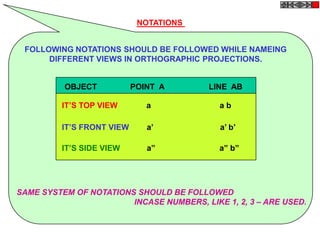
  • 189.
    Solution Steps : 1.Assume it standing on Hp but as said on apex.( inverted ). Problem 4:A square pyramid 30 mm base side 2.It’s Tv will show True Shape of base( square) 3.Draw a corner case square of 30 mm sides as Tv(as shown) and 50 mm long axis is resting on it’s apex on Hp, Showing all slant edges dotted, as those will not be visible from top. such that it’s one slant edge is vertical and a 4.taking 50 mm axis project Fv. ( a triangle) triangular face through it is perpendicular to Vp. 5.Name all points as shown in illustration. Draw it’s projections. 6.Draw 2nd Fv keeping o’a’ slant edge vertical & project it’s Tv 7.Make visible lines dark and hidden dotted, as per the procedure. 8.Then redrew 2nd Tv as final Tv keeping a1o1d1 triangular face perpendicular to Vp I.e.xy. Then as usual project final Fv. a’ b’d’ c’ a’1 d’1 b’1 c’1 X o’ o’1 Y d d1 a b o c a1 o1 b1 c1
  • 190.
    Solution Steps: Problem 5:A cube of 50 mm long 1.Assuming standing on Hp, begin with Tv,a square with all sides edges is so placed on Hp on one equally inclined to xy.Project Fv and name all points of FV & TV. corner that a body diagonal is 2.Draw a body-diagonal joining c’ with 3’( This can become // to xy) parallel to Hp and perpendicular to 3.From 1’ drop a perpendicular on this and name it p’ Vp Draw it’s projections. 4.Draw 2nd Fv in which 1’-p’ line is vertical means c’-3’ diagonal must be horizontal. .Now as usual project Tv.. 6.In final Tv draw same diagonal is perpendicular to Vp as said in problem. Then as usual project final FV. a’1 d’1 d’1 a’ b’d’ c’ 3’ c’1 3’ 1’ 1’ 1’ X d Y d1 a c a1 c1 b b1
  • 191.
    Problem 6:A tetrahedronof 50 mm Solution Steps long edges is resting on one edge on As it is resting assume it standing on Hp. Hp while one triangular face containing Begin with Tv , an equilateral triangle as side case as shown: this edge is vertical and 450 inclined to First project base points of Fv on xy, name those & axis line. Vp. Draw projections. From a’ with TL of edge, 50 mm, cut on axis line & mark o’ (as axis is not known, o’ is finalized by slant edge length) IMPORTANT: Then complete Fv. Tetrahedron is a In 2nd Fv make face o’b’c’ vertical as said in problem. special type And like all previous problems solve completely. of triangular pyramid in which base sides & o’1 slant edges are o’ equal in length. TL Solid of four faces. a’1 Like cube it is also 900 described by One X a’ b’ b’1 c’ c’1 Y dimension only.. 450 Axis length c c1 generally not given. a o a1 o1 b b1
  • 192.
    FREELY SUSPENDED SOLIDS: Positionsof CG, on axis, from base, for different solids are shown below. H CG H/2 CG H/4 GROUP A SOLIDS GROUP B SOLIDS ( Cylinder & Prisms) ( Cone & Pyramids)
  • 193.
    Solution Steps: Problem 7:A pentagonal pyramid In all suspended cases axis shows inclination with Hp. 30 mm base sides & 60 mm long axis, 1.Hence assuming it standing on Hp, drew Tv - a regular pentagon,corner case. is freely suspended from one corner of 2.Project Fv & locate CG position on axis – ( ¼ H from base.) and name g’ and base so that a plane containing it’s axis Join it with corner d’ remains parallel to Vp. 3.As 2nd Fv, redraw first keeping line g’d’ vertical. Draw it’s three views. 4.As usual project corresponding Tv and then Side View looking from. LINE d’g’ VERTICAL d” o’ d’ c’e’ e” c” FOR SIDE VIEW g’ H a’b’ a” b” g’ H/4 o” IMPORTANT: a’ b’ c’ e’ d’ Y X When a solid is freely e1 e suspended from a a1 corner, then line a d1 joining point of o do 1 contact & C.G. b b1 remains vertical. c c1 ( Here axis shows inclination with Hp.) So in all such cases, assume solid standing on Hp initially.)
  • 194.
    Solution Steps: Problem 8: 1.Assuming it standing on Hp begin with Tv, a square of corner case. A cube of 50 mm long edges is so placed 2.Project corresponding Fv.& name all points as usual in both views. on Hp on one corner that a body diagonal 3.Join a’1’ as body diagonal and draw 2nd Fv making it vertical (I’ on xy) through this corner is perpendicular to Hp 4.Project it’s Tv drawing dark and dotted lines as per the procedure. and parallel to Vp Draw it’s three views. 5.With standard method construct Left-hand side view. ( Draw a 450 inclined Line in Tv region ( below xy). Project horizontally all points of Tv on this line and reflect vertically upward, above xy.After this, draw horizontal lines, from all points of Fv, to meet these lines. Name points of intersections and join properly. a’’ For dark & dotted lines locate observer on left side of Fv as shown.) d’’ b’’ a’ b’d’ c’ c’’ X 1’ Y 1’ d d1 1’ a c a1 c1 b b
  • 195.
    Problem 9: Aright circular cone, This case resembles to problem no.7 & 9 from projections of planes topic. 40 mm base diameter and 60 mm In previous all cases 2nd inclination was done by a parameter not showing TL.Like long axis is resting on Hp on one Tv of axis is inclined to Vp etc. But here it is clearly said that the axis is 40 0 inclined point of base circle such that it’s to Vp. Means here TL inclination is expected. So the same construction done in those axis makes 450 inclination with Problems is done here also. See carefully the final Tv and inclination taken there. Hp and 400 inclination with Vp. So assuming it standing on HP begin as usual. Draw it’s projections. o’ o’1 a’1 h’1 b’1 g’1 c’1 450 f’1 d’1 X a’ h’b’ c’ g’ f’ d’ e’ e’1 y Axis True Length g g1 400 h f h1 f1 Axis Tv Length a e a1 1 e1 o1 Locus of Center 1 b1 d1 1 b d c c1 Axis Tv Length
  • 196.
    Problem 10: Atriangular prism, 40 mm base side 60 mm axis is lying on Hp on one rectangular face with axis perpendicular to Vp. One square pyramid is leaning on it’s face F.V. centrally with axis // to vp. It’s base side is 30 mm & axis is 60 mm long resting on Hp on one edge of base.Draw FV & TV of both solids.Project another FV on an AVP 450 inclined to VP. X Y 450 Steps : Draw Fv of lying prism ( an equilateral Triangle) And Fv of a leaning pyramid. T.V. Project Tv of both solids. Draw x1y1 450 inclined to xy and project aux.Fv on it. Aux.F.V. Mark the distances of first FV from first xy for the distances of aux. Fv from x1y1 line. Note the observer’s directions Shown by arrows and further steps carefully.
  • 197.
    Problem 11:A hexagonalprism of base side 30 mm longand axis 40 mm long, is standing on Hp on it’s base with one base edge // to Vp. A tetrahedron is placed centrally on the top of it.The base of tetrahedron is a triangle formed by joining alternate corners of top of prism..Draw projections of both solids. o’ Project an auxiliary Tv on AIP 450 inclined to Hp. STEPS: Draw a regular hexagon as Tv of standing prism With one side // to xy Y1 and name the top points.Project it’s Fv – a’ b’ f’ c’ e’ d’ a rectangle and name it’s top. Now join it’s alternate corners Fv a-c-e and the triangle formed is base of a tetrahedron as said. X Y Aux.Tv Locate center of this triangle e1 o1 450 & locate apex o f e Extending it’s axis line upward f1 d1 mark apex o’ By cutting TL of edge of tetrahedron equal to a-c. and complete Fv Tva o d a1 c1 of tetrahedron. Draw an AIP ( x1y1) 450 inclined to xy b1 And project Aux.Tv on it by using similar b c Steps like previous problem. X1
  • 198.
    Problem 12: Afrustum of regular hexagonal pyramid is standing on it’s larger base On Hp with one base side perpendicular to Vp.Draw it’s Fv & Tv. Project it’s Aux.Tv on an AIP parallel to one of the slant edges showing TL. Base side is 50 mm long , top side is 30 mm long and 50 mm is height of frustum. Fv AIP // to slant edge 1’ 2’5’ 3’4’ Y1 Showing true length i.e. a’- 1’ 4 5 3 1 2 X a’ b’ e’ c’ d’ Y Aux.Tv e d1 c1 d e1 Tv 5 4 X1 a1 b1 a 1 3 2 c b
  • 199.
    ENGINEERING APPLICATIONS OF THE PRINCIPLES OF PROJECTIONS OF SOLIDES. 1. SECTIONS OF SOLIDS. 2. DEVELOPMENT. 3. INTERSECTIONS. STUDY CAREFULLY THE ILLUSTRATIONS GIVEN ON NEXT SIX PAGES !
  • 200.
    SECTIONING A SOLID. The action of cutting is called An object ( here a solid ) is cut by SECTIONING a solid some imaginary cutting plane & to understand internal details of that object. The plane of cutting is called SECTION PLANE. Two cutting actions means section planes are recommended. OBSERVER A) Section Plane perpendicular to Vp and inclined to Hp. ASSUME UPPER PART ( This is a definition of an Aux. Inclined Plane i.e. A.I.P.) REMOVED NOTE:- This section plane appears (A) as a straight line in FV. B) Section Plane perpendicular to Hp and inclined to Vp. ( This is a definition of an Aux. Vertical Plane i.e. A.V.P.) NOTE:- This section plane appears (B) as a straight line in TV. Remember:- 1. After launching a section plane ASSUME LOWER PART either in FV or TV, the part towards observer REMOVED OBSERVER is assumed to be removed. 2. As far as possible the smaller part is assumed to be removed.
  • 201.
    For TV ILLUSTRATION SHOWING IMPORTANT TERMS IN SECTIONING. SECTION PLANE TRUE SHAPE Of SECTION x y Apparent Shape of section SECTION LINES (450 to XY) SECTIONAL T.V.
  • 202.
    Typical Section Planes & Typical Shapes Of Sections. Section Plane Ellipse Section PlaneTriangle Through Generators Through Apex Section Plane Parallel Section Plane Hyperbola to end generator. Parallel to Axis. Ellipse Trapezium Cylinder through Sq. Pyramid through generators. all slant edges
  • 203.
    DEVELOPMENT OF SURFACESOF SOLIDS. MEANING:- ASSUME OBJECT HOLLOW AND MADE-UP OF THIN SHEET. CUT OPEN IT FROM ONE SIDE AND UNFOLD THE SHEET COMPLETELY. THEN THE SHAPE OF THAT UNFOLDED SHEET IS CALLED DEVELOPMENT OF LATERLAL SUEFACES OF THAT OBJECT OR SOLID. LATERLAL SURFACE IS THE SURFACE EXCLUDING SOLID’S TOP & BASE. ENGINEERING APLICATION: THERE ARE SO MANY PRODUCTS OR OBJECTS WHICH ARE DIFFICULT TO MANUFACTURE BY CONVENTIONAL MANUFACTURING PROCESSES, BECAUSE OF THEIR SHAPES AND SIZES. THOSE ARE FABRICATED IN SHEET METAL INDUSTRY BY USING DEVELOPMENT TECHNIQUE. THERE IS A VAST RANGE OF SUCH OBJECTS. EXAMPLES:- Boiler Shells & chimneys, Pressure Vessels, Shovels, Trays, Boxes & Cartons, Feeding Hoppers, Large Pipe sections, Body & Parts of automotives, Ships, Aeroplanes and many more. WHAT IS To learn methods of development of surfaces of OUR OBJECTIVE different solids, their sections and frustums. IN THIS TOPIC ? 1. Development is different drawing than PROJECTIONS. But before going ahead, 2. It is a shape showing AREA, means it’s a 2-D plain drawing. note following 3. Hence all dimensions of it must be TRUE dimensions. Important points. 4. As it is representing shape of an un-folded sheet, no edges can remain hidden And hence DOTTED LINES are never shown on development. Study illustrations given on next page carefully.
  • 204.
    Development of lateralsurfaces of different solids. (Lateral surface is the surface excluding top & base) Cylinder: A Rectangle Pyramids: (No.of triangles) Cone: (Sector of circle) H D D H= Height D= base diameter  Prisms: No.of Rectangles R=Base circle radius. L= Slant edge. L=Slant height. S = Edge of base  R 3600 =L H S S H= Height S = Edge of base Cube: Six Squares. Tetrahedron: Four Equilateral Triangles All sides equal in length
  • 205.
    FRUSTUMS DEVELOPMENT OF DEVELOPMENT OF FRUSTUM OF CONE FRUSTUM OF SQUARE PYRAMID Base side Top side   = R 3600 L R= Base circle radius of cone L= Slant height of cone L= Slant edge of pyramid L1 = Slant height of cut part. L1 = Slant edge of cut part. STUDY NEXT NINE PROBLEMS OF SECTIONS & DEVELOPMENT
  • 206.
    Problem 1: Apentagonal prism , 30 mm base side & 50 mm axis Solution Steps:for sectional views: is standing on Hp on it’s base whose one side is perpendicular to Vp. Draw three views of standing prism. It is cut by a section plane 450 inclined to Hp, through mid point of axis. Locate sec.plane in Fv as described. Draw Fv, sec.Tv & sec. Side view. Also draw true shape of section and Project points where edges are getting Development of surface of remaining solid. Cut on Tv & Sv as shown in illustration. C Join those points in sequence and show B Section lines in it. D Make remaining part of solid dark. Y1 A A B C D E E A d” c” X1 e” b” X a” Y e DEVELOPMENT d For True Shape: a For Development: Draw x1y1 // to sec. plane Draw development of entire solid. Name from Draw projectors on it from c cut-open edge I.e. A. in sequence as shown. cut points. b Mark the cut points on respective edges. Mark distances of points Join them in sequence in st. lines. of Sectioned part from Tv, Make existing parts dev.dark. on above projectors from x1y1 and join in sequence. Draw section lines in it. It is required true shape.
  • 207.
    Problem 2: Acone, 50 mm base diameter and 70 mm axis is Solution Steps:for sectional views: standing on it’s base on Hp. It cut by a section plane 450 inclined Draw three views of standing cone. to Hp through base end of end generator.Draw projections, Locate sec.plane in Fv as described. sectional views, true shape of section and development of surfaces Project points where generators are of remaining solid. getting Cut on Tv & Sv as shown in illustration.Join those points in sequence and show Section lines in it. Make remaining part of solid dark. Y1 A SECTIONAL S.V o’ B DEVELOPMENT C D X1 E X a’ h’b’ c’ g’ f’ d’ e’ Y g” h”f” a”e” b”d” c” F g For True Shape: h G f Draw x1y1 // to sec. plane Draw projectors on it from For Development: H cut points. a e Draw development of entire solid. Mark distances of points Name from cut-open edge i.e. A. A of Sectioned part from Tv, in sequence as shown.Mark the cut on above projectors from b d points on respective edges. x1y1 and join in sequence. c Join them in sequence in curvature. Draw section lines in it. SECTIONAL T.V Make existing parts dev.dark. It is required true shape.
  • 208.
    Problem 3: Acone 40mm diameter and 50 mm axis is resting on one generator on Hp( lying on Hp) which is // to Vp.. Draw it‟s projections.It is cut by a horizontal section plane through it‟s base center. Draw sectional TV, development of the surface of the remaining part of cone. Follow similar solution steps for Sec.views - True shape – Development as per previous problem! o’ DEVELOPMENT A B HORIZONTAL SECTION PLANE C D X a’ h’b’ c’ g’ f’ d’ e’ o’ Y g O E g1 h f f1 h1 F a e e1 a1 o1 G O H b d d1 b1 c A c1 SECTIONAL T.V (SHOWING TRUE SHAPE OF SECTION)
  • 209.
    Note the stepsto locate Problem 4: A hexagonal prism. 30 mm base side & Points 1, 2 , 5, 6 in sec.Fv: 55 mm axis is lying on Hp on it’s rect.face with axis Those are transferred to // to Vp. It is cut by a section plane normal to Hp and 1st TV, then to 1st Fv and 300 inclined to Vp bisecting axis. a’ b’ c’ f’ d’ e’ Then on 2nd Fv. Draw sec. Views, true shape & development. 3 SECTIONAL F.V. 4 Use similar steps for sec.views & true shape. NOTE: for development, always cut open object from 2 5 From an edge in the boundary of the view in which sec.plane appears as a line. Here it is Tv and in boundary, there is c1 edge.Hence 1 6 it is opened from c and named C,D,E,F,A,B,C. X Y 8 7 f f1 e a1 e1 a A.V.P300 inclined to Vp Through mid-point of axis. b d b1 d1 AS SECTION PLANE IS IN T.V., c X1 c1 CUT OPEN FROM BOUNDRY EDGE C1 FOR DEVELOPMENT. C D E F A B C Y1 DEVELOPMENT
  • 210.
    Problem 5:A solidcomposed of a half-cone and half- hexagonal pyramid is 3 shown in figure.It is cut by a section plane 45 0 inclined to Hp, passing through 2 mid-point of axis.Draw F.v., sectional T.v.,true shape of section and 4 development of remaining part of the solid. Y1 ( take radius of cone and each side of hexagon 30mm long and axis 70mm.) 5 1 O’ Note: 6 A Fv & TV 8f two solids sandwiched 7 B Section lines style in both: Development of 4’ half cone & half pyramid: 3’ X1 5’ F.V. C 2’ 6’ 4 2 3 1 D 1’ 7’ X Y d’e’ c’f’ g’b’ a’ O f E g 7 6 e 5 SECTIONAL 7 4 5 6 4 TOP VIEW. a F 1 3 d 2 b G c A
  • 211.
    Problem 6: Drawa semicircle 0f 100 mm diameter and inscribe in it a largest TO DRAW PRINCIPAL circle.If the semicircle is development of a cone and inscribed circle is some VIEWS FROM GIVEN curve on it, then draw the projections of cone showing that curve. DEVELOPMENT. E D F o’ R=Base circle radius. 4 L=Slant height. 3 5  = R 3600 C L G 1’ 7’ 2 6 B H 6’ 2’ 1 3’ 5’ 4’  7 X a’ h’ b’ c’ g’ d’f’ e’ Y A A O g L 6 h f Solution Steps: 5 Draw semicircle of given diameter, divide it in 8 Parts and inscribe in it a largest circle as shown.Name intersecting points 1, 2, 3 etc. a 7 o Semicircle being dev.of a cone it’s radius is slant height of cone.( L ) 4 e Then using above formula find R of base of cone. Using this data 1 draw Fv & Tv of cone and form 8 generators and name. Take o -1 distance from dev.,mark on TL i.e.o’a’ on Fv & bring on o’b’ b 3 d and name 1’ Similarly locate all points on Fv. Then project all on Tv 2 on respective generators and join by smooth curve. c
  • 212.
    Problem 7:Draw asemicircle 0f 100 mm diameter and inscribe in it a largest TO DRAW PRINCIPAL rhombus.If the semicircle is development of a cone and rhombus is some curve VIEWS FROM GIVEN on it, then draw the projections of cone showing that curve. DEVELOPMENT. Solution Steps: o’ Similar to previous Problem: E D F C G 2’ 6’ B H 3’ 5’ a’ h’ b’ c’ g’ f’ d’ e’  X 1’ 7’ 4’ Y g A A O L 7 6 h f 5 R=Base circle radius. L=Slant height. a 4 e  = R 3600 L b 3 d 2 1 c
  • 213.
    Problem 8: Ahalf cone of 50 mm base diameter, 70 mm axis, is standing on it’s half base on HP with it’s flat face parallel and nearer to VP.An inextensible string is wound round it’s surface from one point of base circle and brought back to the same point.If the string is of shortest length, find it and show it on the projections of the cone. TO DRAW A CURVE ON PRINCIPAL VIEWS FROM DEVELOPMENT. Concept: A string wound from a point up to the same o’ Point, of shortest length A Must appear st. line on it’s Development. B Solution steps: Hence draw development, 1 C Name it as usual and join 3’ A to A This is shortest 2’ 4’ Length of that string. D 1’ 2 Further steps are as usual. 3 On dev. Name the points of Intersections of this line with X Y 4 E a’ b’ c’ d’ e’ Different generators.Bring O Those on Fv & Tv and join a o 4 e by smooth curves. Draw 4’ a’ part of string dotted 3 As it is on back side of cone. 1 2 b d c A
  • 214.
    Problem 9: A particle which is initially on base circle of a cone, standing on Hp, moves upwards and reaches apex in one complete turn around the cone. Draw it’s path on projections of cone as well as on it’s development. Take base circle diameter 50 mm and axis 70 mm long. It‟s a construction of curve o’ Helix of one turn on cone: 7’ DEVELOPMENT Draw Fv & Tv & dev.as usual HELIX CURVE 6’ On all form generators & name. A Construction of curve Helix:: 5’ 4’ B Show 8 generators on both views 3’ Divide axis also in same parts. 2’ 1 Draw horizontal lines from those 1’ C points on both end generators. X Y 2 1’ is a point where first horizontal a’ h’b’ c’ g g’ f’ d’ e’ D Line & gen. b’o’ intersect. 3 2’ is a point where second horiz. h f O 4 E Line & gen. c’o’ intersect. 7 6 6 5 In this way locate all points on Fv. 5 a 7 F Project all on Tv.Join in curvature. O e For Development: 4 Then taking each points true 3 G b 1 d Distance From resp.generator 2 from apex, Mark on development c H & join. A
  • 215.
    INTERPENETRATION OF SOLIDS WHEN ONE SOLID PENETRATES ANOTHER SOLID THEN THEIR SURFACES INTERSECT AND AT THE JUNCTION OF INTERSECTION A TYPICAL CURVE IS FORMED, WHICH REMAINS COMMON TO BOTH SOLIDS. THIS CURVE IS CALLED CURVE OF INTERSECTION AND IT IS A RESULT OF INTERPENETRATION OF SOLIDS. PURPOSE OF DRAWING THESE CURVES:- WHEN TWO OBJECTS ARE TO BE JOINED TOGATHER, MAXIMUM SURFACE CONTACT BETWEEN BOTH BECOMES A BASIC REQUIREMENT FOR STRONGEST & LEAK-PROOF JOINT. Curves of Intersections being common to both Intersecting solids, show exact & maximum surface contact of both solids. Study Following Illustrations Carefully. Minimum Surface Contact. ( Point Contact) (Maximum Surface Contact) Lines of Intersections. Curves of Intersections. Square Pipes. Circular Pipes. Square Pipes. Circular Pipes.
  • 216.
    SOME ACTUAL OBJECTSARE SHOWN, SHOWING CURVES OF INTERSECTIONS. BY WHITE ARROWS. A machine component having An Industrial Dust collector. Intersection of a Cylindrical two intersecting cylindrical Intersection of two cylinders. main and Branch Pipe. surfaces with the axis at acute angle to each other. Pump lid having shape of a Two Cylindrical hexagonal Prism and A Feeding Hopper Forged End of a surfaces. Hemi-sphere intersecting In industry. Connecting Rod. each other.
  • 217.
    FOLLOWING CASES ARESOLVED. COMMON SOLUTION STEPS REFFER ILLUSTRATIONS One solid will be standing on HP AND Other will penetrate horizontally. NOTE THE COMMON CONSTRUCTION Draw three views of standing solid. FOR ALL Name views as per the illustrations. Beginning with side view draw three 1.CYLINDER TO CYLINDER2. Views of penetrating solids also. On it’s S.V. mark number of points 2.SQ.PRISM TO CYLINDER And name those(either letters or nos.) The points which are on standard 3.CONE TO CYLINDER generators or edges of standing solid, ( in S.V.) can be marked on respective 4.TRIANGULAR PRISM TO CYLNDER generators in Fv and Tv. And other 5.SQ.PRISM TO SQ.PRISM points from SV should be brought to Tv first and then projecting upward 6.SQ.PRISM TO SQ.PRISM To Fv. ( SKEW POSITION) Dark and dotted line’s decision should 7.SQARE PRISM TO CONE ( from top ) be taken by observing side view from it’s right side as shown by arrow. 8.CYLINDER TO CONE Accordingly those should be joined by curvature or straight lines. Note: Incase cone is penetrating solid Side view is not necessary. Similarly in case of penetration from top it is not required.
  • 218.
    Problem: A cylinder50mm dia.and 70mm axis is completely penetrated CASE 1. by another of 40 mm dia.and 70 mm axis horizontally Both axes intersect CYLINDER STANDING & bisect each other. Draw projections showing curves of intersections. & CYLINDER PENETRATING 1’ 2’ 4’ 3’ 4” 1”3” 2” a’ a” b ’h’ h” b” c’g’ g” c” d’f’ f” d” a’ e” X Y 4 1 3 2
  • 219.
    Problem: A cylinder50mm dia.and 70mm axis is completely penetrated CASE 2. by a square prism of 25 mm sides.and 70 mm axis, horizontally. Both axes CYLINDER STANDING Intersect & bisect each other. All faces of prism are equally inclined to Hp. & Draw projections showing curves of intersections. SQ.PRISM PENETRATING 1’ 2’ 4’ 3’ 4” 1”3” 2” a’ a’ a” b’ b’ d” b” d’ d’ c’ c’ c” X Y 4 1 3 2
  • 220.
    Problem: A cylinderof 80 mm diameter and 100 mm axis CASE 3. is completely penetrated by a cone of 80 mm diameter and CYLINDER STANDING 120 mm long axis horizontally.Both axes intersect & bisect & each other. Draw projections showing curve of intersections. CONE PENETRATING 7’ 6’ 8’ 1’ 5’ 2’ 4’ 3’ X Y 1 28 37 46 5
  • 221.
    Problem: A sq.prism30 mm base sides.and 70mm axis is completely penetrated CASE 4. by another square prism of 25 mm sides.and 70 mm axis, horizontally. Both axes SQ.PRISM STANDING Intersects & bisect each other. All faces of prisms are equally inclined to Vp. & Draw projections showing curves of intersections. SQ.PRISM PENETRATING 1’ 2’4’ 3’ 4” 1”3” 2” a’ a’ a” b’ b’ d” b” d’ d’ c’ c’ c” X Y 4 1 3 2
  • 222.
    Problem: A cylinder50mm dia.and 70mm axis is completely penetrated by a triangular prism of 45 mm sides.and 70 mm axis, horizontally. One flat face of prism is parallel to Vp and Contains axis of cylinder. Draw projections showing curves of intersections. CASE 5. CYLINDER STANDING & TRIANGULAR PRISM PENETRATING 1’ 2’4’ 3’ 4” 1” 3” 2” a a a b b b c c d e e d e f f f X Y 4 1 3 2
  • 223.
    Problem: A sq.prism30 mm base sides.and 70mm axis is CASE 6. completely penetrated by another square prism of 25 mm side SQ.PRISM STANDING s.and 70 mm axis, horizontally. Both axes Intersect & bisect & each other.Two faces of penetrating prism are 300 inclined to Hp. SQ.PRISM PENETRATING Draw projections showing curves of intersections. (300 SKEW POSITION) 1’ 2’4’ 3’ 4” 1”3” 2” a’ f’ f” e’ b’ c’ c” d’ X 300 Y 4 1 3 2
  • 224.
    CASE 7. CONE STANDING & SQ.PRISM PENETRATING (BOTH AXES VERTICAL) 2’ 1’ 3’ 5’ 4’ 6’ X a’ b’h’ c’g’ d’f’ e’ Y g h 8 f 9 7 10 Problem: A cone70 mm base diameter and 90 mm axis 6 a 1 e is completely penetrated by a square prism from top 2 with it’s axis // to cone’s axis and 5 mm away from it. 3 5 a vertical plane containing both axes is parallel to Vp. 4 Take all faces of sq.prism equally inclined to Vp. b d Base Side of prism is 0 mm and axis is 100 mm long. c Draw projections showing curves of intersections. 5 mm OFF-SET
  • 225.
    Problem: A verticalcone, base diameter 75 mm and axis 100 mm long, CASE 8. is completely penetrated by a cylinder of 45 mm diameter. The axis of the CONE STANDING cylinder is parallel to Hp and Vp and intersects axis of the cone at a point & 28 mm above the base. Draw projections showing curves of intersection. CYLINDER PENETRATING o’ o” 1 1 2 8,2 8 1 2 7 3 3 3 7, 4 64 6 4 5 5 5 X a’ b’h’ c’g’ d’f’ e’ g” g”h” a”e” b”d” c” Y g h f a e b d c
  • 226.
    ISOMETRIC DRAWING TYPICAL CONDITION. IT IS A TYPE OF PICTORIAL PROJECTION IN THIS 3-D DRAWING OF AN OBJECT, IN WHICH ALL THREE DIMENSIONS OF ALL THREE DIMENSIONAL AXES ARE AN OBJECT ARE SHOWN IN ONE VIEW AND MENTAINED AT EQUAL INCLINATIONS IF REQUIRED, THEIR ACTUAL SIZES CAN BE WITH EACH OTHER.( 1200) MEASURED DIRECTLY FROM IT. 3-D DRAWINGS CAN BE DRAWN NOW OBSERVE BELOW GIVEN DRAWINGS. IN NUMEROUS WAYS AS SHOWN BELOW. ONE CAN NOTE SPECIFIC INCLINATION ALL THESE DRAWINGS MAY BE CALLED AMONG H, L & D AXES. 3-DIMENSIONAL DRAWINGS, ISO MEANS SAME, SIMILAR OR EQUAL. OR PHOTOGRAPHIC HERE ONE CAN FIND OR PICTORIAL DRAWINGS. EDUAL INCLINATION AMONG H, L & D AXES. HERE NO SPECIFIC RELATION EACH IS 1200 INCLINED WITH OTHER TWO. AMONG H, L & D AXES IS MENTAINED. HENCE IT IS CALLED ISOMETRIC DRAWING L H H H PURPOSE OF ISOMETRIC DRAWING IS TO UNDERSTAND OVERALL SHAPE, SIZE & APPEARANCE OF AN OBJECT PRIOR TO IT‟S PRODUCTION.
  • 227.
    SOME IMPORTANT TERMS: ISOMETRICAXES, LINES AND PLANES: The three lines AL, AD and AH, meeting at point A and making 1200 angles with each other are termed Isometric Axes. A The lines parallel to these axes are called Isometric Lines. The planes representing the faces of of the cube as well as H other planes parallel to these planes are called Isometric Planes. ISOMETRIC SCALE: When one holds the object in such a way that all three dimensions are visible then in the process all dimensions become proportionally inclined to observer‟s eye sight and hence appear apparent in lengths. This reduction is 0.815 or 9 / 11 ( approx.) It forms a reducing scale which Is used to draw isometric drawings and is called Isometric scale. In practice, while drawing isometric projection, it is necessary to convert true lengths into isometric lengths for measuring and marking the sizes. This is conveniently done by constructing an isometric scale as described on next page.
  • 228.
    TYPES OF ISOMETRICDRAWINGS ISOMETRIC VIEW ISOMETRIC PROJECTION Drawn by using True scale Drawn by using Isometric scale ( True dimensions ) ( Reduced dimensions ) D 4 3 H 2 C H 4 1 3 2 CONSTRUCTION OF ISOM.SCALE. 0 From point A, with line AB draw 300 and 1 450 inclined lines AC & AD resp on AD. 450 Mark divisions of true length and from 0 300 A B each division-point draw vertical lines Isometric scale [ Line AC ] upto AC line. The divisions thus obtained on AC required for Isometric Projection give lengths on isometric scale.
  • 229.
    1 Isometric view if the Shape is ISOMETRIC SHAPE OF F.V. or T.V. D PLANE FIGURES H RECTANGLE D A D A AS THESE ALL ARE C 2-D FIGURES C WE REQUIRE ONLY TWO A ISOMETRIC AXES. B C B B IF THE FIGURE IS B H FRONT VIEW, H & L TRIANGLE B AXES ARE REQUIRED. 1 3 B 1 3 IF THE FIGURE IS TOP A A VIEW, D & L AXES ARE 3 1 REQUIRED. 2 A 2 2 Shapes containing 4 Inclined lines should PENTAGON H E be enclosed in a 1 E 4 1 D 4 rectangle as shown. D Then first draw isom. A D A E of that rectangle and 1 3 then inscribe that 3 A C C shape as it is. 2 B B C 3 B 2 2
  • 230.
    STUDY 2 Z ILLUSTRATIONS DRAW ISOMETRIC VIEW OF A CIRCLE IF IT IS A TV OR FV. FIRST ENCLOSE IT IN A SQUARE. IT‟S ISOMETRIC IS A RHOMBUS WITH D & L AXES FOR TOP VIEW. THEN USE H & L AXES FOR ISOMETRIC WHEN IT IS FRONT VIEW. FOR CONSTRUCTION USE RHOMBUS METHOD SHOWN HERE. STUDY IT. 2 A B 3 4 D C 1
  • 231.
    3 STUDY Z ILLUSTRATIONS 25 R DRAW ISOMETRIC VIEW OF THE FIGURE SHOWN WITH DIMENTIONS (ON RIGHT SIDE) CONSIDERING IT FIRST AS F.V. AND THEN T.V. 50 MM IF FRONT VIEW 100 MM IF TOP VIEW
  • 232.
    ISOMETRIC SHAPE IF F.V. IF T.V. 4 OF PLANE FIGURES HEXAGON AS THESE ALL ARE 2-D FIGURES WE REQUIRE ONLY TWO ISOMETRIC AXES. CIRCLE IF THE FIGURE IS FRONT VIEW, H & L AXES ARE REQUIRED. IF THE FIGURE IS TOP VIEW, D & L For Isometric of Circle/Semicircle use Rhombus method. Construct Rhombus AXES ARE REQUIRED. of sides equal to Diameter of circle always. ( Ref. topic ENGG. CURVES.) SEMI CIRCLE For Isometric of Circle/Semicircle use Rhombus method. Construct it of sides equal to diameter of circle always. ( Ref. Previous two pages.)
  • 233.
    5 STUDY Z ILLUSTRATIONS ISOMETRIC VIEW OF PENTAGONAL PYRAMID STANDING ON H.P. (Height is added from center of pentagon) ISOMETRIC VIEW OF BASE OF PENTAGONAL PYRAMID STANDING ON H.P. 4 4 D D E E 1 3 1 3 A C A C B 2 B 2
  • 234.
    6 STUDY Z ILLUSTRATIONS ISOMETRIC VIEW OF PENTAGONALL PRISM LYING ON H.P. 4 H E 1 D A 3 C B 2 ISOMETRIC VIEW OF HEXAGONAL PRISM STANDING ON H.P.
  • 235.
    7 STUDY Z ILLUSTRATIONS CYLINDER STANDING ON H.P. CYLINDER LYING ON H.P.
  • 236.
    8 STUDY Z HALF CYLINDER ILLUSTRATIONS STANDING ON H.P. ( ON IT’S SEMICIRCULAR BASE) HALF CYLINDER LYING ON H.P. ( with flat face // to H.P.)
  • 237.
    9 ISOMETRIC VIEW OF STUDY Z A FRUSTOM OF SQUARE PYRAMID ILLUSTRATIONS STANDING ON H.P. ON IT’S LARGER BASE. 60 FV X Y 40 20 TV
  • 238.
    STUDY 10 ILLUSTRATION PROJECTIONS OF FRUSTOM OF ISOMETRIC VIEW PENTAGONAL PYRAMID ARE GIVEN. OF FRUSTOM OF PENTAGONAL PYRAMID DRAW IT‟S ISOMETRIC VIEW. SOLUTION STEPS: 60 FV FIRST DRAW ISOMETRIC OF IT‟S BASE. x y THEN DRAWSAME SHAPE E AS TOP, 60 MM ABOVE THE 1 4 BASE PENTAGON CENTER. A THEN REDUCE THE TOP TO 20 MM SIDES AND JOIN WITH TV 40 20 D THE PROPER BASE CORNERS. B 2 3 C
  • 239.
    ISOMETRIC VIEW OF 11 STUDY A FRUSTOM OF CONE Z ILLUSTRATIONS STANDING ON H.P. ON IT’S LARGER BASE. 60 FV X Y 40 20 TV
  • 240.
    PROBLEM: A SQUAREPYRAMID OF 30 MM BASE SIDES AND 12 STUDY 50 MM LONG AXIS, IS CENTRALLY PLACED ON THE TOP OF A Z ILLUSTRATIONS CUBE OF 50 MM LONG EDGES.DRAW ISOMETRIC VIEW OF THE PAIR.
  • 241.
    13 STUDY Z ILLUSTRATIONS c PROBLEM: A TRIANGULAR PYRAMID OF 30 MM BASE SIDES AND 50 MM a LONG AXIS, IS CENTRALLY PLACED o ON THE TOP OF A CUBE OF 50 MM p a LONG EDGES. b DRAW ISOMETRIC VIEW OF THE PAIR. o c p b SOLUTION HINTS. TO DRAW ISOMETRIC OF A CUBE IS SIMPLE. DRAW IT AS USUAL. BUT FOR PYRAMID AS IT’S BASE IS AN EQUILATERAL TRIANGLE, IT CAN NOT BE DRAWN DIRECTLY.SUPPORT OF IT’S TV IS REQUIRED. SO DRAW TRIANGLE AS A TV, SEPARATELY AND NAME VARIOUS POINTS AS SHOWN. AFTER THIS PLACE IT ON THE TOP OF CUBE AS SHOWN. THEN ADD HEIGHT FROM IT’S CENTER AND COMPLETE IT’S ISOMETRIC AS SHOWN.
  • 242.
    14 STUDY PROBLEM: Z ILLUSTRATIONS A SQUARE PLATE IS PIERCED THROUGH CENTRALLY BY A CYLINDER WHICH COMES OUT EQUALLY FROM BOTH FACES OF PLATE. IT‟S FV & TV ARE SHOWN. DRAW ISOMETRIC VIEW. FV 30 10 30 30 D 50 + 50 TV
  • 243.
    15 STUDY PROBLEM: Z ILLUSTRATIONS A CIRCULAR PLATE IS PIERCED THROUGH CENTRALLY BY A SQUARE PYRAMID WHICH COMES OUT EQUALLY FROM BOTH FACES OF PLATE. IT‟S FV & TV ARE SHOWN. DRAW ISOMETRIC VIEW. FV 30 10 30 40 SQUARE 60 D TV
  • 244.
    16 STUDY Z F.V. & T.V. of an object are given. Draw it‟s isometric view. ILLUSTRATIONS 10 20 40 FV 40 X Y TV 50 D 30 D
  • 245.
    STUDY Z ILLUSTRATIONS ISOMETRIC PROJECTIONS OF SPHERE & HEMISPHERE 17 450 r 300 R r r Isom. Scale P C r r R C R TO DRAW ISOMETRIC PROJECTION R OF A HEMISPHERE P r P Adopt same procedure. C = Center of Sphere. Draw lower semicircle only. Then around „C‟ construct P = Point of contact Rhombus of Sides equal to R = True Radius of Sphere Isometric Diameter. r = Isometric Radius. For this use iso-scale. Then construct ellipse in TO DRAW ISOMETRIC PROJECTION OF A SPHERE this Rhombus as usual 1. FIRST DRAW ISOMETRIC OF SQUARE PLATE. And Complete 2. LOCATE IT‟S CENTER. NAME IT P. Isometric-Projection 3. FROM PDRAW VERTICAL LINE UPWARD, LENGTH „ r mm‟ of Hemi-sphere. AND LOCATE CENTER OF SPHERE “C” 4. „C‟ AS CENTER, WITH RADIUS „R‟ DRAW CIRCLE. THIS IS ISOMETRIC PROJECTION OF A SPHERE.
  • 246.
    PROBLEM: 18 A HEMI-SPHERE IS CENTRALLY PLACED STUDY ON THE TOP OF A FRUSTOM OF CONE. Z ILLUSTRATIONS DRAW ISOMETRIC PROJECTIONS OF THE ASSEMBLY. r 50 D R r 30 D r 50 P 50 D FIRST CONSTRUCT ISOMETRIC SCALE. USE THIS SCALE FOR ALL DIMENSIONS IN THIS PROBLEM. 450 300
  • 247.
    19 STUDY A SQUARE PYRAMID OF 40 MM BASE SIDES AND 60 MM AXIS Z ILLUSTRATIONS IS CUT BY AN INCLINED SECTION PLANE THROUGH THE MID POINT OF AXIS AS SHOWN.DRAW ISOMETRIC VIEW OF SECTION OF PYRAMID. 3’ 4’ 4 3 1’2’ X Y 1 a d 1 4 2 o 3 b 2 c
  • 248.
    20 STUDY Z F.V. & T.V. of an object are given. Draw it‟s isometric view. ILLUSTRATIONS 50 O X Y 20 25 O 25 20
  • 249.
    21 STUDY Z F.V. & T.V. of an object are given. Draw it‟s isometric view. ILLUSTRATIONS 35 FV 35 10 x y O 10 20 30 40 70 TV O
  • 250.
    22 STUDY Z F.V. & T.V. and S.V.of an object are given. Draw it‟s isometric view. ILLUSTRATIONS FV 30 10 30 SV 30 10 30 x y ALL VIEWS IDENTICAL TV
  • 251.
    24 STUDY Z F.V. & T.V. and S.V.of an object are given. Draw it‟s isometric view. ILLUSTRATIONS ALL VIEWS IDENTICAL FV SV x y 10 40 60 40 TV 60
  • 252.
    F.V. & T.V.and S.V.of an object are given. Draw it‟s isometric view. 25 STUDY Z ILLUSTRATIONS ALL VIEWS IDENTICAL FV SV x y 10 40 60 40 TV 60
  • 253.
    26 STUDY Z ILLUSTRATIONS F.V. & T.V. and S.V.of an object are given. Draw it‟s isometric view. ORTHOGRAPHIC PROJECTIONS FRONT VIEW L.H.SIDE VIEW 20 20 20 x y O 50 20 30 O 20 20 20 TOP VIEW
  • 254.
    27 STUDY Z ILLUSTRATIONS F.V. and S.V.of an object are given. Draw it‟s isometric view. 30 SQUARE 40 20 50 20 10 O 30 60 F.V. S.V. O
  • 255.
    28 STUDY Z ILLUSTRATIONS F.V. & T.V. of an object are given. Draw it‟s isometric view. FV 40 10 O 30 D 45 10 50 O 80 TV
  • 256.
    29 STUDY F.V. & T.V. of an object are given. Draw it‟s isometric view. Z ILLUSTRATIONS FV 40 X O 10 Y 100 10 25 TV 10 30 10 25 30 R O 20 D
  • 257.
    30 STUDY F.V. & T.V. of an object are given. Draw it‟s isometric view. Z ILLUSTRATIONS 30 FV RECT. SLOT 10 50 35 10 X Y O 20 D TV 60 D 30 D O
  • 258.
    31 STUDY Z ILLUSTRATIONS F.V. and S.V.of an object are given. Draw it‟s isometric view. 10 25 15 25 40 10 25 25 O O 80 25 F.V. S.V.
  • 259.
    F.V. & T.V.of an object are given. Draw it‟s isometric view. 32 STUDY Z ILLUSTRATIONS 450 30 FV 40 X Y O 30 D 40 TV 15 O 40
  • 260.
    33 STUDY Z ILLUSTRATIONS F.V. and S.V.of an object are given. Draw it‟s isometric view. HEX PART 30 20 20 40 20 O 50 20 15 O 30 100 60
  • 261.
    34 STUDY F.V. & T.V. of an object are given. Draw it‟s isometric view. Z ILLUSTRATIONS 20 40 F.V. 30 10 X Y O 10 30 10 30 O 80 T.V.
  • 262.
    F.V. and S.V.ofan object are given. 35 Draw it‟s isometric view. 10 10 15 STUDY Z ILLUSTRATIONS 25 25 X Y O 50 10 FV LSV 36 NOTE THE SMALL CHZNGE IN 2ND FV & SV. DRAW ISOMETRIC ACCORDINGLY. 10 X Y O FV LSV
  • 263.
    37 STUDY Z ILLUSTRATIONS F.V. and S.V.of an object are given. Draw it‟s isometric view. 30 20 10 20 15 10 15 O 15 30 15 X O Y 50 F.V. LEFT S.V.
  • 264.
    38 STUDY Z ILLUSTRATIONS F.V. and S.V.of an object are given. Draw it‟s isometric view. 30 10 60 30 O O 40 40 F.V. S.V.
  • 265.
    EXERCISES: PROJECTIONS OF STRAIGHTLINES 1. A line AB is in first quadrant. Its ends A and B are 25mm and 65mm in front of VP respectively. The distance between the end projectors is 75mm. The line is inclined at 30 0 to VP and its VT is 10mm above HP. Draw the projections of AB and determine its true length and HT and inclination with HP. 2. A line AB measures 100mm. The projections through its VT and end A are 50mm apart. The point A is 35mm above HP and 25mm in front VP. The VT is 15mm above HP. Draw the projections of line and determine its HT and Inclinations with HP and VP. 3. Draw the three views of line AB, 80mm long, when it is lying in profile plane and inclined at 350 to HP. Its end A is in HP and 20mm in front of VP, while other end B is in first quadrant. Determine also its traces. 4. A line AB 75 mm long, has its one end A in VP and other end B 15mm above HP and 50mm in front of VP. Draw the projections of line when sum of inclinations with HP and VP is 900. Determine the true angles of inclination and show traces. 5. A line AB is 75mm long and lies in an auxiliary inclined plane (AIP) which makes an angle of 450 with the HP. The front view of the line measures 55mm. The end A is in VP and 20mm above HP. Draw the projections of the line AB and find its inclination with HP and VP. 6. Line AB lies in an AVP 500 inclined to Vp while line is 300 inclined to Hp. End A is 10 mm above Hp. & 15 mm in front of Vp.Distance between projectors is 50 mm.Draw projections and find TL and inclination of line with Vp. Locate traces also.
  • 266.
    APPLICATIONS OF LINES Room, compound wall cases 7) A room measures 8m x 5m x4m high. An electric point hang in the center of ceiling and 1m below it. A thin straight wire connects the point to the switch in one of the corners of the room and 2m above the floor. Draw the projections of the and its length and slope angle with the floor. 8) A room is of size 6m5m3.5m high. Determine graphically the real distance between the top corner and its diagonally apposite bottom corners. consider appropriate scale 9) Two pegs A and B are fixed in each of the two adjacent side walls of the rectangular room 3m x 4m sides. Peg A is 1.5m above the floor, 1.2m from the longer side wall and is protruding 0.3m from the wall. Peg B is 2m above the floor, 1m from other side wall and protruding 0.2m from the wall. Find the distance between the ends of the two pegs. Also find the height of the roof if the shortest distance between peg A and and center of the ceiling is 5m. 10) Two fan motors hang from the ceiling of a hall 12m x 5m x 8m high at heights of 4m and 6m respectively. Determine graphically the distance between the motors. Also find the distance of each motor from the top corner joining end and front wall. 11) Two mangos on a two tree are 2m and 3m above the ground level and 1.5m and 2.5m from a 0.25m thick wall but on apposite sides of it. Distances being measured from the center line of the wall. The distance between the apples, measured along ground and parallel to the wall is 3m. Determine the real distance between the ranges.
  • 267.
    POLES,ROADS, PIPE LINES,,NORTH- EAST-SOUTH WEST, SLOPE AND GRADIENT CASES. 12)Three vertical poles AB, CD and EF are lying along the corners of equilateral triangle lying on the ground of 100mm sides. Their lengths are 5m, 8m and 12m respectively. Draw their projections and find real distance between their top ends. 13) A straight road going up hill from a point A due east to another point B is 4km long and has a slop of 250. Another straight road from B due 300 east of north to a point C is also 4 kms long but going downward and has slope of 150. Find the length and slope of the straight road connecting A and C. 14) An electric transmission line laid along an uphill from the hydroelectric power station due west to a substation is 2km long and has a slop of 300. Another line from the substation, running W 450 N to village, is 4km long and laid on the ground level. Determine the length and slope of the proposed telephone line joining the the power station and village. 15) Two wire ropes are attached to the top corner of a 15m high building. The other end of one wire rope is attached to the top of the vertical pole 5m high and the rope makes an angle of depression of 45 0. The rope makes 300 angle of depression and is attached to the top of a 2m high pole. The pole in the top view are 2m apart. Draw the projections of the wire ropes. 16) Two hill tops A and B are 90m and 60m above the ground level respectively. They are observed from the point C, 20m above the ground. From C angles and elevations for A and B are 45 0 and 300 respectively. From B angle of elevation of A is 450. Determine the two distances between A, B and C.
  • 268.
    PROJECTIONS OF PLANES:- 1.A thin regular pentagon of 30mm sides has one side // to Hp and 30 0 inclined to Vp while its surface is 450 inclines to Hp. Draw its projections. 2. A circle of 50mm diameter has end A of diameter AB in Hp and AB diameter 300 inclined to Hp. Draw its projections if a) the TV of same diameter is 450 inclined to Vp, OR b) Diameter AB is in profile plane. 3. A thin triangle PQR has sides PQ = 60mm. QR = 80mm. and RP = 50mm. long respectively. Side PQ rest on ground and makes 300 with Vp. Point P is 30mm in front of Vp and R is 40mm above ground. Draw its projections. 4. An isosceles triangle having base 60mm long and altitude 80mm long appears as an equilateral triangle of 60mm sides with one side 300 inclined to XY in top view. Draw its projections. 5. A 300-600 set-square of 40mm long shortest side in Hp appears is an isosceles triangle in its TV. Draw projections of it and find its inclination with Hp. 6. A rhombus of 60mm and 40mm long diagonals is so placed on Hp that in TV it appears as a square of 40mm long diagonals. Draw its FV. 7. Draw projections of a circle 40 mm diameter resting on Hp on a point A on the circumference with its surface 30 0 inclined to Hp and 450 to Vp. 8. A top view of plane figure whose surface is perpendicular to Vp and 60 0 inclined to Hp is regular hexagon of 30mm sides with one side 300 inclined to xy.Determine it’s true shape. 9. Draw a rectangular abcd of side 50mm and 30mm with longer 35 0 with XY, representing TV of a quadrilateral plane ABCD. The point A and B are 25 and 50mm above Hp respectively. Draw a suitable Fv and determine its true shape. 10.Draw a pentagon abcde having side 500 to XY, with the side ab =30mm, bc = 60mm, cd =50mm, de = 25mm and angles abc 1200, cde 1250. A figure is a TV of a plane whose ends A,B and E are 15, 25 and 35mm above Hp respectively. Complete the projections and determine the true shape of the plane figure.0
  • 269.
    PROJECTIONS OF SOLIDS 1.Draw the projections of a square prism of 25mm sides base and 50mm long axis. The prism is resting with one of its corners in VP and axis inclined at 300 to VP and parallel to HP. 2. A pentagonal pyramid, base 40mm side and height 75mm rests on one edge on its base on the ground so that the highest point in the base is 25mm. above ground. Draw the projections when the axis is parallel to Vp. Draw an another front view on an AVP inclined at 30 0 to edge on which it is resting so that the base is visible. 3. A square pyramid of side 30mm and axis 60 mm long has one of its slant edges inclined at 45 0 to HP and a plane containing that slant edge and axis is inclined at 300 to VP. Draw the projections. 4. A hexagonal prism, base 30mm sides and axis 75mm long, has an edge of the base parallel to the HP and inclined at 450 to the VP. Its axis makes an angle of 600 with the HP. Draw its projections. Draw another top view on an auxiliary plane inclined at 500 to the HP. 5. Draw the three views of a cone having base 50 mm diameter and axis 60mm long It is resting on a ground on a point of its base circle. The axis is inclined at 40 0 to ground and at 300 to VP. 6. Draw the projections of a square prism resting on an edge of base on HP. The axis makes an angle of 300 with VP and 450 with HP. Take edge of base 25mm and axis length as 125mm. 7. A right pentagonal prism is suspended from one of its corners of base. Draw the projections (three views) when the edge of base apposite to the point of suspension makes an angle of 30 0 to VP. Take base side 30mm and axis length 60mm.s 8. A cone base diameter 50mm and axis 70mm long, is freely suspended from a point on the rim of its base. Draw the front view and the top view when the plane containing its axis is perpendicular to HP and makes an angle of 450 with VP.
  • 270.
    CASES OF COMPOSITESOLIDS. 9. A cube of 40mm long edges is resting on the ground with its vertical faces equally inclined to the VP. A right circular cone base 25mm diameter and height 50mm is placed centrally on the top of the cube so that their axis are in a straight line. Draw the front and top views of the solids. Project another top view on an AIP making 450 with the HP 10.A square bar of 30mm base side and 100mm long is pushed through the center of a cylindrical block of 30mm thickness and 70mm diameter, so that the bar comes out equally through the block on either side. Draw the front view, top view and side view of the solid when the axis of the bar is inclined at 300 to HP and parallel to VP, the sides of a bar being 450 to VP. 11.A cube of 50mm long edges is resting on the ground with its vertical faces equally inclined to VP. A hexagonal pyramid , base 25mm side and axis 50mm long, is placed centrally on the top of the cube so that their axes are in a straight line and two edges of its base are parallel to VP. Draw the front view and the top view of the solids, project another top view on an AIP making an angle of 450 with the HP. 12.A circular block, 75mm diameter and 25mm thick is pierced centrally through its flat faces by a square prism of 35mm base sides and 125mm long axis, which comes out equally on both sides of the block. Draw the projections of the solids when the combined axis is parallel to HP and inclined at 300 to VP, and a face of the prism makes an angle of 30 0 with HP. Draw side view also.
  • 271.
    SECTION & DEVELOPMENT 1)A square pyramid of 30mm base sides and 50mm long axis is resting on its base in HP. Edges of base is equally inclined to VP. It is cut by section plane perpendicular to VP and inclined at 450 to HP. The plane cuts the axis at 10mm above the base. Draw the projections of the solid and show its development. 2) A hexagonal pyramid, edge of base 30mm and axis 75mm, is resting on its edge on HP which is perpendicular toVP. The axis makes an angle of 300to HP. the solid is cut by a section plane perpendicular to both HP and VP, and passing through the mid point of the axis. Draw the projections showing the sectional view, true shape of section and development of surface of a cut pyramid containing apex. 3) A cone of base diameter 60mm and axis 80mm, long has one of its generators in VP and parallel to HP. It is cut by a section plane perpendicular HP and parallel to VP. Draw the sectional FV, true shape of section and develop the lateral surface of the cone containing the apex. 4) A cube of 50mm long slid diagonal rest on ground on one of its corners so that the solid diagonal is vertical and an edge through that corner is parallel to VP. A horizontal section plane passing through midpoint of vertical solid diagonal cuts the cube. Draw the front view of the sectional top view and development of surface. 5) A vertical cylinder cut by a section plane perpendicular to VP and inclined to HP in such a way that the true shape of a section is an ellipse with 50mm and 80mm as its minor and major axes. The smallest generator on the cylinder is 20mm long after it is cut by a section plane. Draw the projections and show the true shape of the section. Also find the inclination of the section plane with HP. Draw the development of the lower half of the cylinder. 6) A cube of 75mm long edges has its vertical faces equally inclined to VP. It is cut by a section plane perpendicular to VP such that the true shape of section is regular hexagon. Determine the inclination of cutting plane with HP.Draw the sectional top view and true shape of section. 7) The pyramidal portion of a half pyramidal and half conical solid has a base ofthree sides, each 30mm long. The length of axis is 80mm. The solid rest on its base with the side of the pyramid base perpendicular to VP. A plane parallel to VP cuts the solid at a distance of 10mm from the top view of the axis. Draw sectional front view and true shape of section. Also develop the lateral surface of the cut solid.
  • 272.
    8) A hexagonalpyramid having edge to edge distance 40mm and height 60mm has its base in HP and an edge of base perpendicular to VP. It is cut by a section plane, perpendicular to VP and passing through a point on the axis 10mm from the base. Draw three views of solid when it is resting on its cut face in HP, resting the larger part of the pyramid. Also draw the lateral surface development of the pyramid. 9) A cone diameter of base 50mm and axis 60mm long is resting on its base on ground. It is cut by a section plane perpendicular to VP in such a way that the true shape of a section is a parabola having base 40mm. Draw three views showing section, true shape of section and development of remaining surface of cone removing its apex. 10) A hexagonal pyramid, base 50mm side and axis 100mm long is lying on ground on one of its triangular faces with axis parallel to VP. A vertical section plane, the HT of which makes an angle of 300 with the reference line passes through center of base, the apex being retained. Draw the top view, sectional front view and the development of surface of the cut pyramid containing apex. 11) Hexagonal pyramid of 40mm base side and height 80mm is resting on its base on ground. It is cut by a section plane parallel to HP and passing through a point on the axis 25mm from the apex. Draw the projections of the cut pyramid. A particle P, initially at the mid point of edge of base, starts moving over the surface and reaches the mid point of apposite edge of the top face. Draw the development of the cut pyramid and show the shortest path of particle P. Also show the path in front and top views 12) A cube of 65 mm long edges has its vertical face equally inclined to the VP. It is cut by a section plane, perpendicular to VP, so that the true shape of the section is a regular hexagon, Determine the inclination of the cutting plane with the HP and draw the sectional top view and true shape of the section.
  • 273.
    PROBLEM 14:-Two objects,a flower (A) and an orange (B) are within a rectangular compound wall, whose P & Q are walls meeting at 900. Flower A is 1.5M & 1 M from walls P & Q respectively. Orange B is 3.5M & 5.5M from walls P & Q respectively. Drawing projection, find distance between them If flower is 1.5 M and orange is 3.5 M above the ground. Consider suitable scale.. b’ b’1 3,5M a’ 1.5M x y Wall P Wall P B 1.5M a 3.6M 1M A Wall Q b 5.5M Wall Q F.V.
  • 274.
    PROBLEM 15 :-Two mangos on a tree A & B are 1.5 m and 3.00 m above ground and those are 1.2 m & 1.5 m from a 0.3 m thick wall but on opposite sides of it. If the distance measured between them along the ground and parallel to wall is 2.6 m, Then find real distance between them by drawing their projections. TV b’ b1’ B 3.00 m a’ 1.5m A 0.3M THICK WALL (GL) X Y b 0.3m 1.5m Wall thickness 1.2m a 2.6m REAL DISTANCE BETWEEN MANGOS A & B IS = a’ b1’
  • 275.
    PROBLEM 16 :- oa, ob & oc are three lines, 25mm, 45mm and 65mm Tv long respectively.All equally inclined and the shortest is vertical.This fig. is TV of three rods OA, OB and OC whose ends A,B & C are on ground and end O is 100mm above ground. Draw their projections and find length of each along with their angles with ground. O o’ C A TL2 TL1 Fv b1’ b’ a’ a1’ c’ c1’ x y a B o Answers: TL1 TL2 & TL3 b c
  • 276.
    PROBLEM 17:- Apipe line from point A has a downward gradient 1:5 and it runs due South - East. Another Point B is 12 M from A and due East of A and in same level of A. Pipe line from B runs 150 Due East of South and meets pipe line from A at point C. Draw projections and find length of pipe line from B and it‟s inclination with ground. 12m a’ 5 b’ 1 5 1 FV A 12 M c’ c’1 c’2 B E x y N W b a 450 EAST C 150 TV c = Inclination of pipe line BC SOUTH
  • 277.
    PROBLEM 18: Aperson observes two objects, A & B, on the ground, from a tower, 15 M high, At the angles of depression 300 & 450. Object A is is due North-West direction of observer and object B is due West direction. Draw projections of situation and find distance of objects from observer and from tower also. o’ 300 450 15M O a’1 a’ b’ 300 450 a N W E A b o S Answers: B Distances of objects from observe W o’a’1 & o’b’ From tower S oa & ob
  • 278.
    PROBLEM 19:-Guy ropesof two poles fixed at 4.5m and 7.5 m above ground, are attached to a corner of a building 15 M high, make 300 and 450 inclinations with ground respectively.The poles are 10 M apart. Determine by drawing their projections,Length of each rope and distance of poles from building. c1’ c’ c’2 TV C 300 b’ a’ 15M 450 15 M 7.5M 4.5M 300 A 4.5 M 450 12M B a b 7.5M c Answers: Length of Rope BC= b’c’2 Length of Rope AC= a’c’1 Distances of poles from building = ca & cb
  • 279.
    PROBLEM 20:- Atank of 4 M height is to be strengthened by four stay rods from each corner by fixing their other ends to the flooring, at a point 1.2 M and 0.7 M from two adjacent walls respectively, as shown. Determine graphically length and angle of each rod with flooring. FV a’ TV True Length Answers: Length of each rod = a‟b‟1 Angle with Hp. A = X b’1 Y b’ 4M a B b TV
  • 280.
    PROBLEM 21:- Ahorizontal wooden platform 2 M long and 1.5 M wide is supported by four chains from it‟s corners and chains are attached to a hook 5 M above the center of the platform. Draw projections of the objects and determine length of each chain along with it‟s inclination with ground. h’ TV H Hook TL 5M d’1 x a’d’ b’c’ y (GL) d c D 1.5 M h A C a b 2M Answers: Length of each chain = a‟d‟1 B Angle with Hp. =
  • 281.
    PROBLEM 22. A room is of size 6.5m L ,5m D,3.5m high. An electric bulb hangs 1m below the center of ceiling. A switch is placed in one of the corners of the room, 1.5m above the flooring. Draw the projections an determine real distance between the bulb and switch. 6.5m Ceiling TV 1m b’ b’1 Bulb 3.5m a’ 1.5 x y Switch a D 5m b B- Bulb A-Switch Answer :- a’ b’1
  • 282.
    PROBLEM 23:- A PICTUREFRAME 2 M WIDE AND 1 M TALL IS RESTING ON HORIZONTAL WALL RAILING MAKES 350 INCLINATION WITH WALL. IT IS ATTAACHED TO A HOOK IN THE WALL BY TWO STRINGS. THE HOOK IS 1.5 M ABOVE WALL RAILING. DETERMINE LENGTH OF EACH CHAIN AND TRUE ANGLE BETWEEN THEM h’ (chains) a’b’ 1.5M A 350 1M B c’d’ (wall railing) D X Y a1 ad C Wall railing (frame) h (chains) Answers: Length of each chain= hb1 b1 bc True angle between chains =