B Y : - DR . N A NDA J A GTAP
D U BSS C O LLAGE , D A POLI
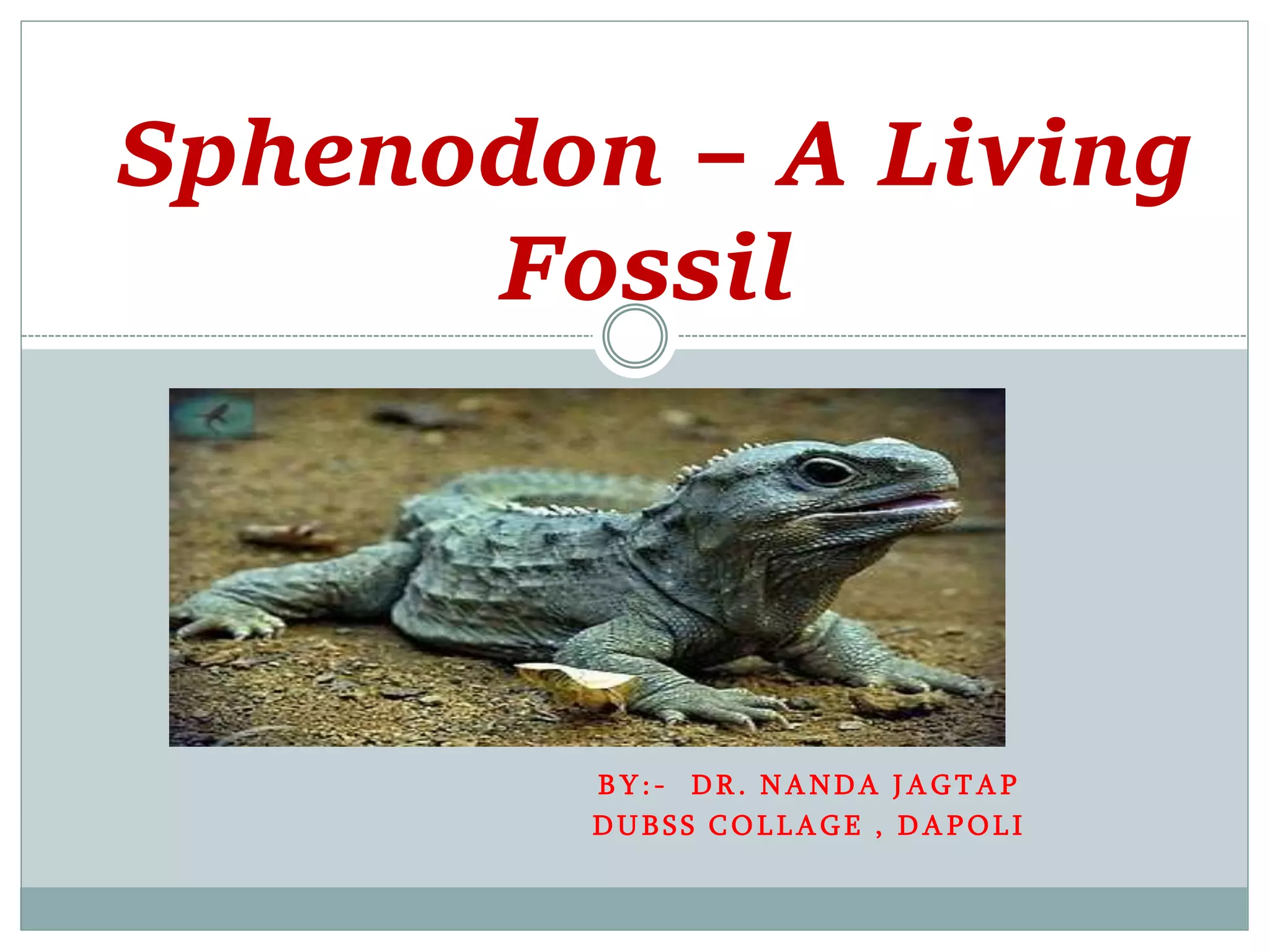
Sphenodon – A Living
Fossil
Synopsis
1. Introduction
2. Classification
3. Habit & habitat
4. Morphological features
5. Anatomical features
6. Phylogeny
7. Economic Importance
8. Conclusion
Introduction
The living fossil is an animal that has survived
beyond its era.
Living Fossil is a organism which Keeps its
Characters Unchanged around Millions of year
 Sphenodon punctatum is commonly known as
Tuatara.
Life span is up to 100 years or more .
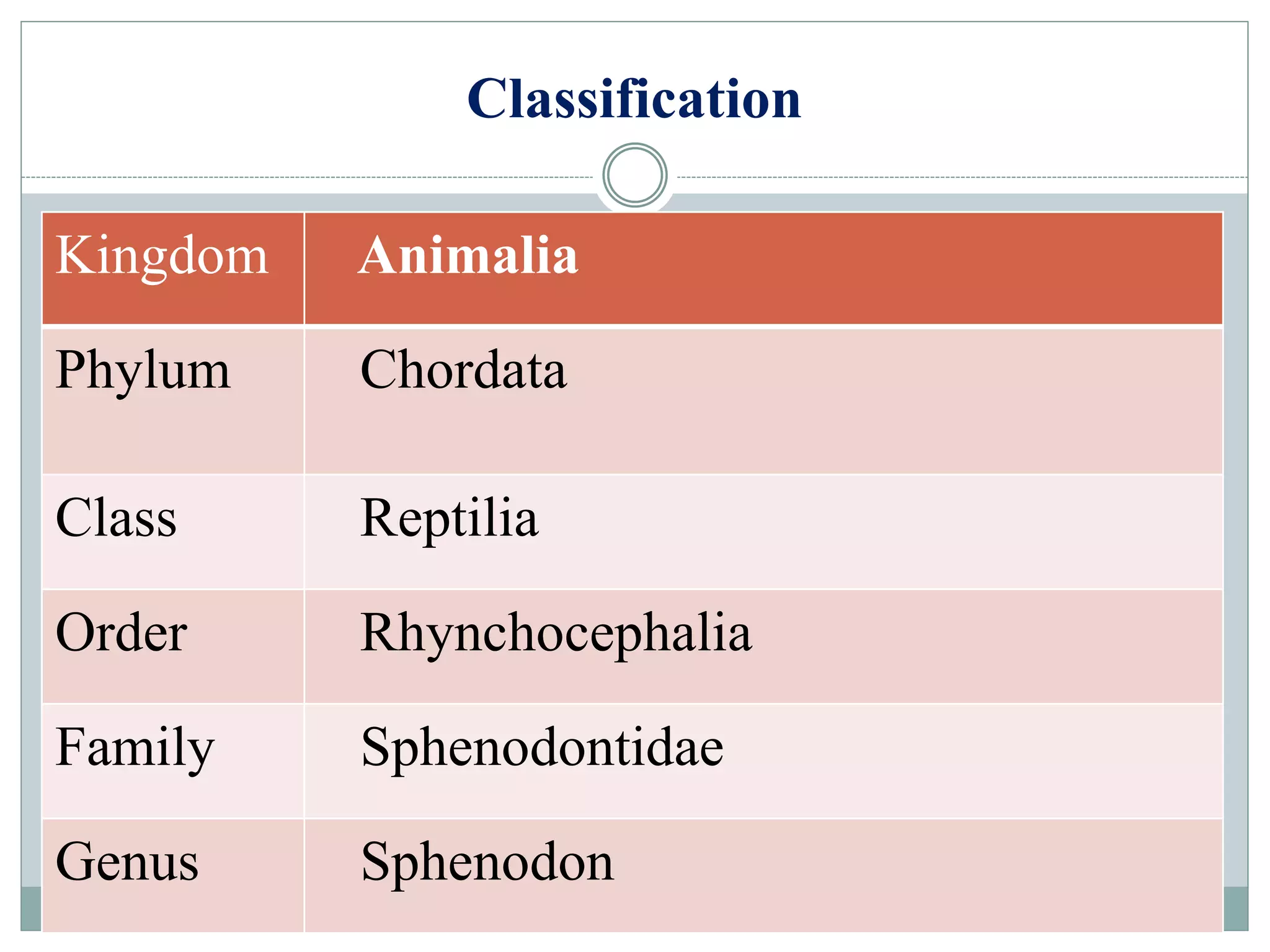
Classification
Kingdom Animalia
Phylum Chordata
Class Reptilia
Order Rhynchocephalia
Family Sphenodontidae
Genus Sphenodon
Habit & Habitat
 Sphenodon inhabits burrows made in the soft soil
and in rocks.
 Terrestrial ,nocturnal, carnivorous and oviparous.
Endemic to New Zealand.
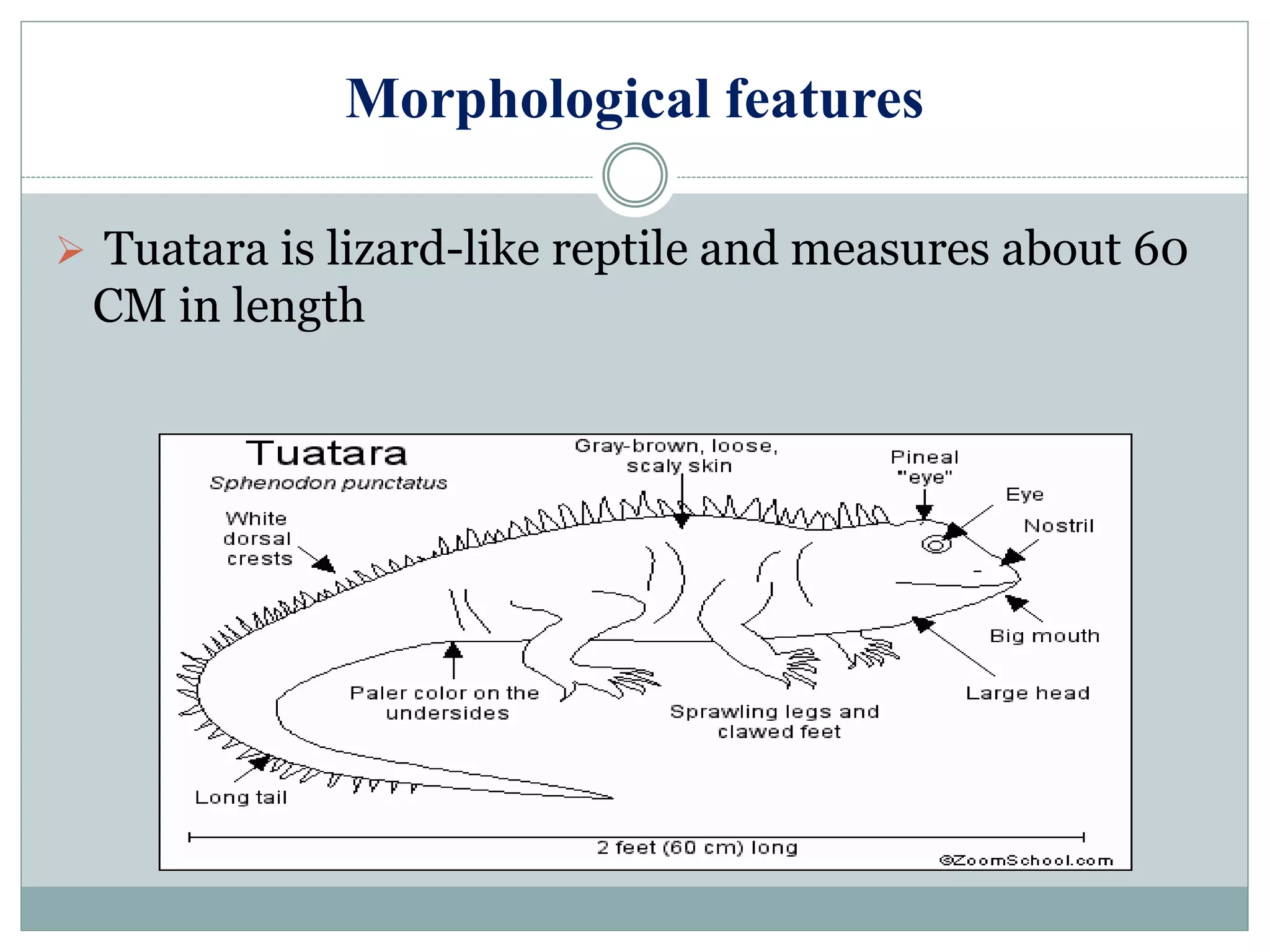
Morphological features
 Tuatara is lizard-like reptile and measures about 60
CM in length
Anatomical Features
 Endoskeleton:-
- Vertebrae are amphicoelous with remnants of
notochord in the inter central spaces.
- Ribs are single headed, uncinate prosess.
- Skull is lizard-like but there is a complete lower
temporal arch.
Digestive system
• It consist of alimentary canal and associated
digestive line.
• Alimentary canal is short and coiled which begins
from mouth and finish with cloaca.
Respiratory System
 It includes respiratory tract and respiratory organ.
• Trachea is long ,elongated & it’s anterior part dilated
called larynx, supported by cricoid and arytenoids
cartilages
• It emits soft frog like croak.
• lungs are paired elongated fusiform thin walled
elastic sac.
Anatomy of Sphenodon
Blood Vascular System
 Blood vascular system is similar to lizard.
 Heart is triangular, red in color and partially 4
chambered muscular organ, two auricles and one
ventricle with incomplete septum .
 Sinus venous not easily distinguish externally.
 Jacobson’s organs in primitive form .
Nervous System
 Brain lies inside the cranial cavity covered by two
membranes , inner piamater and outer duramater.
Brain is divided into three regions namely
forebrain , midbrain and hindbrain.
 olfactory lobes are small and Cerebral hemisphere
larger in size.
Urinogenital System
Excretory and reproductive organs are closely
associated and forming urino genital system.
Paired metanephric kidney are elongated , dark red
flattened lying in posterior region of abdominal
cavity.
Phylogeny
Phylogeny means an evolutionary development and
diversification of a species or a group of an organism.
Primitive reptiles are originated from some primitive
amphibians in the beginning of Carboniferous
period.
No fossil specimen of Sphenodon has been found.
It is referred as a “Living Fossil”.
Economic Importance
 Tuatara is an extremely important component of
extant biodiversity
It has played a key role in phylogenetic analysis.
It is valuable for comparative studies of soft tissue
and behavior in lizard.
It is used as model organism.
It has appeared on stamps and 5 cent coin.
Conclusion
 There is no evolution therefore Sphenodon is
 on the way of extinction. Due to global worming,
their island habitat is becoming less.
 Conservation of Sphenodon has started by The
Government Of New Zealand.
References
1) Chordate Zoology Jordan and
Verma, Chand Publications.
2) Vertebrates Kotpal,
Rastogi publications.
3) www.google.coms
THANKYOU!

spenadon - A living fossil

  • 1.
    B Y :- DR . N A NDA J A GTAP D U BSS C O LLAGE , D A POLI Sphenodon – A Living Fossil
  • 2.
    Synopsis 1. Introduction 2. Classification 3.Habit & habitat 4. Morphological features 5. Anatomical features 6. Phylogeny 7. Economic Importance 8. Conclusion
  • 3.
    Introduction The living fossilis an animal that has survived beyond its era. Living Fossil is a organism which Keeps its Characters Unchanged around Millions of year  Sphenodon punctatum is commonly known as Tuatara. Life span is up to 100 years or more .
  • 4.
    Classification Kingdom Animalia Phylum Chordata ClassReptilia Order Rhynchocephalia Family Sphenodontidae Genus Sphenodon
  • 5.
    Habit & Habitat Sphenodon inhabits burrows made in the soft soil and in rocks.  Terrestrial ,nocturnal, carnivorous and oviparous. Endemic to New Zealand.
  • 6.
    Morphological features  Tuatarais lizard-like reptile and measures about 60 CM in length
  • 7.
    Anatomical Features  Endoskeleton:- -Vertebrae are amphicoelous with remnants of notochord in the inter central spaces. - Ribs are single headed, uncinate prosess. - Skull is lizard-like but there is a complete lower temporal arch.
  • 8.
    Digestive system • Itconsist of alimentary canal and associated digestive line. • Alimentary canal is short and coiled which begins from mouth and finish with cloaca.
  • 9.
    Respiratory System  Itincludes respiratory tract and respiratory organ. • Trachea is long ,elongated & it’s anterior part dilated called larynx, supported by cricoid and arytenoids cartilages • It emits soft frog like croak. • lungs are paired elongated fusiform thin walled elastic sac.
  • 10.
  • 11.
    Blood Vascular System Blood vascular system is similar to lizard.  Heart is triangular, red in color and partially 4 chambered muscular organ, two auricles and one ventricle with incomplete septum .  Sinus venous not easily distinguish externally.  Jacobson’s organs in primitive form .
  • 12.
    Nervous System  Brainlies inside the cranial cavity covered by two membranes , inner piamater and outer duramater. Brain is divided into three regions namely forebrain , midbrain and hindbrain.  olfactory lobes are small and Cerebral hemisphere larger in size.
  • 13.
    Urinogenital System Excretory andreproductive organs are closely associated and forming urino genital system. Paired metanephric kidney are elongated , dark red flattened lying in posterior region of abdominal cavity.
  • 14.
    Phylogeny Phylogeny means anevolutionary development and diversification of a species or a group of an organism. Primitive reptiles are originated from some primitive amphibians in the beginning of Carboniferous period. No fossil specimen of Sphenodon has been found. It is referred as a “Living Fossil”.
  • 15.
    Economic Importance  Tuatarais an extremely important component of extant biodiversity It has played a key role in phylogenetic analysis. It is valuable for comparative studies of soft tissue and behavior in lizard. It is used as model organism. It has appeared on stamps and 5 cent coin.
  • 16.
    Conclusion  There isno evolution therefore Sphenodon is  on the way of extinction. Due to global worming, their island habitat is becoming less.  Conservation of Sphenodon has started by The Government Of New Zealand.
  • 17.
    References 1) Chordate ZoologyJordan and Verma, Chand Publications. 2) Vertebrates Kotpal, Rastogi publications. 3) www.google.coms
  • 18.