PHYLUM ECHINODERMATA
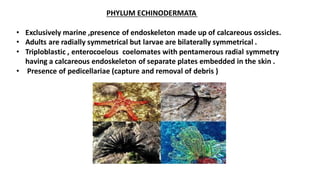
• Exclusively marine ,presence of endoskeleton made up of calcareous ossicles.
• Adults are radially symmetrical but larvae are bilaterally symmetrical .
• Triploblastic , enterocoelous coelomates with pentamerous radial symmetry
having a calcareous endoskeleton of separate plates embedded in the skin .
• Presence of pedicellariae (capture and removal of debris )
• Many echinoderms bear spines and pincer like pedicellariae ,the spines are protective
in function ,the pedicellariae keep the body surface clear of debris and minute
organisms .
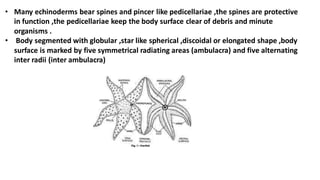
• Body segmented with globular ,star like spherical ,discoidal or elongated shape ,body
surface is marked by five symmetrical radiating areas (ambulacra) and five alternating
inter radii (inter ambulacra)
• Body wall consists of an outer epidermis (single layered and ciliated ) , a middle
dermis and an inner lining of peritoneum .
• Alimentary canal is straight or coiled .
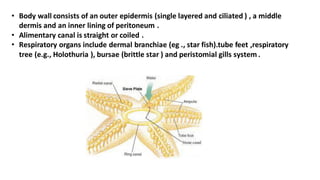
• Respiratory organs include dermal branchiae (eg ., star fish).tube feet ,respiratory
tree (e.g., Holothuria ), bursae (brittle star ) and peristomial gills system .
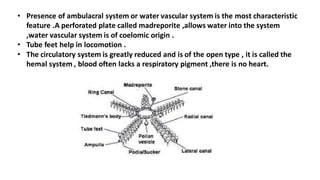
• Presence of ambulacral system or water vascular system is the most characteristic
feature .A perforated plate called madreporite ,allows water into the system
,water vascular system is of coelomic origin .
• Tube feet help in locomotion .
• The circulatory system is greatly reduced and is of the open type , it is called the
hemal system , blood often lacks a respiratory pigment ,there is no heart.
• Nitrogenous waste diffuses out via gills .
• The nervous system includes a nerve ring and radial nerve cords ,there is no brain .
• Poorly developed sense organs include tactile organs ,chemoreceptors ,terminal
tentacles ,photoreceptors and statocysts.
• Reproduction is both asexual and sexual .sexes are usually separate with a few
exceptions ,copulation does not occur ,fertilization is external .
• Development is indirect through free swimming larval forms .the bilateral symmetry
larvae undergo metamorphosis to change into radially symmetrical adults .
• Echinoderms resemble chordates in early embryonic development .
Examples ; Asterias (star fish),Echinus (sea urchin ), Antedon
(sea lily), Cucumaria (sea cucumber ,Ophiura( brittle star)

NEET 11th PHYLUM ECHINODERMATA.pdf

  • 1.
    PHYLUM ECHINODERMATA • Exclusivelymarine ,presence of endoskeleton made up of calcareous ossicles. • Adults are radially symmetrical but larvae are bilaterally symmetrical . • Triploblastic , enterocoelous coelomates with pentamerous radial symmetry having a calcareous endoskeleton of separate plates embedded in the skin . • Presence of pedicellariae (capture and removal of debris )
  • 2.
    • Many echinodermsbear spines and pincer like pedicellariae ,the spines are protective in function ,the pedicellariae keep the body surface clear of debris and minute organisms . • Body segmented with globular ,star like spherical ,discoidal or elongated shape ,body surface is marked by five symmetrical radiating areas (ambulacra) and five alternating inter radii (inter ambulacra)
  • 3.
    • Body wallconsists of an outer epidermis (single layered and ciliated ) , a middle dermis and an inner lining of peritoneum . • Alimentary canal is straight or coiled . • Respiratory organs include dermal branchiae (eg ., star fish).tube feet ,respiratory tree (e.g., Holothuria ), bursae (brittle star ) and peristomial gills system .
  • 4.
    • Presence ofambulacral system or water vascular system is the most characteristic feature .A perforated plate called madreporite ,allows water into the system ,water vascular system is of coelomic origin . • Tube feet help in locomotion . • The circulatory system is greatly reduced and is of the open type , it is called the hemal system , blood often lacks a respiratory pigment ,there is no heart.
  • 5.
    • Nitrogenous wastediffuses out via gills . • The nervous system includes a nerve ring and radial nerve cords ,there is no brain . • Poorly developed sense organs include tactile organs ,chemoreceptors ,terminal tentacles ,photoreceptors and statocysts. • Reproduction is both asexual and sexual .sexes are usually separate with a few exceptions ,copulation does not occur ,fertilization is external .
  • 6.
    • Development isindirect through free swimming larval forms .the bilateral symmetry larvae undergo metamorphosis to change into radially symmetrical adults . • Echinoderms resemble chordates in early embryonic development . Examples ; Asterias (star fish),Echinus (sea urchin ), Antedon (sea lily), Cucumaria (sea cucumber ,Ophiura( brittle star)