Chemical Engineering
Thermodynamics – II
 An azeotrope or a constant boiling mixture is a
mixture of two or more liquids whose proportions
cannot be altered by simple distillation.
 This happens because, when an azeotrope is boiled,
the vapour has the same proportions of constituents
as the unboiled mixture.
Minimum Boiling Azeotropes
 Each azeotrope has a characteristic boiling point. The
boiling point of an azeotrope is less than the boiling
point temperatures of any of its constituents is a
Minimum boiling azeotrope.
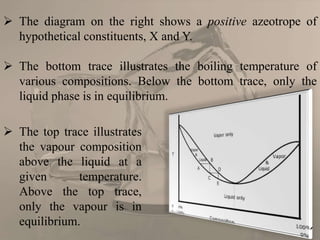
 The diagram on the right shows a positive azeotrope of
hypothetical constituents, X and Y.
 The bottom trace illustrates the boiling temperature of
various compositions. Below the bottom trace, only the
liquid phase is in equilibrium.
 The top trace illustrates
the vapour composition
above the liquid at a
given temperature.
Above the top trace,
only the vapour is in
equilibrium.
 Between the two traces, liquid and vapor phases exist
simultaneously in equilibrium: for example, heating a 25%
X : 75% Y mixture to temperature AB would generate
vapor of composition B over liquid of composition A.
 The azeotrope is the point on the diagram where the two
curves touch. The horizontal and vertical steps show the
path of repeated distillations.
 Point A is the boiling point of a nonazeotropic mixture. The
vapor that separates at that temperature has composition B.
 The shape of the curves requires that the vapor at B be
richer in constituent X than the liquid at point A.
 The vapor is physically separated from the VLE (vapor-
liquid equilibrium) system and is cooled to point C, where
it condenses.
 The resulting liquid (point C) is now richer in X than it
was at point A.
 If the collected liquid is boiled again, it progresses to
point D, and so on.
 The stepwise progression shows how repeated distillation
can never produce a distillate that is richer in constituent X
than the azeotrope.
Maximum Boiling Azeotropes
 Each azeotrope has a characteristic boiling point. The
boiling point of an azeotrope is more than the boiling
point temperatures of any of its constituents is a
Maximum boiling azeotrope.
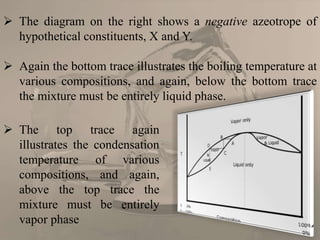
 The diagram on the right shows a negative azeotrope of
hypothetical constituents, X and Y.
 Again the bottom trace illustrates the boiling temperature at
various compositions, and again, below the bottom trace
the mixture must be entirely liquid phase.
 The top trace again
illustrates the condensation
temperature of various
compositions, and again,
above the top trace the
mixture must be entirely
vapor phase
 The point, A, shown here is a boiling point with a
composition chosen very near to the azeotrope.
 The vapor is collected at the same temperature at point B.
That vapor is cooled, condensed, and collected at point C.
 Because this example is a negative azeotrope rather than a
positive one, the distillate is farther from the azeotrope than
the original liquid mixture at point A was.
 So the distillate is poorer in constituent X and richer in
constituent Y than the original mixture
 Because this process has removed a greater fraction of Y
from the liquid than it had originally, the residue must be
poorer in Y and richer in X after distillation than before.
 If the point, A had been chosen to the right of the
azeotrope rather than to the left, the distillate at point C
would be farther to the right than A, which is to say that
the distillate would be richer in X and poorer in Y than the
original mixture.
 So in this case too, the distillate moves away from the
azeotrope and the residue moves toward it.
 This is characteristic of negative azeotropes.
Azeotropes
Azeotropes

Azeotropes

  • 1.
  • 2.
     An azeotropeor a constant boiling mixture is a mixture of two or more liquids whose proportions cannot be altered by simple distillation.  This happens because, when an azeotrope is boiled, the vapour has the same proportions of constituents as the unboiled mixture.
  • 4.
    Minimum Boiling Azeotropes Each azeotrope has a characteristic boiling point. The boiling point of an azeotrope is less than the boiling point temperatures of any of its constituents is a Minimum boiling azeotrope.
  • 5.
     The diagramon the right shows a positive azeotrope of hypothetical constituents, X and Y.  The bottom trace illustrates the boiling temperature of various compositions. Below the bottom trace, only the liquid phase is in equilibrium.  The top trace illustrates the vapour composition above the liquid at a given temperature. Above the top trace, only the vapour is in equilibrium.
  • 6.
     Between thetwo traces, liquid and vapor phases exist simultaneously in equilibrium: for example, heating a 25% X : 75% Y mixture to temperature AB would generate vapor of composition B over liquid of composition A.  The azeotrope is the point on the diagram where the two curves touch. The horizontal and vertical steps show the path of repeated distillations.  Point A is the boiling point of a nonazeotropic mixture. The vapor that separates at that temperature has composition B.  The shape of the curves requires that the vapor at B be richer in constituent X than the liquid at point A.
  • 7.
     The vaporis physically separated from the VLE (vapor- liquid equilibrium) system and is cooled to point C, where it condenses.  The resulting liquid (point C) is now richer in X than it was at point A.  If the collected liquid is boiled again, it progresses to point D, and so on.  The stepwise progression shows how repeated distillation can never produce a distillate that is richer in constituent X than the azeotrope.
  • 9.
    Maximum Boiling Azeotropes Each azeotrope has a characteristic boiling point. The boiling point of an azeotrope is more than the boiling point temperatures of any of its constituents is a Maximum boiling azeotrope.
  • 10.
     The diagramon the right shows a negative azeotrope of hypothetical constituents, X and Y.  Again the bottom trace illustrates the boiling temperature at various compositions, and again, below the bottom trace the mixture must be entirely liquid phase.  The top trace again illustrates the condensation temperature of various compositions, and again, above the top trace the mixture must be entirely vapor phase
  • 11.
     The point,A, shown here is a boiling point with a composition chosen very near to the azeotrope.  The vapor is collected at the same temperature at point B. That vapor is cooled, condensed, and collected at point C.  Because this example is a negative azeotrope rather than a positive one, the distillate is farther from the azeotrope than the original liquid mixture at point A was.  So the distillate is poorer in constituent X and richer in constituent Y than the original mixture
  • 12.
     Because thisprocess has removed a greater fraction of Y from the liquid than it had originally, the residue must be poorer in Y and richer in X after distillation than before.  If the point, A had been chosen to the right of the azeotrope rather than to the left, the distillate at point C would be farther to the right than A, which is to say that the distillate would be richer in X and poorer in Y than the original mixture.  So in this case too, the distillate moves away from the azeotrope and the residue moves toward it.  This is characteristic of negative azeotropes.