

CLASSIFICATION OF MANAGEMENT FUNCTIONS
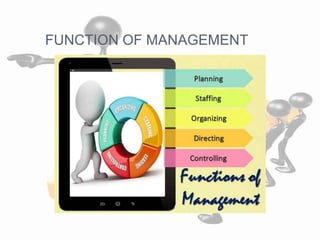
According to Luther Gullick gave the Keyword :
 P........................Planning
 O.......................Organizing
 S........................Staffing
 D........................Directing
 Co………………Coordinating
 R........................Reporting
 B........................Budgeting
 Primary function of management.
 Blue print of action & operation.
 Thinking before doing.
 Focus on the future course of
action.
 Specifies the objectives to be
achieved in future.
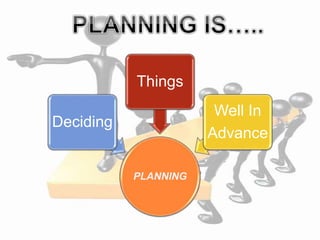
PLANNING
Deciding
Things
Well In
Advance
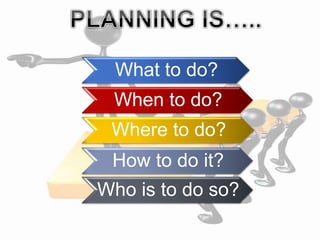
What to do?
When to do?
Where to do?
How to do it?
Who is to do so?
“Planning is a method or technique of looking ahead. It is a
deliberate conscious search used to formulate the design
& orderly sequence of actions through which it is
expected to reach the objective.”
-Dr. George Terry
“the plan of action is at one & the same time the result
envisaged, the line of action to be followed, the
stages to go through & the methods to use.”
-Hanry Fayol
“Planning is fundamentally a mental predisposition
to do things in an orderly way, to think before acting
& to act in the light of facts rather than of guesses.”
-Urwick
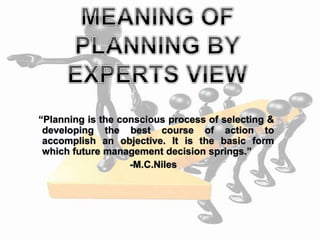
“Planning is the conscious process of selecting &
developing the best course of action to
accomplish an objective. It is the basic form
which future management decision springs.”
-M.C.Niles
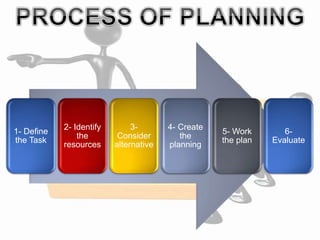
1- Define
the Task
2- Identify
the
resources
3-
Consider
alternative
4- Create
the
planning
5- Work
the plan
6-
Evaluate
FUNCTION OF MANAGEMENT
IMPORTANCE&ADVANTAGE OF PLANING
(1) Awareness for objective and result
(2) Uncertainity decreases
(3) Awareness of direction
(4) Improve ,promote research
(5) Co-ordination
(6) Guides decision making
(7) Foundation for decetralisation
(8) Presents economy in operations
(9) Easy control
AWAWENESS FOR OBJECTIVE AND RESULT

* due to proper planing ,awerwness for final goal
of the compony .
*short term and long term goal among employees and
workers becomes easy
*this goal is very easily successfull
UNCERTAINTY DECREASES
 Planing provides structurefor action plan.
 Empolyees and workers at all levels can easily
understand their responsibilities.
 They are very well awere what they needs to do
and within what time they required to finish it up.
 Every task is clearl mentiond.
AWARENESS OF DIRECTION
 Due to planing managers knowns how much he
work he need to comple within specific time.
 They are clearly and perfact results .
 This way of direction awareness for direction
increases.
PROMOTE AND IMPROVEMENT AND RESEARCH
 According to “awareness of a goods planing
process will provided avenue for individual
participation .
 Will throws up more ideas about the compony and
its environment .
 They clearly and new reaserch & development
ASSSIST IN CO – ORDINATION
 Planing provides the base for distribution of work
and proper inter – relationship can be managed .
 All the departments can be well connected .
 Due to this co-ordination among all department and
departmental heads becomes possible.

GUIDES FOR DECISION –MAKING
 Since planing is helpful for proper forecasting .
 But specefic cases it also provided information for
various option which option is best suitable for
circumstance is also provided
 Hence planing also provide for decision –making.
EASY CONTROL
 Sinse the responsibility of all department is already
decided in advance.if the work could not done as
per the order then the deficiency cab be easily
located.
 Hence, control activity should become simple for
the manager
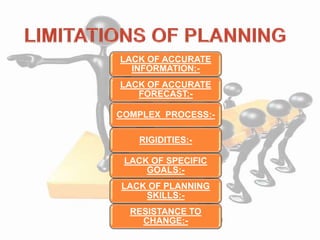
LACK OF ACCURATE
INFORMATION:-
LACK OF ACCURATE
FORECAST:-
COMPLEX PROCESS:-
RIGIDITIES:-
LACK OF SPECIFIC
GOALS:-
LACK OF PLANNING
SKILLS:-
RESISTANCE TO
CHANGE:-
The reliability of a plan depends upon facts
& information on which it is based. If reliable
information & dependable data are not
available, planning is sure to lose its
importance.
LACK OF ACCURATE INFORMATION:-
Planning concerns future activity & its
quality will be determined by the quality of
forecast of future events. No manager can
predict completely & accurately the events
of future, the plans may cause problems in
operation.
LACK OF ACCURATE
FORECAST:-
Planning is a complex & expensive process. It
demands serious thinking, hard work & time.
Some managers do not like to undergo such a
complicated process as they like short-cuts.
Such planning may not yield the desired
results.
COMPLEX
PROCESS:-
Planning may result in internal inflexibilities.
By limiting individual freedom, planning may
stifle initiative & personal development.
Rigidities appear from managers negligence
to revise the plan, policies & procedures.
RIGIDITIES:-
Qualitative objectives like social
responsibility, management development,
quality of work life, etc are often expressed.
Planning cannot be effective unless goals
are specific & clear.1
LACK OF SPECIFIC
GOALS:-
Planning is an art & takes a special type of
person to plan. Not everyone is capable of
planning & solving organizational problems. A
planner should not only have skill, but also
intelligence & vision for long range planning &
must have ability to forecast.
LACK OF PLANNING
SKILLS:-
Resistance to change is another r factor which
puts limits on planning. It is commonly
experienced in the business world. Sometimes,
planners themselves do not like change & they
do not think it is good & necessary to bring
changes as it will create resistance on the part
of workers. This attitude makes the planning
process ineffective.
RESISTANCE TO
CHANGE:-
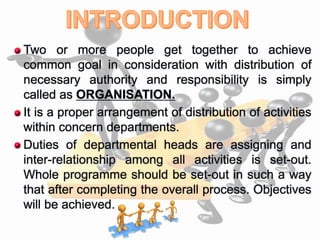
 Two or more people get together to achieve
common goal in consideration with distribution of
necessary authority and responsibility is simply
called as ORGANISATION.
 It is a proper arrangement of distribution of activities
within concern departments.
 Duties of departmental heads are assigning and
inter-relationship among all activities is set-out.
Whole programme should be set-out in such a way
that after completing the overall process. Objectives
will be achieved.
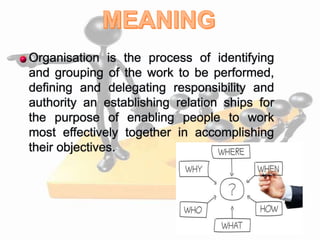
 Organisation is the process of identifying
and grouping of the work to be performed,
defining and delegating responsibility and
authority an establishing relation ships for
the purpose of enabling people to work
most effectively together in accomplishing
their objectives.
NATUREOFORGANISATION
1. Set-up to realise
objectives
2. Simplicity
3. Possibility for co-
operation
4. Division into
departments
5. Authority &
Responsibility
6. Leadership Oriented
7. closely linked with
planning
8. must be stable
9. Flexibility
10. Efficient
11. Easy for supervision
and control
12. Importance of
human element
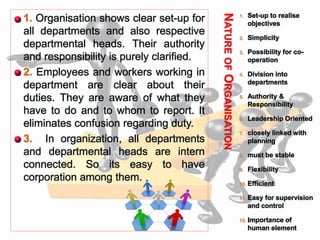
 1. Organisation shows clear set-up for
all departments and also respective
departmental heads. Their authority
and responsibility is purely clarified.
 2. Employees and workers working in
department are clear about their
duties. They are aware of what they
have to do and to whom to report. It
eliminates confusion regarding duty.
 3. In organization, all departments
and departmental heads are intern
connected. So its easy to have
corporation among them.
NATUREOFORGANISATION
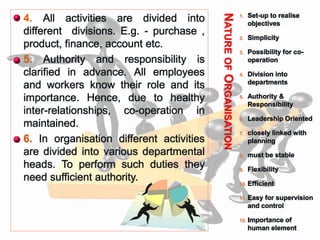
 4. All activities are divided into
different divisions. E.g. - purchase ,
product, finance, account etc.
 5. Authority and responsibility is
clarified in advance. All employees
and workers know their role and its
importance. Hence, due to healthy
inter-relationships, co-operation in
maintained.
 6. In organisation different activities
are divided into various departmental
heads. To perform such duties they
need sufficient authority.
1. Set-up to realise
objectives
2. Simplicity
3. Possibility for co-
operation
4. Division into
departments
5. Authority &
Responsibility
6. Leadership Oriented
7. closely linked with
planning
8. must be stable
9. Flexibility
10. Efficient
11. Easy for supervision
and control
12. Importance of
human element
NATUREOFORGANISATION
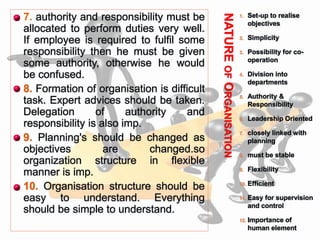
 7. authority and responsibility must be
allocated to perform duties very well.
If employee is required to fulfil some
responsibility then he must be given
some authority, otherwise he would
be confused.
 8. Formation of organisation is difficult
task. Expert advices should be taken.
Delegation of authority and
responsibility is also imp.
 9. Planning's should be changed as
objectives are changed.so
organization structure in flexible
manner is imp.
 10. Organisation structure should be
easy to understand. Everything
should be simple to understand.
1. Set-up to realise
objectives
2. Simplicity
3. Possibility for co-
operation
4. Division into
departments
5. Authority &
Responsibility
6. Leadership Oriented
7. closely linked with
planning
8. must be stable
9. Flexibility
10. Efficient
11. Easy for supervision
and control
12. Importance of
human element
NATUREOFORGANISATION
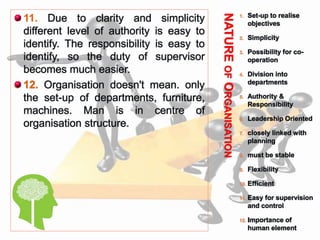
 11. Due to clarity and simplicity
different level of authority is easy to
identify. The responsibility is easy to
identify, so the duty of supervisor
becomes much easier.
 12. Organisation doesn't mean. only
the set-up of departments, furniture,
machines. Man is in centre of
organisation structure.
1. Set-up to realise
objectives
2. Simplicity
3. Possibility for co-
operation
4. Division into
departments
5. Authority &
Responsibility
6. Leadership Oriented
7. closely linked with
planning
8. must be stable
9. Flexibility
10. Efficient
11. Easy for supervision
and control
12. Importance of
human element
IMPORTANCEOFORGANISATION
1. Goal &
objective
2. Clarification of
authorities &
responsibilitie
s.
3. Facilitates
administration
4. Employee
awareness
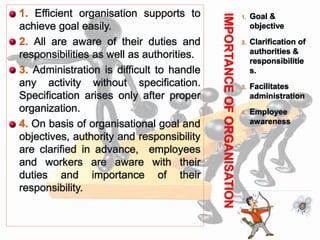
 1. Efficient organisation supports to
achieve goal easily.
 2. All are aware of their duties and
responsibilities as well as authorities.
 3. Administration is difficult to handle
any activity without specification.
Specification arises only after proper
organization.
 4. On basis of organisational goal and
objectives, authority and responsibility
are clarified in advance, employees
and workers are aware with their
duties and importance of their
responsibility.
IMPORTANCEOFORGANISATION
5. Cooperation &
industrial
peace
6. Possibility for
specialisation
7. Solution for
employees
problem
 5. Authority and responsibility is
clarified in advance. All employees
and workers know their role and its
importance. Hence, due to healthy
inter-relationships, co-operation in
maintained.
 6. All activities are divided into
different departmental head and
respective supervisors ad employees
after continuation of same activity
becomes experts.
 7. Enployees are automatically aware
of their job, minor problems are easily
solved by themselves. Their mutual
understanding automatically
increases due to good organisation
structure.
IMPORTANCEOFORGANISATION
8. Supports
efficient
direction &
control
9. Discipline &
morale
increase
10. Use of
scare
resource
 8. Due to efficient organisation inter
relation among employees and even
among all departments become easy
Their responsibility and authority is
clarified in advance.
 9. After comparing the efficiency and
presentation of one department with
another department. management
can evaluate the performance.
 10. Supervisors and employees know
what to do and what is expected of
them, they do it efficiently. This directs
to maximum use of minimum
resources.
IMPORTANCEOFORGANISATION
11. Support
creativity
12. Assists new
technology
 11. A perfect organisation provides an
opportunity for new creation. It
supports also new research for
improvements in organisation
structure. The encouraging structure
provides base for showing their talent.
 12. A competent organisation is that
much of flexible that suits to the use
of new technology. Use of a new
machine or technique is helpful for
greater production at lowest cost. It is
necessary for profitability and
sustainability of the company
IMPORTANCEOFORGANISATION
13. Business
opportunity
14. Possibility
for growth
and
diversificati
on
 13. Management team slowly and
gradually become tension free due to
perfect distribution of authority and
responsibility, they have some space
to think about other business
opportunities.
 14. Due to efficient organisation, scale
of present operations increases. And
possibility of new opportunities also
opens. Moreover, the company
divided into different divisions and
sub-divisions after changes in
requirement. Hence, possibility of
growth and diversification increases.
planning and organization

planning and organization

  • 2.
    CLASSIFICATION OF MANAGEMENTFUNCTIONS According to Luther Gullick gave the Keyword :  P........................Planning  O.......................Organizing  S........................Staffing  D........................Directing  Co………………Coordinating  R........................Reporting  B........................Budgeting
  • 3.
     Primary functionof management.  Blue print of action & operation.  Thinking before doing.  Focus on the future course of action.  Specifies the objectives to be achieved in future.
  • 4.
  • 5.
    What to do? Whento do? Where to do? How to do it? Who is to do so?
  • 6.
    “Planning is amethod or technique of looking ahead. It is a deliberate conscious search used to formulate the design & orderly sequence of actions through which it is expected to reach the objective.” -Dr. George Terry
  • 7.
    “the plan ofaction is at one & the same time the result envisaged, the line of action to be followed, the stages to go through & the methods to use.” -Hanry Fayol
  • 8.
    “Planning is fundamentallya mental predisposition to do things in an orderly way, to think before acting & to act in the light of facts rather than of guesses.” -Urwick
  • 9.
    “Planning is theconscious process of selecting & developing the best course of action to accomplish an objective. It is the basic form which future management decision springs.” -M.C.Niles
  • 10.
    1- Define the Task 2-Identify the resources 3- Consider alternative 4- Create the planning 5- Work the plan 6- Evaluate
  • 12.
  • 13.
    IMPORTANCE&ADVANTAGE OF PLANING (1)Awareness for objective and result (2) Uncertainity decreases (3) Awareness of direction (4) Improve ,promote research (5) Co-ordination (6) Guides decision making (7) Foundation for decetralisation (8) Presents economy in operations (9) Easy control
  • 14.
    AWAWENESS FOR OBJECTIVEAND RESULT  * due to proper planing ,awerwness for final goal of the compony . *short term and long term goal among employees and workers becomes easy *this goal is very easily successfull
  • 15.
    UNCERTAINTY DECREASES  Planingprovides structurefor action plan.  Empolyees and workers at all levels can easily understand their responsibilities.  They are very well awere what they needs to do and within what time they required to finish it up.  Every task is clearl mentiond.
  • 16.
    AWARENESS OF DIRECTION Due to planing managers knowns how much he work he need to comple within specific time.  They are clearly and perfact results .  This way of direction awareness for direction increases.
  • 17.
    PROMOTE AND IMPROVEMENTAND RESEARCH  According to “awareness of a goods planing process will provided avenue for individual participation .  Will throws up more ideas about the compony and its environment .  They clearly and new reaserch & development
  • 18.
    ASSSIST IN CO– ORDINATION  Planing provides the base for distribution of work and proper inter – relationship can be managed .  All the departments can be well connected .  Due to this co-ordination among all department and departmental heads becomes possible. 
  • 19.
    GUIDES FOR DECISION–MAKING  Since planing is helpful for proper forecasting .  But specefic cases it also provided information for various option which option is best suitable for circumstance is also provided  Hence planing also provide for decision –making.
  • 20.
    EASY CONTROL  Sinsethe responsibility of all department is already decided in advance.if the work could not done as per the order then the deficiency cab be easily located.  Hence, control activity should become simple for the manager
  • 22.
    LACK OF ACCURATE INFORMATION:- LACKOF ACCURATE FORECAST:- COMPLEX PROCESS:- RIGIDITIES:- LACK OF SPECIFIC GOALS:- LACK OF PLANNING SKILLS:- RESISTANCE TO CHANGE:-
  • 23.
    The reliability ofa plan depends upon facts & information on which it is based. If reliable information & dependable data are not available, planning is sure to lose its importance. LACK OF ACCURATE INFORMATION:-
  • 24.
    Planning concerns futureactivity & its quality will be determined by the quality of forecast of future events. No manager can predict completely & accurately the events of future, the plans may cause problems in operation. LACK OF ACCURATE FORECAST:-
  • 25.
    Planning is acomplex & expensive process. It demands serious thinking, hard work & time. Some managers do not like to undergo such a complicated process as they like short-cuts. Such planning may not yield the desired results. COMPLEX PROCESS:-
  • 26.
    Planning may resultin internal inflexibilities. By limiting individual freedom, planning may stifle initiative & personal development. Rigidities appear from managers negligence to revise the plan, policies & procedures. RIGIDITIES:-
  • 27.
    Qualitative objectives likesocial responsibility, management development, quality of work life, etc are often expressed. Planning cannot be effective unless goals are specific & clear.1 LACK OF SPECIFIC GOALS:-
  • 28.
    Planning is anart & takes a special type of person to plan. Not everyone is capable of planning & solving organizational problems. A planner should not only have skill, but also intelligence & vision for long range planning & must have ability to forecast. LACK OF PLANNING SKILLS:-
  • 29.
    Resistance to changeis another r factor which puts limits on planning. It is commonly experienced in the business world. Sometimes, planners themselves do not like change & they do not think it is good & necessary to bring changes as it will create resistance on the part of workers. This attitude makes the planning process ineffective. RESISTANCE TO CHANGE:-
  • 31.
     Two ormore people get together to achieve common goal in consideration with distribution of necessary authority and responsibility is simply called as ORGANISATION.  It is a proper arrangement of distribution of activities within concern departments.  Duties of departmental heads are assigning and inter-relationship among all activities is set-out. Whole programme should be set-out in such a way that after completing the overall process. Objectives will be achieved.
  • 32.
     Organisation isthe process of identifying and grouping of the work to be performed, defining and delegating responsibility and authority an establishing relation ships for the purpose of enabling people to work most effectively together in accomplishing their objectives.
  • 33.
    NATUREOFORGANISATION 1. Set-up torealise objectives 2. Simplicity 3. Possibility for co- operation 4. Division into departments 5. Authority & Responsibility 6. Leadership Oriented 7. closely linked with planning 8. must be stable 9. Flexibility 10. Efficient 11. Easy for supervision and control 12. Importance of human element  1. Organisation shows clear set-up for all departments and also respective departmental heads. Their authority and responsibility is purely clarified.  2. Employees and workers working in department are clear about their duties. They are aware of what they have to do and to whom to report. It eliminates confusion regarding duty.  3. In organization, all departments and departmental heads are intern connected. So its easy to have corporation among them.
  • 34.
    NATUREOFORGANISATION  4. Allactivities are divided into different divisions. E.g. - purchase , product, finance, account etc.  5. Authority and responsibility is clarified in advance. All employees and workers know their role and its importance. Hence, due to healthy inter-relationships, co-operation in maintained.  6. In organisation different activities are divided into various departmental heads. To perform such duties they need sufficient authority. 1. Set-up to realise objectives 2. Simplicity 3. Possibility for co- operation 4. Division into departments 5. Authority & Responsibility 6. Leadership Oriented 7. closely linked with planning 8. must be stable 9. Flexibility 10. Efficient 11. Easy for supervision and control 12. Importance of human element
  • 35.
    NATUREOFORGANISATION  7. authorityand responsibility must be allocated to perform duties very well. If employee is required to fulfil some responsibility then he must be given some authority, otherwise he would be confused.  8. Formation of organisation is difficult task. Expert advices should be taken. Delegation of authority and responsibility is also imp.  9. Planning's should be changed as objectives are changed.so organization structure in flexible manner is imp.  10. Organisation structure should be easy to understand. Everything should be simple to understand. 1. Set-up to realise objectives 2. Simplicity 3. Possibility for co- operation 4. Division into departments 5. Authority & Responsibility 6. Leadership Oriented 7. closely linked with planning 8. must be stable 9. Flexibility 10. Efficient 11. Easy for supervision and control 12. Importance of human element
  • 36.
    NATUREOFORGANISATION  11. Dueto clarity and simplicity different level of authority is easy to identify. The responsibility is easy to identify, so the duty of supervisor becomes much easier.  12. Organisation doesn't mean. only the set-up of departments, furniture, machines. Man is in centre of organisation structure. 1. Set-up to realise objectives 2. Simplicity 3. Possibility for co- operation 4. Division into departments 5. Authority & Responsibility 6. Leadership Oriented 7. closely linked with planning 8. must be stable 9. Flexibility 10. Efficient 11. Easy for supervision and control 12. Importance of human element
  • 37.
    IMPORTANCEOFORGANISATION 1. Goal & objective 2.Clarification of authorities & responsibilitie s. 3. Facilitates administration 4. Employee awareness  1. Efficient organisation supports to achieve goal easily.  2. All are aware of their duties and responsibilities as well as authorities.  3. Administration is difficult to handle any activity without specification. Specification arises only after proper organization.  4. On basis of organisational goal and objectives, authority and responsibility are clarified in advance, employees and workers are aware with their duties and importance of their responsibility.
  • 38.
    IMPORTANCEOFORGANISATION 5. Cooperation & industrial peace 6.Possibility for specialisation 7. Solution for employees problem  5. Authority and responsibility is clarified in advance. All employees and workers know their role and its importance. Hence, due to healthy inter-relationships, co-operation in maintained.  6. All activities are divided into different departmental head and respective supervisors ad employees after continuation of same activity becomes experts.  7. Enployees are automatically aware of their job, minor problems are easily solved by themselves. Their mutual understanding automatically increases due to good organisation structure.
  • 39.
    IMPORTANCEOFORGANISATION 8. Supports efficient direction & control 9.Discipline & morale increase 10. Use of scare resource  8. Due to efficient organisation inter relation among employees and even among all departments become easy Their responsibility and authority is clarified in advance.  9. After comparing the efficiency and presentation of one department with another department. management can evaluate the performance.  10. Supervisors and employees know what to do and what is expected of them, they do it efficiently. This directs to maximum use of minimum resources.
  • 40.
    IMPORTANCEOFORGANISATION 11. Support creativity 12. Assistsnew technology  11. A perfect organisation provides an opportunity for new creation. It supports also new research for improvements in organisation structure. The encouraging structure provides base for showing their talent.  12. A competent organisation is that much of flexible that suits to the use of new technology. Use of a new machine or technique is helpful for greater production at lowest cost. It is necessary for profitability and sustainability of the company
  • 41.
    IMPORTANCEOFORGANISATION 13. Business opportunity 14. Possibility forgrowth and diversificati on  13. Management team slowly and gradually become tension free due to perfect distribution of authority and responsibility, they have some space to think about other business opportunities.  14. Due to efficient organisation, scale of present operations increases. And possibility of new opportunities also opens. Moreover, the company divided into different divisions and sub-divisions after changes in requirement. Hence, possibility of growth and diversification increases.