By Ashutosh Kumar Dubey
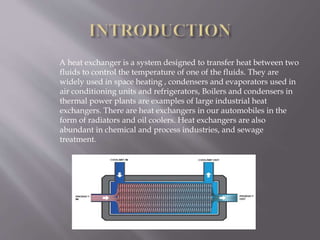
A heat exchanger is a system designed to transfer heat between two 
fluids to control the temperature of one of the fluids. They are 
widely used in space heating , condensers and evaporators used in 
air conditioning units and refrigerators, Boilers and condensers in 
thermal power plants are examples of large industrial heat 
exchangers. There are heat exchangers in our automobiles in the 
form of radiators and oil coolers. Heat exchangers are also 
abundant in chemical and process industries, and sewage 
treatment.
Heat exchanger is divided on the basis of 
1.Flow arrangement 
a) Single pass (parallel flow, counter-flow, cross –flow) 
b) Multi-pass (parallel flow, counter-flow, split-flow, divided flow) 
2.Surface compactness 
Non-compact (surface area density < 700 m2/m3) 
Compact (surface area density > 700 m2/m3) 
3.Contacting technique 
a) Indirect contact 
b) Direct contact 
4.Construction 
a) Tubular (double-pipe, shell and tube, spiral tube) 
b) Plate (plate and frame (gasket and welded plate),spiral plate) 
c) Extended surface (plate-fin, tube-fin) 
d) Regenerative
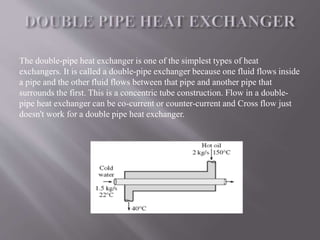
The double-pipe heat exchanger is one of the simplest types of heat 
exchangers. It is called a double-pipe exchanger because one fluid flows inside 
a pipe and the other fluid flows between that pipe and another pipe that 
surrounds the first. This is a concentric tube construction. Flow in a double-pipe 
heat exchanger can be co-current or counter-current and Cross flow just 
doesn't work for a double pipe heat exchanger.
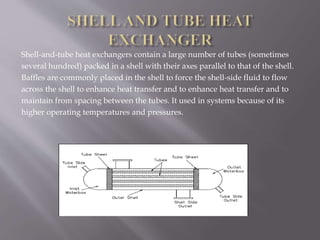
Shell-and-tube heat exchangers contain a large number of tubes (sometimes 
several hundred) packed in a shell with their axes parallel to that of the shell. 
Baffles are commonly placed in the shell to force the shell-side fluid to flow 
across the shell to enhance heat transfer and to enhance heat transfer and to 
maintain from spacing between the tubes. It used in systems because of its 
higher operating temperatures and pressures.
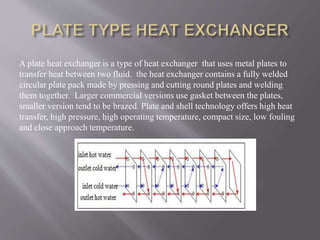
A plate heat exchanger is a type of heat exchanger that uses metal plates to 
transfer heat between two fluid. the heat exchanger contains a fully welded 
circular plate pack made by pressing and cutting round plates and welding 
them together. Larger commercial versions use gasket between the plates, 
smaller version tend to be brazed. Plate and shell technology offers high heat 
transfer, high pressure, high operating temperature, compact size, low fouling 
and close approach temperature.
Three flow arrangement are possible in heat exchange 
1.parallel flow 
When working fluid pass from one tube and refrigerant pass from other tube 
and their direction of flow is in same direction then heat exchanger act as a 
heat exchanger with parallel flow. 
2.Counter flow 
When working fluid pass from one tube and refrigerant pass from other tube 
and their but direction of flow is in different direction then heat exchanger act 
as a heat exchanger with counter flow. 
3.Cross flow 
In compact heat exchangers, the two fluids usually move perpendicular to each 
other and such flow configuration is called each other, and such flow 
configuration is called cross-flow. 
There are two types of cross flow heat exchangers 
(a) Unmixed and (b) Mixed flow
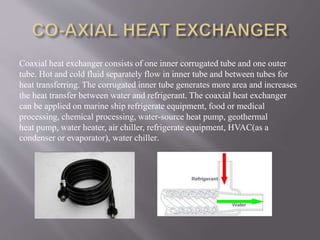
Coaxial heat exchanger consists of one inner corrugated tube and one outer 
tube. Hot and cold fluid separately flow in inner tube and between tubes for 
heat transferring. The corrugated inner tube generates more area and increases 
the heat transfer between water and refrigerant. The coaxial heat exchanger 
can be applied on marine ship refrigerate equipment, food or medical 
processing, chemical processing, water-source heat pump, geothermal 
heat pump, water heater, air chiller, refrigerate equipment, HVAC(as a 
condenser or evaporator), water chiller.
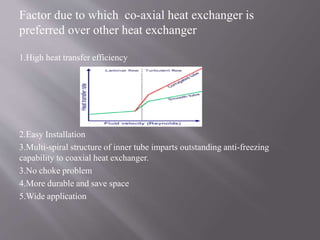
Factor due to which co-axial heat exchanger is 
preferred over other heat exchanger 
1.High heat transfer efficiency 
2.Easy Installation 
3.Multi-spiral structure of inner tube imparts outstanding anti-freezing 
capability to coaxial heat exchanger. 
3.No choke problem 
4.More durable and save space 
5.Wide application

Heat exchanger

  • 1.
  • 2.
    A heat exchangeris a system designed to transfer heat between two fluids to control the temperature of one of the fluids. They are widely used in space heating , condensers and evaporators used in air conditioning units and refrigerators, Boilers and condensers in thermal power plants are examples of large industrial heat exchangers. There are heat exchangers in our automobiles in the form of radiators and oil coolers. Heat exchangers are also abundant in chemical and process industries, and sewage treatment.
  • 3.
    Heat exchanger isdivided on the basis of 1.Flow arrangement a) Single pass (parallel flow, counter-flow, cross –flow) b) Multi-pass (parallel flow, counter-flow, split-flow, divided flow) 2.Surface compactness Non-compact (surface area density < 700 m2/m3) Compact (surface area density > 700 m2/m3) 3.Contacting technique a) Indirect contact b) Direct contact 4.Construction a) Tubular (double-pipe, shell and tube, spiral tube) b) Plate (plate and frame (gasket and welded plate),spiral plate) c) Extended surface (plate-fin, tube-fin) d) Regenerative
  • 4.
    The double-pipe heatexchanger is one of the simplest types of heat exchangers. It is called a double-pipe exchanger because one fluid flows inside a pipe and the other fluid flows between that pipe and another pipe that surrounds the first. This is a concentric tube construction. Flow in a double-pipe heat exchanger can be co-current or counter-current and Cross flow just doesn't work for a double pipe heat exchanger.
  • 5.
    Shell-and-tube heat exchangerscontain a large number of tubes (sometimes several hundred) packed in a shell with their axes parallel to that of the shell. Baffles are commonly placed in the shell to force the shell-side fluid to flow across the shell to enhance heat transfer and to enhance heat transfer and to maintain from spacing between the tubes. It used in systems because of its higher operating temperatures and pressures.
  • 6.
    A plate heatexchanger is a type of heat exchanger that uses metal plates to transfer heat between two fluid. the heat exchanger contains a fully welded circular plate pack made by pressing and cutting round plates and welding them together. Larger commercial versions use gasket between the plates, smaller version tend to be brazed. Plate and shell technology offers high heat transfer, high pressure, high operating temperature, compact size, low fouling and close approach temperature.
  • 7.
    Three flow arrangementare possible in heat exchange 1.parallel flow When working fluid pass from one tube and refrigerant pass from other tube and their direction of flow is in same direction then heat exchanger act as a heat exchanger with parallel flow. 2.Counter flow When working fluid pass from one tube and refrigerant pass from other tube and their but direction of flow is in different direction then heat exchanger act as a heat exchanger with counter flow. 3.Cross flow In compact heat exchangers, the two fluids usually move perpendicular to each other and such flow configuration is called each other, and such flow configuration is called cross-flow. There are two types of cross flow heat exchangers (a) Unmixed and (b) Mixed flow
  • 8.
    Coaxial heat exchangerconsists of one inner corrugated tube and one outer tube. Hot and cold fluid separately flow in inner tube and between tubes for heat transferring. The corrugated inner tube generates more area and increases the heat transfer between water and refrigerant. The coaxial heat exchanger can be applied on marine ship refrigerate equipment, food or medical processing, chemical processing, water-source heat pump, geothermal heat pump, water heater, air chiller, refrigerate equipment, HVAC(as a condenser or evaporator), water chiller.
  • 9.
    Factor due towhich co-axial heat exchanger is preferred over other heat exchanger 1.High heat transfer efficiency 2.Easy Installation 3.Multi-spiral structure of inner tube imparts outstanding anti-freezing capability to coaxial heat exchanger. 3.No choke problem 4.More durable and save space 5.Wide application