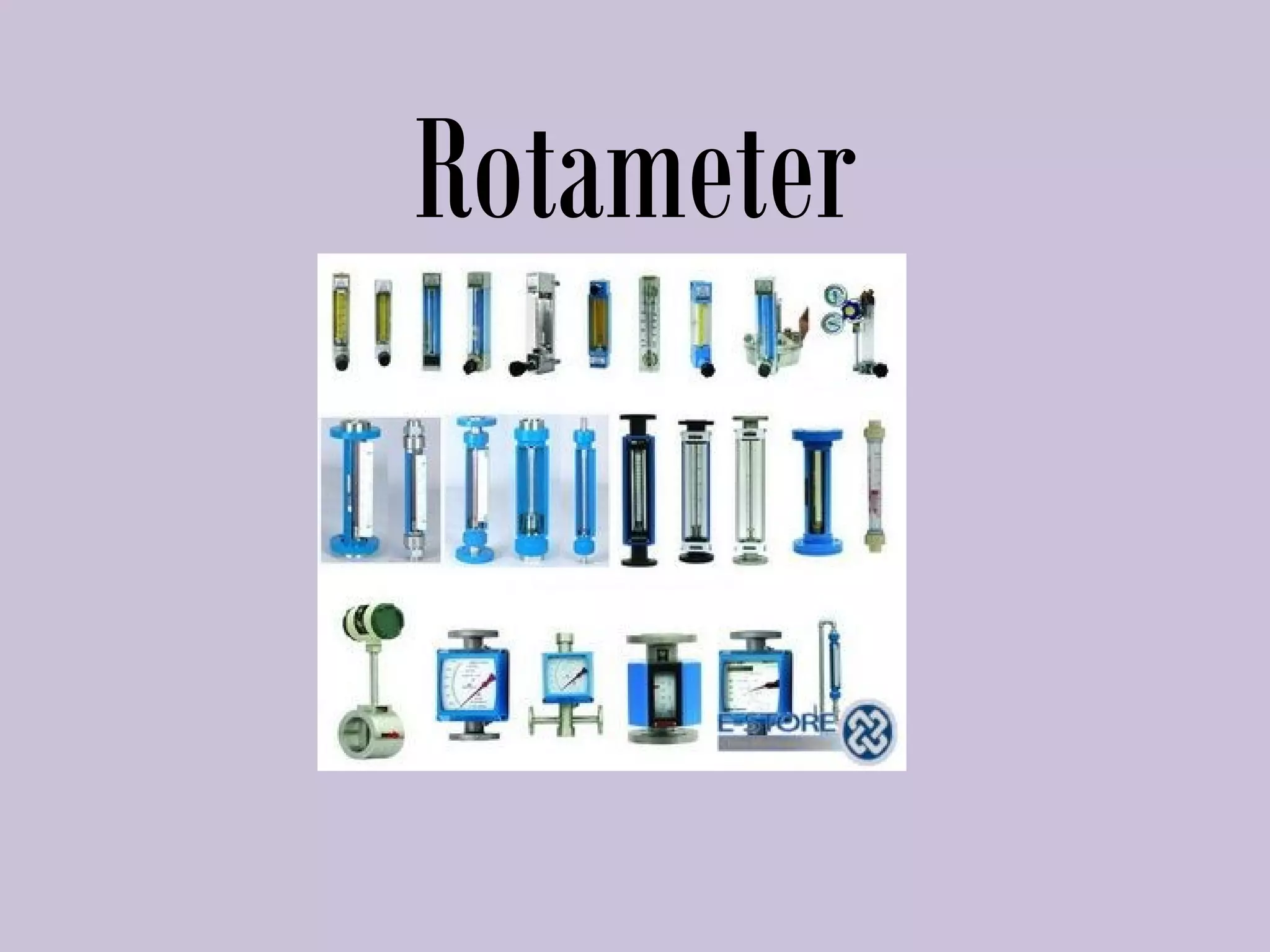
Rotameter
Rotameter: 
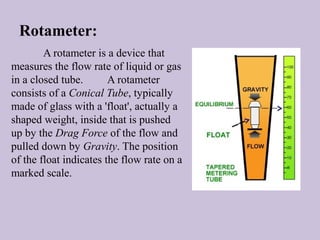
A rotameter is a device that 
measures the flow rate of liquid or gas 
in a closed tube. A rotameter 
consists of a Conical Tube, typically 
made of glass with a 'float', actually a 
shaped weight, inside that is pushed 
up by the Drag Force of the flow and 
pulled down by Gravity. The position 
of the float indicates the flow rate on a 
marked scale.
Working of Rotameter: 
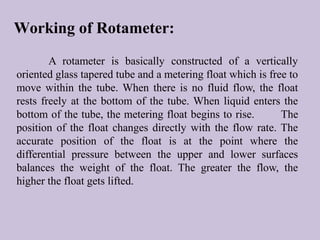
A rotameter is basically constructed of a vertically 
oriented glass tapered tube and a metering float which is free to 
move within the tube. When there is no fluid flow, the float 
rests freely at the bottom of the tube. When liquid enters the 
bottom of the tube, the metering float begins to rise. The 
position of the float changes directly with the flow rate. The 
accurate position of the float is at the point where the 
differential pressure between the upper and lower surfaces 
balances the weight of the float. The greater the flow, the 
higher the float gets lifted.
Advantages: 
•A rotameter requires no external power or fuel, it uses only the 
inherent properties of the fluid, along with gravity, to measure 
flow rate. 
•A rotameter is also a relatively simple device that can be mass 
manufactured out of cheap materials, allowing for its 
wide spread use. 
•Since the area of the flow passage increases as the float moves 
up the tube, the scale is approximately linear.
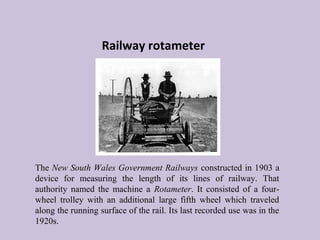
Railway rotameter 
The New South Wales Government Railways constructed in 1903 a 
device for measuring the length of its lines of railway. That 
authority named the machine a Rotameter. It consisted of a four-wheel 
trolley with an additional large fifth wheel which traveled 
along the running surface of the rail. Its last recorded use was in the 
1920s.
Venturimeter 
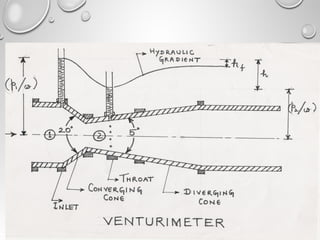
It is a device, which is used for measuring the 
rate of flow of fluid through a pipe. 
It consists of an 
• Inlet section followed by 
• Convergent section 
• A cylindrical throat and 
• A gradually divergent cone.
WORKING. 
AS THE CROSS SECTION OF THE THROAT 
IS SMALLER THAN THE CROSS 
SECTIONAL AREA OF THE INLET SECTION, 
THE VELOCITY OF FLOW AT THE THROAT 
WILL BECOME GREATER THAN THAT AT 
THE INLET SECTION, ACCORDING TO 
CONTINUITY EQUATION.
THE INCREASE IN THE VELOCITY OF FLOW AT THE 
THROAT RESULT IN DECREASE IN PRESSURE AT THIS 
SECTION. AS SUCH A PRESSURE IS DEVELOPED 
BETWEEN THE INLET SECTION AND THE THROAT OF 
VENTURIMETER. 
THIS PRESSURE DIFFERENCE CAN BE DETERMINED 
EITHER BY CONNECTING DIFFERENTIAL 
MANOMETER BETWEEN THE PRESSURE TAPS 
PROVIDED AT THESE SECTIONS OR BY CONNECTING 
THE SEPARATE PRESSURE GAUGE AT EACH OF THE 
PRESSURE TAPS. THE MEASURE OF THE PRESSURE 
DIFFERENCE BETWEEN THESE SECTIONS ENABLES 
THE RATE OF FLOW OF FLUID TO BE CALCULATED.
THE CROSS SECTIONAL AREA OF THE THROAT 
OF VENTURIMETER SHOULD NOT BE REDUCED 
UNTO A CERTAIN LIMIT, OTHERWISE THE 
PRESSURE AT THIS SECTION DROPS BELOW 
THE VAPOR PRESSURE OF THE FLOWING 
FLUID THAN THE FLOWING FLUID MAY 
VAPORIZE AND THE VAPOR POCKETS MAY BE 
FORMED IN THE LIQUID AT THIS SECTION.
Electromagnetic Flowmeters 
• Magnetic flowmeters have been widely used in industry 
for many years. 
• They are easy to install and use to the extent that 
existing pipes in a process can be turned into meters 
simply by adding external electrodes and suitable 
magnets. 
• They can measure reverse flows and are insensitive to 
viscosity, density, and flow disturbances. 
• Electromagnetic flowmeters can rapidly respond to 
flow changes and they are linear devices for a wide 
range of measurements. 
• The induced voltages in an electromagnetic flowmeter 
are linearly proportional to the mean velocity of liquids 
or to the volumetric flow rates.
• The accuracy of these meters can be as low as 0.25% and, in most 
applications, an accuracy of 1% is used. 
• At worst, 5% accuracy is obtained in some difficult applications 
where impurities of liquids and the contact resistances of the 
electrodes are inferior as in the case of low-purity sodium liquid 
solutions. 
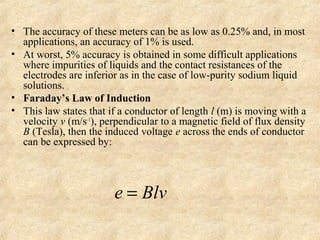
• Faraday’s Law of Induction 
• This law states that if a conductor of length l (m) is moving with a 
velocity v (m/s–1), perpendicular to a magnetic field of flux density 
B (Tesla), then the induced voltage e across the ends of conductor 
can be expressed by: 
e = Blv
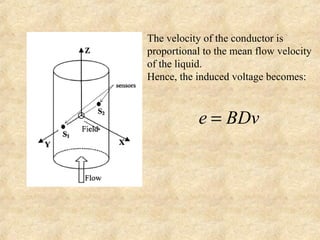
The velocity of the conductor is 
proportional to the mean flow velocity 
of the liquid. 
Hence, the induced voltage becomes: 
e = BDv
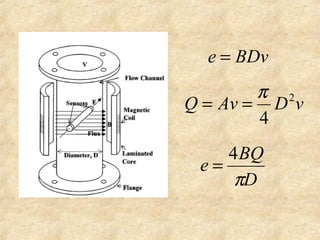
e = BDv 
Q = Av = p 
D2v 
4 
e BQ 
D 
= 4 
p
Positive Displacement Flowmeters 
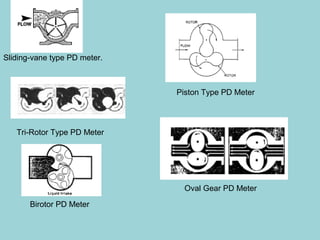
• A positive displacement flowmeter, commonly called a PD 
meter, measures the volume flow rate of a continuous flow 
stream by momentarily entrapping a segment of the fluid into 
a chamber of known volume and releasing that fluid back into 
the flow stream on the discharge side of the meter. 
• By monitoring the number of entrapments for a known period 
of time or number of entrapments per unit time, the total 
volume of flow or the flow rate of the stream can be 
ascertained. 
• The total volume and the flow rate can then be displayed 
locally or transmitted to a remote monitoring station.
Sliding-vane type PD meter. 
Tri-Rotor Type PD Meter 
Birotor PD Meter 
Piston Type PD Meter 
Oval Gear PD Meter
Advantages PD Meters 
• Advantages PD Meters 
• High-quality, high accuracy, a wide range, and are 
very reliable, insensitive to inlet flow profile 
distortions, low pressure drop across the meter. 
• Until the introduction of electronic correctors and 
flow controls on other types of meters, PD meters 
were most widely used in batch loading and 
dispensing applications. All mechanical units can be 
installed in remote locations.
Disadvantages PD Meters 
• bulky, especially in the larger sizes. 
• the fluid must be clean for measurement accuracy and 
longevity of themeter. 
• More accurate PD meters are quite expensive. 
• Have high inertia of the moving parts; a sudden change in the 
flow rate can damage the meter. 
• Only for limited ranges of pressure and temperature 
• Most PD meters require a good maintenance schedule and are 
high repair and maintenance meters. 
• Recurring costs in maintaining a positive displacement 
flowmeter can be a significant factor in overall flowmeter cost.

various flow meter

  • 1.
  • 2.
    Rotameter: A rotameteris a device that measures the flow rate of liquid or gas in a closed tube. A rotameter consists of a Conical Tube, typically made of glass with a 'float', actually a shaped weight, inside that is pushed up by the Drag Force of the flow and pulled down by Gravity. The position of the float indicates the flow rate on a marked scale.
  • 3.
    Working of Rotameter: A rotameter is basically constructed of a vertically oriented glass tapered tube and a metering float which is free to move within the tube. When there is no fluid flow, the float rests freely at the bottom of the tube. When liquid enters the bottom of the tube, the metering float begins to rise. The position of the float changes directly with the flow rate. The accurate position of the float is at the point where the differential pressure between the upper and lower surfaces balances the weight of the float. The greater the flow, the higher the float gets lifted.
  • 4.
    Advantages: •A rotameterrequires no external power or fuel, it uses only the inherent properties of the fluid, along with gravity, to measure flow rate. •A rotameter is also a relatively simple device that can be mass manufactured out of cheap materials, allowing for its wide spread use. •Since the area of the flow passage increases as the float moves up the tube, the scale is approximately linear.
  • 5.
    Railway rotameter TheNew South Wales Government Railways constructed in 1903 a device for measuring the length of its lines of railway. That authority named the machine a Rotameter. It consisted of a four-wheel trolley with an additional large fifth wheel which traveled along the running surface of the rail. Its last recorded use was in the 1920s.
  • 6.
    Venturimeter It isa device, which is used for measuring the rate of flow of fluid through a pipe. It consists of an • Inlet section followed by • Convergent section • A cylindrical throat and • A gradually divergent cone.
  • 7.
    WORKING. AS THECROSS SECTION OF THE THROAT IS SMALLER THAN THE CROSS SECTIONAL AREA OF THE INLET SECTION, THE VELOCITY OF FLOW AT THE THROAT WILL BECOME GREATER THAN THAT AT THE INLET SECTION, ACCORDING TO CONTINUITY EQUATION.
  • 8.
    THE INCREASE INTHE VELOCITY OF FLOW AT THE THROAT RESULT IN DECREASE IN PRESSURE AT THIS SECTION. AS SUCH A PRESSURE IS DEVELOPED BETWEEN THE INLET SECTION AND THE THROAT OF VENTURIMETER. THIS PRESSURE DIFFERENCE CAN BE DETERMINED EITHER BY CONNECTING DIFFERENTIAL MANOMETER BETWEEN THE PRESSURE TAPS PROVIDED AT THESE SECTIONS OR BY CONNECTING THE SEPARATE PRESSURE GAUGE AT EACH OF THE PRESSURE TAPS. THE MEASURE OF THE PRESSURE DIFFERENCE BETWEEN THESE SECTIONS ENABLES THE RATE OF FLOW OF FLUID TO BE CALCULATED.
  • 9.
    THE CROSS SECTIONALAREA OF THE THROAT OF VENTURIMETER SHOULD NOT BE REDUCED UNTO A CERTAIN LIMIT, OTHERWISE THE PRESSURE AT THIS SECTION DROPS BELOW THE VAPOR PRESSURE OF THE FLOWING FLUID THAN THE FLOWING FLUID MAY VAPORIZE AND THE VAPOR POCKETS MAY BE FORMED IN THE LIQUID AT THIS SECTION.
  • 11.
    Electromagnetic Flowmeters •Magnetic flowmeters have been widely used in industry for many years. • They are easy to install and use to the extent that existing pipes in a process can be turned into meters simply by adding external electrodes and suitable magnets. • They can measure reverse flows and are insensitive to viscosity, density, and flow disturbances. • Electromagnetic flowmeters can rapidly respond to flow changes and they are linear devices for a wide range of measurements. • The induced voltages in an electromagnetic flowmeter are linearly proportional to the mean velocity of liquids or to the volumetric flow rates.
  • 12.
    • The accuracyof these meters can be as low as 0.25% and, in most applications, an accuracy of 1% is used. • At worst, 5% accuracy is obtained in some difficult applications where impurities of liquids and the contact resistances of the electrodes are inferior as in the case of low-purity sodium liquid solutions. • Faraday’s Law of Induction • This law states that if a conductor of length l (m) is moving with a velocity v (m/s–1), perpendicular to a magnetic field of flux density B (Tesla), then the induced voltage e across the ends of conductor can be expressed by: e = Blv
  • 13.
    The velocity ofthe conductor is proportional to the mean flow velocity of the liquid. Hence, the induced voltage becomes: e = BDv
  • 14.
    e = BDv Q = Av = p D2v 4 e BQ D = 4 p
  • 15.
    Positive Displacement Flowmeters • A positive displacement flowmeter, commonly called a PD meter, measures the volume flow rate of a continuous flow stream by momentarily entrapping a segment of the fluid into a chamber of known volume and releasing that fluid back into the flow stream on the discharge side of the meter. • By monitoring the number of entrapments for a known period of time or number of entrapments per unit time, the total volume of flow or the flow rate of the stream can be ascertained. • The total volume and the flow rate can then be displayed locally or transmitted to a remote monitoring station.
  • 16.
    Sliding-vane type PDmeter. Tri-Rotor Type PD Meter Birotor PD Meter Piston Type PD Meter Oval Gear PD Meter
  • 17.
    Advantages PD Meters • Advantages PD Meters • High-quality, high accuracy, a wide range, and are very reliable, insensitive to inlet flow profile distortions, low pressure drop across the meter. • Until the introduction of electronic correctors and flow controls on other types of meters, PD meters were most widely used in batch loading and dispensing applications. All mechanical units can be installed in remote locations.
  • 18.
    Disadvantages PD Meters • bulky, especially in the larger sizes. • the fluid must be clean for measurement accuracy and longevity of themeter. • More accurate PD meters are quite expensive. • Have high inertia of the moving parts; a sudden change in the flow rate can damage the meter. • Only for limited ranges of pressure and temperature • Most PD meters require a good maintenance schedule and are high repair and maintenance meters. • Recurring costs in maintaining a positive displacement flowmeter can be a significant factor in overall flowmeter cost.