65- Anish Nagmotii
66- Nikita Najan
67- Hitesh Nikam
68- Sarthak Nikam
69- Aditya Pagar
70- Vaishnavi Pagar
71- Mayuri Pagare
72- Bhushan Palve
OBJLECTIVES :
(A) introduction of cycloalkane
*nomenclature of cycloalkane
*Preparation of cycloalkane
*Physical properties of cycloalkane
(B) Baeyer’sstarintheory & it’s limitations
(C) coulsonMoffittmodification
(D) Sachse Mohr's theory
(E ) Reactionof cycloalkanes
* Introduction *
* Cycloalkanes or cycloparaffins are saturated
hydrocarbons in which the carbon atoms are joined by
single covalent bonds to form a ring
* The Unsubstituted cycloalkanes forms homologous
series with the general formula CnH2n
* sp³ hybridisation
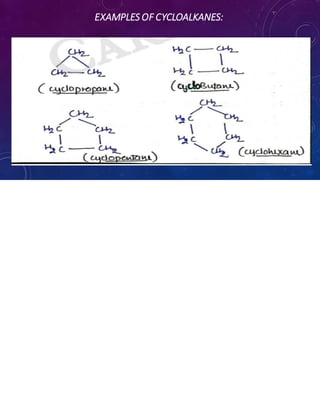
EXAMPLES OF CYCLOALKANES:
*Nomenclature*
*The name of an unsubstituted cycloalkane is
obtained by attaching the prefix cyclo. to the name of the
corresponding normal alkane having the same number of
carbon atoms as in the ring.
*Substituent's on the ring are named, and their
positions are indicated by numbers. The ring is numbered so
that the carbon bearing the substituent’s will have lowest
possible number.
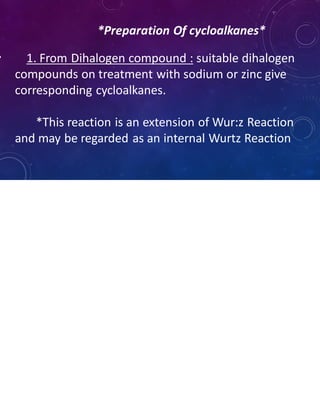
*Preparation Of cycloalkanes*
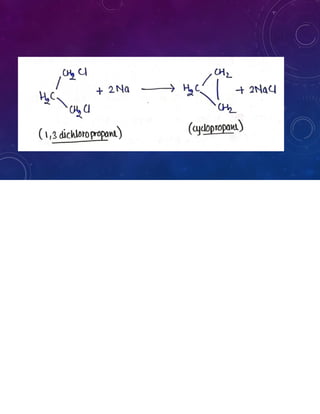
• 1. From Dihalogen compound : suitable dihalogen
compounds on treatment with sodium or zinc give
corresponding cycloalkanes.
*This reaction is an extension of Wur:z Reaction
and may be regarded as an internal Wurtz Reaction
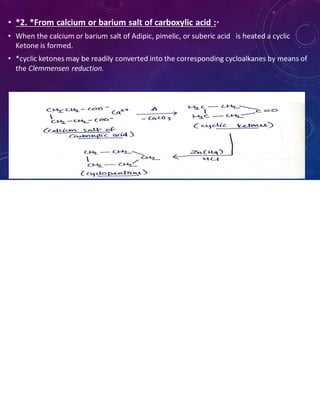
• *2. *From calcium or barium salt of carboxylic acid :*
• When the calcium or barium salt of Adipic, pimelic, or suberic acid is heated a cyclic
Ketone is formed.
• *cyclic ketones may be readily converted into the corresponding cycloalkanes by means of
the Clemmensen reduction.
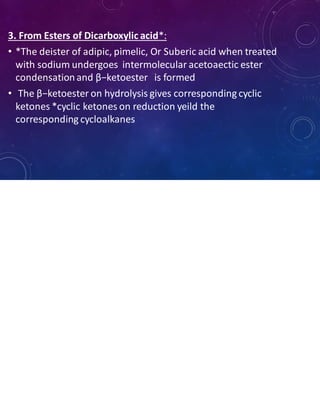
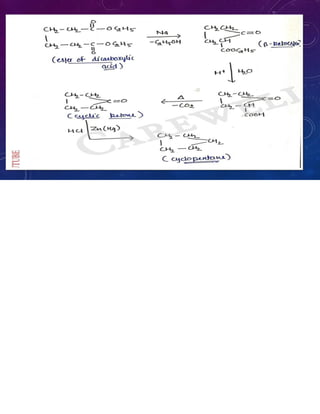
3. From Esters of Dicarboxylic acid*:
• *The deister of adipic, pimelic, Or Suberic acid when treated
with sodium undergoes intermolecular acetoaectic ester
condensationand β−ketoester is formed
• The β−ketoester on hydrolysis gives corresponding cyclic
ketones *cyclic ketones on reduction yeild the
corresponding cycloalkanes
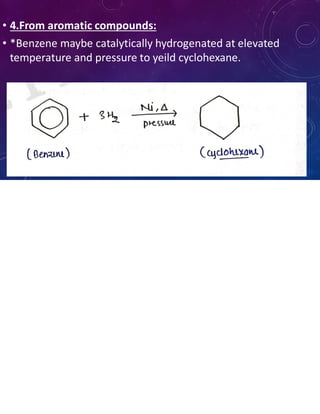
• 4.From aromatic compounds:
• *Benzene maybe catalytically hydrogenated at elevated
temperature and pressure to yeild cyclohexane.
*PHYSICAL PROPERTIES*
1). Cyclopropane and cyclobutane are gases at ordinary temperatures;
the remaining cycloalkanes are liquids. Their melting points and boiling
points show a gradual rise with the increase in molecular weight.
(2) They are all lighter than water; the series has a limiting destiny of less
than 09.
(3) They are insoluble in water but are soluble in organic solvents such
as ethers and alcohols.
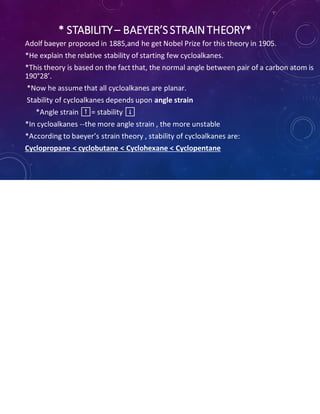
* STABILITY– BAEYER’SSTRAIN THEORY*
Adolf baeyer proposed in 1885,and he get Nobel Prize for this theory in 1905.
*He explain the relative stability of starting few cycloalkanes.
*This theory is based on the fact that, the normal angle between pair of a carbon atom is
190°28’.
*Now he assume that all cycloalkanes are planar.
Stability of cycloalkanes depends upon angle strain
*Angle strain ⬆️= stability ⬇️
*In cycloalkanes --the more angle strain , the more unstable
*According to baeyer’s strain theory , stability of cycloalkanes are:
Cyclopropane < cyclobutane < Cyclohexane < Cyclopentane
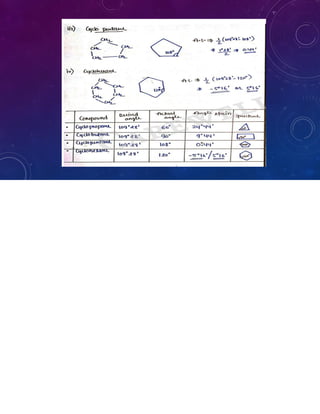
Angle strain: It is angle difference between desire angle (109°28’)
and actual angle.
* Angle strain =1/2 [desire angle –actual angle]
=1/2[ 109°28’-actual angle]
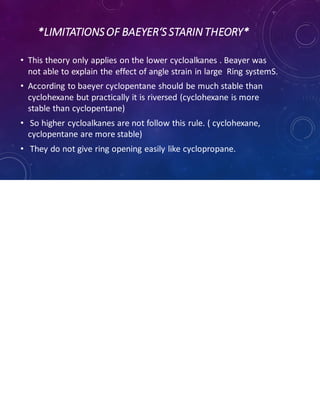
*LIMITATIONSOF BAEYER‘S STARIN THEORY*
• This theory only applies on the lower cycloalkanes . Beayer was
not able to explain the effect of angle strain in large Ring systemS.
• According to baeyer cyclopentane should be much stable than
cyclohexane but practically it is riversed (cyclohexane is more
stable than cyclopentane)
• So higher cycloalkanes are not follow this rule. ( cyclohexane,
cyclopentane are more stable)
• They do not give ring opening easily like cyclopropane.
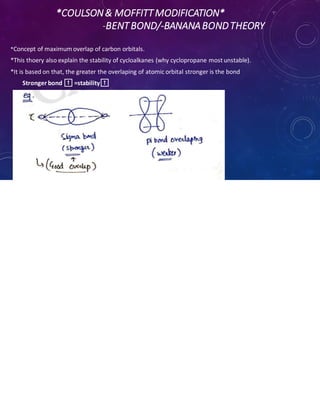
*COULSON& MOFFITTMODIFICATION*
-BENTBOND/-BANANABONDTHEORY
*Concept of maximum overlap of carbon orbitals.
*This thoery also explain the stability of cycloalkanes (why cyclopropane mostunstable).
*It is based on that, the greater the overlaping of atomic orbital stronger is the bond
Stronger bond ⬆️ =stability⬆️
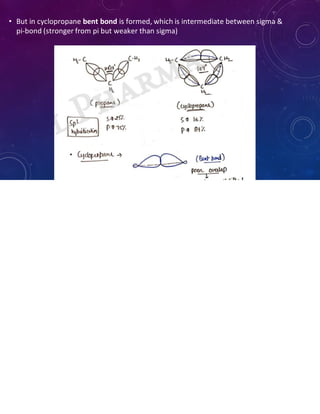
• But in cyclopropane bent bond is formed, which is intermediate between sigma &
pi-bond (stronger from pi but weaker than sigma)
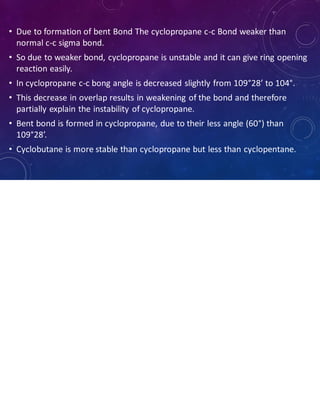
• Due to formation of bent Bond The cyclopropane c-c Bond weaker than
normal c-c sigma bond.
• So due to weaker bond, cyclopropane is unstable and it can give ring opening
reaction easily.
• In cyclopropane c-c bong angle is decreased slightly from 109°28’ to 104°.
• This decrease in overlap results in weakening of the bond and therefore
partially explain the instability of cyclopropane.
• Bent bond is formed in cyclopropane, due to their less angle (60°) than
109°28’.
• Cyclobutane is more stable than cyclopropane but less than cyclopentane.
*SACHSE-MOHRTHEORY*
(THEORY OF STAINLESSRINGS)
• Sachse and mohr proposed this theory in 1918 to explain about the stability ofcyclohexane
and higher cycloalkanes.
• According to baeyer’s members higher than cyclopentane should be increase single unstable
(limitations). But according to sachse-Mohrtheory –Cycloalkanes are not in a plane (co-
planer)
• Sachse Mohr’s theory proposed that higher member ring can free from starin if all the ring
carbon are not forced into one plan.
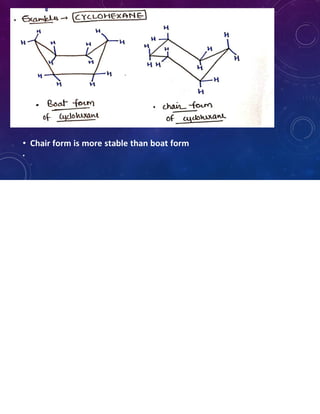
• They exhibit in two non-polar ‘folder or ‘puckered’ confirmation both of which are
completely free from starin.
• These are stainless as the carbon atom lie in different planes and the normal angle (109°28’)
is retained.
• Chair form is more stable than boat form
•
*CHEMICALREACTIONOF CYCLOALKANES*
Cycloalkanes gives two reactions:
1). Substitution reaction
2). Addition reaction(Ring opening reaction )
1) Substitution reaction: in this reaction one hydrogen atom replaced but ring does not
affected
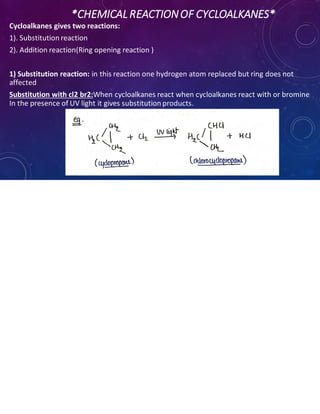
Substitution with cl2 br2:When cycloalkanes react when cycloalkanes react with or bromine
In the presence of UV light it gives substitution products.
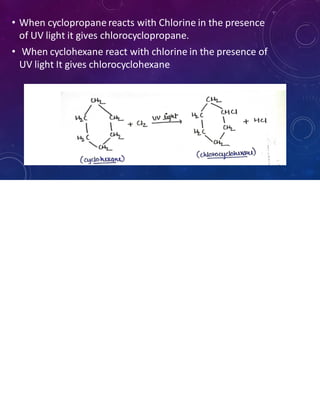
• When cyclopropane reacts with Chlorine in the presence
of UV light it gives chlorocyclopropane.
• When cyclohexane react with chlorine in the presence of
UV light It gives chlorocyclohexane
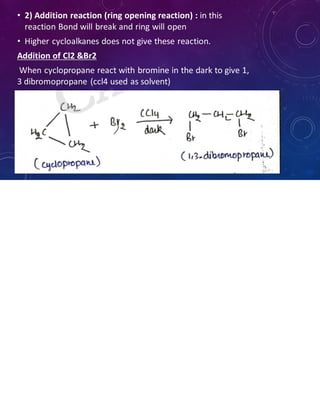
• 2) Addition reaction (ring opening reaction) : in this
reaction Bond will break and ring will open
• Higher cycloalkanes does not give these reaction.
Addition of Cl2 &Br2
When cyclopropane react with bromine in the dark to give 1,
3 dibromopropane (ccl4 used as solvent)
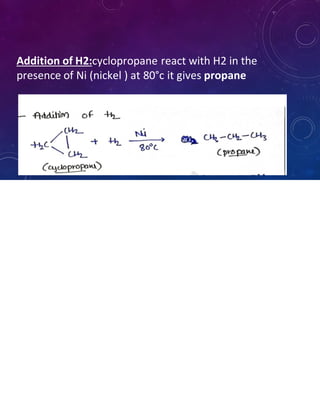
Addition of H2:cyclopropane react with H2 in the
presence of Ni (nickel ) at 80°c it gives propane
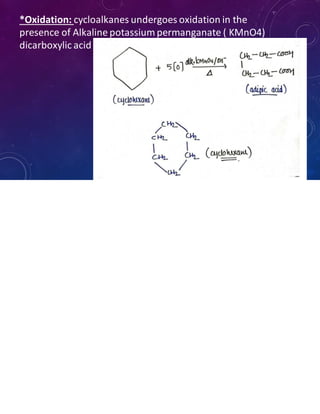
*Oxidation: cycloalkanes undergoes oxidation in the
presence of Alkaline potassium permanganate ( KMnO4)
dicarboxylic acid
THANK YOU

Cycloalkanes

  • 1.
    65- Anish Nagmotii 66-Nikita Najan 67- Hitesh Nikam 68- Sarthak Nikam 69- Aditya Pagar 70- Vaishnavi Pagar 71- Mayuri Pagare 72- Bhushan Palve
  • 2.
    OBJLECTIVES : (A) introductionof cycloalkane *nomenclature of cycloalkane *Preparation of cycloalkane *Physical properties of cycloalkane (B) Baeyer’sstarintheory & it’s limitations (C) coulsonMoffittmodification (D) Sachse Mohr's theory (E ) Reactionof cycloalkanes
  • 3.
    * Introduction * *Cycloalkanes or cycloparaffins are saturated hydrocarbons in which the carbon atoms are joined by single covalent bonds to form a ring * The Unsubstituted cycloalkanes forms homologous series with the general formula CnH2n * sp³ hybridisation
  • 4.
  • 5.
    *Nomenclature* *The name ofan unsubstituted cycloalkane is obtained by attaching the prefix cyclo. to the name of the corresponding normal alkane having the same number of carbon atoms as in the ring. *Substituent's on the ring are named, and their positions are indicated by numbers. The ring is numbered so that the carbon bearing the substituent’s will have lowest possible number.
  • 6.
    *Preparation Of cycloalkanes* •1. From Dihalogen compound : suitable dihalogen compounds on treatment with sodium or zinc give corresponding cycloalkanes. *This reaction is an extension of Wur:z Reaction and may be regarded as an internal Wurtz Reaction
  • 8.
    • *2. *Fromcalcium or barium salt of carboxylic acid :* • When the calcium or barium salt of Adipic, pimelic, or suberic acid is heated a cyclic Ketone is formed. • *cyclic ketones may be readily converted into the corresponding cycloalkanes by means of the Clemmensen reduction.
  • 9.
    3. From Estersof Dicarboxylic acid*: • *The deister of adipic, pimelic, Or Suberic acid when treated with sodium undergoes intermolecular acetoaectic ester condensationand β−ketoester is formed • The β−ketoester on hydrolysis gives corresponding cyclic ketones *cyclic ketones on reduction yeild the corresponding cycloalkanes
  • 11.
    • 4.From aromaticcompounds: • *Benzene maybe catalytically hydrogenated at elevated temperature and pressure to yeild cyclohexane.
  • 12.
    *PHYSICAL PROPERTIES* 1). Cyclopropaneand cyclobutane are gases at ordinary temperatures; the remaining cycloalkanes are liquids. Their melting points and boiling points show a gradual rise with the increase in molecular weight. (2) They are all lighter than water; the series has a limiting destiny of less than 09. (3) They are insoluble in water but are soluble in organic solvents such as ethers and alcohols.
  • 13.
    * STABILITY– BAEYER’SSTRAINTHEORY* Adolf baeyer proposed in 1885,and he get Nobel Prize for this theory in 1905. *He explain the relative stability of starting few cycloalkanes. *This theory is based on the fact that, the normal angle between pair of a carbon atom is 190°28’. *Now he assume that all cycloalkanes are planar. Stability of cycloalkanes depends upon angle strain *Angle strain ⬆️= stability ⬇️ *In cycloalkanes --the more angle strain , the more unstable *According to baeyer’s strain theory , stability of cycloalkanes are: Cyclopropane < cyclobutane < Cyclohexane < Cyclopentane
  • 14.
    Angle strain: Itis angle difference between desire angle (109°28’) and actual angle. * Angle strain =1/2 [desire angle –actual angle] =1/2[ 109°28’-actual angle]
  • 16.
    *LIMITATIONSOF BAEYER‘S STARINTHEORY* • This theory only applies on the lower cycloalkanes . Beayer was not able to explain the effect of angle strain in large Ring systemS. • According to baeyer cyclopentane should be much stable than cyclohexane but practically it is riversed (cyclohexane is more stable than cyclopentane) • So higher cycloalkanes are not follow this rule. ( cyclohexane, cyclopentane are more stable) • They do not give ring opening easily like cyclopropane.
  • 17.
    *COULSON& MOFFITTMODIFICATION* -BENTBOND/-BANANABONDTHEORY *Concept ofmaximum overlap of carbon orbitals. *This thoery also explain the stability of cycloalkanes (why cyclopropane mostunstable). *It is based on that, the greater the overlaping of atomic orbital stronger is the bond Stronger bond ⬆️ =stability⬆️
  • 18.
    • But incyclopropane bent bond is formed, which is intermediate between sigma & pi-bond (stronger from pi but weaker than sigma)
  • 19.
    • Due toformation of bent Bond The cyclopropane c-c Bond weaker than normal c-c sigma bond. • So due to weaker bond, cyclopropane is unstable and it can give ring opening reaction easily. • In cyclopropane c-c bong angle is decreased slightly from 109°28’ to 104°. • This decrease in overlap results in weakening of the bond and therefore partially explain the instability of cyclopropane. • Bent bond is formed in cyclopropane, due to their less angle (60°) than 109°28’. • Cyclobutane is more stable than cyclopropane but less than cyclopentane.
  • 20.
    *SACHSE-MOHRTHEORY* (THEORY OF STAINLESSRINGS) •Sachse and mohr proposed this theory in 1918 to explain about the stability ofcyclohexane and higher cycloalkanes. • According to baeyer’s members higher than cyclopentane should be increase single unstable (limitations). But according to sachse-Mohrtheory –Cycloalkanes are not in a plane (co- planer) • Sachse Mohr’s theory proposed that higher member ring can free from starin if all the ring carbon are not forced into one plan. • They exhibit in two non-polar ‘folder or ‘puckered’ confirmation both of which are completely free from starin. • These are stainless as the carbon atom lie in different planes and the normal angle (109°28’) is retained.
  • 21.
    • Chair formis more stable than boat form •
  • 22.
    *CHEMICALREACTIONOF CYCLOALKANES* Cycloalkanes givestwo reactions: 1). Substitution reaction 2). Addition reaction(Ring opening reaction ) 1) Substitution reaction: in this reaction one hydrogen atom replaced but ring does not affected Substitution with cl2 br2:When cycloalkanes react when cycloalkanes react with or bromine In the presence of UV light it gives substitution products.
  • 23.
    • When cyclopropanereacts with Chlorine in the presence of UV light it gives chlorocyclopropane. • When cyclohexane react with chlorine in the presence of UV light It gives chlorocyclohexane
  • 24.
    • 2) Additionreaction (ring opening reaction) : in this reaction Bond will break and ring will open • Higher cycloalkanes does not give these reaction. Addition of Cl2 &Br2 When cyclopropane react with bromine in the dark to give 1, 3 dibromopropane (ccl4 used as solvent)
  • 25.
    Addition of H2:cyclopropanereact with H2 in the presence of Ni (nickel ) at 80°c it gives propane
  • 26.
    *Oxidation: cycloalkanes undergoesoxidation in the presence of Alkaline potassium permanganate ( KMnO4) dicarboxylic acid
  • 27.