Alcohols
P.M. Jadhav
Assistant Professor
Dept. of Chemistry
M.S.P. Mandals, Shri Muktanand college,
Gangapur, Dist: Aurangabad.
Alcohols
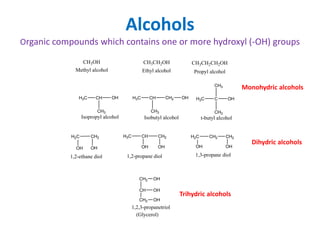
Organic compounds which contains one or more hydroxyl (-OH) groups
CH3OH CH3CH2OH CH3CH2CH2OH
Ethyl alcoholMethyl alcohol Propyl alcohol
CHH3C
CH3
OH CHH3C
CH3
CH2 OH
Isobutyl alcoholIsopropyl alcohol
CH3C
CH3
CH3
OH
t-butyl alcohol
H2C
OH
CH2
1,2-ethane diol
OH
H3C CH
OH
CH2
OH
H2C CH2 CH2
OH OH
1,2-propane diol 1,3-propane diol
CH2
CH
CH2 OH
OH
OH
1,2,3-propanetriol
(Glycerol)
Monohydric alcohols
Dihydric alcohols
Trihydric alcohols
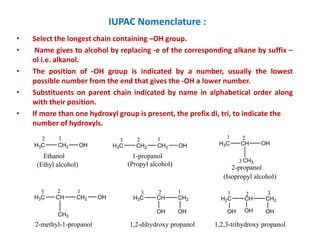
IUPAC Nomenclature :
• Select the longest chain containing –OH group.
• Name gives to alcohol by replacing -e of the corresponding alkane by suffix –
ol i.e. alkanol.
• The position of -OH group is indicated by a number, usually the lowest
possible number from the end that gives the -OH a lower number.
• Substituents on parent chain indicated by name in alphabetical order along
with their position.
• If more than one hydroxyl group is present, the prefix di, tri, to indicate the
number of hydroxyls.
(Ethyl alcohol) (Propyl alcohol)
CHH3C
CH3
OH
CHH3C
CH3
CH2 OH
(Isopropyl alcohol)
H3C CH2 OH H3C CH2 CH2 OH
12 123
Ethanol 1-propanol
1 2
3
2-propanol
123
2-methyl-1-propanol
H3C CH
OH
CH2
OH
H2C CH CH2
OH OH
1,2-dihydroxy propanol 1,2,3-trihydroxy propanol
123
OH
1 2 3
Preparation methods:
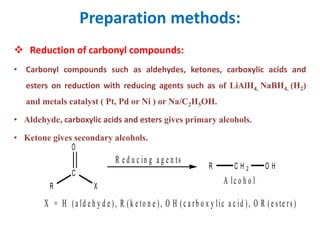
 Reduction of carbonyl compounds:
• Carbonyl compounds such as aldehydes, ketones, carboxylic acids and
esters on reduction with reducing agents such as of LiAlH4, NaBH4, (H2)
and metals catalyst ( Pt, Pd or Ni ) or Na/C2H5OH.
• Aldehyde, carboxylic acids and esters gives primary alcohols.
• Ketone gives secondary alcohols.
R
C
X
O
R C H 2 O H
A lc o h o l
R e d u c in g a g e n ts
X = H (a ld e h y d e ), R (k e to n e ), O H (c a rb o x y lic a c id ), O R (e s te rs )
Acidic nature of alcohol:
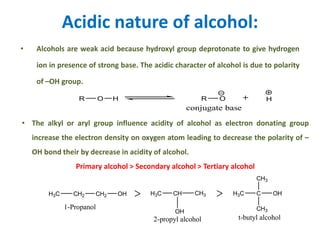
• Alcohols are weak acid because hydroxyl group deprotonate to give hydrogen
ion in presence of strong base. The acidic character of alcohol is due to polarity
of –OH group.
R O H R O H
conjugate base
• The alkyl or aryl group influence acidity of alcohol as electron donating group
increase the electron density on oxygen atom leading to decrease the polarity of –
OH bond their by decrease in acidity of alcohol.
Primary alcohol > Secondary alcohol > Tertiary alcohol
H3C CH2 CH2 OH
1-Propanol
CH3C
CH3
CH3
OH
t-butyl alcohol
CHH3C
OH
CH3
2-propyl alcohol
Chemical Reactions:
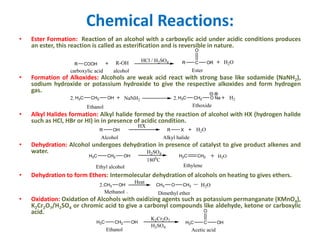
• Ester Formation: Reaction of an alcohol with a carboxylic acid under acidic conditions produces
an ester, this reaction is called as esterification and is reversible in nature.
• Formation of Alkoxides: Alcohols are weak acid react with strong base like sodamide (NaNH2),
sodium hydroxide or potassium hydroxide to give the respective alkoxides and form hydrogen
gas.
• Alkyl Halides formation: Alkyl halide formed by the reaction of alcohol with HX (hydrogen halide
such as HCl, HBr or HI) in in presence of acidic condition.
• Dehydration: Alcohol undergoes dehydration in presence of catalyst to give product alkenes and
water.
• Dehydration to form Ethers: Intermolecular dehydration of alcohols on heating to gives ethers.
• Oxidation: Oxidation of Alcohols with oxidizing agents such as potassium permanganate (KMnO4),
K2Cr2O7/H2SO4 or chromic acid to give a carbonyl compounds like aldehyde, ketone or carboxylic
acid.
R C OR
O
R-OHR COOH
Ester
HCl / H2SO4 H2O
carboxylic acid alcohol
H3C CH2 OH
Ethanol
NaNH2 H3C CH2 O Na H2
Ethoxide
2. 2.
R OH
HX
R X H2O
Alcohol Alkyl halide
H3C CH2 OH H2C CH2
1800
C
H2SO4
H2O
Ethyl alcohol Ethylene
Ethanol
K2Cr2O7
H2SO4
H3C CH2 OH H3C C OH
O
Acetic acid
CH3 OH CH3 O CH32.
Heat
Methanol Dimethyl ether
H2O
Physical Properties of Alcohols:
• Hydrogen Bonding: The polar -OH group forms hydrogen bonds because the
partial positive charge on H atom of the -OH group has no electrons other than
the electron pair in the O-H bond, it interacts with unshared electron pairs on
oxygen atoms of neighboring alcohol molecules and forms a weak hydrogen bond
with a partially negative oxygen atom of a neighboring alcohol molecule.
• Boiling Point: Alcohols forms hydrogen bond to each other, they have higher
boiling points than alkanes. The boiling point of alcohols increases as the
molecules become larger.
• Solubility: Alcohols are soluble in water. The presence of hydroxyl group in
alcohol which is able to forms hydrogen bonds with water molecules.
• Polarity: Alcohol is polar due to its hydrogen bonding ability and the presence of
oxygen atom in the molecule.
• Viscosity: The viscosity of alcohol increases as the size of molecule increase.
R O H O
H
R
H O R
H O R
Intramolecular Hydrogen bonding
R O H O
H
H
H O H
H O R
Intermolecular Hydrogen bonding
(alcohol & water)
Thank You

Alcohol

  • 1.
    Alcohols P.M. Jadhav Assistant Professor Dept.of Chemistry M.S.P. Mandals, Shri Muktanand college, Gangapur, Dist: Aurangabad.
  • 2.
    Alcohols Organic compounds whichcontains one or more hydroxyl (-OH) groups CH3OH CH3CH2OH CH3CH2CH2OH Ethyl alcoholMethyl alcohol Propyl alcohol CHH3C CH3 OH CHH3C CH3 CH2 OH Isobutyl alcoholIsopropyl alcohol CH3C CH3 CH3 OH t-butyl alcohol H2C OH CH2 1,2-ethane diol OH H3C CH OH CH2 OH H2C CH2 CH2 OH OH 1,2-propane diol 1,3-propane diol CH2 CH CH2 OH OH OH 1,2,3-propanetriol (Glycerol) Monohydric alcohols Dihydric alcohols Trihydric alcohols
  • 3.
    IUPAC Nomenclature : •Select the longest chain containing –OH group. • Name gives to alcohol by replacing -e of the corresponding alkane by suffix – ol i.e. alkanol. • The position of -OH group is indicated by a number, usually the lowest possible number from the end that gives the -OH a lower number. • Substituents on parent chain indicated by name in alphabetical order along with their position. • If more than one hydroxyl group is present, the prefix di, tri, to indicate the number of hydroxyls. (Ethyl alcohol) (Propyl alcohol) CHH3C CH3 OH CHH3C CH3 CH2 OH (Isopropyl alcohol) H3C CH2 OH H3C CH2 CH2 OH 12 123 Ethanol 1-propanol 1 2 3 2-propanol 123 2-methyl-1-propanol H3C CH OH CH2 OH H2C CH CH2 OH OH 1,2-dihydroxy propanol 1,2,3-trihydroxy propanol 123 OH 1 2 3
  • 4.
    Preparation methods:  Reductionof carbonyl compounds: • Carbonyl compounds such as aldehydes, ketones, carboxylic acids and esters on reduction with reducing agents such as of LiAlH4, NaBH4, (H2) and metals catalyst ( Pt, Pd or Ni ) or Na/C2H5OH. • Aldehyde, carboxylic acids and esters gives primary alcohols. • Ketone gives secondary alcohols. R C X O R C H 2 O H A lc o h o l R e d u c in g a g e n ts X = H (a ld e h y d e ), R (k e to n e ), O H (c a rb o x y lic a c id ), O R (e s te rs )
  • 5.
    Acidic nature ofalcohol: • Alcohols are weak acid because hydroxyl group deprotonate to give hydrogen ion in presence of strong base. The acidic character of alcohol is due to polarity of –OH group. R O H R O H conjugate base • The alkyl or aryl group influence acidity of alcohol as electron donating group increase the electron density on oxygen atom leading to decrease the polarity of – OH bond their by decrease in acidity of alcohol. Primary alcohol > Secondary alcohol > Tertiary alcohol H3C CH2 CH2 OH 1-Propanol CH3C CH3 CH3 OH t-butyl alcohol CHH3C OH CH3 2-propyl alcohol
  • 6.
    Chemical Reactions: • EsterFormation: Reaction of an alcohol with a carboxylic acid under acidic conditions produces an ester, this reaction is called as esterification and is reversible in nature. • Formation of Alkoxides: Alcohols are weak acid react with strong base like sodamide (NaNH2), sodium hydroxide or potassium hydroxide to give the respective alkoxides and form hydrogen gas. • Alkyl Halides formation: Alkyl halide formed by the reaction of alcohol with HX (hydrogen halide such as HCl, HBr or HI) in in presence of acidic condition. • Dehydration: Alcohol undergoes dehydration in presence of catalyst to give product alkenes and water. • Dehydration to form Ethers: Intermolecular dehydration of alcohols on heating to gives ethers. • Oxidation: Oxidation of Alcohols with oxidizing agents such as potassium permanganate (KMnO4), K2Cr2O7/H2SO4 or chromic acid to give a carbonyl compounds like aldehyde, ketone or carboxylic acid. R C OR O R-OHR COOH Ester HCl / H2SO4 H2O carboxylic acid alcohol H3C CH2 OH Ethanol NaNH2 H3C CH2 O Na H2 Ethoxide 2. 2. R OH HX R X H2O Alcohol Alkyl halide H3C CH2 OH H2C CH2 1800 C H2SO4 H2O Ethyl alcohol Ethylene Ethanol K2Cr2O7 H2SO4 H3C CH2 OH H3C C OH O Acetic acid CH3 OH CH3 O CH32. Heat Methanol Dimethyl ether H2O
  • 7.
    Physical Properties ofAlcohols: • Hydrogen Bonding: The polar -OH group forms hydrogen bonds because the partial positive charge on H atom of the -OH group has no electrons other than the electron pair in the O-H bond, it interacts with unshared electron pairs on oxygen atoms of neighboring alcohol molecules and forms a weak hydrogen bond with a partially negative oxygen atom of a neighboring alcohol molecule. • Boiling Point: Alcohols forms hydrogen bond to each other, they have higher boiling points than alkanes. The boiling point of alcohols increases as the molecules become larger. • Solubility: Alcohols are soluble in water. The presence of hydroxyl group in alcohol which is able to forms hydrogen bonds with water molecules. • Polarity: Alcohol is polar due to its hydrogen bonding ability and the presence of oxygen atom in the molecule. • Viscosity: The viscosity of alcohol increases as the size of molecule increase. R O H O H R H O R H O R Intramolecular Hydrogen bonding R O H O H H H O H H O R Intermolecular Hydrogen bonding (alcohol & water)
  • 8.