
Plant Nomenclature
National workshop on Grass Systematics
Sharad Suresh Kambale
Assistant Professor,
Department of Botany,
Maratha Vidya Prasarak Samaj’s Arts, Commerce
& Science College, Tryambakeshwar,
Nashik- 422212.
Email: skambalesu@gmail.com
Contact no.: 09623127314
Nomenclature?
Giving names to plants, algae and fungi.
How we give names to plants?
International Code of Nomenclature for algae,
fungi, and plants (ICN)
(Earlier International Code of Botanical Nomenclature, ICBN)
What we can name by using ICN?
Land plants, "algae," and fungi (+slime molds, water
molds)
Scientific name?
 The names assigned by the rules of the ICN
 In Latin language
Usually italicized or underlined, or bolded
 E.g., Hubbardia, Jansenella, Apluda
Binomials
E.g., Themeda pseudotremula Potdar, Salunkhe & S.R.Yadav
Themeda = genus name (capitalized)
pseudotremula =
Themeda pseudotremula = species name
Potdar, Salunkhe & S.R.Yadav = authors
Linnaeus: consistently used binomials
specific epithet (not capitalized)
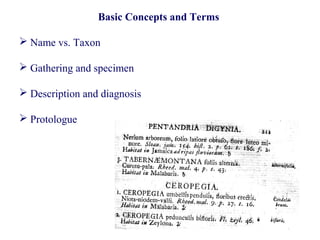
Basic Concepts and Terms
 Name vs. Taxon
 Gathering and specimen
 Description and diagnosis
 Protologue
Legitimate Names: in accordance with the rules of the ICN
 Illegitimate Names: violate one or more rules of the ICN
 Homonyms
 Isonyms
 Circumscription
 Tautonyms
= a heterotypic synonym, based on a different type
≡ a homotypic synonym, based on the same type
ICN Governs two basic activities:
1) Naming new taxa
2) Determining the correct name for previously
named taxa
Principles of Plant Nomenclature
1) Botanical nomenclature is independent of Zoological
and Bacteriological nomenclature.
2) The application of botanical names is determined by
means of nomenclatural types.
3) Botanical nomenclature is based upon priority of
publication.
4) Each taxon of a particular circumscription, position, and rank
can have only one correct name, the earliest in accordance with
the rules. [=Fundamental Principle!]
5) Scientific names are treated as Latin.
6) The rules and regulations of the International Code of
Botanical Nomenclature are retroactive.
Why not Common names?
1) Scientific names are universal, used the same world-wide.
2) Common names are not consistent.
a) A taxon may have more than one common name (e.g
Woodbine, Morning Glory for Ipomoea)
b) One common name to more than one taxon (e.g., “Salai”
(Konkani) for Aporosa lindleyana and Ehretia indica).
3) Common names tell nothing about rank; scientific names do.
4) Many, if not most, organisms have no common name in any
language.
Rank?
Hierarchical classification in which a higher rank
is inclusive of all lower ranks.
Position?
Placement of a taxon as a member within particular genus or species
E.g., Apluda & Cyperus of same rank (genus) but different positions
(Poaceae & Cyperaceae)
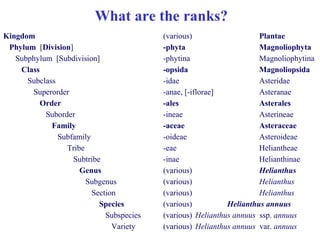
What are the ranks?
Kingdom (various) Plantae
Phylum [Division] -phyta Magnoliophyta
Subphylum [Subdivision] -phytina Magnoliophytina
Class -opsida Magnoliopsida
Subclass -idae Asteridae
Superorder -anae, [-iflorae] Asteranae
Order -ales Asterales
Suborder -ineae Asterineae
Family -aceae Asteraceae
Subfamily -oideae Asteroideae
Tribe -eae Heliantheae
Subtribe -inae Helianthinae
Genus (various) Helianthus
Subgenus (various) Helianthus
Section (various) Helianthus
Species (various) Helianthus annuus
Subspecies (various) Helianthus annuus ssp. annuus
Variety (various) Helianthus annuus var. annuus
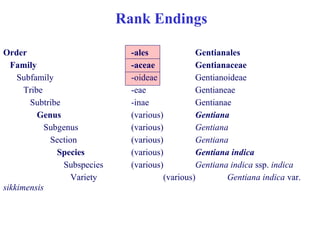
Rank Endings
Order -ales Gentianales
Family -aceae Gentianaceae
Subfamily -oideae Gentianoideae
Tribe -eae Gentianeae
Subtribe -inae Gentianae
Genus (various) Gentiana
Subgenus (various) Gentiana
Section (various) Gentiana
Species (various) Gentiana indica
Subspecies (various) Gentiana indica ssp. indica
Variety (various) Gentiana indica var.
sikkimensis
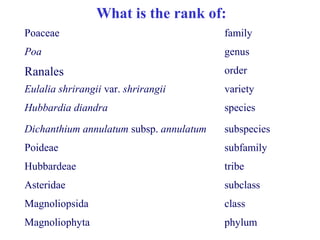
What is the rank of:
Poideae subfamily
Poaceae family
Hubbardeae tribe
Asteridae subclass
Eulalia shrirangii var. shrirangii variety
Magnoliopsida class
Magnoliophyta phylum
Ranales order
Poa genus
Hubbardia diandra species
Dichanthium annulatum subsp. annulatum subspecies
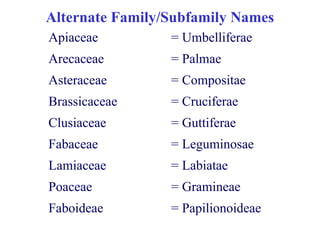
Alternate Family/Subfamily Names
Apiaceae = Umbelliferae
Arecaceae = Palmae
Asteraceae = Compositae
Brassicaceae = Cruciferae
Fabaceae = Leguminosae
Faboideae = Papilionoideae
Clusiaceae = Guttiferae
Lamiaceae = Labiatae
Poaceae = Gramineae
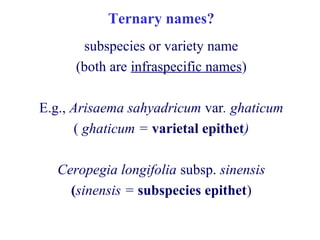
Ternary names?
subspecies or variety name
(both are infraspecific names)
E.g., Arisaema sahyadricum var. ghaticum
( ghaticum = varietal epithet)
Ceropegia longifolia subsp. sinensis
(sinensis = subspecies epithet)
Authorship?
the name of the person who first validly published
the name
Poaceae Barnhart
Pooideae Benth.
 Sorghum Moench
Sorghum bicolor (L.) Moench
Author names often abbreviated:
Eg. L.= Linnaeus; Benth. =Bentham
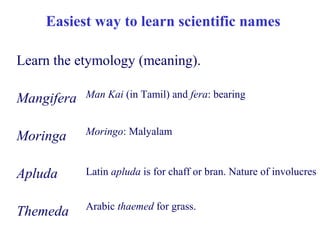
Easiest way to learn scientific names
Learn the etymology (meaning).
Mangifera
Moringa
Apluda
Themeda
Man Kai (in Tamil) and fera: bearing
Moringo: Malyalam
Latin apluda is for chaff or bran. Nature of involucres
Arabic thaemed for grass.
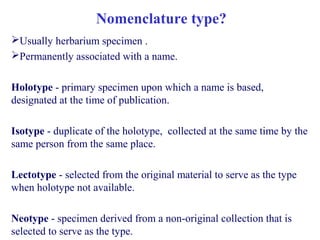
Usually herbarium specimen .
Permanently associated with a name.
Holotype - primary specimen upon which a name is based,
designated at the time of publication.
Isotype - duplicate of the holotype, collected at the same time by the
same person from the same place.
Lectotype - selected from the original material to serve as the type
when holotype not available.
Neotype - specimen derived from a non-original collection that is
selected to serve as the type.
Nomenclature type?
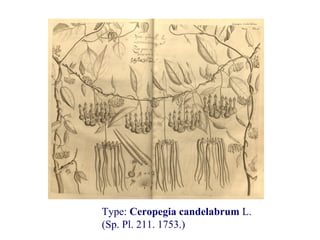
Type: Ceropegia candelabrum L.
(Sp. Pl. 211. 1753.)
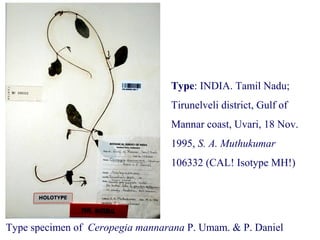
Type specimen of Ceropegia mannarana P. Umam. & P. Daniel
Type: INDIA. Tamil Nadu;
Tirunelveli district, Gulf of
Mannar coast, Uvari, 18 Nov.
1995, S. A. Muthukumar
106332 (CAL! Isotype MH!)
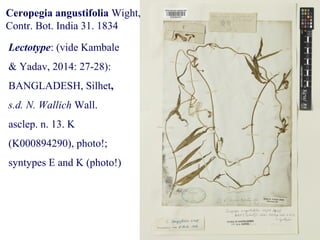
Ceropegia angustifolia Wight,
Contr. Bot. India 31. 1834
Lectotype: (vide Kambale
& Yadav, 2014: 27-28):
BANGLADESH, Silhet,
s.d. N. Wallich Wall.
asclep. n. 13. K
(K000894290), photo!;
syntypes E and K (photo!)
Syntype: When no holotype designated or more than one type designated
Isosyntype: Duplicate of Syntype
Paratype: Specimen cited in Protologue other than holotype/isotype
Original material: Syntype, paratype, holotype and isotype
Epitype: Specimen/illustration selected to serve as interpretative type
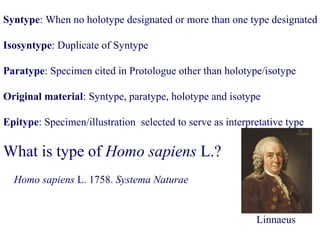
What is type of Homo sapiens L.?
Homo sapiens L. 1758. Systema Naturae
Linnaeus
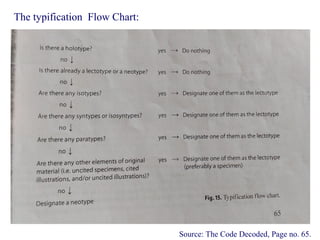
Source: The Code Decoded, Page no. 65.
The typification Flow Chart:
Types exist for all ranks up to family
Hubbardia diandra L. Chandore 31
Ceropegia candelabrum L. is the type for
the genus Ceropegia L.
Genus Poa is the type for family Poaceae Borkh.
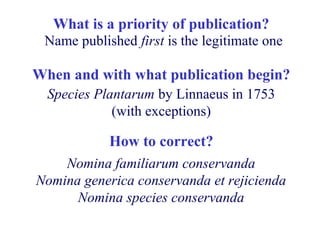
What is a priority of publication?
When and with what publication begin?
Nomina familiarum conservanda
Nomina generica conservanda et rejicienda
Nomina species conservanda
Species Plantarum by Linnaeus in 1753
(with exceptions)
Name published first is the legitimate one
How to correct?
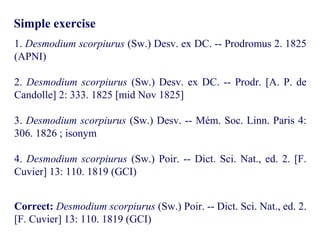
Simple exercise
1. Desmodium scorpiurus (Sw.) Desv. ex DC. -- Prodromus 2. 1825
(APNI)
2. Desmodium scorpiurus (Sw.) Desv. ex DC. -- Prodr. [A. P. de
Candolle] 2: 333. 1825 [mid Nov 1825]
3. Desmodium scorpiurus (Sw.) Desv. -- Mém. Soc. Linn. Paris 4:
306. 1826 ; isonym
4. Desmodium scorpiurus (Sw.) Poir. -- Dict. Sci. Nat., ed. 2. [F.
Cuvier] 13: 110. 1819 (GCI)
Correct: Desmodium scorpiurus (Sw.) Poir. -- Dict. Sci. Nat., ed. 2.
[F. Cuvier] 13: 110. 1819 (GCI)
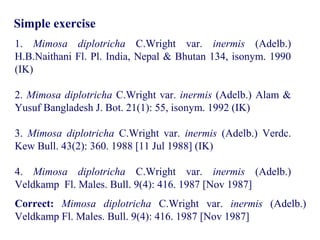
Simple exercise
1. Mimosa diplotricha C.Wright var. inermis (Adelb.)
H.B.Naithani Fl. Pl. India, Nepal & Bhutan 134, isonym. 1990
(IK)
2. Mimosa diplotricha C.Wright var. inermis (Adelb.) Alam &
Yusuf Bangladesh J. Bot. 21(1): 55, isonym. 1992 (IK)
3. Mimosa diplotricha C.Wright var. inermis (Adelb.) Verdc.
Kew Bull. 43(2): 360. 1988 [11 Jul 1988] (IK)
4. Mimosa diplotricha C.Wright var. inermis (Adelb.)
Veldkamp Fl. Males. Bull. 9(4): 416. 1987 [Nov 1987]
Correct: Mimosa diplotricha C.Wright var. inermis (Adelb.)
Veldkamp Fl. Males. Bull. 9(4): 416. 1987 [Nov 1987]
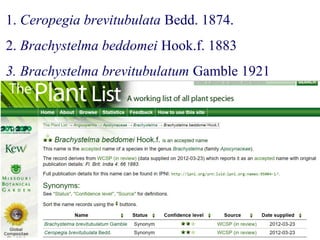
1. Ceropegia brevitubulata Bedd. 1874.
2. Brachystelma beddomei Hook.f. 1883
3. Brachystelma brevitubulatum Gamble 1921
Two reasons for name change?
1) Name contrary to the rules (illegitimate).
2) Additional research has changed definition and
delimitation of a taxon.
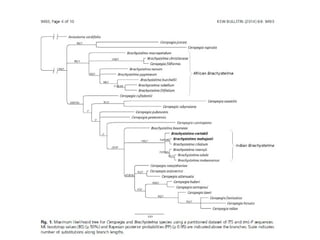
NEW Research:
Phylogenetic studies may demonstrate at taxon
to be non-monophyletic
Four major ways that names are changed?
United
Divided
Changed in rank
Changed in Position
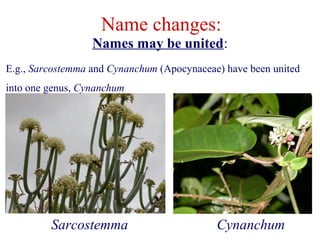
Names may be united:
Name changes:
E.g., Sarcostemma and Cynanchum (Apocynaceae) have been united
into one genus, Cynanchum
Sarcostemma Cynanchum
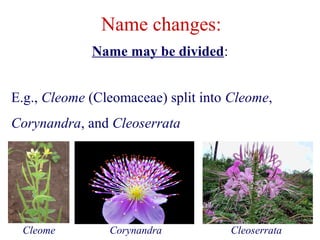
Name may be divided:
E.g., Cleome (Cleomaceae) split into Cleome,
Corynandra, and Cleoserrata
Name changes:
Cleome Corynandra Cleoserrata
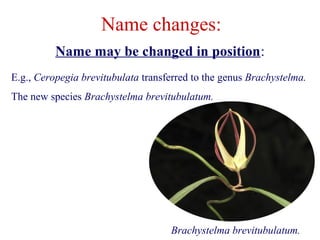
Name may be changed in position:
Name changes:
E.g., Ceropegia brevitubulata transferred to the genus Brachystelma.
The new species Brachystelma brevitubulatum.
Brachystelma brevitubulatum.
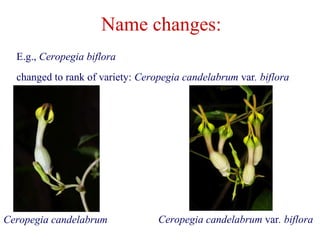
Name changes:
E.g., Ceropegia biflora
changed to rank of variety: Ceropegia candelabrum var. biflora
Ceropegia candelabrum Ceropegia candelabrum var. biflora
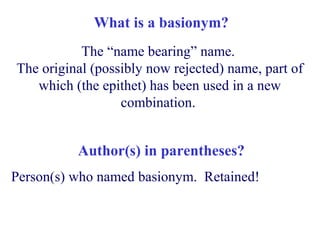
What is a basionym?
The “name bearing” name.
The original (possibly now rejected) name, part of
which (the epithet) has been used in a new
combination.
Person(s) who named basionym. Retained!
Author(s) in parentheses?
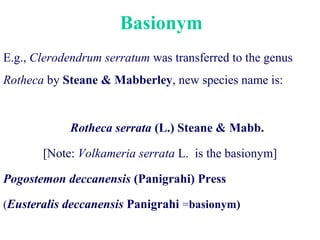
Basionym
E.g., Clerodendrum serratum was transferred to the genus
Rotheca by Steane & Mabberley, new species name is:
Rotheca serrata (L.) Steane & Mabb.
[Note: Volkameria serrata L. is the basionym]
Pogostemon deccanensis (Panigrahi) Press
(Eusteralis deccanensis Panigrahi =basionym)
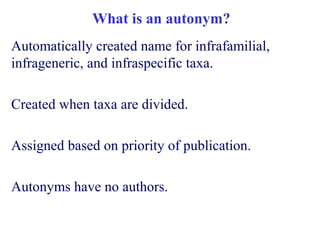
What is an autonym?
Automatically created name for infrafamilial,
infrageneric, and infraspecific taxa.
Created when taxa are divided.
Assigned based on priority of publication.
Autonyms have no authors.
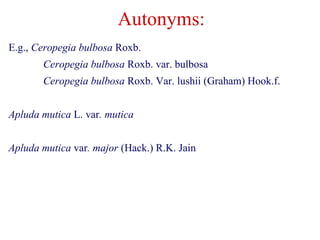
Autonyms:
E.g., Ceropegia bulbosa Roxb.
Ceropegia bulbosa Roxb. var. bulbosa
Ceropegia bulbosa Roxb. Var. lushii (Graham) Hook.f.
Apluda mutica L. var. mutica
Apluda mutica var. major (Hack.) R.K. Jain
What are the main criteria of valid publication?
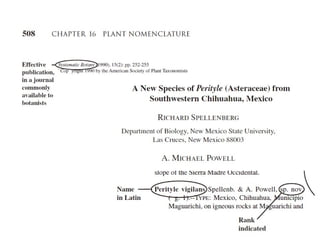
1) Name must be effectively published
= in a journal generally available to botanists
As of 1 Jan 2012:
Electronic material published online in Portable
Document Format (PDF) with an International
Standard Serial Number (ISSN) or an International
Standard Book Number (ISBN) will constitute
effective publication
What are the main criteria of valid publication?
2) Name must be published in the correct form, properly
Latinized with the correct rank ending.
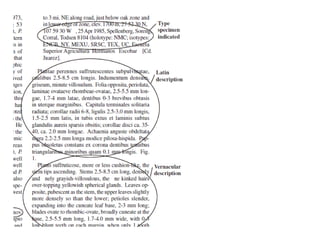
3) Name must be published with a Latin description or
diagnosis or with a reference to such.
[Vernacular description typically included.]
As of 1 Jan 2012:
A description or diagnosis may be in either Latin or
English.
What are the main criteria of valid publication?
4) Rank must be indicated (e.g., “sp. nov.,” “subsp. nov.,”
or “var. nov.”)
5) Nomenclatural type must be indicated (for genus and
below).
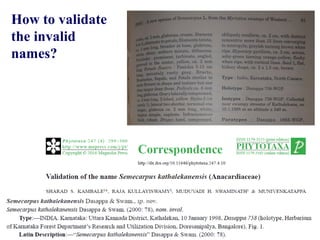
How to validate
the invalid
names?
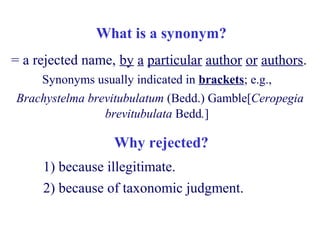
What is a synonym?
= a rejected name, by a particular author or authors.
Synonyms usually indicated in brackets; e.g.,
Brachystelma brevitubulatum (Bedd.) Gamble[Ceropegia
brevitubulata Bedd.]
1) because illegitimate.
2) because of taxonomic judgment.
Why rejected?
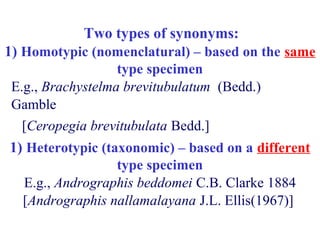
Two types of synonyms:
E.g., Brachystelma brevitubulatum (Bedd.)
Gamble
[Ceropegia brevitubulata Bedd.]
1) Homotypic (nomenclatural) – based on the same
type specimen
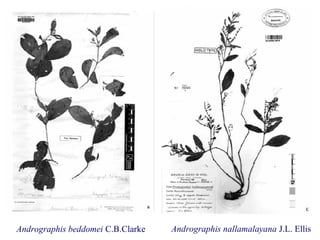
E.g., Andrographis beddomei C.B. Clarke 1884
[Andrographis nallamalayana J.L. Ellis(1967)]
1) Heterotypic (taxonomic) – based on a different
type specimen
Andrographis beddomei C.B.Clarke Andrographis nallamalayana J.L. Ellis
What is a correct name?
A legitimate (and therefore validly published) name
that is accepted by a particular author or authors.
Each taxon can have only one correct name.
How can a name be legitimate but not correct?
There may be 2 (or more) alternative,
legitimate names.
Only one of these can be correct
(in any given work).
What is a homonym?
= synonym identical to accepted, correct name.
E.g.: Vicia gigantea Hook., 1831 [Vicia gigantea Bunge,1833]
= binomial in which genus and specific epithets are identical
in spelling.
Tautonyms are not permitted by the ICN!
E.g., Themeda themeda would be a tautonym and illegitimate.
Ziziphus zizyphus (L.) H. Karst. (Jujube) is not a tautonym and is
permitted.
What is a tautonym?
Abbreviations:
"in" = "in the publication of”
Amorphophallus commutatus var. anshiensis Punekar in
Punekar and Lakshminarasimhan.
"ex" = "validly published by.”
comb. nov. (combinatio nova) means a new nomenclatural
combination
E.g., Decalepis khasiana (Kurz) Ionta ex Kambale
May be abbrev.: Decalepis khasiana Kambale
Abbreviations:
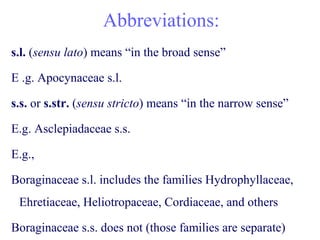
s.l. (sensu lato) means “in the broad sense”
E .g. Apocynaceae s.l.
s.s. or s.str. (sensu stricto) means “in the narrow sense”
E.g. Asclepiadaceae s.s.
E.g.,
Boraginaceae s.l. includes the families Hydrophyllaceae,
Ehretiaceae, Heliotropaceae, Cordiaceae, and others
Boraginaceae s.s. does not (those families are separate)
Abbreviations
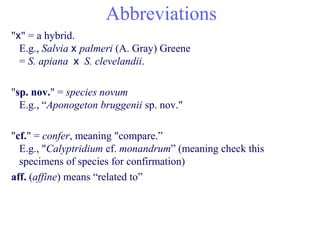
"x" = a hybrid.
E.g., Salvia x palmeri (A. Gray) Greene
= S. apiana x S. clevelandii.
"sp. nov." = species novum
E.g., “Aponogeton bruggenii sp. nov."
"cf." = confer, meaning "compare.”
E.g., "Calyptridium cf. monandrum” (meaning check this
specimens of species for confirmation)
aff. (affine) means “related to”
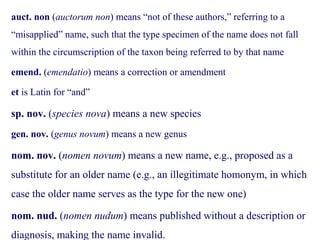
auct. non (auctorum non) means “not of these authors,” referring to a
“misapplied” name, such that the type specimen of the name does not fall
within the circumscription of the taxon being referred to by that name
emend. (emendatio) means a correction or amendment
et is Latin for “and”
sp. nov. (species nova) means a new species
gen. nov. (genus novum) means a new genus
nom. nov. (nomen novum) means a new name, e.g., proposed as a
substitute for an older name (e.g., an illegitimate homonym, in which
case the older name serves as the type for the new one)
nom. nud. (nomen nudum) means published without a description or
diagnosis, making the name invalid.
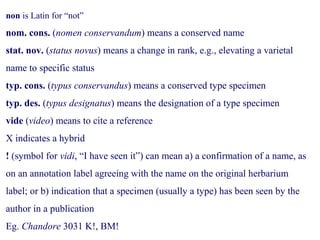
non is Latin for “not”
nom. cons. (nomen conservandum) means a conserved name
stat. nov. (status novus) means a change in rank, e.g., elevating a varietal
name to specific status
typ. cons. (typus conservandus) means a conserved type specimen
typ. des. (typus designatus) means the designation of a type specimen
vide (video) means to cite a reference
X indicates a hybrid
! (symbol for vidi, “I have seen it”) can mean a) a confirmation of a name, as
on an annotation label agreeing with the name on the original herbarium
label; or b) indication that a specimen (usually a type) has been seen by the
author in a publication
Eg. Chandore 3031 K!, BM!
n. v. (non visus) is Latin for “not seen,” typically meaning that
authors did not see a specimen, such as a type.
orth. cons. (orthographia conservanda) means a conserved spelling
Gender of the generic names:
General rule
"-us" ending: masculine: Phaseolus, Helianthus, Hibiscus,
"-a”, “is”, “es”, ending: feminine: Rosa, Brassica, Oryza, Carota,
Coffea. Aerides, etc.
"-um" ending: neuter: Triticum, Coriandrum, Psidium
Exceptions: 1) The "-ma" ending generic names of Greek origin may be
neuter or feminine:
e.g.,
Neuter: Abroma, Aneilema, Arisaema, Megastigma, Melastoma,
Theobroma, Trema, Zygnema (alga) and Brachystelma
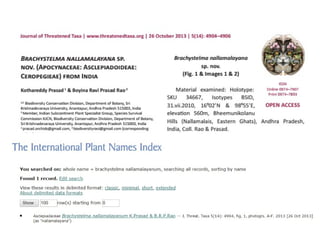
Feminine: Hedeoma, Callicoma, Meliosma, Radiopalma and Ceropegia
Note: Only adjectival epithets need to match their genders with
the gender of the genus name.
Exercises on gender endings
1. Ceropegia manoharii Sujanapal, P.M.Salim, Anil Kumar &
Sasidh.
The epithet "manoharii" is NOT a Latin term (but is Latinized).
2. Barleria prattensis Santapau
3. Crinum pratense Herb.
4. Polygonum plebeium R. Br. var. indica (Heyne ex Roth) Hook. f.
5. Balanophora elkinsi Blatt.
6. Antidesma bunius Spreng.
7. Cymbopogon martini (Roxb.) Will.Watson
8. Enteropogon prieurii (Kunth) Clayton
9. Isachne borii Hemadri
11. Aerides multiflorum Roxb.
12. Aerides crispum
12. Dendrobium lawanum Lindl.
13. Brachystelma nallamalayana K.Prasad & B.R.P.Rao
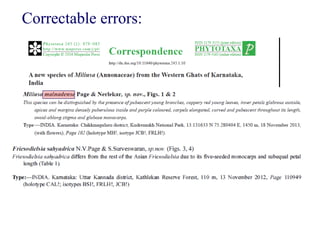
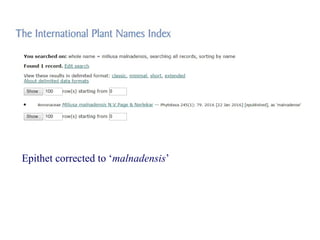
14. Miliusa malnadense Page & Nerlekar
15. Ceropegia candelabrum L.
Only the "-er" ending is treated as a vowel, and we add a single "i",
e.g., alexander; "alexanderi"
"-ar", "-ir", "-or", and "-ur" endings are treated as consonants.
Therefore, we add 2 "i"
10. Sporobolus helvola T.Durand & Schinz
Correctable errors:
Epithet corrected to ‘malnadensis’
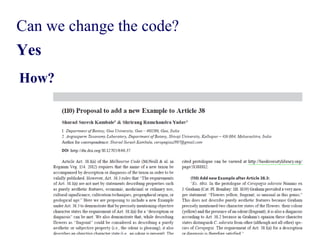
Can we change the code?
Yes
How?
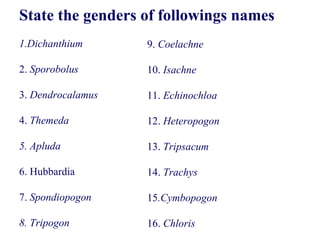
State the genders of followings names
1.Dichanthium
2. Sporobolus
3. Dendrocalamus
4. Themeda
5. Apluda
6. Hubbardia
7. Spondiopogon
8. Tripogon
9. Coelachne
10. Isachne
11. Echinochloa
12. Heteropogon
13. Tripsacum
14. Trachys
15.Cymbopogon
16. Chloris
Nomenclatural Guru: Dr. K. N. Gandhi Sir
Thank you!!!