VASODILATORS
I Antihistaminic agents and Antineoplastic
agents
II Antianginals, Diuretics and antihypertensive
agents
III Antiarrythmics
IV Drugs acting on Endocrine system
V Antidiabetics
Antianginals
 Vasodilators
 Calcium channel blockers
Diuretics
Antihypertensives
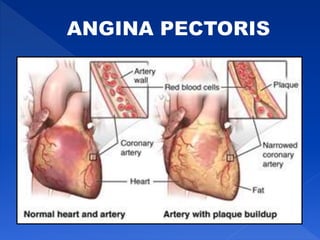
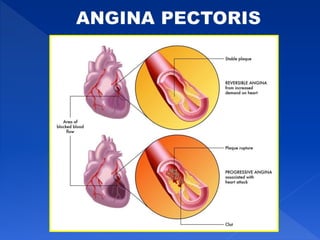
 An antianginal is a drug used in the treatment
of angina pectoris, a symptom of ischaemic heart
disease
 Angina is characterized by a narrowing of the
coronary arteries. Chest pain is its main symptom.
 Stable angina and unstable angina
 Variant or Prinzmetals angina and Microvasucular
angina
Vasodilation is the widening of blood vessels. It results from
relaxation of smooth muscle cells within the vessel walls, in
particular in the large veins, large arteries, and smaller
arterioles. The process is the opposite of vasoconstriction,
which is the narrowing of blood vessels.
Vasodilators are used to treat hypertension, heart
failure and angina
Vasodilators
a. Arterial vasodilators
eg. Hydralazine, Minoxidil and Diazoxide
b. Venous vasodilators
eg. Nitro vasodilators
c. Arterial and venous vasodilators
eg. Sodium nitroprusside
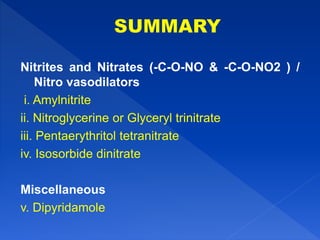
Nitrites and Nitrates (-C-O-NO & -C-O-NO2 ) / Nitro vasodilators
i. Amylnitrite
ii. Nitroglycerine or Glyceryl trinitrate
iii. Pentaerythritol tetranitrate
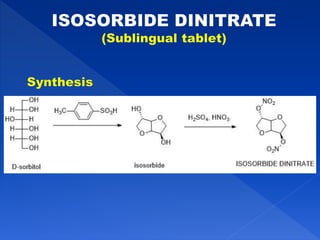
iv. Isosorbide dinitrate
Miscellaneous
v. Dipyridamole
Treats systemic and pulmonary hypertension,
heart failure and angina
 Reduces arterial pressure by decreasing systemic vascular
resistance
 In Anginal patients they reduce after load on the heart
 Decrease the oxygen demand of the heart, and thereby
improve the oxygen supply/demand ratio
 Reduce venous pressure, which reduces preload on the
heart thereby decreasing cardiac output
 In angina it is useful as it decreases the oxygen demand of
the heart and thereby increases the oxygen supply/demand
ratio
 Oxygen demand is reduced because decreasing preload
leads to a reduction in ventricular wall stress by decreasing
the size of the heart
 Vasodilators act on both arteries and veins
 Exceptions are hydralazine (arterial dilator) and organic
nitrate dilators (venous dilators)
 They decrease systemic vascular resistance and arterial
pressure with relatively little change in right atrial (or central
venous) pressure (i.e., little change in cardiac preload), and
they have a relatively little effect on cardiac output
i. Decrease in peripheral vascular resistance (decrease of
afterload)
ii. Venodilatation (decreased preload)
iii. Redistribution of flow to sub endocardium without
overall change in coronary flow
iv. Preferential dilatation of larger coronary vessels and
collaterals favouring distribution of blood to ischemic
areas
 BP = CO ˟ PVR
BP exerted at three anatomical sites - arterioles, postcapillary
venules, and heart.
The fourth anatomical control site, the kidney contributes to the
maintenance of blood pressure regulating fluid in the body.
Baroreceptor reflexes - renin-angiotensin-aldosterone system -
co-ordinate function at these four control sites and to maintain
Normal B.P. regulation.
All antihypertensive/CVS drugs act by interfering with the above
specified mechanism.
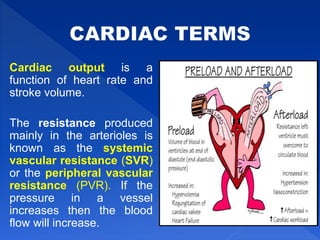
Cardiac output is a
function of heart rate and
stroke volume.
The resistance produced
mainly in the arterioles is
known as the systemic
vascular resistance (SVR)
or the peripheral vascular
resistance (PVR). If the
pressure in a vessel
increases then the blood
flow will increase.
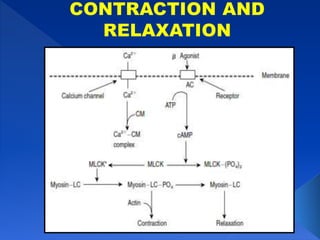
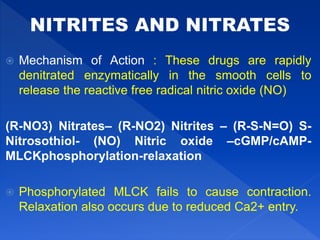
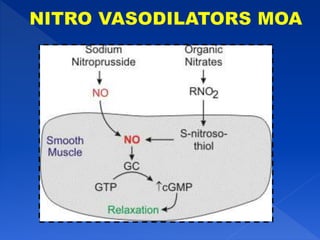
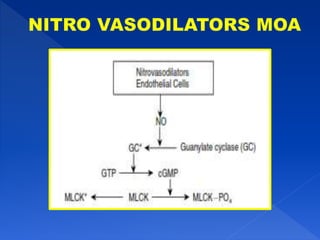
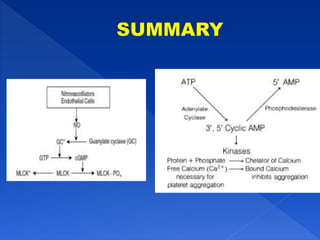
 Mechanism of Action : These drugs are rapidly
denitrated enzymatically in the smooth cells to
release the reactive free radical nitric oxide (NO)
(R-NO3) Nitrates– (R-NO2) Nitrites – (R-S-N=O) S-
Nitrosothiol- (NO) Nitric oxide –cGMP/cAMP-
MLCKphosphorylation-relaxation
 Phosphorylated MLCK fails to cause contraction.
Relaxation also occurs due to reduced Ca2+ entry.
 All organic nitrates are subjected to first-pass metabolism,
by the action of glutathione nitrate reductase in the liver, and
in the extra hepatic tissues
 Some metabolites of long-acting nitrates are active as
vasodilators
E.g. Isosorbide dinitrate (Isosorbide-2-mononitrate and
Isosorbide-5-mononitrate)
It is metabolized primarily in the liver by glutathione nitrate
reductase, which also participates in the metabolism of other
organic nitrates, catalyzing the denitration of the parent
drugs to yield two metabolites, 2- and 5-isosorbate
mononitrate
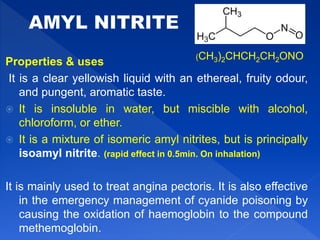
Properties & uses
It is a clear yellowish liquid with an ethereal, fruity odour,
and pungent, aromatic taste.
 It is insoluble in water, but miscible with alcohol,
chloroform, or ether.
 It is a mixture of isomeric amyl nitrites, but is principally
isoamyl nitrite. (rapid effect in 0.5min. On inhalation)
It is mainly used to treat angina pectoris. It is also effective
in the emergency management of cyanide poisoning by
causing the oxidation of haemoglobin to the compound
methemoglobin.
(CH3)2CHCH2CH2ONO
Properties and uses
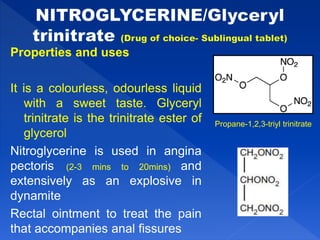
It is a colourless, odourless liquid
with a sweet taste. Glyceryl
trinitrate is the trinitrate ester of
glycerol
Nitroglycerine is used in angina
pectoris (2-3 mins to 20mins) and
extensively as an explosive in
dynamite
Rectal ointment to treat the pain
that accompanies anal fissures
Propane-1,2,3-triyl trinitrate
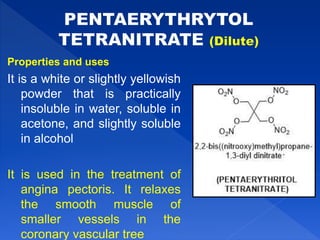
Properties and uses
It is a white or slightly yellowish
powder that is practically
insoluble in water, soluble in
acetone, and slightly soluble
in alcohol
It is used in the treatment of
angina pectoris. It relaxes
the smooth muscle of
smaller vessels in the
coronary vascular tree
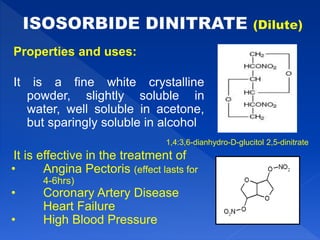
Properties and uses:
It is a fine white crystalline
powder, slightly soluble in
water, well soluble in acetone,
but sparingly soluble in alcohol
It is effective in the treatment of
• Angina Pectoris (effect lasts for
4-6hrs)
• Coronary Artery Disease
Heart Failure
• High Blood Pressure
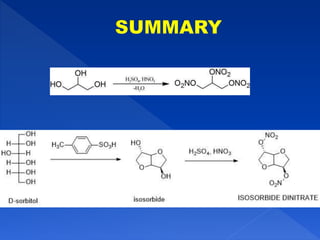
1,4:3,6-dianhydro-D-glucitol 2,5-dinitrate
Properties and uses:
It is a bright yellow crystalline powder, which dissolves in
dilute solutions of mineral acids, but insoluble in water,
soluble in acetone and ethanol.
It is a long-acting vasodilator. Its vasodilating effect is
selective for the coronary system.
It is also used to treat/prophylaxis of angina pectoris
• Coronary Artery Disease (CAD)
• Postoperative Thromboembolism (Platelet
aggregation inhibitor)
• Stroke
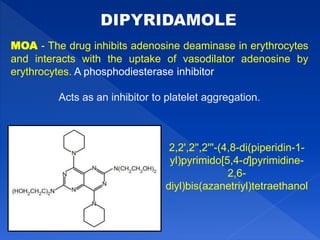
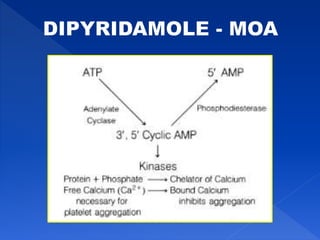
MOA - The drug inhibits adenosine deaminase in erythrocytes
and interacts with the uptake of vasodilator adenosine by
erythrocytes. A phosphodiesterase inhibitor
Acts as an inhibitor to platelet aggregation.
2,2',2'',2'''-(4,8-di(piperidin-1-
yl)pyrimido[5,4-d]pyrimidine-
2,6-
diyl)bis(azanetriyl)tetraethanol
 Headache (cerebral arteries)
 Nitrite ions: oxidation of hemoglobin to
methemoglobin causing reduced blood oxygen
 Route of administration (sublingual for nitroglycerin)
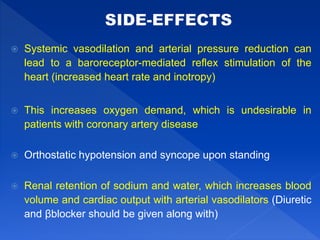
 Systemic vasodilation and arterial pressure reduction can
lead to a baroreceptor-mediated reflex stimulation of the
heart (increased heart rate and inotropy)
 This increases oxygen demand, which is undesirable in
patients with coronary artery disease
 Orthostatic hypotension and syncope upon standing
 Renal retention of sodium and water, which increases blood
volume and cardiac output with arterial vasodilators (Diuretic
and βblocker should be given along with)
Nitrites and Nitrates (-C-O-NO & -C-O-NO2 ) /
Nitro vasodilators
i. Amylnitrite
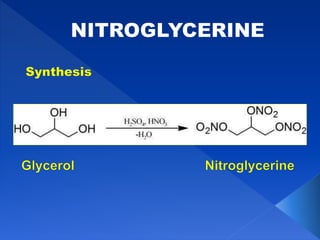
ii. Nitroglycerine or Glyceryl trinitrate
iii. Pentaerythritol tetranitrate
iv. Isosorbide dinitrate
Miscellaneous
v. Dipyridamole
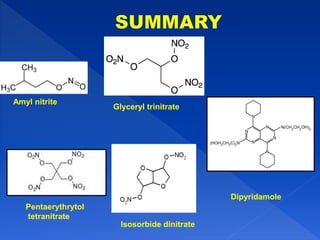
Amyl nitrite
Isosorbide dinitrate
Glyceryl trinitrate
Dipyridamole
Pentaerythrytol
tetranitrate
Vasodilators - Medicinal chemistry for B.Pharm.