ANTITUSSIVE AND EXPECTORENTS
RESPIRATORY STIMULATION
SOS IN PHARMACEUTICAL SCIENCES
JIWAJI UNVERSITY
SUBMITTED BY:- Maneesha Kushwaha
SUBMITTED TO:-Manoj Sharma
ANTITUSSIVE
• Antitussives are drugs that suppress coughing
,possibly by reducing the activity of the cough
center in the brain.
• Antitussive agents are used to relieve dry
cough
COUGH
• Cough is protective reflex, its purpose being
• expulsion of respiratory secretions or foreign
• particles from the lungs and upper airway
• passages.
MACHANISM OF COUGH
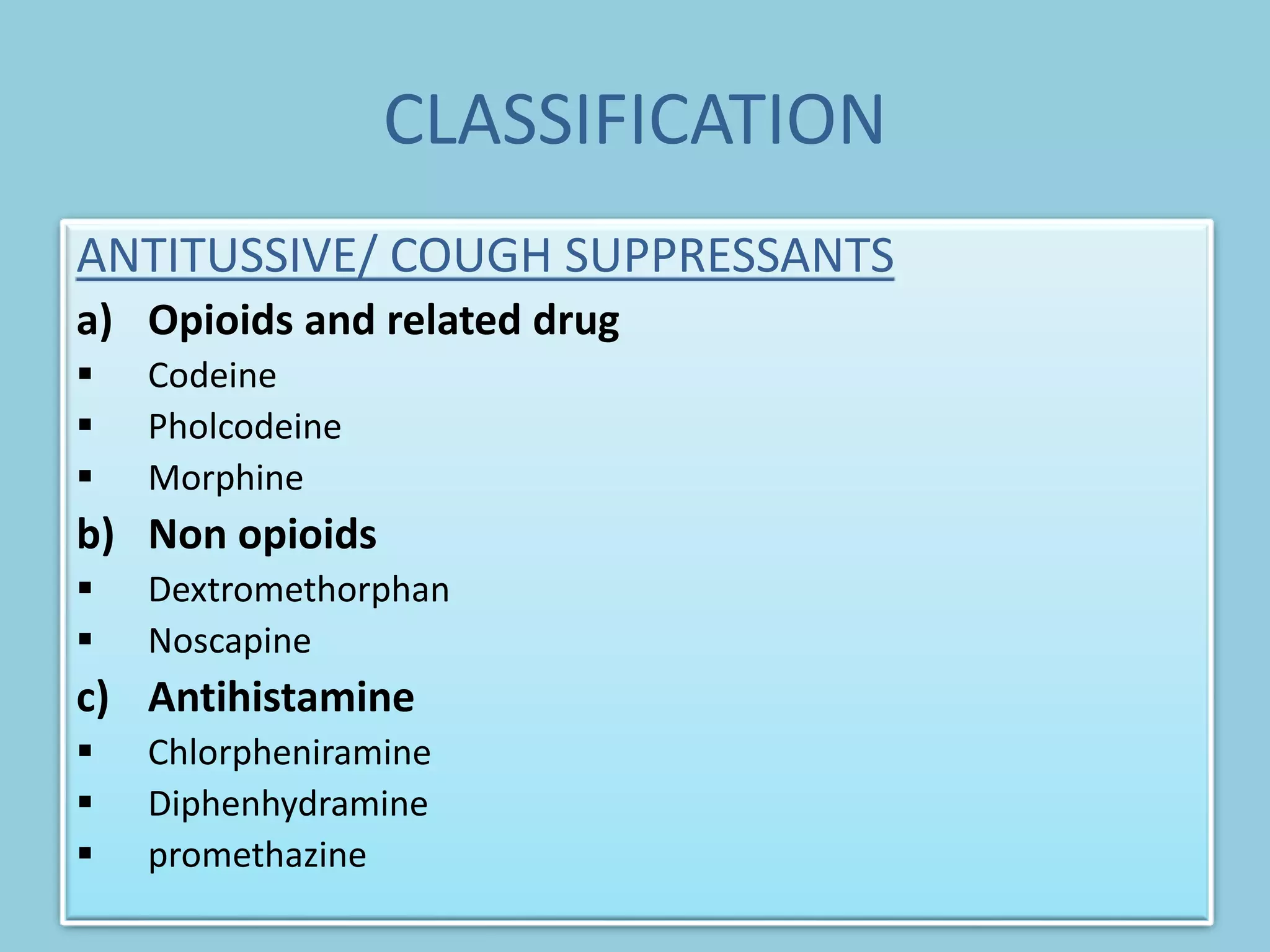
CLASSIFICATION
ANTITUSSIVE/ COUGH SUPPRESSANTS
a) Opioids and related drug
 Codeine
 Pholcodeine
 Morphine
b) Non opioids
 Dextromethorphan
 Noscapine
c) Antihistamine
 Chlorpheniramine
 Diphenhydramine
 promethazine
COMMON COUGH SYRUP AND
CODEINE
CODEINE
• Codeine is an opioid (methylmorphine) with a
relatively limited analgesic effect; it does not cause
significant respiratory depressions but has good
antitussive properties.
• Codeine raises the stimulus threshold of the cough
center and thus has a cough suppressing effect.
• In most humans 10% of a codeine dose is
transformed to morphine through demethylation in
the liver. This explains the analgesic effect that is
absent in individuals with the respective genetic
traits.
MECHANISM OF ACTION
• Codeine sulfate is an opioid analgesic, related
to morphine, but with less potent analgesic
properties.
Codeine is selective for the mu receptor, but
with a much weaker affinity than morphine.
The analgesic properties of codeine have been
speculated to come from its conversion to
morphine, although the exact mechanism of
analgesic action remains unknown.
PHARMACOKINETICS AND ADVERSE
REACTION OF CODEINE
Pharmacokinetics
Bioavailability: 50%
Peak plasma level: 1 hour
Plasma half-life: 3 to 4 hours
Active metabolites: several
Elimination: predominantly
extrarenal
Adverse Reaction
• Retention of urine
• itching
• vertigo
• palpitations or bradycardia
• sweating
• mild central nervous effects
INTERACTION
EXPECTORANTS
EXPECTORANTS
CLASSIFICATION OF EXPECTOTANTS
a) Directly acting:
 Sodium and potassium salt of iodine , citrate and
acetic acid, guaicol, tolu balsam,
hydrate,guaiphenesin
b) Mucolytics:
 Bromhexine
 Acetylcysteine
 Carbocisteine
c) Pharyngdemulcents:
lozenges, cough drops ,linctuses containing syrup,
glycerine, liquorice
GUAIPHENESIN
• Guaifenesin is an expectorant, the action of
which promotes or facilitates the removal of
secretions from the respiratory tract.
MACHANISM OF ACTION
• By increasing sputum volume and making
sputum less viscous, guaifenesin facilitates
expectoration of retained secretions.
PHARMACOKINETICS AND ADVERSE
REACTION
PHARMACOKINETICS
• Absorption
Readily absorbed.
• Elimination The half-life
is 1 h; renal excretion;
major urinary
metabolite is beta-2-
(methoxyphenoxy)
lactic acid
ADVERSE REACTION
• Dizziness,
• Headache and rash
(including urticaria).
• Rare drowsiness or mild
gastrointestinal
• disturbances are the only
side effects associated with
extromethorphan in clinical
use.
MUCOLYTICS
• Mucolytics are administered by inhalation to liquefy
mucus in the respiratory tract. Solutions of mucolytic
drugs may be nebulized into a face mask or
mouthpiece or instilled directly into the respiratory
tract through a tracheostomy.
• Sodium chloride solution and acetylcysteine
(Mucomyst) are the only agent recommende for use
as mucolytics.
ACETYLCYSTEINE
• Acetylcysteine is
effective within 1 minute
after inhalation, and
maximal effects occur
within 5 to 10 minutes. It
is effective immediately
after direct instillation.
• Oral acetylcysteine is
widely used in the
treatment of
acetaminophen
overdosage
OTHER EXPECTORANT
Expectorants like bromhexine or ambroxole
may effectively decrease viscosity of bronchial
secretions
RESPIRATORY STIMULATION OR
ANALEPTICS
Introduction:
A respiratory stimulant is primarily used in addition
to noninvasive ventilation (Noninvasive ventilation
support to a patient through the upper airways) as a
means to help increase the urge to breath. It work by
stimulating the central nervous system, resulting in
an increase in respiration rate and tidal volume,
which is the amount of air that is inhaled or exhaled
during a normal breath
• Respiratory stimulate and have resuscitative value in
coma or fainting.
RESPIRATORY STIMULATION OR
ANALEPTICS
• Situations in which analeptics are used:
 Respiratory depression due to hypnotic drug
poisoning
 Suffocation on drowning
 Apnoea in premature infants
 Failure to ventilate spontaneously after general
anesthesia
RESPIRATORY STIMULANTS/
ANALEPTICS DRUG
Doxapram
Prethcamide
Modafinil
Reflex stimulant: Ammonia,
alcohol,
vapours
DOXAPRAM
Doxapram, also known as dopram, is a respiratory
stimulant and as such, help stimulate the respiratory
drive in patients who are recovering from surgery,
who have overdosed on certain drug or, who have
high carbon dioxide levels in their blood, which can
occur copd (cronic obstractive pulmonary)
MACHANISM OF ACTION
Doxapram stimulates respiration by an action on
peripheral carotid chemoreceptors. As the dosage is
increased, the medulla are stimulated with
progressive stimulation of other parts of the brain
and spinal cord
COMMON RESPIRATORY STIMULANTS
PHARMACOLOGICAL EFFECT
• Direct (respiratory centre) and indirect (reflex via
chemoreceptor)
CLINICAL USES
• Respiratory failure
ADVERSE EFFECTS
Nausea, coughing, restlesness.
DOSE
40 -80 mg I.V. Or I.M
Use
Treats acute respiratory failure
Antitussive and expectorents, respiratory stimulation

Antitussive and expectorents, respiratory stimulation

  • 1.
    ANTITUSSIVE AND EXPECTORENTS RESPIRATORYSTIMULATION SOS IN PHARMACEUTICAL SCIENCES JIWAJI UNVERSITY SUBMITTED BY:- Maneesha Kushwaha SUBMITTED TO:-Manoj Sharma
  • 2.
    ANTITUSSIVE • Antitussives aredrugs that suppress coughing ,possibly by reducing the activity of the cough center in the brain. • Antitussive agents are used to relieve dry cough COUGH • Cough is protective reflex, its purpose being • expulsion of respiratory secretions or foreign • particles from the lungs and upper airway • passages.
  • 3.
  • 5.
    CLASSIFICATION ANTITUSSIVE/ COUGH SUPPRESSANTS a)Opioids and related drug  Codeine  Pholcodeine  Morphine b) Non opioids  Dextromethorphan  Noscapine c) Antihistamine  Chlorpheniramine  Diphenhydramine  promethazine
  • 6.
    COMMON COUGH SYRUPAND CODEINE
  • 7.
    CODEINE • Codeine isan opioid (methylmorphine) with a relatively limited analgesic effect; it does not cause significant respiratory depressions but has good antitussive properties. • Codeine raises the stimulus threshold of the cough center and thus has a cough suppressing effect. • In most humans 10% of a codeine dose is transformed to morphine through demethylation in the liver. This explains the analgesic effect that is absent in individuals with the respective genetic traits.
  • 8.
    MECHANISM OF ACTION •Codeine sulfate is an opioid analgesic, related to morphine, but with less potent analgesic properties. Codeine is selective for the mu receptor, but with a much weaker affinity than morphine. The analgesic properties of codeine have been speculated to come from its conversion to morphine, although the exact mechanism of analgesic action remains unknown.
  • 9.
    PHARMACOKINETICS AND ADVERSE REACTIONOF CODEINE Pharmacokinetics Bioavailability: 50% Peak plasma level: 1 hour Plasma half-life: 3 to 4 hours Active metabolites: several Elimination: predominantly extrarenal Adverse Reaction • Retention of urine • itching • vertigo • palpitations or bradycardia • sweating • mild central nervous effects
  • 10.
  • 11.
  • 12.
  • 13.
    CLASSIFICATION OF EXPECTOTANTS a)Directly acting:  Sodium and potassium salt of iodine , citrate and acetic acid, guaicol, tolu balsam, hydrate,guaiphenesin b) Mucolytics:  Bromhexine  Acetylcysteine  Carbocisteine c) Pharyngdemulcents: lozenges, cough drops ,linctuses containing syrup, glycerine, liquorice
  • 14.
    GUAIPHENESIN • Guaifenesin isan expectorant, the action of which promotes or facilitates the removal of secretions from the respiratory tract. MACHANISM OF ACTION • By increasing sputum volume and making sputum less viscous, guaifenesin facilitates expectoration of retained secretions.
  • 15.
    PHARMACOKINETICS AND ADVERSE REACTION PHARMACOKINETICS •Absorption Readily absorbed. • Elimination The half-life is 1 h; renal excretion; major urinary metabolite is beta-2- (methoxyphenoxy) lactic acid ADVERSE REACTION • Dizziness, • Headache and rash (including urticaria). • Rare drowsiness or mild gastrointestinal • disturbances are the only side effects associated with extromethorphan in clinical use.
  • 17.
    MUCOLYTICS • Mucolytics areadministered by inhalation to liquefy mucus in the respiratory tract. Solutions of mucolytic drugs may be nebulized into a face mask or mouthpiece or instilled directly into the respiratory tract through a tracheostomy. • Sodium chloride solution and acetylcysteine (Mucomyst) are the only agent recommende for use as mucolytics.
  • 18.
    ACETYLCYSTEINE • Acetylcysteine is effectivewithin 1 minute after inhalation, and maximal effects occur within 5 to 10 minutes. It is effective immediately after direct instillation. • Oral acetylcysteine is widely used in the treatment of acetaminophen overdosage
  • 19.
    OTHER EXPECTORANT Expectorants likebromhexine or ambroxole may effectively decrease viscosity of bronchial secretions
  • 20.
    RESPIRATORY STIMULATION OR ANALEPTICS Introduction: Arespiratory stimulant is primarily used in addition to noninvasive ventilation (Noninvasive ventilation support to a patient through the upper airways) as a means to help increase the urge to breath. It work by stimulating the central nervous system, resulting in an increase in respiration rate and tidal volume, which is the amount of air that is inhaled or exhaled during a normal breath • Respiratory stimulate and have resuscitative value in coma or fainting.
  • 21.
    RESPIRATORY STIMULATION OR ANALEPTICS •Situations in which analeptics are used:  Respiratory depression due to hypnotic drug poisoning  Suffocation on drowning  Apnoea in premature infants  Failure to ventilate spontaneously after general anesthesia
  • 22.
  • 23.
    DOXAPRAM Doxapram, also knownas dopram, is a respiratory stimulant and as such, help stimulate the respiratory drive in patients who are recovering from surgery, who have overdosed on certain drug or, who have high carbon dioxide levels in their blood, which can occur copd (cronic obstractive pulmonary)
  • 24.
    MACHANISM OF ACTION Doxapramstimulates respiration by an action on peripheral carotid chemoreceptors. As the dosage is increased, the medulla are stimulated with progressive stimulation of other parts of the brain and spinal cord
  • 25.
  • 26.
    PHARMACOLOGICAL EFFECT • Direct(respiratory centre) and indirect (reflex via chemoreceptor) CLINICAL USES • Respiratory failure ADVERSE EFFECTS Nausea, coughing, restlesness. DOSE 40 -80 mg I.V. Or I.M Use Treats acute respiratory failure