Posology
        &
Dosage Calculations
DEFINITIONS

 • Posology
   – the pharmacological study of drug
     dosage.

   – The study of dosage quantity and
     prescription.
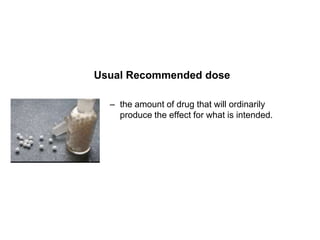
Usual Recommended dose

  – the amount of drug that will ordinarily
    produce the effect for what is intended.
•Minimum dose

  - the smallest dose of drug that produces
  therapeutic effect.


  •Maximum dose

      -the largest dose that can safely administered.

  Ex. Acetaminophen
           10 to 15 mg/kg/dose
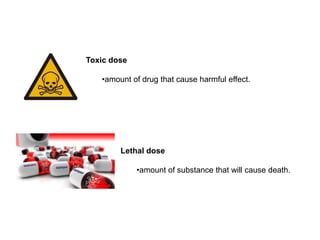
Toxic dose

   •amount of drug that cause harmful effect.


        Lethal dose

             •amount of substance that will cause death.
Single dose

                     - to be taken at one time.


Daily dose
     - amount to be taken in 24 hour period.
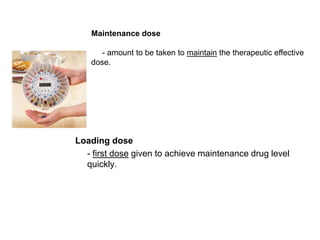
Maintenance dose

       - amount to be taken to maintain the therapeutic effective
    dose.


Loading dose
  - first dose given to achieve maintenance drug level
  quickly.
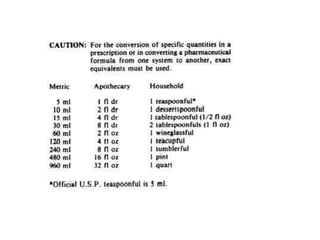
System of Measurement


1. Metric system
2. Apothecary system
3. Household system
System of Measurement
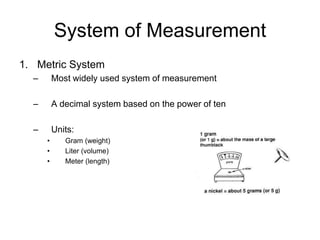
1. Metric System
  –       Most widely used system of measurement

  –       A decimal system based on the power of ten

  –       Units:
      •      Gram (weight)
      •      Liter (volume)
      •      Meter (length)
System of Measurement

2. Apothecary System
   – Uses Roman numerals to express quantity

   – Old system of measurement

   – Uses:
      • minim = liquid
      • Grains = solid
System of Measurement

3. Household System
  – Not as accurate as metric system due to lack of
    standardization of spoons, cups and glasses

  – Teaspoon (tsp) = liquid

  – Pound (lb) = solid
System of Measurement

 ml- milliliter
cc- cubic centimeter
gm- gram
mg- milligram
gr- grain
mEq- milliequivalent
mcg- microgram
GENERAL METHODS
     FOR DRUG CALCULATION


1. BASIC FORMULA

2. RATIO& PROPORTION

3. FRACTIONAL EQUATION

4. BODY WEIGHT

5. BODY SURFACE AREA
1. Basic Formula:
        DxV=A
H
D- desired dose
        (drug dose ordered by health care provider)


H- on-hand
         (stock on hand/on label of container)


V- vehicle
        ( Q- quantity/drug form in which drug comes)


A- Amount calculated to be given to client
Examples:
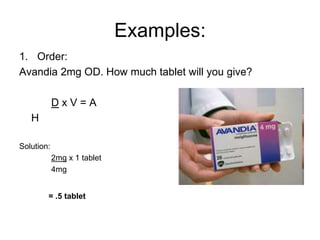
1. Order:
Avandia 2mg OD. How much tablet will you give?

            DxV=A
   H

Solution:
            2mg x 1 tablet
            4mg


        = .5 tablet
Paracemol 500mg. Q 4 hour Round the Clock
  (RTC) p.o. The stock on hand is 250mg/5ml in
  60ml bottle. How many ml should be
  administered?

      DxV=A
  H

      500 mg    x 5 ml =
      250 mg
                                    10 ml
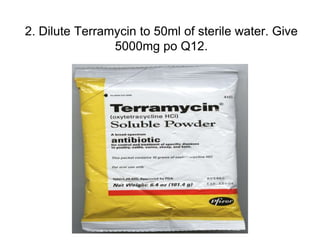
2. Dilute Terramycin to 50ml of sterile water. Give
                5000mg po Q12.
3. Banophen 50mg. TID p.o.

   a. How many tablet will you give in 1 dose?

   b. How many tablets will you give in a day?
2. Ratio and Proportion


      H       :        V       =       D          :   x

Where:
  H = drug on hand (available)
  V = vehicle/drug form (capsule/tablet/liquid)
  D = desired dose (as ordered)
  x = unknown amount to give
Example
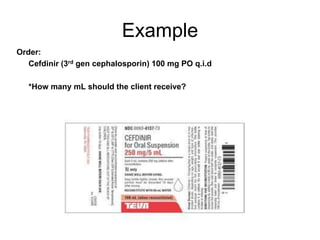
Order:
   Cefdinir (3rd gen cephalosporin) 100 mg PO q.i.d

   *How many mL should the client receive?
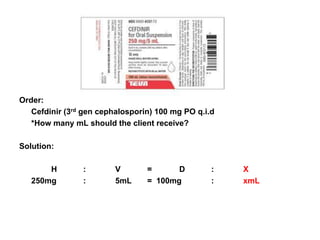
Order:
   Cefdinir (3rd gen cephalosporin) 100 mg PO q.i.d
   *How many mL should the client receive?

Solution:

       H        :        V       =      D         :   X
   250mg        :        5mL     = 100mg          :   xmL
• Your drug order is for morphine sulfate 5 mg, IV, q3h, PRN. The
  drug is available as morphine sulfate 10 mg/mL. Your instructions
  are: infuse morphine sulfate 5 mg; not to exceed 10 mg/4mins

   – How many mL equal morphine sulfate 5 mg?
   – What is the number of minutes to administer morphine sulfate?


Solution:
• a. 0.5 ml
• b. 2 min
3. Fractional Equation

• Same as R & P except it is written as a
  fraction.

     H    =    D
     V         X
Example
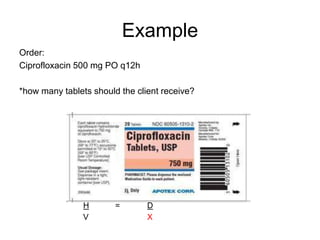
Order:
Ciprofloxacin 500 mg PO q12h

*how many tablets should the client receive?


                H       =       D
                V               X
Order:
Ciprofloxacin 500 mg PO q12h

*how many tablets should the client receive?

Solution:
                H=D       750mg = 500mg
                V X       1 tablet          x

                          750(x) = 500
                                  x = 0.67 tablets
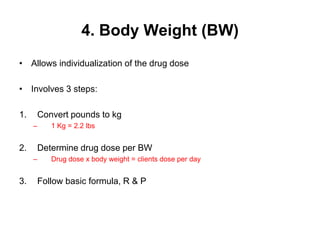
4. Body Weight (BW)
• Allows individualization of the drug dose

• Involves 3 steps:

1.       Convert pounds to kg
     –      1 Kg = 2.2 lbs


2.       Determine drug dose per BW
     –      Drug dose x body weight = clients dose per day


3.       Follow basic formula, R & P
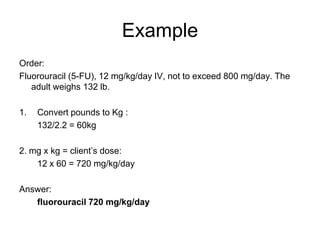
Example
Order:
Fluorouracil (5-FU), 12 mg/kg/day IV, not to exceed 800 mg/day. The
   adult weighs 132 lb.

1.   Convert pounds to Kg :
     132/2.2 = 60kg

2. mg x kg = client’s dose:
    12 x 60 = 720 mg/kg/day

Answer:
   fluorouracil 720 mg/kg/day
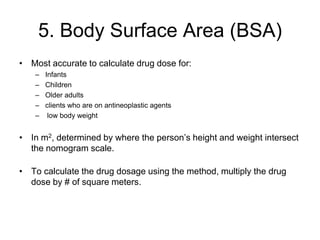
5. Body Surface Area (BSA)
• Most accurate to calculate drug dose for:
   –   Infants
   –   Children
   –   Older adults
   –   clients who are on antineoplastic agents
   –    low body weight


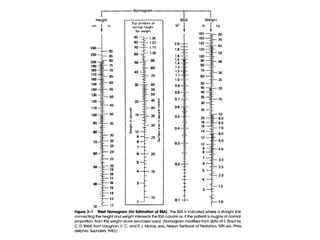
• In m2, determined by where the person’s height and weight intersect
  the nomogram scale.

• To calculate the drug dosage using the method, multiply the drug
  dose by # of square meters.
Example
Order:
Cyclophosphamide (Cytoxan) 100 mg/m2/day, IV; available dosage is 200mg;
   client’s height is 70 inches, weight is 160 lbs.

1. 70 inches and 160 lbs intersect the nomogram scale at 1.97 m2 (BSA).

2. 100 mg x 1.97 = 197mg

Answer:
Administer cyclophosphamide 197 mg/day
Example
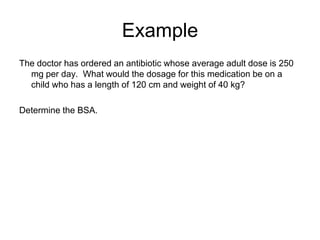
The doctor has ordered an antibiotic whose average adult dose is 250
  mg per day. What would the dosage for this medication be on a
  child who has a length of 120 cm and weight of 40 kg?

Determine the BSA.
The doctor has ordered an antibiotic whose average adult dose is 250 mg per day. What would the dosage
    for this medication be on a child who has a length of 120 cm and weight of 40 kg?

Child dose :
           surface area in sq m (m2) x ave adult dose (mg)
                                1.73

Solution:

                      1.2 m2 x 250 mg
                       1.73
                                                    = 173 mg of medication
                                                    would be given.
Pediatric considerations

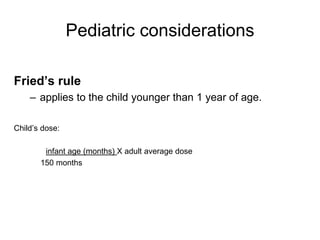
Fried’s rule
    – applies to the child younger than 1 year of age.

Child’s dose:

        infant age (months) X adult average dose
       150 months
Pediatric considerations

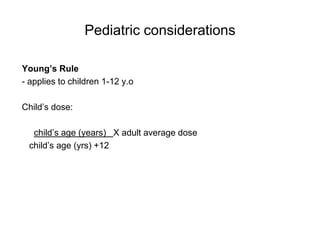
Young’s Rule
- applies to children 1-12 y.o

Child’s dose:

  child’s age (years) X adult average dose
 child’s age (yrs) +12
Pediatric considerations

Clark’s Rule
    – Uses the child’s weight to calculate the appropriate
      dose and assumes that the adult dose is base on 150
      lb person.

Child’s dose:
  child’s weight (pounds) X adult average dose
       150 lbs (pounds)
Calculation of Intravenous Fluid

  – 3 different methods

  – gtt/min


METHOD I: Three-Step

METHOD II: Two-Step

METHOD III: One-Step
Calculation of Intravenous Fluid
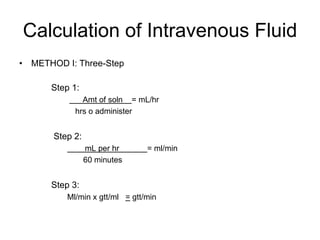
• METHOD I: Three-Step

      Step 1:
              Amt of soln = mL/hr
            hrs o administer


       Step 2:
                 mL per hr      = ml/min
                 60 minutes


      Step 3:
          Ml/min x gtt/ml = gtt/min
Calculation of Intravenous Fluid
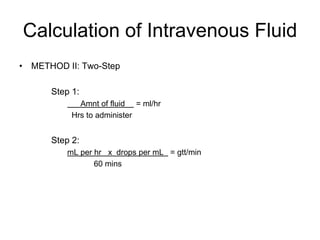
• METHOD II: Two-Step

      Step 1:
             Amnt of fluid = ml/hr
           Hrs to administer


      Step 2:
         mL per hr x drops per mL = gtt/min
                60 mins
Calculation of Intravenous Fluid

• METHOD III: One-Step

 Amnt fluid x gtt/mL = gtt/min
 Hrs to admin x min/hr
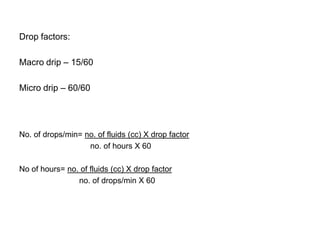
Drop factors:

Macro drip – 15/60

Micro drip – 60/60


No. of drops/min= no. of fluids (cc) X drop factor
                   no. of hours X 60

No of hours= no. of fluids (cc) X drop factor
                no. of drops/min X 60
• Your drug order is for 1000mL of D5/0.5NSS to run for 8
  hours.

   – Would you used macrodrip or microdrip IV set?

   – Calculate the drops per minute (gtt/min) using the 2-step method
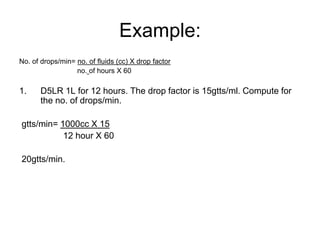
Example:
No. of drops/min= no. of fluids (cc) X drop factor
                  no. of hours X 60

1.     D5LR 1L for 12 hours. The drop factor is 15gtts/ml. Compute for
       the no. of drops/min.

gtts/min= 1000cc X 15
           12 hour X 60

20gtts/min.
2.No. of Hour
No of hours= no. of fluids (cc) X drop factor
                no.of drops/min X 60

D5LR 1L at 2ogtts/min. The IV set delivers at 15gtts/ml. Compute for the no. of
  hours consumed.

No. of hour=  1000cc X 15
            20gtts/min X 60
12 hours = answer
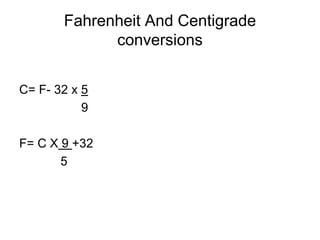
Fahrenheit And Centigrade
             conversions


C= F- 32 x 5
           9

F= C X 9 +32
       5
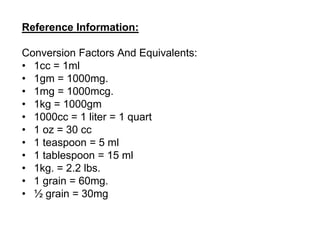
Reference Information:

Conversion Factors And Equivalents:
• 1cc = 1ml
• 1gm = 1000mg.
• 1mg = 1000mcg.
• 1kg = 1000gm
• 1000cc = 1 liter = 1 quart
• 1 oz = 30 cc
• 1 teaspoon = 5 ml
• 1 tablespoon = 15 ml
• 1kg. = 2.2 lbs.
• 1 grain = 60mg.
• ½ grain = 30mg
Route:
• p.o = per orem
• I.M. = intramuscular ( 90 degree)
• S.Q/ S.C = subcutaneous ( 45 degree)
• I.V= intravenous
• I.D = intradermal
• Direct I.V
• Nebulization
• Intrathecal = spinal
• p.c. =post cebum (after meal)
• a.c = ante-cebum ( before meal )
• O.D = oculo-dexter (right eye)
• O.S = oculo-sinester ( Left eye)
• O.U = oculo-urique (Both eyes )
• E.T = endotracheal
• Per rectum- anus/anal
• Intra-vaginal- vagina
• I.J = Intra-jugular
• S.L = Sublingual
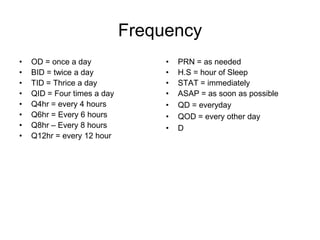
Frequency
•   OD = once a day               •   PRN = as needed
•   BID = twice a day             •   H.S = hour of Sleep
•   TID = Thrice a day            •   STAT = immediately
•   QID = Four times a day        •   ASAP = as soon as possible
•   Q4hr = every 4 hours          •   QD = everyday
•   Q6hr = Every 6 hours          •   QOD = every other day
•   Q8hr – Every 8 hours          •   D
•   Q12hr = every 12 hour
PHARMA-Dosage calculations

PHARMA-Dosage calculations

  • 1.
    Posology & Dosage Calculations
  • 2.
    DEFINITIONS • Posology – the pharmacological study of drug dosage. – The study of dosage quantity and prescription.
  • 3.
    Usual Recommended dose – the amount of drug that will ordinarily produce the effect for what is intended.
  • 4.
    •Minimum dose - the smallest dose of drug that produces therapeutic effect. •Maximum dose -the largest dose that can safely administered. Ex. Acetaminophen 10 to 15 mg/kg/dose
  • 5.
    Toxic dose •amount of drug that cause harmful effect. Lethal dose •amount of substance that will cause death.
  • 6.
    Single dose - to be taken at one time. Daily dose - amount to be taken in 24 hour period.
  • 7.
    Maintenance dose - amount to be taken to maintain the therapeutic effective dose. Loading dose - first dose given to achieve maintenance drug level quickly.
  • 8.
    System of Measurement 1.Metric system 2. Apothecary system 3. Household system
  • 9.
    System of Measurement 1.Metric System – Most widely used system of measurement – A decimal system based on the power of ten – Units: • Gram (weight) • Liter (volume) • Meter (length)
  • 10.
    System of Measurement 2.Apothecary System – Uses Roman numerals to express quantity – Old system of measurement – Uses: • minim = liquid • Grains = solid
  • 12.
    System of Measurement 3.Household System – Not as accurate as metric system due to lack of standardization of spoons, cups and glasses – Teaspoon (tsp) = liquid – Pound (lb) = solid
  • 14.
    System of Measurement ml- milliliter cc- cubic centimeter gm- gram mg- milligram gr- grain mEq- milliequivalent mcg- microgram
  • 15.
    GENERAL METHODS FOR DRUG CALCULATION 1. BASIC FORMULA 2. RATIO& PROPORTION 3. FRACTIONAL EQUATION 4. BODY WEIGHT 5. BODY SURFACE AREA
  • 16.
    1. Basic Formula: DxV=A H D- desired dose (drug dose ordered by health care provider) H- on-hand (stock on hand/on label of container) V- vehicle ( Q- quantity/drug form in which drug comes) A- Amount calculated to be given to client
  • 17.
    Examples: 1. Order: Avandia 2mgOD. How much tablet will you give? DxV=A H Solution: 2mg x 1 tablet 4mg = .5 tablet
  • 18.
    Paracemol 500mg. Q4 hour Round the Clock (RTC) p.o. The stock on hand is 250mg/5ml in 60ml bottle. How many ml should be administered? DxV=A H 500 mg x 5 ml = 250 mg 10 ml
  • 19.
    2. Dilute Terramycinto 50ml of sterile water. Give 5000mg po Q12.
  • 20.
    3. Banophen 50mg.TID p.o. a. How many tablet will you give in 1 dose? b. How many tablets will you give in a day?
  • 21.
    2. Ratio andProportion H : V = D : x Where: H = drug on hand (available) V = vehicle/drug form (capsule/tablet/liquid) D = desired dose (as ordered) x = unknown amount to give
  • 22.
    Example Order: Cefdinir (3rd gen cephalosporin) 100 mg PO q.i.d *How many mL should the client receive?
  • 23.
    Order: Cefdinir (3rd gen cephalosporin) 100 mg PO q.i.d *How many mL should the client receive? Solution: H : V = D : X 250mg : 5mL = 100mg : xmL
  • 24.
    • Your drugorder is for morphine sulfate 5 mg, IV, q3h, PRN. The drug is available as morphine sulfate 10 mg/mL. Your instructions are: infuse morphine sulfate 5 mg; not to exceed 10 mg/4mins – How many mL equal morphine sulfate 5 mg? – What is the number of minutes to administer morphine sulfate? Solution: • a. 0.5 ml • b. 2 min
  • 25.
    3. Fractional Equation •Same as R & P except it is written as a fraction. H = D V X
  • 26.
    Example Order: Ciprofloxacin 500 mgPO q12h *how many tablets should the client receive? H = D V X
  • 27.
    Order: Ciprofloxacin 500 mgPO q12h *how many tablets should the client receive? Solution: H=D 750mg = 500mg V X 1 tablet x 750(x) = 500 x = 0.67 tablets
  • 28.
    4. Body Weight(BW) • Allows individualization of the drug dose • Involves 3 steps: 1. Convert pounds to kg – 1 Kg = 2.2 lbs 2. Determine drug dose per BW – Drug dose x body weight = clients dose per day 3. Follow basic formula, R & P
  • 29.
    Example Order: Fluorouracil (5-FU), 12mg/kg/day IV, not to exceed 800 mg/day. The adult weighs 132 lb. 1. Convert pounds to Kg : 132/2.2 = 60kg 2. mg x kg = client’s dose: 12 x 60 = 720 mg/kg/day Answer: fluorouracil 720 mg/kg/day
  • 30.
    5. Body SurfaceArea (BSA) • Most accurate to calculate drug dose for: – Infants – Children – Older adults – clients who are on antineoplastic agents – low body weight • In m2, determined by where the person’s height and weight intersect the nomogram scale. • To calculate the drug dosage using the method, multiply the drug dose by # of square meters.
  • 31.
    Example Order: Cyclophosphamide (Cytoxan) 100mg/m2/day, IV; available dosage is 200mg; client’s height is 70 inches, weight is 160 lbs. 1. 70 inches and 160 lbs intersect the nomogram scale at 1.97 m2 (BSA). 2. 100 mg x 1.97 = 197mg Answer: Administer cyclophosphamide 197 mg/day
  • 32.
    Example The doctor hasordered an antibiotic whose average adult dose is 250 mg per day. What would the dosage for this medication be on a child who has a length of 120 cm and weight of 40 kg? Determine the BSA.
  • 35.
    The doctor hasordered an antibiotic whose average adult dose is 250 mg per day. What would the dosage for this medication be on a child who has a length of 120 cm and weight of 40 kg? Child dose : surface area in sq m (m2) x ave adult dose (mg) 1.73 Solution: 1.2 m2 x 250 mg 1.73 = 173 mg of medication would be given.
  • 36.
    Pediatric considerations Fried’s rule – applies to the child younger than 1 year of age. Child’s dose: infant age (months) X adult average dose 150 months
  • 37.
    Pediatric considerations Young’s Rule -applies to children 1-12 y.o Child’s dose: child’s age (years) X adult average dose child’s age (yrs) +12
  • 38.
    Pediatric considerations Clark’s Rule – Uses the child’s weight to calculate the appropriate dose and assumes that the adult dose is base on 150 lb person. Child’s dose: child’s weight (pounds) X adult average dose 150 lbs (pounds)
  • 39.
    Calculation of IntravenousFluid – 3 different methods – gtt/min METHOD I: Three-Step METHOD II: Two-Step METHOD III: One-Step
  • 40.
    Calculation of IntravenousFluid • METHOD I: Three-Step Step 1: Amt of soln = mL/hr hrs o administer Step 2: mL per hr = ml/min 60 minutes Step 3: Ml/min x gtt/ml = gtt/min
  • 41.
    Calculation of IntravenousFluid • METHOD II: Two-Step Step 1: Amnt of fluid = ml/hr Hrs to administer Step 2: mL per hr x drops per mL = gtt/min 60 mins
  • 42.
    Calculation of IntravenousFluid • METHOD III: One-Step Amnt fluid x gtt/mL = gtt/min Hrs to admin x min/hr
  • 43.
    Drop factors: Macro drip– 15/60 Micro drip – 60/60 No. of drops/min= no. of fluids (cc) X drop factor no. of hours X 60 No of hours= no. of fluids (cc) X drop factor no. of drops/min X 60
  • 44.
    • Your drugorder is for 1000mL of D5/0.5NSS to run for 8 hours. – Would you used macrodrip or microdrip IV set? – Calculate the drops per minute (gtt/min) using the 2-step method
  • 45.
    Example: No. of drops/min=no. of fluids (cc) X drop factor no. of hours X 60 1. D5LR 1L for 12 hours. The drop factor is 15gtts/ml. Compute for the no. of drops/min. gtts/min= 1000cc X 15 12 hour X 60 20gtts/min.
  • 46.
    2.No. of Hour Noof hours= no. of fluids (cc) X drop factor no.of drops/min X 60 D5LR 1L at 2ogtts/min. The IV set delivers at 15gtts/ml. Compute for the no. of hours consumed. No. of hour= 1000cc X 15 20gtts/min X 60 12 hours = answer
  • 47.
    Fahrenheit And Centigrade conversions C= F- 32 x 5 9 F= C X 9 +32 5
  • 48.
    Reference Information: Conversion FactorsAnd Equivalents: • 1cc = 1ml • 1gm = 1000mg. • 1mg = 1000mcg. • 1kg = 1000gm • 1000cc = 1 liter = 1 quart • 1 oz = 30 cc • 1 teaspoon = 5 ml • 1 tablespoon = 15 ml • 1kg. = 2.2 lbs. • 1 grain = 60mg. • ½ grain = 30mg
  • 49.
    Route: • p.o =per orem • I.M. = intramuscular ( 90 degree) • S.Q/ S.C = subcutaneous ( 45 degree) • I.V= intravenous • I.D = intradermal • Direct I.V • Nebulization • Intrathecal = spinal • p.c. =post cebum (after meal) • a.c = ante-cebum ( before meal ) • O.D = oculo-dexter (right eye) • O.S = oculo-sinester ( Left eye) • O.U = oculo-urique (Both eyes ) • E.T = endotracheal • Per rectum- anus/anal • Intra-vaginal- vagina • I.J = Intra-jugular • S.L = Sublingual
  • 50.
    Frequency • OD = once a day • PRN = as needed • BID = twice a day • H.S = hour of Sleep • TID = Thrice a day • STAT = immediately • QID = Four times a day • ASAP = as soon as possible • Q4hr = every 4 hours • QD = everyday • Q6hr = Every 6 hours • QOD = every other day • Q8hr – Every 8 hours • D • Q12hr = every 12 hour