
Drug Forms
        and
Drug Delivery System


                       1
Before FDA approval
• Rx company must clearly state in what form or
  forms the drug will be manufactured

• Rx company must clearly state what routes of
  administration are determined safe and effective


                                                     2
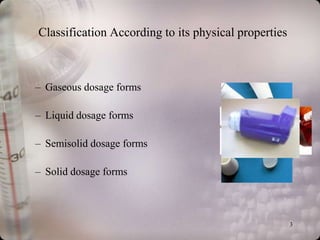
Classification According to its physical properties


– Gaseous dosage forms

– Liquid dosage forms

– Semisolid dosage forms

– Solid dosage forms


                                                      3
4
Classification According to its physical
                   properties

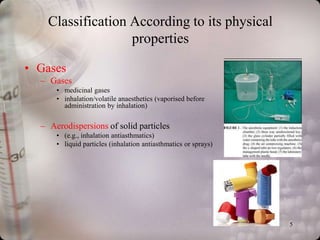
• Gases
  – Gases
      • medicinal gases
      • inhalation/volatile anaesthetics (vaporised before
        administration by inhalation)

  – Aerodispersions of solid particles
      • (e.g., inhalation antiasthmatics)
      • liquid particles (inhalation antiasthmatics or sprays)


                                                                 5
Classification According to its physical
                   properties
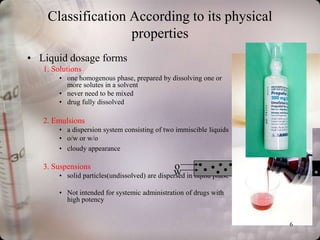
• Liquid dosage forms
   1. Solutions
        • one homogenous phase, prepared by dissolving one or
          more solutes in a solvent
        • never need to be mixed
        • drug fully dissolved

   2. Emulsions
        • a dispersion system consisting of two immiscible liquids
        • o/w or w/o
        • cloudy appearance

   3. Suspensions                                  o
        •                                         w in liquid phase
            solid particles(undissolved) are dispersed

        • Not intended for systemic administration of drugs with
          high potency


                                                                      6
Types of Solutions
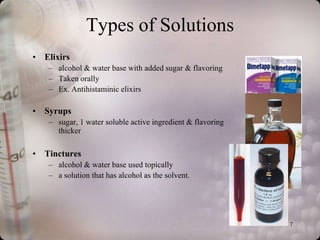
• Elixirs
   – alcohol & water base with added sugar & flavoring
   – Taken orally
   – Ex. Antihistaminic elixirs

• Syrups
   – sugar, 1 water soluble active ingredient & flavoring
     thicker

• Tinctures
   – alcohol & water base used topically
   – a solution that has alcohol as the solvent.


                                                            7
Liquid Sprays


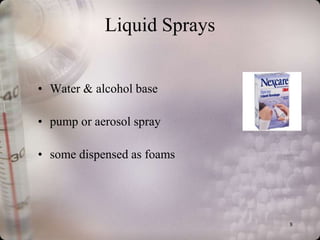
• Water & alcohol base

• pump or aerosol spray

• some dispensed as foams


                            8
Suspensions

• Contain fine, undissolved particles of a drug
  suspended in a liquid base

• Important to always shake before use

• gel-suspended in a thicken water medium- does
  not have to be shaken


                                                  9
Classification According to its physical
                    properties
• Semisolid dosage forms
   – Unshaped (without specific physical shape)

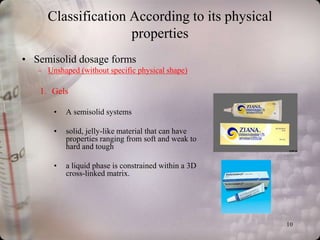
   1. Gels

       •   A semisolid systems

       •   solid, jelly-like material that can have
           properties ranging from soft and weak to
           hard and tough

       •   a liquid phase is constrained within a 3D
           cross-linked matrix.


                                                       10
• Semisolid dosage forms
  – Unshaped (without specific physical shape)

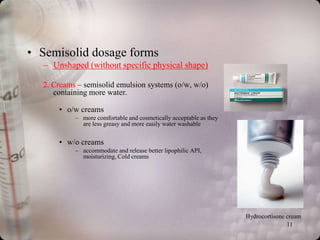
  2. Creams – semisolid emulsion systems (o/w, w/o)
     containing more water.

      • o/w creams
           – more comfortable and cosmetically acceptable as they
             are less greasy and more easily water washable


      • w/o creams
           – accommodate and release better lipophilic API,
             moisturizing, Cold creams


                                                                    Hydrocortisone cream
                                                                                   11
• Semisolid dosage forms
   – Unshaped (without specific physical
     shape)

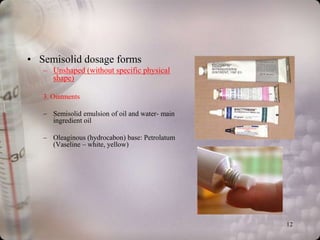
   3. Ointments

   – Semisolid emulsion of oil and water- main
     ingredient oil

   – Oleaginous (hydrocabon) base: Petrolatum
     (Vaseline – white, yellow)


                                                 12
Classification According to its physical
                   properties
• Semisolid dosage forms

   – Shaped

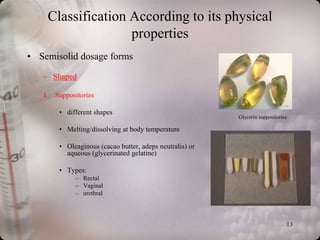
   1. Suppositories

        • different shapes
                                                          Glycerin suppositories

        • Melting/dissolving at body temperature

        • Oleaginous (cacao butter, adeps neutralis) or
          aqueous (glycerinated gelatine)

        • Types:
             – Rectal
             – Vaginal
             – urethral


                                                                               13
•   Solid suppository is melted within the ampula recti, API is dissolved and is absorbed

•   It can gets into the systemic circulation (Middle & inferior haemorrhoidal veins   Iliac
    vein inferior vena cava – bypassing liver there is no first pass effect)

•   It can pass through portal circulation: via Superior haemorrhoidal veins Inferior
    mesenteric vein Hepatic portal Liver (First Pass effect can take place). It becomes
    to be more important when supp. is position too high in rectum.


•   Storage: cool place!


                                                                                            14
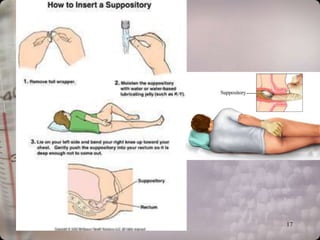
1. Suppositories (for rectal administration)

•   Preferred:
     – when drug is destroyed in GI tract
     – + vomiting
     – unconscious,
     – difficulty swallowing

• Major disadvantages:

     1. Inconvenient.

     2. Rectal absorption of most drugs is frequently erratic and unpredictable.

     3. Some suppositories "leak" or are expelled after insertion.


                                                                                   15
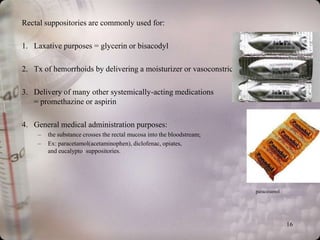
Rectal suppositories are commonly used for:

1. Laxative purposes = glycerin or bisacodyl

2. Tx of hemorrhoids by delivering a moisturizer or vasoconstrictor

3. Delivery of many other systemically-acting medications
                                                                        Glycerin suppositories
   = promethazine or aspirin

4. General medical administration purposes:
    –   the substance crosses the rectal mucosa into the bloodstream;
    –   Ex: paracetamol(acetaminophen), diclofenac, opiates,
        and eucalyptol suppositories.


                                                                        paracetamol


                                                                                      16
17
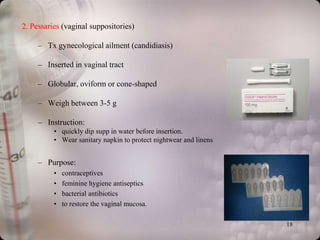
2. Pessaries (vaginal suppositories)

     – Tx gynecological ailment (candidiasis)

     – Inserted in vaginal tract

     – Globular, oviform or cone-shaped

     – Weigh between 3-5 g

     – Instruction:
          • quickly dip supp in water before insertion.
          • Wear sanitary napkin to protect nightwear and linens


     – Purpose:
          •   contraceptives
          •   feminine hygiene antiseptics
          •   bacterial antibiotics
          •   to restore the vaginal mucosa.

                                                                   18
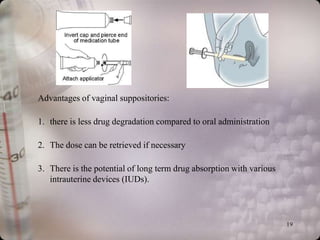
Advantages of vaginal suppositories:

1. there is less drug degradation compared to oral administration

2. The dose can be retrieved if necessary

3. There is the potential of long term drug absorption with various
   intrauterine devices (IUDs).


                                                                      19
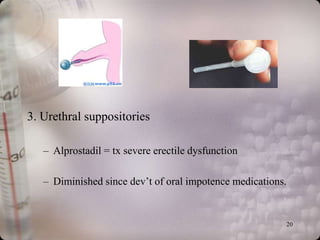
3. Urethral suppositories

   – Alprostadil = tx severe erectile dysfunction

   – Diminished since dev’t of oral impotence medications.


                                                         20
Classification according to its physical
                      properties

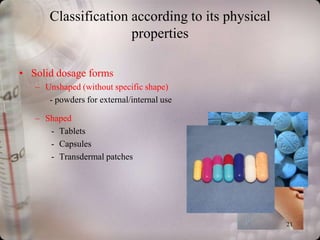
• Solid dosage forms
   – Unshaped (without specific shape)
      - powders for external/internal use

   – Shaped
      - Tablets
      - Capsules
      - Transdermal patches


                                                  21
Classification according to the route of
                  administration
• Dosage forms
   – for systemic administration
       • p.o.
       • s.l. and buc.
       • rectal
       • parenteral
       • transdermal
       • inhalation
   – for local administration
       • Topical (on the skin or mucosa)
            – Into/onto - the eye, nose, ear
                               - the oral cavity
                          - the vagina, rectum
                            - the skin
        • Local parenteral (viz Parenteral above)
                                                    22
Pharmaceutical dosage forms                                    for
    systemic administration
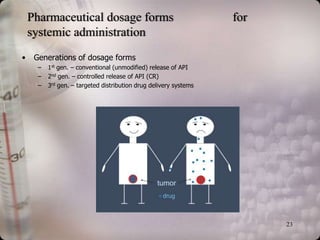
•    Generations of dosage forms
      –   1st gen. – conventional (unmodified) release of API
      –   2nd gen. – controlled release of API (CR)
      –   3rd gen. – targeted distribution drug delivery systems


                                                                         23
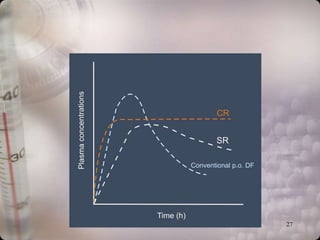
Conventional vs. controlled release
                                 dosage forms
•   I. Gen.
     – Disintegration of the dosage form and dissolution of API is spontaneous process;

     – drug absorption and distribution is based only on physico-chemical properties of API


•   II. Gen.
     – The release of API is under control of the drug delivery system (temporal control)

     –   Advantages:
     –   Avoids fluctuations of plasma drug concentration   better safety and efficacy
     –   Decreased frequency of drug administration (often once daily admin)     better compliance
     –   Can be much more economical (better cost-effectiveness)


                                                                                                24
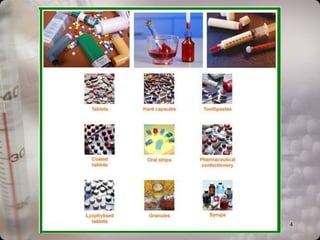
Tablets
• Drug form which contains dried powdered active
  drug

• Contains binders and fillers to provide bulk and
  proper size

• Many different types of tablets
  1. Conventional = can be divided
  2. Coated = not to be divided

                                                 25
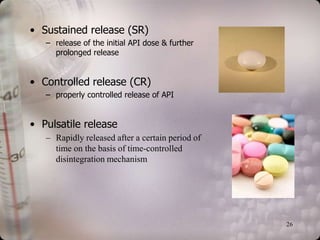
• Sustained release (SR)
   – release of the initial API dose & further
     prolonged release


• Controlled release (CR)
   – properly controlled release of API


• Pulsatile release
   – Rapidly released after a certain period of
     time on the basis of time-controlled
     disintegration mechanism


                                                  26
27
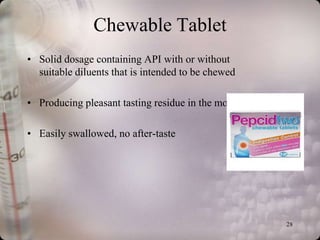
Chewable Tablet
• Solid dosage containing API with or without
  suitable diluents that is intended to be chewed

• Producing pleasant tasting residue in the mouth

• Easily swallowed, no after-taste


                                                    28
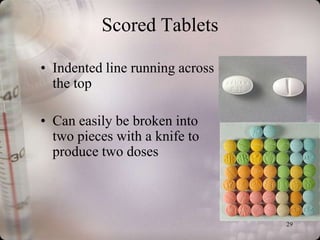
Scored Tablets

• Indented line running across
  the top

• Can easily be broken into
  two pieces with a knife to
  produce two doses


                                 29
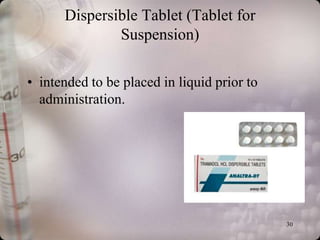
Dispersible Tablet (Tablet for
              Suspension)

• intended to be placed in liquid prior to
  administration.


                                             30
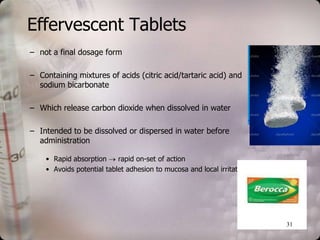
Effervescent Tablets
– not a final dosage form

– Containing mixtures of acids (citric acid/tartaric acid) and
  sodium bicarbonate

– Which release carbon dioxide when dissolved in water

– Intended to be dissolved or dispersed in water before
  administration

    • Rapid absorption     rapid on-set of action
    • Avoids potential tablet adhesion to mucosa and local irritation


                                                                        31
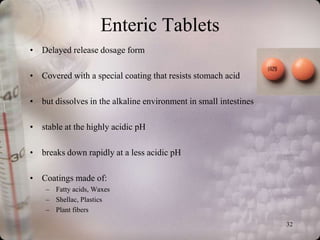
Enteric Tablets
• Delayed release dosage form

• Covered with a special coating that resists stomach acid

• but dissolves in the alkaline environment in small intestines

• stable at the highly acidic pH

• breaks down rapidly at a less acidic pH

• Coatings made of:
    – Fatty acids, Waxes
    – Shellac, Plastics
    – Plant fibers

                                                                  32
• Coated (not to be divided)
   Advantages:
   – To mask unpleasant taste or smell of API

   – To avoid of adhesion in esophagus (to facilitate swallowing and/or
     avoid release of API and local adverse rxns)

   – To ensure drug stability

   – To provide enterosolvent coating

       • To overcome – possible degradation of API in the stomach and possible local
         irritation/adverse reactions in the stomach


                                                                              33
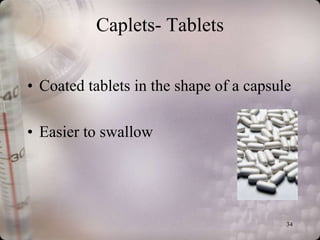
Caplets- Tablets


• Coated tablets in the shape of a capsule

• Easier to swallow


                                         34
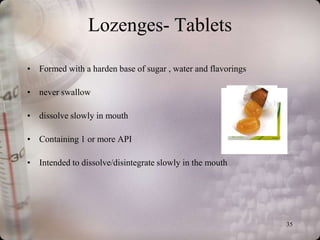
Lozenges- Tablets

• Formed with a harden base of sugar , water and flavorings

• never swallow

• dissolve slowly in mouth

• Containing 1 or more API

• Intended to dissolve/disintegrate slowly in the mouth


                                                              35
Capsule
• Comes in two varieties

• generally easier to swallow


                                36
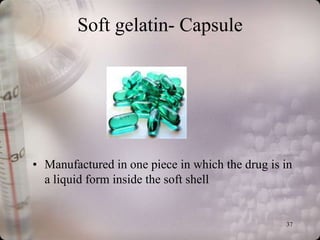
Soft gelatin- Capsule


• Manufactured in one piece in which the drug is in
  a liquid form inside the soft shell


                                                 37
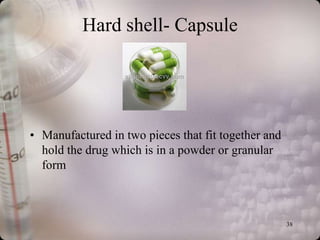
Hard shell- Capsule


• Manufactured in two pieces that fit together and
  hold the drug which is in a powder or granular
  form


                                                     38
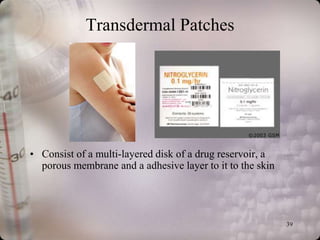
Transdermal Patches


• Consist of a multi-layered disk of a drug reservoir, a
  porous membrane and a adhesive layer to it to the skin


                                                           39
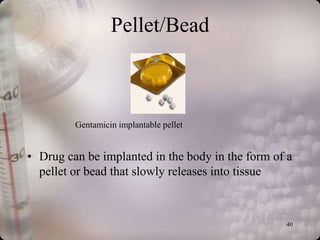
Pellet/Bead


         Gentamicin implantable pellet


• Drug can be implanted in the body in the form of a
  pellet or bead that slowly releases into tissue


                                                  40
Parenteral Drugs
• Drugs administered other than the alimentary canal

   1. Inhalation
       • Drugs administered by nasal/oral-respi route
       • Nebulizers, aerosols


   – Forms of Inhalation
       1.   Gaseous/volatile drugs
       2.   Suspended tiny droplets in aerosols
       3.   Inhaler/puffer (to the lungs)
       4.   Nebulizer (mist inhaled into lungs)


                                                        41
Advantages of Inhalation:
1. Pulmonary administration offers large surface alveolar area for
    diffusion of drug into pulmonary circulation.
2. Rapid entry of drug to the blood stream
3. Direct application of drug to the bronchial tree and alveolar tissues
4. Fastest method, 7-10 secs for the drug to reach the brain
5. User can titrate (regulate) the amount of drug they are receiving.


                                                                           42
Disadvantage of Inhalation:
1. Difficult to administer, some have difficulty in using inhalers
2. Particles are trapped in the cilia and mucus in the respiratory tract
3. Drugs may serve as irritant to alveoli and respiratory tract
4. Unpredictable amount of drugs delivered to the lungs
5. Most addictive route of administration as it hits the brain so quickly.
6. Difficulties in regulating the exact amount of dosage.


                                                                         43
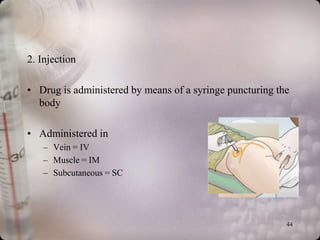
2. Injection

• Drug is administered by means of a syringe puncturing the
  body

• Administered in
   – Vein = IV
   – Muscle = IM
   – Subcutaneous = SC


                                                          44
Forms of Injection:

1.   Liquid for injection IV (vein)
2.   Liquid for intra-arterially (Arteries)
3.   Liquid for subcutaneous (directly beneath the skin)
4.   Liquid for intramuscular (within large muscles)
5.   Liquid for intrathecal (within the sheath or at the spinal
     subarachnoid space)


                                                                  45
Advantages of Injection
1. Outcome can be predicted in a short period of time
2. Reach the target sites rapidly
3. Drugs given intra-arterially are used to localize drugs into certain
    tissues with few exposure of drug to other tissues.
4. Effective for administration of radio opaque dyes for diagnostic
    purposes.
5. Effects seen within few minutes.
6. Convenience in 1 time administration that has a long acting effect
    (ex. Depo-Provera, a birth control shot that works for 3 months)


                                                                          46
Disadvantages of Injections:
1.   self-administration may be difficult with most of the injection routes

2.    High risk for addiction due to the quick onset of action of most injectable drugs.

3.    Risk of HIV and other infectious diseases transmission if needles are accidentally
      shared.

4.    most dangerous route of administration because the drug is not screened by the body’s
      natural defenses, placing the client at risk of developing hepatitis, abscesses, and
      infections from undissolved particles or additive/contaminants.

5.    Risk of air boluses (bubbles) which can be fatal may occur during drug administration
      especially when drugs are not prepared properly.

6.    Need for observing strict asepsis as this provide a port entry for microbes that can
      cause infection


                                                                                             47
3. Topical/Dermatologic
   – Drugs applied to the surface of the skin/mucous
     membrane

   1. Iontophoresis
      •   Use electric current to drive the ionized form of medications
          through the skin


   2. Phonophoresis
      •   Use ultrasound waves as driving force to propel drug
          through the dermis.


                                                                      48
Forms of Topical/Dermatologic Drugs

1.   Ointments
2.   Creams
3.   Gel
4.   Paste
5.   Powder
6.   Liniment (muscular stiffness/pain)
7.   Lotion
8.   Transdermal patch
9.   epicutaneous


                                          49
Advantages:
1. Applied directly to skin/membranes to treat itself
2. Bypasses systemic absorption
3. Direct action
4. Easy to apply
5. Safe and effective method of administering medications
6. Provides a slow, controlled release of the drugs into the body
7. Effective in maintaining plasma levels at constant levels for
    prolonged period of time.


                                                                    50
Disadvantages:
1. Poorly absorbed systemically through epidermis and are not intended
    for systemic tx.
2. Some drugs applied to the mucous membranes are also absorbed to
    some degree that may cause adverse effects.
3. Drugs that cannot penetrate the skin will unlikely be an effective
    agent administered by this route.
4. Drugs that are easily degraded by the enzymes present in the skin
    will cause failure of the drug to meet its therapeutic effects.


                                                                    51
4. Instillation & irrigations

Instillation
   – Administered in drop form or
   – Administered into the body cavity by means of catheter
     and stays in place after administration.


Irrigation
   – Administering drugs that stays for a while and are
     removed minutes after it is administered.


                                                              52
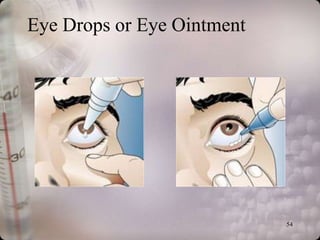
1. Opthalmic Administration
  –       Eye medications

  Eye drops
      •     Saline-containing liquid
      •     Used as vector to administer medication in the eye
      •     May contain steroids or topical anesthetics

  Advantage:
      •     Direct contact on the target site

 Disadvantages:
      •     Intolerance to bright light
      •     Excess use may discourage the eyes to produce tears naturally = increase
            dependence on drugs


                                                                                       53
Eye Drops or Eye Ointment


                            54
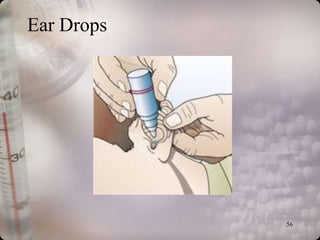
2. Otic administration
   – Ear drops (antibiotics & steroids for otitis externa)

   Advantage:
      • Has direct contact to affected site


   Disadvantage:
      • Client has to be kept in position for 2-3 min to facilitate drops
        to reach the affected area

      • Head tilted slightly toward the unaffected side


                                                                        55
Ear Drops


            56
3. Nasal administration
   – Intransal route (into the nose)
   – Ex decongestant nasal sprays.

   Advantage:
      • Direct contact to affected site


   Disadvantage:
      • Client may become uncomfortable when asked to maintain
        position (head tilted backward) for 5 mins after instillation of
        drops


                                                                           57
4. Vaginal administration
  – Vaginal, ex:
     • Topical estrogens
     • Antibacterial


  – Advantage:
     • Direct contact to affected site.


  – Disadvantage:
     • May cause severe vaginal wall irritation


                                                  58
5. Rectal administration

  – Advantages:
     • Direct contact
     • Ease in application


  – Disadvantages:
     • Vaginal and rectal suppositories melts easily even
       before application.

                                                            59
HAND OUTS


            60

PHARMA-Drug forms

  • 1.
    Drug Forms and Drug Delivery System 1
  • 2.
    Before FDA approval •Rx company must clearly state in what form or forms the drug will be manufactured • Rx company must clearly state what routes of administration are determined safe and effective 2
  • 3.
    Classification According toits physical properties – Gaseous dosage forms – Liquid dosage forms – Semisolid dosage forms – Solid dosage forms 3
  • 4.
  • 5.
    Classification According toits physical properties • Gases – Gases • medicinal gases • inhalation/volatile anaesthetics (vaporised before administration by inhalation) – Aerodispersions of solid particles • (e.g., inhalation antiasthmatics) • liquid particles (inhalation antiasthmatics or sprays) 5
  • 6.
    Classification According toits physical properties • Liquid dosage forms 1. Solutions • one homogenous phase, prepared by dissolving one or more solutes in a solvent • never need to be mixed • drug fully dissolved 2. Emulsions • a dispersion system consisting of two immiscible liquids • o/w or w/o • cloudy appearance 3. Suspensions o • w in liquid phase solid particles(undissolved) are dispersed • Not intended for systemic administration of drugs with high potency 6
  • 7.
    Types of Solutions •Elixirs – alcohol & water base with added sugar & flavoring – Taken orally – Ex. Antihistaminic elixirs • Syrups – sugar, 1 water soluble active ingredient & flavoring thicker • Tinctures – alcohol & water base used topically – a solution that has alcohol as the solvent. 7
  • 8.
    Liquid Sprays • Water& alcohol base • pump or aerosol spray • some dispensed as foams 8
  • 9.
    Suspensions • Contain fine,undissolved particles of a drug suspended in a liquid base • Important to always shake before use • gel-suspended in a thicken water medium- does not have to be shaken 9
  • 10.
    Classification According toits physical properties • Semisolid dosage forms – Unshaped (without specific physical shape) 1. Gels • A semisolid systems • solid, jelly-like material that can have properties ranging from soft and weak to hard and tough • a liquid phase is constrained within a 3D cross-linked matrix. 10
  • 11.
    • Semisolid dosageforms – Unshaped (without specific physical shape) 2. Creams – semisolid emulsion systems (o/w, w/o) containing more water. • o/w creams – more comfortable and cosmetically acceptable as they are less greasy and more easily water washable • w/o creams – accommodate and release better lipophilic API, moisturizing, Cold creams Hydrocortisone cream 11
  • 12.
    • Semisolid dosageforms – Unshaped (without specific physical shape) 3. Ointments – Semisolid emulsion of oil and water- main ingredient oil – Oleaginous (hydrocabon) base: Petrolatum (Vaseline – white, yellow) 12
  • 13.
    Classification According toits physical properties • Semisolid dosage forms – Shaped 1. Suppositories • different shapes Glycerin suppositories • Melting/dissolving at body temperature • Oleaginous (cacao butter, adeps neutralis) or aqueous (glycerinated gelatine) • Types: – Rectal – Vaginal – urethral 13
  • 14.
    Solid suppository is melted within the ampula recti, API is dissolved and is absorbed • It can gets into the systemic circulation (Middle & inferior haemorrhoidal veins Iliac vein inferior vena cava – bypassing liver there is no first pass effect) • It can pass through portal circulation: via Superior haemorrhoidal veins Inferior mesenteric vein Hepatic portal Liver (First Pass effect can take place). It becomes to be more important when supp. is position too high in rectum. • Storage: cool place! 14
  • 15.
    1. Suppositories (forrectal administration) • Preferred: – when drug is destroyed in GI tract – + vomiting – unconscious, – difficulty swallowing • Major disadvantages: 1. Inconvenient. 2. Rectal absorption of most drugs is frequently erratic and unpredictable. 3. Some suppositories "leak" or are expelled after insertion. 15
  • 16.
    Rectal suppositories arecommonly used for: 1. Laxative purposes = glycerin or bisacodyl 2. Tx of hemorrhoids by delivering a moisturizer or vasoconstrictor 3. Delivery of many other systemically-acting medications Glycerin suppositories = promethazine or aspirin 4. General medical administration purposes: – the substance crosses the rectal mucosa into the bloodstream; – Ex: paracetamol(acetaminophen), diclofenac, opiates, and eucalyptol suppositories. paracetamol 16
  • 17.
  • 18.
    2. Pessaries (vaginalsuppositories) – Tx gynecological ailment (candidiasis) – Inserted in vaginal tract – Globular, oviform or cone-shaped – Weigh between 3-5 g – Instruction: • quickly dip supp in water before insertion. • Wear sanitary napkin to protect nightwear and linens – Purpose: • contraceptives • feminine hygiene antiseptics • bacterial antibiotics • to restore the vaginal mucosa. 18
  • 19.
    Advantages of vaginalsuppositories: 1. there is less drug degradation compared to oral administration 2. The dose can be retrieved if necessary 3. There is the potential of long term drug absorption with various intrauterine devices (IUDs). 19
  • 20.
    3. Urethral suppositories – Alprostadil = tx severe erectile dysfunction – Diminished since dev’t of oral impotence medications. 20
  • 21.
    Classification according toits physical properties • Solid dosage forms – Unshaped (without specific shape) - powders for external/internal use – Shaped - Tablets - Capsules - Transdermal patches 21
  • 22.
    Classification according tothe route of administration • Dosage forms – for systemic administration • p.o. • s.l. and buc. • rectal • parenteral • transdermal • inhalation – for local administration • Topical (on the skin or mucosa) – Into/onto - the eye, nose, ear - the oral cavity - the vagina, rectum - the skin • Local parenteral (viz Parenteral above) 22
  • 23.
    Pharmaceutical dosage forms for systemic administration • Generations of dosage forms – 1st gen. – conventional (unmodified) release of API – 2nd gen. – controlled release of API (CR) – 3rd gen. – targeted distribution drug delivery systems 23
  • 24.
    Conventional vs. controlledrelease dosage forms • I. Gen. – Disintegration of the dosage form and dissolution of API is spontaneous process; – drug absorption and distribution is based only on physico-chemical properties of API • II. Gen. – The release of API is under control of the drug delivery system (temporal control) – Advantages: – Avoids fluctuations of plasma drug concentration better safety and efficacy – Decreased frequency of drug administration (often once daily admin) better compliance – Can be much more economical (better cost-effectiveness) 24
  • 25.
    Tablets • Drug formwhich contains dried powdered active drug • Contains binders and fillers to provide bulk and proper size • Many different types of tablets 1. Conventional = can be divided 2. Coated = not to be divided 25
  • 26.
    • Sustained release(SR) – release of the initial API dose & further prolonged release • Controlled release (CR) – properly controlled release of API • Pulsatile release – Rapidly released after a certain period of time on the basis of time-controlled disintegration mechanism 26
  • 27.
  • 28.
    Chewable Tablet • Soliddosage containing API with or without suitable diluents that is intended to be chewed • Producing pleasant tasting residue in the mouth • Easily swallowed, no after-taste 28
  • 29.
    Scored Tablets • Indentedline running across the top • Can easily be broken into two pieces with a knife to produce two doses 29
  • 30.
    Dispersible Tablet (Tabletfor Suspension) • intended to be placed in liquid prior to administration. 30
  • 31.
    Effervescent Tablets – nota final dosage form – Containing mixtures of acids (citric acid/tartaric acid) and sodium bicarbonate – Which release carbon dioxide when dissolved in water – Intended to be dissolved or dispersed in water before administration • Rapid absorption rapid on-set of action • Avoids potential tablet adhesion to mucosa and local irritation 31
  • 32.
    Enteric Tablets • Delayedrelease dosage form • Covered with a special coating that resists stomach acid • but dissolves in the alkaline environment in small intestines • stable at the highly acidic pH • breaks down rapidly at a less acidic pH • Coatings made of: – Fatty acids, Waxes – Shellac, Plastics – Plant fibers 32
  • 33.
    • Coated (notto be divided) Advantages: – To mask unpleasant taste or smell of API – To avoid of adhesion in esophagus (to facilitate swallowing and/or avoid release of API and local adverse rxns) – To ensure drug stability – To provide enterosolvent coating • To overcome – possible degradation of API in the stomach and possible local irritation/adverse reactions in the stomach 33
  • 34.
    Caplets- Tablets • Coatedtablets in the shape of a capsule • Easier to swallow 34
  • 35.
    Lozenges- Tablets • Formedwith a harden base of sugar , water and flavorings • never swallow • dissolve slowly in mouth • Containing 1 or more API • Intended to dissolve/disintegrate slowly in the mouth 35
  • 36.
    Capsule • Comes intwo varieties • generally easier to swallow 36
  • 37.
    Soft gelatin- Capsule •Manufactured in one piece in which the drug is in a liquid form inside the soft shell 37
  • 38.
    Hard shell- Capsule •Manufactured in two pieces that fit together and hold the drug which is in a powder or granular form 38
  • 39.
    Transdermal Patches • Consistof a multi-layered disk of a drug reservoir, a porous membrane and a adhesive layer to it to the skin 39
  • 40.
    Pellet/Bead Gentamicin implantable pellet • Drug can be implanted in the body in the form of a pellet or bead that slowly releases into tissue 40
  • 41.
    Parenteral Drugs • Drugsadministered other than the alimentary canal 1. Inhalation • Drugs administered by nasal/oral-respi route • Nebulizers, aerosols – Forms of Inhalation 1. Gaseous/volatile drugs 2. Suspended tiny droplets in aerosols 3. Inhaler/puffer (to the lungs) 4. Nebulizer (mist inhaled into lungs) 41
  • 42.
    Advantages of Inhalation: 1.Pulmonary administration offers large surface alveolar area for diffusion of drug into pulmonary circulation. 2. Rapid entry of drug to the blood stream 3. Direct application of drug to the bronchial tree and alveolar tissues 4. Fastest method, 7-10 secs for the drug to reach the brain 5. User can titrate (regulate) the amount of drug they are receiving. 42
  • 43.
    Disadvantage of Inhalation: 1.Difficult to administer, some have difficulty in using inhalers 2. Particles are trapped in the cilia and mucus in the respiratory tract 3. Drugs may serve as irritant to alveoli and respiratory tract 4. Unpredictable amount of drugs delivered to the lungs 5. Most addictive route of administration as it hits the brain so quickly. 6. Difficulties in regulating the exact amount of dosage. 43
  • 44.
    2. Injection • Drugis administered by means of a syringe puncturing the body • Administered in – Vein = IV – Muscle = IM – Subcutaneous = SC 44
  • 45.
    Forms of Injection: 1. Liquid for injection IV (vein) 2. Liquid for intra-arterially (Arteries) 3. Liquid for subcutaneous (directly beneath the skin) 4. Liquid for intramuscular (within large muscles) 5. Liquid for intrathecal (within the sheath or at the spinal subarachnoid space) 45
  • 46.
    Advantages of Injection 1.Outcome can be predicted in a short period of time 2. Reach the target sites rapidly 3. Drugs given intra-arterially are used to localize drugs into certain tissues with few exposure of drug to other tissues. 4. Effective for administration of radio opaque dyes for diagnostic purposes. 5. Effects seen within few minutes. 6. Convenience in 1 time administration that has a long acting effect (ex. Depo-Provera, a birth control shot that works for 3 months) 46
  • 47.
    Disadvantages of Injections: 1. self-administration may be difficult with most of the injection routes 2. High risk for addiction due to the quick onset of action of most injectable drugs. 3. Risk of HIV and other infectious diseases transmission if needles are accidentally shared. 4. most dangerous route of administration because the drug is not screened by the body’s natural defenses, placing the client at risk of developing hepatitis, abscesses, and infections from undissolved particles or additive/contaminants. 5. Risk of air boluses (bubbles) which can be fatal may occur during drug administration especially when drugs are not prepared properly. 6. Need for observing strict asepsis as this provide a port entry for microbes that can cause infection 47
  • 48.
    3. Topical/Dermatologic – Drugs applied to the surface of the skin/mucous membrane 1. Iontophoresis • Use electric current to drive the ionized form of medications through the skin 2. Phonophoresis • Use ultrasound waves as driving force to propel drug through the dermis. 48
  • 49.
    Forms of Topical/DermatologicDrugs 1. Ointments 2. Creams 3. Gel 4. Paste 5. Powder 6. Liniment (muscular stiffness/pain) 7. Lotion 8. Transdermal patch 9. epicutaneous 49
  • 50.
    Advantages: 1. Applied directlyto skin/membranes to treat itself 2. Bypasses systemic absorption 3. Direct action 4. Easy to apply 5. Safe and effective method of administering medications 6. Provides a slow, controlled release of the drugs into the body 7. Effective in maintaining plasma levels at constant levels for prolonged period of time. 50
  • 51.
    Disadvantages: 1. Poorly absorbedsystemically through epidermis and are not intended for systemic tx. 2. Some drugs applied to the mucous membranes are also absorbed to some degree that may cause adverse effects. 3. Drugs that cannot penetrate the skin will unlikely be an effective agent administered by this route. 4. Drugs that are easily degraded by the enzymes present in the skin will cause failure of the drug to meet its therapeutic effects. 51
  • 52.
    4. Instillation &irrigations Instillation – Administered in drop form or – Administered into the body cavity by means of catheter and stays in place after administration. Irrigation – Administering drugs that stays for a while and are removed minutes after it is administered. 52
  • 53.
    1. Opthalmic Administration – Eye medications Eye drops • Saline-containing liquid • Used as vector to administer medication in the eye • May contain steroids or topical anesthetics Advantage: • Direct contact on the target site Disadvantages: • Intolerance to bright light • Excess use may discourage the eyes to produce tears naturally = increase dependence on drugs 53
  • 54.
    Eye Drops orEye Ointment 54
  • 55.
    2. Otic administration – Ear drops (antibiotics & steroids for otitis externa) Advantage: • Has direct contact to affected site Disadvantage: • Client has to be kept in position for 2-3 min to facilitate drops to reach the affected area • Head tilted slightly toward the unaffected side 55
  • 56.
  • 57.
    3. Nasal administration – Intransal route (into the nose) – Ex decongestant nasal sprays. Advantage: • Direct contact to affected site Disadvantage: • Client may become uncomfortable when asked to maintain position (head tilted backward) for 5 mins after instillation of drops 57
  • 58.
    4. Vaginal administration – Vaginal, ex: • Topical estrogens • Antibacterial – Advantage: • Direct contact to affected site. – Disadvantage: • May cause severe vaginal wall irritation 58
  • 59.
    5. Rectal administration – Advantages: • Direct contact • Ease in application – Disadvantages: • Vaginal and rectal suppositories melts easily even before application. 59
  • 60.