DOPAMINE
PRESENTED BY RUCHI YADAV
MPH:1
Introduction
 Dopamine belongs to the family of catecholamines
 Hormones Epinephrine and Norepinephrine (other catecholamines) are
derived from Dopamine
 Significant role in learning, goal-directed behavior, regulation of
hormones, motor control
DA synthesis and metabolism
L phenylalanine (amino acid from diet)
phenyalanine hydroxylase
L- Tyrosine
Tyrosine hydroxylase RLS
L Dopa
Dopa decarboxylase
Dopamine (DA)
Monoamine oxidase (MAO)
Catechol-O-methyl transferase (COMT)
DOPAC + HVA
After synthesis, dopamine is packaged into synaptic vesicles via
the vesicular monoamine transporter (VMAT2) and stored there
until its release into the synapse during neurotransmission.
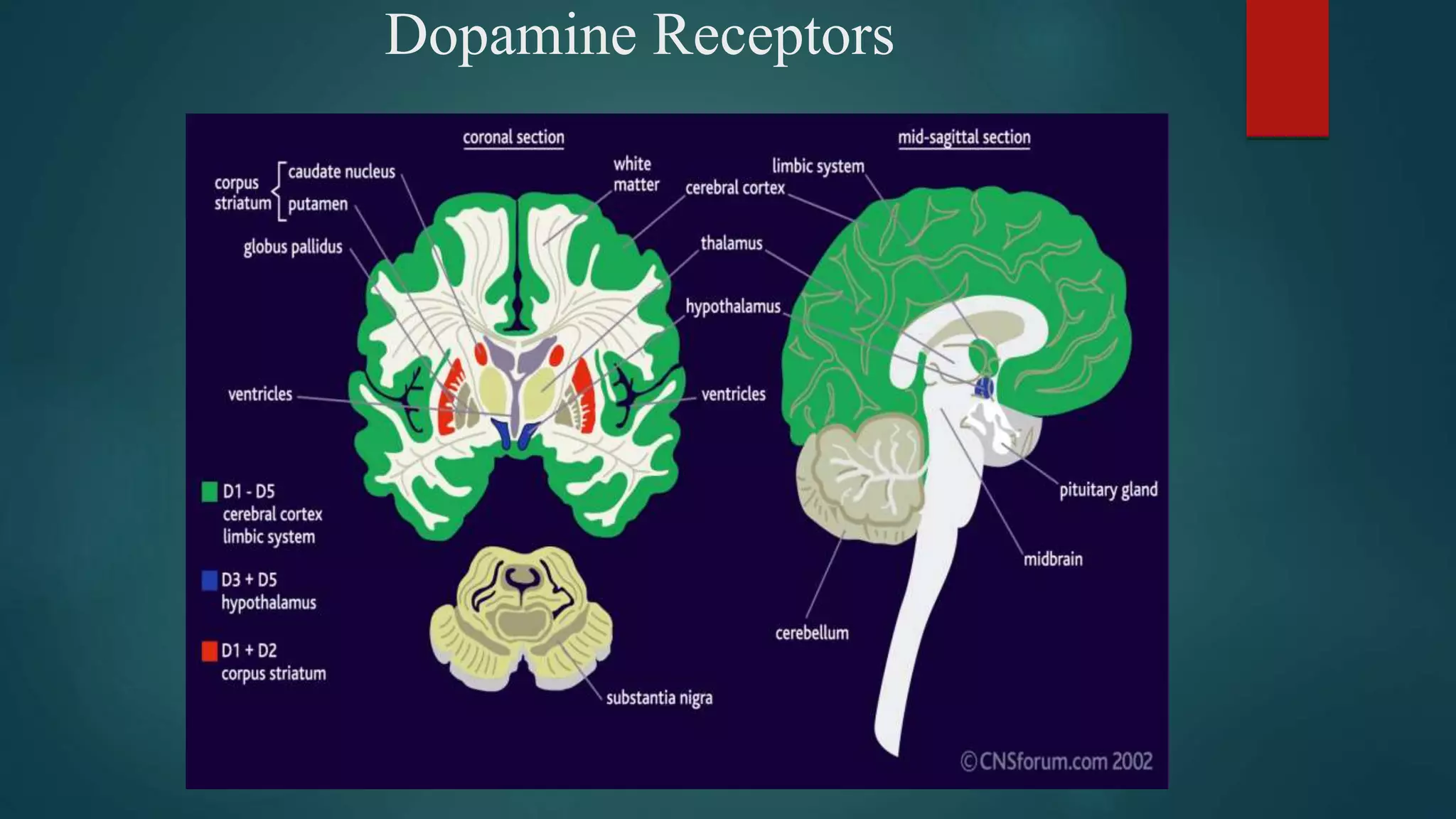
Dopamine Receptors
 Metabotropic G-protein coupled receptors
 D1 – like family:
 Includes subtypes D1 and D5
 Activation is coupled to Gαs ; activates adenylyl cylcase which
leads to increase in concentration of cAMP
 D2 – like family:
 Includes D2, D3 and D4
 Activation is coupled to Gαi ; inhibits adenylyl cyclase leading to
decrease in concentration of cAMP
Receptor Locations Functions
D1 Found in high concentration in mesolimbic, nigrostratal and
mesocortical areas , such as substancia nigra, olfactory bulb, nucleus
accumbens, cuadate, putamen, striatum, Expressed in low level in
cerebellum, hippocampus, thalamus, hypothalamus, kidney
Voluntary movements, regulate growth and development,
regulations of feeding, affect, attentions, reward, sleep,
impulse control, reproductive behaviors, working memory,
learning, control of rennin in kidney
D2 Expressed in high levels in as substancia nigra, olfactory bulb,
cuadate, putamen, ventral tagemental area(VTA), nucleus accumbens
Found in low level in hypothalamus, septum, kidney, cortex, heart,
blood vessels, adrenal glands, gastrointestinal tract, sympathetic
ganglia
Involved in working memory, reward-motivation
functions regulate blood pressure, renal functions,
gastrointestinal motility, vasodilatations, regulate
locomotion-presynatic receptors inhibit locomotion and
post synaptic receptors activate locomotion
D3 Expressed only in CNS and it is not found outside the CNS. Found in
olfactory bulb, nucleus accumbens
Involved in endocrine function cognitions, emotions,
regulations oflocomotor functions and modulates
endocrine functions
D4 Substancia nigra, hippocampus, amygdala, thalamus, hypothalamus,
kidney, frontal cortex, heart, blood vessels, adrenal glands,
gastrointestinal tract, sympathetic ganglia, globus palidum, Lowest
receptor found in CNS than all dopamine receptors
Regulations of renal functions, gastrointestinal motility,
vasodilatations, blood pressure, modulations of cognitive
functions
D5 Substancia nigra, hypothalamus, hippocampus, dental gyrus, kidney,
heart, blood vessels, adrenal glands, gastrointestinal tract, sympathetic
ganglia
Involved in pain process, affective functions, endocrine
functions of dopamine
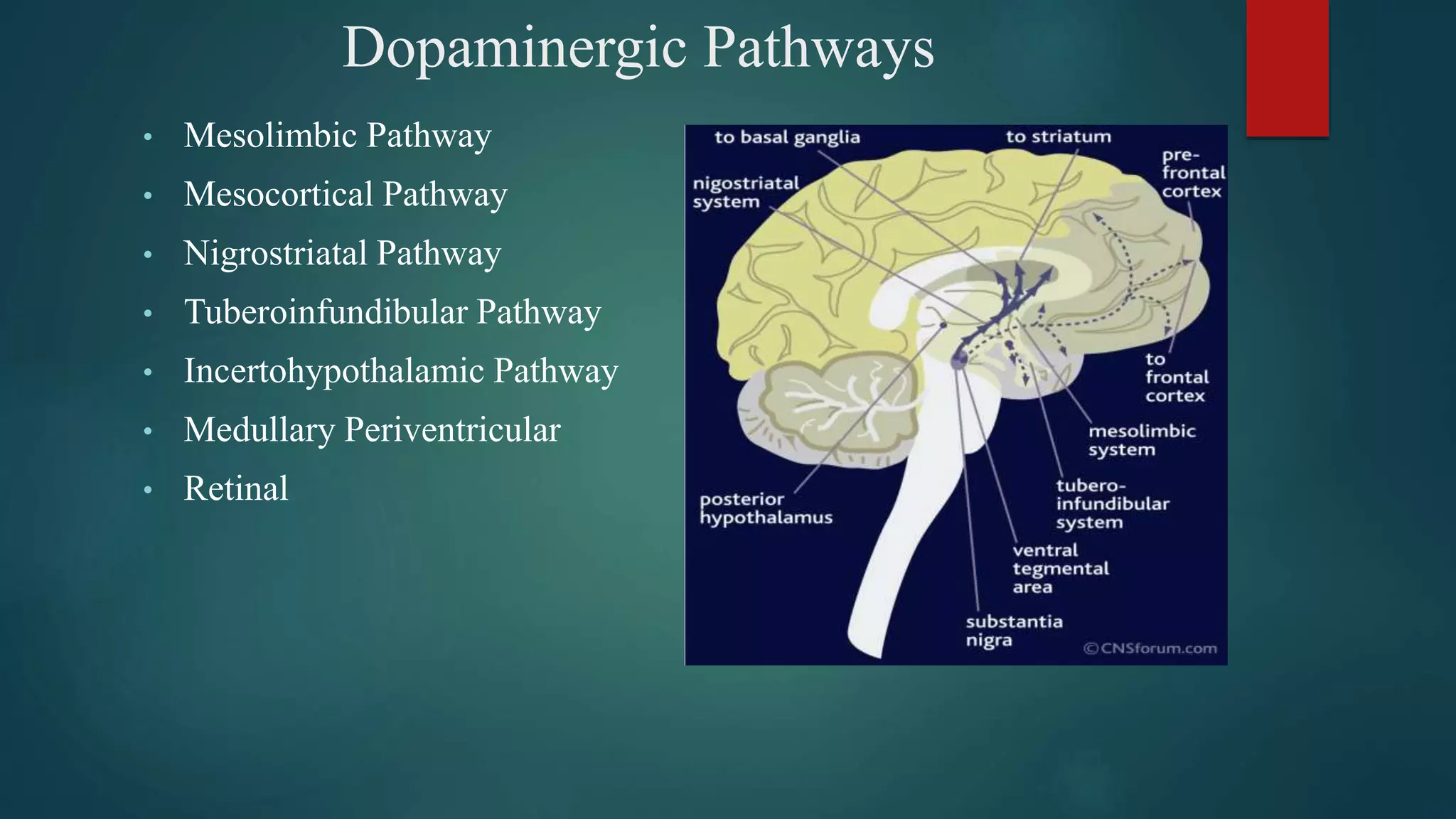
Dopaminergic Pathways
• Mesolimbic Pathway
• Mesocortical Pathway
• Nigrostriatal Pathway
• Tuberoinfundibular Pathway
• Incertohypothalamic Pathway
• Medullary Periventricular
• Retinal
Functions
 Precursor
 NEEpinephrine
 Neurotransmitter
 Neurohormone
 prolactin
 Pleasure
 Reward
 emotion
 Memory
 Attention
 Learning
 Locomotion
 smooth and
 controlled muscular
movements
 Renal-
 vasodilation, diuresis,
and natriuresis
Drugs and Diseases associated with
Dopamine
Vomiting
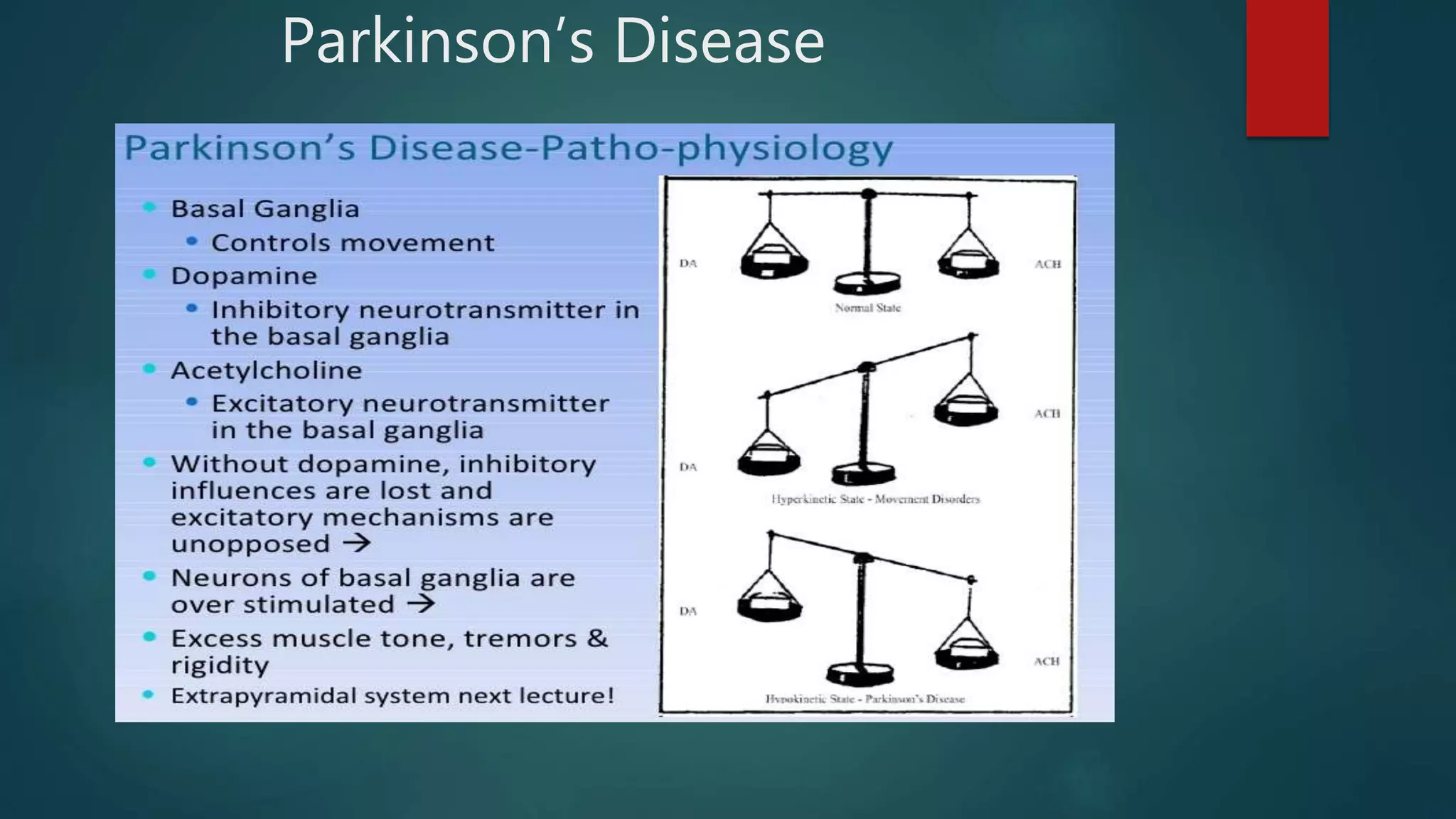
Parkinson’s Disease
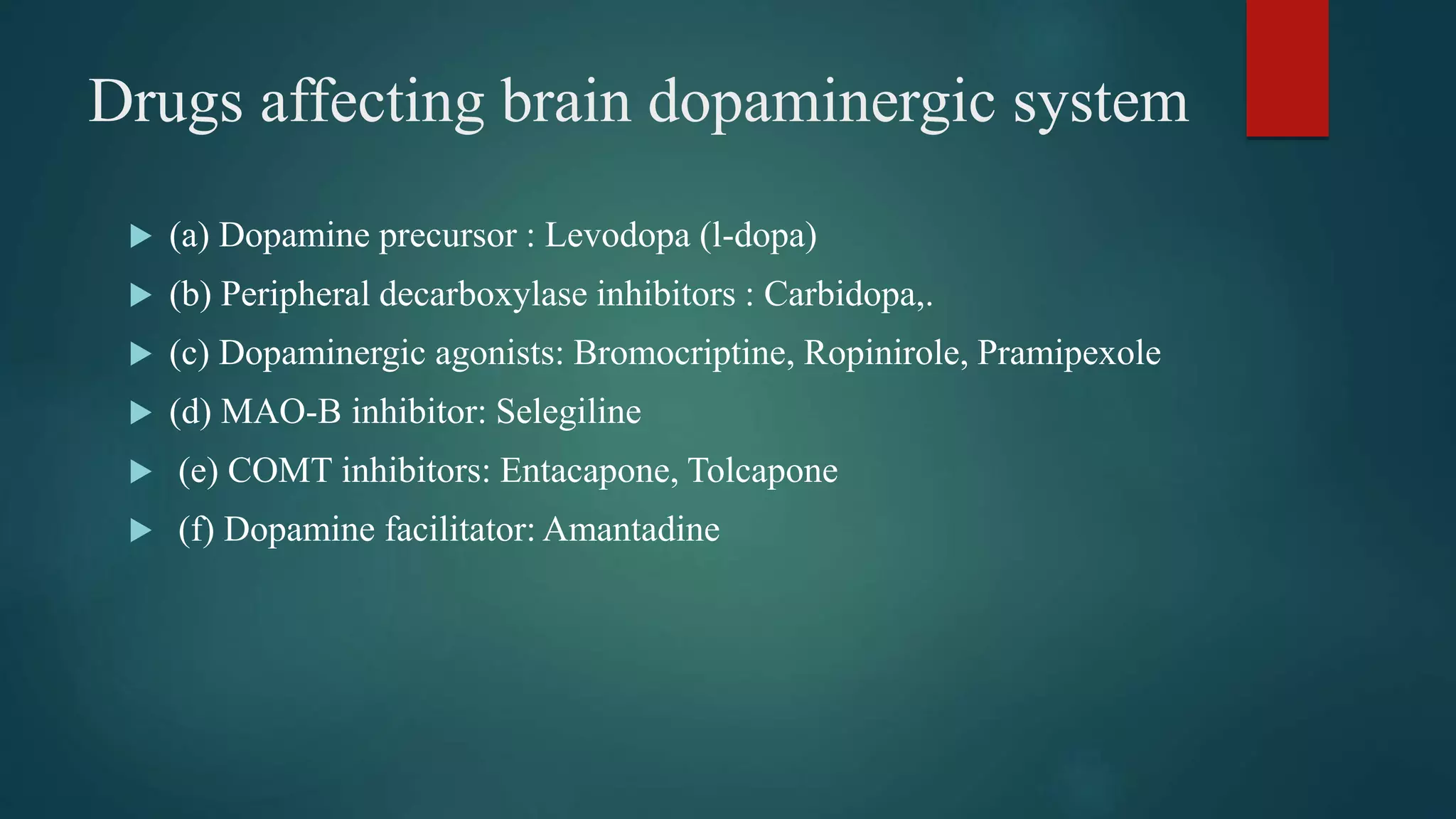
Drugs affecting brain dopaminergic system
 (a) Dopamine precursor : Levodopa (l-dopa)
 (b) Peripheral decarboxylase inhibitors : Carbidopa,.
 (c) Dopaminergic agonists: Bromocriptine, Ropinirole, Pramipexole
 (d) MAO-B inhibitor: Selegiline
 (e) COMT inhibitors: Entacapone, Tolcapone
 (f) Dopamine facilitator: Amantadine
Dopamine and Reward Signaling
 Behavior studies show that dopamine projections to striatum and
frontal cortex play important role in effect of rewards on learning
 Dopamine neurons in the basal ganglia show increase in activity
when the animal receives an unexpected reward, or a cue that
predicts a reward and a decrease in activity when an expected
reward is not obtained
Addiction and drug abuse
 The dopaminergic projection to ventral striatum has often been
implicated in the mechanisms for addiction
 Increased locomotor activity and stereotypy caused due to
psychostimulant involve dopamine release in striatum
 Psychostimulants such as Cocaine and Amphetamine are known to
alter dopamine activity in brain
Impulsive cycle
 Occasional substance use is an impulse choice driven by positive
reinforcement of the drug’s expected effect
 This teaches the brain to anticipate reward on subsequent exposure
to the drug
 When the substance is taken, pleasure will be experienced again,
usually followed by regret
Compulsive cycle
 With repeated exposure to the drug neurobiological changes occur in
the brain
 leads to craving,
reduced reward on drug exposure
withdrawal during abstinence
(negative reinforcement)
 This leads to craving which is
released by drug ingestion
Attention deficit hyperactivity disorder
 Decrease In Dopamine Level in Anterior frontal cortex
 An area associated with cognitive function such as
 Attention
 Concentration
Schizophrenia
 Defective dopamine neurotransmission – relative excess of central
dopaminergic activity
 An increase in DA function in the mesolimbic system (postive symptom)
 Decreased function in the mesocortical DA system (negative symptoms)
 Behavior similar to the behavioral effects of psychostimulants
ANTIPSYCHOTIC DRUGS
1) Phenothiazines
Aliphatic side chain: Chlorpromazine
Piperidine side chain: Thioridazine
Piperazine side chain: Trifluoperazine Fluphenazine
All antipsychotics (except clozapine-like atypical) have potent dopamine D2
receptor blocking action; antipsychotic potency has shown good correlation
with their capacity to bind to D2 receptor.
 Phenothiazines and thioxanthenes also block D1, D3 and D4 receptors,
but there is no correlation with antipsychotic potency.
 Blockade of dopaminergic projections to the temporal and prefrontal areas
constituting the ‘limbic system’ and in mesocortical areas is probably
responsible for the antipsychotic action.
Role of dopamine o prolactin secretion
 Inhibits secretion of prolactin by acting on D2 receptors.
 Treatment of hyperprolactinemia
 Ergot derivatives : bromocriptine, cabergoline, pergolide.
 Non ergot : Quinagolide
References
 Rang H.P. and Dale M.M;Antipsychotics;7th edition; 39,45,49; 557
 http://en.wikipedia.org/wiki/Dopamine

Dopamine

  • 1.
  • 2.
    Introduction  Dopamine belongsto the family of catecholamines  Hormones Epinephrine and Norepinephrine (other catecholamines) are derived from Dopamine  Significant role in learning, goal-directed behavior, regulation of hormones, motor control
  • 3.
    DA synthesis andmetabolism L phenylalanine (amino acid from diet) phenyalanine hydroxylase L- Tyrosine Tyrosine hydroxylase RLS L Dopa Dopa decarboxylase Dopamine (DA) Monoamine oxidase (MAO) Catechol-O-methyl transferase (COMT) DOPAC + HVA
  • 4.
    After synthesis, dopamineis packaged into synaptic vesicles via the vesicular monoamine transporter (VMAT2) and stored there until its release into the synapse during neurotransmission.
  • 5.
  • 6.
     Metabotropic G-proteincoupled receptors  D1 – like family:  Includes subtypes D1 and D5  Activation is coupled to Gαs ; activates adenylyl cylcase which leads to increase in concentration of cAMP  D2 – like family:  Includes D2, D3 and D4  Activation is coupled to Gαi ; inhibits adenylyl cyclase leading to decrease in concentration of cAMP
  • 7.
    Receptor Locations Functions D1Found in high concentration in mesolimbic, nigrostratal and mesocortical areas , such as substancia nigra, olfactory bulb, nucleus accumbens, cuadate, putamen, striatum, Expressed in low level in cerebellum, hippocampus, thalamus, hypothalamus, kidney Voluntary movements, regulate growth and development, regulations of feeding, affect, attentions, reward, sleep, impulse control, reproductive behaviors, working memory, learning, control of rennin in kidney D2 Expressed in high levels in as substancia nigra, olfactory bulb, cuadate, putamen, ventral tagemental area(VTA), nucleus accumbens Found in low level in hypothalamus, septum, kidney, cortex, heart, blood vessels, adrenal glands, gastrointestinal tract, sympathetic ganglia Involved in working memory, reward-motivation functions regulate blood pressure, renal functions, gastrointestinal motility, vasodilatations, regulate locomotion-presynatic receptors inhibit locomotion and post synaptic receptors activate locomotion D3 Expressed only in CNS and it is not found outside the CNS. Found in olfactory bulb, nucleus accumbens Involved in endocrine function cognitions, emotions, regulations oflocomotor functions and modulates endocrine functions D4 Substancia nigra, hippocampus, amygdala, thalamus, hypothalamus, kidney, frontal cortex, heart, blood vessels, adrenal glands, gastrointestinal tract, sympathetic ganglia, globus palidum, Lowest receptor found in CNS than all dopamine receptors Regulations of renal functions, gastrointestinal motility, vasodilatations, blood pressure, modulations of cognitive functions D5 Substancia nigra, hypothalamus, hippocampus, dental gyrus, kidney, heart, blood vessels, adrenal glands, gastrointestinal tract, sympathetic ganglia Involved in pain process, affective functions, endocrine functions of dopamine
  • 8.
    Dopaminergic Pathways • MesolimbicPathway • Mesocortical Pathway • Nigrostriatal Pathway • Tuberoinfundibular Pathway • Incertohypothalamic Pathway • Medullary Periventricular • Retinal
  • 10.
    Functions  Precursor  NEEpinephrine Neurotransmitter  Neurohormone  prolactin  Pleasure  Reward  emotion  Memory  Attention  Learning  Locomotion  smooth and  controlled muscular movements  Renal-  vasodilation, diuresis, and natriuresis
  • 11.
    Drugs and Diseasesassociated with Dopamine
  • 12.
  • 13.
  • 14.
    Drugs affecting braindopaminergic system  (a) Dopamine precursor : Levodopa (l-dopa)  (b) Peripheral decarboxylase inhibitors : Carbidopa,.  (c) Dopaminergic agonists: Bromocriptine, Ropinirole, Pramipexole  (d) MAO-B inhibitor: Selegiline  (e) COMT inhibitors: Entacapone, Tolcapone  (f) Dopamine facilitator: Amantadine
  • 15.
  • 17.
    Dopamine and RewardSignaling  Behavior studies show that dopamine projections to striatum and frontal cortex play important role in effect of rewards on learning  Dopamine neurons in the basal ganglia show increase in activity when the animal receives an unexpected reward, or a cue that predicts a reward and a decrease in activity when an expected reward is not obtained
  • 18.
  • 19.
     The dopaminergicprojection to ventral striatum has often been implicated in the mechanisms for addiction  Increased locomotor activity and stereotypy caused due to psychostimulant involve dopamine release in striatum  Psychostimulants such as Cocaine and Amphetamine are known to alter dopamine activity in brain
  • 20.
    Impulsive cycle  Occasionalsubstance use is an impulse choice driven by positive reinforcement of the drug’s expected effect  This teaches the brain to anticipate reward on subsequent exposure to the drug  When the substance is taken, pleasure will be experienced again, usually followed by regret
  • 21.
    Compulsive cycle  Withrepeated exposure to the drug neurobiological changes occur in the brain  leads to craving, reduced reward on drug exposure withdrawal during abstinence (negative reinforcement)  This leads to craving which is released by drug ingestion
  • 22.
    Attention deficit hyperactivitydisorder  Decrease In Dopamine Level in Anterior frontal cortex  An area associated with cognitive function such as  Attention  Concentration
  • 24.
    Schizophrenia  Defective dopamineneurotransmission – relative excess of central dopaminergic activity  An increase in DA function in the mesolimbic system (postive symptom)  Decreased function in the mesocortical DA system (negative symptoms)  Behavior similar to the behavioral effects of psychostimulants
  • 25.
    ANTIPSYCHOTIC DRUGS 1) Phenothiazines Aliphaticside chain: Chlorpromazine Piperidine side chain: Thioridazine Piperazine side chain: Trifluoperazine Fluphenazine All antipsychotics (except clozapine-like atypical) have potent dopamine D2 receptor blocking action; antipsychotic potency has shown good correlation with their capacity to bind to D2 receptor.  Phenothiazines and thioxanthenes also block D1, D3 and D4 receptors, but there is no correlation with antipsychotic potency.  Blockade of dopaminergic projections to the temporal and prefrontal areas constituting the ‘limbic system’ and in mesocortical areas is probably responsible for the antipsychotic action.
  • 28.
    Role of dopamineo prolactin secretion  Inhibits secretion of prolactin by acting on D2 receptors.  Treatment of hyperprolactinemia  Ergot derivatives : bromocriptine, cabergoline, pergolide.  Non ergot : Quinagolide
  • 29.
    References  Rang H.P.and Dale M.M;Antipsychotics;7th edition; 39,45,49; 557  http://en.wikipedia.org/wiki/Dopamine