DRUGS THAT ACT ON
CNS
Introduction to the
    Pharmacology of CNS Drugs
 Drugs acting in the central nervous system
  (CNS) were among the first to be
  discovered by primitive humans and are
  still the most widely used group of
  pharmacologic agents.
 In addition to their use in therapy, many
  drugs acting on the CNS are used without
  prescription to increase one‘s sense of
  well-being.
 The mechanisms by which various drugs
  act in the CNS have not always been
  clearly understood.
 In the last 3 decades, however, dramatic
  advances have been made in the
  methodology of CNS pharmacology.
 It is now possible to study the action of a
  drug on individual cells and even single ion
  channels within synapses. The information
  obtained from such studies is the basis for
  several major developments in studies of
  the CNS.
Major Developments In
    Studies Of The CNS
 Nearly all drugs with CNS effects act on
  specific receptors that modulate synaptic
  transmission.
 Drugs are among the most important tools
  for studying all aspects of CNS physiology.
 Unravelling the actions of drugs with known
  clinical efficacy has led to some of the most
  fruitful hypotheses regarding the
  mechanisms of disease
Methods for the Study of CNS
    Pharmacology
 A detailed description of synaptic
  transmission was not possible until glass
  microelectrodes, which permit intracellular
  recording, were developed.
 Detailed electrophysiologic studies of the
  action of drugs on both voltage- and
  transmitter-operated channels were further
  facilitated by the introduction of the patch
  clamp technique, which permits the
  recording of current through single
  channels.
 Histochemical, immunologic, and
  radioisotopic methods are widely used to
  map the distribution of specific transmitters,
  their associated enzyme systems, and their
  receptors.
 Molecular cloning has had a major impact
  on our understanding of CNS receptors
 Mice with mutated genes for specific
  receptors or enzymes (knockout mice) can
  provide important information regarding the
  physiologic and pharmacologic roles of these
  components.
SEDATIVE-HYPNOTIC
DRUGS
What are sedative-hypnotics?
 Sedative-hypnotics are drugs which depress
  or slow down the body's functions.
 Often these drugs are referred to as
  tranquilizers and sleeping pills or sometimes
  just as sedatives.
 Their effects range from calming down
  anxious people to promoting sleep. Both
  tranquilizers and sleeping pills can have
  either effect, depending on how much is
  taken.
 At high doses or when they are abused,
  many of these drugs can even cause
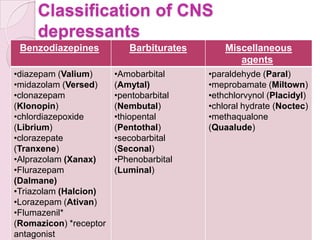
Classification of CNS
     depressants
 Benzodiazepines           Barbiturates       Miscellaneous
                                                 agents
•diazepam (Valium)      •Amobarbital      •paraldehyde (Paral)
•midazolam (Versed)     (Amytal)          •meprobamate (Miltown)
•clonazepam             •pentobarbital    •ethchlorvynol (Placidyl)
(Klonopin)              (Nembutal)        •chloral hydrate (Noctec)
•chlordiazepoxide       •thiopental       •methaqualone
(Librium)               (Pentothal)       (Quaalude)
•clorazepate            •secobarbital
(Tranxene)              (Seconal)
•Alprazolam (Xanax)     •Phenobarbital
•Flurazepam             (Luminal)
(Dalmane)
•Triazolam (Halcion)
•Lorazepam (Ativan)
•Flumazenil*
(Romazicon) *receptor
antagonist
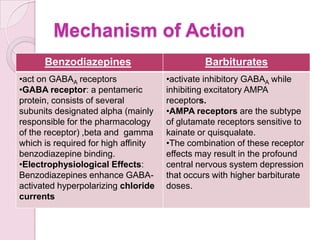
Mechanism of Action
      Benzodiazepines                          Barbiturates
•act on GABAA receptors               •activate inhibitory GABAA while
•GABA receptor: a pentameric          inhibiting excitatory AMPA
protein, consists of several          receptors.
subunits designated alpha (mainly     •AMPA receptors are the subtype
responsible for the pharmacology      of glutamate receptors sensitive to
of the receptor) ,beta and gamma      kainate or quisqualate.
which is required for high affinity   •The combination of these receptor
benzodiazepine binding.               effects may result in the profound
•Electrophysiological Effects:        central nervous system depression
Benzodiazepines enhance GABA-         that occurs with higher barbiturate
activated hyperpolarizing chloride    doses.
currents
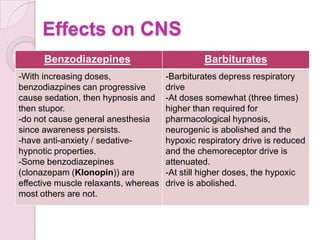
Effects on CNS
      Benzodiazepines                           Barbiturates
-With increasing doses,               -Barbiturates depress respiratory
benzodiazpines can progressive        drive
cause sedation, then hypnosis and     -At doses somewhat (three times)
then stupor.                          higher than required for
-do not cause general anesthesia      pharmacological hypnosis,
since awareness persists.             neurogenic is abolished and the
-have anti-anxiety / sedative-        hypoxic respiratory drive is reduced
hypnotic properties.                  and the chemoreceptor drive is
-Some benzodiazepines                 attenuated.
(clonazepam (Klonopin)) are           -At still higher doses, the hypoxic
effective muscle relaxants, whereas   drive is abolished.
most others are not.
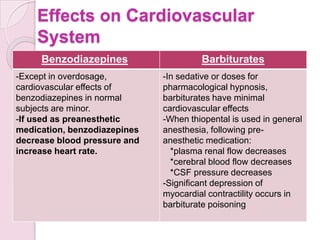
Effects on Cardiovascular
    System
     Benzodiazepines                   Barbiturates
-Except in overdosage,        -In sedative or doses for
cardiovascular effects of     pharmacological hypnosis,
benzodiazepines in normal     barbiturates have minimal
subjects are minor.           cardiovascular effects
-If used as preanesthetic     -When thiopental is used in general
medication, benzodiazepines   anesthesia, following pre-
decrease blood pressure and   anesthetic medication:
increase heart rate.            *plasma renal flow decreases
                                *cerebral blood flow decreases
                                *CSF pressure decreases
                              -Significant depression of
                              myocardial contractility occurs in
                              barbiturate poisoning
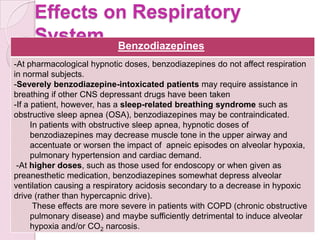
Effects on Respiratory
     System Benzodiazepines
-At pharmacological hypnotic doses, benzodiazepines do not affect respiration
in normal subjects.
-Severely benzodiazepine-intoxicated patients may require assistance in
breathing if other CNS depressant drugs have been taken
-If a patient, however, has a sleep-related breathing syndrome such as
obstructive sleep apnea (OSA), benzodiazepines may be contraindicated.
      In patients with obstructive sleep apnea, hypnotic doses of
      benzodiazepines may decrease muscle tone in the upper airway and
      accentuate or worsen the impact of apneic episodes on alveolar hypoxia,
      pulmonary hypertension and cardiac demand.
 -At higher doses, such as those used for endoscopy or when given as
preanesthetic medication, benzodiazepines somewhat depress alveolar
ventilation causing a respiratory acidosis secondary to a decrease in hypoxic
drive (rather than hypercapnic drive).
       These effects are more severe in patients with COPD (chronic obstructive
      pulmonary disease) and maybe sufficiently detrimental to induce alveolar
      hypoxia and/or CO2 narcosis.
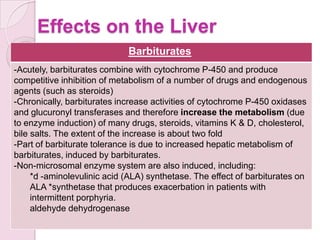
Effects on the Liver
                             Barbiturates
-Acutely, barbiturates combine with cytochrome P-450 and produce
competitive inhibition of metabolism of a number of drugs and endogenous
agents (such as steroids)
-Chronically, barbiturates increase activities of cytochrome P-450 oxidases
and glucuronyl transferases and therefore increase the metabolism (due
to enzyme induction) of many drugs, steroids, vitamins K & D, cholesterol,
bile salts. The extent of the increase is about two fold
-Part of barbiturate tolerance is due to increased hepatic metabolism of
barbiturates, induced by barbiturates.
-Non-microsomal enzyme system are also induced, including:
     *d -aminolevulinic acid (ALA) synthetase. The effect of barbiturates on
     ALA *synthetase that produces exacerbation in patients with
     intermittent porphyria.
     aldehyde dehydrogenase
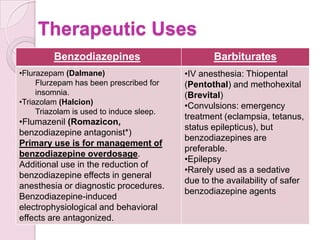
Therapeutic Uses
         Benzodiazepines                         Barbiturates
•Flurazepam (Dalmane)                     •IV anesthesia: Thiopental
     Flurzepam has been prescribed for    (Pentothal) and methohexital
     insomnia.                            (Brevital)
•Triazolam (Halcion)
                                          •Convulsions: emergency
     Triazolam is used to induce sleep.
                                          treatment (eclampsia, tetanus,
•Flumazenil (Romazicon,
                                          status epilepticus), but
benzodiazepine antagonist*)
                                          benzodiazepines are
Primary use is for management of
                                          preferable.
benzodiazepine overdosage.
                                          •Epilepsy
Additional use in the reduction of
                                          •Rarely used as a sedative
benzodiazepine effects in general
                                          due to the availability of safer
anesthesia or diagnostic procedures.
                                          benzodiazepine agents
Benzodiazepine-induced
electrophysiological and behavioral
effects are antagonized.
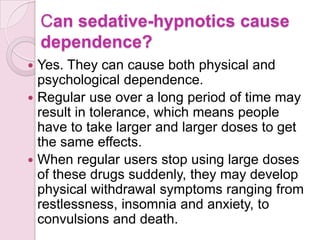
Can sedative-hypnotics cause
    dependence?
 Yes. They can cause both physical and
  psychological dependence.
 Regular use over a long period of time may
  result in tolerance, which means people
  have to take larger and larger doses to get
  the same effects.
 When regular users stop using large doses
  of these drugs suddenly, they may develop
  physical withdrawal symptoms ranging from
  restlessness, insomnia and anxiety, to
  convulsions and death.
Effects combining sedative-
    hypnotics with alcohol
 Taken together, alcohol and sedative-
  hypnotics can kill.
 The use of barbiturates and other sedative-
  hypnotics with other drugs that slow down
  the body, such as alcohol, multiplies their
  effects and greatly increases the risk of
  death.
 Overdose deaths can occur when
  barbiturates and alcohol are used together,
  either deliberately or accidentally.
Barbiturate Adverse Effects
   Adverse Effects:
    ◦  Drowsiness, impaired judgment, impaired motor skills
    ◦  Significant CNS/respiratory depression with high dosage.
    ◦  Paradoxical excitement
    ◦  If barbiturates are given for pain, restlessness, excitement,
      or delirium may result
    ◦ Hypersensitivity: allergic reaction in patients who are
      predisposed to angioedema, urticaria, and asthma
    ◦ Drug interactions: combination with other sedative agents
      can result in severe CNS depression.
   Untoward effects:
    ◦ Absolutely contraindicated in acute intermittent porphyria or
      porphyria variegata because barbiturates increase
      porphyrin synthesis.
    ◦ i.v. administration can produce cardiovascular collapse;
      overdosage can cause severe respiratory depression.
Management of barbiturate
        poisoning
 Severe intoxication is associated with coma
  and depressed respiration
 Treatment is supportive with CNS
  stimulants contraindicated (increases
  mortality)
 Hemodialysis or hemoperfusion may be
  needed
 Complicating factors include:
    ◦   circulatory collapse
    ◦   shock
    ◦   dehydration
    ◦   renal failure.
Adverse Effects:
    Benzodiazepines
    ◦ Common: Drowsiness, lethargy
    ◦ Less common: Muscular incoordination, ataxia
    ◦ Other: hypotonia, dysarthria, dizziness, behavior
      disturbances including hyperactivity, irritability, difficulty in
      concentration.
    ◦ Seizures may occur if drug is discontinued abruptly.
   Flurazepam (Dalmane)
    ◦ Flurazepam has long-acting metabolites.
    ◦ Adverse Effects:
       Presence of long-acting metabolites may cause daytime sedation,
        which may be undesirable.
   Triazolam (Halcion)
    ◦ Triazolam is short-acting with no active metabolites
    ◦ Adverse Effects: Tolerance may develop and rebound
      insomnia has been reported.
       Reported associations of triazolam with psychotic reactions,
        dependency, anterograde amnesia are some factors that
        contributed to triazolam removal from the market in some European
Flumazenil (Romazicon,
    benzodiazepine antagonist*)
   Adverse Effects:
    ◦ in comatose patients, intoxicated with alcohol,
      flumazenil may increase risk of seizures.
    ◦ in comatose patients due to tricyclic
      antidepressant agents, flumazenil increases
      seizure risk.
Effects of Barbiturates When
Abused
 Similar to the effects of alcohol.
 Small amounts produce calmness and
  relax muscles. Somewhat larger doses
  can cause slurred speech, staggering
  gait, poor judgment, and slow, uncertain
  reflexes.
 These effects make it dangerous to drive
  a car or operate machinery. Large doses
  can cause unconsciousness and death.
How dangerous are
barbiturates?
 Barbiturate overdose is a factor in nearly
  one-third of all reported drug-related
  deaths.
 These include suicides and accidental
  drug poisonings.
 Accidental deaths sometimes occur when
  a user takes one dose, becomes confused
  and unintentionally takes additional or
  larger doses.
 With   barbiturates there is less
  difference between the amount that
  produces sleep and the amount that
  kills.
 Furthermore, barbiturate withdrawal
  can be more serious than heroin
  withdrawal
Other Abused Sedative-
hypnotics
 All the other sedative-hypnotics can be
  abused, including the benzodiazepines.
  Diazepam (Valium), chlordiazepoxide
  (Librium), and chlorazepate (Tranxene)
  are examples of benzodiazepines.
 These drugs are also sold on the street
  as downers.
 As with the barbiturates, tolerance and
  dependence can develop if
  benzodiazepines are taken regularly in
  high doses over prolonged periods of
  time.
 Other sedative-hypnotics which are
  abused include glutethimide (Doriden),
  ethchlorvynol (Placidyl), and
  methaqualone (Sopor, Quaalude).
Sedative-hypnotic "Look-alikes"
 These are pills manufactured to look
  like real sedative-hypnotics and mimic
  their effects.
 Sometimes look-alikes contain over-
  the-counter drugs such as
  antihistamines and decongestants,
  which tend to cause drowsiness.
   The negative effects can include nausea,
    stomach cramps, lack of coordination,
    temporary memory loss, becoming out of
    touch with the surroundings, and anxious
    behavior.

Drugs that act on CNS

  • 1.
  • 2.
    Introduction to the Pharmacology of CNS Drugs  Drugs acting in the central nervous system (CNS) were among the first to be discovered by primitive humans and are still the most widely used group of pharmacologic agents.  In addition to their use in therapy, many drugs acting on the CNS are used without prescription to increase one‘s sense of well-being.
  • 3.
     The mechanismsby which various drugs act in the CNS have not always been clearly understood.  In the last 3 decades, however, dramatic advances have been made in the methodology of CNS pharmacology.  It is now possible to study the action of a drug on individual cells and even single ion channels within synapses. The information obtained from such studies is the basis for several major developments in studies of the CNS.
  • 4.
    Major Developments In Studies Of The CNS  Nearly all drugs with CNS effects act on specific receptors that modulate synaptic transmission.  Drugs are among the most important tools for studying all aspects of CNS physiology.  Unravelling the actions of drugs with known clinical efficacy has led to some of the most fruitful hypotheses regarding the mechanisms of disease
  • 5.
    Methods for theStudy of CNS Pharmacology  A detailed description of synaptic transmission was not possible until glass microelectrodes, which permit intracellular recording, were developed.  Detailed electrophysiologic studies of the action of drugs on both voltage- and transmitter-operated channels were further facilitated by the introduction of the patch clamp technique, which permits the recording of current through single channels.
  • 6.
     Histochemical, immunologic,and radioisotopic methods are widely used to map the distribution of specific transmitters, their associated enzyme systems, and their receptors.  Molecular cloning has had a major impact on our understanding of CNS receptors  Mice with mutated genes for specific receptors or enzymes (knockout mice) can provide important information regarding the physiologic and pharmacologic roles of these components.
  • 7.
  • 8.
    What are sedative-hypnotics? Sedative-hypnotics are drugs which depress or slow down the body's functions.  Often these drugs are referred to as tranquilizers and sleeping pills or sometimes just as sedatives.  Their effects range from calming down anxious people to promoting sleep. Both tranquilizers and sleeping pills can have either effect, depending on how much is taken.  At high doses or when they are abused, many of these drugs can even cause
  • 9.
    Classification of CNS depressants Benzodiazepines Barbiturates Miscellaneous agents •diazepam (Valium) •Amobarbital •paraldehyde (Paral) •midazolam (Versed) (Amytal) •meprobamate (Miltown) •clonazepam •pentobarbital •ethchlorvynol (Placidyl) (Klonopin) (Nembutal) •chloral hydrate (Noctec) •chlordiazepoxide •thiopental •methaqualone (Librium) (Pentothal) (Quaalude) •clorazepate •secobarbital (Tranxene) (Seconal) •Alprazolam (Xanax) •Phenobarbital •Flurazepam (Luminal) (Dalmane) •Triazolam (Halcion) •Lorazepam (Ativan) •Flumazenil* (Romazicon) *receptor antagonist
  • 10.
    Mechanism of Action Benzodiazepines Barbiturates •act on GABAA receptors •activate inhibitory GABAA while •GABA receptor: a pentameric inhibiting excitatory AMPA protein, consists of several receptors. subunits designated alpha (mainly •AMPA receptors are the subtype responsible for the pharmacology of glutamate receptors sensitive to of the receptor) ,beta and gamma kainate or quisqualate. which is required for high affinity •The combination of these receptor benzodiazepine binding. effects may result in the profound •Electrophysiological Effects: central nervous system depression Benzodiazepines enhance GABA- that occurs with higher barbiturate activated hyperpolarizing chloride doses. currents
  • 11.
    Effects on CNS Benzodiazepines Barbiturates -With increasing doses, -Barbiturates depress respiratory benzodiazpines can progressive drive cause sedation, then hypnosis and -At doses somewhat (three times) then stupor. higher than required for -do not cause general anesthesia pharmacological hypnosis, since awareness persists. neurogenic is abolished and the -have anti-anxiety / sedative- hypoxic respiratory drive is reduced hypnotic properties. and the chemoreceptor drive is -Some benzodiazepines attenuated. (clonazepam (Klonopin)) are -At still higher doses, the hypoxic effective muscle relaxants, whereas drive is abolished. most others are not.
  • 12.
    Effects on Cardiovascular System Benzodiazepines Barbiturates -Except in overdosage, -In sedative or doses for cardiovascular effects of pharmacological hypnosis, benzodiazepines in normal barbiturates have minimal subjects are minor. cardiovascular effects -If used as preanesthetic -When thiopental is used in general medication, benzodiazepines anesthesia, following pre- decrease blood pressure and anesthetic medication: increase heart rate. *plasma renal flow decreases *cerebral blood flow decreases *CSF pressure decreases -Significant depression of myocardial contractility occurs in barbiturate poisoning
  • 13.
    Effects on Respiratory System Benzodiazepines -At pharmacological hypnotic doses, benzodiazepines do not affect respiration in normal subjects. -Severely benzodiazepine-intoxicated patients may require assistance in breathing if other CNS depressant drugs have been taken -If a patient, however, has a sleep-related breathing syndrome such as obstructive sleep apnea (OSA), benzodiazepines may be contraindicated. In patients with obstructive sleep apnea, hypnotic doses of benzodiazepines may decrease muscle tone in the upper airway and accentuate or worsen the impact of apneic episodes on alveolar hypoxia, pulmonary hypertension and cardiac demand. -At higher doses, such as those used for endoscopy or when given as preanesthetic medication, benzodiazepines somewhat depress alveolar ventilation causing a respiratory acidosis secondary to a decrease in hypoxic drive (rather than hypercapnic drive). These effects are more severe in patients with COPD (chronic obstructive pulmonary disease) and maybe sufficiently detrimental to induce alveolar hypoxia and/or CO2 narcosis.
  • 14.
    Effects on theLiver Barbiturates -Acutely, barbiturates combine with cytochrome P-450 and produce competitive inhibition of metabolism of a number of drugs and endogenous agents (such as steroids) -Chronically, barbiturates increase activities of cytochrome P-450 oxidases and glucuronyl transferases and therefore increase the metabolism (due to enzyme induction) of many drugs, steroids, vitamins K & D, cholesterol, bile salts. The extent of the increase is about two fold -Part of barbiturate tolerance is due to increased hepatic metabolism of barbiturates, induced by barbiturates. -Non-microsomal enzyme system are also induced, including: *d -aminolevulinic acid (ALA) synthetase. The effect of barbiturates on ALA *synthetase that produces exacerbation in patients with intermittent porphyria. aldehyde dehydrogenase
  • 15.
    Therapeutic Uses Benzodiazepines Barbiturates •Flurazepam (Dalmane) •IV anesthesia: Thiopental Flurzepam has been prescribed for (Pentothal) and methohexital insomnia. (Brevital) •Triazolam (Halcion) •Convulsions: emergency Triazolam is used to induce sleep. treatment (eclampsia, tetanus, •Flumazenil (Romazicon, status epilepticus), but benzodiazepine antagonist*) benzodiazepines are Primary use is for management of preferable. benzodiazepine overdosage. •Epilepsy Additional use in the reduction of •Rarely used as a sedative benzodiazepine effects in general due to the availability of safer anesthesia or diagnostic procedures. benzodiazepine agents Benzodiazepine-induced electrophysiological and behavioral effects are antagonized.
  • 16.
    Can sedative-hypnotics cause dependence?  Yes. They can cause both physical and psychological dependence.  Regular use over a long period of time may result in tolerance, which means people have to take larger and larger doses to get the same effects.  When regular users stop using large doses of these drugs suddenly, they may develop physical withdrawal symptoms ranging from restlessness, insomnia and anxiety, to convulsions and death.
  • 17.
    Effects combining sedative- hypnotics with alcohol  Taken together, alcohol and sedative- hypnotics can kill.  The use of barbiturates and other sedative- hypnotics with other drugs that slow down the body, such as alcohol, multiplies their effects and greatly increases the risk of death.  Overdose deaths can occur when barbiturates and alcohol are used together, either deliberately or accidentally.
  • 18.
    Barbiturate Adverse Effects  Adverse Effects: ◦ Drowsiness, impaired judgment, impaired motor skills ◦ Significant CNS/respiratory depression with high dosage. ◦ Paradoxical excitement ◦ If barbiturates are given for pain, restlessness, excitement, or delirium may result ◦ Hypersensitivity: allergic reaction in patients who are predisposed to angioedema, urticaria, and asthma ◦ Drug interactions: combination with other sedative agents can result in severe CNS depression.  Untoward effects: ◦ Absolutely contraindicated in acute intermittent porphyria or porphyria variegata because barbiturates increase porphyrin synthesis. ◦ i.v. administration can produce cardiovascular collapse; overdosage can cause severe respiratory depression.
  • 19.
    Management of barbiturate poisoning  Severe intoxication is associated with coma and depressed respiration  Treatment is supportive with CNS stimulants contraindicated (increases mortality)  Hemodialysis or hemoperfusion may be needed  Complicating factors include: ◦ circulatory collapse ◦ shock ◦ dehydration ◦ renal failure.
  • 20.
    Adverse Effects: Benzodiazepines ◦ Common: Drowsiness, lethargy ◦ Less common: Muscular incoordination, ataxia ◦ Other: hypotonia, dysarthria, dizziness, behavior disturbances including hyperactivity, irritability, difficulty in concentration. ◦ Seizures may occur if drug is discontinued abruptly.  Flurazepam (Dalmane) ◦ Flurazepam has long-acting metabolites. ◦ Adverse Effects:  Presence of long-acting metabolites may cause daytime sedation, which may be undesirable.  Triazolam (Halcion) ◦ Triazolam is short-acting with no active metabolites ◦ Adverse Effects: Tolerance may develop and rebound insomnia has been reported.  Reported associations of triazolam with psychotic reactions, dependency, anterograde amnesia are some factors that contributed to triazolam removal from the market in some European
  • 21.
    Flumazenil (Romazicon, benzodiazepine antagonist*)  Adverse Effects: ◦ in comatose patients, intoxicated with alcohol, flumazenil may increase risk of seizures. ◦ in comatose patients due to tricyclic antidepressant agents, flumazenil increases seizure risk.
  • 22.
    Effects of BarbituratesWhen Abused  Similar to the effects of alcohol.  Small amounts produce calmness and relax muscles. Somewhat larger doses can cause slurred speech, staggering gait, poor judgment, and slow, uncertain reflexes.  These effects make it dangerous to drive a car or operate machinery. Large doses can cause unconsciousness and death.
  • 23.
    How dangerous are barbiturates? Barbiturate overdose is a factor in nearly one-third of all reported drug-related deaths.  These include suicides and accidental drug poisonings.  Accidental deaths sometimes occur when a user takes one dose, becomes confused and unintentionally takes additional or larger doses.
  • 24.
     With barbiturates there is less difference between the amount that produces sleep and the amount that kills.  Furthermore, barbiturate withdrawal can be more serious than heroin withdrawal
  • 25.
    Other Abused Sedative- hypnotics All the other sedative-hypnotics can be abused, including the benzodiazepines. Diazepam (Valium), chlordiazepoxide (Librium), and chlorazepate (Tranxene) are examples of benzodiazepines.  These drugs are also sold on the street as downers.
  • 26.
     As withthe barbiturates, tolerance and dependence can develop if benzodiazepines are taken regularly in high doses over prolonged periods of time.  Other sedative-hypnotics which are abused include glutethimide (Doriden), ethchlorvynol (Placidyl), and methaqualone (Sopor, Quaalude).
  • 27.
    Sedative-hypnotic "Look-alikes"  Theseare pills manufactured to look like real sedative-hypnotics and mimic their effects.  Sometimes look-alikes contain over- the-counter drugs such as antihistamines and decongestants, which tend to cause drowsiness.
  • 28.
    The negative effects can include nausea, stomach cramps, lack of coordination, temporary memory loss, becoming out of touch with the surroundings, and anxious behavior.

Editor's Notes

  • #11 Barbiturates interact differently than benzodiazepines at GABA receptors. For example, the gamma subunit is not required for barbiturate activity