Endocrine Drugs, Hormones andEndocrine Drugs, Hormones and
Related CompoundsRelated Compounds
OverviewOverview
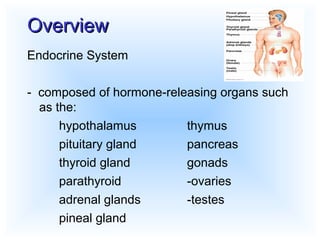
Endocrine System
- composed of hormone-releasing organs such
as the:
hypothalamus thymus
pituitary gland pancreas
thyroid gland gonads
parathyroid -ovaries
adrenal glands -testes
pineal gland
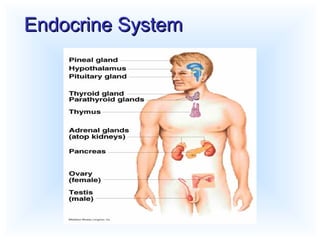
Endocrine SystemEndocrine System
- is controlled by the hypothalamus and
the pituitary gland
- along with the Nervous System, it
coordinates and directs body function
- maintains homeostasis by releasing
chemicals called hormones
Endocrine vs NervousEndocrine vs Nervous
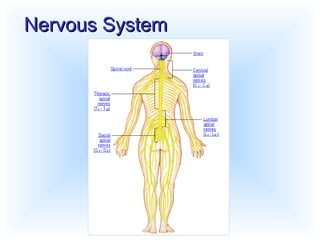
- the nervous system communicates
locally by electrical impulses and
neurotransmitters directed through
neurons to other neurons or to specific
target organs such as muscle or glands
- nerve impulses generally act within
milliseconds
Nervous SystemNervous System
Endocrine vs NervousEndocrine vs Nervous
- the endocrine system releases
hormones into the blood stream
- the hormones are then carried by the
blood stream into target cells
throughout the body
- hormones have broader range of
response times (they act from seconds
to days or longer)
Endocrine vs NervousEndocrine vs Nervous
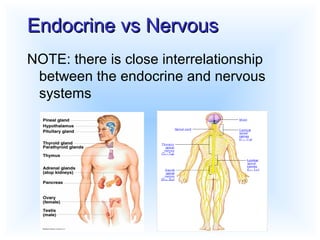
NOTE: there is close interrelationship
between the endocrine and nervous
systems
Endocrine SystemEndocrine System
Processes controlled by the endocrine
System:
1. growth & development
2. reproduction
3. body defenses
4. water, electrolyte and nutrient
balance
5. regulation of cellular metabolism
and energy balance
HormonesHormones
HormonesHormones
- Greek word, “to arouse”
- chemical substances secreted by the
cells into the extracellular fluids that
stimulate or regulate the metabolic
activity of other cells in the body.
- Gen. MOA: binding of the hormone to
the target cell or organ elicits response.
Endocrine DrugsEndocrine Drugs
- Hormones are pharmacologically
classified as drugs
- can be natural (from animals), semi-
synthetic or synthetic compounds
- Indications:
a. replacement therapy
b. treatment for certain disorders
c. diagnostic purposes
Endocrine DrugsEndocrine Drugs
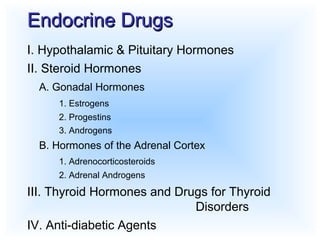
I. Hypothalamic & Pituitary Hormones
II. Steroid Hormones
A. Gonadal Hormones
1. Estrogens
2. Progestins
3. Androgens
B. Hormones of the Adrenal Cortex
1. Adrenocorticosteroids
2. Adrenal Androgens
III. Thyroid Hormones and Drugs for Thyroid
Disorders
IV. Anti-diabetic Agents
Hypothalamic & PituitaryHypothalamic & Pituitary
HormonesHormones
HypothalamusHypothalamus
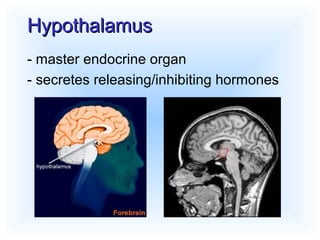
- master endocrine organ
- secretes releasing/inhibiting hormones
Pituitary GlandPituitary Gland
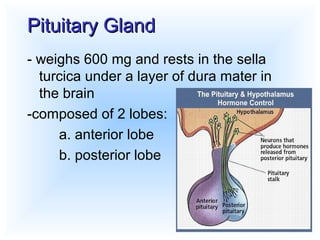
- weighs 600 mg and rests in the sella
turcica under a layer of dura mater in
the brain
-composed of 2 lobes:
a. anterior lobe
b. posterior lobe
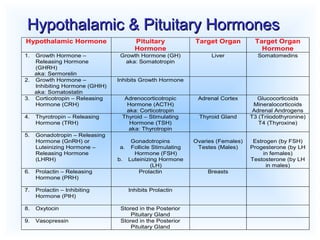
Hypothalamic & Pituitary HormonesHypothalamic & Pituitary Hormones
Hypothalamic Hormone Pituitary
Hormone
Target Organ Target Organ
Hormone
1. Growth Hormone –
Releasing Hormone
(GHRH)
aka: Sermorelin
Growth Hormone (GH)
aka: Somatotropin
Liver Somatomedins
2. Growth Hormone –
Inhibiting Hormone (GHIH)
aka: Somatostatin
Inhibits Growth Hormone
3. Corticotropin – Releasing
Hormone (CRH)
Adrenocorticotropic
Hormone (ACTH)
aka: Corticotropin
Adrenal Cortex Glucocorticoids
Mineralocorticoids
Adrenal Androgens
4. Thyrotropin – Releasing
Hormone (TRH)
Thyroid – Stimulating
Hormone (TSH)
aka: Thyrotropin
Thyroid Gland T3 (Triiodothyronine)
T4 (Thyroxine)
5. Gonadotropin – Releasing
Hormone (GnRH) or
Luteinizing Hormone –
Releasing Hormone
(LHRH)
Gonadotropins
a. Follicle Stimulating
Hormone (FSH)
b. Luteinizing Hormone
(LH)
Ovaries (Females)
Testes (Males)
Estrogen (by FSH)
Progesterone (by LH
in females)
Testosterone (by LH
in males)
6. Prolactin – Releasing
Hormone (PRH)
Prolactin Breasts
7. Prolactin – Inhibiting
Hormone (PIH)
Inhibits Prolactin
8. Oxytocin Stored in the Posterior
Pituitary Gland
9. Vasopressin Stored in the Posterior
Pituitary Gland
Growth HormoneGrowth Hormone
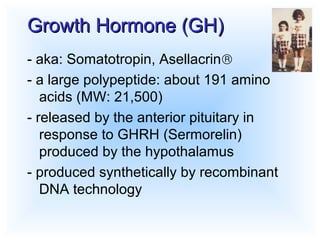
Growth Hormone (GH)Growth Hormone (GH)
- aka: Somatotropin, Asellacrin®
- a large polypeptide: about 191 amino
acids (MW: 21,500)
- released by the anterior pituitary in
response to GHRH (Sermorelin)
produced by the hypothalamus
- produced synthetically by recombinant
DNA technology
Growth Hormone (GH)Growth Hormone (GH)
- animal source is ineffective in humans
- induces the release of somatomedins in
the liver
- promotion of cell proliferation and bone
growth at open epiphyses
- boosts cartilage synthesis
Growth Hormone (GH)Growth Hormone (GH)
Indications:
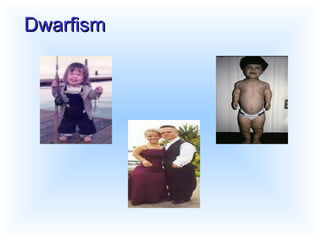
- for long term treatment in growth
hormone deficiency in children
(Dwarfism)
- for non-GH deficient short children (can
grow up to 2 cm per year)
DwarfismDwarfism
SomatremSomatrem
- a therapeutically equivalent drug of GH
- contains an extra terminal methionyl
group
Growth Hormone InhibitingGrowth Hormone Inhibiting
HormoneHormone
Growth Hormone InhibitingGrowth Hormone Inhibiting
Hormone (GHIH)Hormone (GHIH)
- aka: Somatostatin
- inhibits Growth Hormone
- Indications:
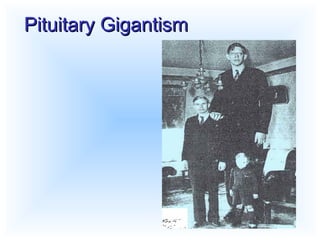
Pituitary Gigantism (pre-pubertal)
Acromegaly (post-pubertal)
Pituitary GigantismPituitary Gigantism
AcromegalyAcromegaly
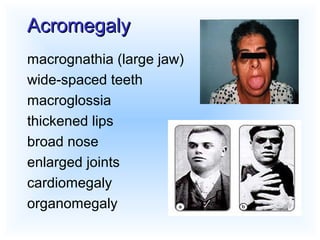
macrognathia (large jaw)
wide-spaced teeth
macroglossia
thickened lips
broad nose
enlarged joints
cardiomegaly
organomegaly
OctreotideOctreotide
- synthetic octapeptide analog of
somatostatin
- 45x more potent than GHIH
Adrenocorticotropic HormoneAdrenocorticotropic Hormone
Adrenocorticotropic Hormone (ACTH)Adrenocorticotropic Hormone (ACTH)
- aka: Corticotropin, Acthar®
- single-chain polypeptide containing 39
amino acids
- precursor: pro-opiomelanocortin
- released by the anterior pituitary in
response to CRH produced by the
hypothalamus
Adrenocorticotropic Hormone (ACTH)Adrenocorticotropic Hormone (ACTH)
- stimulates the adrenal cortex to produce
adrenocorticosteroids & androgens
- is used primarily for the diagnosis and
differentiation of primary & secondary
adrenal insufficiency
- Primary: Addison’s Disease associated
with adrenal atrophy
- Secondary: caused by inadequate
secretion of ACTH by the pituitary
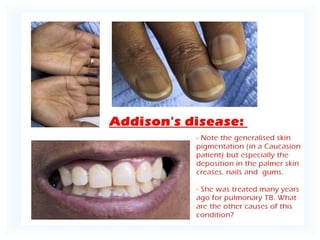
Addison’s DiseaseAddison’s Disease
• hyposecretion of adrenocorticosteroids
• characterized by:
– anorexia
– dehydration
– weakness and lethargy
– hyperpigmentation (bronze-colored skin)
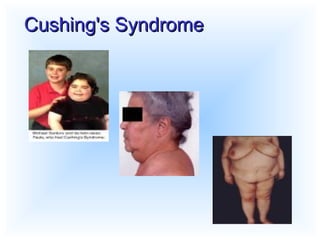
Cushing’s SyndromeCushing’s Syndrome
• hypersecretion of adrenocorticosteroids
• characterized by:
– moon face
– buffalo hump
– pendulous abdomen
– hypertension
Cushing's SyndromeCushing's Syndrome
CosyntropinCosyntropin
- synthetic human ACTH
- more preferred since animal ACTH can
cause allergic reactions
Thyrotropin StimulatingThyrotropin Stimulating
HormoneHormone
Thyrotropin Stimulating Hormone (TSH)Thyrotropin Stimulating Hormone (TSH)
- aka: Thyrotropin
- released by the anterior pituitary in
response to TRH (aka: Protirelin)
produced by the hypothalamus
- stimulates the thyroid to produce T3 and
T4
- T3: triiodothyronine (most active)
- T4: thyroxine
(converted to T3 in the body)
Thyrotropin Stimulating Hormone (TSH)Thyrotropin Stimulating Hormone (TSH)
- the thyroid hormones T3 and T4 are
essential for the normal growth and
maturation of the body
- Conditions:
hypothyroidism
hyperthyroidism
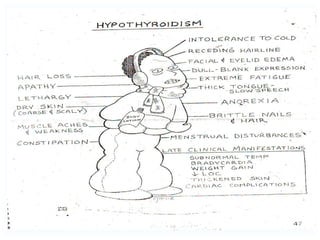
HypothyroidismHypothyroidism
- inability of the thyroid gland to supply
sufficient thyroid hormone to the body
- manifestations:
Cretinism (infant-state)
Myxedema (adult-state)
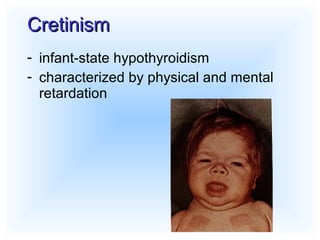
CretinismCretinism
- infant-state hypothyroidism
- characterized by physical and mental
retardation
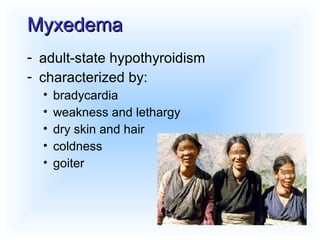
MyxedemaMyxedema
- adult-state hypothyroidism
- characterized by:
• bradycardia
• weakness and lethargy
• dry skin and hair
• coldness
• goiter
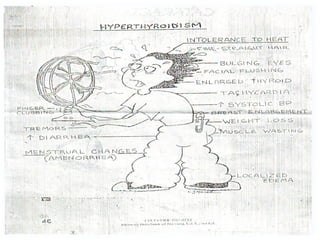
HyperthyroidismHyperthyroidism
- overabundance of thyroid hormone in
the body
- thyrotoxicosis
- Forms:
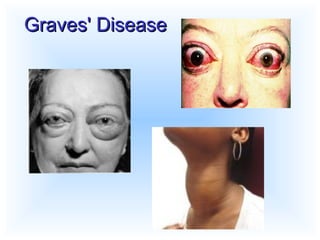
Graves’ Disease - most common
Plummer’s Disease - less common
- with cardiac abnormalities
Graves' DiseaseGraves' Disease
GonadotropinsGonadotropins
- include:
Follicle-Stimulating Hormone (FSH)
Luteinizing Hormone (LH)
- released by the anterior pituitary gland
in response to GnRH / LHRH
- stimulates the gonads (ovaries & testes)
to produce sex hormones
- Females: FSH → estrogen
LH → progesterone
- Males: LH → testosterone
GonadotropinsGonadotropins
NOTE: Pituitary gonadotropins (FSH, LH)
are not available for therapeutic use,
however, there are non-pituitary
gonadotropins that have FSH-like or
LH-like activity and are the ones used
therapeutically
Non-Pituitary GonadotropinsNon-Pituitary Gonadotropins
1. Menotropins
2. Urofollitropin
3. Human Chorionic Gonadotropin
Non-Pituitary GonadotropinsNon-Pituitary Gonadotropins
- Indications:
women: to induce ovulation &
pregnancy
men: to induce spermatogenesis
- Adverse effects:
ovarian enlargement
multiple births
gynecomastia in men
MenotropinMenotropin
- aka:
Human Menopausal Gonadotropin
(hMG)
Pergonal®
- obtained from the urine of post-
menopausal women
- partially broken down into FSH and LH
in the body
UrofollitropinUrofollitropin
- Metrodin®
- obtained from the urine of post-
menopausal women
- high in FSH-like activity
Human Chorionic GonadotropinHuman Chorionic Gonadotropin
- aka: hCG, Follutein®
- a placental hormone
- LH agonist effect
-obtained from the urine of pregnant
women
Hormones of the PosteriorHormones of the Posterior
Pituitary GlandPituitary Gland
Hormones of the PosteriorHormones of the Posterior
Pituitary GlandPituitary Gland
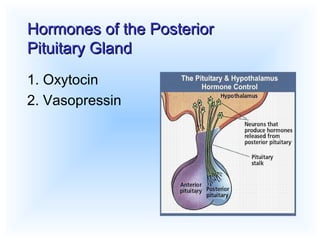
1. Oxytocin
2. Vasopressin
OxytocinOxytocin
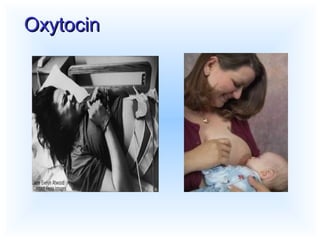
- stimulates uterine contraction and plays an
important role in the induction of labor
- also promotes breast milk ejection
- Indications:
to induce contraction during labor
to control postpartum bleeding
- Contraindications:
abnormal fetal presentation
fetal distress
premature births
OxytocinOxytocin
VasopressinVasopressin
- aka: Antidiuretic Hormone (ADH)
- has both antidiuretic and vasopressor
activity
-acts by binding to its receptor in the
kidneys promoting the reabsorption of
water in the collecting tubules
-Indications:
Diabetes Insipidus
Postoperative Abdominal Distention
Diabetes Insipidus (DI)Diabetes Insipidus (DI)
- a disorder due to the deficiency or lack
of response to Antidiuretic Hormone
(ADH)
- 2 Types:
a. Central DI - deficiency in ADH
b. Nephrogenic DI - sufficient ADH
but body does not respond
to the hormone
DesmopressinDesmopressin
- modified analog of vasopressin
- more preferred for DI and nocturnal
enuresis because it is largely free of
pressor effects and is longer-acting
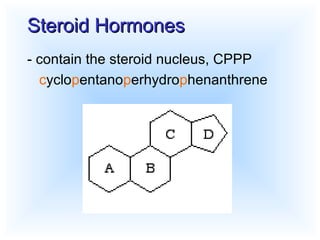
Steroid HormonesSteroid Hormones
- contain the steroid nucleus, CPPP
cyclopentanoperhydrophenanthrene
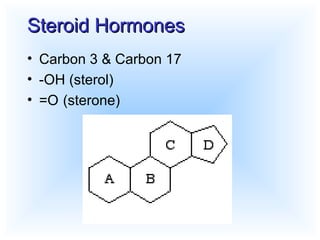
Steroid HormonesSteroid Hormones
• Carbon 3 & Carbon 17
• -OH (sterol)
• =O (sterone)
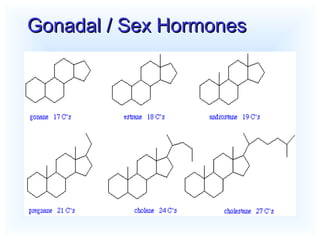
Gonadal / Sex HormonesGonadal / Sex Hormones
Steroid HormonesSteroid Hormones
A. Gonadal / Sex Hormones
1. Estrogens
2. Progestins
3. Androgens
B. Hormones of the Adrenal Cortex
1. Adrenocoticosteroids
a. Glucocorticoids
b. Mineralocorticoids
2. Adrenal Androgens
Gonadal / Sex HormonesGonadal / Sex Hormones
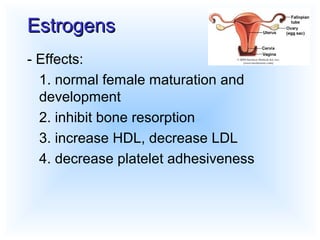
EstrogensEstrogens
EstrogensEstrogens
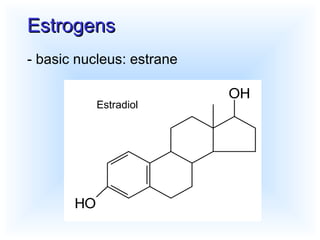
- basic nucleus: estrane
Estradiol
EstrogensEstrogens
- Effects:
1. normal female maturation and
development
2. inhibit bone resorption
3. increase HDL, decrease LDL
4. decrease platelet adhesiveness
EstrogensEstrogens
- Indications:
contraception
postmenopausal hormone therapy
primary hypogonadism
osteoporosis
Natural Steroidal EstrogensNatural Steroidal Estrogens
Estradiol - most potent estrogen
produced by women
Estrone, Estriol - have about one tenth
the potency of estradiol
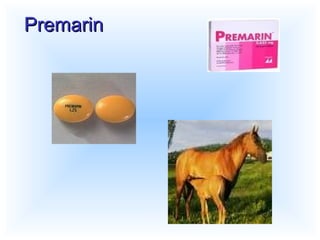
* Premarin - a preparation of conjugated
estrogens (sulfate esters of estrone &
equilin)
- obtained from pregnant mare’s urine
PremarinPremarin
Synthetic Steroidal EstrogensSynthetic Steroidal Estrogens
Ethinyl estradiol
Mestranol
Quinestrol
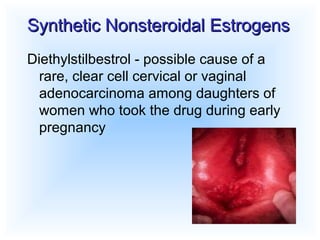
Synthetic Nonsteroidal EstrogensSynthetic Nonsteroidal Estrogens
Diethylstilbestrol - possible cause of a
rare, clear cell cervical or vaginal
adenocarcinoma among daughters of
women who took the drug during early
pregnancy
Estrogen Antagonists /Estrogen Antagonists /
AntiestrogensAntiestrogens
Clomiphene - fertility drug; it induces
ovulation by negative feedback
mechanism
Tamoxifen & Toremifene - palliative
treatment of advanced breast cancer in
postmenopausal women
Estrogen Related DrugsEstrogen Related Drugs
Aromatase Inhibitors
Selective Estrogen Receptor Modulators
Aromatase InhibitorsAromatase Inhibitors
- are potent and selective non-steroidal
inhibitors of aromatase, an enzyme
reponsible for the conversion of
androgens to estrogens
- used to treat advanced breast cancer
- Anastrozole, Letrozole
SERMsSERMs
- Selective Estrogen Receptor Modulators
- reduce bone resorption and decrease
bone turnover
- used for the prevention of osteoporosis
- Raloxifene
ProgestinsProgestins
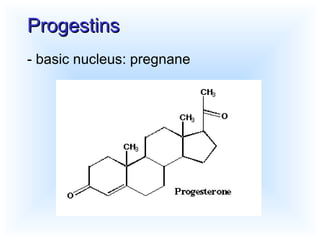
- basic nucleus: pregnane
ProgestinsProgestins
- Effects:
1. endometrial changes
2. alveolobular development of
secretory apparatus in breasts
3. hepatic glycogenesis &ketogenesis
4. increase lipoprotein lipase activity
and fat deposition
ProgestinsProgestins
- Indications:
contraception
for menstrual disorders
-dysfunctional uterine bleeding
-dysmenorrhea
endometriosis
Natural ProgestinNatural Progestin
Progesterone
- endogenous progestin produced in
response to luteinizing hormone (LH)
- also synthesized by the adrenal cortex
- in females, it promotes the development
of a secretory endometrium that can
accommodate implantation of a newly
forming embryo
Synthetic ProgestinsSynthetic Progestins
- more stable to first-pass metabolism,
allowing for lower doses when
administered orally
- medroxyprogesterone
hydroxyprogesterone
megestrol
norethindrone
norgestrel
Progestin Antagonist /Progestin Antagonist /
AntiprogestinAntiprogestin
Mifepristone
- aka: RU 486
- progestin antagonist with partial
agonist activity
- can cause abortion of the fetus due to
the interference with progesterone and
the decline in hCG
Oral & ImplantableOral & Implantable
ContraceptivesContraceptives
Major ClassesMajor Classes
1. Combination Pills
2. Progestin Only Contraceptives
3. Postcoital Contraceptives
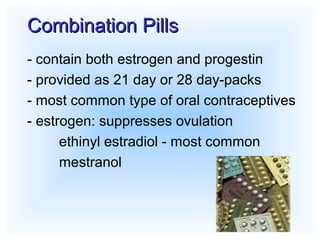
Combination PillsCombination Pills
- contain both estrogen and progestin
- provided as 21 day or 28 day-packs
- most common type of oral contraceptives
- estrogen: suppresses ovulation
ethinyl estradiol - most common
mestranol
Combination PillsCombination Pills
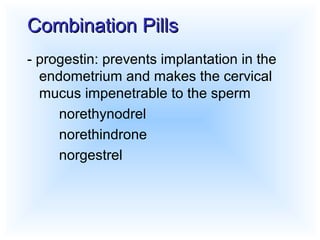
- progestin: prevents implantation in the
endometrium and makes the cervical
mucus impenetrable to the sperm
norethynodrel
norethindrone
norgestrel
Progestin Only ContraceptivesProgestin Only Contraceptives
- less effective than combination pills
- dosage forms/ delivery systems:
a. “mini-pill” - low dose progestins
350 µg norethindrone or
75 µg norgestrel
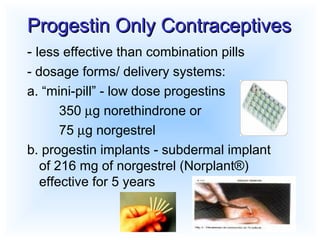
b. progestin implants - subdermal implant
of 216 mg of norgestrel (Norplant®)
effective for 5 years
Progestin Only ContraceptivesProgestin Only Contraceptives
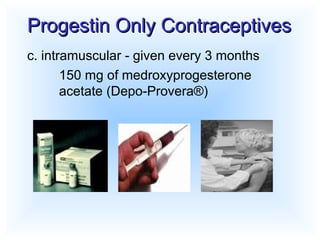
c. intramuscular - given every 3 months
150 mg of medroxyprogesterone
acetate (Depo-Provera®)
Progestin Only ContraceptivesProgestin Only Contraceptives
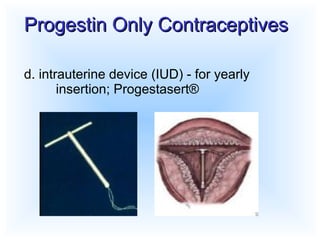
d. intrauterine device (IUD) - for yearly
insertion; Progestasert®
Postcoital ContraceptivesPostcoital Contraceptives
- called, “morning-after pills”
- high dose estrogen administered within
72 hours after coitus and continued 2x
for 5 days
- ethinyl estradiol
diethylstilbestrol
conjugated estrogens
estrone
AndrogensAndrogens
AndrogensAndrogens
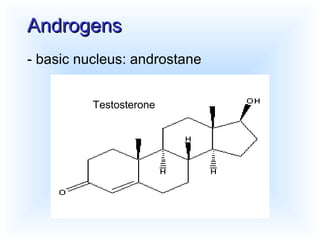
- basic nucleus: androstane
Testosterone
AndrogensAndrogens
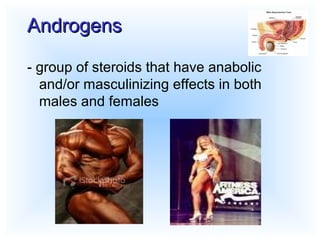
- group of steroids that have anabolic
and/or masculinizing effects in both
males and females
Endogenous AndrogenEndogenous Androgen
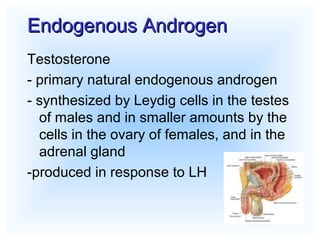
Testosterone
- primary natural endogenous androgen
- synthesized by Leydig cells in the testes
of males and in smaller amounts by the
cells in the ovary of females, and in the
adrenal gland
-produced in response to LH
Synthetic AndrogensSynthetic Androgens
Methyltestosterone
Danazol
Stanozolol
Nandrolone