



MUCOLYTICS
PREPARED BY:
USHA RANI KANDULA,
ASSISTANT PROFESSOR,
DEPARTMENT OF ADULT HEALTH NURSING,
ARSI UNIVERSITY,ASELLA,ETHIOPIA,
SOUTH EAST AFRICA.
ď‚— Mucus is a slippery liquid that is
made by glands in the mucous
membranes that line the mouth,
nose, throat, lungs, breathing
passageways, digestive organs
and reproductive orans.
ď‚— The lining of the respiratory tract
is covered with mucous
membranes, which secrete sticky
fluid called mucus.
ď‚— Mucolytic drugs help loosen and
thin the mucus.
ď‚— Once the mucus is thinned, it is
then easier to cough up or
suction from the airway,
improving the patient breathing.
CLASSIFICATION
OF
MUCOLYTICS
CLASSIFICATION OF MUCOLYTICS
ď‚— Bromhexine
ď‚— Ambroxol
ď‚— Acetylcysteine
BROMHEXINE
BROMHEXINE
ď‚— -Bromhexine is a mucolytic
agents.
ď‚— -used in treatment of respiratory
disorders associated with
excessive mucus.
BROMHEXINE MOA
ď‚— BROMHEXINE depolymerises the
muco polysaccharides in mucus.
ď‚— It decreasing viscosity, allowing
for removal by normal chest
physiology.
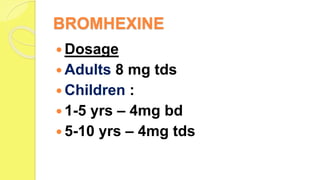
BROMHEXINE
ď‚— Dosage
ď‚— Adults 8 mg tds
ď‚— Children :
 1-5 yrs – 4mg bd
 5-10 yrs – 4mg tds
AMBROXOL
ď‚— Ambroxol is a metabolite of
bromhexine.
ď‚— Systemically active mucolytic agent.
ď‚— The breakdown of acid
mucopolysaccharide fibers makes
the sputum thinner and less viscous
and more easily removed by
coughing.
MECHANISM OF ACTION
ď‚— The substance is a mucoactive drug
,
ď‚— It restore the physiological clearance
mechanisms of the respiratory tract,
ď‚— It promotes mucus clearance,
facilitates expectoration, allowing
patients to breath freely.
AMBROXOL
ď‚— Dosage
ď‚— Adults : daily dose of 30 mg taken
in 2-3 divided doses
ď‚— Children up to 2 years : half a
teaspoon ambroxol syrup twice
daily
ď‚— Children 2-5 years : half a
teaspoon ambroxol syrup three
times daily
ď‚— Children over 5 years : one
teaspoonful ambroxol syrup 3
times daily
ACETYLCYSTEINE
ACETYLCYSTEINE
ď‚— The common type of mucolytic
called N-acetylcysteine.
ď‚— It breaks the mucus, lubricates many
parts of the body as mouth, throat
and lungs.
ACETYLCYSTEINE
ď‚— Dosage
ď‚— Acetylcysteine solution, is
available in rubber stoppered
glass vials containing 10 ml or 30
ml.
ď‚— The 20% solution diluted with
sodium chloride.
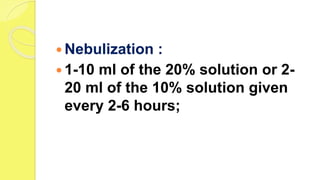
ď‚— Nebulization :
ď‚— 1-10 ml of the 20% solution or 2-
20 ml of the 10% solution given
every 2-6 hours;
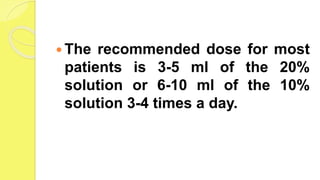
ď‚— The recommended dose for most
patients is 3-5 ml of the 20%
solution or 6-10 ml of the 10%
solution 3-4 times a day.
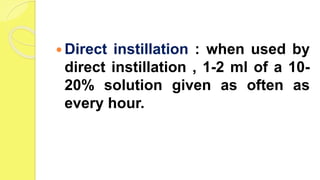
ď‚— Direct instillation : when used by
direct instillation , 1-2 ml of a 10-
20% solution given as often as
every hour.
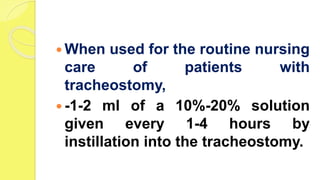
ď‚— When used for the routine nursing
care of patients with
tracheostomy,
ď‚— -1-2 ml of a 10%-20% solution
given every 1-4 hours by
instillation into the tracheostomy.
ď‚— Acetylcysteine introduced directly
into a segment of the broncho
pulmonary tree by inserting a small
plastic catheter into the trachea.
ď‚— 2-5 ml of the 20% solution instilled
by syringe connected to the catheter.
ď‚— Diagnostic bronchograms :
ď‚— for diagnostic bronchial studies, 2 or
3 administrations of 1-2 ml of the
20% solution or 2-4 ml of the 10%
solution should be given by
nebulization or by instillation
intratracheally, prior to the
procedure.
NURSING
RESPONSIBILITIES
NURSING RESPONSIBILITIES
ď‚— Be prepared for suction if cough is
present
ď‚— Increased fluid intake to thin secretions
ď‚— Rinse the mouth with water to avoid
oropharyngeal irritation.
ď‚— Maintain patient airway.
ď‚— If needed oxygen administration.
PATIENT EDUCATION
PATIENT EDUCATION
ď‚— Clear airway by coughing deeply
ď‚— Wash face mask before and after
use
ď‚— Report complications.
THANKING
YOU

Mucolytic Drugs

  • 1.
    MUCOLYTICS PREPARED BY: USHA RANIKANDULA, ASSISTANT PROFESSOR, DEPARTMENT OF ADULT HEALTH NURSING, ARSI UNIVERSITY,ASELLA,ETHIOPIA, SOUTH EAST AFRICA.
  • 2.
    ď‚— Mucus isa slippery liquid that is made by glands in the mucous membranes that line the mouth, nose, throat, lungs, breathing passageways, digestive organs and reproductive orans.
  • 3.
    ď‚— The liningof the respiratory tract is covered with mucous membranes, which secrete sticky fluid called mucus.
  • 4.
    ď‚— Mucolytic drugshelp loosen and thin the mucus. ď‚— Once the mucus is thinned, it is then easier to cough up or suction from the airway, improving the patient breathing.
  • 5.
  • 6.
    CLASSIFICATION OF MUCOLYTICS ď‚—Bromhexine ď‚— Ambroxol ď‚— Acetylcysteine
  • 7.
  • 8.
    BROMHEXINE ď‚— -Bromhexine isa mucolytic agents. ď‚— -used in treatment of respiratory disorders associated with excessive mucus.
  • 9.
    BROMHEXINE MOA ď‚— BROMHEXINEdepolymerises the muco polysaccharides in mucus. ď‚— It decreasing viscosity, allowing for removal by normal chest physiology.
  • 10.
    BROMHEXINE  Dosage  Adults8 mg tds  Children :  1-5 yrs – 4mg bd  5-10 yrs – 4mg tds
  • 11.
  • 12.
    ď‚— Ambroxol isa metabolite of bromhexine. ď‚— Systemically active mucolytic agent. ď‚— The breakdown of acid mucopolysaccharide fibers makes the sputum thinner and less viscous and more easily removed by coughing.
  • 13.
    MECHANISM OF ACTION ď‚—The substance is a mucoactive drug , ď‚— It restore the physiological clearance mechanisms of the respiratory tract, ď‚— It promotes mucus clearance, facilitates expectoration, allowing patients to breath freely.
  • 14.
    AMBROXOL ď‚— Dosage ď‚— Adults: daily dose of 30 mg taken in 2-3 divided doses ď‚— Children up to 2 years : half a teaspoon ambroxol syrup twice daily
  • 15.
    ď‚— Children 2-5years : half a teaspoon ambroxol syrup three times daily ď‚— Children over 5 years : one teaspoonful ambroxol syrup 3 times daily
  • 16.
  • 17.
    ACETYLCYSTEINE ď‚— The commontype of mucolytic called N-acetylcysteine. ď‚— It breaks the mucus, lubricates many parts of the body as mouth, throat and lungs.
  • 18.
    ACETYLCYSTEINE ď‚— Dosage ď‚— Acetylcysteinesolution, is available in rubber stoppered glass vials containing 10 ml or 30 ml. ď‚— The 20% solution diluted with sodium chloride.
  • 19.
    ď‚— Nebulization : ď‚—1-10 ml of the 20% solution or 2- 20 ml of the 10% solution given every 2-6 hours;
  • 20.
    ď‚— The recommendeddose for most patients is 3-5 ml of the 20% solution or 6-10 ml of the 10% solution 3-4 times a day.
  • 21.
    ď‚— Direct instillation: when used by direct instillation , 1-2 ml of a 10- 20% solution given as often as every hour.
  • 22.
    ď‚— When usedfor the routine nursing care of patients with tracheostomy, ď‚— -1-2 ml of a 10%-20% solution given every 1-4 hours by instillation into the tracheostomy.
  • 23.
    ď‚— Acetylcysteine introduceddirectly into a segment of the broncho pulmonary tree by inserting a small plastic catheter into the trachea. ď‚— 2-5 ml of the 20% solution instilled by syringe connected to the catheter.
  • 24.
    ď‚— Diagnostic bronchograms: ď‚— for diagnostic bronchial studies, 2 or 3 administrations of 1-2 ml of the 20% solution or 2-4 ml of the 10% solution should be given by nebulization or by instillation intratracheally, prior to the procedure.
  • 25.
  • 26.
    NURSING RESPONSIBILITIES ď‚— Beprepared for suction if cough is present ď‚— Increased fluid intake to thin secretions ď‚— Rinse the mouth with water to avoid oropharyngeal irritation. ď‚— Maintain patient airway. ď‚— If needed oxygen administration.
  • 27.
  • 28.
    PATIENT EDUCATION ď‚— Clearairway by coughing deeply ď‚— Wash face mask before and after use ď‚— Report complications.
  • 29.