Pharmacology of thePharmacology of the
Endocrine SystemEndocrine System
TopicsTopics
 Pituitary and hypothalamic hormonesPituitary and hypothalamic hormones
 Thyroid and antithyroid DrugsThyroid and antithyroid Drugs
 Adrenal DrugsAdrenal Drugs
 Pancreatic DrugsPancreatic Drugs
 Gonadal hormones and inhibitorsGonadal hormones and inhibitors
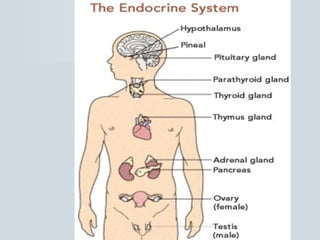
TheThe Endocrine SystemEndocrine System
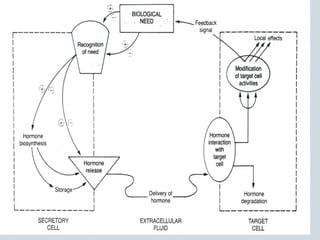
 Controls many body functionsControls many body functions
– exerts control by releasing special chemicalexerts control by releasing special chemical
substances into the blood calledsubstances into the blood called hormoneshormones
– HormonesHormones affect other endocrine glands oraffect other endocrine glands or
body systemsbody systems
Endocrine SystemEndocrine System
Hormone
 A substance that is releaseA substance that is releasedd in one tissue andin one tissue and
travels through the circulation (usually) to thetravels through the circulation (usually) to the
target tissue.target tissue.
 Hormones reach all parts of the body, but onlyHormones reach all parts of the body, but only
target cells are equipped to respondtarget cells are equipped to respond
Hormones are secreted in small amounts andHormones are secreted in small amounts and
often in bursts (pulsatile secretion)often in bursts (pulsatile secretion)
Endocrine FunctionsEndocrine Functions
• Maintain Internal Homeostasis
• Support Cell Growth
• Coordinate Development
• Coordinate Reproduction , fertility, sexual
function
• Facilitate Responses to External Stimuli
4 Classes of Hormones4 Classes of Hormones
1.1. Peptide/ ProteinPeptide/ Protein ((Range from 3 aminoRange from 3 amino
acids to hundreds of amino acids in size. )acids to hundreds of amino acids in size. )
2.2. SteroidSteroid
3.3. AmineAmine (Thyroid hormones and(Thyroid hormones and
Catecholamines)Catecholamines)
4.4. EicosanoidEicosanoid (Fatty acid derivatives )(Fatty acid derivatives )
 The hormones fall into two general classes based
on their solubility in water.
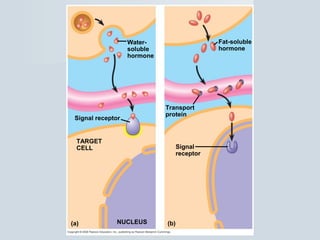
The water soluble { amine (epinephrine) and
peptide/protein hormones} are secreted by
exocytosis, travel freely in the bloodstream,
and bind to cell-surface receptors.
The lipid soluble hormones { thyroid hormone,
steroid hormones and Vitamin D3}. diffuse
across cell membranes, travel in the
bloodstream bound to transport proteins, and
diffuse through the membrane of target cells .
NUCLEUS
Signal
receptor
(a) (b)
TARGET
CELL
Signal receptor
Transport
protein
Water-
soluble
hormone
Fat-soluble
hormone
Location of receptorsLocation of receptors
- On cell surfaceOn cell surface
Peptides and proteinsPeptides and proteins
- In cytoplasmIn cytoplasm
SteroidsSteroids
- In nucleusIn nucleus
Thyroid hormonesThyroid hormones
Mechanisms of endocrine diseaseMechanisms of endocrine disease
 Endocrine disorders result from:
Hormone deficiency,
(HRT)(HRT)
Hormone excess
(Specific antagonists or release(Specific antagonists or release
inhibitors )inhibitors )
Hormone resistance
(sensitizers(sensitizers)
Sources of hormones:Sources of hormones:
- Natural
Human (GH; LH & FSH; hCG);
Animal (Insulin, T3 & T4)
- Biosynthetic
Insulin (Porcine & Bovine)
- Synthetic
Most hormones and their antagonists
DNA recombinant technology
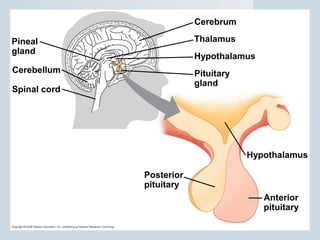
Hypothalamic &
Pituitary Hormones
Spinal cord
Posterior
pituitary
Cerebellum
Pineal
gland
Anterior
pituitary
Hypothalamus
Pituitary
gland
Hypothalamus
Thalamus
Cerebrum
Hypothalamus and Pituitary
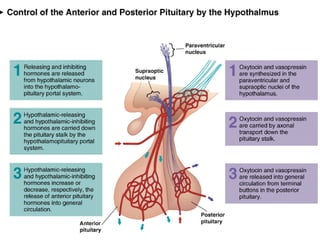
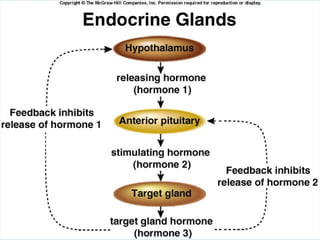
 The output of the hypothalamus-pituitary unit regulates the
function of the thyroid, adrenal and reproductive glands and
also controls somatic growth, lactation, milk secretion and
water metabolism.
 Hypothalamic Hs can have effect of stimulating or inhibiting
the release of ant. Pit. Hs. Called RELEASING HORMONES
“RH” or INHIBITING HORMONES “IH” respectively, reflecting their
influence on ant. Pit. Hs.
The Pituitary GlandThe Pituitary Gland
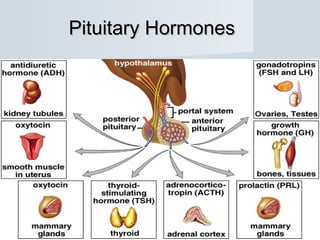
 The Pituitary Gland is divided into 2 areas, with separate types
of hormone production.
The anterior pituitary makes and releases H under
regulation of the hypothalamus
 Growth Hormone (GH)
 Thyroid-stimulating Hormone (TSH)
 Adrenocorticotropin (ACTH)
 Follicle-stimulating Hormone (FSH) ),
 Leutinizing Hormone (LH),
 Prolactin
– The posterior pituitary stores and secretes H that are
made in the hypothalamus: oxytocin and antidiuretic
hormone (ADH)
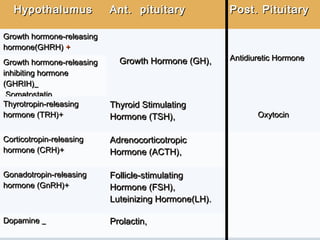
HypothalumusHypothalumus Ant. pituitaryAnt. pituitary Post. PituitaryPost. Pituitary
Growth hormone-releasingGrowth hormone-releasing
hormone(GHRH)hormone(GHRH) ++
Growth Hormone (GH),Growth Hormone (GH), Antidiuretic Hormone Antidiuretic Hormone 
Growth hormone-releasingGrowth hormone-releasing
inhibiting hormoneinhibiting hormone
(GHRIH)_(GHRIH)_
SomatostatinSomatostatin
Thyrotropin-releasingThyrotropin-releasing
hormone (TRH)+hormone (TRH)+
Thyroid StimulatingThyroid Stimulating
Hormone (TSH),Hormone (TSH), OxytocinOxytocin
Corticotropin-releasingCorticotropin-releasing
hormone (CRH)+hormone (CRH)+
AdrenocorticotropicAdrenocorticotropic
Hormone (ACTH),Hormone (ACTH),
Gonadotropin-releasingGonadotropin-releasing
hormone (GnRH)+hormone (GnRH)+
Follicle-stimulatingFollicle-stimulating
Hormone (FSH),Hormone (FSH),
Luteinizing Hormone(LH).Luteinizing Hormone(LH).
Dopamine _Dopamine _ Prolactin,Prolactin,
Hypothalamic hormones:Hypothalamic hormones:
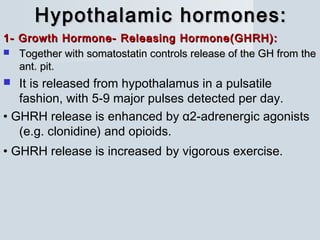
1- Growth Hormone- Releasing Hormone(GHRH):1- Growth Hormone- Releasing Hormone(GHRH):
 Together with somatostatin controls release of the GH from theTogether with somatostatin controls release of the GH from the
ant. pit.ant. pit.
 It is released from hypothalamus in a pulsatile
fashion, with 5-9 major pulses detected per day.
• GHRH release is enhanced by α2-adrenergic agonists
(e.g. clonidine) and opioids.
• GHRH release is increased by vigorous exercise.
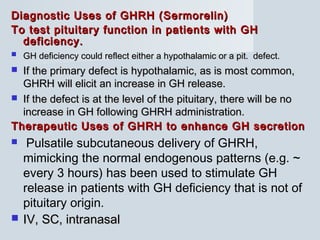
Diagnostic Uses of GHRH (Sermorelin)Diagnostic Uses of GHRH (Sermorelin)
To test pituitary function in patients with GHTo test pituitary function in patients with GH
deficiency.deficiency.
 GH deficiency could reflect either a hypothalamic or a pit. defect.GH deficiency could reflect either a hypothalamic or a pit. defect.
 If the primary defect is hypothalamic, as is most common,If the primary defect is hypothalamic, as is most common,
GHRH will elicit an increase in GH release.GHRH will elicit an increase in GH release.
 If the defect is at the level of the pituitary, there will be noIf the defect is at the level of the pituitary, there will be no
increase in GH following GHRH administration.increase in GH following GHRH administration.
Therapeutic Uses of GHRH to enhance GH secretionTherapeutic Uses of GHRH to enhance GH secretion
 Pulsatile subcutaneous delivery of GHRH,
mimicking the normal endogenous patterns (e.g. ~
every 3 hours) has been used to stimulate GH
release in patients with GH deficiency that is not of
pituitary origin.
 IV, SC, intranasalIV, SC, intranasal
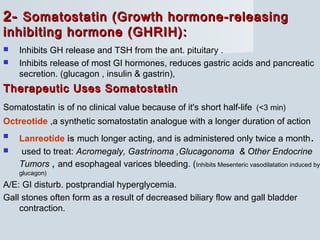
 Inhibits GH release and TSH from the ant. pituitary .
 Inhibits release of most GI hormones, reduces gastric acids and pancreatic
secretion. (glucagon , insulin & gastrin),
Therapeutic Uses SomatostatinTherapeutic Uses Somatostatin
Somatostatin is of no clinical value because of it's short half-life (<3 min)
Octreotide ,a synthetic somatostatin analogue with a longer duration of action
 Lanreotide is much longer acting, and is administered only twice a month.
 used to treat: Acromegaly, Gastrinoma ,Glucagonoma & Other Endocrine
Tumors , and esophageal varices bleeding. (Inhibits Mesenteric vasodilatation induced by
glucagon)
A/E: GI disturb. postprandial hyperglycemia.
Gall stones often form as a result of decreased biliary flow and gall bladder
contraction.
2-2- Somatostatin (Growth hormone-releasingSomatostatin (Growth hormone-releasing
inhibiting hormone (GHRIH):inhibiting hormone (GHRIH):
3- Thyrotropin-Releasing Hormone(TRH):3- Thyrotropin-Releasing Hormone(TRH):
 Stimulates release of thyrotropin (TSH) from the ant pit.
 Is used in diagnostic testing of thyroid dysfunction
 Protirelin: IV
4- Corticotropin Releasing4- Corticotropin Releasing
Hormone(CRH)Hormone(CRH)
 ItIt stimulates secretion of both ACTH & beta –endorphin (a
closely related peptide ) from the ant. pituitary .
 CRH can be used in the diagnoses of abnormalities of ACTH
secretion .
5- Gonadotropin-Releasing Hormone:(GnRH):5- Gonadotropin-Releasing Hormone:(GnRH):
 Stimulate the gonadotroph cell to produce and releaseStimulate the gonadotroph cell to produce and release LHLH
andand FSHFSH,,
 Gonadorelin, Buserelin, NafarelinGonadorelin, Buserelin, Nafarelin
 GnRH agonists, SC infusion inGnRH agonists, SC infusion in pulsespulses mimicmimic physiologicalphysiological
GnRH, stimulates ovulation.GnRH, stimulates ovulation.
 In contrast,In contrast, steadysteady dosing inhibits gonadotropin release bydosing inhibits gonadotropin release by
causing down –regulation (desensitization) of GnRHcausing down –regulation (desensitization) of GnRH
receptors in pituitary cells that normally releasereceptors in pituitary cells that normally release
gonadotropins .gonadotropins .
 GnRH is used in the diagnosis & treatment (by pulsatileGnRH is used in the diagnosis & treatment (by pulsatile
administration) ofadministration) of hypogonadalhypogonadal states in females & males .states in females & males .
 Continuous GnRH agonists are used in sex H-dependentContinuous GnRH agonists are used in sex H-dependent
conditions: prostate & breast cancers, uterine fibroids,conditions: prostate & breast cancers, uterine fibroids,
endometriosis or precocious puberty .endometriosis or precocious puberty .
6- Prolactin-Inhibiting Hormone (PIH,dopamine):6- Prolactin-Inhibiting Hormone (PIH,dopamine):
 Dopamine is the physiologic inhibitor of prolactin releaseDopamine is the physiologic inhibitor of prolactin release
 Because of its peripheral effects & the need for parenteralBecause of its peripheral effects & the need for parenteral
administration, dopamine is not useful in the control ofadministration, dopamine is not useful in the control of
hyperprolactinemia, buthyperprolactinemia, but bromocrptinebromocrptine & other orally active& other orally active
ergot –derivatives (egergot –derivatives (eg. Cabergoline. Cabergoline,, pergolinepergoline) are effective) are effective
in reducing prolactin secretion from the normal glands asin reducing prolactin secretion from the normal glands as
well as from prolactinomas .well as from prolactinomas .
 Also used in treatment of acromegalyAlso used in treatment of acromegaly
A/E: orthostatic hypotension, Psychiatric manifestationsA/E: orthostatic hypotension, Psychiatric manifestations
Pituitary HormonesPituitary Hormones
Anterior pituitary
Hormones
Growth HormoneGrowth Hormone
• Derived from the somatotroph cells
• Its secretion is controlled by GHRH and somatostatin;
• GH secretion is high in newborn, deceasing at 4 yr to an
intermediate level, which is then maintained until puberty,
when there is further decline.
• Insulin-like growth factor 1 (IGF-1) released from the liver
inhibits GH secretion by stimulating somatostatin secretion
from the hypothalamus,
Growth Hormone ActivityGrowth Hormone Activity
1. Increases plasma free fatty acids (source of energy for
muscle tissue)
2. Increases hepatic glucose output
3. Decreases insulin sensitivity in muscle
4. Is protein anabolic hormone
Growth Hormone DeficiencyGrowth Hormone Deficiency
Can have a genetic basis or can be acquired as a result of
damage to the pituitary or hypothalamus by a tumor,
infection, surgery, or radiation therapy.
In childhood: short stature and adiposity, hypoglycemia.
Adults : generalized obesity, reduced muscle mass.
GROWTH HORMONE EXCESSGROWTH HORMONE EXCESS
 Mainly benign pituitary tumor
 In adults causes acromegaly,
 If this occurred before the long bone epiphyses
close, it leads to the rare condition, gigantism.
Treatment of excess GH disorders:
- Synthetic Somatostatin (Octreotide)
- DA agonists (Bromocriptine)
- Surgical removal / Radiotherapy of the tumor
- GH Antagonists (Pegvisomant)
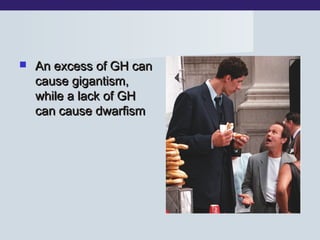
 An excess of GH canAn excess of GH can
cause gigantism,cause gigantism,
while a lack of GHwhile a lack of GH
can cause dwarfismcan cause dwarfism
Clinical uses of GHClinical uses of GH
SomatotropinSomatotropin
 GH deficiency in children & adults.GH deficiency in children & adults.
 Children with short stature that is due to factorsChildren with short stature that is due to factors
other than GH deficiency:other than GH deficiency:
 Idiopathic short stature, Turner syndrome, Chronic renalIdiopathic short stature, Turner syndrome, Chronic renal
failurefailure
A/EA/E::
Hypothyroidism, Pancreatitis, Gynecomastia,Hypothyroidism, Pancreatitis, Gynecomastia,
Possibilities of abuse have also arisen, e.g. creation
of “super” sports people.
Thyroid-stimulating Hormone (TSH)Thyroid-stimulating Hormone (TSH)
 Also called thyrotrophinAlso called thyrotrophin
 Stimulates secretion of thyroid hormone &
growth of thyroid gland.
Diagnostic Uses of TSHDiagnostic Uses of TSH
 In patients who have been treatedIn patients who have been treated
surgically for thyroid carcinoma, to test forsurgically for thyroid carcinoma, to test for
recurrencerecurrence
Adrenocorticotropin (ACTH)Adrenocorticotropin (ACTH)
Stimulates cortisol secretion by the adrenal cortex &
promotes growth of adrenal cortex
Diagnostic useDiagnostic use: as a test of the capacity of the
adrenal cortex to produce cortisol;
FollicleFollicle ––stimulating hormone (FSH)stimulating hormone (FSH)
• Females: stimulates growth & development of ovarian
follicles, promotes secretion of estrogen by ovaries.
• Males: required for sperm production
3 preparations are available for clinical use:
 Urofollitropin ,purified from of the urine of post menopausal
women,
 2 recombinant forms, follitropin alpha & follitropin beta.
 These products are used in combination with other drugs to
treat infertility in women & men.
Leutinizing hormone (LH)Leutinizing hormone (LH)
• Females: responsible for ovulation, formation of corpus luteum
in the ovary, and regulation of ovarian secretion of female sex
hormones.
• Males: stimulates cell in the testes to secrete testosterone
• Lutropin alfa, approved for use in combination with
follitropin alfa for stimulation of follicular development in
infertile women with profound LH deficiency..
ProlactinProlactin
 Secreted by lactotroph cells of the ant. Pit., which increase
in number during pregnancy.
 Its secretion is stimulated by estrogen
• Females: stimulates breast development and milk
production.
• Males: involved in testicular function
 No preparation of prolactin is available for use in prolactin-
deficient patients.
 For patients with symptomatic hyperprolactinemia,
inhibition of prolactin secretion can be achieved with
dopamine agonists, which act in the pituitary to inhibit
prolactin release.
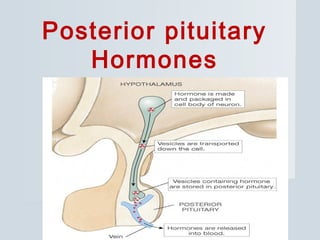
Posterior pituitary
Hormones
OxytocinOxytocin
• It is synthesized in the hypothalamus & transported toIt is synthesized in the hypothalamus & transported to
the post. Pit.the post. Pit.
• It is an effective stimulant ofIt is an effective stimulant of uterine contractionsuterine contractions & is& is
used intravenously to induce or reinforceused intravenously to induce or reinforce laborlabor ..
• Induces theInduces the release of milkrelease of milk
• Suckling sends a message to the hypothalamus viaSuckling sends a message to the hypothalamus via
the nervous system to release oxytocin, which furtherthe nervous system to release oxytocin, which further
stimulates the milk glandsstimulates the milk glands
Clinical uses of oxyticinClinical uses of oxyticin
IV, IMIV, IM
 Induction of laborInduction of labor
 Control of postpartum bleedingControl of postpartum bleeding
A/EA/E ::
fetal distress, placental abruption, or uterinefetal distress, placental abruption, or uterine
rupturerupture
excessive fluid retentionexcessive fluid retention
Vasopressin (antidiuretic hormone ADH)Vasopressin (antidiuretic hormone ADH)
• It is synthesized in the hypothalamus & transported to the post.It is synthesized in the hypothalamus & transported to the post.
Pit.Pit.
 The function ofThe function of ADHADH is tois to increase water conservationincrease water conservation by theby the
kidney.kidney.
 If there is aIf there is a highhigh level of ADH secretion, the kidneyslevel of ADH secretion, the kidneys reabsorbreabsorb
water.water.
 If there is aIf there is a lowlow level of ADH secretion, the kidneyslevel of ADH secretion, the kidneys releaserelease
water inwater in dilute urinedilute urine..
ADH release increases if blood pressure falls or blood becomesADH release increases if blood pressure falls or blood becomes
too salty.too salty.
ADH causes peripheral blood vessel constriction to help elevateADH causes peripheral blood vessel constriction to help elevate
blood pressure .blood pressure .
Clinical usesClinical uses
 Diabetes insipidus,Diabetes insipidus,
 Nocturnal enuresis (by decreasingNocturnal enuresis (by decreasing
nocturnal urine production)nocturnal urine production)
A/E: hyponatremia and seizuresA/E: hyponatremia and seizures
Synthetic ADH drugsSynthetic ADH drugs
– Vasopressin: IV, IMVasopressin: IV, IM
– Desmopressin: IV, IM. PO, intranasalDesmopressin: IV, IM. PO, intranasal
Endocrine pharmacology in Brief