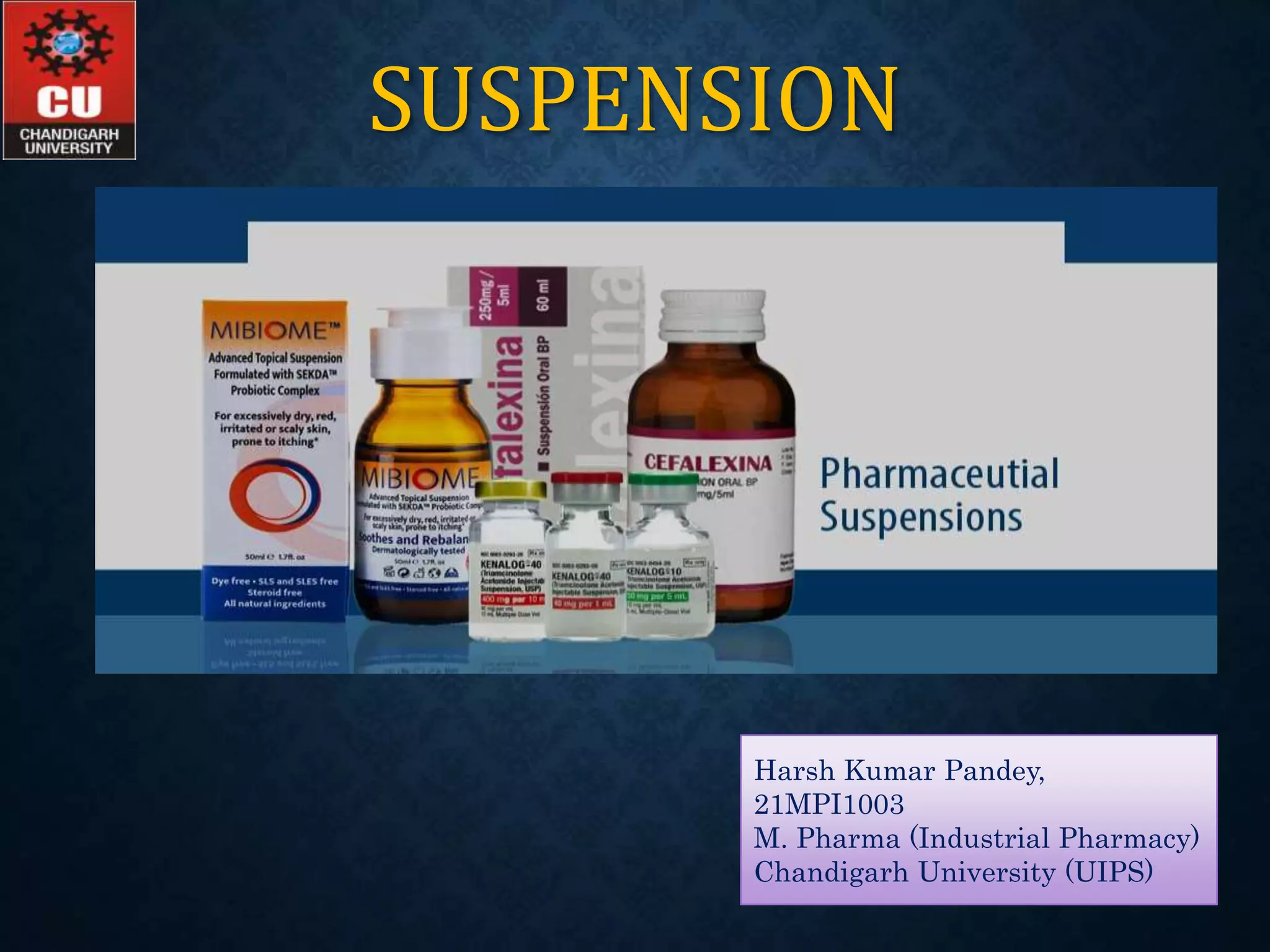

SUSPENSION
Harsh Kumar Pandey,
21MPI1003
M. Pharma (Industrial Pharmacy)
Chandigarh University (UIPS)
SUSPENSION
• A pharmaceutical suspension may be defined as a coarse dispersion
containing finely divided insoluble material suspended in a liquid
medium.
• The physical chemist defines the word “suspension” as two-phase
system consisting of an undissolved or immiscible material dispersed in
a vehicle (solid, liquid, or gas).
• Generally pharmaceutical suspensions contain aqueous dispersion
phase however in some cases they may be an oily or organic phase.
• The suspensions have dispersed particles above the colloidal size that is
mean particle diameter above 1µm.
EXAMPLES OF PHARMACEUTICAL
SUSPENSIONS
Antacid oral suspensions Antibacterial oral suspension
Dry powders for oral suspension (antibiotic)
Analgesic oral suspension
Anti helminthic oral suspension
Anticonvulsant oral suspension
Antifungal oral suspension
PHARMACEUTICAL APPLICATIONS OF SUSPENSIONS
Insoluble drug or poorly soluble drugs which required to be given orally in liquid
dosage forms ( in case of children, elderly, and patients have difficulty in
swallowing solids dosage forms)
To over come the instability of certain drug in aqueous solution:
 Insoluble derivative formulated as suspension
An example is oxytetracycline HCL (instable)  calcium salt (stable)
Reduce the contact time between solid drug particles and dispersion media 
increase the stability of drug like Ampicillin by making it as reconstituted
powder.
A drug that degraded in the presence of water  suspended in non-aqueous
vehicles. Examples are phenoxymethy penicillin/ coconut oil and tetracycline
HCL/ oil
To mask the taste:
Examples are paracetamol suspension (more palatable) and chloramphenicol
palmitate.
Some materials are needed to be present as finely divided forms to
increase the surface area. Fore example, Mg carbonate and Mg
trisilicate are used to adsorb some toxins
Suspension can be used topical applications:
An example is calamine lotion BP  after evaporation of dispersing
media; the active agent will be left as light deposit
Can be used for parenteral administration  intramuscular (I.M.) to
control arte of absorption
X-ray contrast media: an example is oral and rectal administration of
propyliodone
In aerosol  suspension of active agents in mixture of propellants
ADVANTAGES
• Suspension can improve chemical stability of certain drug.
E.g. Procaine penicillin G
• Drug in suspension exhibits higher rate of bioavailability than other
dosage forms. bioavailability is in following order,
Solution > Suspension > Capsule > Compressed Tablet > Coated tablet
• Duration and onset of action can be controlled. E.g. Protamine Zinc-
Insulin suspension
• Suspension can mask the unpleasant/ bitter taste of drug. E.g.
Chloramphenicol
DISADVANTAGES
• Physical stability, sedimentation and compaction can
causes problems.
• It is bulky sufficient care must be taken during handling
and transport.
• It is difficult to formulate
• Uniform and accurate dose can not be achieved unless
suspension are packed in unit dosage form
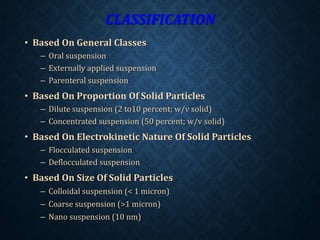
CLASSIFICATION
• Based On General Classes
– Oral suspension
– Externally applied suspension
– Parenteral suspension
• Based On Proportion Of Solid Particles
– Dilute suspension (2 to10 percent; w/v solid)
– Concentrated suspension (50 percent; w/v solid)
• Based On Electrokinetic Nature Of Solid Particles
– Flocculated suspension
– Deflocculated suspension
• Based On Size Of Solid Particles
– Colloidal suspension (< 1 micron)
– Coarse suspension (>1 micron)
– Nano suspension (10 nm)
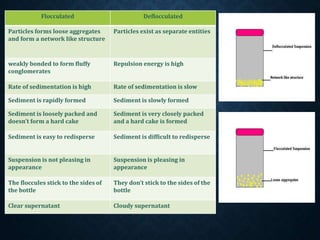
Flocculated Deflocculated
Particles forms loose aggregates
and form a network like structure
Particles exist as separate entities
weakly bonded to form fluffy
conglomerates
Repulsion energy is high
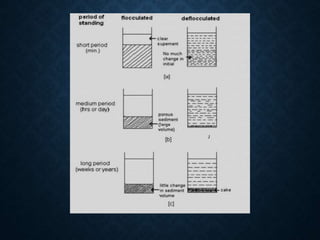
Rate of sedimentation is high Rate of sedimentation is slow
Sediment is rapidly formed Sediment is slowly formed
Sediment is loosely packed and
doesn’t form a hard cake
Sediment is very closely packed
and a hard cake is formed
Sediment is easy to redisperse Sediment is difficult to redisperse
Suspension is not pleasing in
appearance
Suspension is pleasing in
appearance
The floccules stick to the sides of
the bottle
They don’t stick to the sides of the
bottle
Clear supernatant Cloudy supernatant
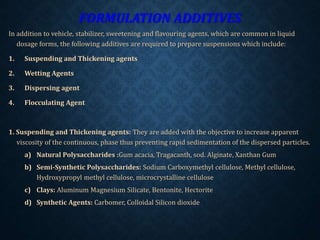
FORMULATION ADDITIVES
In addition to vehicle, stabilizer, sweetening and flavouring agents, which are common in liquid
dosage forms, the following additives are required to prepare suspensions which include:
1. Suspending and Thickening agents
2. Wetting Agents
3. Dispersing agent
4. Flocculating Agent
1. Suspending and Thickening agents: They are added with the objective to increase apparent
viscosity of the continuous, phase thus preventing rapid sedimentation of the dispersed particles.
a) Natural Polysaccharides :Gum acacia, Tragacanth, sod. Alginate, Xanthan Gum
b) Semi-Synthetic Polysaccharides: Sodium Carboxymethyl cellulose, Methyl cellulose,
Hydroxypropyl methyl cellulose, microcrystalline cellulose
c) Clays: Aluminum Magnesium Silicate, Bentonite, Hectorite
d) Synthetic Agents: Carbomer, Colloidal Silicon dioxide
FORMULATION ADDITIVES
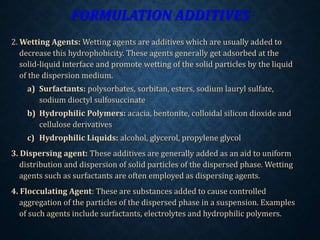
2. Wetting Agents: Wetting agents are additives which are usually added to
decrease this hydrophobicity. These agents generally get adsorbed at the
solid-liquid interface and promote wetting of the solid particles by the liquid
of the dispersion medium.
a) Surfactants: polysorbates, sorbitan, esters, sodium lauryl sulfate,
sodium dioctyl sulfosuccinate
b) Hydrophilic Polymers: acacia, bentonite, colloidal silicon dioxide and
cellulose derivatives
c) Hydrophilic Liquids: alcohol, glycerol, propylene glycol
3. Dispersing agent: These additives are generally added as an aid to uniform
distribution and dispersion of solid particles of the dispersed phase. Wetting
agents such as surfactants are often employed as dispersing agents.
4. Flocculating Agent: These are substances added to cause controlled
aggregation of the particles of the dispersed phase in a suspension. Examples
of such agents include surfactants, electrolytes and hydrophilic polymers.
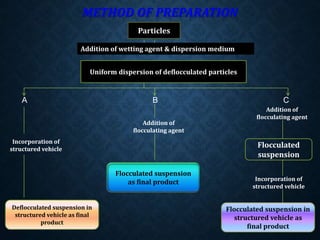
METHOD OF PREPARATION
Incorporation of
structured vehicle
A B C
Addition of
flocculating agent
Addition of
flocculating agent
Deflocculated suspension in
structured vehicle as final
product
Flocculated suspension
as final product
Flocculated
suspension
Incorporation of
structured vehicle
Flocculated suspension in
structured vehicle as
final product
Particles
Uniform dispersion of deflocculated particles
Addition of wetting agent & dispersion medium
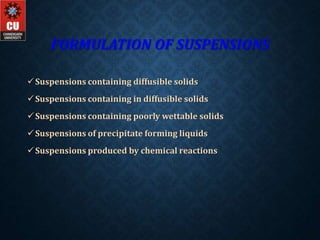
FORMULATION OF SUSPENSIONS
Suspensions containing diffusible solids
Suspensions containing in diffusible solids
Suspensions containing poorly wettable solids
Suspensions of precipitate forming liquids
Suspensions produced by chemical reactions
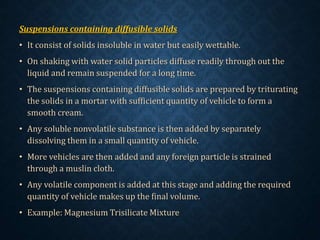
Suspensions containing diffusible solids
• It consist of solids insoluble in water but easily wettable.
• On shaking with water solid particles diffuse readily through out the
liquid and remain suspended for a long time.
• The suspensions containing diffusible solids are prepared by triturating
the solids in a mortar with sufficient quantity of vehicle to form a
smooth cream.
• Any soluble nonvolatile substance is then added by separately
dissolving them in a small quantity of vehicle.
• More vehicles are then added and any foreign particle is strained
through a muslin cloth.
• Any volatile component is added at this stage and adding the required
quantity of vehicle makes up the final volume.
• Example: Magnesium Trisilicate Mixture
Suspensions containing indiffusible solids
• It consist of substances, which do not remain distributed in the
dispersion medium when shaken for long time to ensure uniformity of
dose.
• They are prepared by adding a suitable thickening agent to the vehicle,
which increases the viscosity of the vehicle and delays the separation or
sedimentation of indiffusible particles.
Example: Calamine Lotion
Suspensions containing poorly wettable solids
• It consist of substances, which are poorly soluble, and at the same time
poorly wetted by the dispersion medium, and clump together with the
difficulty to disperse.
• They are prepared by including suitable wetting agent in the
formulation. These agents get adsorbed at the solid/liquid interface and
promote wetting of the solid particles by the liquid of the dispersion
medium. Example: Sulphur Lotion
Suspensions of precipitate forming liquids
• It consist of liquid tinctures which are alcoholic or hydroalcoholic
extract of vegetable drugs which contain resinous material.
• When tinctures are added to water they precipitate. Precipitates are
indiffusible and stick to the walls of the container.
• They are prepared by adding a suitable thickening agent prior to the
addition of the precipitate forming liquid.
Example: Lobelia and Stramonium Mixture
Suspensions produced by chemical reactions
• They are prepared by mixing two dilute solutions of reactants to form a
fine precipitate.
• Generally precipitates so formed are diffusible and no suspending agent
is required.
• If precipitate is indiffusible a suitable thickening or suspending agent
may be added.
• They are prepared by dissolving the reactants separately in
approximately half volumes of the vehicle and the two portions are then
mixed together. Example: Zinc Sulphide Lotion
PACKAGING AND STORAGE OF SUSPENSIONS
1. Should be packaged in wide mouth containers having adequate air
space above the liquid.
2. Should be stored in tight containers protected from: freezing, excessive
heat & light
3. Label: "Shake Before Use" to ensure uniform distribution of solid
particles and thereby uniform and proper dosage.
4. Stored in room temperature if it is dry powder (25 0C). It should be
stored in the refrigerator after opening or reconstitute (freezing should
be avoided to prevent aggregation)
STABILITY OF SUSPENSIONS
A-Physical stability
• Appearance, color, odor and
taste
• pH
• Specific gravity
• Sedimentation arte
• Sedimentation volume
• Zeta potential measurement
• Compatibility with container
• Compatibility with cap liner
• Microscopic examination
• Determination crystal size
• Determination uniform drug
distribution
B-Chemical stability:
• Degradation of active
ingredient
• Viscosity change
• antimicrobial activity:
I. Incompatibility
with
preservative
II. Degradation of
preservative
III. Adsorption of
preservative
onto drug
particle
ROUTES OF ADMINISTRATION OF SUSPENSION
• Suspensions are used to administer insoluble and distasteful
substances in a form that is pleasant to taste by providing a suitable
form, for the application of dermatological materials to the skin and
mucous membrane and for parenteral usage.
• Thus suspensions can be administered by
Oral
Topical
Parenteral
ophthalmic application
ORAL SUSPENSIONS
• Patients who have problems in swallowing solid dosage forms require
drugs to be dispersed in a liquid.
• Oral suspensions permit the formulation of poorly soluble drugs in the
form of liquid dosage form.
• As these suspensions are to be taken by oral route therefore they must
contain suitable flavoring and sweetening agents.
• Drugs, which possess unpleasant taste in solution dosage form like
paracetamol, chloramphenicol palmitate etc. can be formulated as
palatable suspension as they are suitable for administration to peadiatric
patients.
• Finely divided solids like kaolin, magnesium carbonate etc., when
administered in the form of suspensions will be available to a higher
surface area for adsorptive and neutralizing actions in the gastrointestinal
tract.
TOPICAL SUSPENSIONS
• These suspensions are meant for external application and therefore
should be free from gritty particles.
• There consistency may range from fluid to paste.
• Example of fluid suspension includes calamine lotion, which leave a
deposit of calamine on the skin after evaporation of the aqueous
dispersion phase. Zinc cream has a consistency of semisolid. Zinc cream
consists of high percentage of powders dispersed in an oily (paraffin)
phase.
PARENTERAL SUSPENSIONS
• These suspensions should be sterile and should possess property of
syringability.
• Parenteral suspensions are also used to control the rate of absorption. As
the absorption rate of the drug is dependent on the dissolution rate of the
solid. Therefore by varying the size of the dispersed solid particles the
duration and absorption can be controlled.
• Vaccines are also formulated as dispersions of killed microorganisms for
example in Cholera vaccine or as toxoid adsorbed on to substrate like
aluminium hydroxide or phosphate for prolonged antigenic stimulus. For
example adsorbed Diphtheria and Tetanus toxoid.
OPHTHALMIC SUSPENSIONS
• These should also be sterile and should possess very fine
particles.
• Drugs, which are unstable in aqueous solution, are
formulated as stable suspensions using non-aqueous
solvents.
• For example fractioned coconut oil is used for dispersing
tetracycline hydrochloride for ophthalmic use
EVALUATION OF SUSPENSIONS
 Sedimentation volume
 Re-dispersibility
 Rheological property
 Zeta-potential/Electro-Kinetic property
Presentation on Suspension liquid dose.ppt

Presentation on Suspension liquid dose.ppt

  • 1.
    SUSPENSION Harsh Kumar Pandey, 21MPI1003 M.Pharma (Industrial Pharmacy) Chandigarh University (UIPS)
  • 2.
    SUSPENSION • A pharmaceuticalsuspension may be defined as a coarse dispersion containing finely divided insoluble material suspended in a liquid medium. • The physical chemist defines the word “suspension” as two-phase system consisting of an undissolved or immiscible material dispersed in a vehicle (solid, liquid, or gas). • Generally pharmaceutical suspensions contain aqueous dispersion phase however in some cases they may be an oily or organic phase. • The suspensions have dispersed particles above the colloidal size that is mean particle diameter above 1µm.
  • 3.
    EXAMPLES OF PHARMACEUTICAL SUSPENSIONS Antacidoral suspensions Antibacterial oral suspension Dry powders for oral suspension (antibiotic) Analgesic oral suspension Anti helminthic oral suspension Anticonvulsant oral suspension Antifungal oral suspension
  • 4.
    PHARMACEUTICAL APPLICATIONS OFSUSPENSIONS Insoluble drug or poorly soluble drugs which required to be given orally in liquid dosage forms ( in case of children, elderly, and patients have difficulty in swallowing solids dosage forms) To over come the instability of certain drug in aqueous solution:  Insoluble derivative formulated as suspension An example is oxytetracycline HCL (instable)  calcium salt (stable) Reduce the contact time between solid drug particles and dispersion media  increase the stability of drug like Ampicillin by making it as reconstituted powder. A drug that degraded in the presence of water  suspended in non-aqueous vehicles. Examples are phenoxymethy penicillin/ coconut oil and tetracycline HCL/ oil To mask the taste: Examples are paracetamol suspension (more palatable) and chloramphenicol palmitate.
  • 5.
    Some materials areneeded to be present as finely divided forms to increase the surface area. Fore example, Mg carbonate and Mg trisilicate are used to adsorb some toxins Suspension can be used topical applications: An example is calamine lotion BP  after evaporation of dispersing media; the active agent will be left as light deposit Can be used for parenteral administration  intramuscular (I.M.) to control arte of absorption X-ray contrast media: an example is oral and rectal administration of propyliodone In aerosol  suspension of active agents in mixture of propellants
  • 6.
    ADVANTAGES • Suspension canimprove chemical stability of certain drug. E.g. Procaine penicillin G • Drug in suspension exhibits higher rate of bioavailability than other dosage forms. bioavailability is in following order, Solution > Suspension > Capsule > Compressed Tablet > Coated tablet • Duration and onset of action can be controlled. E.g. Protamine Zinc- Insulin suspension • Suspension can mask the unpleasant/ bitter taste of drug. E.g. Chloramphenicol
  • 7.
    DISADVANTAGES • Physical stability,sedimentation and compaction can causes problems. • It is bulky sufficient care must be taken during handling and transport. • It is difficult to formulate • Uniform and accurate dose can not be achieved unless suspension are packed in unit dosage form
  • 8.
    CLASSIFICATION • Based OnGeneral Classes – Oral suspension – Externally applied suspension – Parenteral suspension • Based On Proportion Of Solid Particles – Dilute suspension (2 to10 percent; w/v solid) – Concentrated suspension (50 percent; w/v solid) • Based On Electrokinetic Nature Of Solid Particles – Flocculated suspension – Deflocculated suspension • Based On Size Of Solid Particles – Colloidal suspension (< 1 micron) – Coarse suspension (>1 micron) – Nano suspension (10 nm)
  • 9.
    Flocculated Deflocculated Particles formsloose aggregates and form a network like structure Particles exist as separate entities weakly bonded to form fluffy conglomerates Repulsion energy is high Rate of sedimentation is high Rate of sedimentation is slow Sediment is rapidly formed Sediment is slowly formed Sediment is loosely packed and doesn’t form a hard cake Sediment is very closely packed and a hard cake is formed Sediment is easy to redisperse Sediment is difficult to redisperse Suspension is not pleasing in appearance Suspension is pleasing in appearance The floccules stick to the sides of the bottle They don’t stick to the sides of the bottle Clear supernatant Cloudy supernatant
  • 11.
    FORMULATION ADDITIVES In additionto vehicle, stabilizer, sweetening and flavouring agents, which are common in liquid dosage forms, the following additives are required to prepare suspensions which include: 1. Suspending and Thickening agents 2. Wetting Agents 3. Dispersing agent 4. Flocculating Agent 1. Suspending and Thickening agents: They are added with the objective to increase apparent viscosity of the continuous, phase thus preventing rapid sedimentation of the dispersed particles. a) Natural Polysaccharides :Gum acacia, Tragacanth, sod. Alginate, Xanthan Gum b) Semi-Synthetic Polysaccharides: Sodium Carboxymethyl cellulose, Methyl cellulose, Hydroxypropyl methyl cellulose, microcrystalline cellulose c) Clays: Aluminum Magnesium Silicate, Bentonite, Hectorite d) Synthetic Agents: Carbomer, Colloidal Silicon dioxide
  • 12.
    FORMULATION ADDITIVES 2. WettingAgents: Wetting agents are additives which are usually added to decrease this hydrophobicity. These agents generally get adsorbed at the solid-liquid interface and promote wetting of the solid particles by the liquid of the dispersion medium. a) Surfactants: polysorbates, sorbitan, esters, sodium lauryl sulfate, sodium dioctyl sulfosuccinate b) Hydrophilic Polymers: acacia, bentonite, colloidal silicon dioxide and cellulose derivatives c) Hydrophilic Liquids: alcohol, glycerol, propylene glycol 3. Dispersing agent: These additives are generally added as an aid to uniform distribution and dispersion of solid particles of the dispersed phase. Wetting agents such as surfactants are often employed as dispersing agents. 4. Flocculating Agent: These are substances added to cause controlled aggregation of the particles of the dispersed phase in a suspension. Examples of such agents include surfactants, electrolytes and hydrophilic polymers.
  • 13.
    METHOD OF PREPARATION Incorporationof structured vehicle A B C Addition of flocculating agent Addition of flocculating agent Deflocculated suspension in structured vehicle as final product Flocculated suspension as final product Flocculated suspension Incorporation of structured vehicle Flocculated suspension in structured vehicle as final product Particles Uniform dispersion of deflocculated particles Addition of wetting agent & dispersion medium
  • 14.
    FORMULATION OF SUSPENSIONS Suspensionscontaining diffusible solids Suspensions containing in diffusible solids Suspensions containing poorly wettable solids Suspensions of precipitate forming liquids Suspensions produced by chemical reactions
  • 15.
    Suspensions containing diffusiblesolids • It consist of solids insoluble in water but easily wettable. • On shaking with water solid particles diffuse readily through out the liquid and remain suspended for a long time. • The suspensions containing diffusible solids are prepared by triturating the solids in a mortar with sufficient quantity of vehicle to form a smooth cream. • Any soluble nonvolatile substance is then added by separately dissolving them in a small quantity of vehicle. • More vehicles are then added and any foreign particle is strained through a muslin cloth. • Any volatile component is added at this stage and adding the required quantity of vehicle makes up the final volume. • Example: Magnesium Trisilicate Mixture
  • 16.
    Suspensions containing indiffusiblesolids • It consist of substances, which do not remain distributed in the dispersion medium when shaken for long time to ensure uniformity of dose. • They are prepared by adding a suitable thickening agent to the vehicle, which increases the viscosity of the vehicle and delays the separation or sedimentation of indiffusible particles. Example: Calamine Lotion
  • 17.
    Suspensions containing poorlywettable solids • It consist of substances, which are poorly soluble, and at the same time poorly wetted by the dispersion medium, and clump together with the difficulty to disperse. • They are prepared by including suitable wetting agent in the formulation. These agents get adsorbed at the solid/liquid interface and promote wetting of the solid particles by the liquid of the dispersion medium. Example: Sulphur Lotion
  • 18.
    Suspensions of precipitateforming liquids • It consist of liquid tinctures which are alcoholic or hydroalcoholic extract of vegetable drugs which contain resinous material. • When tinctures are added to water they precipitate. Precipitates are indiffusible and stick to the walls of the container. • They are prepared by adding a suitable thickening agent prior to the addition of the precipitate forming liquid. Example: Lobelia and Stramonium Mixture
  • 19.
    Suspensions produced bychemical reactions • They are prepared by mixing two dilute solutions of reactants to form a fine precipitate. • Generally precipitates so formed are diffusible and no suspending agent is required. • If precipitate is indiffusible a suitable thickening or suspending agent may be added. • They are prepared by dissolving the reactants separately in approximately half volumes of the vehicle and the two portions are then mixed together. Example: Zinc Sulphide Lotion
  • 20.
    PACKAGING AND STORAGEOF SUSPENSIONS 1. Should be packaged in wide mouth containers having adequate air space above the liquid. 2. Should be stored in tight containers protected from: freezing, excessive heat & light 3. Label: "Shake Before Use" to ensure uniform distribution of solid particles and thereby uniform and proper dosage. 4. Stored in room temperature if it is dry powder (25 0C). It should be stored in the refrigerator after opening or reconstitute (freezing should be avoided to prevent aggregation)
  • 21.
    STABILITY OF SUSPENSIONS A-Physicalstability • Appearance, color, odor and taste • pH • Specific gravity • Sedimentation arte • Sedimentation volume • Zeta potential measurement • Compatibility with container • Compatibility with cap liner • Microscopic examination • Determination crystal size • Determination uniform drug distribution B-Chemical stability: • Degradation of active ingredient • Viscosity change • antimicrobial activity: I. Incompatibility with preservative II. Degradation of preservative III. Adsorption of preservative onto drug particle
  • 22.
    ROUTES OF ADMINISTRATIONOF SUSPENSION • Suspensions are used to administer insoluble and distasteful substances in a form that is pleasant to taste by providing a suitable form, for the application of dermatological materials to the skin and mucous membrane and for parenteral usage. • Thus suspensions can be administered by Oral Topical Parenteral ophthalmic application
  • 23.
    ORAL SUSPENSIONS • Patientswho have problems in swallowing solid dosage forms require drugs to be dispersed in a liquid. • Oral suspensions permit the formulation of poorly soluble drugs in the form of liquid dosage form. • As these suspensions are to be taken by oral route therefore they must contain suitable flavoring and sweetening agents. • Drugs, which possess unpleasant taste in solution dosage form like paracetamol, chloramphenicol palmitate etc. can be formulated as palatable suspension as they are suitable for administration to peadiatric patients. • Finely divided solids like kaolin, magnesium carbonate etc., when administered in the form of suspensions will be available to a higher surface area for adsorptive and neutralizing actions in the gastrointestinal tract.
  • 24.
    TOPICAL SUSPENSIONS • Thesesuspensions are meant for external application and therefore should be free from gritty particles. • There consistency may range from fluid to paste. • Example of fluid suspension includes calamine lotion, which leave a deposit of calamine on the skin after evaporation of the aqueous dispersion phase. Zinc cream has a consistency of semisolid. Zinc cream consists of high percentage of powders dispersed in an oily (paraffin) phase.
  • 25.
    PARENTERAL SUSPENSIONS • Thesesuspensions should be sterile and should possess property of syringability. • Parenteral suspensions are also used to control the rate of absorption. As the absorption rate of the drug is dependent on the dissolution rate of the solid. Therefore by varying the size of the dispersed solid particles the duration and absorption can be controlled. • Vaccines are also formulated as dispersions of killed microorganisms for example in Cholera vaccine or as toxoid adsorbed on to substrate like aluminium hydroxide or phosphate for prolonged antigenic stimulus. For example adsorbed Diphtheria and Tetanus toxoid.
  • 26.
    OPHTHALMIC SUSPENSIONS • Theseshould also be sterile and should possess very fine particles. • Drugs, which are unstable in aqueous solution, are formulated as stable suspensions using non-aqueous solvents. • For example fractioned coconut oil is used for dispersing tetracycline hydrochloride for ophthalmic use
  • 27.
    EVALUATION OF SUSPENSIONS Sedimentation volume  Re-dispersibility  Rheological property  Zeta-potential/Electro-Kinetic property