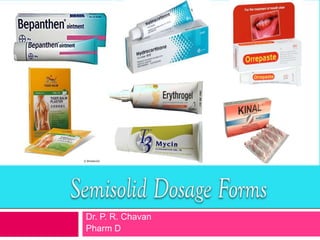
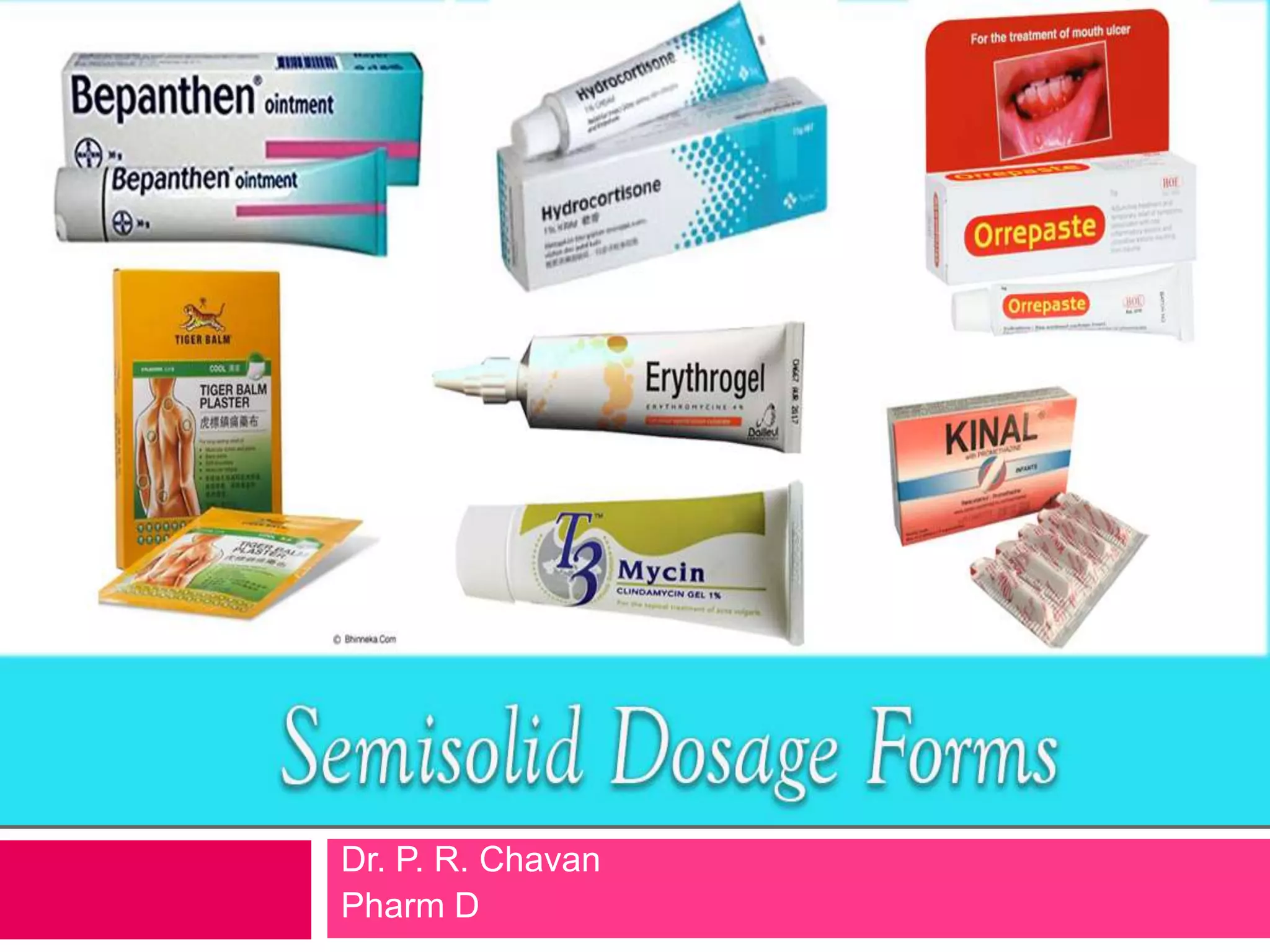

SEMISOLID DOSAGE
FORMS
Dr. P. R. Chavan
Pharm D
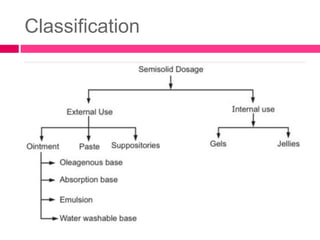
Classification
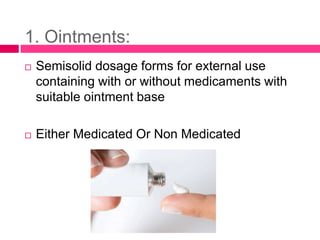
1. Ointments:
 Semisolid dosage forms for external use
containing with or without medicaments with
suitable ointment base
 Either Medicated Or Non Medicated
Types
 Medicated
Either dissolved or dispersed in a vehicle as fine
powder e.g steroids.
 Unmedicated
Unmedicated ointments are used for physical
effects such as protectants or lubricants
OINTMENT BASES
Ointment bases are classified into four general
groups. .
 Oleaginous bases.
 Absorption bases.
 Water-removable bases/ emulsion bases.
 Water-soluble bases.
OLEAGINOUS BASES
(HYDROCARBON BASES)
 On application to skin they have an emollient
effect.
 Protect against escape of moisture.
 They are effective as occlusive dressings.
 Immiscible with water and difficult to wash off.
 They can remain on skin for longer periods
without drying out.
 Water and aqueous solutions in small amounts
can be incorporated with small difficulty. . .
 When powdered substances are to be
incorrporated liquid petrolatum is used as
levigating agent.
THEY INCLUDE
 Petrolatum .
 white petrolatum .
 Yellow ointment .
 White ointment
ABSORPTION BASES
 Two types those that permit incorporation of
aqueous solutions resulting in formation of w/o
emulsions . . those that are already w/o
emulsions and permit incorporation of
additional quantity of aqueous solution
THEY INCLUDE
 Lanolin
 Anhydrous Lanolin
 Cold Cream
WATER REMOVABLE BASES
(EMULSIFYING BASES)
 They are oil in water emulsions having an
emulsifier which makes them readily miscible with
water.
 They may be diluted with water or aqueous
solutions. . .
 Because of their surface active property they
facilitate contact b/w skin and medicament
 Readily water washable
THEY INCLUDE
 Hydrophillic Ointments .
 Vanishing Creams
WATER SOLUBLE BASES
 Unlike other bases they contain only water
soluble components (greaseless bases) .
 They are completely water washable .
 Aqueous solutions can not be incorporated
efficiently because they soften greatly with
water addition
 They mostly are used for incorporation of solid
substances .
 These bases are used for local anaesthetics
and are used when easy washing from skin is
required .
 They include:
Peg ointment
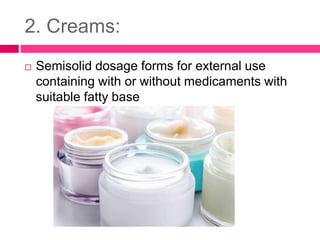
2. Creams:
 Semisolid dosage forms for external use
containing with or without medicaments with
suitable fatty base
types
 Aqueous - o/w
EA- anionic, cationic, and nonionic waxes,
polysoebates and triethanolamine soaps
 Oily – w/o
EA- wool fat,wool alcohols, beeswax, calcium
soap
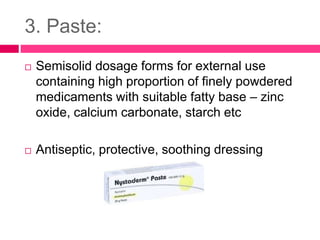
3. Paste:
 Semisolid dosage forms for external use
containing high proportion of finely powdered
medicaments with suitable fatty base – zinc
oxide, calcium carbonate, starch etc
 Antiseptic, protective, soothing dressing
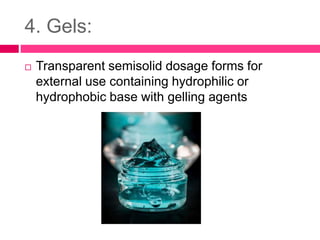
4. Gels:
 Transparent semisolid dosage forms for
external use containing hydrophilic or
hydrophobic base with gelling agents
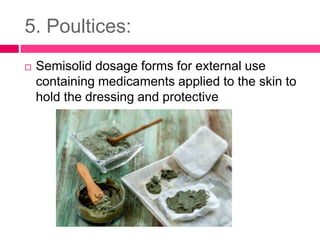
5. Poultices:
 Semisolid dosage forms for external use
containing medicaments applied to the skin to
hold the dressing and protective
Advantages of semi-solid
dosage forms:
 The major advantage of a semi-solid dosage form
is that it can be applied directly to the affected
area, it gives prolong the action, and does not
need to be administered orally.
 It is convenient for unconscious patients or
patients, such as children and old people, for
whom oral administration is difficult.
 Semisolid dosage forms are more stable in
atmospheric conditions than liquid dosage forms
and solid dosage forms.
Cont..
 It is suitable for those APIs that are low-density,
amorphous hygroscopic.
 Different drugs and excipients or ingredients can
be added together to form a single dose.
 It gives better adhesion and lasts long after
application, hence the medicament give longer
action.
 It is washable after each use.
Cont..
 It is used externally, thereby reducing the risk of
side effects.
 It does not harm the gastrointestinal tract, as it
does not need to be taken orally.
 The semi-solid dosage form is more convenient
for patients than other forms of drug
administration.
 It is suitable for medicines with a bitter taste, as it
does not need to be taken orally.
Disadvantages of semi-solid
dosage forms:
 The major disadvantage of the semi-solid
dosage form is that it has no dose accuracy
and it needs to be applied directly.
 In general, Pharmaceutical creams, ointments,
gels, suppositories, and paste are greasy and
they difficult to clean.
 The semi-solid dosage form is less stable than
the solid dosage form.
Cont..
 The need to apply with the fingers every
time can cause contamination.
 Some patients may become irritation or
allergic.
 Semisolid dosage forms are usually a
costly dosage because its manufacturing
process is complex.
Cont..
 Semisolid dosage forms are Physio-
chemically less stable compared with the
solid dosage form.
 Clothing staining is often associated with
the use of creams, ointments, gels, and
paste.
 The base used in the dose may be
oxidized.
Semisolid dosage forms ppt

Semisolid dosage forms ppt

  • 1.
  • 2.
  • 3.
    1. Ointments:  Semisoliddosage forms for external use containing with or without medicaments with suitable ointment base  Either Medicated Or Non Medicated
  • 4.
    Types  Medicated Either dissolvedor dispersed in a vehicle as fine powder e.g steroids.  Unmedicated Unmedicated ointments are used for physical effects such as protectants or lubricants
  • 5.
    OINTMENT BASES Ointment basesare classified into four general groups. .  Oleaginous bases.  Absorption bases.  Water-removable bases/ emulsion bases.  Water-soluble bases.
  • 6.
    OLEAGINOUS BASES (HYDROCARBON BASES) On application to skin they have an emollient effect.  Protect against escape of moisture.  They are effective as occlusive dressings.  Immiscible with water and difficult to wash off.
  • 7.
     They canremain on skin for longer periods without drying out.  Water and aqueous solutions in small amounts can be incorporated with small difficulty. . .  When powdered substances are to be incorrporated liquid petrolatum is used as levigating agent.
  • 8.
    THEY INCLUDE  Petrolatum.  white petrolatum .  Yellow ointment .  White ointment
  • 9.
    ABSORPTION BASES  Twotypes those that permit incorporation of aqueous solutions resulting in formation of w/o emulsions . . those that are already w/o emulsions and permit incorporation of additional quantity of aqueous solution
  • 10.
    THEY INCLUDE  Lanolin Anhydrous Lanolin  Cold Cream
  • 11.
    WATER REMOVABLE BASES (EMULSIFYINGBASES)  They are oil in water emulsions having an emulsifier which makes them readily miscible with water.  They may be diluted with water or aqueous solutions. . .  Because of their surface active property they facilitate contact b/w skin and medicament  Readily water washable
  • 12.
    THEY INCLUDE  HydrophillicOintments .  Vanishing Creams
  • 13.
    WATER SOLUBLE BASES Unlike other bases they contain only water soluble components (greaseless bases) .  They are completely water washable .  Aqueous solutions can not be incorporated efficiently because they soften greatly with water addition
  • 14.
     They mostlyare used for incorporation of solid substances .  These bases are used for local anaesthetics and are used when easy washing from skin is required .  They include: Peg ointment
  • 15.
    2. Creams:  Semisoliddosage forms for external use containing with or without medicaments with suitable fatty base
  • 16.
    types  Aqueous -o/w EA- anionic, cationic, and nonionic waxes, polysoebates and triethanolamine soaps  Oily – w/o EA- wool fat,wool alcohols, beeswax, calcium soap
  • 17.
    3. Paste:  Semisoliddosage forms for external use containing high proportion of finely powdered medicaments with suitable fatty base – zinc oxide, calcium carbonate, starch etc  Antiseptic, protective, soothing dressing
  • 18.
    4. Gels:  Transparentsemisolid dosage forms for external use containing hydrophilic or hydrophobic base with gelling agents
  • 19.
    5. Poultices:  Semisoliddosage forms for external use containing medicaments applied to the skin to hold the dressing and protective
  • 20.
    Advantages of semi-solid dosageforms:  The major advantage of a semi-solid dosage form is that it can be applied directly to the affected area, it gives prolong the action, and does not need to be administered orally.  It is convenient for unconscious patients or patients, such as children and old people, for whom oral administration is difficult.  Semisolid dosage forms are more stable in atmospheric conditions than liquid dosage forms and solid dosage forms.
  • 21.
    Cont..  It issuitable for those APIs that are low-density, amorphous hygroscopic.  Different drugs and excipients or ingredients can be added together to form a single dose.  It gives better adhesion and lasts long after application, hence the medicament give longer action.  It is washable after each use.
  • 22.
    Cont..  It isused externally, thereby reducing the risk of side effects.  It does not harm the gastrointestinal tract, as it does not need to be taken orally.  The semi-solid dosage form is more convenient for patients than other forms of drug administration.  It is suitable for medicines with a bitter taste, as it does not need to be taken orally.
  • 23.
    Disadvantages of semi-solid dosageforms:  The major disadvantage of the semi-solid dosage form is that it has no dose accuracy and it needs to be applied directly.  In general, Pharmaceutical creams, ointments, gels, suppositories, and paste are greasy and they difficult to clean.  The semi-solid dosage form is less stable than the solid dosage form.
  • 24.
    Cont..  The needto apply with the fingers every time can cause contamination.  Some patients may become irritation or allergic.  Semisolid dosage forms are usually a costly dosage because its manufacturing process is complex.
  • 25.
    Cont..  Semisolid dosageforms are Physio- chemically less stable compared with the solid dosage form.  Clothing staining is often associated with the use of creams, ointments, gels, and paste.  The base used in the dose may be oxidized.