TOPIC –
SUSPENSIONS
PHARMACEUTICS – I
SUSPENSIONS
Definition
¡ Pharmaceutical Suspension
A Pharmaceutical suspension is a dispersion
in which the Active Pharmaceutical
Ingredient (internal phase)is dispersed in
the vehicle (external phase).
As per this definition, the solubility of the therapeutic agent
in the vehicle is low.
The internal phase consists of insoluble or poorly soluble solid
particles.
These particles in the size range from 0.5-5 µ that is
maintained consistently throughout the suspending medium
with the aid of a single/combination of the suspending agent.
The external phase (suspending medium) is generally aqueous
in some instances. It may be an organic or oily liquid for non-
oral use.
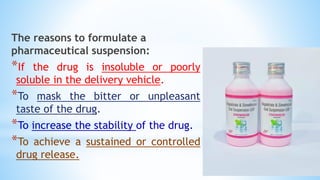
The reasons to formulate a
pharmaceutical suspension:
*If the drug is insoluble or poorly
soluble in the delivery vehicle.
*To mask the bitter or unpleasant
taste of the drug.
*To increase the stability of the drug.
*To achieve a sustained or controlled
drug release.
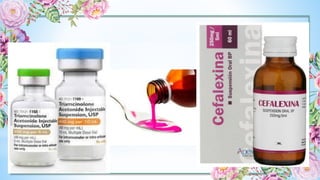
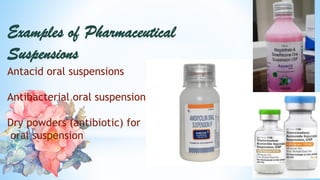
Examples of Pharmaceutical
Suspensions
Antacid oral suspensions
Antibacterial oral suspension
Dry powders (antibiotic) for
oral suspension
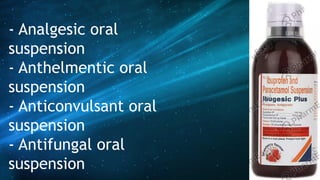
- Analgesic oral
suspension
- Anthelmentic oral
suspension
- Anticonvulsant oral
suspension
- Antifungal oral
suspension
Classification -
- Based on General Classes
- Based on the Proportion of Solid
Particles
- Based on Electro-kinetic Nature of
Solid Particles
- Based on Size of Solid Particles
Based on General Classes
· Oral suspension – e.g. Antacids,
Paracetamol suspension, and Tetracycline
hydrochloride.
· Externally applied suspension - e.g.
Calamine lotion.
· Parenteral suspension - e.g. Procaine
penicillin G, Insulin Zinc Suspension.
Based on the Proportion of Solid
Particles
· Dilute suspension (2-10%w/v solid) -
e.g. Cortisone acetate, Prednisolone
acetate.
· Concentrated suspension (50%w/v
solid) - e.g. Zinc oxide suspension.
Based on Electro-kinetic Nature
of Solid Particles
· Flocculated suspension
· Deflocculated suspension
Based on Size of Solid Particles
Colloidal suspensions -Particle sizes of suspended solid
less than about 1 micron in size.
Coarse suspensions -Particle sizes of greater than
about 1micron in diameter.
Nano-suspensions -Biphasic colloidal dispersions of
Nano-sized drug particles stabilized by surfactants.
Advantages
&
Disadvantages
Advantages of Pharmaceutical Suspension
It enhances the chemical stability of some drugs like Procaine penicillin G.
Therapeutic agents present in the suspension gives a higher bioavailability rate as
compared to other dosage forms. Solution > Suspension > Capsule > Compressed Tablet >
Coated tablet.
Duration and the onset of action can be controlled like Protamine Zinc-Insulin suspension.
It can mask the unpleasant or bitter taste of therapeutic agents like Chloramphenicol.
Pharmaceutical suspensions are a useful drug delivery system for drugs that have a low
solubility.
Pharmaceutical suspensions may be employed to
administer drugs to patients who have difficulty in
swallowing of solid-dosage forms.
Pharmaceutical suspensions may be formulated to
provide controlled drug delivery, e.g. as
intramuscular injections.
Disadvantages of Pharmaceutical Suspension
Physical stability, sedimentation, and compaction can cause some troubles.
It is bulky sufficient care must be taken during handling and transport and therefore
difficult for a patient to carry.
It is difficult to formulate.
Uniform and accurate dose of the therapeutic agent cannot be obtained unless it
packed in the unit dosage form.
Pharmaceutical suspensions are essentially unstable. Hence, it requires formulation
skill to ensure the physical stability of the formulation is retained over the period of
the shelf-life.
The formulation of anesthetic suspension is difficult.
Applications
A suspension is usually suitable for poorly soluble or insoluble drugs E.g.
Prednisolone suspension.
To prevent drug degradation or to improve the drug stability. E.g. Oxytetracycline
suspension.
To mask the bitter or unpleasant taste of the drug. e.g. Chloramphenicol
palmitate suspension.
It can be formulated for topical application e.g. Calamine lotion.
Vaccines are often formulated as a suspension. e.g. Cholera vaccine.
Features expected in Pharmaceutical suspensions
It should have a low rate of sedimentation it means suspended particles should not
settle rapidly.
It should be easy to pour.
It should have good syringeability.
It should be physically, chemically, and microbiologically stable.
In case of parenteral or ophthalmic, it should be sterilizable.
The disperse phase must be easily redispersed with gentle shaking.
The flow properties of the suspension should be such that the formulation to be easily
removed from the container.
It should be aesthetically pleasing.
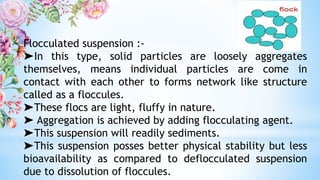
Flocculated suspension :-
➤In this type, solid particles are loosely aggregates
themselves, means individual particles are come in
contact with each other to forms network like structure
called as a floccules.
➤These flocs are light, fluffy in nature.
➤ Aggregation is achieved by adding flocculating agent.
➤This suspension will readily sediments.
➤This suspension posses better physical stability but less
bioavailability as compared to deflocculated suspension
due to dissolution of floccules.
Deflocculated suspension
➤In this type of suspension, individual particle exits as a
separate entity. Hence particles approaches each other,
they experience repulsive forces. This force create a high
potential barrier, which prevents a aggregation of particles.
➤During storage, these suspension shows a sedimentation at
slow rate, due to that particles forms a close packing
arrangement.
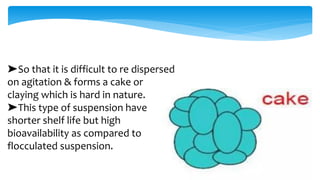
➤So that it is difficult to re dispersed
on agitation & forms a cake or
claying which is hard in nature.
➤This type of suspension have
shorter shelf life but high
bioavailability as compared to
flocculated suspension.
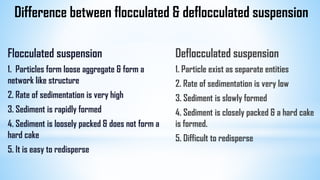
Difference between flocculated & deflocculated suspension
Flocculated suspension
1. Particles form loose aggregate & form a
network like structure
2. Rate of sedimentation is very high
3. Sediment is rapidly formed
4. Sediment is loosely packed & does not form a
hard cake
5. It is easy to redisperse
Deflocculated suspension
1. Particle exist as separate entities
2. Rate of sedimentation is very low
3. Sediment is slowly formed
4. Sediment is closely packed & a hard cake
is formed.
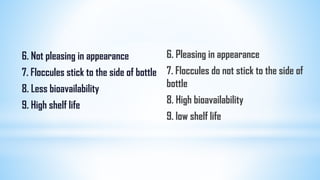
5. Difficult to redisperse
6. Not pleasing in appearance
7. Floccules stick to the side of bottle
8. Less bioavailability
9. High shelf life
6. Pleasing in appearance
7. Floccules do not stick to the side of
bottle
8. High bioavailability
9. low shelf life
4. Suspending Agent –
A – Natural - Acacia, Tragacant, Alginates.
B – Semi - Synthetic - Methyl cellulose,
Microcrystalline cellulose.
C – Synthetic – Carbomers / Carbopol, Colloidal
silicon dioxide
5. Organoleptic Agents –
A – Coloring Agent-
B – Flavoring Agent-
C – Sweetening Agent-
Formulation :-
1. Medicament / Drug
2. Flocculating agent-
A – Electrolytes – sodium phosphate, citrates
B – Surfactant - ionic and nonionic
C – Polymers – Starch, Cellulose, Tragacanth,
Carbomer.
3. Deflocculating agent – Polyphosphates, lignophosphates, and
water soluble synthetic polymer.
Evaluation :-
1. Physically –
Sedimentation rate
Flocculation, Caking, Color, Taste, Visual
inspection, Particle size, Clarity, Homogeneity,
Viscosity
2. Chemically:-
pH, Mixing / % of assay, Dissolution Rate,
3. Microbiologically:-
Microbial limit, preservative efficacy
Bacteria, yeast, fungi, etc
Method to overcome stability problems
1. – Use stabilizer – Gums, Polymers.
Adjusting particle size
Increase viscosity
Using anti settling agent – silica
Homogenization
2. – Use antioxidants – like Vit. – E
pH adjuster / Buffers
Use preservative / Antimicrobial agent –
Methyl paraben, Propyl paraben.
Control of storage condition – Temperature
control, light protection (amber colored bottle),
Humidity control.
3. – Sterilization ( By heat – dry / moist)
4. – Formulation / process optimization
5. – Container and closure selection.
What is the primary advantage of
suspensions in pharmaceutical
formulations?
A. Rapid absorption in the gastrointestinal tract
B. Extended shelf life
C. Easy preparation
D. High solubility
MCQS QUESTION :-
Which of the following is a
disadvantage of using suspensions
in pharmaceuticals?
A. Limited stability
B. Rapid absorption
C. High clarity
D. Low viscosity
Which of the following is an
advantage of suspensions?
A. Suspensions are easy to prepare.
B. Suspensions are stable.
C. Suspensions are easy to administer.
D. All of the above.
Which of the following is a disadvantage of
suspensions?
A. Suspensions can settle out over time.
B. Suspensions can be difficult to filter.
C. Suspensions can be difficult to sterilize.
D. All of the above.
Which of the following is a
suspending agent used in oral
suspensions?
A. Methylcellulose
B. Xanthan gum
C. Bentonite
D. All of the above
Which of the following is a preservative used in
suspensions?
A. Sodium benzoate
B. Methylparaben
C. Propylparaben
D. All of the above
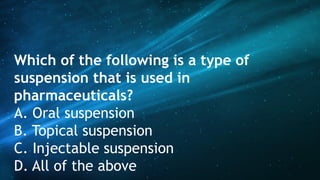
Which of the following is a type of
suspension that is used in
pharmaceuticals?
A. Oral suspension
B. Topical suspension
C. Injectable suspension
D. All of the above
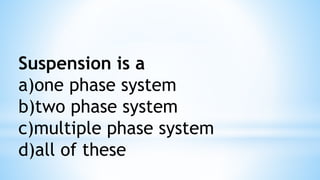
Suspension is a
a)one phase system
b)two phase system
c)multiple phase system
d)all of these
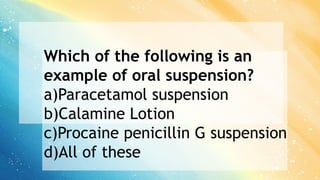
Which of the following is an
example of oral suspension?
a)Paracetamol suspension
b)Calamine Lotion
c)Procaine penicillin G suspension
d)All of these
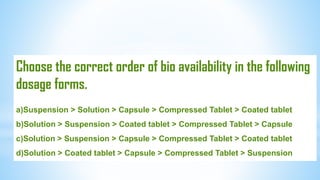
Choose the correct order of bio availability in the following
dosage forms.
a)Suspension > Solution > Capsule > Compressed Tablet > Coated tablet
b)Solution > Suspension > Coated tablet > Compressed Tablet > Capsule
c)Solution > Suspension > Capsule > Compressed Tablet > Coated tablet
d)Solution > Coated tablet > Capsule > Compressed Tablet > Suspension
Thank
you

Suspension By Deepak Kumar assistant professor

  • 1.
  • 2.
    SUSPENSIONS Definition ¡ Pharmaceutical Suspension APharmaceutical suspension is a dispersion in which the Active Pharmaceutical Ingredient (internal phase)is dispersed in the vehicle (external phase).
  • 4.
    As per thisdefinition, the solubility of the therapeutic agent in the vehicle is low. The internal phase consists of insoluble or poorly soluble solid particles. These particles in the size range from 0.5-5 µ that is maintained consistently throughout the suspending medium with the aid of a single/combination of the suspending agent. The external phase (suspending medium) is generally aqueous in some instances. It may be an organic or oily liquid for non- oral use.
  • 5.
    The reasons toformulate a pharmaceutical suspension: *If the drug is insoluble or poorly soluble in the delivery vehicle. *To mask the bitter or unpleasant taste of the drug. *To increase the stability of the drug. *To achieve a sustained or controlled drug release.
  • 6.
    Examples of Pharmaceutical Suspensions Antacidoral suspensions Antibacterial oral suspension Dry powders (antibiotic) for oral suspension
  • 7.
    - Analgesic oral suspension -Anthelmentic oral suspension - Anticonvulsant oral suspension - Antifungal oral suspension
  • 8.
    Classification - - Basedon General Classes - Based on the Proportion of Solid Particles - Based on Electro-kinetic Nature of Solid Particles - Based on Size of Solid Particles
  • 9.
    Based on GeneralClasses · Oral suspension – e.g. Antacids, Paracetamol suspension, and Tetracycline hydrochloride. · Externally applied suspension - e.g. Calamine lotion. · Parenteral suspension - e.g. Procaine penicillin G, Insulin Zinc Suspension.
  • 10.
    Based on theProportion of Solid Particles · Dilute suspension (2-10%w/v solid) - e.g. Cortisone acetate, Prednisolone acetate. · Concentrated suspension (50%w/v solid) - e.g. Zinc oxide suspension.
  • 11.
    Based on Electro-kineticNature of Solid Particles · Flocculated suspension · Deflocculated suspension
  • 12.
    Based on Sizeof Solid Particles Colloidal suspensions -Particle sizes of suspended solid less than about 1 micron in size. Coarse suspensions -Particle sizes of greater than about 1micron in diameter. Nano-suspensions -Biphasic colloidal dispersions of Nano-sized drug particles stabilized by surfactants.
  • 13.
  • 14.
    Advantages of PharmaceuticalSuspension It enhances the chemical stability of some drugs like Procaine penicillin G. Therapeutic agents present in the suspension gives a higher bioavailability rate as compared to other dosage forms. Solution > Suspension > Capsule > Compressed Tablet > Coated tablet. Duration and the onset of action can be controlled like Protamine Zinc-Insulin suspension. It can mask the unpleasant or bitter taste of therapeutic agents like Chloramphenicol. Pharmaceutical suspensions are a useful drug delivery system for drugs that have a low solubility.
  • 15.
    Pharmaceutical suspensions maybe employed to administer drugs to patients who have difficulty in swallowing of solid-dosage forms. Pharmaceutical suspensions may be formulated to provide controlled drug delivery, e.g. as intramuscular injections.
  • 16.
    Disadvantages of PharmaceuticalSuspension Physical stability, sedimentation, and compaction can cause some troubles. It is bulky sufficient care must be taken during handling and transport and therefore difficult for a patient to carry. It is difficult to formulate. Uniform and accurate dose of the therapeutic agent cannot be obtained unless it packed in the unit dosage form. Pharmaceutical suspensions are essentially unstable. Hence, it requires formulation skill to ensure the physical stability of the formulation is retained over the period of the shelf-life. The formulation of anesthetic suspension is difficult.
  • 17.
    Applications A suspension isusually suitable for poorly soluble or insoluble drugs E.g. Prednisolone suspension. To prevent drug degradation or to improve the drug stability. E.g. Oxytetracycline suspension. To mask the bitter or unpleasant taste of the drug. e.g. Chloramphenicol palmitate suspension. It can be formulated for topical application e.g. Calamine lotion. Vaccines are often formulated as a suspension. e.g. Cholera vaccine.
  • 18.
    Features expected inPharmaceutical suspensions It should have a low rate of sedimentation it means suspended particles should not settle rapidly. It should be easy to pour. It should have good syringeability. It should be physically, chemically, and microbiologically stable. In case of parenteral or ophthalmic, it should be sterilizable. The disperse phase must be easily redispersed with gentle shaking. The flow properties of the suspension should be such that the formulation to be easily removed from the container. It should be aesthetically pleasing.
  • 19.
    Flocculated suspension :- ➤Inthis type, solid particles are loosely aggregates themselves, means individual particles are come in contact with each other to forms network like structure called as a floccules. ➤These flocs are light, fluffy in nature. ➤ Aggregation is achieved by adding flocculating agent. ➤This suspension will readily sediments. ➤This suspension posses better physical stability but less bioavailability as compared to deflocculated suspension due to dissolution of floccules.
  • 20.
    Deflocculated suspension ➤In thistype of suspension, individual particle exits as a separate entity. Hence particles approaches each other, they experience repulsive forces. This force create a high potential barrier, which prevents a aggregation of particles. ➤During storage, these suspension shows a sedimentation at slow rate, due to that particles forms a close packing arrangement.
  • 21.
    ➤So that itis difficult to re dispersed on agitation & forms a cake or claying which is hard in nature. ➤This type of suspension have shorter shelf life but high bioavailability as compared to flocculated suspension.
  • 22.
    Difference between flocculated& deflocculated suspension Flocculated suspension 1. Particles form loose aggregate & form a network like structure 2. Rate of sedimentation is very high 3. Sediment is rapidly formed 4. Sediment is loosely packed & does not form a hard cake 5. It is easy to redisperse Deflocculated suspension 1. Particle exist as separate entities 2. Rate of sedimentation is very low 3. Sediment is slowly formed 4. Sediment is closely packed & a hard cake is formed. 5. Difficult to redisperse
  • 23.
    6. Not pleasingin appearance 7. Floccules stick to the side of bottle 8. Less bioavailability 9. High shelf life 6. Pleasing in appearance 7. Floccules do not stick to the side of bottle 8. High bioavailability 9. low shelf life
  • 24.
    4. Suspending Agent– A – Natural - Acacia, Tragacant, Alginates. B – Semi - Synthetic - Methyl cellulose, Microcrystalline cellulose. C – Synthetic – Carbomers / Carbopol, Colloidal silicon dioxide 5. Organoleptic Agents – A – Coloring Agent- B – Flavoring Agent- C – Sweetening Agent-
  • 25.
    Formulation :- 1. Medicament/ Drug 2. Flocculating agent- A – Electrolytes – sodium phosphate, citrates B – Surfactant - ionic and nonionic C – Polymers – Starch, Cellulose, Tragacanth, Carbomer. 3. Deflocculating agent – Polyphosphates, lignophosphates, and water soluble synthetic polymer.
  • 26.
    Evaluation :- 1. Physically– Sedimentation rate Flocculation, Caking, Color, Taste, Visual inspection, Particle size, Clarity, Homogeneity, Viscosity
  • 27.
    2. Chemically:- pH, Mixing/ % of assay, Dissolution Rate, 3. Microbiologically:- Microbial limit, preservative efficacy Bacteria, yeast, fungi, etc
  • 28.
    Method to overcomestability problems 1. – Use stabilizer – Gums, Polymers. Adjusting particle size Increase viscosity Using anti settling agent – silica Homogenization
  • 29.
    2. – Useantioxidants – like Vit. – E pH adjuster / Buffers Use preservative / Antimicrobial agent – Methyl paraben, Propyl paraben. Control of storage condition – Temperature control, light protection (amber colored bottle), Humidity control. 3. – Sterilization ( By heat – dry / moist) 4. – Formulation / process optimization 5. – Container and closure selection.
  • 31.
    What is theprimary advantage of suspensions in pharmaceutical formulations? A. Rapid absorption in the gastrointestinal tract B. Extended shelf life C. Easy preparation D. High solubility MCQS QUESTION :-
  • 32.
    Which of thefollowing is a disadvantage of using suspensions in pharmaceuticals? A. Limited stability B. Rapid absorption C. High clarity D. Low viscosity
  • 33.
    Which of thefollowing is an advantage of suspensions? A. Suspensions are easy to prepare. B. Suspensions are stable. C. Suspensions are easy to administer. D. All of the above.
  • 34.
    Which of thefollowing is a disadvantage of suspensions? A. Suspensions can settle out over time. B. Suspensions can be difficult to filter. C. Suspensions can be difficult to sterilize. D. All of the above.
  • 35.
    Which of thefollowing is a suspending agent used in oral suspensions? A. Methylcellulose B. Xanthan gum C. Bentonite D. All of the above
  • 36.
    Which of thefollowing is a preservative used in suspensions? A. Sodium benzoate B. Methylparaben C. Propylparaben D. All of the above
  • 37.
    Which of thefollowing is a type of suspension that is used in pharmaceuticals? A. Oral suspension B. Topical suspension C. Injectable suspension D. All of the above
  • 38.
    Suspension is a a)onephase system b)two phase system c)multiple phase system d)all of these
  • 39.
    Which of thefollowing is an example of oral suspension? a)Paracetamol suspension b)Calamine Lotion c)Procaine penicillin G suspension d)All of these
  • 40.
    Choose the correctorder of bio availability in the following dosage forms. a)Suspension > Solution > Capsule > Compressed Tablet > Coated tablet b)Solution > Suspension > Coated tablet > Compressed Tablet > Capsule c)Solution > Suspension > Capsule > Compressed Tablet > Coated tablet d)Solution > Coated tablet > Capsule > Compressed Tablet > Suspension
  • 41.