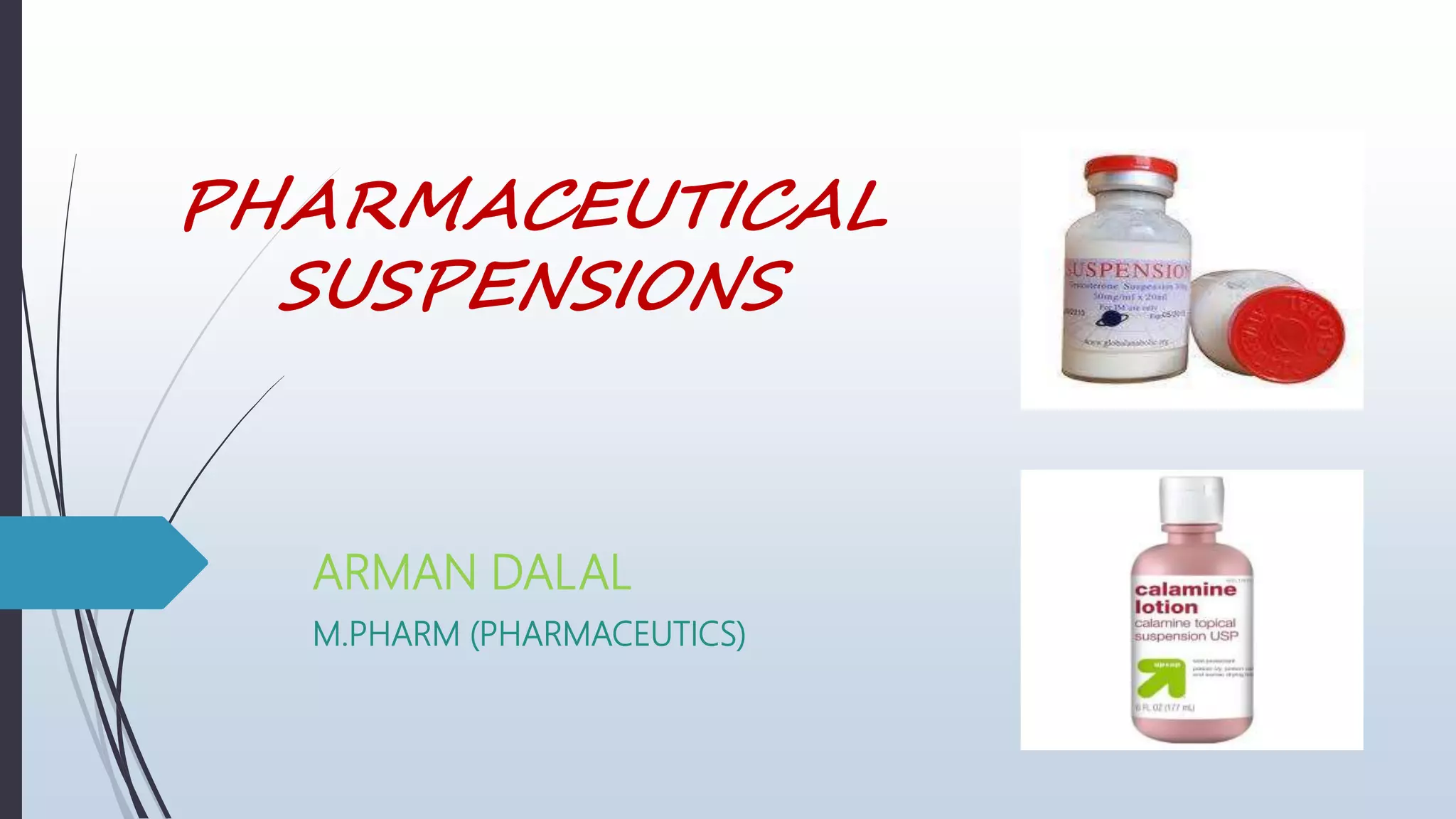
PHARMACEUTICAL
SUSPENSIONS
ARMAN DALAL
M.PHARM (PHARMACEUTICS)
Contents
Definition
Classification
Stability of suspensions
Theoretic Considerations
Sedimentation
Brownian Movement
Electrokinetic Properties
Formulation of suspensions
Preparation of suspensions
Quality control of suspensions
Recent advancements in suspensions
DEFINITION :
A Pharmaceutical suspension is a biphasic
coarse dispersion in which internal phase
(therapeutically active ingredient) is dispersed
uniformly throughout the external phase.
The internal phase consisting of insoluble solid
particles having a range of size(0.5 to 5 microns)
which is maintained uniformly through out the
suspending vehicle with aid of single or
combination of suspending agent.
The external phase (suspending medium) is
generally aqueous in some instance, may be an
organic or oily liquid for non oral use.
CLASSIFICATION :
• Based On General Classes
– Oral suspension
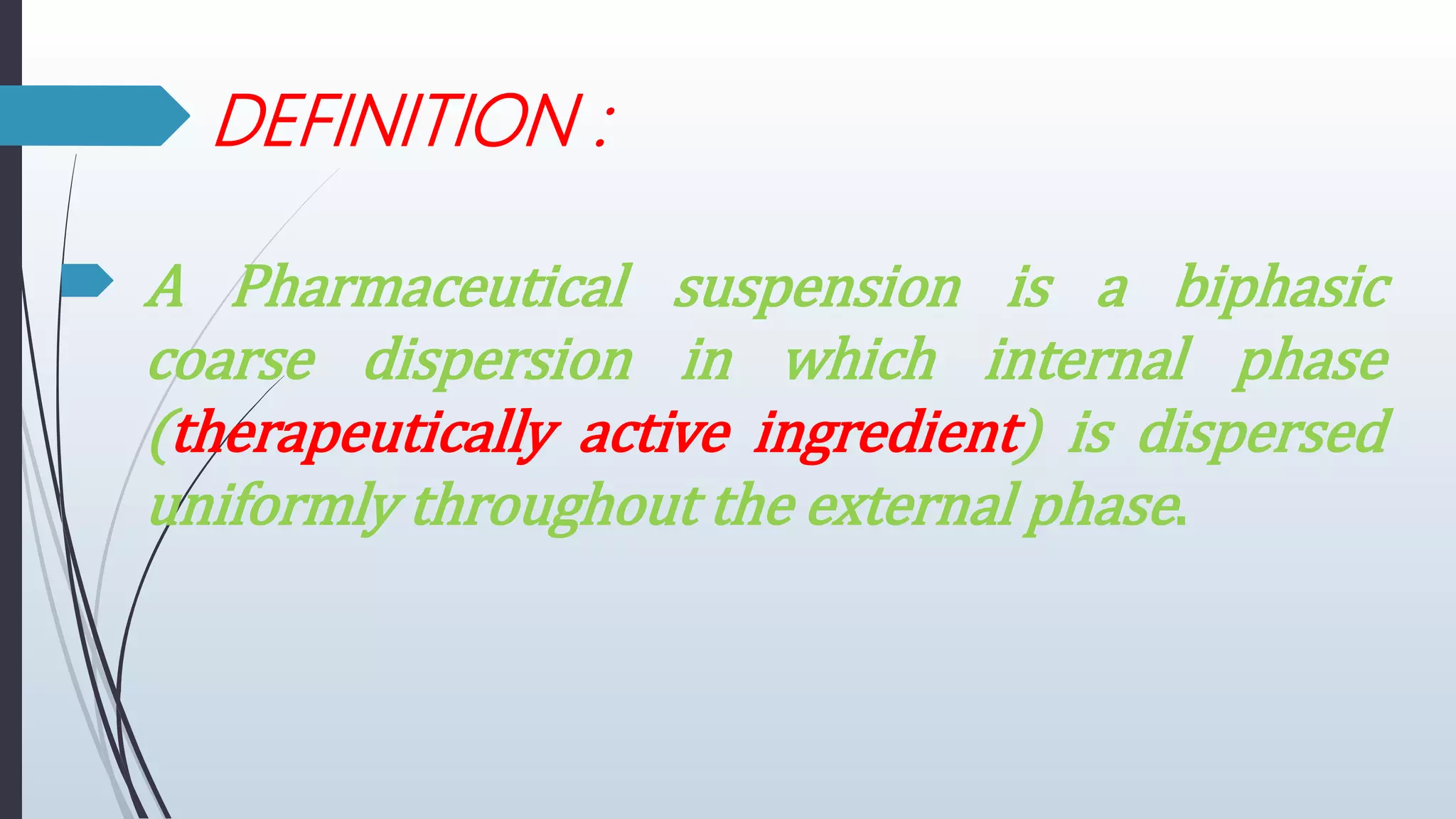
– Externally applied suspension
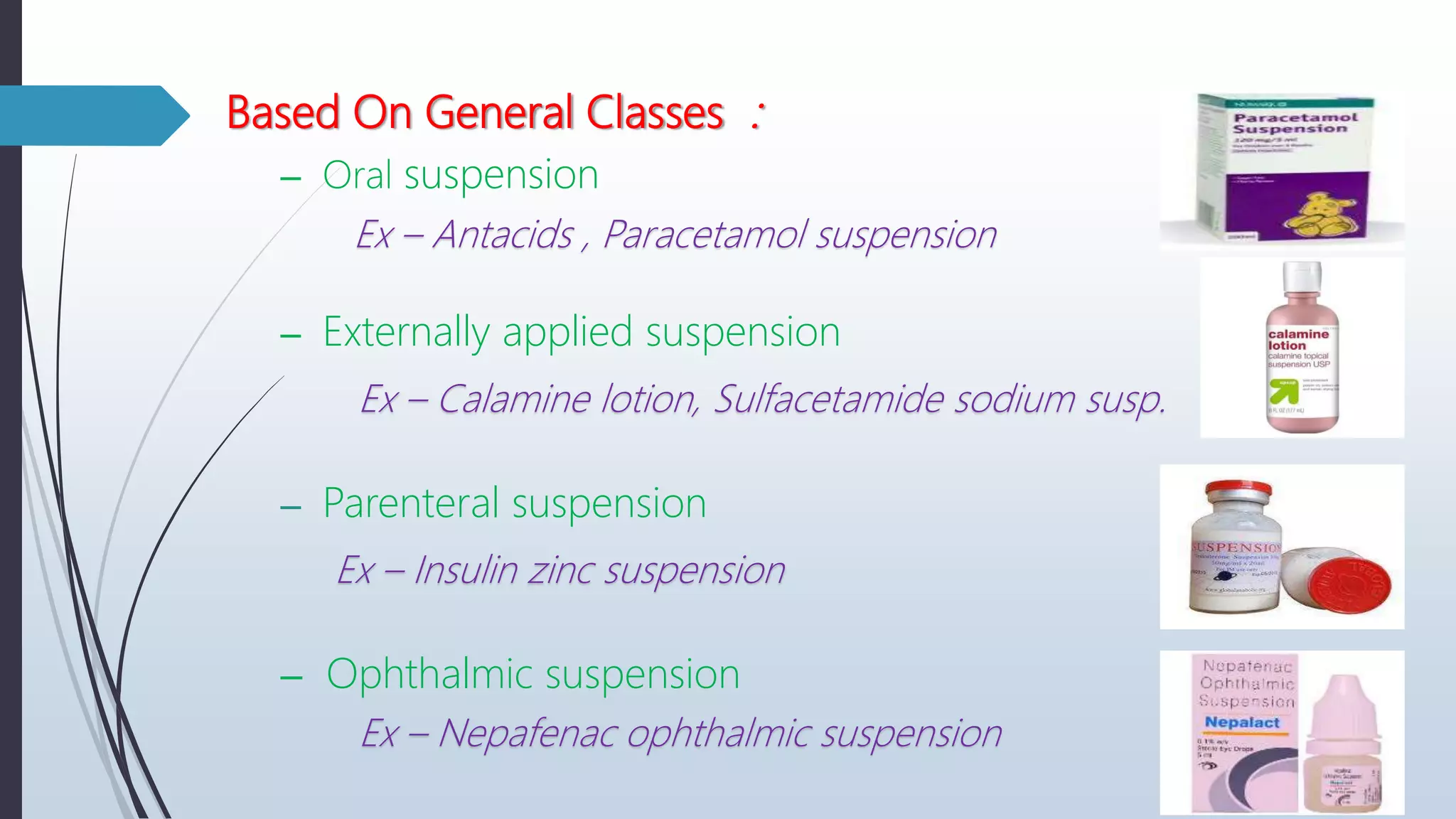
– Parenteral suspension
– Ophthalmic suspension
• Based On Proportion Of Solid Particles
– Dilute suspension (2 to10 % w/v solid)
– Concentrated suspension (50 % w/v solid)
• Based On Size Of Solid Particles
– Colloidal suspension (< 1 micron)
– Coarse suspension (>1 micron)
– Nano suspension
• Based On Electrokinetic Nature Of Solid Particles
– Flocculated suspension
– Deflocculated suspension
Based On General Classes :
– Oral suspension
Ex – Antacids , Paracetamol suspension
– Externally applied suspension
Ex – Calamine lotion, Sulfacetamide sodium susp.
– Parenteral suspension
Ex – Insulin zinc suspension
– Ophthalmic suspension
Ex – Nepafenac ophthalmic suspension
Based On Proportion Of Solid Particles :
– Dilute suspension (2 to10 % w/v solid)
Ex – Cortisone acetate
– Concentrated suspension (50 % w/v solid)
Ex – Zinc oxide suspension
Based On Size Of Solid Particles :
– Colloidal suspension (< 1 micron)
Suspensions having particle sizes of suspended solid less than about 1
micron in size are called as colloidal suspensions.
– Coarse suspension (>1 micron)
Suspensions having particle sizes of greater
than about 1 micron in diameter are called as
coarse suspensions.
– Nano suspensions
colloidal dispersions of nanosized drug
particles stabilized by surfactants. Size less
than 1 mm. Image at 500 nm zoom.
Based On Electrokinetic Nature Of Solid Particles :
– Flocculated suspension
– Deflocculated suspension
In flocculated system the individual particle are contact with
each other to form loose aggregate & create network like
structure.
In deflocculated system the individual particle are exist as
separate entities.
Difference b/w flocculated & non flocculated
THEORETIC CONSIDERATIONS :
Theory of sedimentation -
Sedimentation means settling of particle (or) floccules
occur under gravitational force in liquid dosage form.
Velocity of sedimentation expressed by Stoke’s equation
Where,
d = Diameter of particle
r = radius of particle
vsed.= sedimentation velocity in cm / sec
ρ s= density of disperse phase
ρ o= density of disperse media
g = acceleration due to gravity
η o = viscosity of disperse medium in poise
Stoke's equation applies only to:
Spherical particles in a very dilute suspension (0.5 to 2 gm per 100
Particles which freely settle without collision .
Particles with no physical or chemical attraction.
Limitation Of Stoke’s Equation
Brownian Movement -
Brownian movement of particle prevents sedimentation by keeping
the dispersed material in random motion.
Brownian movement depends on the density of dispersed
phase and the density and viscosity of the disperse medium
Brownian movement can be
observed,
If particle size is about 2 to 5 mm,
When the density of particle &
viscosity of medium are favorable
Electrokinetic Properties -
• Zeta Potential
The zeta potential defined as the difference between the surface of the
tightly bound layer (shear plane) & the electroneutral region of the solution.
Zeta potential has practical application in stability of systems containing
dispersed particles .
STABILITY OF SUSPENSIONS :
• Methods for stabilizing suspension
-
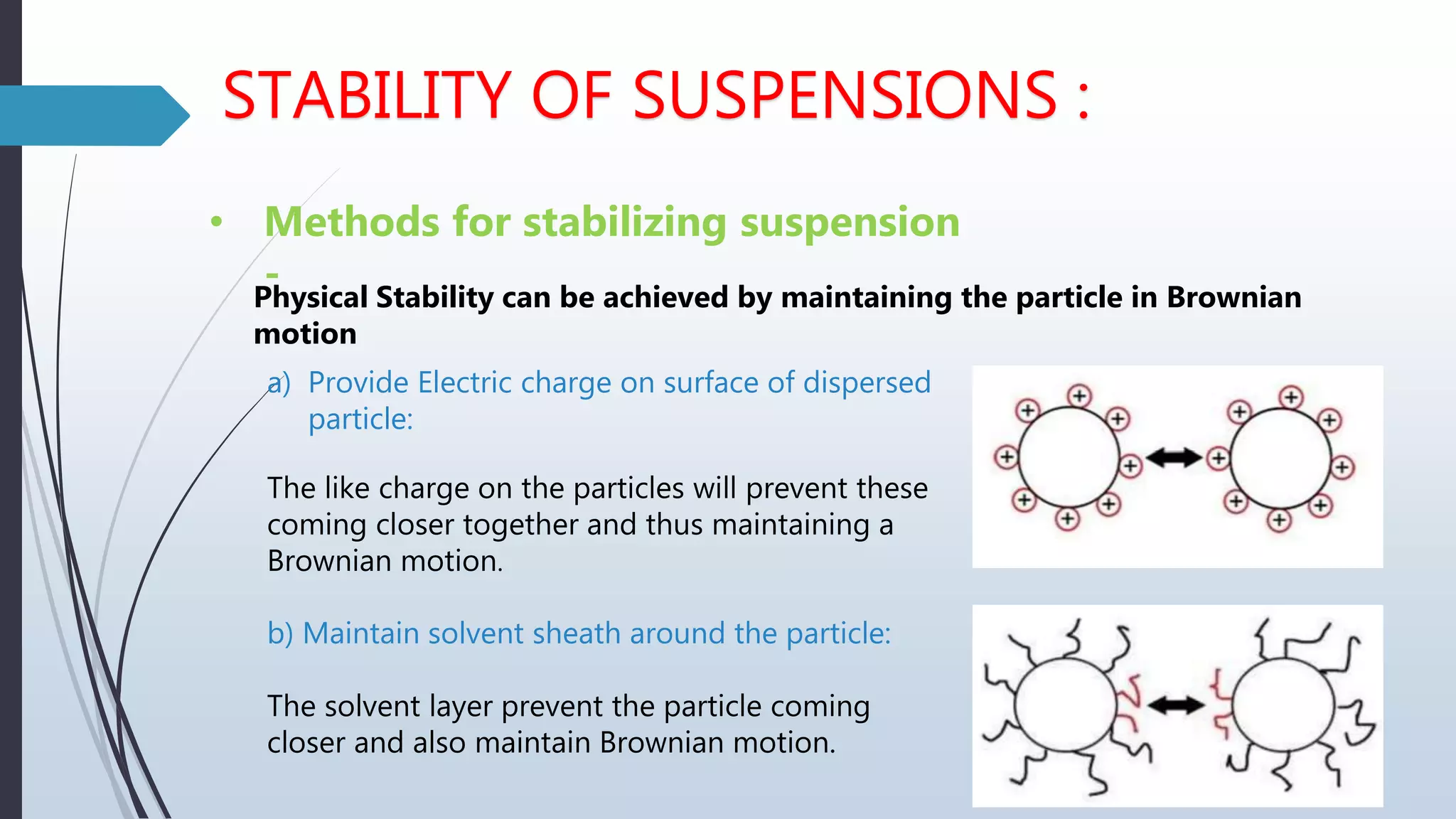
Physical Stability can be achieved by maintaining the particle in Brownian
motion
a) Provide Electric charge on surface of dispersed
particle:
The like charge on the particles will prevent these
coming closer together and thus maintaining a
Brownian motion.
b) Maintain solvent sheath around the particle:
The solvent layer prevent the particle coming
closer and also maintain Brownian motion.
• Factors that contribute to stability of a suspension -
Small particle size - reduce the size of the dispersed particle increases
the total surface area of the solid.
The greater the degree of subdivision of a given solid the larger the
surface area.
The increase in surface area means also an increase in interface
between the solids and liquids leading to an increase in viscosity of a
system
Increasing the viscosity – increasing the viscosity of the continuous
phase can lead to the stability of suspensions.
This is so because the rate of sedimentation can be reduced by
increase in viscosity.
Viscosity increase is brought about by addition of thickening
agents to the external phase.
It is important to note that the rate of release of a drug from a
suspension is also dependent on viscosity
Temperature –
Another factor which negatively affects the stability and usefulness
of pharmaceutical suspensions is fluctuation of temperature.
Temperature fluctuations can lead to caking and claying
FORMULATION OF SUSPENSIONS:
Wetting agents: They are added to disperse solids in continuous
liquid phase . ex: polysorbate 80,20, span etc.
Suspending agents: They are added to flocs the drug particles.
Ex- Xanthan gum, Carrageenan, Avicel RC 591, 581
Thickeners: They are added to increase the viscosity of
suspension. ex: gaur gum , xanthan gum,
Buffers and pH adjusting agents: They are added to stabilize the
suspension to a desired pH range. Ex – Phosphates, citrates
Flavoring & Coloring agents: They are added to impart desired
color to suspension and improve elegance. Ex- Ginger, spearmint
oil
Preservatives: They are added to prevent microbial growth . Ex-
Benzoic acid, Propylene glycol, butyl paraben
PREPARATION OF SUSPENSIONS :
Step 1: Suspensions are prepared by grinding (or) levigating the insoluble materials in
the mortar to a smooth paste with a vehicle containing the wetting agent.
Step 2: ƒ
All soluble ingredients are dissolved in same portion of the vehicle and
added to the smooth paste to step1 to get slurry.
Step 3: The slurry is transformed to a graduated cylinder, the mortar is rinsed with
successive portion of the vehicle.
Step 4: Decide whether the solids are Suspended in a structured vehicle or
Flocculated or Flocculated and then suspended
Step 5: Make up the dispersion to the final volume . Thus suspension is prepared.
QUALITY CONTROL OF SUSPENSIONS
:
• Appearance Colour, odour and taste
• Sedimentation rate and Zeta Potential measurement
• Sedimentation volume
• pH value
• Re-dispersibility
• Rheological measurement
• Stress test
• Density
• Clarity testing, Pourability, Viscosity, Syringe ability
• Dissolution studies, Drug Content Uniformity
RECENT ADVANCEMENTS IN
SUSPENSIONS :
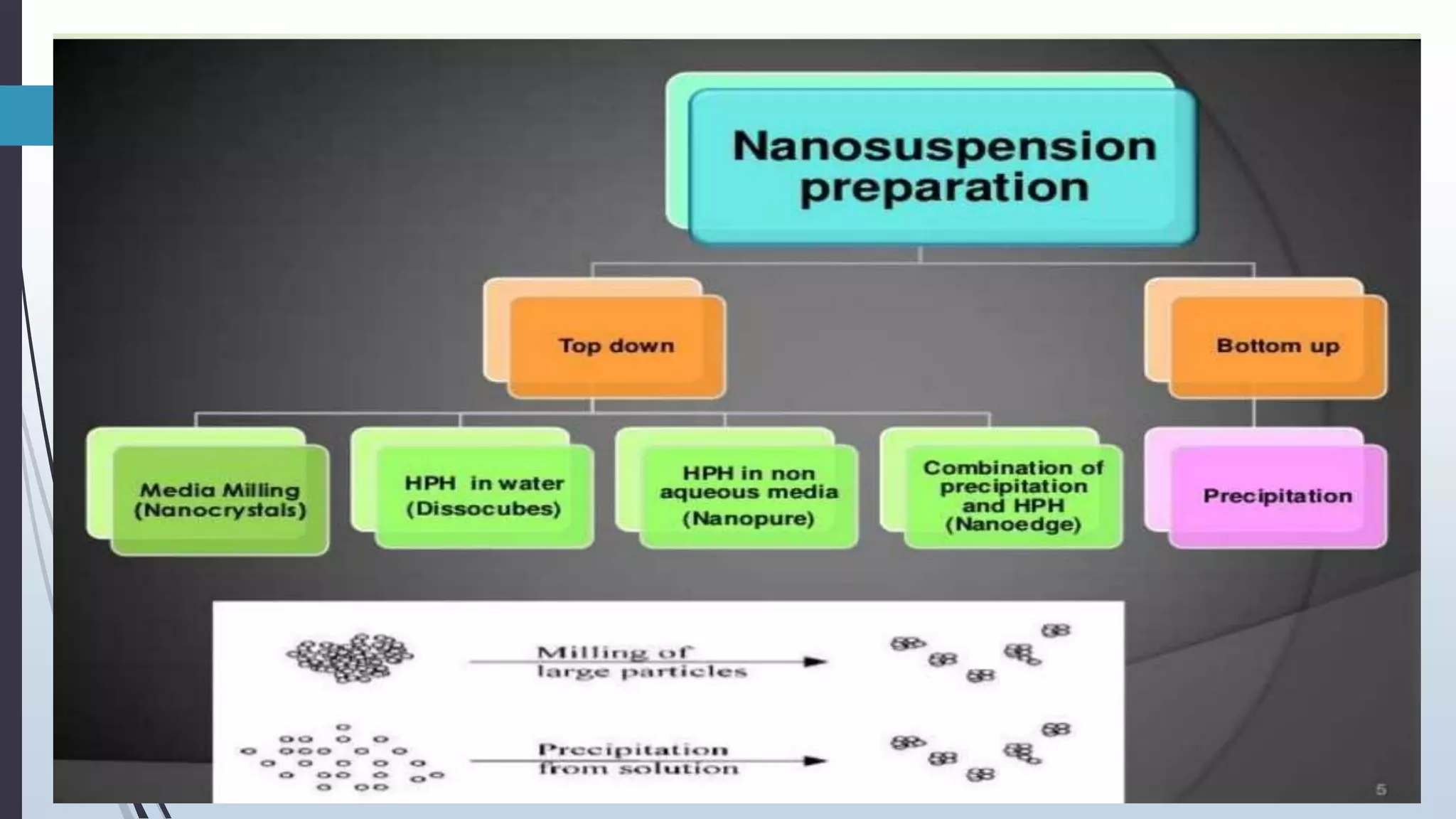
• Nano suspensions.
• Taste masked pharmaceutical suspensions.
• Sustained release suspensions.
Nano suspension -
• Nano suspensions are the biphasic colloidal
dispersions of nanosized drug particles stabilized by
surfactants without the matrix materials.
• They can also be defined as a biphasic system
consisting of pure drug particles dispersed in an
aqueous vehicle in which the diameter of the
suspended particle is less than 1 μm in size.
• They have average diameter of particle 200-600 nm
Taste masked suspension -
• Un-palatability due to bad taste is a major concern in most
of the dosage forms containing bitter drugs.
• In case of suspensions also taste masking is being applied
to mask bitterness of drugs formulated. It is done by using
polymers such as Eudragit RL 100, Eudragit RS 100
Sustained release suspension -
• Sustained release is a method to increase only the duration of action
of drug being formulated without affecting onset of action.
• In suspension sustained release affected by coating the drug to be
formulated as suspension by insoluble polymer coating.
• The polymer coating provides sustained release and also masks the
taste of the bitter drug.
• They decrease dosage frequency
• Ethyl cellulose, Eudragit, Cellulose acetate are used for making
sustained release formulation
Thank You!

Pharmaceutical suspensions

  • 1.
  • 2.
    Contents Definition Classification Stability of suspensions TheoreticConsiderations Sedimentation Brownian Movement Electrokinetic Properties
  • 3.
    Formulation of suspensions Preparationof suspensions Quality control of suspensions Recent advancements in suspensions
  • 4.
    DEFINITION : A Pharmaceuticalsuspension is a biphasic coarse dispersion in which internal phase (therapeutically active ingredient) is dispersed uniformly throughout the external phase.
  • 5.
    The internal phaseconsisting of insoluble solid particles having a range of size(0.5 to 5 microns) which is maintained uniformly through out the suspending vehicle with aid of single or combination of suspending agent.
  • 6.
    The external phase(suspending medium) is generally aqueous in some instance, may be an organic or oily liquid for non oral use.
  • 7.
    CLASSIFICATION : • BasedOn General Classes – Oral suspension – Externally applied suspension – Parenteral suspension – Ophthalmic suspension • Based On Proportion Of Solid Particles – Dilute suspension (2 to10 % w/v solid) – Concentrated suspension (50 % w/v solid) • Based On Size Of Solid Particles – Colloidal suspension (< 1 micron) – Coarse suspension (>1 micron) – Nano suspension • Based On Electrokinetic Nature Of Solid Particles – Flocculated suspension – Deflocculated suspension
  • 8.
    Based On GeneralClasses : – Oral suspension Ex – Antacids , Paracetamol suspension – Externally applied suspension Ex – Calamine lotion, Sulfacetamide sodium susp. – Parenteral suspension Ex – Insulin zinc suspension – Ophthalmic suspension Ex – Nepafenac ophthalmic suspension
  • 9.
    Based On ProportionOf Solid Particles : – Dilute suspension (2 to10 % w/v solid) Ex – Cortisone acetate – Concentrated suspension (50 % w/v solid) Ex – Zinc oxide suspension
  • 10.
    Based On SizeOf Solid Particles : – Colloidal suspension (< 1 micron) Suspensions having particle sizes of suspended solid less than about 1 micron in size are called as colloidal suspensions. – Coarse suspension (>1 micron) Suspensions having particle sizes of greater than about 1 micron in diameter are called as coarse suspensions. – Nano suspensions colloidal dispersions of nanosized drug particles stabilized by surfactants. Size less than 1 mm. Image at 500 nm zoom.
  • 11.
    Based On ElectrokineticNature Of Solid Particles : – Flocculated suspension – Deflocculated suspension In flocculated system the individual particle are contact with each other to form loose aggregate & create network like structure. In deflocculated system the individual particle are exist as separate entities.
  • 12.
    Difference b/w flocculated& non flocculated
  • 13.
    THEORETIC CONSIDERATIONS : Theoryof sedimentation - Sedimentation means settling of particle (or) floccules occur under gravitational force in liquid dosage form. Velocity of sedimentation expressed by Stoke’s equation
  • 14.
    Where, d = Diameterof particle r = radius of particle vsed.= sedimentation velocity in cm / sec ρ s= density of disperse phase ρ o= density of disperse media g = acceleration due to gravity η o = viscosity of disperse medium in poise
  • 15.
    Stoke's equation appliesonly to: Spherical particles in a very dilute suspension (0.5 to 2 gm per 100 Particles which freely settle without collision . Particles with no physical or chemical attraction. Limitation Of Stoke’s Equation
  • 16.
    Brownian Movement - Brownianmovement of particle prevents sedimentation by keeping the dispersed material in random motion. Brownian movement depends on the density of dispersed phase and the density and viscosity of the disperse medium Brownian movement can be observed, If particle size is about 2 to 5 mm, When the density of particle & viscosity of medium are favorable
  • 17.
    Electrokinetic Properties - •Zeta Potential The zeta potential defined as the difference between the surface of the tightly bound layer (shear plane) & the electroneutral region of the solution. Zeta potential has practical application in stability of systems containing dispersed particles .
  • 19.
    STABILITY OF SUSPENSIONS: • Methods for stabilizing suspension - Physical Stability can be achieved by maintaining the particle in Brownian motion a) Provide Electric charge on surface of dispersed particle: The like charge on the particles will prevent these coming closer together and thus maintaining a Brownian motion. b) Maintain solvent sheath around the particle: The solvent layer prevent the particle coming closer and also maintain Brownian motion.
  • 20.
    • Factors thatcontribute to stability of a suspension - Small particle size - reduce the size of the dispersed particle increases the total surface area of the solid. The greater the degree of subdivision of a given solid the larger the surface area. The increase in surface area means also an increase in interface between the solids and liquids leading to an increase in viscosity of a system
  • 21.
    Increasing the viscosity– increasing the viscosity of the continuous phase can lead to the stability of suspensions. This is so because the rate of sedimentation can be reduced by increase in viscosity. Viscosity increase is brought about by addition of thickening agents to the external phase. It is important to note that the rate of release of a drug from a suspension is also dependent on viscosity Temperature – Another factor which negatively affects the stability and usefulness of pharmaceutical suspensions is fluctuation of temperature. Temperature fluctuations can lead to caking and claying
  • 22.
    FORMULATION OF SUSPENSIONS: Wettingagents: They are added to disperse solids in continuous liquid phase . ex: polysorbate 80,20, span etc. Suspending agents: They are added to flocs the drug particles. Ex- Xanthan gum, Carrageenan, Avicel RC 591, 581 Thickeners: They are added to increase the viscosity of suspension. ex: gaur gum , xanthan gum, Buffers and pH adjusting agents: They are added to stabilize the suspension to a desired pH range. Ex – Phosphates, citrates Flavoring & Coloring agents: They are added to impart desired color to suspension and improve elegance. Ex- Ginger, spearmint oil Preservatives: They are added to prevent microbial growth . Ex- Benzoic acid, Propylene glycol, butyl paraben
  • 25.
    PREPARATION OF SUSPENSIONS: Step 1: Suspensions are prepared by grinding (or) levigating the insoluble materials in the mortar to a smooth paste with a vehicle containing the wetting agent. Step 2: ƒ All soluble ingredients are dissolved in same portion of the vehicle and added to the smooth paste to step1 to get slurry. Step 3: The slurry is transformed to a graduated cylinder, the mortar is rinsed with successive portion of the vehicle. Step 4: Decide whether the solids are Suspended in a structured vehicle or Flocculated or Flocculated and then suspended Step 5: Make up the dispersion to the final volume . Thus suspension is prepared.
  • 26.
    QUALITY CONTROL OFSUSPENSIONS : • Appearance Colour, odour and taste • Sedimentation rate and Zeta Potential measurement • Sedimentation volume • pH value • Re-dispersibility • Rheological measurement • Stress test • Density • Clarity testing, Pourability, Viscosity, Syringe ability • Dissolution studies, Drug Content Uniformity
  • 27.
    RECENT ADVANCEMENTS IN SUSPENSIONS: • Nano suspensions. • Taste masked pharmaceutical suspensions. • Sustained release suspensions.
  • 28.
    Nano suspension - •Nano suspensions are the biphasic colloidal dispersions of nanosized drug particles stabilized by surfactants without the matrix materials. • They can also be defined as a biphasic system consisting of pure drug particles dispersed in an aqueous vehicle in which the diameter of the suspended particle is less than 1 μm in size. • They have average diameter of particle 200-600 nm
  • 30.
    Taste masked suspension- • Un-palatability due to bad taste is a major concern in most of the dosage forms containing bitter drugs. • In case of suspensions also taste masking is being applied to mask bitterness of drugs formulated. It is done by using polymers such as Eudragit RL 100, Eudragit RS 100
  • 31.
    Sustained release suspension- • Sustained release is a method to increase only the duration of action of drug being formulated without affecting onset of action. • In suspension sustained release affected by coating the drug to be formulated as suspension by insoluble polymer coating. • The polymer coating provides sustained release and also masks the taste of the bitter drug. • They decrease dosage frequency • Ethyl cellulose, Eudragit, Cellulose acetate are used for making sustained release formulation
  • 32.