PRESENTED BY: STEFFI
THOMAS
M.PHARM,2ND SEM
DEPARTMENT OF PHARMACY
B.U. ,BHOPAL
The suitability of either a drug substance
or a drug product for its intended use. This
term includes such attributes as the
identity, strength and purity.
A systematic approach to development
that begins with pre-defined objectives and
emphasizes product and process
understanding and process control, based
on sound science and quality risk
management.
QUALITY BY DESIGN MEANS- designing
and developing formulations and
manufacturing processes to ensure a
predefined quality.
QUALITY BY DESIGN REQUIRES-
understanding how formulation and
manufacturing process variables influence
product quality.
QUALITY BY DESIGN ENSURES-
Product quality with effective control
The QbD frame contains concepts and
tools-e.g. design space-to practice QbD in
a submission file (design space approval).
The selection of QbD implies the use of
Quality Risk Management (ICH 9,Quality
Risk Management).
The connection to a suitable
(bio)pharmaceutical quality system offers
oppurtunities to enhance science ad risk
based submissions approaches.
Active pharmaceutical ingredients
Materials including excipients
Analytics
Simple dosage forms
Advanced drug delivery systems
Devices
Combination products
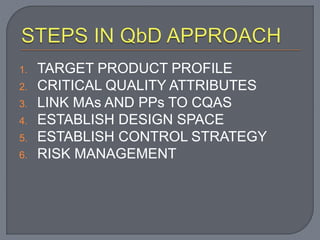
1. TARGET PRODUCT PROFILE
2. CRITICAL QUALITY ATTRIBUTES
3. LINK MAs AND PPs TO CQAS
4. ESTABLISH DESIGN SPACE
5. ESTABLISH CONTROL STRATEGY
6. RISK MANAGEMENT
The target product profile (TPP) has been
defined as a “prospective and dynamic
summary of the quality characteristics of a
drug product that ideally will be achieved
to ensure that the desired quality, and thus
the safety and efficacy, of a drug product is
realized”.
A CQA is a physical, chemical, biological,
or microbiological property or characteristic
that should be within an appropriate limit,
range, or distribution to ensure the desired
product quality.
CQAs are generally associated with the-
• Drug substance
• Excipients
• intermediates (in-process materials)
• Drug product
MATERIAL: Raw materials, starting
materials, reagents, solvents, process
aids, intermediates, APIs, packaging and
labelling materials, ICH Q7A
ATTRIBUTE: A physical, chemical,
biological or microbiological property or
characteristic
MATERIAL ATTRIBUTE:
• Can be an excipient CQA, raw material
CQA, starting material CQA, drug
substance CQA etc
• A material attribute can be quantified
• Typically fixed
• Can sometimes be changed during further
processing (e.g.PSD-milling)
• Example of material attributes:PSD,
impurity profile,porosity, specific volume,
moisture level, sterility.
A process parameter whose variability has
an impact on a critical quality attribute and
therefore should be monitored or
controlled to ensure the process produces
the desired quality (Q8R2).
CPPs have a direct impact on the CQAs.
A process parameter (PP) can be
measured and controlled (adjusted)
• Examples of CPPs for small molecule:
temperature, addition rate, cooling rate,
rotation speed
• Examples of CPPs for large molecule:
temperature, pH, agitation, dissolved
oxygen, medium constituents , feed type
and rate
The multidimensional combination and
interaction of input variables (e.g., material
attributes) and process parameters that
have been demonstrated to provide
assurance of quality.
Regulatory flexibility- working within the
design space is not considered a change
Design space is proposed by the applicant
and is subject to regulatory assessment
and approval.
FIRST-PRINCIPLES APPROACH
Combination of experimental data and
mechanistic knowledge of chemistry,
physics and engineering to model and
predict performance
NON-MECHANISTIC/EMPIRICAL
APPROACH
Statistically designed experiments (does)
linear and multiple-linear regression
SCALE-UP CORRELATIONS
Translate operating conditions between
different scales or pieces of equipment
RISK ANALYSIS
Determine significance of effects
ANY COMBINATION OF THE ABOVE
A PLANNED SET OF CONTROLS
• Derived from current product and process
understanding.
• That assures process performance and
product quality.
THE CONTROLS CAN INCLUDE
Parameters and attributes related to
• Drug substance
• Drug product materials
• Components, facility
• Equipment operating conditions
• In-process controls
• Finished product specifications
• The associated methods and frequency of
monitoring and control (ICH 10)
RISK : Risk is defined as the combination
of the probability of occurrence of harm
and the severity of that harm.
RISK ASSESSMENT: A systematic
process of organizing information to
support a risk decision to be made within a
risk management process. It consists of
the identification of hazards and the
analysis and evaluation of risks associated
with exposure to those hazards.
ICH Guideline Q8-Pharmaceutical
Development, http://www.ich.org (10 NOV
2005)
U.S. Food and Drug Administration
Guidance for Industry. PAT- A Framework
for Innovative.
THANKS

Quality-by-design(QbD) in pharmaceutical development

  • 1.
    PRESENTED BY: STEFFI THOMAS M.PHARM,2NDSEM DEPARTMENT OF PHARMACY B.U. ,BHOPAL
  • 2.
    The suitability ofeither a drug substance or a drug product for its intended use. This term includes such attributes as the identity, strength and purity.
  • 3.
    A systematic approachto development that begins with pre-defined objectives and emphasizes product and process understanding and process control, based on sound science and quality risk management.
  • 4.
    QUALITY BY DESIGNMEANS- designing and developing formulations and manufacturing processes to ensure a predefined quality. QUALITY BY DESIGN REQUIRES- understanding how formulation and manufacturing process variables influence product quality. QUALITY BY DESIGN ENSURES- Product quality with effective control
  • 5.
    The QbD framecontains concepts and tools-e.g. design space-to practice QbD in a submission file (design space approval). The selection of QbD implies the use of Quality Risk Management (ICH 9,Quality Risk Management). The connection to a suitable (bio)pharmaceutical quality system offers oppurtunities to enhance science ad risk based submissions approaches.
  • 6.
    Active pharmaceutical ingredients Materialsincluding excipients Analytics Simple dosage forms Advanced drug delivery systems Devices Combination products
  • 7.
    1. TARGET PRODUCTPROFILE 2. CRITICAL QUALITY ATTRIBUTES 3. LINK MAs AND PPs TO CQAS 4. ESTABLISH DESIGN SPACE 5. ESTABLISH CONTROL STRATEGY 6. RISK MANAGEMENT
  • 8.
    The target productprofile (TPP) has been defined as a “prospective and dynamic summary of the quality characteristics of a drug product that ideally will be achieved to ensure that the desired quality, and thus the safety and efficacy, of a drug product is realized”.
  • 9.
    A CQA isa physical, chemical, biological, or microbiological property or characteristic that should be within an appropriate limit, range, or distribution to ensure the desired product quality. CQAs are generally associated with the- • Drug substance • Excipients • intermediates (in-process materials) • Drug product
  • 10.
    MATERIAL: Raw materials,starting materials, reagents, solvents, process aids, intermediates, APIs, packaging and labelling materials, ICH Q7A ATTRIBUTE: A physical, chemical, biological or microbiological property or characteristic
  • 11.
    MATERIAL ATTRIBUTE: • Canbe an excipient CQA, raw material CQA, starting material CQA, drug substance CQA etc • A material attribute can be quantified • Typically fixed • Can sometimes be changed during further processing (e.g.PSD-milling) • Example of material attributes:PSD, impurity profile,porosity, specific volume, moisture level, sterility.
  • 12.
    A process parameterwhose variability has an impact on a critical quality attribute and therefore should be monitored or controlled to ensure the process produces the desired quality (Q8R2). CPPs have a direct impact on the CQAs.
  • 13.
    A process parameter(PP) can be measured and controlled (adjusted) • Examples of CPPs for small molecule: temperature, addition rate, cooling rate, rotation speed • Examples of CPPs for large molecule: temperature, pH, agitation, dissolved oxygen, medium constituents , feed type and rate
  • 14.
    The multidimensional combinationand interaction of input variables (e.g., material attributes) and process parameters that have been demonstrated to provide assurance of quality. Regulatory flexibility- working within the design space is not considered a change Design space is proposed by the applicant and is subject to regulatory assessment and approval.
  • 15.
    FIRST-PRINCIPLES APPROACH Combination ofexperimental data and mechanistic knowledge of chemistry, physics and engineering to model and predict performance NON-MECHANISTIC/EMPIRICAL APPROACH Statistically designed experiments (does) linear and multiple-linear regression
  • 16.
    SCALE-UP CORRELATIONS Translate operatingconditions between different scales or pieces of equipment RISK ANALYSIS Determine significance of effects ANY COMBINATION OF THE ABOVE
  • 17.
    A PLANNED SETOF CONTROLS • Derived from current product and process understanding. • That assures process performance and product quality. THE CONTROLS CAN INCLUDE Parameters and attributes related to • Drug substance • Drug product materials • Components, facility
  • 18.
    • Equipment operatingconditions • In-process controls • Finished product specifications • The associated methods and frequency of monitoring and control (ICH 10)
  • 19.
    RISK : Riskis defined as the combination of the probability of occurrence of harm and the severity of that harm. RISK ASSESSMENT: A systematic process of organizing information to support a risk decision to be made within a risk management process. It consists of the identification of hazards and the analysis and evaluation of risks associated with exposure to those hazards.
  • 20.
    ICH Guideline Q8-Pharmaceutical Development,http://www.ich.org (10 NOV 2005) U.S. Food and Drug Administration Guidance for Industry. PAT- A Framework for Innovative.
  • 21.