Pharmaceutical
preformulation and
formulation
SUCHANDRA BAGCHI
M.S.(PHARMACEUTICS)
NIPERA1517PE10
Flow of seminar
 Introduction
 Candidate drug selection
 Pharmacological characterization
 Early of candidate drug selection
 Biopharmaceutical consideration
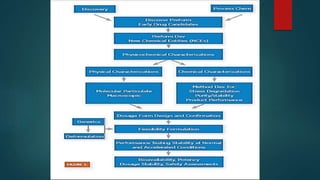
 Early drug development and product design
 Product optimization
 Post product optimization
 conclusion
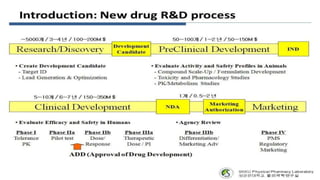
Introduction
 To be successful and competitive, research based pharmaceutical companies
must ensure that new discoveries are frequently brought to the market to
generate cash flow. This is required to find the next generation compounds, to
meet the therapeutic needs of patients and of course, to benefit the
shareholders. This cycle of events is sometimes referred to as Product Life
Cycle.
 Unsuccessful compounds should be removed at R&D level only to minimise
expenses of clinical research.
 In spite of high risk and high cost involved, there is still a huge incentive for
pharmaceutical companies to seek financial rewards such as “blockbuster”(I
billion US$ per year).
 Hence the importance of accelerating and optimizing drug discovery and
development, and getting to the market first with a new therapeutic class
medicinal product, cannot be underestimated.
To avoid backtracking along the way with long life years
investments a forward planning should provide opportunity for a
well throughout and efficient approach to product development
• Product design
• Process design
• Product optimization
• Process optimization
• Scale up
• Clinical trials
• Scale up for commercial production
• Process validation
The development
process can be
broken down into
several key
defined stages
such as
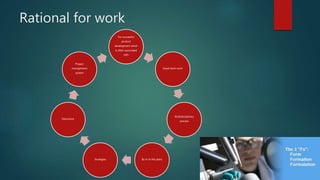
Rational for work
For successful
product
development which
is often associated
with
Good team work
Multidisciplinary
process
By in to the plansStrategies
Descisions
Project
management
system
Candidate drug selection
Depending on potency, specificity, duration, safety and pharmaceutical aspects candidate drugs are nominated
for development after being passed through “combinatorial chemistry” and automated “high throughput
screenings”. To ease this burden some rational drug design and quantitative structure activity relationships
(QSAR) are often introduced. Representative libraries of compounds are also present along with genomics.
During CD selection molecular lead is optimized by testing in vitro and in vivo studies with range of
compounds.
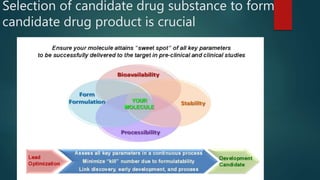
Selection of candidate drug substance to form
candidate drug product is crucial
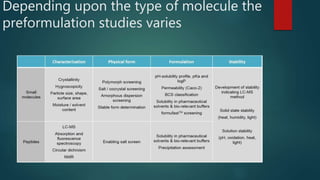
Depending upon the type of molecule the
preformulation studies varies
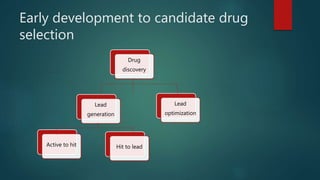
Early development to candidate drug
selection
Drug
discovery
Lead
generation
Lead
optimization
Hit to leadActive to hit
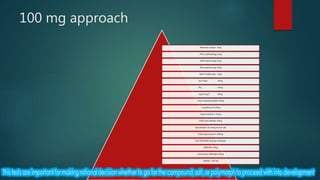
100 mg approach
Elemental analysis -4mg
HPLC methodology-2mg
NMR spectroscopy-5mg
Mass spectroscopy-5mg
IR/UV-Visible spec -5mg
Karl Fisher -20mg
Pka -10mg
Log P/Log D -10mg
Initial solubility/stability-10mg
Crystallinity-20-30mg
Hygroscopicity-5-10mg
Initial solid stability-10mg
Salt selection-10-50mg of each salt
Initial polymorphism-100mg
DSC/TGA/HSM-2mg per technique
XRPD/RH-10mg
microscopy-/SEM/light-10mg
Stability -100 mg
To check the solid state characteristics
of the drug
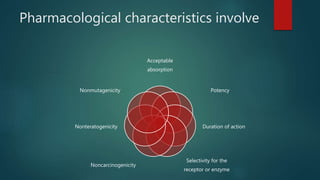
Pharmacological characteristics involve
Acceptable
absorption
Potency
Duration of action
Selectivity for the
receptor or enzyme
Noncarcinogenicity
Nonteratogenicity
Nonmutagenicity
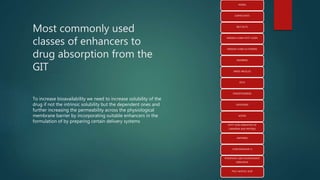
Most commonly used
classes of enhancers to
drug absorption from the
GIT
NSAIDs
SURFECTANTS
BILE SALTS
MEDIUM CHAIN FATTY ACIDS
MEDIUM CHAIN GLYCERIDES
ENAMINES
MIXED MICELLES
EDTA
PHENOTHIAZINES
LIPOSOMES
AZONE
FATTY ACID DERIVATIVE OF
CARNITINE AND PEPTIDES
SAPONINS
CONCANAVALIN A
PHOSPHATE AND PHOSPHONATE
DERIVATIVE
POLY ACRYLIC ACID
To increase bioavailability we need to increase solubility of the
drug if not the intrinsic solubility but the dependent ones and
further increasing the permeability across the physiological
membrane barrier by incorporating suitable enhancers in the
formulation of by preparing certain delivery systems
Biopharmaceutical support in
candidate drug selection
Dissolution,
solubility
affects
absorption
of the drug
Distribution
Degradation
and
metabolism
Models for
study
Computational
method
Partitioning
between oil
and water
Cell
cultures
Membrane
vesicles
Intestinal
rings or
sacs
Excised
segments
from
animals
using
suitable
chamber
In vitro and
in situ
intestinal
perfusions
In vivo
cannulated
or
fistulated
animals
and
In vivo
gavaged
animals
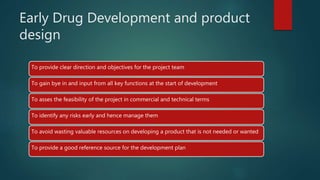
Early Drug Development and product
design
To provide clear direction and objectives for the project team
To gain bye in and input from all key functions at the start of development
To asses the feasibility of the project in commercial and technical terms
To identify any risks early and hence manage them
To avoid wasting valuable resources on developing a product that is not needed or wanted
To provide a good reference source for the development plan
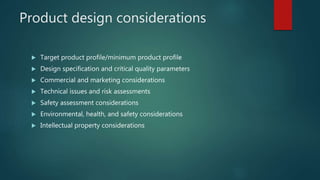
Product design considerations
 Target product profile/minimum product profile
 Design specification and critical quality parameters
 Commercial and marketing considerations
 Technical issues and risk assessments
 Safety assessment considerations
 Environmental, health, and safety considerations
 Intellectual property considerations
Product optimization
Formulate
•Get specifications
•Propose tablet properties
•Choose fillers
•Choose disintegrants
•Choose binders
•Choose surfectants
•Choose glidants
•Choose lubricants
•Recommend formulation
•Evaluate formulation
•Compare against specifications
•Change excipients
•Optimize formulation
Post optimization
Scale up
Technology
transfer
Validation
and launch
Clinical trial
process
validation
Validation of
commercial
process
Preapproval
inspection
Postapproval
changes
Conclusion
These product optimization is done for solid
state only. For parenteral, ophthalmic,
inhalational and oral different formulation
excipients are taken into account.
Thank you

Pharmaceutical preformulation and formulation

  • 1.
  • 2.
    Flow of seminar Introduction  Candidate drug selection  Pharmacological characterization  Early of candidate drug selection  Biopharmaceutical consideration  Early drug development and product design  Product optimization  Post product optimization  conclusion
  • 3.
    Introduction  To besuccessful and competitive, research based pharmaceutical companies must ensure that new discoveries are frequently brought to the market to generate cash flow. This is required to find the next generation compounds, to meet the therapeutic needs of patients and of course, to benefit the shareholders. This cycle of events is sometimes referred to as Product Life Cycle.  Unsuccessful compounds should be removed at R&D level only to minimise expenses of clinical research.  In spite of high risk and high cost involved, there is still a huge incentive for pharmaceutical companies to seek financial rewards such as “blockbuster”(I billion US$ per year).  Hence the importance of accelerating and optimizing drug discovery and development, and getting to the market first with a new therapeutic class medicinal product, cannot be underestimated.
  • 5.
    To avoid backtrackingalong the way with long life years investments a forward planning should provide opportunity for a well throughout and efficient approach to product development • Product design • Process design • Product optimization • Process optimization • Scale up • Clinical trials • Scale up for commercial production • Process validation The development process can be broken down into several key defined stages such as
  • 6.
    Rational for work Forsuccessful product development which is often associated with Good team work Multidisciplinary process By in to the plansStrategies Descisions Project management system
  • 7.
    Candidate drug selection Dependingon potency, specificity, duration, safety and pharmaceutical aspects candidate drugs are nominated for development after being passed through “combinatorial chemistry” and automated “high throughput screenings”. To ease this burden some rational drug design and quantitative structure activity relationships (QSAR) are often introduced. Representative libraries of compounds are also present along with genomics. During CD selection molecular lead is optimized by testing in vitro and in vivo studies with range of compounds.
  • 8.
    Selection of candidatedrug substance to form candidate drug product is crucial
  • 10.
    Depending upon thetype of molecule the preformulation studies varies
  • 11.
    Early development tocandidate drug selection Drug discovery Lead generation Lead optimization Hit to leadActive to hit
  • 12.
    100 mg approach Elementalanalysis -4mg HPLC methodology-2mg NMR spectroscopy-5mg Mass spectroscopy-5mg IR/UV-Visible spec -5mg Karl Fisher -20mg Pka -10mg Log P/Log D -10mg Initial solubility/stability-10mg Crystallinity-20-30mg Hygroscopicity-5-10mg Initial solid stability-10mg Salt selection-10-50mg of each salt Initial polymorphism-100mg DSC/TGA/HSM-2mg per technique XRPD/RH-10mg microscopy-/SEM/light-10mg Stability -100 mg
  • 13.
    To check thesolid state characteristics of the drug
  • 14.
    Pharmacological characteristics involve Acceptable absorption Potency Durationof action Selectivity for the receptor or enzyme Noncarcinogenicity Nonteratogenicity Nonmutagenicity
  • 15.
    Most commonly used classesof enhancers to drug absorption from the GIT NSAIDs SURFECTANTS BILE SALTS MEDIUM CHAIN FATTY ACIDS MEDIUM CHAIN GLYCERIDES ENAMINES MIXED MICELLES EDTA PHENOTHIAZINES LIPOSOMES AZONE FATTY ACID DERIVATIVE OF CARNITINE AND PEPTIDES SAPONINS CONCANAVALIN A PHOSPHATE AND PHOSPHONATE DERIVATIVE POLY ACRYLIC ACID To increase bioavailability we need to increase solubility of the drug if not the intrinsic solubility but the dependent ones and further increasing the permeability across the physiological membrane barrier by incorporating suitable enhancers in the formulation of by preparing certain delivery systems
  • 16.
    Biopharmaceutical support in candidatedrug selection Dissolution, solubility affects absorption of the drug Distribution Degradation and metabolism Models for study Computational method Partitioning between oil and water Cell cultures Membrane vesicles Intestinal rings or sacs Excised segments from animals using suitable chamber In vitro and in situ intestinal perfusions In vivo cannulated or fistulated animals and In vivo gavaged animals
  • 17.
    Early Drug Developmentand product design To provide clear direction and objectives for the project team To gain bye in and input from all key functions at the start of development To asses the feasibility of the project in commercial and technical terms To identify any risks early and hence manage them To avoid wasting valuable resources on developing a product that is not needed or wanted To provide a good reference source for the development plan
  • 18.
    Product design considerations Target product profile/minimum product profile  Design specification and critical quality parameters  Commercial and marketing considerations  Technical issues and risk assessments  Safety assessment considerations  Environmental, health, and safety considerations  Intellectual property considerations
  • 19.
    Product optimization Formulate •Get specifications •Proposetablet properties •Choose fillers •Choose disintegrants •Choose binders •Choose surfectants •Choose glidants •Choose lubricants •Recommend formulation •Evaluate formulation •Compare against specifications •Change excipients •Optimize formulation
  • 20.
    Post optimization Scale up Technology transfer Validation andlaunch Clinical trial process validation Validation of commercial process Preapproval inspection Postapproval changes
  • 24.
    Conclusion These product optimizationis done for solid state only. For parenteral, ophthalmic, inhalational and oral different formulation excipients are taken into account.
  • 25.