Unit 1
PHRAMACEUTICAL PRODUCT
DEVELOPMENT
ELECTIVE COURSE
IV/IV B.PHARM II SEM
Dr.K.L.DEEPTHI, M.PHARM PH.D
ASSOCIATE PROFESSOR
DEPARTMENT OF PHARMACEUTICS
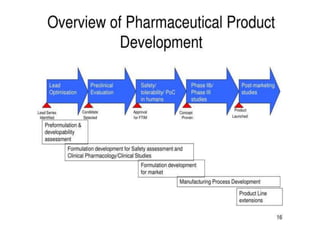
Overview of Pharmaceutical Product
Development
• Objective:
To achieve a predictable
therapeutic response to a drug
included in a formulation which is
capable of large scale
manufacture with reproducible
product quality.
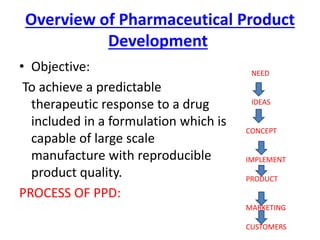
PROCESS OF PPD:
NEED
IDEAS
CONCEPT
IMPLEMENT
PRODUCT
MARKETING
CUSTOMERS
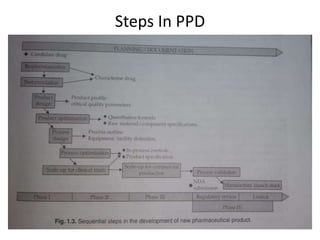
Steps In PPD
TYPES OF PRODUCTS
BREAK THROUGH PRODUCTS:
NEW TO WORLD PRODUCTS
• AIDS VACCINE
• COVID VACCINE
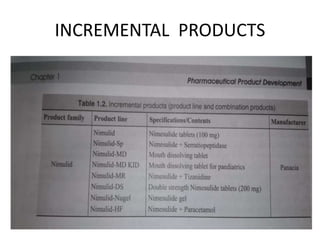
INCREMENTAL PRODUCTS
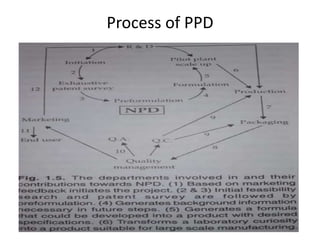
Process of PPD
REGULATORY REQUIREMENTS FOR
PREFORMULATION STUDIES
INTRODUCTION:
• Prior to nomination into full development, a candidate drug
should undergo a phase traditionally called
preformulation.Preformulation is the physiochemical
characterization of the solid and solution properties of
compounds.
• Preformulation encompasses all studies enacted on a new
drug compound in order to produce useful information for
subsequent formulation of a stable and
biopharmaceutically suitable drug dosage form.These
should focus on those physiochemical properties of new
compound that could effect drug performance and
development of an efficacious dosage form.
• DEFINITION:“
• A phase of a research and development process where the
preformulation scientist characterizes the physical , chemical
and mechanical properties of a new drug substance in order
to develop stable , safe and effective dosage forms”
• GOAL:
To establish the physico-chemical properties of a new drugTo
establish the data on drug-excipient compatibilityTo establish
API ‘s kinetic rate profile
REGULATORY REQUIREMENTS SMALL
MOLECULES/General:
1. Q1A(R2) Stability Testing of New Drug Substances and Products (Issued 11/2003,
Posted 11/20/2003);
2. Q1B Photo stability Testing of New Drug Substances and Products (Issued 11/1996,
Reposted 7/7/1998);
3. Q1C Stability Testing for New Dosage Forms (Issued 5/9/1997, Posted 3/19/1998);
4. Q1D Bracketing and Matrixing Designs for Stability Testing of New Drug Substances
and Products (Issued 1/2003, Posted 1/15/2003);
5. Q3A Impurities in New Drug Substances (Issued 2/10/2003, Posted2/10/2003
6. Q3B(R) Impurities in New Drug Products (Issued 11/2003, Posted 11/13/2003);
7. Q3C Impurities: Residual Solvents (Issued 12/24/1997, Posted 12/30/1997);
8. Q3C Tables and Lists (Posted 11/12/2003);
9. Q6A International Conference on Harmonization; Guidance on Q6A Specifications:
Test Procedures and Acceptance Criteria for New Drug Substances and New Drug
Products: Chemical Substances (12/29/2000);
10. Q7A Good Manufacturing Practice Guidance for Active Pharmaceutical Ingredients
(Issued 8/2001, Posted 9/24/2001).
The general method of preparation is
provided under Sec312
•
The general method of preparation is provided under Sec
(a)(7)(iv)(a).
• The EMEA provides the following guidelines for herbal (botanical as
listed in United States) products:
• COMMITTEE FOR PROPRIETARY MEDICINE PRODUCTS
(CPMP)/QUALITY WORKING PARTY (QWP)/2819/00 [EUROPEAN
MEDICINES EVALUATION AGENCY (EMEA)/COMMITTEE ON
VETERINARY MEDICINAL PRODUCTS (CVMP)/814/00] Note for
Guidance on Quality of Herbal Medicinal Products (CPMP/CVMP
adopted July 01).CPMP/QWP/2820/00 (EMEA/CVMP/815/00)
• Note for Guidance on Specifications: Test procedures and
Acceptance Criteria for Herbal Drugs, Herbal Drug Preparations and
Herbal Medicinal Products (CPMP/CVMP adopted July 01).
REFERENCES
N.K.JAIN PHARMACEUTICAL PRODUCT
DEVELOPMENT
PHARMACEUTICAL PRODUCT DEVELOPMENT

PHARMACEUTICAL PRODUCT DEVELOPMENT

  • 1.
    Unit 1 PHRAMACEUTICAL PRODUCT DEVELOPMENT ELECTIVECOURSE IV/IV B.PHARM II SEM Dr.K.L.DEEPTHI, M.PHARM PH.D ASSOCIATE PROFESSOR DEPARTMENT OF PHARMACEUTICS
  • 2.
    Overview of PharmaceuticalProduct Development • Objective: To achieve a predictable therapeutic response to a drug included in a formulation which is capable of large scale manufacture with reproducible product quality. PROCESS OF PPD: NEED IDEAS CONCEPT IMPLEMENT PRODUCT MARKETING CUSTOMERS
  • 3.
  • 4.
    TYPES OF PRODUCTS BREAKTHROUGH PRODUCTS: NEW TO WORLD PRODUCTS • AIDS VACCINE • COVID VACCINE
  • 5.
  • 6.
  • 8.
    REGULATORY REQUIREMENTS FOR PREFORMULATIONSTUDIES INTRODUCTION: • Prior to nomination into full development, a candidate drug should undergo a phase traditionally called preformulation.Preformulation is the physiochemical characterization of the solid and solution properties of compounds. • Preformulation encompasses all studies enacted on a new drug compound in order to produce useful information for subsequent formulation of a stable and biopharmaceutically suitable drug dosage form.These should focus on those physiochemical properties of new compound that could effect drug performance and development of an efficacious dosage form.
  • 9.
    • DEFINITION:“ • Aphase of a research and development process where the preformulation scientist characterizes the physical , chemical and mechanical properties of a new drug substance in order to develop stable , safe and effective dosage forms” • GOAL: To establish the physico-chemical properties of a new drugTo establish the data on drug-excipient compatibilityTo establish API ‘s kinetic rate profile
  • 10.
    REGULATORY REQUIREMENTS SMALL MOLECULES/General: 1.Q1A(R2) Stability Testing of New Drug Substances and Products (Issued 11/2003, Posted 11/20/2003); 2. Q1B Photo stability Testing of New Drug Substances and Products (Issued 11/1996, Reposted 7/7/1998); 3. Q1C Stability Testing for New Dosage Forms (Issued 5/9/1997, Posted 3/19/1998); 4. Q1D Bracketing and Matrixing Designs for Stability Testing of New Drug Substances and Products (Issued 1/2003, Posted 1/15/2003); 5. Q3A Impurities in New Drug Substances (Issued 2/10/2003, Posted2/10/2003 6. Q3B(R) Impurities in New Drug Products (Issued 11/2003, Posted 11/13/2003); 7. Q3C Impurities: Residual Solvents (Issued 12/24/1997, Posted 12/30/1997); 8. Q3C Tables and Lists (Posted 11/12/2003); 9. Q6A International Conference on Harmonization; Guidance on Q6A Specifications: Test Procedures and Acceptance Criteria for New Drug Substances and New Drug Products: Chemical Substances (12/29/2000); 10. Q7A Good Manufacturing Practice Guidance for Active Pharmaceutical Ingredients (Issued 8/2001, Posted 9/24/2001).
  • 11.
    The general methodof preparation is provided under Sec312 • The general method of preparation is provided under Sec (a)(7)(iv)(a). • The EMEA provides the following guidelines for herbal (botanical as listed in United States) products: • COMMITTEE FOR PROPRIETARY MEDICINE PRODUCTS (CPMP)/QUALITY WORKING PARTY (QWP)/2819/00 [EUROPEAN MEDICINES EVALUATION AGENCY (EMEA)/COMMITTEE ON VETERINARY MEDICINAL PRODUCTS (CVMP)/814/00] Note for Guidance on Quality of Herbal Medicinal Products (CPMP/CVMP adopted July 01).CPMP/QWP/2820/00 (EMEA/CVMP/815/00) • Note for Guidance on Specifications: Test procedures and Acceptance Criteria for Herbal Drugs, Herbal Drug Preparations and Herbal Medicinal Products (CPMP/CVMP adopted July 01).
  • 12.