M. Pharm Project (Pharmaceutics)
SUBMITTED BY
UDIT MISHRA
M.PHARM. III SEM
SUBMITTED TO
NAVEEN SINGHAL
Assistant Professor
SANJEEVAN COLLEGE OF
PHARMACY, DAUSA (Raj.)
CHAPTER
NUMBER
CHAPTER NAME
1 INTRODUCTION
2 LITERATURE SURVEY
3 RESEARCH ENVISAGED
4 EXPERIMENTAL WORK
“CONTENTS OF PROJECT”
INTRODUCTION
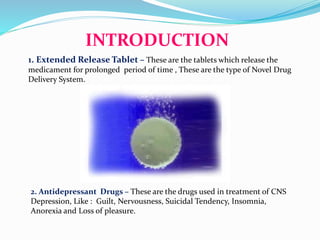
1. Extended Release Tablet – These are the tablets which release the
medicament for prolonged period of time , These are the type of Novel Drug
Delivery System.
2. Antidepressant Drugs – These are the drugs used in treatment of CNS
Depression, Like : Guilt, Nervousness, Suicidal Tendency, Insomnia,
Anorexia and Loss of pleasure.
LITERATURE SURVEY
ADVANTAGES OF EXTENDED RELEASE DRUG DELIVERY SYSTEM
The frequency of drug administration is reduced, so patient compliance can
be improved.
The blood level oscillation characteristics of multiple dosing of conventional
dosage form is reduced.
Total amount of drug administered can be reduced.
better control of drug absorption.
The safety margin of high potency drug can be increased.
LIMITATIONS OF EXTENDED RELEASE DRUG DELIVERY SYSTEM
 Administration of Extended release medication produce toxic effects.
 The physician has less flexibility in adjusting dosage regimen.
 Extended release forms are designed for some special cases.
 Extended release drug delivery system is very costly.
 Low physical stability of dosage form.
 Insoluble, erodible material cannot be readily processed to form tablet easily.
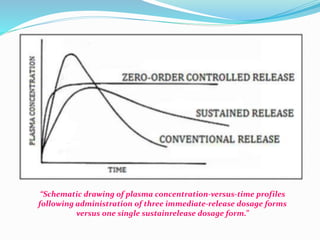
“Schematic drawing of plasma concentration-versus-time profiles
following administration of three immediate-release dosage forms
versus one single sustainrelease dosage form.”
MATRIX SYSTEM
Matrix System used in extent release dosage form to controll the release of
medicaments in desire manner.
TYPE OF MATRIX SYSTEM
Hydrophobic Polymers:
Digestible base (fatty compounds) : Glycerides , Glyceryltristearate, Fatty alcohols,
Fatty acids,
Waxes : carnauba wax
Nondigestible base (insoluble plastics) : Methylacrylate , Methylmethacrylate,
Polyvinyl chloride, Polyethylene, Ethyl cellulose
Hydrophilic polymers:
Hydroxypropyl methyl cellulose, Sodium alginate, Xanthan gum, Polyethylene
oxide, Carbopols.
ADVANTAGES OF MATRIX SYSTEM
Easy to manufacture, Versatile, effective, low cost.
Can be made to release high molecular weight compounds.
Since the drug is dispersed in the matrix system, accidental leakage of the total
drug component is likely to occur, although occasionally, cracking of the matrix
material can cause unwanted release.
DISADVANTAGES OF MATRIX SYSTEM
The remaining matrix must be removed after the drug has been released.
 The drug release rates vary with the square root of time. Release rate
continuously diminishes due to an increase in diffusional resistance and/or a
decrease in effective area at the diffusion front However, a substantial
sustained effect can be produced through the use of very slow release rates,
which in many applications are indistinguishable from zero-order
 One of the least complicated approaches to the manufacture of extended
release dosage form involves the direct compression of blend of drug,
retardant material, and additives to form a tablet in which drug is embedded
in a matrix core of retardant. Alternatively, retardant drug blend may be
granulated prior to compression.
LITERATURE REVIEW
Deore et al : prepare oral sustained release matrix tablets of a highly water soluble drug,
tramadol hydrochloride, and evaluate the effect of concentration of the hydrophobic
polymer content and method of preparation on drug release.
Swati Jagdale et al : illustrated the effect of wax concentration on the release profile of
Diclofenac sodium & Theophylline sustained release fatty matrix tablet using melt
granulation technique.
Uhumwangho et al : illustrated the effect of melt granulation on the release profiles of
the drug particles and Effect of incorporation of hydrophobic agents on the drug release
profiles of the melt granules.
Di Colo et al : formulated Metformin hydrochloride as a hydrophobic matrix sustained
release tablet employing wax materials and the sustained release behavior of the fabricated
tablet was investigated.
Shende M. A. et al : investigate the sustained release behavior of the wax matrix tablets.
Matrices were prepared by melt granulation technique using carnauba wax as a release
retardant.
Uhumwangho et al and Okor et al : carried out the study to investigate the release
profile of matrix (non-disintegrating) granules consisting of paracetamol (drug) and
acrylatemethacrylate copolymer, a matrix forming material.
Shende M. A. et al : investigate the sustained release behavior of the wax matrix tablets.
Matrices were prepared by melt granulation technique using carnauba wax as a release
retardant.
Wadher et al. : designed to develop the oral sustained release Metformin hydrochloride
tablet formulation using lipophilic waxes viz. hydrogenated castor oil, stearic acid and
glyceryl monostearate either alone or their combinations.
Nitin Sharma et al : developed the once a day dose of dexromethorphan HBr with non
swellable waxy polymer Compritol888 by dry granulation method.
Rakesh patel et al : prepared sustained release matrix tablet of Theophylline. Different
grades of Hydroxypropyl methyl cellulose were evaluated for gel forming properties.
Yorinobu Yonezawa et al : worked on Generalization of the release process through the
wax matrix layer was examined by use of a reservoir device tablet.

“FORMULATION DEVELOPMENT, STATISTICAL OPTIMIZATION AND EVALUATION OF EXTENDED RELEASE TABLET FOR ANTIDEPRESSANT DRUG”

  • 1.
    M. Pharm Project(Pharmaceutics) SUBMITTED BY UDIT MISHRA M.PHARM. III SEM SUBMITTED TO NAVEEN SINGHAL Assistant Professor SANJEEVAN COLLEGE OF PHARMACY, DAUSA (Raj.)
  • 2.
    CHAPTER NUMBER CHAPTER NAME 1 INTRODUCTION 2LITERATURE SURVEY 3 RESEARCH ENVISAGED 4 EXPERIMENTAL WORK “CONTENTS OF PROJECT”
  • 3.
    INTRODUCTION 1. Extended ReleaseTablet – These are the tablets which release the medicament for prolonged period of time , These are the type of Novel Drug Delivery System. 2. Antidepressant Drugs – These are the drugs used in treatment of CNS Depression, Like : Guilt, Nervousness, Suicidal Tendency, Insomnia, Anorexia and Loss of pleasure.
  • 4.
    LITERATURE SURVEY ADVANTAGES OFEXTENDED RELEASE DRUG DELIVERY SYSTEM The frequency of drug administration is reduced, so patient compliance can be improved. The blood level oscillation characteristics of multiple dosing of conventional dosage form is reduced. Total amount of drug administered can be reduced. better control of drug absorption. The safety margin of high potency drug can be increased. LIMITATIONS OF EXTENDED RELEASE DRUG DELIVERY SYSTEM  Administration of Extended release medication produce toxic effects.  The physician has less flexibility in adjusting dosage regimen.  Extended release forms are designed for some special cases.  Extended release drug delivery system is very costly.  Low physical stability of dosage form.  Insoluble, erodible material cannot be readily processed to form tablet easily.
  • 5.
    “Schematic drawing ofplasma concentration-versus-time profiles following administration of three immediate-release dosage forms versus one single sustainrelease dosage form.”
  • 6.
    MATRIX SYSTEM Matrix Systemused in extent release dosage form to controll the release of medicaments in desire manner. TYPE OF MATRIX SYSTEM Hydrophobic Polymers: Digestible base (fatty compounds) : Glycerides , Glyceryltristearate, Fatty alcohols, Fatty acids, Waxes : carnauba wax Nondigestible base (insoluble plastics) : Methylacrylate , Methylmethacrylate, Polyvinyl chloride, Polyethylene, Ethyl cellulose Hydrophilic polymers: Hydroxypropyl methyl cellulose, Sodium alginate, Xanthan gum, Polyethylene oxide, Carbopols.
  • 7.
    ADVANTAGES OF MATRIXSYSTEM Easy to manufacture, Versatile, effective, low cost. Can be made to release high molecular weight compounds. Since the drug is dispersed in the matrix system, accidental leakage of the total drug component is likely to occur, although occasionally, cracking of the matrix material can cause unwanted release. DISADVANTAGES OF MATRIX SYSTEM The remaining matrix must be removed after the drug has been released.  The drug release rates vary with the square root of time. Release rate continuously diminishes due to an increase in diffusional resistance and/or a decrease in effective area at the diffusion front However, a substantial sustained effect can be produced through the use of very slow release rates, which in many applications are indistinguishable from zero-order  One of the least complicated approaches to the manufacture of extended release dosage form involves the direct compression of blend of drug, retardant material, and additives to form a tablet in which drug is embedded in a matrix core of retardant. Alternatively, retardant drug blend may be granulated prior to compression.
  • 8.
    LITERATURE REVIEW Deore etal : prepare oral sustained release matrix tablets of a highly water soluble drug, tramadol hydrochloride, and evaluate the effect of concentration of the hydrophobic polymer content and method of preparation on drug release. Swati Jagdale et al : illustrated the effect of wax concentration on the release profile of Diclofenac sodium & Theophylline sustained release fatty matrix tablet using melt granulation technique. Uhumwangho et al : illustrated the effect of melt granulation on the release profiles of the drug particles and Effect of incorporation of hydrophobic agents on the drug release profiles of the melt granules. Di Colo et al : formulated Metformin hydrochloride as a hydrophobic matrix sustained release tablet employing wax materials and the sustained release behavior of the fabricated tablet was investigated. Shende M. A. et al : investigate the sustained release behavior of the wax matrix tablets. Matrices were prepared by melt granulation technique using carnauba wax as a release retardant.
  • 9.
    Uhumwangho et aland Okor et al : carried out the study to investigate the release profile of matrix (non-disintegrating) granules consisting of paracetamol (drug) and acrylatemethacrylate copolymer, a matrix forming material. Shende M. A. et al : investigate the sustained release behavior of the wax matrix tablets. Matrices were prepared by melt granulation technique using carnauba wax as a release retardant. Wadher et al. : designed to develop the oral sustained release Metformin hydrochloride tablet formulation using lipophilic waxes viz. hydrogenated castor oil, stearic acid and glyceryl monostearate either alone or their combinations. Nitin Sharma et al : developed the once a day dose of dexromethorphan HBr with non swellable waxy polymer Compritol888 by dry granulation method. Rakesh patel et al : prepared sustained release matrix tablet of Theophylline. Different grades of Hydroxypropyl methyl cellulose were evaluated for gel forming properties. Yorinobu Yonezawa et al : worked on Generalization of the release process through the wax matrix layer was examined by use of a reservoir device tablet.