Pre-formulation Studies 
By 
Vishesh Rodrigues 
1st Year M.Pharm 
Pharmaceutics
Definition 
“Pre-formulation testing is the first step in 
the rational development of dosage forms. 
It can be defined as an investigation of 
physical and chemical property of a drug 
substance alone and when combined with 
excipients”
Analytical Methods for Characterization 
of Solid Forms 
Microscopy 
Differential Scanning Calorimetry (DSC) 
Powdered X-Ray Diffraction (PXRD) 
Thermo gravimetric Analysis (TGA)
Microscopy 
Microscopy is the technical field of 
using microscopes to view samples and objects that 
can not be seen with the unaided eye (objects that 
are not within the resolution range of the normal 
eye). There are three well-known branches of 
microscopy: optical, electron, and scanning probe 
microscopy
Optical Microscopy 
• The optical microscope, often referred to as the 
"light microscope", is a type of microscope which 
uses visible light and a system of lenses to magnify 
images of small samples. Optical microscopes are the 
oldest design of microscope and were possibly 
invented in their present compound form in the 17th 
century. Basic optical microscopes can be very 
simple, although there are many complex designs 
which aim to improve resolution and 
sample contrast.
Electron Microscope 
• An electron microscope is a microscope that uses 
accelerated electrons as a source of illumination. 
Because the wavelength of an electron can be up to 
100,000 times shorter than that of visible 
light photons, the electron microscope has a 
higher resolving power than alight microscope and 
can reveal the structure of smaller objects.
Scanning Electron Microscopy 
• Scanning electron microscope (SEM) is a type 
of electron microscope that produces images of a 
sample by scanning it with a focused beam 
of electrons. The electrons interact with atoms in the 
sample, producing various signals that can be 
detected and that contain information about the 
sample's surface topography and composition.
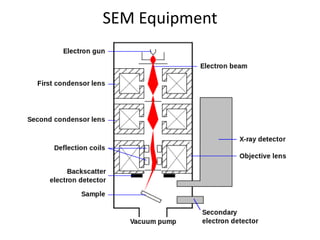
SEM Equipment
Procedure 
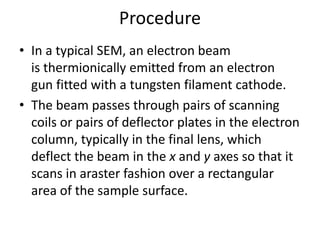
• In a typical SEM, an electron beam 
is thermionically emitted from an electron 
gun fitted with a tungsten filament cathode. 
• The beam passes through pairs of scanning 
coils or pairs of deflector plates in the electron 
column, typically in the final lens, which 
deflect the beam in the x and y axes so that it 
scans in araster fashion over a rectangular 
area of the sample surface.
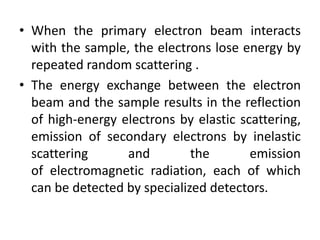
• When the primary electron beam interacts 
with the sample, the electrons lose energy by 
repeated random scattering . 
• The energy exchange between the electron 
beam and the sample results in the reflection 
of high-energy electrons by elastic scattering, 
emission of secondary electrons by inelastic 
scattering and the emission 
of electromagnetic radiation, each of which 
can be detected by specialized detectors.
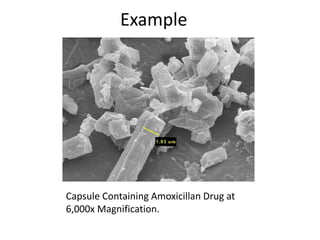
Example 
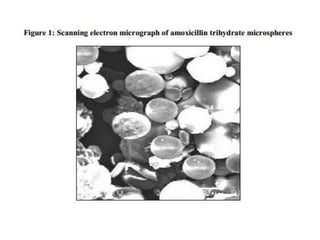
Capsule Containing Amoxicillan Drug at 
6,000x Magnification.
Differential Scanning Calorimetry (DSC) 
• The technique was developed by E.S. Watson and M.J. 
O'Neill in 1960, and introduced commercially at the 
Pittsburgh Conference on Analytical Chemistry and 
Applied Spectroscopy in 1963. 
• This technique is used to study what happens to 
samples upon heating. 
• It is used to study thermal transitions of a sample (the 
changes that take place on heating).
Principle 
• The sample and reference are maintained at the 
same temperature, even during a thermal event in 
the sample. 
• The energy required to maintain zero temperature 
difference between the sample and the reference is 
measured. 
• During a thermal event in the sample, the system will 
transfer heat to or fro from the sample pan to 
maintain the same temperature in reference and 
sample pans.
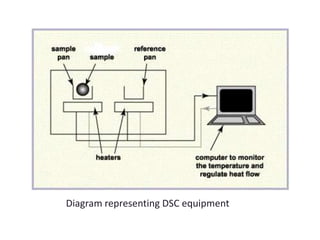
Diagram representing DSC equipment
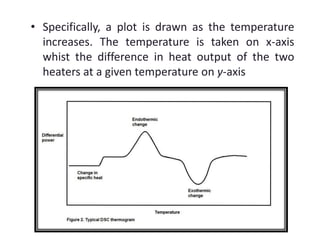
• Depending on the type of change within the 
sample, the thermal event may be endothermic or 
exothermic 
• Endothermic – consume energy 
• Exothermic – release energy to the surrounding
Procedure 
• There are two pans, In sample pan, sample is 
added, while the other, reference pan is left empty. 
• Each pan sits on top of heaters which are 
controlled by a computer 
• The computer turns on heaters, and let them heat 
the two pans at a specific rate, usually 10oC/min 
• The computer makes absolutely sure that the heating 
rate stays exactly the same throughout the experiment.
• The reason is that the two pans are different. One 
has sample in it, and one doesn't. The sample 
means there is extra material in the sample pan. 
Having extra material means that it will take more 
heat to keep the temperature of the sample pan 
increasing at the same rate as the reference pan. 
• So the heater underneath the sample pan has to 
work harder than the heater underneath the 
reference pan. It has to put out more heat. How 
much more heat it has to put out is what measured 
in DSC experiment.
• Specifically, a plot is drawn as the temperature 
increases. The temperature is taken on x-axis 
whist the difference in heat output of the two 
heaters at a given temperature on y-axis
Differential Scanning Calorimetry 
Curve 
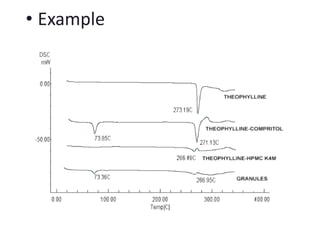
• The result of a DSC experiment is a curve of heat flux versus 
temperature or versus time. There are two different 
conventions: exothermic reactions in the sample shown with 
a positive or negative peak, depending on the kind of 
technology used in the experiment. 
• This curve can be used to calculate enthalpies of transitions, 
which is done by integrating the peak corresponding to a 
given transition. The enthalpy of transition can be expressed 
using equation: ΔH = KA 
• Where ΔH is the enthalpy of transition, 
• K is the calorimetric constant, 
• A is the area under the peak
Application Of Differential Scanning 
Calorimetry 
• Glass transitions 
• Melting and boiling points 
• Crystallizations time and temperature 
• Percent crystallinity 
• Heats of fusion and reactions 
• Specific heat capacity 
• Oxidative/thermal stability 
• Reaction kinetics 
• Purity
• Example
Powdered X-Ray Diffraction 
• X-ray powder diffraction (XRD) is a rapid analytical 
technique primarily used for phase identification of a 
crystalline material and can provide information on 
unit cell dimensions. 
• In other methods a single crystal is required whose 
size is much larger than microscopic dimensions. 
However, in the powder method as little as 1 mg of 
the material is sufficient for the study. 
• The analyzed material is finely ground, homogenized, 
and average bulk composition is determined.
Principle 
• X-ray diffraction is based on constructive 
interference of monochromatic X-rays and a 
crystalline sample. 
• These X-rays are generated by a cathode ray tube, 
filtered to produce monochromatic radiation, 
collimated to concentrate, and directed toward 
the sample. 
• For every set of crystal planes , one or more 
crystals will be in the correct orientation to give 
the correct Bragg angle to satisfy Bragg's 
equation.
• The powdered sample generates the concentric cones 
of diffracted X-rays because of the random orientation 
of crystallites in the sample. 
• The powder diffracts the x-rays in accordance with 
Bragg’s law to produce cones of diffracted beams. 
These cones intersect a strip of photographic film 
located in the cylindrical camera to produce a 
characteristic set of arcs on the film. 
• When the film is removed from the camera, flattened 
and processed, it shows the diffraction lines and the 
holes for the incident and transmitted beams. 
• The x-ray pattern of a pure crystalline substance can 
be considered as a “fingerprint” with each crystalline 
material having, within limits, a unique diffraction 
pattern.
Procedure and Equipment
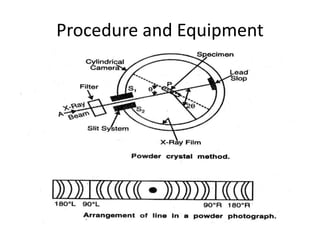
• The experimental arrangement of powder crystal 
method is shown in figure above its main feature are 
outlined as below: 
• A is a source of X-rays which can be made 
monochromatic by a filter 
• The X-ray beam to falls on the powdered specimen P 
through the slits S1 and S2. The function of these slits 
is to get a narrow pencil of X-rays. 
• Fine powder, P, struck on a hair by means of gum is 
suspended vertically in the axis of a cylindrical camera. 
This enables sharp lines to be obtained on the 
photographic film which is surrounding the powder 
crystal in the form of a circular arc.
• The X-rays after falling on the powder passes out 
of the camera through a cut in the film so as to 
minimize the fogging produced by the scattering 
of the direct beam. 
• As the sample and detector are rotated, the 
intensity of the reflected X-rays is recorded. 
• When the geometry of the incident X-rays 
impinging the sample satisfies the Bragg 
Equation, constructive interference occurs and a 
peak in intensity occurs. 
• A detector records and processes this X-ray signal 
and converts the signal to a count rate which is 
then output to a device such as a printer or 
computer monitor.
Advantages 
• Powerful and rapid (< 20 min) technique for 
identification of an unknown mineral. 
• In most cases, it provides a clear structural 
determination. 
• XRD units are widely available. 
• Data interpretation is relatively straight 
forward .
Disadvantages 
• Homogeneous and single phase material is 
best for identification of an unknown. 
• Requires tenths of a gram of material which 
must be ground into a powder. 
• For mixed materials, detection limit is ~ 2% 
of sample. 
• For unit cell determinations, indexing of 
patterns for non-isometric crystal systems is 
complicated .
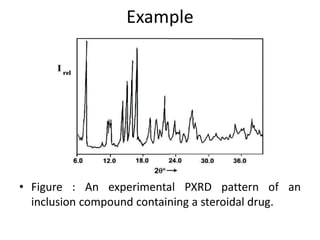
Example 
• Figure : An experimental PXRD pattern of an 
inclusion compound containing a steroidal drug.
Thermal Gravimetric Analysis (TGA) 
• Thermogravimetric analysis or thermal 
gravimetric analysis (TGA) is a method of thermal 
analysis in which changes in physical and 
chemical properties of materials are measured as 
a function of increasing temperature (with 
constant heating rate), or as a function of time 
(with constant temperature and/or constant mass 
loss).1 TGA can provide information about 
physical phenomena, such as second-order phase 
transitions, 
including vaporization, sublimation, absorption, a 
dsorption, and desorption. 
1-Coats, A. W.; Redfern, J. P. (1963). "Thermogravimetric Analysis: A Review". Analyst 88: 906–924
• Likewise, TGA can provide information about 
chemical phenomena 
including chemisorptions, desolvation (especia 
lly dehydration), decomposition, and solid-gas 
reactions (e.g., oxidation or reduction) 
• TGA is commonly used to determine selected 
characteristics of materials that exhibit either 
mass loss or gain due to decomposition, 
oxidation, or loss of volatiles (such as 
moisture).
Principle 
• Thermogravimetry is a technique that 
measures the variation of mass of a sample 
when the latter is subjected to a temperature 
program in a controlled atmosphere. This 
variation of mass can be a loss (vapour 
emission) or a gain (fixing of gases)
Procedure 
• The TGA instrument continuously weighs a sample as it 
is heated to temperatures of up to 2000 °C for coupling 
with FTIR and Mass spectrometry gas analysis. 
• As the temperature increases, various components of 
the sample are decomposed and the weight 
percentage of each resulting mass change can be 
measured. Results are plotted with temperature on the 
X-axis and mass loss on the Y-axis. 
• The data can be adjusted using curve smoothing and 
first derivatives are often also plotted to determine 
points of inflection for more in-depth interpretations .
• TGA instruments can be temperature calibrated with 
melting point standards or Curie point of ferromagnetic 
materials such as Fe or Ni. A ferromagnetic material is 
placed in the sample pan which is placed in a magnetic 
field. 
• The standard is heated and at the Curie point the 
material becomes paramagnetic which nullifies the 
apparent weight change effect of the magnetic field.
Application 
• Purity and thermal stability. 
• Solid state reaction. 
• Decomposition of organic and inorganic compound. 
• Determining composition of material. 
• Corrosion of metals in various atmosphere. 
• Roasting and calcination of minerals. 
• Evaluation of gravimetric precipitates. 
• Oxidative and Reductive stability.
Refrences 
• 
• http://serc.carleton.edu/research_education/geo 
chemsheets/techniques/XRD.html 
• http://pubs.usgs.gov/info/diffraction/html/ 
• Instrumental methods of chemical analysis by 
G.R.Chatwal & Sham.K.Anand … Page No. 2.324- 
2.326 
• Instrumental methods of chemical analysis by B. 
K Sharma… Page No.S-494-536 
• Practical Pharmaceutical Chemistry Beckett and 
Stenlake… Page No. 78-81
• Encyclopedia of Pharmaceutical Technology by 
James Swarbrick 3rd Edition Volume I 
• Martin’s Physical Pharmacy and 
Pharmaceutical Sciences By Patrick J Sinko 6th 
Edition 
• Text book of Remington’s Pharmaceutical 
sciences Vol. I &II by Paul Beringer, 
AraDerMarderosian and other members of 
the editorial board 21st Edition

Analytical Methods for Characterization of Solid Forms

  • 1.
    Pre-formulation Studies By Vishesh Rodrigues 1st Year M.Pharm Pharmaceutics
  • 2.
    Definition “Pre-formulation testingis the first step in the rational development of dosage forms. It can be defined as an investigation of physical and chemical property of a drug substance alone and when combined with excipients”
  • 3.
    Analytical Methods forCharacterization of Solid Forms Microscopy Differential Scanning Calorimetry (DSC) Powdered X-Ray Diffraction (PXRD) Thermo gravimetric Analysis (TGA)
  • 4.
    Microscopy Microscopy isthe technical field of using microscopes to view samples and objects that can not be seen with the unaided eye (objects that are not within the resolution range of the normal eye). There are three well-known branches of microscopy: optical, electron, and scanning probe microscopy
  • 5.
    Optical Microscopy •The optical microscope, often referred to as the "light microscope", is a type of microscope which uses visible light and a system of lenses to magnify images of small samples. Optical microscopes are the oldest design of microscope and were possibly invented in their present compound form in the 17th century. Basic optical microscopes can be very simple, although there are many complex designs which aim to improve resolution and sample contrast.
  • 6.
    Electron Microscope •An electron microscope is a microscope that uses accelerated electrons as a source of illumination. Because the wavelength of an electron can be up to 100,000 times shorter than that of visible light photons, the electron microscope has a higher resolving power than alight microscope and can reveal the structure of smaller objects.
  • 7.
    Scanning Electron Microscopy • Scanning electron microscope (SEM) is a type of electron microscope that produces images of a sample by scanning it with a focused beam of electrons. The electrons interact with atoms in the sample, producing various signals that can be detected and that contain information about the sample's surface topography and composition.
  • 8.
  • 9.
    Procedure • Ina typical SEM, an electron beam is thermionically emitted from an electron gun fitted with a tungsten filament cathode. • The beam passes through pairs of scanning coils or pairs of deflector plates in the electron column, typically in the final lens, which deflect the beam in the x and y axes so that it scans in araster fashion over a rectangular area of the sample surface.
  • 10.
    • When theprimary electron beam interacts with the sample, the electrons lose energy by repeated random scattering . • The energy exchange between the electron beam and the sample results in the reflection of high-energy electrons by elastic scattering, emission of secondary electrons by inelastic scattering and the emission of electromagnetic radiation, each of which can be detected by specialized detectors.
  • 11.
    Example Capsule ContainingAmoxicillan Drug at 6,000x Magnification.
  • 13.
    Differential Scanning Calorimetry(DSC) • The technique was developed by E.S. Watson and M.J. O'Neill in 1960, and introduced commercially at the Pittsburgh Conference on Analytical Chemistry and Applied Spectroscopy in 1963. • This technique is used to study what happens to samples upon heating. • It is used to study thermal transitions of a sample (the changes that take place on heating).
  • 14.
    Principle • Thesample and reference are maintained at the same temperature, even during a thermal event in the sample. • The energy required to maintain zero temperature difference between the sample and the reference is measured. • During a thermal event in the sample, the system will transfer heat to or fro from the sample pan to maintain the same temperature in reference and sample pans.
  • 15.
  • 16.
    • Depending onthe type of change within the sample, the thermal event may be endothermic or exothermic • Endothermic – consume energy • Exothermic – release energy to the surrounding
  • 17.
    Procedure • Thereare two pans, In sample pan, sample is added, while the other, reference pan is left empty. • Each pan sits on top of heaters which are controlled by a computer • The computer turns on heaters, and let them heat the two pans at a specific rate, usually 10oC/min • The computer makes absolutely sure that the heating rate stays exactly the same throughout the experiment.
  • 18.
    • The reasonis that the two pans are different. One has sample in it, and one doesn't. The sample means there is extra material in the sample pan. Having extra material means that it will take more heat to keep the temperature of the sample pan increasing at the same rate as the reference pan. • So the heater underneath the sample pan has to work harder than the heater underneath the reference pan. It has to put out more heat. How much more heat it has to put out is what measured in DSC experiment.
  • 19.
    • Specifically, aplot is drawn as the temperature increases. The temperature is taken on x-axis whist the difference in heat output of the two heaters at a given temperature on y-axis
  • 20.
    Differential Scanning Calorimetry Curve • The result of a DSC experiment is a curve of heat flux versus temperature or versus time. There are two different conventions: exothermic reactions in the sample shown with a positive or negative peak, depending on the kind of technology used in the experiment. • This curve can be used to calculate enthalpies of transitions, which is done by integrating the peak corresponding to a given transition. The enthalpy of transition can be expressed using equation: ΔH = KA • Where ΔH is the enthalpy of transition, • K is the calorimetric constant, • A is the area under the peak
  • 21.
    Application Of DifferentialScanning Calorimetry • Glass transitions • Melting and boiling points • Crystallizations time and temperature • Percent crystallinity • Heats of fusion and reactions • Specific heat capacity • Oxidative/thermal stability • Reaction kinetics • Purity
  • 22.
  • 23.
    Powdered X-Ray Diffraction • X-ray powder diffraction (XRD) is a rapid analytical technique primarily used for phase identification of a crystalline material and can provide information on unit cell dimensions. • In other methods a single crystal is required whose size is much larger than microscopic dimensions. However, in the powder method as little as 1 mg of the material is sufficient for the study. • The analyzed material is finely ground, homogenized, and average bulk composition is determined.
  • 24.
    Principle • X-raydiffraction is based on constructive interference of monochromatic X-rays and a crystalline sample. • These X-rays are generated by a cathode ray tube, filtered to produce monochromatic radiation, collimated to concentrate, and directed toward the sample. • For every set of crystal planes , one or more crystals will be in the correct orientation to give the correct Bragg angle to satisfy Bragg's equation.
  • 25.
    • The powderedsample generates the concentric cones of diffracted X-rays because of the random orientation of crystallites in the sample. • The powder diffracts the x-rays in accordance with Bragg’s law to produce cones of diffracted beams. These cones intersect a strip of photographic film located in the cylindrical camera to produce a characteristic set of arcs on the film. • When the film is removed from the camera, flattened and processed, it shows the diffraction lines and the holes for the incident and transmitted beams. • The x-ray pattern of a pure crystalline substance can be considered as a “fingerprint” with each crystalline material having, within limits, a unique diffraction pattern.
  • 26.
  • 27.
    • The experimentalarrangement of powder crystal method is shown in figure above its main feature are outlined as below: • A is a source of X-rays which can be made monochromatic by a filter • The X-ray beam to falls on the powdered specimen P through the slits S1 and S2. The function of these slits is to get a narrow pencil of X-rays. • Fine powder, P, struck on a hair by means of gum is suspended vertically in the axis of a cylindrical camera. This enables sharp lines to be obtained on the photographic film which is surrounding the powder crystal in the form of a circular arc.
  • 28.
    • The X-raysafter falling on the powder passes out of the camera through a cut in the film so as to minimize the fogging produced by the scattering of the direct beam. • As the sample and detector are rotated, the intensity of the reflected X-rays is recorded. • When the geometry of the incident X-rays impinging the sample satisfies the Bragg Equation, constructive interference occurs and a peak in intensity occurs. • A detector records and processes this X-ray signal and converts the signal to a count rate which is then output to a device such as a printer or computer monitor.
  • 29.
    Advantages • Powerfuland rapid (< 20 min) technique for identification of an unknown mineral. • In most cases, it provides a clear structural determination. • XRD units are widely available. • Data interpretation is relatively straight forward .
  • 30.
    Disadvantages • Homogeneousand single phase material is best for identification of an unknown. • Requires tenths of a gram of material which must be ground into a powder. • For mixed materials, detection limit is ~ 2% of sample. • For unit cell determinations, indexing of patterns for non-isometric crystal systems is complicated .
  • 31.
    Example • Figure: An experimental PXRD pattern of an inclusion compound containing a steroidal drug.
  • 32.
    Thermal Gravimetric Analysis(TGA) • Thermogravimetric analysis or thermal gravimetric analysis (TGA) is a method of thermal analysis in which changes in physical and chemical properties of materials are measured as a function of increasing temperature (with constant heating rate), or as a function of time (with constant temperature and/or constant mass loss).1 TGA can provide information about physical phenomena, such as second-order phase transitions, including vaporization, sublimation, absorption, a dsorption, and desorption. 1-Coats, A. W.; Redfern, J. P. (1963). "Thermogravimetric Analysis: A Review". Analyst 88: 906–924
  • 33.
    • Likewise, TGAcan provide information about chemical phenomena including chemisorptions, desolvation (especia lly dehydration), decomposition, and solid-gas reactions (e.g., oxidation or reduction) • TGA is commonly used to determine selected characteristics of materials that exhibit either mass loss or gain due to decomposition, oxidation, or loss of volatiles (such as moisture).
  • 34.
    Principle • Thermogravimetryis a technique that measures the variation of mass of a sample when the latter is subjected to a temperature program in a controlled atmosphere. This variation of mass can be a loss (vapour emission) or a gain (fixing of gases)
  • 35.
    Procedure • TheTGA instrument continuously weighs a sample as it is heated to temperatures of up to 2000 °C for coupling with FTIR and Mass spectrometry gas analysis. • As the temperature increases, various components of the sample are decomposed and the weight percentage of each resulting mass change can be measured. Results are plotted with temperature on the X-axis and mass loss on the Y-axis. • The data can be adjusted using curve smoothing and first derivatives are often also plotted to determine points of inflection for more in-depth interpretations .
  • 36.
    • TGA instrumentscan be temperature calibrated with melting point standards or Curie point of ferromagnetic materials such as Fe or Ni. A ferromagnetic material is placed in the sample pan which is placed in a magnetic field. • The standard is heated and at the Curie point the material becomes paramagnetic which nullifies the apparent weight change effect of the magnetic field.
  • 37.
    Application • Purityand thermal stability. • Solid state reaction. • Decomposition of organic and inorganic compound. • Determining composition of material. • Corrosion of metals in various atmosphere. • Roasting and calcination of minerals. • Evaluation of gravimetric precipitates. • Oxidative and Reductive stability.
  • 38.
    Refrences • •http://serc.carleton.edu/research_education/geo chemsheets/techniques/XRD.html • http://pubs.usgs.gov/info/diffraction/html/ • Instrumental methods of chemical analysis by G.R.Chatwal & Sham.K.Anand … Page No. 2.324- 2.326 • Instrumental methods of chemical analysis by B. K Sharma… Page No.S-494-536 • Practical Pharmaceutical Chemistry Beckett and Stenlake… Page No. 78-81
  • 39.
    • Encyclopedia ofPharmaceutical Technology by James Swarbrick 3rd Edition Volume I • Martin’s Physical Pharmacy and Pharmaceutical Sciences By Patrick J Sinko 6th Edition • Text book of Remington’s Pharmaceutical sciences Vol. I &II by Paul Beringer, AraDerMarderosian and other members of the editorial board 21st Edition