GENERIC DRUGS
PRODUCT
DEVELOPMENT
Bashant kumar sah
M.PHARM 1ST SEMESTER
DEPT.PHARMACEUTICS, Nargund college of
pharmacy
GENERIC DRUG
 A drug product that is comparable
to brand/innovator drug in dosage
form , strength , route of
administration , quality and
performance characteristics , and
intended use. It should contain the
same active ingredients as the
original formulation
WHAT ARE GENERIC DRUGS ?
They are drugs which have the same chemical
composition as branded drugs are and sold under their
chemical name . For example paracetamol , a pain killer
, is the generic name for branded drugs like Crocin and
Calpol.
 The market situation is a little different in India than
the USA or other developed nations . In USA , when a
new drug is launched only the company that holds the
FDA patent are legally allowed to set the drug , thus
giving them market monopoly.
In India however there were no patent laws till 2005
which meant that anyone could replicate any drug in
India without legal ramifications . This led to the trend
of branded generic drugs which has 99.5% of the
countrys generic drug share
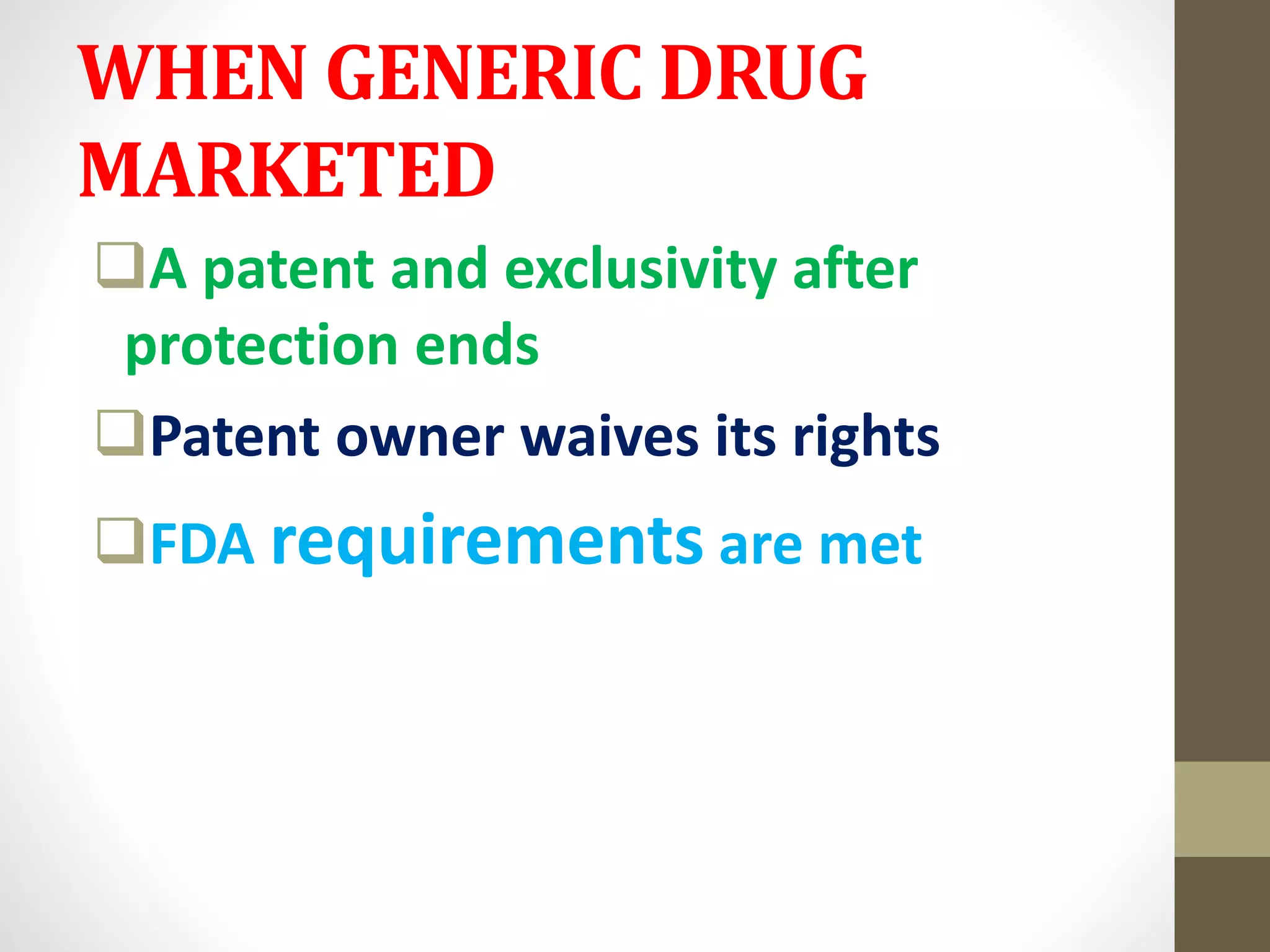
WHEN GENERIC DRUG
MARKETED
A patent and exclusivity after
protection ends
Patent owner waives its rights
FDA requirements are met
BRAND NAME DRUG
NDA REQUIREMENTS
GENERIC DRUG ANDA
REQUIREMENTS
1. Labelling 1. Labelling
2. Pharma 2. Pharma
3. Chemistry 3. Chemistry
4. Manufacturing 4. Manufacturing
5. Controls 5. Control
6. Microbiology 6. Microbiology
7. Testing 7. Testing
8. Animal studies 8. Bioequivalence
9. Clinical studies
10. Bioavailability
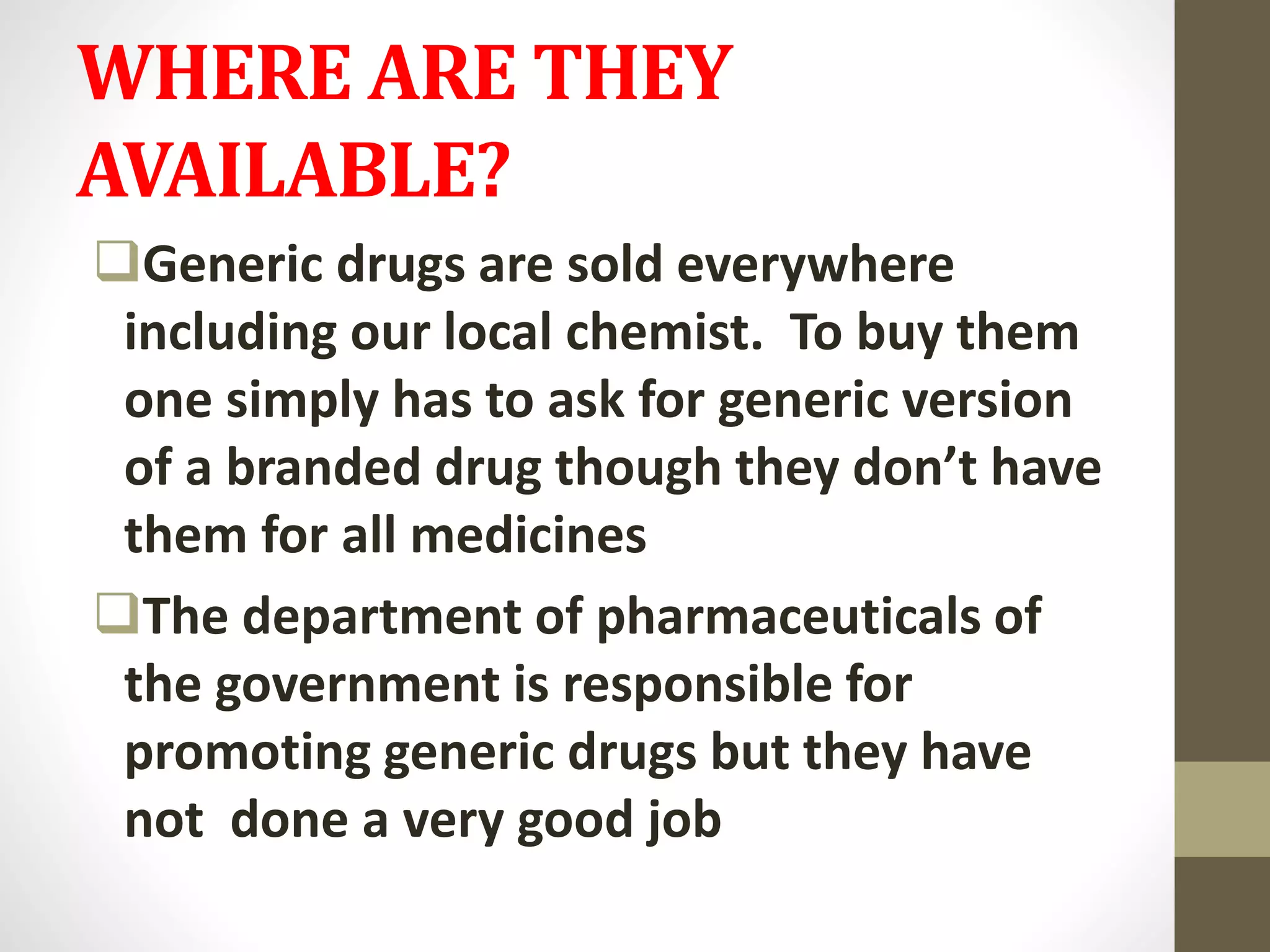
WHERE ARE THEY
AVAILABLE?
Generic drugs are sold everywhere
including our local chemist. To buy them
one simply has to ask for generic version
of a branded drug though they don’t have
them for all medicines
The department of pharmaceuticals of
the government is responsible for
promoting generic drugs but they have
not done a very good job
After the expiry of the patent or marketing
rights of the patent drug , generic drugs are
marketed.
They are comparable to brand drug in dosage
form , strength , route of administration ,
quality and performance characteristics , and
intended use.
Generic drugs are available at affordable prices
with maintaining quality..
These Generic formulations balance public
interest as critical disease like cancer , AIDS etc
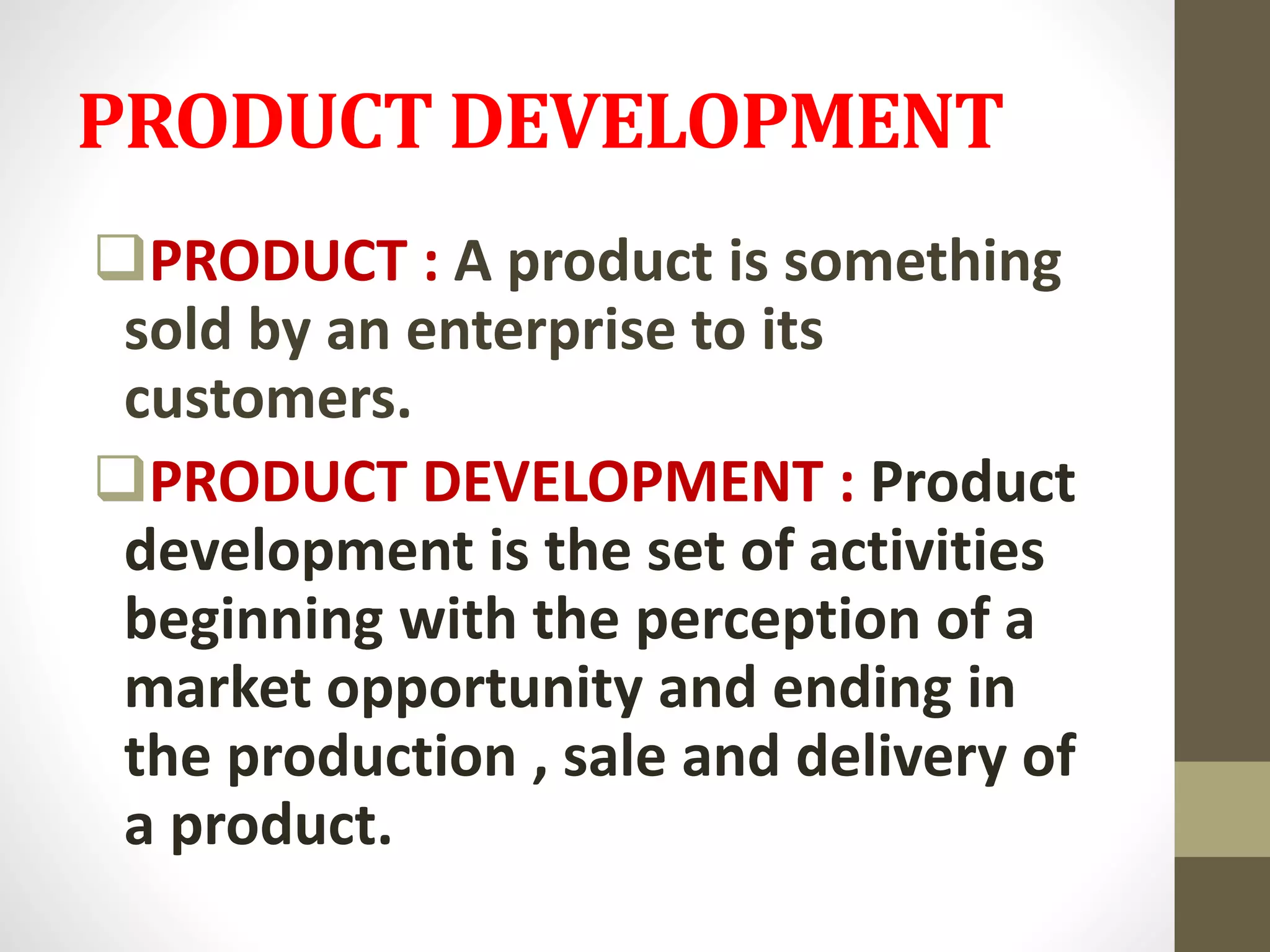
PRODUCT DEVELOPMENT
PRODUCT : A product is something
sold by an enterprise to its
customers.
PRODUCT DEVELOPMENT : Product
development is the set of activities
beginning with the perception of a
market opportunity and ending in
the production , sale and delivery of
a product.
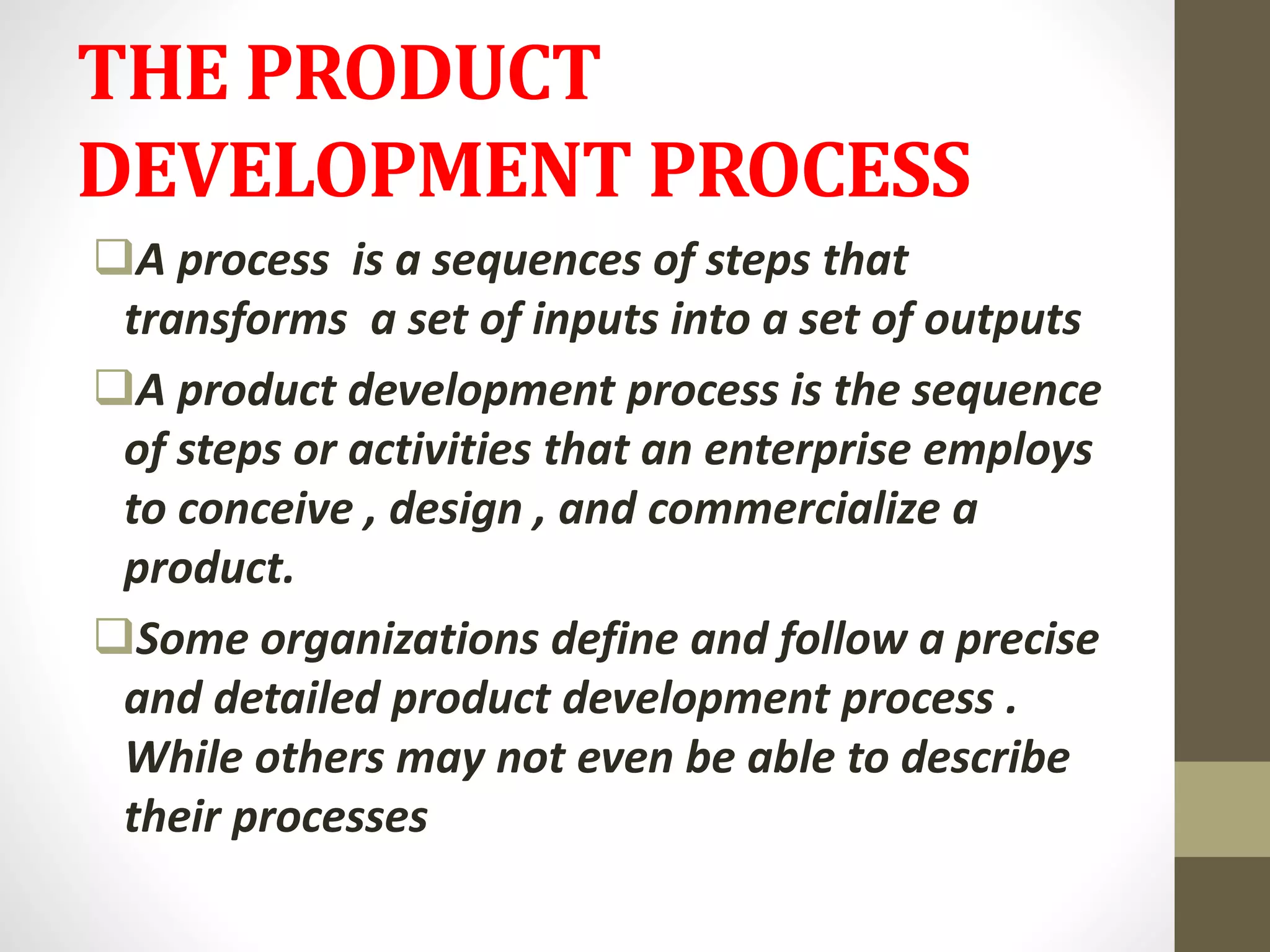
THE PRODUCT
DEVELOPMENT PROCESS
A process is a sequences of steps that
transforms a set of inputs into a set of outputs
A product development process is the sequence
of steps or activities that an enterprise employs
to conceive , design , and commercialize a
product.
Some organizations define and follow a precise
and detailed product development process .
While others may not even be able to describe
their processes
A GENERIC PRODUCT
DEVELOPMENT PROCESS
We will consider here a generic product development
that can be used in a market pull- situation.
The input of the process is a mission statement and the
output of the process is the product launch
MISSION STATEMENT : identifies the target market for
the product , provides a basic functional description of
the product , and specifies the business goals of the
effort ; results from well executed product planning
phase
PRODUCT LAUNCH : Occures when the product
becomes available for purchase in the market place
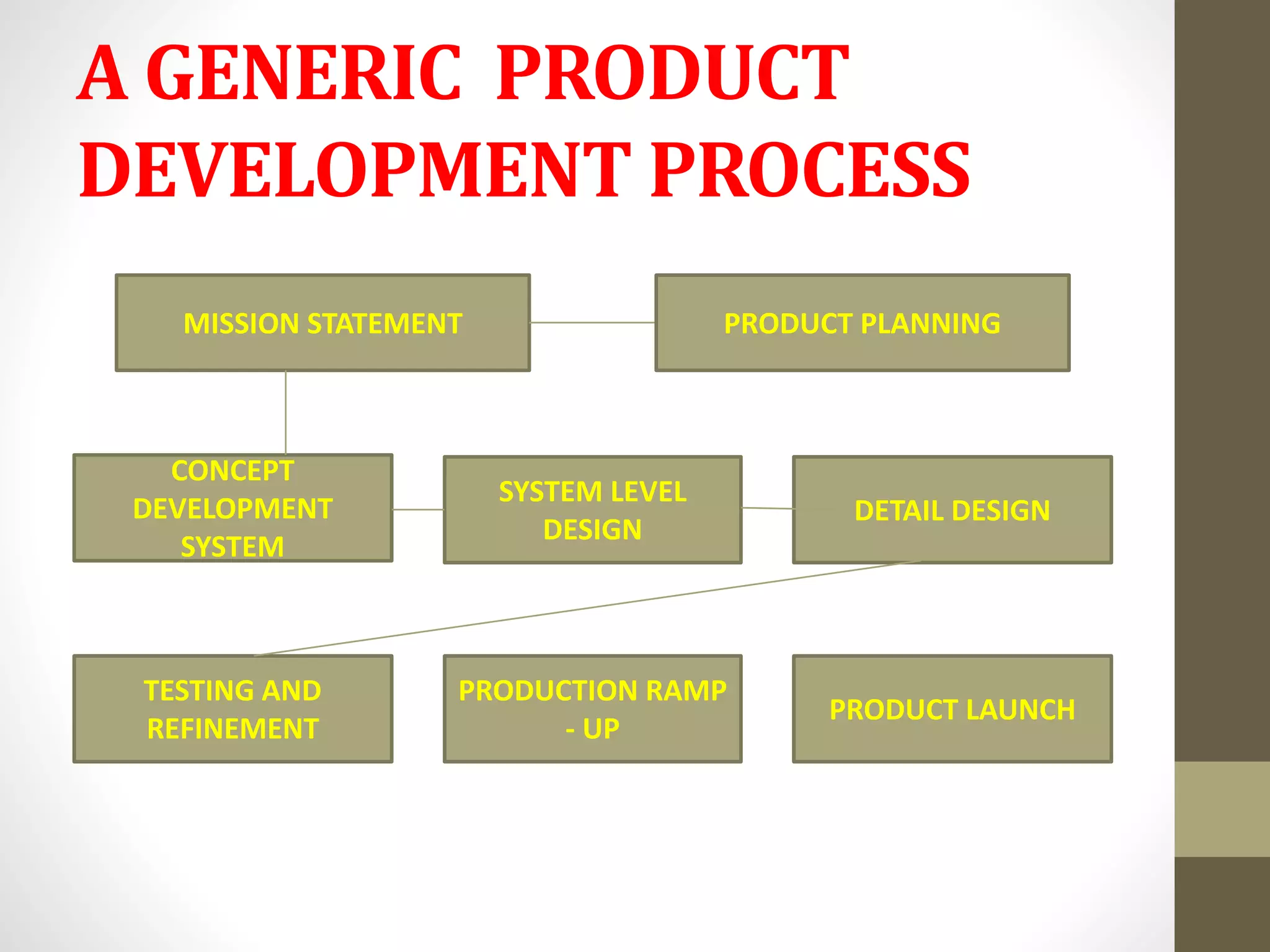
A GENERIC PRODUCT
DEVELOPMENT PROCESS
MISSION STATEMENT PRODUCT PLANNING
CONCEPT
DEVELOPMENT
SYSTEM
SYSTEM LEVEL
DESIGN
DETAIL DESIGN
TESTING AND
REFINEMENT
PRODUCTION RAMP
- UP
PRODUCT LAUNCH
CONCEPT DEVELOPMENT
The needs of the target market are
identified , alternative product concepts
are generated and evaluated , and a
single development is selected for further
development
A concept is the description of the form ,
function and features of a product and is
usually accompanied by a set of
specifications , an analysis of competitive
products , and an economic justification
of the project
SYSTEM – LEVEL DESIGN
Includes the definition of the product
architecture and the division of the product into
subsystems and components
The final assembly scheme for the production
system is usually defined during this phase
The output of this phase is usually a geometric
layout of the product , a functional specification
of each of the products subsystems , and a
preliminary process flow diagram for the final
assembly process
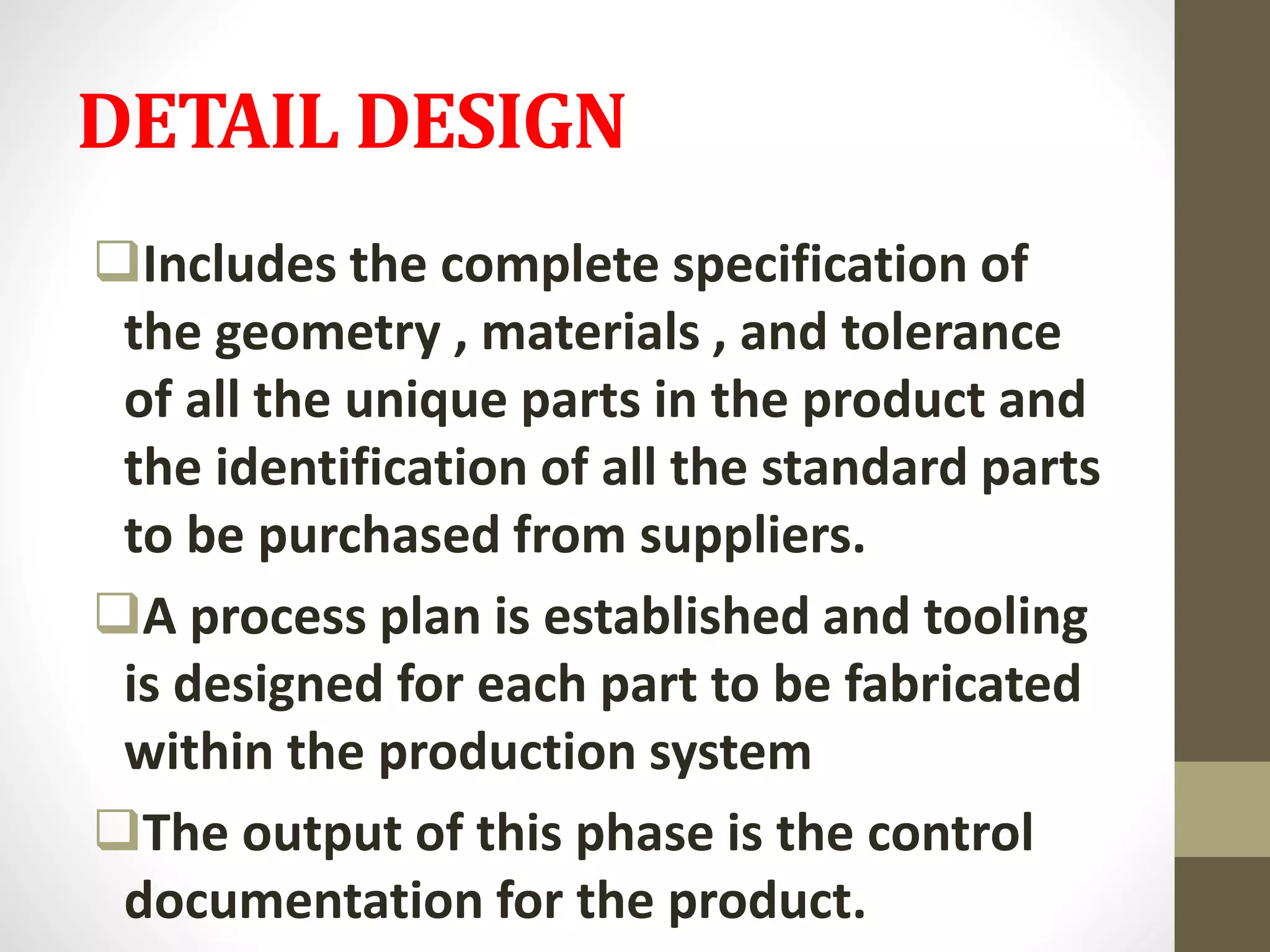
DETAIL DESIGN
Includes the complete specification of
the geometry , materials , and tolerance
of all the unique parts in the product and
the identification of all the standard parts
to be purchased from suppliers.
A process plan is established and tooling
is designed for each part to be fabricated
within the production system
The output of this phase is the control
documentation for the product.
TESTING AND REFINEMENT
Involves the construction and evaluation
of multiple pre – production versions of
the product.
Early prototypes are usually built with
production intent parts [parts with the
same geometry and material properties
as intended for the production version of
the product will work as designed and
whether or not the product will work as
designed and whether or not the product
satisfies the key customer needs
Later prototypes are usually built with
parts supplied by the intended
production process but may not be
assembled using the intended final
assembly process
Later prototypes are extensively
evaluated internally and are also typically
tested by customers in their own use
environment
The goal of the beta prototypes is usually
to answer questions about performance
and reliability in order to identify
necessary changes for the final product.
PRODUCTION RAMP - UP
Ramp up is a term used in economics and business to
describe an increase in firm production ahead of
anticipated increases in product demand. Alternatively,
ramp up describes the period from completed initial
product development to maximum capacity utilization,
characterized by product and process experimentation
and improvements.
Ramp up in the first sense often occurs when a company
strikes a deal with a distributor, retailer, or producer, which
will substantially increase product demand.
THANK YOU

Generic drug product development

  • 1.
    GENERIC DRUGS PRODUCT DEVELOPMENT Bashant kumarsah M.PHARM 1ST SEMESTER DEPT.PHARMACEUTICS, Nargund college of pharmacy
  • 2.
    GENERIC DRUG  Adrug product that is comparable to brand/innovator drug in dosage form , strength , route of administration , quality and performance characteristics , and intended use. It should contain the same active ingredients as the original formulation
  • 3.
    WHAT ARE GENERICDRUGS ? They are drugs which have the same chemical composition as branded drugs are and sold under their chemical name . For example paracetamol , a pain killer , is the generic name for branded drugs like Crocin and Calpol.  The market situation is a little different in India than the USA or other developed nations . In USA , when a new drug is launched only the company that holds the FDA patent are legally allowed to set the drug , thus giving them market monopoly. In India however there were no patent laws till 2005 which meant that anyone could replicate any drug in India without legal ramifications . This led to the trend of branded generic drugs which has 99.5% of the countrys generic drug share
  • 4.
    WHEN GENERIC DRUG MARKETED Apatent and exclusivity after protection ends Patent owner waives its rights FDA requirements are met
  • 5.
    BRAND NAME DRUG NDAREQUIREMENTS GENERIC DRUG ANDA REQUIREMENTS 1. Labelling 1. Labelling 2. Pharma 2. Pharma 3. Chemistry 3. Chemistry 4. Manufacturing 4. Manufacturing 5. Controls 5. Control 6. Microbiology 6. Microbiology 7. Testing 7. Testing 8. Animal studies 8. Bioequivalence 9. Clinical studies 10. Bioavailability
  • 6.
    WHERE ARE THEY AVAILABLE? Genericdrugs are sold everywhere including our local chemist. To buy them one simply has to ask for generic version of a branded drug though they don’t have them for all medicines The department of pharmaceuticals of the government is responsible for promoting generic drugs but they have not done a very good job
  • 7.
    After the expiryof the patent or marketing rights of the patent drug , generic drugs are marketed. They are comparable to brand drug in dosage form , strength , route of administration , quality and performance characteristics , and intended use. Generic drugs are available at affordable prices with maintaining quality.. These Generic formulations balance public interest as critical disease like cancer , AIDS etc
  • 8.
    PRODUCT DEVELOPMENT PRODUCT :A product is something sold by an enterprise to its customers. PRODUCT DEVELOPMENT : Product development is the set of activities beginning with the perception of a market opportunity and ending in the production , sale and delivery of a product.
  • 9.
    THE PRODUCT DEVELOPMENT PROCESS Aprocess is a sequences of steps that transforms a set of inputs into a set of outputs A product development process is the sequence of steps or activities that an enterprise employs to conceive , design , and commercialize a product. Some organizations define and follow a precise and detailed product development process . While others may not even be able to describe their processes
  • 10.
    A GENERIC PRODUCT DEVELOPMENTPROCESS We will consider here a generic product development that can be used in a market pull- situation. The input of the process is a mission statement and the output of the process is the product launch MISSION STATEMENT : identifies the target market for the product , provides a basic functional description of the product , and specifies the business goals of the effort ; results from well executed product planning phase PRODUCT LAUNCH : Occures when the product becomes available for purchase in the market place
  • 11.
    A GENERIC PRODUCT DEVELOPMENTPROCESS MISSION STATEMENT PRODUCT PLANNING CONCEPT DEVELOPMENT SYSTEM SYSTEM LEVEL DESIGN DETAIL DESIGN TESTING AND REFINEMENT PRODUCTION RAMP - UP PRODUCT LAUNCH
  • 12.
    CONCEPT DEVELOPMENT The needsof the target market are identified , alternative product concepts are generated and evaluated , and a single development is selected for further development A concept is the description of the form , function and features of a product and is usually accompanied by a set of specifications , an analysis of competitive products , and an economic justification of the project
  • 13.
    SYSTEM – LEVELDESIGN Includes the definition of the product architecture and the division of the product into subsystems and components The final assembly scheme for the production system is usually defined during this phase The output of this phase is usually a geometric layout of the product , a functional specification of each of the products subsystems , and a preliminary process flow diagram for the final assembly process
  • 14.
    DETAIL DESIGN Includes thecomplete specification of the geometry , materials , and tolerance of all the unique parts in the product and the identification of all the standard parts to be purchased from suppliers. A process plan is established and tooling is designed for each part to be fabricated within the production system The output of this phase is the control documentation for the product.
  • 15.
    TESTING AND REFINEMENT Involvesthe construction and evaluation of multiple pre – production versions of the product. Early prototypes are usually built with production intent parts [parts with the same geometry and material properties as intended for the production version of the product will work as designed and whether or not the product will work as designed and whether or not the product satisfies the key customer needs
  • 16.
    Later prototypes areusually built with parts supplied by the intended production process but may not be assembled using the intended final assembly process Later prototypes are extensively evaluated internally and are also typically tested by customers in their own use environment The goal of the beta prototypes is usually to answer questions about performance and reliability in order to identify necessary changes for the final product.
  • 17.
    PRODUCTION RAMP -UP Ramp up is a term used in economics and business to describe an increase in firm production ahead of anticipated increases in product demand. Alternatively, ramp up describes the period from completed initial product development to maximum capacity utilization, characterized by product and process experimentation and improvements. Ramp up in the first sense often occurs when a company strikes a deal with a distributor, retailer, or producer, which will substantially increase product demand.
  • 18.