PRODUCTION PLANNING
AND CONTROL
BY
M. PRIYANKA
M. PHARMACY
SCHOOL OF PHARMACEUTICAL SCIENCES
JNTUK
CONTENTS
 Introduction
 Production planning
 Process planning
 Routing
 Scheduling
 loading
 Production control
 Dispatching
 Follow up
 Cost control
 Quality control priyanmodugu@gmail.com
2
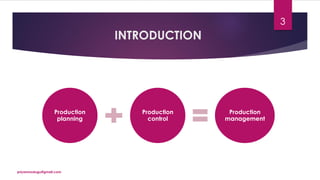
INTRODUCTION
Production
planning
Production
control
Production
management
priyanmodugu@gmail.com
3
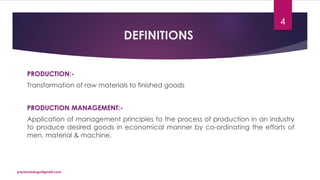
DEFINITIONS
PRODUCTION:-
Transformation of raw materials to finished goods
PRODUCTION MANAGEMENT:-
Application of management principles to the process of production in an industry
to produce desired goods in economical manner by co-ordinating the efforts of
men, material & machine.
priyanmodugu@gmail.com
4
PRODUCTION PLANNING:-
It is a technique which helps in planning & scheduling the work in the
manufacturing plant to obtain the desired quality of products with optimum
efficiency & at minimum cost.
PRODUCTION CONTROL:-
It ensures that the work is being done according to the plan
priyanmodugu@gmail.com
5
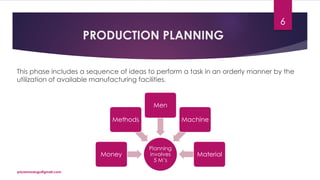
PRODUCTION PLANNING
This phase includes a sequence of ideas to perform a task in an orderly manner by the
utilization of available manufacturing facilities.
Planning
involves
5 M’s
Money
Methods
Men
Machine
Material
priyanmodugu@gmail.com
6
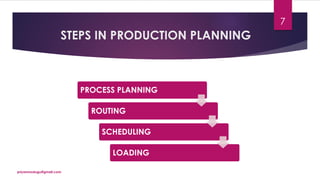
STEPS IN PRODUCTION PLANNING
PROCESS PLANNING
ROUTING
SCHEDULING
LOADING
priyanmodugu@gmail.com
7
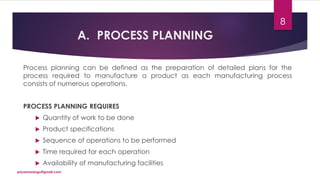
A. PROCESS PLANNING
Process planning can be defined as the preparation of detailed plans for the
process required to manufacture a product as each manufacturing process
consists of numerous operations.
PROCESS PLANNING REQUIRES
 Quantity of work to be done
 Product specifications
 Sequence of operations to be performed
 Time required for each operation
 Availability of manufacturing facilities
priyanmodugu@gmail.com
8
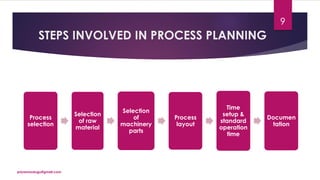
STEPS INVOLVED IN PROCESS PLANNING
Process
selection
Selection
of raw
material
Selection
of
machinery
parts
Process
layout
Time
setup &
standard
operation
time
Documen
tation
priyanmodugu@gmail.com
9
a) PROCESS SELECTION:-
 The operations selected for a particular process should be most economical
 Should satisfy the product specifications
 Selection mainly depends upon quality, quantity, time period & machines
available
b) SELECTION OF RAW MATERIALS:-
 Should meet quality standards
 Should show chemical compatibility
priyanmodugu@gmail.com
10
c) SELECTION OF MACHINERY PARTS:-
Proper selection of machinery attachments like inspection gauges, jigs, etc., is
necessary for the smooth functioning of machines. This helps in reducing the costs
& duration of production & results in high output.
d) PROCESS LAYOUT:-
It describes every step of operation as well as the sequence in which each
operation is to be carried out.
priyanmodugu@gmail.com
11
e) TIME SETUP & STANDARD OPERATION TIME:-
They should be established to complete the production within the time.
f) DOCUMENTATION:-
Process planning should be clearly summarized in documents such as
operation & route sheets.
priyanmodugu@gmail.com
12
B. ROUTING
 Routing is the process of determining the sequence of operations to be carried out.
 Determines the path for flow of work right from the selection of raw materials until
the completion of production of finished goods.
 Routing is summarized in route sheets. Prepared sheets are then dispatched to the
production department.
Route sheets summarizes processes like
 Description of operations
 Sequence of operations
 Type of machinery
 Setup time
 Operation time
priyanmodugu@gmail.com
13
C. SCHEDULING:-
 Scheduling concerns with time element. It refers to the time frame of all production
activities therefore scheduling is also known as time phase of loading.
OBJECTIVE:-
 To reduce the time of production
 To ensure that the products can be delivered before the due date
TECHNIQUES:-
 Master schedule
 Perpetual schedule
 Order schedule
priyanmodugu@gmail.com
14
a) MASTER SCHEDULE
 It contains information about all orders
 On receiving the orders they marked on the master schedule depending upon their
delivery date.
 It shows running production work & work ahead
priyanmodugu@gmail.com
15
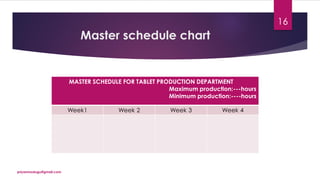
Master schedule chart
MASTER SCHEDULE FOR TABLET PRODUCTION DEPARTMENT
Maximum production:---hours
Minimum production:----hours
Week1 Week 2 Week 3 Week 4
priyanmodugu@gmail.com
16
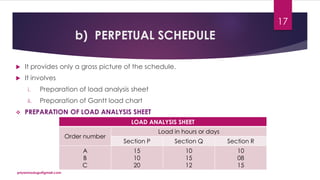
b) PERPETUAL SCHEDULE
 It provides only a gross picture of the schedule.
 It involves
i. Preparation of load analysis sheet
ii. Preparation of Gantt load chart
 PREPARATION OF LOAD ANALYSIS SHEET
LOAD ANALYSIS SHEET
Order number
Load in hours or days
Section P Section Q Section R
A
B
C
15
10
20
10
15
12
10
08
15
priyanmodugu@gmail.com
17
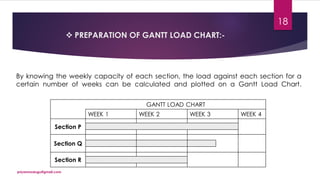
 PREPARATION OF GANTT LOAD CHART
GANTT LOAD CHART
WEEK 1 WEEK 2 WEEK 3 WEEK 4
Section P
Section Q
Section R
By knowing the weekly capacity of each section, the load against each section for a
certain number of weeks can be calculated and plotted on a Gantt Load Chart.
priyanmodugu@gmail.com
18
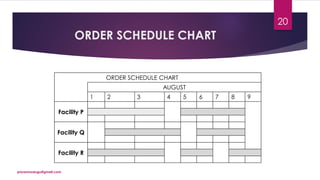
c) ORDER SCHEDULE
 Order schedule can be prepared by plotting dates vertically & facility horizontally
on the chart.
 Information required to prepare order schedule
 Name of machines & their set up times
 Total production time
 Date on which the order is to be completed
priyanmodugu@gmail.com
19
ORDER SCHEDULE CHART
AUGUST
1 2 3 4 5 6 7 8 9
Facility P
Facility Q
Facility R
priyanmodugu@gmail.com
20
D. LOADING
 Loading is the relationship between load and capacity at work
place. It gives the information about number of machines, available,
their speed, capacity, capability. It helps to determine work load
and actual capacity of production.
priyanmodugu@gmail.com
21
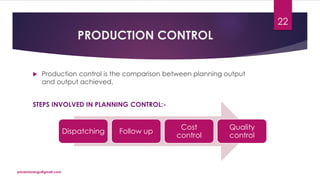
PRODUCTION CONTROL
 Production control is the comparison between planning output
and output achieved.
STEPS INVOLVED IN PRODUCTION CONTROL:-
Dispatching Follow up
Cost
control
Quality
control
priyanmodugu@gmail.com
22
A. DISPATCHING
 It is the process of issuing orders & instructions to a particular operating
section of industry to start the processing of a given job on an assigned
machine in accordance with the previously planned sequence & time as
detailed in route sheets & schedule charts.
 Movement of materials to different work stations, movement of work from
one operation to another & supervision of work comes under this category.
priyanmodugu@gmail.com
23
B. FOLLOW UP
 It includes delays or deviations from the production plans
 It helps to reveal the defects in
 Routing
 Scheduling
 Loading
 Dispatching
 Misunderstanding of orders
priyanmodugu@gmail.com
24
C. COST CONTROL
 The total cost for the production of goods is determined & is compared with
standard cost to calculate the deviations as well as to follow corrective
action.
 It can be controlled by
 Reducing wastage
 Value analysis
 Inventory control
priyanmodugu@gmail.com
25
D. QUALITY CONTROL
 It helps to avoid & detects the defects in production process & isolation of
defective finished goods
 Finished products are inspected to ensure their acceptable quality
 Quality control techniques
 Statistical quality control
 Probability concept
 Poisson distribution
 Sampling inspection
priyanmodugu@gmail.com
26
REFERENCES
 www.wikipedia.com
 www.managementstudyguide.com
 www.tandfonline.com
priyanmodugu@gmail.com
27
“Always have a plan, and believe in it”
Priyanka Modugu
priyanmodugu@gmail.com
28

PRODUCTION PLANNING AND CONTROL

  • 1.
    PRODUCTION PLANNING AND CONTROL BY M.PRIYANKA M. PHARMACY SCHOOL OF PHARMACEUTICAL SCIENCES JNTUK
  • 2.
    CONTENTS  Introduction  Productionplanning  Process planning  Routing  Scheduling  loading  Production control  Dispatching  Follow up  Cost control  Quality control priyanmodugu@gmail.com 2
  • 3.
  • 4.
    DEFINITIONS PRODUCTION:- Transformation of rawmaterials to finished goods PRODUCTION MANAGEMENT:- Application of management principles to the process of production in an industry to produce desired goods in economical manner by co-ordinating the efforts of men, material & machine. priyanmodugu@gmail.com 4
  • 5.
    PRODUCTION PLANNING:- It isa technique which helps in planning & scheduling the work in the manufacturing plant to obtain the desired quality of products with optimum efficiency & at minimum cost. PRODUCTION CONTROL:- It ensures that the work is being done according to the plan priyanmodugu@gmail.com 5
  • 6.
    PRODUCTION PLANNING This phaseincludes a sequence of ideas to perform a task in an orderly manner by the utilization of available manufacturing facilities. Planning involves 5 M’s Money Methods Men Machine Material priyanmodugu@gmail.com 6
  • 7.
    STEPS IN PRODUCTIONPLANNING PROCESS PLANNING ROUTING SCHEDULING LOADING priyanmodugu@gmail.com 7
  • 8.
    A. PROCESS PLANNING Processplanning can be defined as the preparation of detailed plans for the process required to manufacture a product as each manufacturing process consists of numerous operations. PROCESS PLANNING REQUIRES  Quantity of work to be done  Product specifications  Sequence of operations to be performed  Time required for each operation  Availability of manufacturing facilities priyanmodugu@gmail.com 8
  • 9.
    STEPS INVOLVED INPROCESS PLANNING Process selection Selection of raw material Selection of machinery parts Process layout Time setup & standard operation time Documen tation priyanmodugu@gmail.com 9
  • 10.
    a) PROCESS SELECTION:- The operations selected for a particular process should be most economical  Should satisfy the product specifications  Selection mainly depends upon quality, quantity, time period & machines available b) SELECTION OF RAW MATERIALS:-  Should meet quality standards  Should show chemical compatibility priyanmodugu@gmail.com 10
  • 11.
    c) SELECTION OFMACHINERY PARTS:- Proper selection of machinery attachments like inspection gauges, jigs, etc., is necessary for the smooth functioning of machines. This helps in reducing the costs & duration of production & results in high output. d) PROCESS LAYOUT:- It describes every step of operation as well as the sequence in which each operation is to be carried out. priyanmodugu@gmail.com 11
  • 12.
    e) TIME SETUP& STANDARD OPERATION TIME:- They should be established to complete the production within the time. f) DOCUMENTATION:- Process planning should be clearly summarized in documents such as operation & route sheets. priyanmodugu@gmail.com 12
  • 13.
    B. ROUTING  Routingis the process of determining the sequence of operations to be carried out.  Determines the path for flow of work right from the selection of raw materials until the completion of production of finished goods.  Routing is summarized in route sheets. Prepared sheets are then dispatched to the production department. Route sheets summarizes processes like  Description of operations  Sequence of operations  Type of machinery  Setup time  Operation time priyanmodugu@gmail.com 13
  • 14.
    C. SCHEDULING:-  Schedulingconcerns with time element. It refers to the time frame of all production activities therefore scheduling is also known as time phase of loading. OBJECTIVE:-  To reduce the time of production  To ensure that the products can be delivered before the due date TECHNIQUES:-  Master schedule  Perpetual schedule  Order schedule priyanmodugu@gmail.com 14
  • 15.
    a) MASTER SCHEDULE It contains information about all orders  On receiving the orders they marked on the master schedule depending upon their delivery date.  It shows running production work & work ahead priyanmodugu@gmail.com 15
  • 16.
    Master schedule chart MASTERSCHEDULE FOR TABLET PRODUCTION DEPARTMENT Maximum production:---hours Minimum production:----hours Week1 Week 2 Week 3 Week 4 priyanmodugu@gmail.com 16
  • 17.
    b) PERPETUAL SCHEDULE It provides only a gross picture of the schedule.  It involves i. Preparation of load analysis sheet ii. Preparation of Gantt load chart  PREPARATION OF LOAD ANALYSIS SHEET LOAD ANALYSIS SHEET Order number Load in hours or days Section P Section Q Section R A B C 15 10 20 10 15 12 10 08 15 priyanmodugu@gmail.com 17
  • 18.
     PREPARATION OFGANTT LOAD CHART GANTT LOAD CHART WEEK 1 WEEK 2 WEEK 3 WEEK 4 Section P Section Q Section R By knowing the weekly capacity of each section, the load against each section for a certain number of weeks can be calculated and plotted on a Gantt Load Chart. priyanmodugu@gmail.com 18
  • 19.
    c) ORDER SCHEDULE Order schedule can be prepared by plotting dates vertically & facility horizontally on the chart.  Information required to prepare order schedule  Name of machines & their set up times  Total production time  Date on which the order is to be completed priyanmodugu@gmail.com 19
  • 20.
    ORDER SCHEDULE CHART ORDERSCHEDULE CHART AUGUST 1 2 3 4 5 6 7 8 9 Facility P Facility Q Facility R priyanmodugu@gmail.com 20
  • 21.
    D. LOADING  Loadingis the relationship between load and capacity at work place. It gives the information about number of machines, available, their speed, capacity, capability. It helps to determine work load and actual capacity of production. priyanmodugu@gmail.com 21
  • 22.
    PRODUCTION CONTROL  Productioncontrol is the comparison between planning output and output achieved. STEPS INVOLVED IN PRODUCTION CONTROL:- Dispatching Follow up Cost control Quality control priyanmodugu@gmail.com 22
  • 23.
    A. DISPATCHING  Itis the process of issuing orders & instructions to a particular operating section of industry to start the processing of a given job on an assigned machine in accordance with the previously planned sequence & time as detailed in route sheets & schedule charts.  Movement of materials to different work stations, movement of work from one operation to another & supervision of work comes under this category. priyanmodugu@gmail.com 23
  • 24.
    B. FOLLOW UP It includes delays or deviations from the production plans  It helps to reveal the defects in  Routing  Scheduling  Loading  Dispatching  Misunderstanding of orders priyanmodugu@gmail.com 24
  • 25.
    C. COST CONTROL The total cost for the production of goods is determined & is compared with standard cost to calculate the deviations as well as to follow corrective action.  It can be controlled by  Reducing wastage  Value analysis  Inventory control priyanmodugu@gmail.com 25
  • 26.
    D. QUALITY CONTROL It helps to avoid & detects the defects in production process & isolation of defective finished goods  Finished products are inspected to ensure their acceptable quality  Quality control techniques  Statistical quality control  Probability concept  Poisson distribution  Sampling inspection priyanmodugu@gmail.com 26
  • 27.
    REFERENCES  www.wikipedia.com  www.managementstudyguide.com www.tandfonline.com priyanmodugu@gmail.com 27
  • 28.
    “Always have aplan, and believe in it” Priyanka Modugu priyanmodugu@gmail.com 28