Submitted by:
Srinu KN
1st M pharmacy
Dept. of Pharmaceutics
Al-Ameen college of pharmacy
Submitted to:
Mrs. Asha mam
Dept. of Pharmaceutics
CONTENTS
• Introduction
• Objectives
• Production system and techniques
• Limitation
• Reference
INTRODUCTION
 Once the entrepreneur has taken the decisions
regarding the product design and product processes
and system, his next task is to take steps for production
planning and control, as this function is essentially
required for efficient and economical production.
 The highest efficiency in production is obtained by
manufacturing the required quantity of the product, of
the required quality at the required time, with the best
and cheapest method.
“Production planning and control is the coordination of a
series of functions according to a plan which will
economically utilize the plant facilities and regulate the
orderly movement of goods through the entire
manufacturing cycle, from the procurement of all
materials to the shipping of finished goods at a
predetermined rate.”
The process should be,
a) economical and hence needs planning.
b) validated, so as to produce products consistent with
the established specifications.
• The production schedule is planned as per the needs of
marketing.
• Planning is needed for meeting the changing economic
and social conditions, seasonal demands and market
fluctuations.
OBJECTIVE
 Planning is required to produce economical
products with in time
 To avoid difficulties in production and marketing
of products
 Planning is needed for meeting and changing
economic social conditions seasonal demands and
marketing fluctuations
 In case of series of operations are involved in the
production of a product then planning will
improves the efficiency and effectiveness.
 To increase productivity too.
Production planning and Control
A. Planning:
It is the first element of production planning and control
with a separate department.
Planning is deciding in advance what is to be done in
future.
Control devices are also decided in advance so that all
activities are carried on properly.
An organizational set up is created to prepare plans and
policies. Various charts, manuals and production budgets
are also prepared.
If production planning is defective then control will also
be defective. Planning provides a sound base for control.
B. Routing:
 It is determining the exact path or route which will be
followed in production.
 “Production routing involves the planning of the exact
sequence of work stations to be used in processing a
part of product. Once a layout has been established the
routing of an item is the determination of the path that
item should follow as it is manufactured.”
Objects of Routing:
The main object of routing is to determine the best and
cheapest sequence of operations to be followed.
In case of continuous manufacturing units where
standardized products are produced routing becomes
automatic.
In case of job order and batch production every product
requires different design and varying sequence of
operations.
Another object of routing is to help in determining
proper tools and equipment’s and the number of
workers required for carrying out the work.
13
Routing Procedure:
1.Deciding what Part to be made /Purchased:
(a) The relative cost involved
(b) Purchase policies of the firm
(c) Technical considerations and
(d) Availability of equipment and personnel.
2.Determining Materials Required:
The right type of quality, quantity, and time when needed
should also be decided in advance.
14
3.Determining Manufacturing Operations and
Sequences:
The manufacturing operations and their sequences can be
determined from technical experience and layout of
machines.
4.Determining of Lot Sizes:
A decision has to be taken about the number of units to
be produced in one lot. If production is carried on the
basis of
orders => size of the lot.
for the stock => lot is decided by considering various
economies which may accurate.
5. Determining of Scrap Factors:
 There may be some scrap during the course of
manufacture.
 The finished products are generally less than the units
introduced at the beginning.
 If products pass through three processes and a normal
scrap is 5% of input at every stage then it will be easy
to anticipate the units entering various processes and
arrange equipments and manpower.
6.Analysis of Cost of the Product:
 The determination of cost of products may be the duty
of cost department but still production department
makes records of direct materials, labour, direct and
indirect expenses. These estimates are greatly useful to
costing department also.
7.Preparation of Production Control Forms:
 The carrying out of routing will be facilitated if forms
are prepared to collect information for control purpose.
The requirements are: job cards, inspection cards, labour
cards, tool tickets, etc.
17
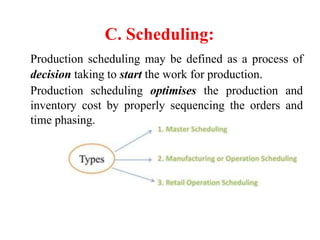
C. Scheduling:
Production scheduling may be defined as a process of
decision taking to start the work for production.
Production scheduling optimises the production and
inventory cost by properly sequencing the orders and
time phasing.
1. Master Scheduling:
 This schedule is prepared by keeping in view the order
or likely sales order in near future.
 Master scheduling is the breakup of production
requirements. This may be prepared for a week, a
month etc.
 It becomes complex when more products are required
to be produced.
 Master schedule has to be adjusted as per the new
order received.
 No definite pattern may be suggested for master
schedules because it differs from industry to industry
or in the same industry.
2. Manufacturing /Operation Scheduling:
 Manufacturing schedule is used where production
process is continuous.
 The name and number of the product and the quantity
to be produced in a given time are required to prepare a
manufacturing schedule.
 If the product to be produced is in a variety of sizes,
colors, weights, types etc. then these things should also
be mentioned in the schedule.
 The order of preference for the manufacture is also
mentioned in the schedule for a systematic production
planning.
21
3. Detail Operation Scheduling:
 It indicated the time required to perform each and
every detailed operations of a given machine or
process.
22
D. Loading
Load indicates the assignment of work to men,
machines or department in advance without specifying
when the work is to be done.
Loading is used for ensuring efficient utilization of
plant and labour.
E. Dispatching:
 Key link between production and sales
 Dispatching function may be routine one of issuing
authorization to start work operation
 Few section authorization are follows
 Stores -authorized to deliver materials
 Tool stores- authorized to release necessary tools
 Line ticketing-It record the beginning and ending time
of operations
 Inspection order-to carry out quality of the products
Dispatching Procedures:
(A) Centralized Dispatching:
 Under centralized dispatching orders are directly
issued to workmen and machines.
 The dispatching section keeps full information of the
capacity and work loads of various machines or work
centres and sends instructions as per requirements.
 Centralized dispatching helps in exercising effective
control.
25
(b) Decentralized Dispatching:
 Under this procedure all work orders are issued to the
foreman or dispatch clerk of the department or section.
 It is the responsibility of the department or section to
decide about the actual start of work on priority among
different products.
 The dispatch of orders of materials is left to the
decision of the foreman or dispatch clerk.
 This system minimizes red-tape, duplication of
posting, production delays and other drawbacks
involved in centralized dispatching.
 This procedure suffers from difficulties in achieving
coordination among different departments.
F. Follow Up and Expediting:
It regulates the progress of materials and part through
the production process.
This is an important function of production control. If
goods are to be produced as per the plans then a proper
follow-up of work is essential to see whether production
schedule is properly adhered to or not.
In case there are any bottlenecks then these must be
removed in time.
G. Inspection:
It is an important step in production control, because it
tells whether the product is of desired quality or not.
If inspection is not regularly undertaken then there may
be a possibility of more rejections.
Inspection is undertaken both of products and inputs.
On the one hand work-in-progress and finished
products are inspected.
On the other hand the quality of materials issued,
equipment’s used and machines employed is also taken
into account.
The final product will certainly be influenced by the
quality of various inputs used in production. So
inspection ensures the maintenance of predetermined
quality of products.
28
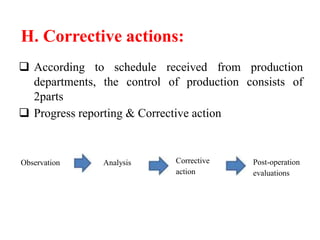
H. Corrective actions:
 According to schedule received from production
departments, the control of production consists of
2parts
 Progress reporting & Corrective action
Observation Analysis Corrective
action
Post-operation
evaluations
Progress report
 Trying to achieve the standards set that is a certain
level of efficiency a volume of production in a
specified duration
 Production department transmits the progress report
to controlling sector
 It interprets the progress report and suggest the
corrective action
Corrective action
 Depends on several factors external and internal
 External factors- these are beyond the control
organization like change in priority of orders due to the
arrival of new orders or due to cancellation of few
previous order
 Internal factors-these are with in the control
organization like labour turnover become expansible,
lack of necessary instruction and materials mass
absenteeism
Methods to take corrective action
 By making flexible schedules
 Capacity modification by changing the number of
working hours and number of workers
 Flow control is a function of keeping each operation at
the same rate of flow such that the sequence of
operations will be completed on prescribed time
 By decreasing operating times of machines or
equipment
 Routing and scheduling also done for this reason too.
Limitation of PPC
 Lack of reliable data
 Time consuming process
 Expensive
 External factors may reduce utility
 Sudden emergencies
 Resistance to change
33
Production And Planning control.ppt

Production And Planning control.ppt

  • 1.
    Submitted by: Srinu KN 1stM pharmacy Dept. of Pharmaceutics Al-Ameen college of pharmacy Submitted to: Mrs. Asha mam Dept. of Pharmaceutics
  • 2.
    CONTENTS • Introduction • Objectives •Production system and techniques • Limitation • Reference
  • 3.
    INTRODUCTION  Once theentrepreneur has taken the decisions regarding the product design and product processes and system, his next task is to take steps for production planning and control, as this function is essentially required for efficient and economical production.  The highest efficiency in production is obtained by manufacturing the required quantity of the product, of the required quality at the required time, with the best and cheapest method.
  • 4.
    “Production planning andcontrol is the coordination of a series of functions according to a plan which will economically utilize the plant facilities and regulate the orderly movement of goods through the entire manufacturing cycle, from the procurement of all materials to the shipping of finished goods at a predetermined rate.” The process should be, a) economical and hence needs planning. b) validated, so as to produce products consistent with the established specifications. • The production schedule is planned as per the needs of marketing. • Planning is needed for meeting the changing economic and social conditions, seasonal demands and market fluctuations.
  • 5.
    OBJECTIVE  Planning isrequired to produce economical products with in time  To avoid difficulties in production and marketing of products  Planning is needed for meeting and changing economic social conditions seasonal demands and marketing fluctuations  In case of series of operations are involved in the production of a product then planning will improves the efficiency and effectiveness.  To increase productivity too.
  • 6.
  • 7.
    A. Planning: It isthe first element of production planning and control with a separate department. Planning is deciding in advance what is to be done in future. Control devices are also decided in advance so that all activities are carried on properly. An organizational set up is created to prepare plans and policies. Various charts, manuals and production budgets are also prepared. If production planning is defective then control will also be defective. Planning provides a sound base for control.
  • 8.
    B. Routing:  Itis determining the exact path or route which will be followed in production.  “Production routing involves the planning of the exact sequence of work stations to be used in processing a part of product. Once a layout has been established the routing of an item is the determination of the path that item should follow as it is manufactured.”
  • 9.
    Objects of Routing: Themain object of routing is to determine the best and cheapest sequence of operations to be followed. In case of continuous manufacturing units where standardized products are produced routing becomes automatic. In case of job order and batch production every product requires different design and varying sequence of operations. Another object of routing is to help in determining proper tools and equipment’s and the number of workers required for carrying out the work. 13
  • 10.
    Routing Procedure: 1.Deciding whatPart to be made /Purchased: (a) The relative cost involved (b) Purchase policies of the firm (c) Technical considerations and (d) Availability of equipment and personnel. 2.Determining Materials Required: The right type of quality, quantity, and time when needed should also be decided in advance. 14
  • 11.
    3.Determining Manufacturing Operationsand Sequences: The manufacturing operations and their sequences can be determined from technical experience and layout of machines. 4.Determining of Lot Sizes: A decision has to be taken about the number of units to be produced in one lot. If production is carried on the basis of orders => size of the lot. for the stock => lot is decided by considering various economies which may accurate.
  • 12.
    5. Determining ofScrap Factors:  There may be some scrap during the course of manufacture.  The finished products are generally less than the units introduced at the beginning.  If products pass through three processes and a normal scrap is 5% of input at every stage then it will be easy to anticipate the units entering various processes and arrange equipments and manpower.
  • 13.
    6.Analysis of Costof the Product:  The determination of cost of products may be the duty of cost department but still production department makes records of direct materials, labour, direct and indirect expenses. These estimates are greatly useful to costing department also. 7.Preparation of Production Control Forms:  The carrying out of routing will be facilitated if forms are prepared to collect information for control purpose. The requirements are: job cards, inspection cards, labour cards, tool tickets, etc. 17
  • 14.
    C. Scheduling: Production schedulingmay be defined as a process of decision taking to start the work for production. Production scheduling optimises the production and inventory cost by properly sequencing the orders and time phasing.
  • 15.
    1. Master Scheduling: This schedule is prepared by keeping in view the order or likely sales order in near future.  Master scheduling is the breakup of production requirements. This may be prepared for a week, a month etc.  It becomes complex when more products are required to be produced.  Master schedule has to be adjusted as per the new order received.  No definite pattern may be suggested for master schedules because it differs from industry to industry or in the same industry.
  • 16.
    2. Manufacturing /OperationScheduling:  Manufacturing schedule is used where production process is continuous.  The name and number of the product and the quantity to be produced in a given time are required to prepare a manufacturing schedule.  If the product to be produced is in a variety of sizes, colors, weights, types etc. then these things should also be mentioned in the schedule.  The order of preference for the manufacture is also mentioned in the schedule for a systematic production planning. 21
  • 17.
    3. Detail OperationScheduling:  It indicated the time required to perform each and every detailed operations of a given machine or process. 22
  • 18.
    D. Loading Load indicatesthe assignment of work to men, machines or department in advance without specifying when the work is to be done. Loading is used for ensuring efficient utilization of plant and labour.
  • 19.
    E. Dispatching:  Keylink between production and sales  Dispatching function may be routine one of issuing authorization to start work operation  Few section authorization are follows  Stores -authorized to deliver materials  Tool stores- authorized to release necessary tools  Line ticketing-It record the beginning and ending time of operations  Inspection order-to carry out quality of the products
  • 20.
    Dispatching Procedures: (A) CentralizedDispatching:  Under centralized dispatching orders are directly issued to workmen and machines.  The dispatching section keeps full information of the capacity and work loads of various machines or work centres and sends instructions as per requirements.  Centralized dispatching helps in exercising effective control. 25
  • 21.
    (b) Decentralized Dispatching: Under this procedure all work orders are issued to the foreman or dispatch clerk of the department or section.  It is the responsibility of the department or section to decide about the actual start of work on priority among different products.  The dispatch of orders of materials is left to the decision of the foreman or dispatch clerk.  This system minimizes red-tape, duplication of posting, production delays and other drawbacks involved in centralized dispatching.  This procedure suffers from difficulties in achieving coordination among different departments.
  • 22.
    F. Follow Upand Expediting: It regulates the progress of materials and part through the production process. This is an important function of production control. If goods are to be produced as per the plans then a proper follow-up of work is essential to see whether production schedule is properly adhered to or not. In case there are any bottlenecks then these must be removed in time.
  • 23.
    G. Inspection: It isan important step in production control, because it tells whether the product is of desired quality or not. If inspection is not regularly undertaken then there may be a possibility of more rejections. Inspection is undertaken both of products and inputs. On the one hand work-in-progress and finished products are inspected. On the other hand the quality of materials issued, equipment’s used and machines employed is also taken into account. The final product will certainly be influenced by the quality of various inputs used in production. So inspection ensures the maintenance of predetermined quality of products. 28
  • 24.
    H. Corrective actions: According to schedule received from production departments, the control of production consists of 2parts  Progress reporting & Corrective action Observation Analysis Corrective action Post-operation evaluations
  • 25.
    Progress report  Tryingto achieve the standards set that is a certain level of efficiency a volume of production in a specified duration  Production department transmits the progress report to controlling sector  It interprets the progress report and suggest the corrective action
  • 26.
    Corrective action  Dependson several factors external and internal  External factors- these are beyond the control organization like change in priority of orders due to the arrival of new orders or due to cancellation of few previous order  Internal factors-these are with in the control organization like labour turnover become expansible, lack of necessary instruction and materials mass absenteeism
  • 27.
    Methods to takecorrective action  By making flexible schedules  Capacity modification by changing the number of working hours and number of workers  Flow control is a function of keeping each operation at the same rate of flow such that the sequence of operations will be completed on prescribed time  By decreasing operating times of machines or equipment  Routing and scheduling also done for this reason too.
  • 28.
    Limitation of PPC Lack of reliable data  Time consuming process  Expensive  External factors may reduce utility  Sudden emergencies  Resistance to change 33