M. Pharm Sem-I Presentations
Pharmaceutical Plant Layout
SUBMITTED TO
SAVITRIB AI PHULE, PUNE UNIVERSITY , PUNE
FOR
PARTIAL FULFILMENT OF REQUIREMENTS FOR THE AWARDOF
MASTER OF PHARMACY
IN THE SUBJECT
Pharmaceutical Manufacturing Technology
IN THE FACULTYOF SCIENCE ANDTECHNOLOGY
Bhujbal Knowledge City,
MET’s Institute of Pharmacy,
Adgaon, Nashik, 422003.
Maharashtra, India
AcademicYear: 2021-2022 1
Presented By-
Bairagi Akshata A.
Guided By-
Dr. Sapna Ahirrao
Contents
 Introduction
 Features of Good Pharmaceutical Plant Layout
 General Requirements of Pharmaceutical Plant
 Principles of Plant Layout
 Types of Plant Layout
 Factors Affecting Plant Layout
 Special Provisions Of Plant Layout
 Production Planning
 Managing Risks
 Production Control
 Advantages
 Conclusions
Introduction
3
Pharmaceutical plant layout describes the distribution of space
and the arrangement of equipment, furniture, and other
significant administration and necessary services within a factory
building to perform the various unit operations involved in the
production of dosage forms in an efficient manner and with the
least amount of handling in processing the product from the
receipt of raw material through the distribution of the finished
goods.
Features of Good Pharmaceutical Plant Layout
4
• The following traits a successful pharmaceutical plant layout
should have:
• Ample floor space should be available for machine installation
and use.
• For low-cost processing, the equipment should be properly
organized to allow for the least amount of material handling.
• Effective supervision, coordination, and control of the
production processes should be possible with a proper layout.
• When necessary, there should always be an opportunity for
change and correction.
General Requirements For Pharmaceutical
Plant
• Pharmaceutical facilities must be positioned, planned, built, and
maintained to accommodate the procedures to be performed.
• To reduce the possibility of mistakes and enable efficient cleaning,
they must be laid out and designed in a way that prevents cross-
contamination.
• Manufacturing facilities should be built in a way that makes it possible
to maintain hygienic conditions at all times.
• For cleaning, maintenance, disinfection, and sanitization, SOPs and
records should be kept.
• Plants should be kept in order Power supply lighting, temperature,
humidity, and HVAC are all important factors.
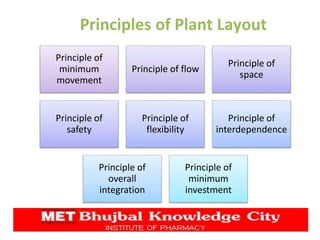
Principles of Plant Layout
Principle of
minimum
movement
Principle of flow
Principle of
space
Principle of
safety
Principle of
flexibility
Principle of
interdependence
Principle of
overall
integration
Principle of
minimum
investment
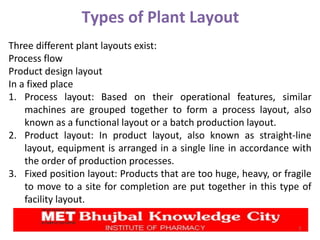
Types of Plant Layout
7
Three different plant layouts exist:
Process flow
Product design layout
In a fixed place
1. Process layout: Based on their operational features, similar
machines are grouped together to form a process layout, also
known as a functional layout or a batch production layout.
2. Product layout: In product layout, also known as straight-line
layout, equipment is arranged in a single line in accordance with
the order of production processes.
3. Fixed position layout: Products that are too huge, heavy, or fragile
to move to a site for completion are put together in this type of
facility layout.
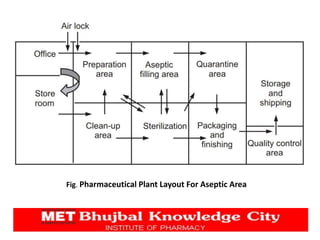
Fig. Pharmaceutical Plant Layout For Aseptic Area
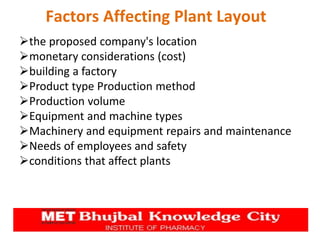
Factors Affecting Plant Layout
the proposed company's location
monetary considerations (cost)
building a factory
Product type Production method
Production volume
Equipment and machine types
Machinery and equipment repairs and maintenance
Needs of employees and safety
conditions that affect plants
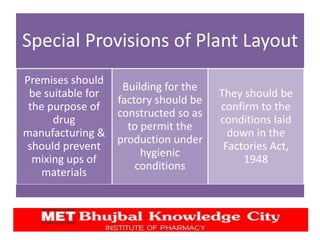
Special Provisions of Plant Layout
Premises should
be suitable for
the purpose of
drug
manufacturing &
should prevent
mixing ups of
materials
Building for the
factory should be
constructed so as
to permit the
production under
hygienic
conditions
They should be
confirm to the
conditions laid
down in the
Factories Act,
1948
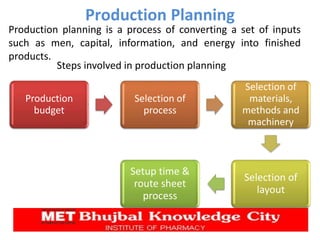
Production Planning
Production planning is a process of converting a set of inputs
such as men, capital, information, and energy into finished
products.
Steps involved in production planning
Production
budget
Selection of
process
Selection of
materials,
methods and
machinery
Selection of
layout
Setup time &
route sheet
process
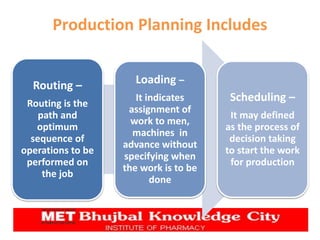
Production Planning Includes
Routing –
Routing is the
path and
optimum
sequence of
operations to be
performed on
the job
Loading –
It indicates
assignment of
work to men,
machines in
advance without
specifying when
the work is to be
done
Scheduling –
It may defined
as the process of
decision taking
to start the work
for production
Managing Risks
Process of risk management - Rather than taking a reactive strategy,
risk management is always proactive.
The major goal of this strategy is to reduce the incidence and its
detrimental effects on project time, cost, and quality.
Clifford Gray and Eric W. Larson have broken down the risk
management procedure into four steps:
1. identification of risks
2. risk evaluation
3. development of risk responses
4. Risk response management
Production Control
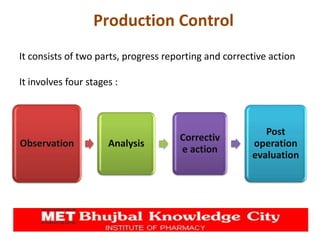
It consists of two parts, progress reporting and corrective action
It involves four stages :
Observation Analysis
Correctiv
e action
Post
operation
evaluation
Advantages of Good Pharmaceutical
Plant Layout
• Maximum utilization of the floor area available for
production activities.
• Decreased risk of cross-contamination leads to higher
product quality.
• Efficient planning for raw materials and completed
goods receipt, transportation, storage, and delivery.
• Low material handling costs.
• Increased output with a lower chance of human error.
Conclusions
• Considering that choosing medication is a long-term
commitment, planning the layout is important.
• Additionally, it is a constant process because there is always
room for development.
• It should be planned in such a way that the output, floor area,
and manufacturing process all have the best possible
relationships, making the plant's operation very efficient.
• Although the layout of pharmaceutical plants varies from plant
to plant, the fundamental ideas behind pharmaceutical plant
layouts are often the same.
References
 Manohar A. Potdar, Pharmaceutical Facilities, Second
Edition, Pharma Med Press.
 Sheetal V. Patil, Dr. Md. Rageeb, PV, A Text Book of
Pharmaceutical Manufacturing Technology, Vikas &
Company (Medical Publishers), Page No.11-13.
 https://www.pharmapproach.com/pharmaceutical-plant-
layout
 https://www.slideshare.net/anks2017/plant-layout-ppt

Pharmaceutical Plant Layout

  • 1.
    M. Pharm Sem-IPresentations Pharmaceutical Plant Layout SUBMITTED TO SAVITRIB AI PHULE, PUNE UNIVERSITY , PUNE FOR PARTIAL FULFILMENT OF REQUIREMENTS FOR THE AWARDOF MASTER OF PHARMACY IN THE SUBJECT Pharmaceutical Manufacturing Technology IN THE FACULTYOF SCIENCE ANDTECHNOLOGY Bhujbal Knowledge City, MET’s Institute of Pharmacy, Adgaon, Nashik, 422003. Maharashtra, India AcademicYear: 2021-2022 1 Presented By- Bairagi Akshata A. Guided By- Dr. Sapna Ahirrao
  • 2.
    Contents  Introduction  Featuresof Good Pharmaceutical Plant Layout  General Requirements of Pharmaceutical Plant  Principles of Plant Layout  Types of Plant Layout  Factors Affecting Plant Layout  Special Provisions Of Plant Layout  Production Planning  Managing Risks  Production Control  Advantages  Conclusions
  • 3.
    Introduction 3 Pharmaceutical plant layoutdescribes the distribution of space and the arrangement of equipment, furniture, and other significant administration and necessary services within a factory building to perform the various unit operations involved in the production of dosage forms in an efficient manner and with the least amount of handling in processing the product from the receipt of raw material through the distribution of the finished goods.
  • 4.
    Features of GoodPharmaceutical Plant Layout 4 • The following traits a successful pharmaceutical plant layout should have: • Ample floor space should be available for machine installation and use. • For low-cost processing, the equipment should be properly organized to allow for the least amount of material handling. • Effective supervision, coordination, and control of the production processes should be possible with a proper layout. • When necessary, there should always be an opportunity for change and correction.
  • 5.
    General Requirements ForPharmaceutical Plant • Pharmaceutical facilities must be positioned, planned, built, and maintained to accommodate the procedures to be performed. • To reduce the possibility of mistakes and enable efficient cleaning, they must be laid out and designed in a way that prevents cross- contamination. • Manufacturing facilities should be built in a way that makes it possible to maintain hygienic conditions at all times. • For cleaning, maintenance, disinfection, and sanitization, SOPs and records should be kept. • Plants should be kept in order Power supply lighting, temperature, humidity, and HVAC are all important factors.
  • 6.
    Principles of PlantLayout Principle of minimum movement Principle of flow Principle of space Principle of safety Principle of flexibility Principle of interdependence Principle of overall integration Principle of minimum investment
  • 7.
    Types of PlantLayout 7 Three different plant layouts exist: Process flow Product design layout In a fixed place 1. Process layout: Based on their operational features, similar machines are grouped together to form a process layout, also known as a functional layout or a batch production layout. 2. Product layout: In product layout, also known as straight-line layout, equipment is arranged in a single line in accordance with the order of production processes. 3. Fixed position layout: Products that are too huge, heavy, or fragile to move to a site for completion are put together in this type of facility layout.
  • 8.
    Fig. Pharmaceutical PlantLayout For Aseptic Area
  • 9.
    Factors Affecting PlantLayout the proposed company's location monetary considerations (cost) building a factory Product type Production method Production volume Equipment and machine types Machinery and equipment repairs and maintenance Needs of employees and safety conditions that affect plants
  • 10.
    Special Provisions ofPlant Layout Premises should be suitable for the purpose of drug manufacturing & should prevent mixing ups of materials Building for the factory should be constructed so as to permit the production under hygienic conditions They should be confirm to the conditions laid down in the Factories Act, 1948
  • 11.
    Production Planning Production planningis a process of converting a set of inputs such as men, capital, information, and energy into finished products. Steps involved in production planning Production budget Selection of process Selection of materials, methods and machinery Selection of layout Setup time & route sheet process
  • 12.
    Production Planning Includes Routing– Routing is the path and optimum sequence of operations to be performed on the job Loading – It indicates assignment of work to men, machines in advance without specifying when the work is to be done Scheduling – It may defined as the process of decision taking to start the work for production
  • 13.
    Managing Risks Process ofrisk management - Rather than taking a reactive strategy, risk management is always proactive. The major goal of this strategy is to reduce the incidence and its detrimental effects on project time, cost, and quality. Clifford Gray and Eric W. Larson have broken down the risk management procedure into four steps: 1. identification of risks 2. risk evaluation 3. development of risk responses 4. Risk response management
  • 14.
    Production Control It consistsof two parts, progress reporting and corrective action It involves four stages : Observation Analysis Correctiv e action Post operation evaluation
  • 15.
    Advantages of GoodPharmaceutical Plant Layout • Maximum utilization of the floor area available for production activities. • Decreased risk of cross-contamination leads to higher product quality. • Efficient planning for raw materials and completed goods receipt, transportation, storage, and delivery. • Low material handling costs. • Increased output with a lower chance of human error.
  • 16.
    Conclusions • Considering thatchoosing medication is a long-term commitment, planning the layout is important. • Additionally, it is a constant process because there is always room for development. • It should be planned in such a way that the output, floor area, and manufacturing process all have the best possible relationships, making the plant's operation very efficient. • Although the layout of pharmaceutical plants varies from plant to plant, the fundamental ideas behind pharmaceutical plant layouts are often the same.
  • 17.
    References  Manohar A.Potdar, Pharmaceutical Facilities, Second Edition, Pharma Med Press.  Sheetal V. Patil, Dr. Md. Rageeb, PV, A Text Book of Pharmaceutical Manufacturing Technology, Vikas & Company (Medical Publishers), Page No.11-13.  https://www.pharmapproach.com/pharmaceutical-plant- layout  https://www.slideshare.net/anks2017/plant-layout-ppt